Kaspr vs RampedUp: Which B2B Contact Data Tool Wins?
Kaspr sells LinkedIn phone numbers. RampedUp sells CRM-ready B2B data. They solve different problems, and both get expensive per seat. Here is the honest head-to-head, plus where a pure email API beats both.
TL;DR
- Kaspr is a LinkedIn-first Chrome extension built for SDRs who live in Sales Navigator and need mobile numbers on demand. It is owned by Cognism, and its centre of gravity is European phone data.
- RampedUp is a CRM-first data platform. It is built for RevOps teams who want to append, clean, and score records already sitting in Salesforce or HubSpot, plus build lists from a static database.
- They are not really the same product. Kaspr wins on per-profile enrichment speed; RampedUp wins on bulk CRM hygiene and job-change tracking.
- Both charge per seat, which punishes teams where more than three people touch data. A credit-based or API-based email finder is usually cheaper at the same volume.
- If your outbound is email-led rather than dial-led, neither tool is the obvious pick — you want verification depth and an API, not a browser sidebar.
What is Kaspr and who is it for?#
Kaspr is a contact-data tool you mostly experience as a Chrome extension. You open a LinkedIn profile, a Sales Navigator search, or a LinkedIn group, click the Kaspr sidebar, and it returns the person's email addresses and — its headline feature — direct dial and mobile numbers. Since being acquired by Cognism in 2022, Kaspr has effectively become the self-serve, SDR-priced entry point into a much larger data estate.
The product philosophy is "one profile at a time, fast." You can bulk-enrich a LinkedIn list, and there is a lightweight lead management layer with tasks, notes, and one-click CRM push, but nobody buys Kaspr for the CRM layer. They buy it because a rep can go from a LinkedIn profile to a ringing mobile phone in about six seconds.
That focus has consequences. Coverage is strongest in Europe, particularly France, the UK, and the DACH region — which makes sense given the company's Paris origins and GDPR-forward posture. North American coverage exists but is not where Kaspr differentiates.
What is RampedUp and who is it for?#
RampedUp approaches the same raw problem — you need accurate contact data — from the opposite end. Instead of starting at a LinkedIn profile, it starts at your CRM.
Its core jobs are data append and data hygiene: take the 40,000 half-empty records rotting in your Salesforce instance, fill in missing titles, emails, phones, firmographics, and technographics, flag the people who have left the company, and surface the ones who moved to a new account (a job-change alert is one of the highest-converting outbound triggers in B2B). On top of that sits list building from RampedUp's own database, plus intent signals and territory/market analysis for planning.
The buyer is different too. Kaspr is bought by an SDR manager with a card. RampedUp is usually bought by RevOps or a sales ops lead who has been told "our CRM data is garbage, fix it." That is a quarterly project, not a daily workflow.

How do Kaspr and RampedUp compare feature by feature?#
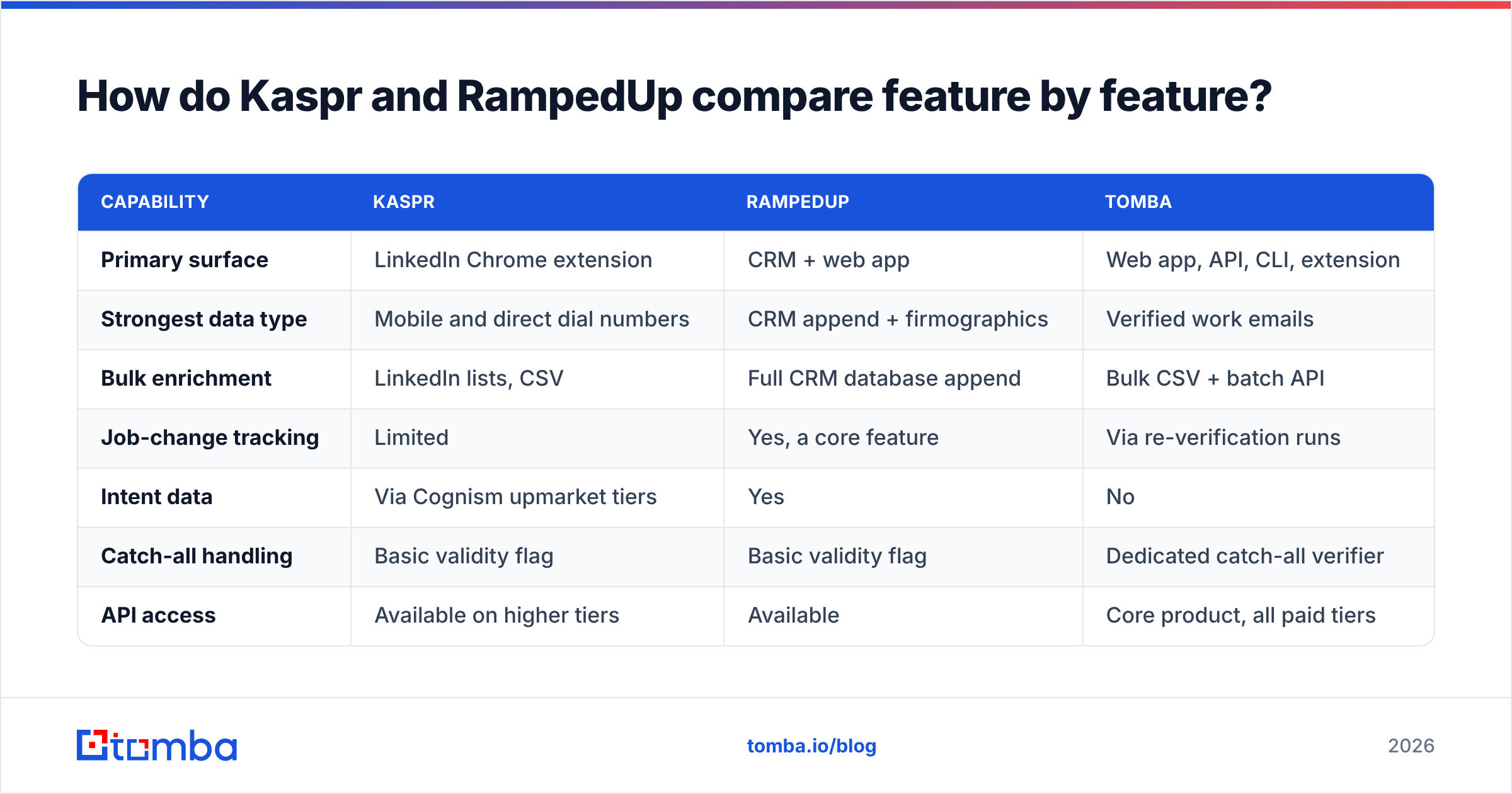
Here is the practical breakdown. I have added a pure email-finding API as a third column, because in real evaluations most teams are actually choosing between three shapes of tool, not two.
| Capability | Kaspr | RampedUp | Tomba |
|---|---|---|---|
| Primary surface | LinkedIn Chrome extension | CRM + web app | Web app, API, CLI, extension |
| Strongest data type | Mobile and direct dial numbers | CRM append + firmographics | Verified work emails |
| Bulk enrichment | LinkedIn lists, CSV | Full CRM database append | Bulk CSV + batch API |
| Job-change tracking | Limited | Yes, a core feature | Via re-verification runs |
| Intent data | Via Cognism upmarket tiers | Yes | No |
| Catch-all handling | Basic validity flag | Basic validity flag | Dedicated catch-all verifier |
| API access | Available on higher tiers | Available | Core product, all paid tiers |
| Geographic sweet spot | EMEA | North America | Global, domain-led |
| Best for | SDRs cold calling from LinkedIn | RevOps cleaning a CRM | Email-led outbound and dev teams |

Read the table as a question about your motion, not about vendor quality. If ten reps dial 60 times a day in France, Kaspr is a rational purchase. If you have one RevOps person and 80,000 stale records, RampedUp is a rational purchase. If you send 5,000 cold emails a month and care about bounce rate above everything, neither is the tool you actually need.
Which one has better data accuracy?#
Accuracy is the only metric that matters, and it is also the one every vendor reports in a self-serving way. Three things to hold onto before reading any accuracy claim:
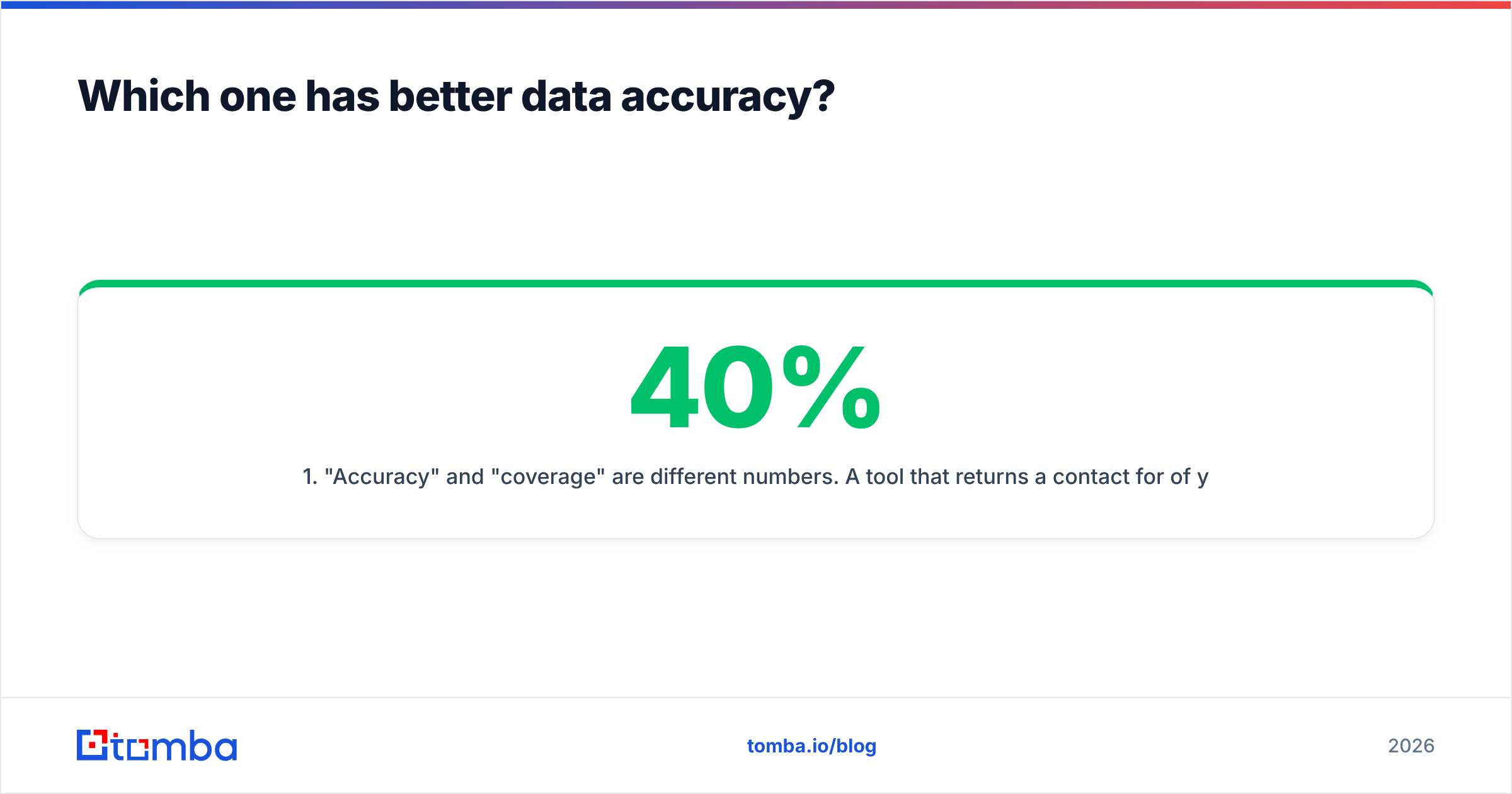
- "Accuracy" and "coverage" are different numbers. A tool that returns a contact for 40% of your list with 95% accuracy is not better or worse than one returning 80% at 80% accuracy — it depends on whether your bottleneck is list size or bounce rate.
- Phone accuracy decays faster than email accuracy. Mobile numbers change with carriers and personal choice; work emails follow a company pattern that stays stable until the person leaves.
- Catch-all domains distort everything. Roughly a fifth of B2B domains accept all mail at the SMTP layer, so a naive verifier marks them "valid" and your bounce rate tells a different story two weeks later.
- Region matters more than brand. Almost every vendor is excellent in one geography and mediocre in another. Test on your actual ICP list, not on a generic sample.

On phones, Kaspr is the stronger of the two in Europe by a clear margin — that is the product's entire reason to exist, and Cognism's Diamond-verified phone lineage sits behind it. RampedUp's phone data skews toward company switchboards and North American direct dials, which is useful but a different asset.
On emails, both are adequate rather than exceptional. Kaspr returns professional and, where available, personal emails from its LinkedIn-sourced graph. RampedUp returns emails as one field among many in an append. Neither exposes the granular verification states — accept-all, role-based, disposable, full-mailbox — that you need to protect email deliverability at volume. If you are running cold email at scale, run any provider's output through a dedicated email verifier before it touches your sending domain, and check catch-all domains with a catch-all verifier rather than trusting a binary valid/invalid flag.
The honest verdict: Kaspr for European mobile numbers, RampedUp for CRM completeness, and a specialist verifier for anything email-led. Do not expect one vendor to top all three.
How does pricing compare between Kaspr and RampedUp?#
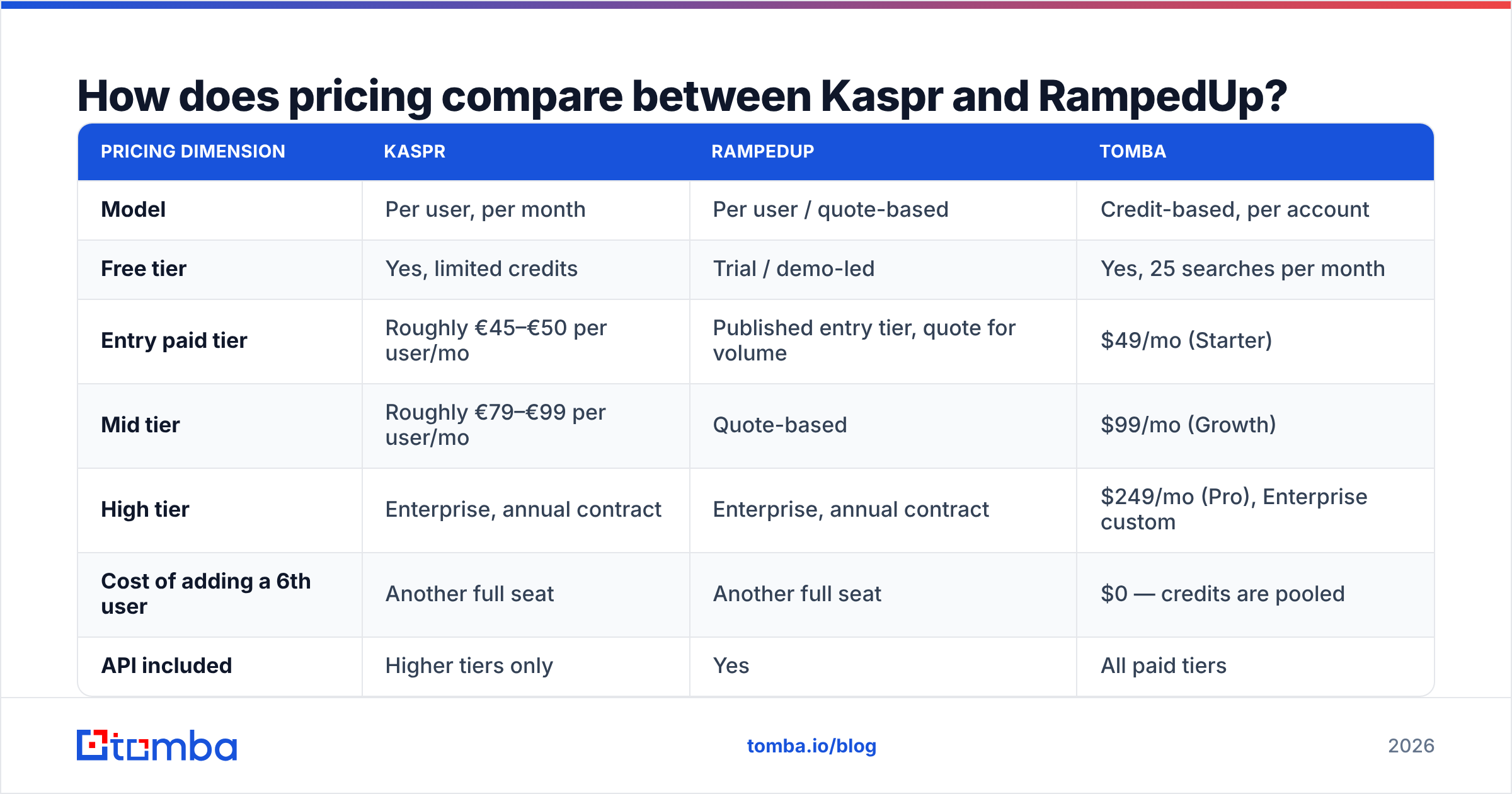
This is where the two diverge most, and where a lot of teams get surprised in month four.
| Pricing dimension | Kaspr | RampedUp | Tomba |
|---|---|---|---|
| Model | Per user, per month | Per user / quote-based | Credit-based, per account |
| Free tier | Yes, limited credits | Trial / demo-led | Yes, 25 searches per month |
| Entry paid tier | Roughly €45–€50 per user/mo | Published entry tier, quote for volume | $49/mo (Starter) |
| Mid tier | Roughly €79–€99 per user/mo | Quote-based | $99/mo (Growth) |
| High tier | Enterprise, annual contract | Enterprise, annual contract | $249/mo (Pro), Enterprise custom |
| Cost of adding a 6th user | Another full seat | Another full seat | $0 — credits are pooled |
| API included | Higher tiers only | Yes | All paid tiers |
Vendor pricing moves; check kaspr.io and rampedup.io for today's numbers, and read recent buyer reviews on G2 before you sign anything annual. What does not move is the structural point:
Per-seat data pricing scales with headcount, not with data volume. A four-person team that pulls 300 contacts a month pays the same as a four-person team pulling 3,000. Once you add a marketing ops person, a founder who occasionally prospects, and an intern building lists, you are paying three extra seats for usage that would fit inside one credit pool. Credit-based models — see Tomba pricing for a straightforward example — invert that: you buy the data, and the seats come along for free.
Also watch the annual-contract lock. Both vendors discount heavily for annual commitments, which is fine if you have validated the data on your ICP. Run a paid one-month test on 500 real prospects first. The difference between a 4% and a 14% bounce rate on the same list is worth more than any discount.

When should you pick Kaspr over RampedUp?#
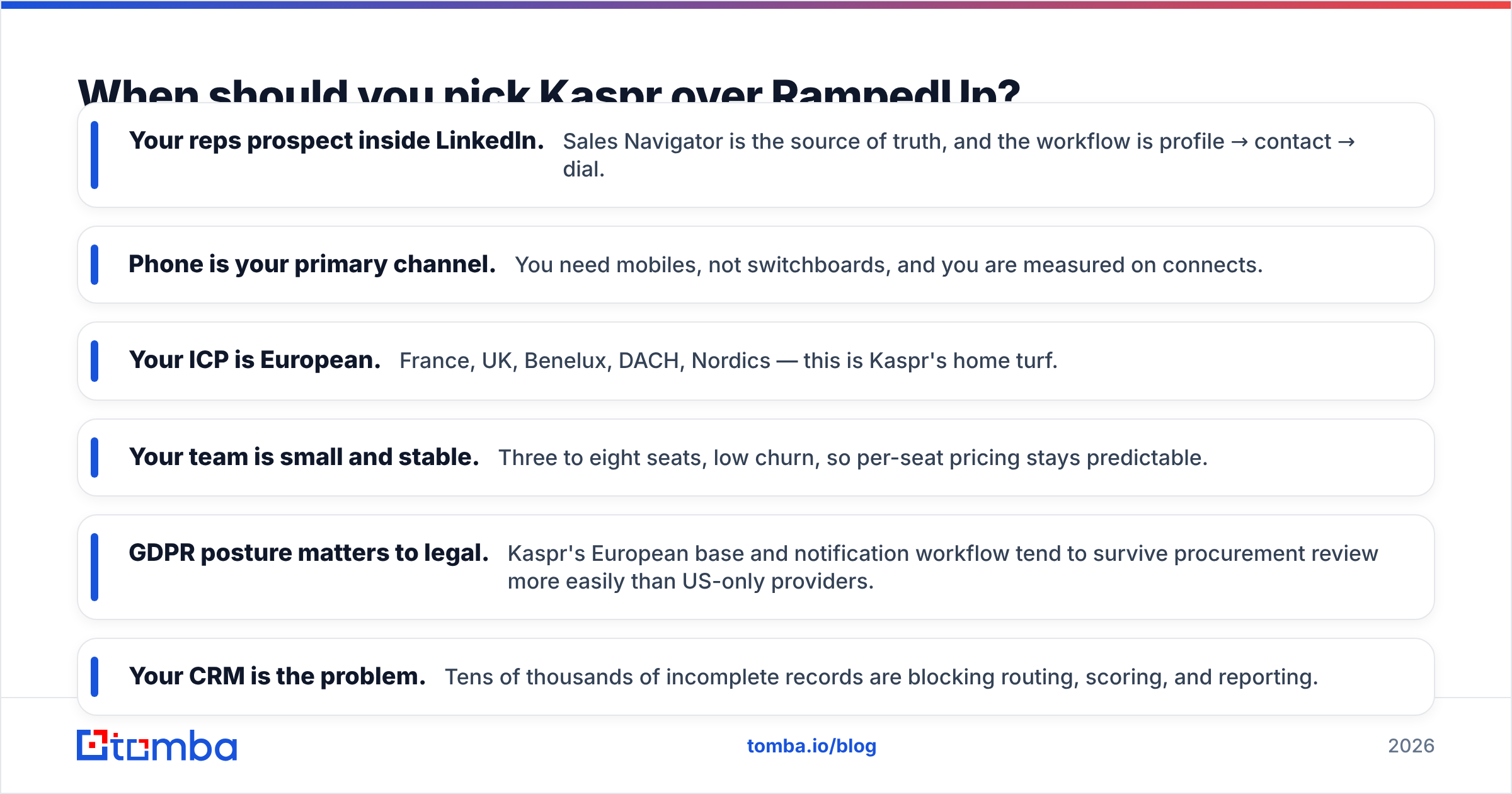
Choose Kaspr when most of these are true:
- Your reps prospect inside LinkedIn. Sales Navigator is the source of truth, and the workflow is profile → contact → dial.
- Phone is your primary channel. You need mobiles, not switchboards, and you are measured on connects.
- Your ICP is European. France, UK, Benelux, DACH, Nordics — this is Kaspr's home turf.
- Your team is small and stable. Three to eight seats, low churn, so per-seat pricing stays predictable.
- GDPR posture matters to legal. Kaspr's European base and notification workflow tend to survive procurement review more easily than US-only providers.
Choose RampedUp when most of these are true:
- Your CRM is the problem. Tens of thousands of incomplete records are blocking routing, scoring, and reporting.
- You need job-change alerts. Tracking champions into new accounts is a named part of your pipeline strategy.
- You are North America-heavy. Coverage is a better fit there than in EMEA.
- RevOps owns the budget. The buyer is thinking about data governance and territory planning, not daily dials.
- You want intent plus firmographics in one contract. Consolidation has real value if you are otherwise stacking three vendors.
Where do both tools fall short?#
Three gaps show up repeatedly in evaluations, regardless of which one you pick.
Email verification depth. Both treat email as a field to return, not a system to guarantee. Neither gives you a real catch-all workflow, SMTP-level state detail, or bulk re-verification as a first-class product. If cold email is your main channel, you will end up buying a verifier anyway — so factor that second line item into the comparison now.
API ergonomics. Kaspr gates API access behind higher tiers; RampedUp's API is real but oriented toward CRM sync rather than arbitrary lookups. If you are building an internal enrichment service, a lead-routing job, or an AI agent that needs contact lookups, you want an email finder API with clean docs and per-call pricing, not a seat licence with an API attached.
Cost predictability at volume. Per-seat pricing hides the real unit economics. Calculate cost per verified, non-bouncing contact — not cost per seat — and the comparison often changes shape entirely.
Overlap you are already paying for. If you run Cognism, Apollo, ZoomInfo, or a similar platform, check the overlap before adding either tool. Plenty of teams buy Kaspr for phones they already have entitlement to elsewhere.
Is there a better third option for email-led outbound?#
If your motion is email-first, the honest answer is that this comparison is the wrong bracket. You are choosing between two contact-data platforms when what you need is a precision email layer.
That layer looks like: domain-level search to find every reachable person at a target company, pattern detection so you can predict addresses for accounts the database has never seen, verification states granular enough to separate risky catch-alls from safe sends, and an API so none of it depends on a human clicking a browser sidebar.
Tomba is built for exactly that shape. Use domain search to map an account, the LinkedIn finder when your source is a profile URL, the phone finder when you do need a dial, and bulk email finder jobs when you are processing a list of thousands. Credits are pooled across the account, so adding teammates does not multiply the bill.
Kaspr vs RampedUp: what's the final verdict?#
Kaspr wins for LinkedIn-native SDR teams dialling European prospects. It is fast, the extension is genuinely good, and the phone data earns its price if calling is your channel.
RampedUp wins for RevOps teams fixing a CRM. Append, hygiene, and job-change tracking across a large existing database is a different job, and it does that job better than a browser extension ever will.
Neither wins for high-volume cold email, because neither was designed to. If your bounce rate is the number that keeps you up at night, buy verification depth and an API, and treat phone data as a separate line item you add only if you actually dial.
Whichever way you lean, do the same test: take 500 real prospects from your ICP, run them through each tool, and measure match rate, bounce rate, and connect rate yourself. Vendor accuracy claims are marketing. Your list is evidence.
Ready to test the email side properly? Start with the Tomba Email Finder — 25 free searches a month, no seat licence, no annual contract. Run your real prospect list through it alongside Kaspr or RampedUp and compare bounce rates on the same 500 contacts. That single test will tell you more than any comparison post, including this one.
Related guides#
// get started
Find, verify and enrich your first contacts today
Start on the free plan with 25 searches a month, then scale when your team is ready.
Free plan · No credit card required · GDPR & CCPA
// about the author