Kaspr vs Reachfast (2026): Which Contact Finder Wins?
Kaspr owns LinkedIn mobile numbers. Reachfast sells cheap credits. Neither is a full prospecting stack — here's how they compare on match rate, pricing, and GDPR risk, and when a dedicated email finder beats both.
TL;DR
- Kaspr is a phone-first LinkedIn tool. Its strength is European mobile numbers pulled while you browse a profile. Its weakness is per-seat pricing and a workflow that dies the moment you leave the Chrome extension.
- Reachfast is a cheap, credit-based contact finder. It competes on price per lookup, not on depth. Good for low-volume, ad-hoc enrichment; thin on verification, team controls, and documented API surface.
- Neither tool is an email-accuracy specialist. Both return a contact object; only one of the fields is usually reliable, and you still need a separate verification step before you send.
- Pricing models differ more than the data does. Kaspr charges per user per month; Reachfast charges per credit pack. At 5 seats and 3,000 lookups/month those two models land in completely different places.
- If email is your primary channel, a dedicated finder+verifier (Tomba starts at $49/mo, free tier included) beats both on cost per deliverable address — which is the only metric that pays your bills.
What are Kaspr and Reachfast, exactly?#
Kaspr is a LinkedIn-native contact-data tool, best known as a Chrome extension that reveals mobile numbers and email addresses on profiles, search results, and group pages. It was acquired by Cognism, which explains two things: the heavy European data bias, and the compliance-forward marketing on kaspr.io. Kaspr's centre of gravity is the SDR who lives in LinkedIn Sales Navigator and wants a phone number before the end of the day.
Reachfast is a smaller, cheaper contact-lookup tool in the same category: you give it a LinkedIn profile, a name and company, or a domain, and it returns work emails and — depending on the record — a phone number. It positions on price-per-lookup and simplicity rather than on database size or enterprise features. Think "credit vending machine" rather than "data platform."
The honest framing of kaspr vs reachfast is not "which has better data." It's which failure mode can you tolerate: Kaspr's is cost per seat, Reachfast's is coverage depth and tooling maturity.
Both belong to a category that has quietly split in two. On one side: LinkedIn-scraping extensions optimised for phone numbers. On the other: API-first email infrastructure optimised for deliverability at volume. Buying the wrong side for your motion is the actual expensive mistake — bigger than any per-credit price difference you'll negotiate.
How do Kaspr and Reachfast compare head-to-head?#
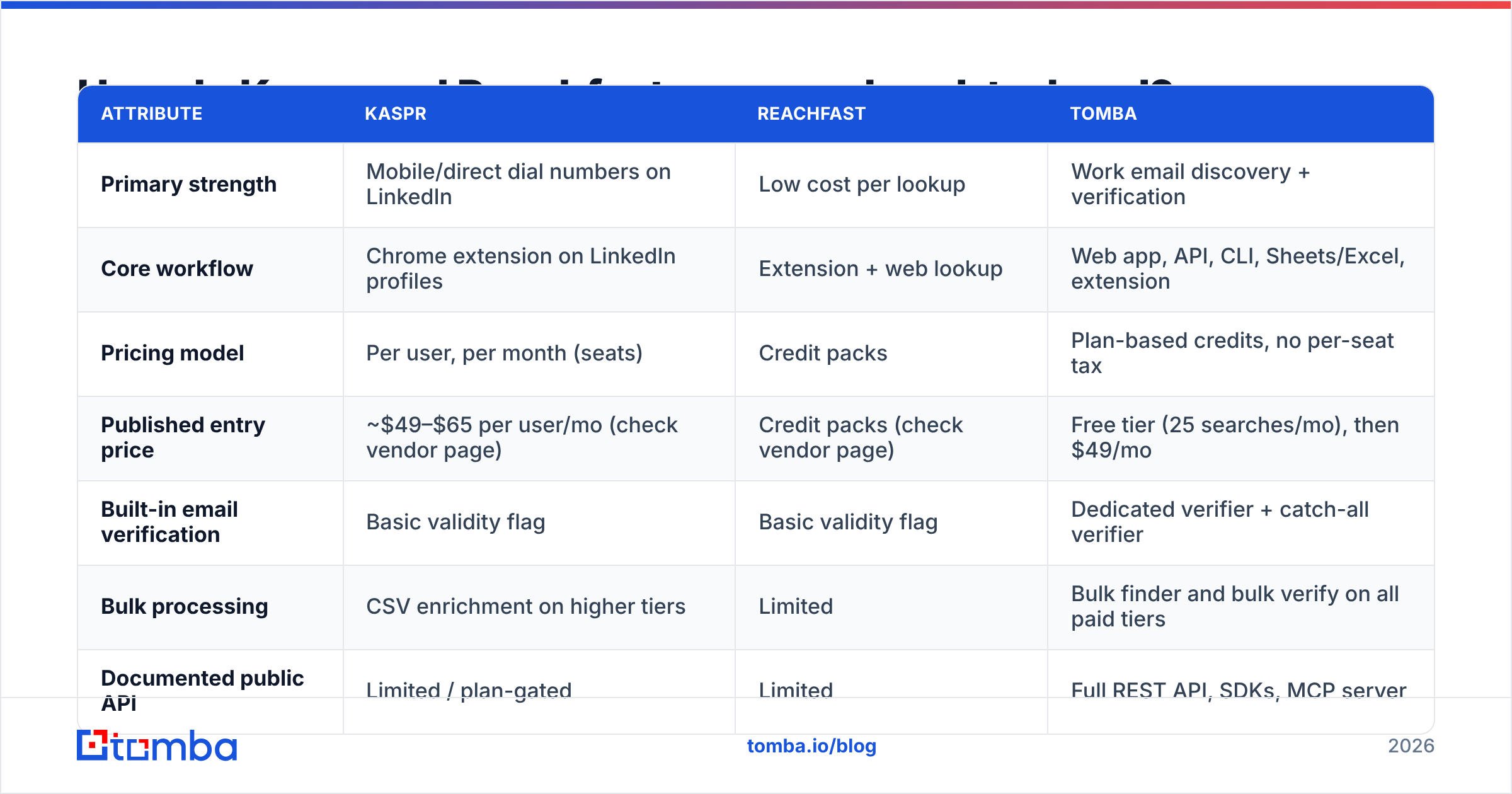
Here is the practical comparison, with Tomba included as the email-specialist reference point so you can see where each tool's centre of gravity sits.
| Attribute | Kaspr | Reachfast | Tomba |
|---|---|---|---|
| Primary strength | Mobile/direct dial numbers on LinkedIn | Low cost per lookup | Work email discovery + verification |
| Core workflow | Chrome extension on LinkedIn profiles | Extension + web lookup | Web app, API, CLI, Sheets/Excel, extension |
| Pricing model | Per user, per month (seats) | Credit packs | Plan-based credits, no per-seat tax |
| Published entry price | ~$49–$65 per user/mo (check vendor page) | Credit packs (check vendor page) | Free tier (25 searches/mo), then $49/mo |
| Built-in email verification | Basic validity flag | Basic validity flag | Dedicated verifier + catch-all verifier |
| Bulk processing | CSV enrichment on higher tiers | Limited | Bulk finder and bulk verify on all paid tiers |
| Documented public API | Limited / plan-gated | Limited | Full REST API, SDKs, MCP server |
| Geographic bias | Strong EU, decent US | Mixed, US-leaning | Global, domain-driven |
| Best for | Outbound teams that cold call | Freelancers, small ad-hoc lists | Email-led outbound and data pipelines |
Two things jump out. First, the per-seat versus per-credit split decides your bill far more than any accuracy difference. Second, neither Kaspr nor Reachfast treats verification as a first-class product — it's a flag on a record, not a pipeline stage. That gap is where bounce rates come from.
Wait — that image needs a proper alt. Here it is rendered correctly:

Which one actually finds more valid emails?#
Short answer: on B2B work emails, a dedicated email finder beats both, and the gap widens as your list gets less LinkedIn-shaped.
Here's why. Kaspr and Reachfast are both profile-driven. They resolve a person → contact record. That works beautifully when your input is a LinkedIn URL and the person has a well-indexed profile. It degrades fast when your input is "40 companies in the Benelux, get me the head of ops at each" — because now you need pattern inference at the domain level, not a profile lookup.
A domain-driven email finder attacks the problem from the other direction: identify the company's email pattern, generate the candidate, then verify it against the mail server. That's why accuracy benchmarks between profile-scrapers and domain-driven finders rarely look like a fair fight — they're solving different problems.

Whatever the vendor marketing says, run your own sample before you commit. The test that matters takes twenty minutes:
- Build a 100-row control list. Pull real prospects from your actual ICP — not a demo list the vendor supplies. Mix company sizes and at least two countries.
- Run the same list through each tool. Record match rate (rows returned) separately from accuracy (rows that are actually correct). Vendors love conflating these.
- Verify every returned address with a third party. Use a neutral email verifier so you're not grading a tool with its own marking scheme.
- Count catch-all domains separately. A "valid" result on a catch-all domain is a coin flip unless the tool runs real catch-all logic.
- Compute cost per deliverable contact. Total spend ÷ addresses that survived verification. This single number ends most vendor debates.
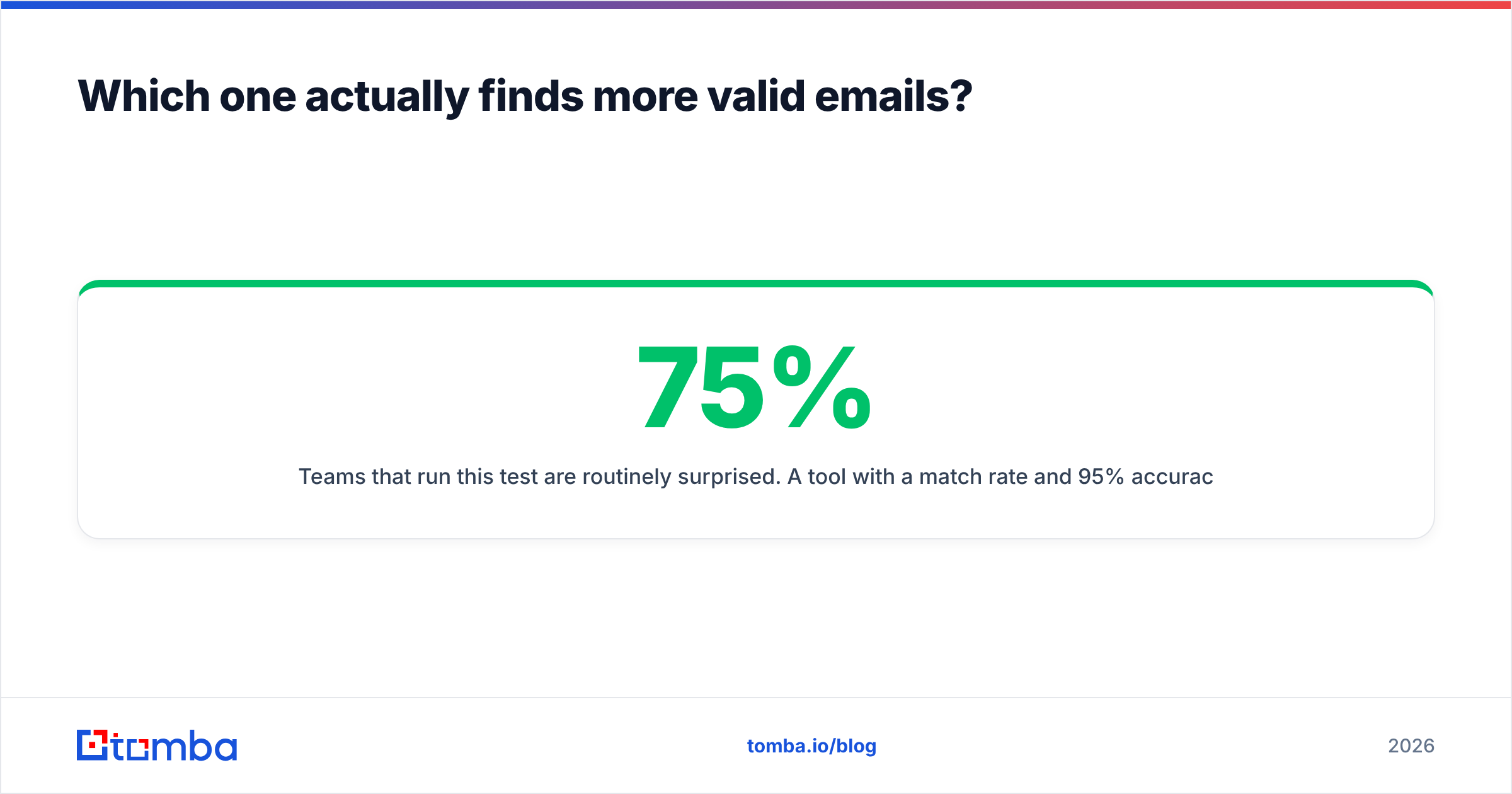
Teams that run this test are routinely surprised. A tool with a 75% match rate and 95% accuracy beats a tool with a 90% match rate and 60% accuracy — and the second tool is usually the one winning the demo.
Which is better for phone numbers?#
Kaspr, clearly, and it isn't close — this is the one dimension where the kaspr vs reachfast question has an easy answer.
Kaspr's entire product identity is built on direct dials and mobiles, with particularly good coverage in France, Benelux, DACH, and the UK. If your team runs a cold-calling motion into European mid-market accounts, that coverage is worth paying seat pricing for. Reachfast returns phone data on some records, but it's a secondary field, not the product.
The caveat: phone coverage is the most volatile data type in B2B. Numbers churn, consent rules differ by country, and "direct dial" sometimes means a switchboard. Validate before your reps burn an hour on dead numbers — either through the vendor's own checks or a standalone phone validator. If you're building a calling list from scratch rather than enriching LinkedIn profiles one at a time, a domain-first phone finder fits the batch workflow better than an extension does.
One more thing calling teams under-budget: you almost always need the email too. Multichannel sequences without an email step underperform, so "we bought Kaspr for phones" quietly becomes "we bought Kaspr for phones and something else for email." Price the pair, not the part.
How does the pricing really work?#
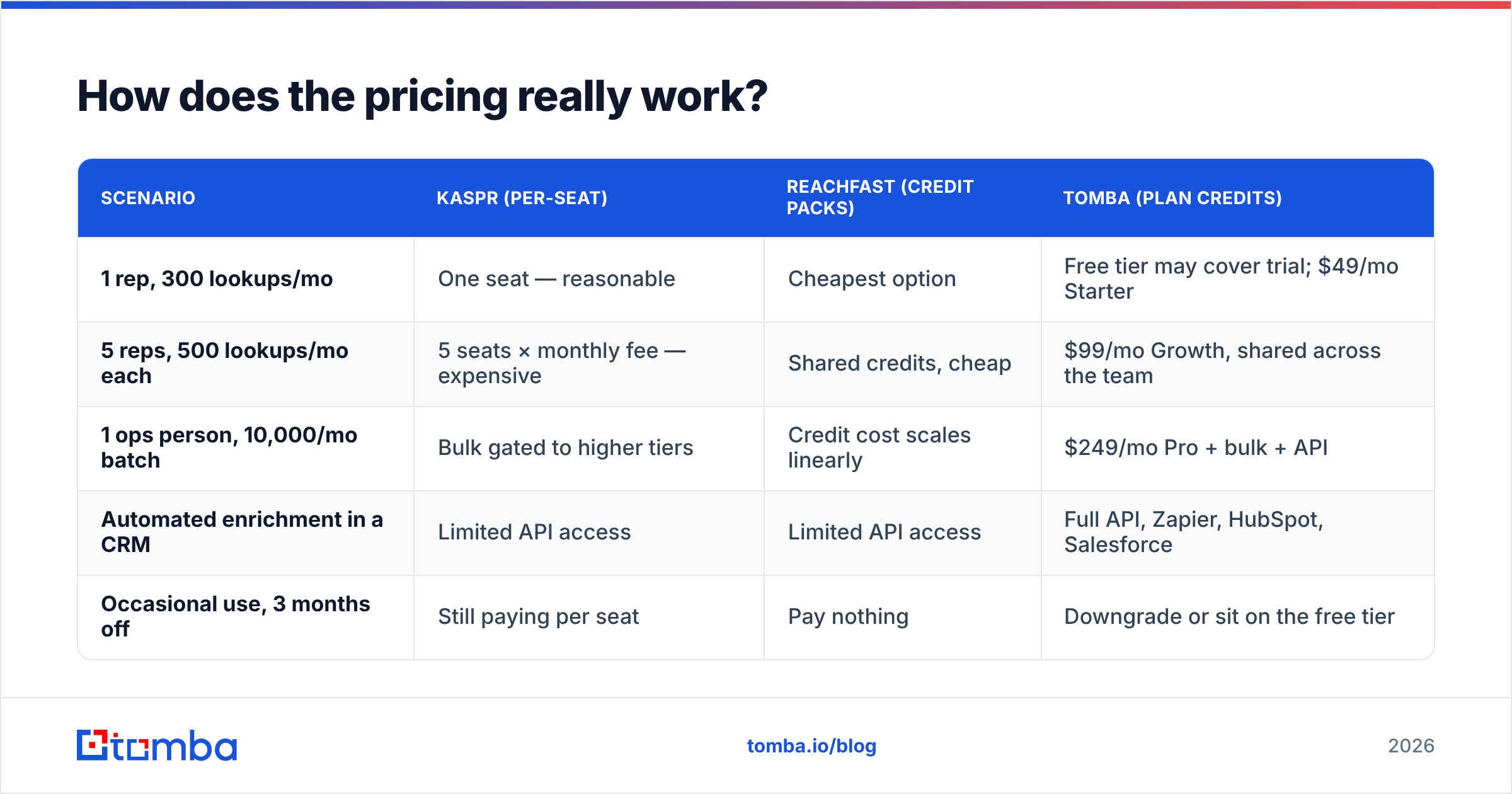
This is where the two tools diverge hardest, and where buyers get burned.
| Scenario | Kaspr (per-seat) | Reachfast (credit packs) | Tomba (plan credits) |
|---|---|---|---|
| 1 rep, 300 lookups/mo | One seat — reasonable | Cheapest option | Free tier may cover trial; $49/mo Starter |
| 5 reps, 500 lookups/mo each | 5 seats × monthly fee — expensive | Shared credits, cheap | $99/mo Growth, shared across the team |
| 1 ops person, 10,000/mo batch | Bulk gated to higher tiers | Credit cost scales linearly | $249/mo Pro + bulk + API |
| Automated enrichment in a CRM | Limited API access | Limited API access | Full API, Zapier, HubSpot, Salesforce |
| Occasional use, 3 months off | Still paying per seat | Pay nothing | Downgrade or sit on the free tier |
Per-seat pricing punishes teams; credit pricing punishes volume. The pattern to watch for is the silent multiplier: a $65/seat tool at 6 reps is $390/month before anyone has found a single email, and half those seats will go unused in month three. Check current numbers on each vendor's own page before you sign — published tiers in this category change several times a year, and the Tomba pricing page is the only one I can promise is accurate as of writing ($49 Starter, $99 Growth, $249 Pro, free tier at 25 searches/month).
Also read the credit-expiry clause. Credits that reset monthly with no rollover are a subscription wearing a pay-as-you-go costume.
What about GDPR and compliance risk?#
Both tools sell personal data about European professionals, which puts them squarely inside GDPR scope — and legitimate-interest processing is a defensible basis for B2B contact data, but only if the vendor's paperwork holds up.
Kaspr is the more mature answer here. Being part of a larger European group, it publishes notification and opt-out processes and markets compliance as a feature. Smaller tools, Reachfast included, typically offer less documentation — which doesn't make them non-compliant, but does shift the burden of proof onto you.
Before you buy either, get three things in writing:
- The lawful basis the vendor relies on, and their data-subject notification process.
- A DPA you can actually sign, plus sub-processor list and data-residency details.
- Suppression handling — how fast an opt-out propagates, and whether it applies across their whole customer base or only your account.
If your prospects are mostly German or French and your legal team is involved, this section will matter more than any match-rate chart. Buyer reviews on G2 are useful here precisely because compliance complaints surface in reviews long before they surface in marketing.
Which workflow should decide your pick?#
Match the tool to the motion, not to the feature list:
- Call-led outbound into Europe. Kaspr. The mobile coverage is the product, and paying per seat for reps who call all day is rational.
- Occasional, low-volume enrichment. Reachfast. When you need 200 contacts a quarter, credit packs beat any subscription, and you shouldn't be paying seats for idle months.
- Email-led outbound at scale. A dedicated finder plus verifier. Cost per deliverable address is what you're optimising, and profile-scrapers lose that race.
- Programmatic enrichment inside a CRM or product. An API-first vendor. If the enrichment has to run without a human in a Chrome tab, extension-first tools are structurally wrong — you want a documented email finder API and webhook-friendly rate limits.
- List building from a target-account list. Domain search. When your input is 500 company domains and a set of job titles, profile lookups are the slow path; domain search is the fast one.

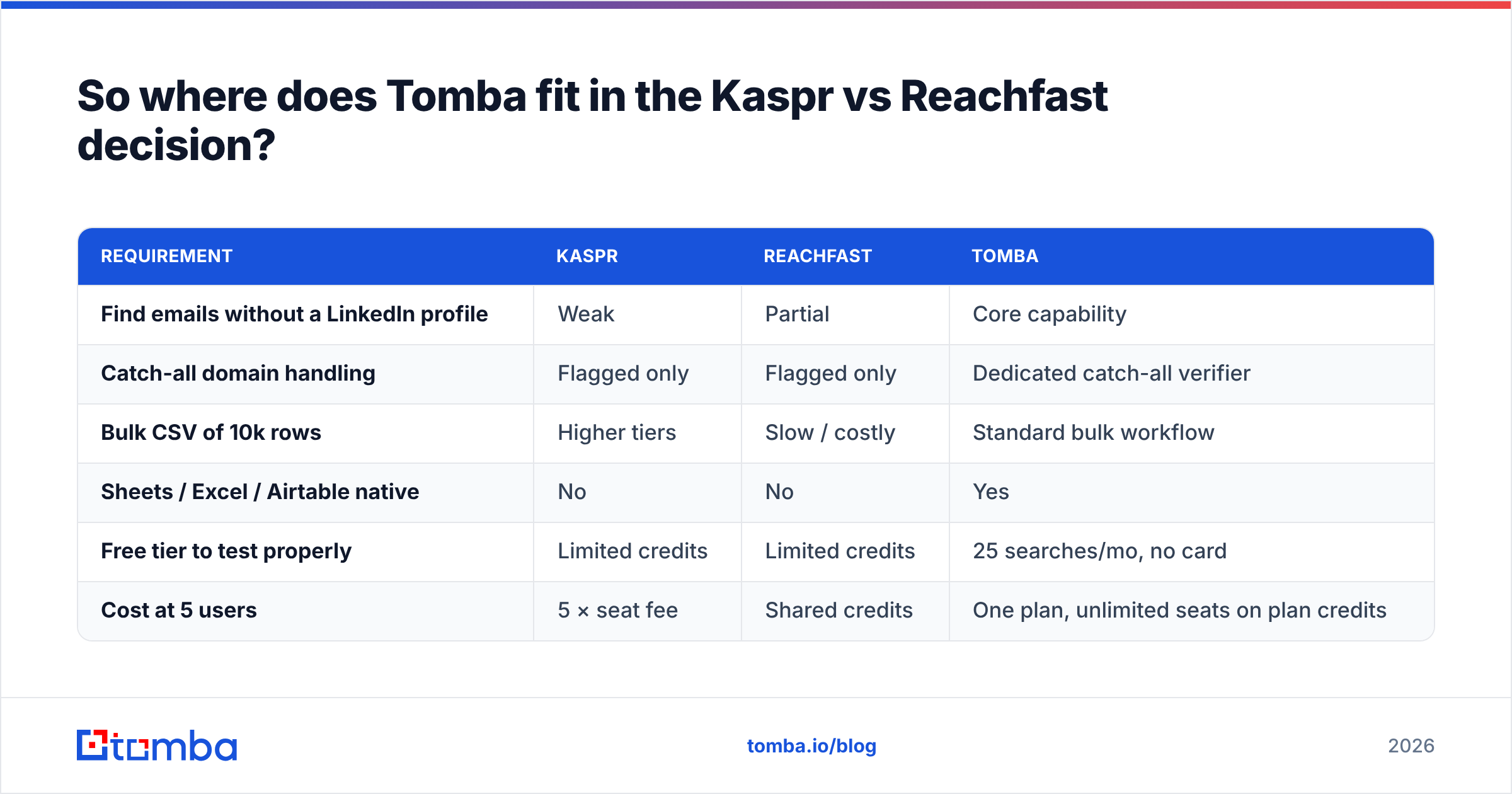
So where does Tomba fit in the Kaspr vs Reachfast decision?#
As the third option most buyers should price before choosing either — specifically when email is the channel that carries your pipeline.

The functional differences that matter:
| Requirement | Kaspr | Reachfast | Tomba |
|---|---|---|---|
| Find emails without a LinkedIn profile | Weak | Partial | Core capability |
| Catch-all domain handling | Flagged only | Flagged only | Dedicated catch-all verifier |
| Bulk CSV of 10k rows | Higher tiers | Slow / costly | Standard bulk workflow |
| Sheets / Excel / Airtable native | No | No | Yes |
| Free tier to test properly | Limited credits | Limited credits | 25 searches/mo, no card |
| Cost at 5 users | 5 × seat fee | Shared credits | One plan, unlimited seats on plan credits |
Where Tomba does not win: if your primary need is a European mobile number on a LinkedIn profile right now, Kaspr is the better buy and you should buy it. Tools that pretend to be best at everything are the ones you should distrust. The realistic stack for a calling team is Kaspr for phones plus an email specialist for the email step — and the realistic stack for an email-led team is the specialist alone.
Before you commit to anything, run the 100-row control test above. It costs you an afternoon and it has ended more overpriced contracts than any comparison post ever will.
Which should you buy in 2026?#
Buy Kaspr if cold calling into Europe is your primary motion, your reps live in Sales Navigator, and you can justify per-seat cost against booked meetings. Buy Reachfast if your volume is genuinely low and irregular, and you want the cheapest possible per-lookup price without a subscription. Buy neither if your pipeline is email-led at volume — in that case you're paying a phone-data premium or a coverage discount for a job you should hand to an email specialist, and then paying a second time in bounce rates.
Whichever way you go, verify before you send. The single biggest cost in this category isn't the subscription; it's the sender reputation you torch by mailing addresses no one checked.
If email is the channel that pays your bills, start with the Tomba Email Finder — find work emails by domain, name, or company, verify them in the same pass, and export straight into your CRM or sequencer. The free tier gives you 25 searches a month with no card, which is enough to run the control test on your own ICP and settle the Kaspr vs Reachfast debate with your own numbers instead of someone else's benchmark.
Related guides#
// get started
Find, verify and enrich your first contacts today
Start on the free plan with 25 searches a month, then scale when your team is ready.
Free plan · No credit card required · GDPR & CCPA
// about the author