Kaspr vs Respona (2026): Which Tool Fits Your Outreach?
Kaspr pulls mobile numbers and emails off LinkedIn. Respona runs link-building and PR outreach campaigns. They get compared constantly — and they solve almost opposite problems. Here's the honest breakdown.
TL;DR
- Kaspr and Respona are not competitors. Kaspr is a LinkedIn-first contact-data extension (mobile numbers, emails). Respona is a campaign platform for link building, digital PR, and blogger outreach. The overlap is roughly "both help you contact someone."
- Pick Kaspr if your bottleneck is getting a phone number or email for a specific person you already found on LinkedIn, and your team lives in Sales Navigator.
- Pick Respona if your bottleneck is finding the right journalist, blogger, or podcast host at scale and sending a personalized sequence with follow-ups — usually for SEO, content, or PR teams.
- Pricing models differ structurally. Kaspr is per-seat with credit buckets; Respona is per-workspace with campaign/email limits. That single difference changes total cost more than any feature.
- Neither is a data layer. If you need raw email discovery and verification piped into a CRM, spreadsheet, or your own app, a dedicated email finder API is cheaper and more portable than either.
What are Kaspr and Respona, actually?#
Start here, because the "Kaspr vs Respona" query usually comes from someone who has seen both on a G2 category page and assumes they do the same thing. They don't.
Kaspr is a Chrome extension plus web app, owned by Cognism. You open a LinkedIn profile, Sales Navigator list, or LinkedIn group, click the Kaspr widget, and it returns the contact's business email and — its real selling point — direct mobile numbers. You can push those contacts into lists, enroll them in lightweight LinkedIn + email sequences, and sync to a CRM. It is a prospect data tool with a thin outreach layer bolted on.
Respona is a browser-based outreach platform built for link building, unlinked-mention reclamation, guest posting, podcast pitching, and PR. You start from a search query or an article URL, Respona crawls the SERP, surfaces relevant pages, identifies the author or editor, finds their email, and then runs a multi-step personalized email sequence out of your own mailbox. It is an outreach campaign tool with a data layer bolted on.
So: Kaspr starts with a person. Respona starts with a page. That's the cleanest mental model, and it predicts almost every other difference between them.
If you think of prospecting as cooking, Kaspr is the butcher — it hands you a specific cut when you point at it. Respona is the meal-kit service — it decides the menu, sources the ingredients, and gives you the steps. You would not ask the butcher to plan your week, and you would not ask the meal-kit company for a particular ribeye.
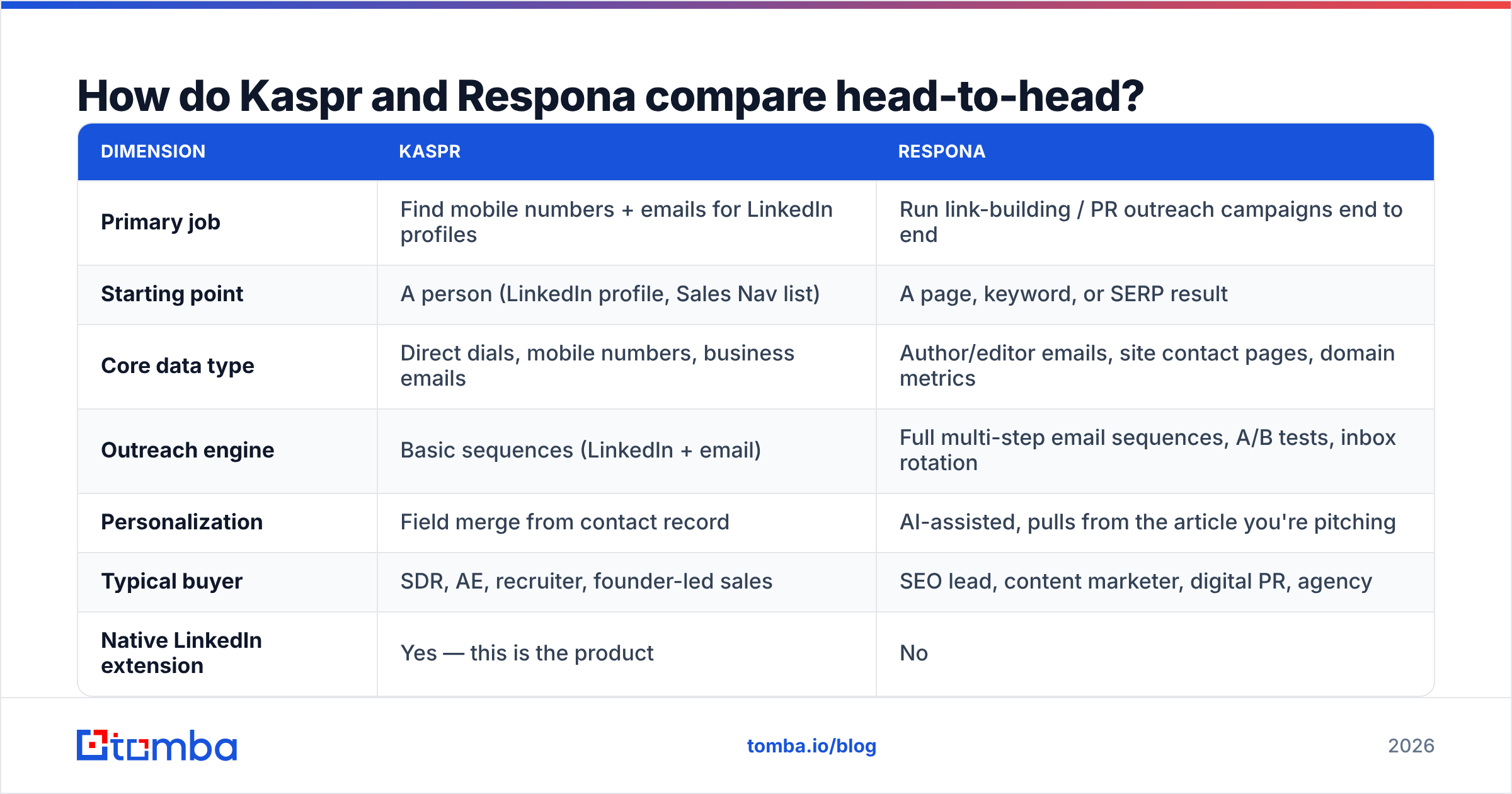
How do Kaspr and Respona compare head-to-head?#
| Dimension | Kaspr | Respona |
|---|---|---|
| Primary job | Find mobile numbers + emails for LinkedIn profiles | Run link-building / PR outreach campaigns end to end |
| Starting point | A person (LinkedIn profile, Sales Nav list) | A page, keyword, or SERP result |
| Core data type | Direct dials, mobile numbers, business emails | Author/editor emails, site contact pages, domain metrics |
| Outreach engine | Basic sequences (LinkedIn + email) | Full multi-step email sequences, A/B tests, inbox rotation |
| Personalization | Field merge from contact record | AI-assisted, pulls from the article you're pitching |
| Typical buyer | SDR, AE, recruiter, founder-led sales | SEO lead, content marketer, digital PR, agency |
| Native LinkedIn extension | Yes — this is the product | No |
| SEO metrics (DR/DA, traffic) | No | Yes, via integrated SEO data |
| CRM sync | HubSpot, Pipedrive, Salesforce, Lemlist | HubSpot, Pipedrive, Zapier |
| Bulk enrichment of a CSV | Limited | Limited |
| Public API | Limited / plan-gated | Limited |
| Billing model | Per seat + credits | Per workspace + campaign limits |
The row that matters most for budget is the last one. Kaspr charges per user, so a five-person SDR team multiplies its cost five times. Respona charges per workspace with email-volume ceilings, so one SEO manager and one agency of ten can pay a similar base rate — until volume caps bite.

What does Kaspr do well — and where does it stop?#
What it does well:
- Mobile numbers. This is the honest reason people buy Kaspr. Business emails are commoditized; verified direct dials are not. Kaspr's phone coverage in Europe — especially France, the UK, Germany, and the Benelux — is genuinely strong, which follows from Cognism's data footprint.
- Zero-friction workflow. The extension sits on the LinkedIn page you're already looking at. There is no export, no CSV round-trip, no waiting. For an SDR doing 60 touches a day, that friction reduction is the product.
- GDPR posture. Cognism has invested heavily in notified-contact compliance across the EU. If your legal team asks hard questions about where a mobile number came from, Kaspr has better answers than most scrapers.
- Team lists and sharing. Contacts saved by one rep are visible to the team, with basic dedupe — useful for avoiding two reps calling the same VP in one week.
Where it stops:
- Coverage outside Europe is thinner. North American mobile coverage is decent but not category-leading, and APAC drops off noticeably.
- It is LinkedIn-shaped. If your target list came from a conference attendee sheet, a job board, or a technographic filter, Kaspr has no good entry point. You need a domain search or bulk enrichment tool instead.
- The sequencing layer is thin. It exists, but nobody switches off Outreach, Salesloft, or Lemlist because Kaspr's sequencer was better.
- Credits burn fast on reveals that fail. Policies vary by plan; check whether you're charged for a reveal that returns nothing, because on high-volume weeks that's a real line item.
- Per-seat pricing punishes growth. Adding your fifth SDR costs the same as your first.
What does Respona do well — and where does it stop?#
What it does well:
- Campaign discovery. You type "best project management software 2026," Respona crawls the SERP, filters by domain metrics, and hands you a target list with contacts attached. No other category of tool collapses research → contact → pitch this tightly.
- Contextual personalization. Because Respona already has the article you're pitching about, its AI-assisted first lines reference the actual content rather than "I loved your post!" Response rates reflect that.
- Real sequencing. Multi-step follow-ups, inbox rotation across multiple sending accounts, reply detection, throttling, and unsubscribe handling — the things that keep your email deliverability intact.
- Agency-friendly workspaces. Separate client campaigns, separate mailboxes, separate reporting.
Where it stops:
- It is not a sales prospecting tool. There is no "give me all VPs of Engineering at 200-employee SaaS companies in Texas" motion. Respona's index is organized around content, not firmographics.
- No phone numbers. At all. If cold calling is part of your motion, Respona is irrelevant to it.
- Email discovery is good, not exhaustive. For editorial and author emails it is strong. For a random enterprise buyer with no byline anywhere, it struggles — that's where a dedicated author finder or pattern-based lookup does better.
- Price floor is high for solo operators. The entry tier assumes you're running real campaigns, not testing 40 emails a month.
- Learning curve. The campaign builder has real depth, which means real onboarding time. Budget a week.
How much do Kaspr and Respona cost in 2026?#
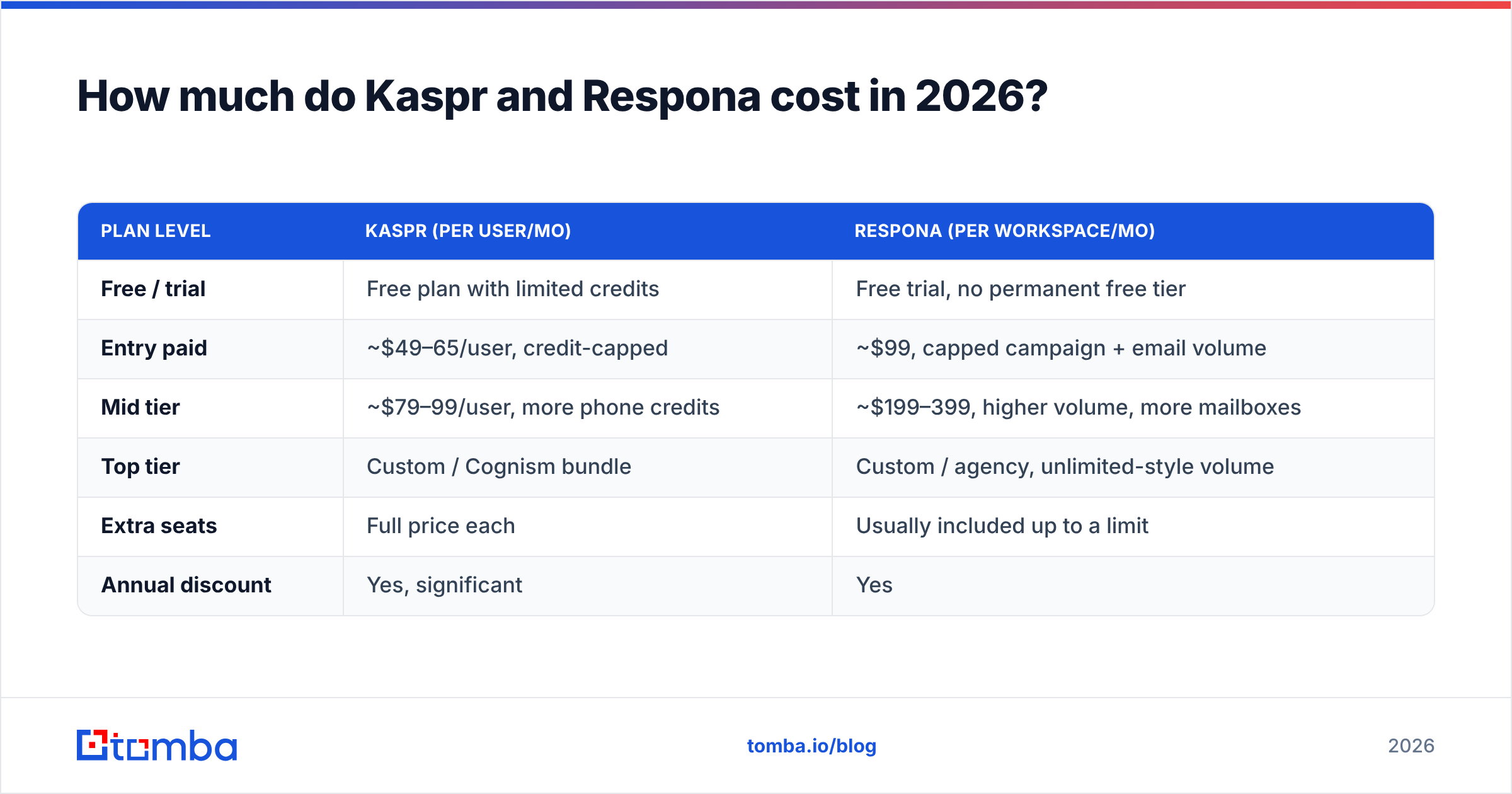
Both vendors have restructured tiers more than once, so treat these as directional and confirm on their own pricing pages before you buy.
| Plan level | Kaspr (per user/mo) | Respona (per workspace/mo) |
|---|---|---|
| Free / trial | Free plan with limited credits | Free trial, no permanent free tier |
| Entry paid | ~$49–65/user, credit-capped | ~$99, capped campaign + email volume |
| Mid tier | ~$79–99/user, more phone credits | ~$199–399, higher volume, more mailboxes |
| Top tier | Custom / Cognism bundle | Custom / agency, unlimited-style volume |
| Extra seats | Full price each | Usually included up to a limit |
| Annual discount | Yes, significant | Yes |
Two cost traps worth naming:
The Kaspr trap is seat sprawl. Three reps at the mid tier is roughly $250–300/month before anyone has verified a single address. If half your team only needs data occasionally, you're paying full seats for occasional use.
The Respona trap is volume ceilings. The entry plan looks cheap until a single campaign month blows through the email cap and you're forced into a tier that costs three to four times more.
Which one should you pick for your use case?#
Match the tool to the bottleneck, not to the feature list.
- You cold call European prospects → Kaspr. Nothing else in this comparison gives you mobile numbers, and mobile numbers are the whole game for phone-led outbound. Pair it with a phone validator so you're not burning dials on dead lines.
- You build links or run digital PR → Respona. The SERP-to-pitch workflow saves more hours per week than any amount of manual prospecting, and the sequencing is genuinely good.
- You need emails for a list you already have → neither. Both tools are optimized for discovery inside their own workflow. A bulk enrichment run against a CSV of 3,000 companies is a job for a bulk email finder, not an extension or a campaign builder.
- You're building a product or internal tool → neither. Kaspr and Respona are UIs first. If you need contact data inside your own app, you need an email finder API with documented endpoints and predictable rate limits.
- You do both motions → buy both, but downsize each. Run Kaspr on the one or two reps who actually dial, run Respona on the single marketing seat that owns link building, and put the data layer underneath both. That usually costs less than over-provisioning either one.

Do you still need an email verifier with either tool?#
Yes — and this is the part both product pages soft-pedal.
Kaspr and Respona both return emails with some confidence indicator, but "found" and "deliverable" are different claims. A B2B address can be technically well-formed, correctly patterned, and still bounce because the person left in March, the domain is catch-all, or the mailbox is a shared alias that auto-rejects external senders.
Bounce rate is the metric that kills cold campaigns. Google and Yahoo's bulk-sender requirements pushed acceptable spam-complaint and bounce thresholds low enough that two bad sends in a row can measurably dent sender reputation. Most deliverability practitioners hold hard bounces under 2%, and many hold under 1% for new domains.
Practical sequence, regardless of which tool you use:
- Export whatever your tool found.
- Run it through a dedicated email verifier — SMTP-level, not just syntax and MX.
- Route catch-all domains through a catch-all verifier rather than guessing.
- Suppress anything marked risky or unknown on a warming domain. Send to them later, from an established one.
This step takes ten minutes and protects the asset you can't easily replace: a sending domain with clean history. Both G2 and Capterra reviews for outreach tools are full of teams who learned this the expensive way.
Is there a middle path between Kaspr and Respona?#
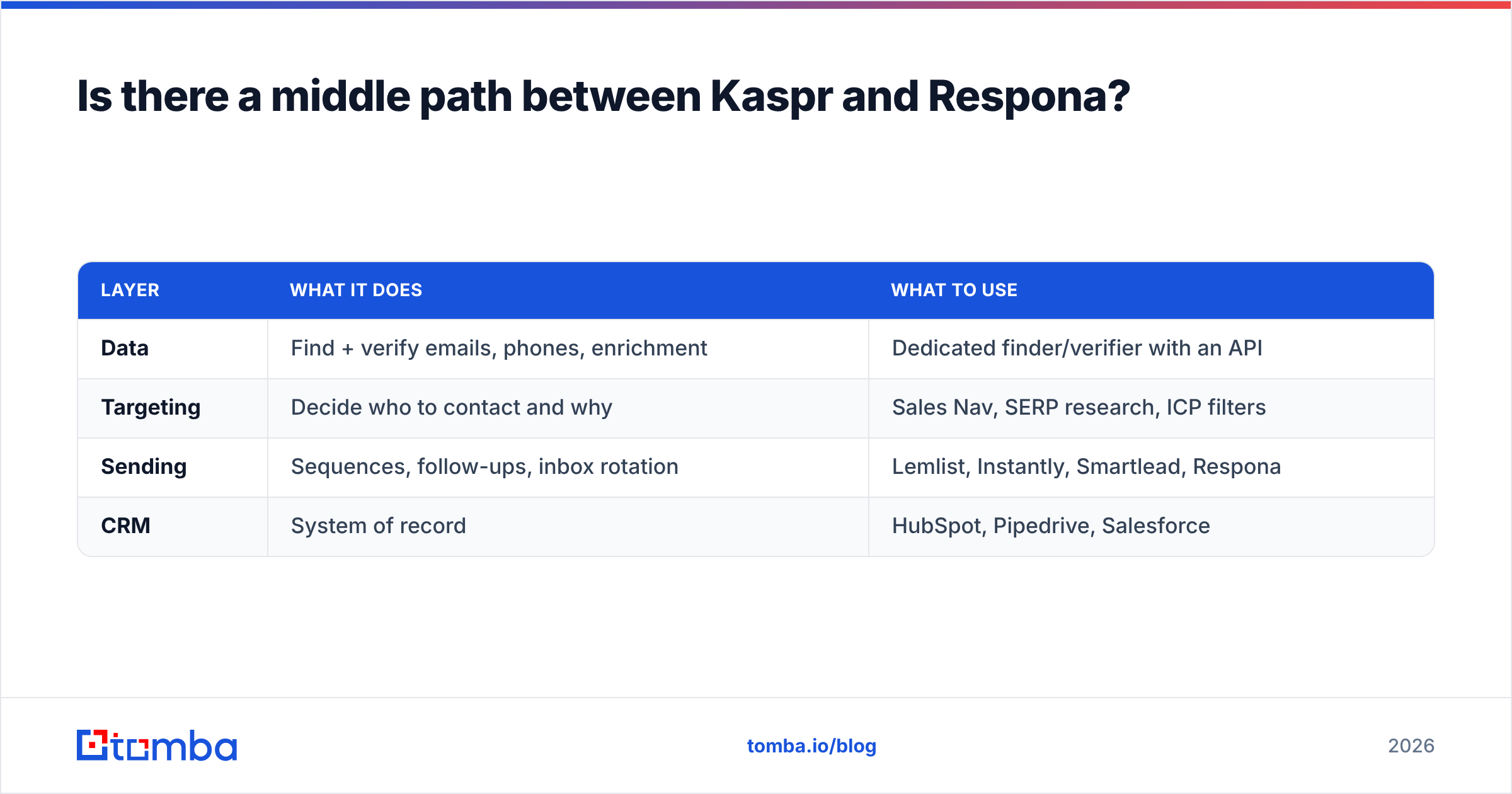
There is, and it's the option most teams skip because it doesn't come with a shiny campaign dashboard: separate your data layer from your sending layer.
The logic is simple. Sending tools churn — you'll swap sequencers every 18–24 months as pricing and deliverability features shift. Data, by contrast, is the thing you keep re-buying. If your contact data is locked inside a per-seat extension or a campaign platform's proprietary index, every migration is painful and every seat is a tax.
A cleaner architecture:
| Layer | What it does | What to use |
|---|---|---|
| Data | Find + verify emails, phones, enrichment | Dedicated finder/verifier with an API |
| Targeting | Decide who to contact and why | Sales Nav, SERP research, ICP filters |
| Sending | Sequences, follow-ups, inbox rotation | Lemlist, Instantly, Smartlead, Respona |
| CRM | System of record | HubSpot, Pipedrive, Salesforce |
Run that way, Kaspr becomes an optional add-on for the reps who need mobile numbers, and Respona becomes an optional add-on for the one person doing link building. You stop paying platform prices for data you could source once, cheaply, and reuse everywhere. If you already use HubSpot or Pipedrive as your system of record, a direct HubSpot integration on the data layer removes most of the CSV shuffling.
What's the verdict on Kaspr vs Respona?#
There is no winner, because there is no shared job. Kaspr wins the "I need this specific person's mobile number, now" job outright. Respona wins the "I need 200 relevant publishers pitched this month" job outright. Comparing their feature counts is like comparing a torque wrench to a table saw.
The decision that actually saves you money is the one underneath both: where your contact data comes from, how it's verified, and whether you can take it with you when you switch sending tools.
That's the layer Tomba sits in. The Tomba Email Finder resolves business emails by name, company, or domain, with source attribution and confidence scoring, and it plugs into the same stack via API, Chrome extension, Google Sheets, or CRM sync. Verification, catch-all handling, and data enrichment run alongside it, so you're not stitching three vendors together. Tomba pricing starts with a free tier at 25 searches a month, then $49/mo for Starter, $99/mo for Growth, and $249/mo for Pro — priced per workspace, not per seat, so adding your fifth rep doesn't multiply the bill.
Test it against whichever of Kaspr or Respona you're leaning toward. Run the same 100 contacts through both and compare hit rate, bounce rate, and cost per verified address. That test takes an afternoon and settles the question better than any comparison post — including this one.
Related guides#
// get started
Find, verify and enrich your first contacts today
Start on the free plan with 25 searches a month, then scale when your team is ready.
Free plan · No credit card required · GDPR & CCPA
// about the author