Kaspr vs Revli: Which Contact Data Tool Wins in 2026?
Kaspr sells mobile numbers scraped off LinkedIn. Revli sells cheap email lookups. They solve different problems badly if you pick wrong — here is the honest breakdown of pricing, accuracy, credits and export limits.
Kaspr vs Revli is the wrong fight for most teams. One sells phone numbers. The other sells cheap emails. Here is the short version before the detail.
TL;DR
- Kaspr is a phone-first LinkedIn extension. Its main draw is mobile numbers for European prospects, surfaced while you browse a profile. Emails come along for the ride, but they are not the headline.
- Revli is an email-first, budget-tier lookup tool. It competes on price and a free allowance, not on depth of coverage or enrichment breadth.
- They are not really the same product. If you compare them on "credits per dollar" alone you will buy the wrong one. Compare them on what you actually dial or send.
- Both make you verify separately. Neither replaces a real verification step before a cold send, and both cap exports in ways that bite mid-campaign.
- If email is your channel, a dedicated finder plus verifier stack (Tomba starts at $49/mo with a free 25-search tier) usually beats bolting a phone tool onto an email workflow.
What are Kaspr and Revli, and who actually uses them?#
Here is the honest framing. These two tools get compared because they show up in the same "cheap contact data" searches. They were never built for the same job.
Kaspr is a Chrome extension and web app that sits on top of LinkedIn. You open a profile, click the widget, and it returns phone numbers, emails and company details. Cognism bought it in 2022. It is now the cheaper, self-serve way into that data set. Its reputation is built on mobile numbers in EMEA — French, UK, DACH and Benelux markets in particular. SDRs who cold call bought Kaspr long before anyone marketed it as an email finder.
Revli plays a different game. It sells itself as a low-cost email finder and B2B lookup tool: find an address from a name and domain, run LinkedIn-based lookups, pull lists in bulk. The pitch is price and a free allowance. The buyer is a solo founder, a freelancer or a small agency that needs a few hundred addresses a month and does not want a seat-based contract.
So the real question is not "which is better." It is: is your bottleneck dials or sends?
One caveat before the numbers: both vendors change plans, credit definitions and regional coverage regularly. Treat every figure below as a starting point and confirm against Kaspr's site and Revli's own pricing page before you buy. I would rather flag that than pretend a screenshot from last quarter is gospel.

Kaspr vs Revli: how do they compare on features and pricing?#
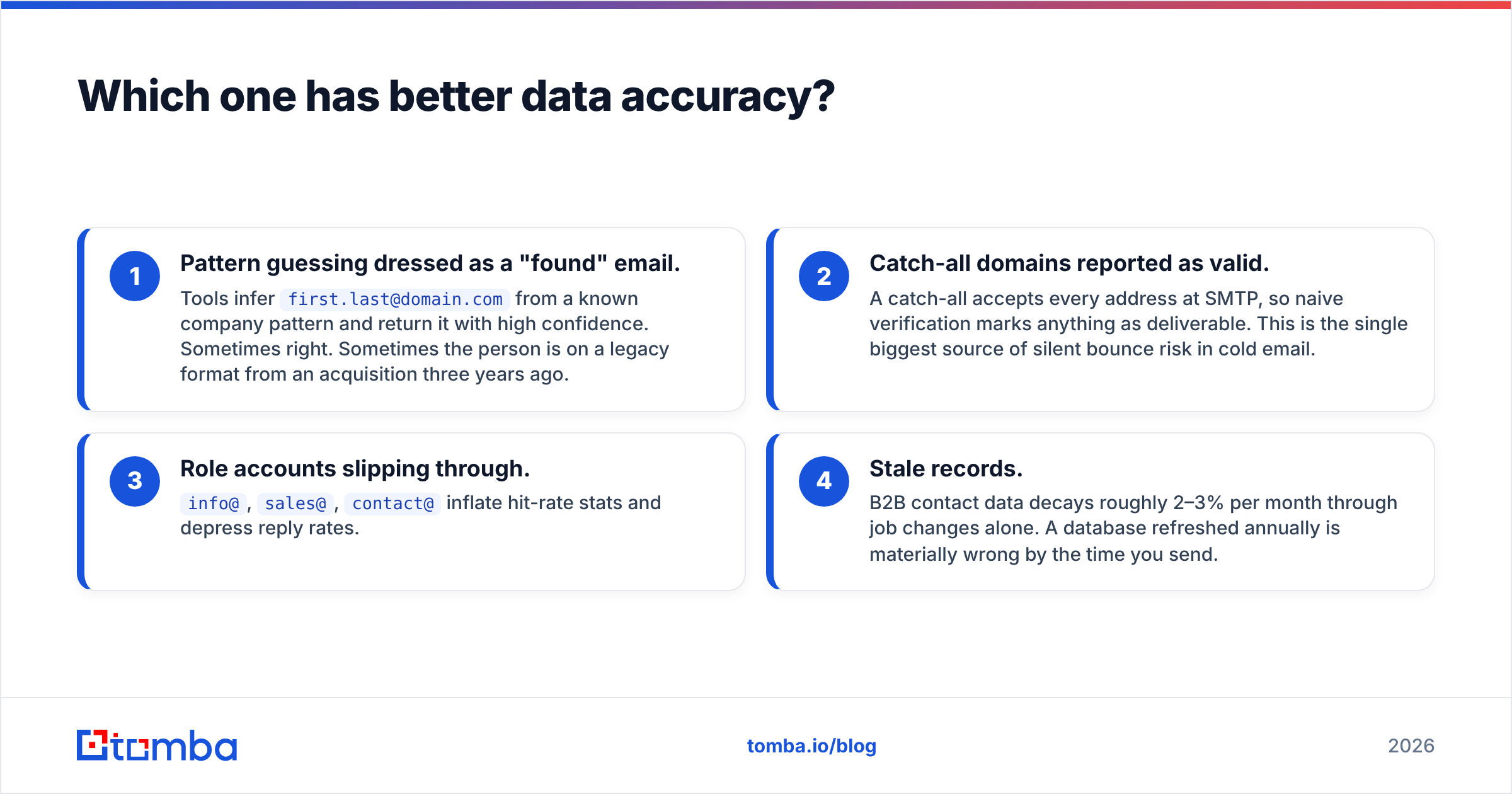
Here is the side-by-side, with Tomba included as the third reference point most buyers end up evaluating anyway.
| Attribute | Kaspr | Revli | Tomba |
|---|---|---|---|
| Primary data type | Mobile + direct dial phones | Business emails | Business emails + phones |
| Core interface | LinkedIn Chrome extension | Web app + bulk upload | Web app, API, extension, Sheets/Excel |
| Free tier | Limited credits, phone credits gated | Free allowance, feature-limited | 25 searches/mo |
| Entry paid plan | Roughly €45–€49 per user/mo | Low-cost, typically sub-$40 | $49/mo (Starter) |
| Mid tier | ~€79–€99 per user/mo | Varies by credit pack | $99/mo (Growth) |
| Seat-based pricing | Yes — cost scales per rep | Mostly credit-based | Credit-based, no per-seat penalty |
| Built-in email verification | Basic | Basic | Full verifier + catch-all handling |
| Catch-all domain handling | Limited | Limited | Dedicated catch-all verifier |
| Bulk enrichment | Yes, with plan caps | Yes, on paid packs | Yes, bulk finder and verifier |
| Public API | Available on higher plans | Limited | Full REST API on all paid plans |
| Strongest region | EMEA (especially France, UK) | Broad but thinner | Global, strong on domain patterns |

The table hides one cost that shows up on the invoice: seat pricing. Kaspr charges per user. Three SDRs on a mid plan is roughly triple a one-rep quote. Revli and Tomba both lean credit-based, which means a five-person team can share one pool. For a small team that difference can be larger than any per-credit price gap you were optimizing for.
The second hidden cost is credit definitions. "Credit" does not mean the same thing across these tools. On Kaspr, a phone credit and an email credit usually come from separate buckets. You can run out of phones while still holding email credits, or the other way round. On credit-based email tools, a failed search may or may not burn a credit. Ask that question during a trial. It changes real cost by 20–40%.
Which one has better data accuracy?#
Different answer per data type, which is exactly why the head-to-head is awkward.
On phone numbers, Kaspr wins and it is not close. Revli is not really competing there. If your team dials, Kaspr's EMEA mobile coverage is the reason to buy it. User reviews on G2 praise European mobile hit rates. The same reviews flag thinner US coverage and stale numbers.
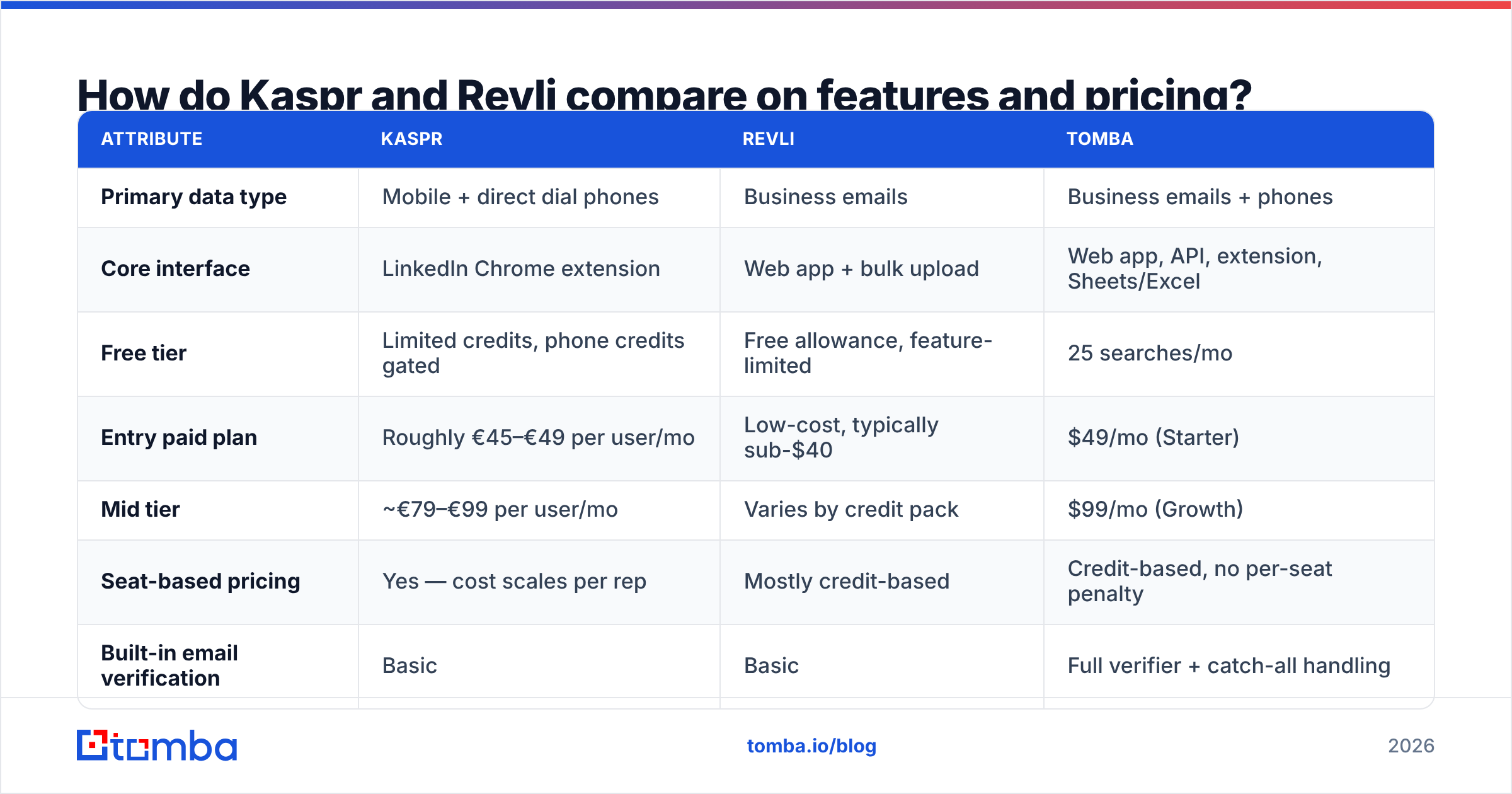
On emails, the picture is muddier. Both tools return addresses from a mix of pattern inference, public sources and contributed data. The failure modes are the same across the category:
- Pattern guessing dressed as a "found" email. Tools infer
first.last@domain.comfrom a known company pattern and return it with high confidence. Sometimes right. Sometimes the person is on a legacy format from an acquisition three years ago. - Catch-all domains reported as valid. A catch-all accepts every address at SMTP, so naive verification marks anything as deliverable. This is the single biggest source of silent bounce risk in cold email.
- Role accounts slipping through.
info@,sales@,contact@inflate hit-rate stats and depress reply rates. - Stale records. B2B contact data decays roughly 2–3% per month through job changes alone. A database refreshed annually is materially wrong by the time you send.

The practical takeaway: do not trust any single vendor's accuracy claim, including the one on this chart. Run the same 100 real prospects through both trials. Push every result through an independent email verifier. Count only the addresses that come back deliverable. That number — verified addresses per dollar — is the only benchmark that predicts your bounce rate.
Pay particular attention to how each tool handles catch-alls. Most finders punt and label them "accept-all, risky." A catch-all verifier that actually resolves those addresses changes the economics on enterprise domains, where catch-all configurations are common.
Do you actually need phone numbers?#
This is the fork in the road, and most buyers skip it.
Buy Kaspr if at least one of these is true:
- Your sequence includes real dials, not just "call task" theater that never gets worked.
- You sell into France, the UK, Germany or Benelux, where Kaspr's mobile coverage is strongest.
- Your reps live inside LinkedIn and want data at the point of research, not in a CSV.
- Your ACV justifies per-seat licensing — roughly, if a single closed deal covers a year of seats, the math is easy.
Skip the phone layer if:
- Your channel is email plus LinkedIn messaging, and calls are aspirational.
- You are running volume outbound where per-contact cost matters more than per-contact depth.
- You are in a market with strict cold-calling rules and no compliance process to back it up.
That last point deserves a line. Phone data carries heavier legal weight than business email in most countries. EU prospects have GDPR notification rights, and Kaspr does email contacts in some regions to tell them. Buyers who skipped the compliance docs find that surprising. It is Kaspr doing the right thing, not a defect, but plan for it.
If you need numbers without the LinkedIn-extension workflow or the per-seat model, a standalone phone finder slots into an email-led stack more cleanly than buying a phone-first platform and using 20% of it.
How do credits and export limits differ?#
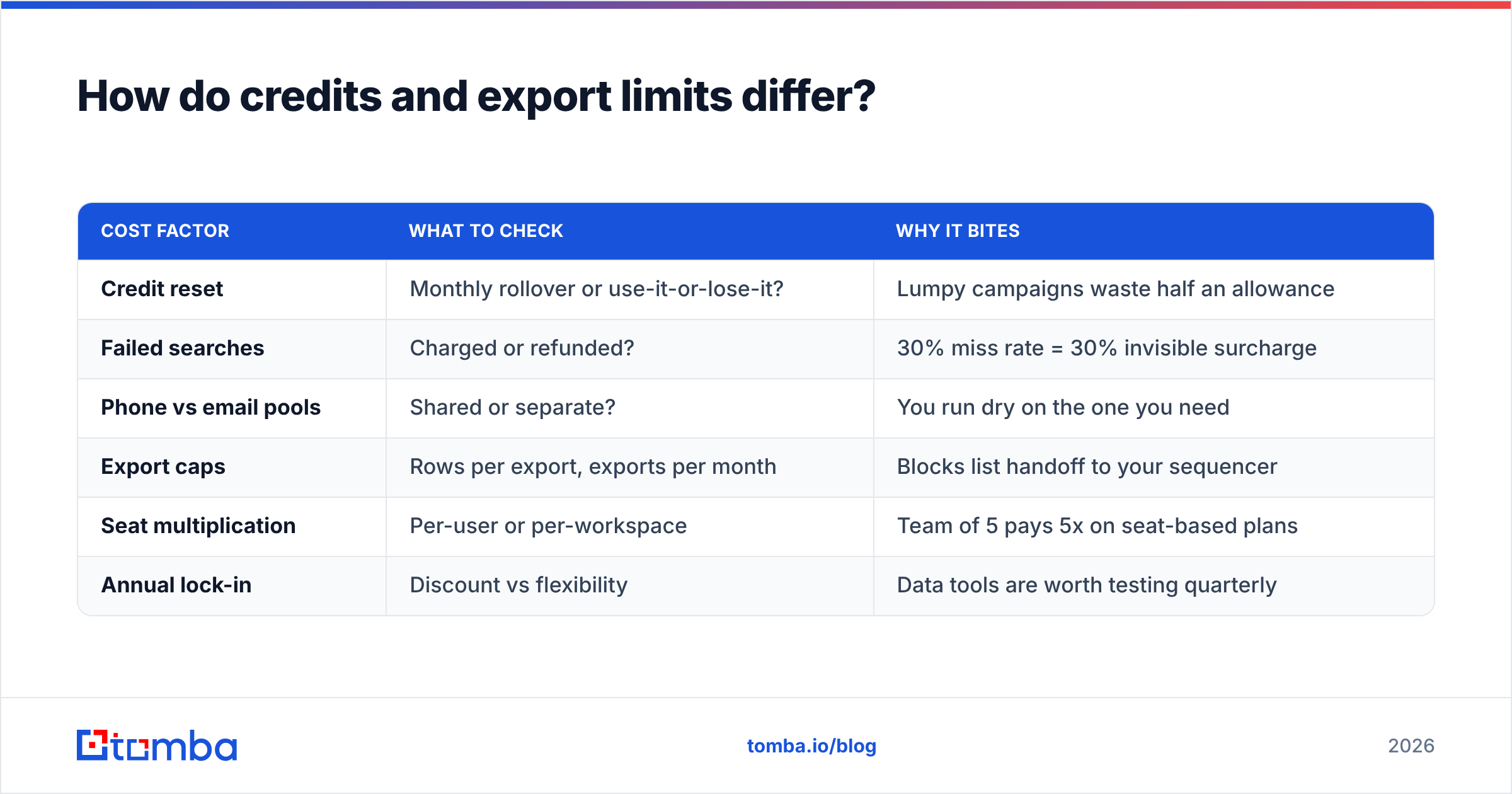
Credits are where these tools quietly diverge from their advertised price.
| Cost factor | What to check | Why it bites |
|---|---|---|
| Credit reset | Monthly rollover or use-it-or-lose-it? | Lumpy campaigns waste half an allowance |
| Failed searches | Charged or refunded? | 30% miss rate = 30% invisible surcharge |
| Phone vs email pools | Shared or separate? | You run dry on the one you need |
| Export caps | Rows per export, exports per month | Blocks list handoff to your sequencer |
| Seat multiplication | Per-user or per-workspace | Team of 5 pays 5x on seat-based plans |
| Annual lock-in | Discount vs flexibility | Data tools are worth testing quarterly |
Kaspr ties export volume and API access to higher tiers. That is normal for the category, but it means the entry plan is genuinely an entry plan: fine for one rep researching, awkward for building a 5,000-row list. Revli's credit packs are easier to reason about. They are also thinner on enrichment fields, so you often run a second pass elsewhere to fill company size, tech stack or role data.
If bulk is your actual workflow — upload a list of names and domains, get verified addresses back — check the bulk email finder style workflow in every trial. Doing 4,000 lookups one profile at a time through a browser extension is not a workflow, it is a punishment.

Which should you pick for your use case?#
Kaspr vs Revli lands differently depending on who is buying. Five scenarios, five honest answers. First, the three most common:
- Outbound SDR team dialing EMEA prospects. Kaspr. The mobile coverage is the product, and nothing in Revli's lineup replaces it. Budget for per-seat cost and a separate verification step for the emails it returns.
- Solo founder or freelancer needing a few hundred emails a month. Revli, or a free tier elsewhere. Do not pay seat-based pricing for a workflow that fits inside a free allowance. Spend the savings on verification instead.
- Agency running multi-client cold email at volume. Neither, as a primary. You need credit-based pricing, a real API, catch-all handling and clean bulk exports. A dedicated email finder plus verifier stack is the better fit, with Kaspr added later only if a client demands dials.
Two more that come up often:
- RevOps enriching an existing CRM. Look at API depth, not extension UX. Extensions do not enrich 40,000 stale records. Check rate limits, field coverage and whether the vendor bills for null returns.
- Sourcing contacts from LinkedIn specifically. Both touch this, from different angles. Kaspr is the profile-by-profile research tool. A dedicated LinkedIn finder fits better when you are turning exported LinkedIn lists into verified, sendable addresses at scale.
What are the best Kaspr and Revli alternatives?#
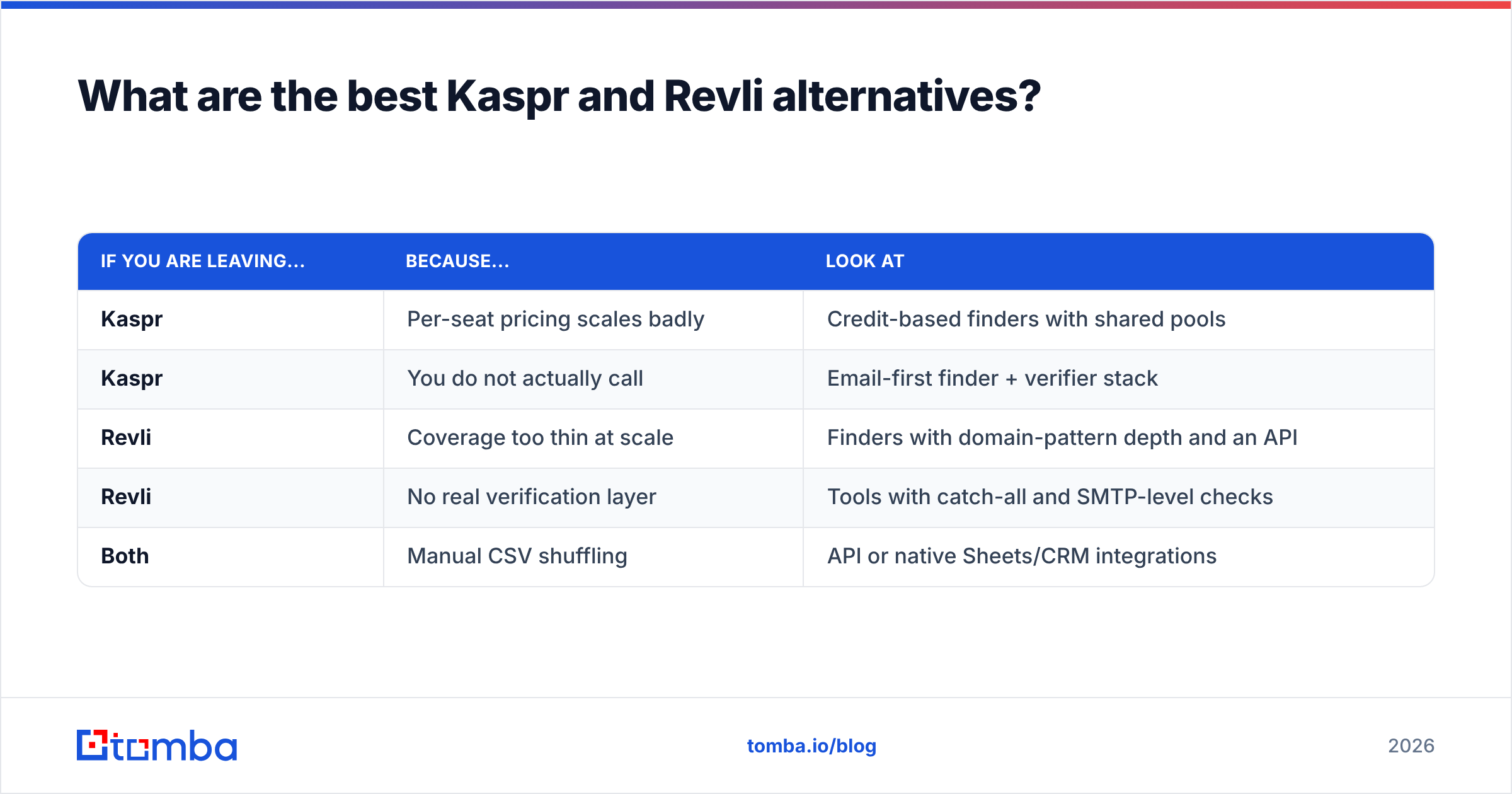
Neither side of the Kaspr vs Revli matchup is your only option. The category is crowded, and "alternative" means different things depending on which half you are replacing.
| If you are leaving... | Because... | Look at |
|---|---|---|
| Kaspr | Per-seat pricing scales badly | Credit-based finders with shared pools |
| Kaspr | You do not actually call | Email-first finder + verifier stack |
| Revli | Coverage too thin at scale | Finders with domain-pattern depth and an API |
| Revli | No real verification layer | Tools with catch-all and SMTP-level checks |
| Both | Manual CSV shuffling | API or native Sheets/CRM integrations |
Two things worth checking in any replacement. First, verification quality, because a finder that returns more addresses at a worse deliverability rate is a downgrade wearing a growth chart. Second, integration surface — an email finder API, a Sheets add-on or a CRM sync removes the CSV round-trip that eats an hour a week per rep.
If cost transparency is what pushed you to compare in the first place, put all three plans side by side: Kaspr per seat, Revli per credit pack, and Tomba pricing at $49/mo Starter, $99/mo Growth and $249/mo Pro with no per-seat tax. Model it at your real team size, not at one user.
So which one wins?#
Kaspr vs Revli comes down to one question: dials or sends?
Kaspr wins if you dial European prospects. Nothing in this comparison changes that. It is a focused tool that does one hard thing well, and the per-seat price is defensible when calls close deals.
Revli wins if your requirement is "a few hundred emails, cheaply, this month." It is honest about being a budget option and it does not pretend to be a platform.
Neither wins if your actual job is sending verified cold email at volume. That workload needs pattern-level domain coverage, catch-all resolution, real bulk processing and an API. It needs those things without paying for a phone database you touch twice a quarter.
Run the 100-prospect test. Count verified deliverable addresses, not raw hits. Then buy the tool that wins that count at your team size.
Ready to test it against your own list? Run the same 100 prospects through the Tomba Email Finder — 25 free searches, no card, and every result flows straight into the verifier so you see deliverable addresses instead of optimistic guesses. If it does not beat your current hit rate on your own data, you will know in ten minutes.
Related guides#
// get started
Find, verify and enrich your first contacts today
Start on the free plan with 25 searches a month, then scale when your team is ready.
Free plan · No credit card required · GDPR & CCPA
// about the author