Kaspr vs Salesgenie: Which B2B Data Tool Wins in 2026?
Kaspr sells LinkedIn-sourced mobile numbers. Salesgenie sells a 40-year US business file. They barely compete on the same ground — here's which one actually fits your pipeline, and what both cost.
Kaspr vs Salesgenie is an odd matchup. One tool finds a person. The other finds a market. Here is how to tell which one your team needs.
TL;DR
- Kaspr is a LinkedIn-first contact finder. You open a profile, it shows mobile numbers and emails. Great for SDRs who live in Sales Navigator. Weak once you step off LinkedIn.
- Salesgenie (Data Axle) is the opposite. It is a 40-year US business file you search by SIC code, revenue, and location. Great for local and SMB territory work. Weak on job titles and tech personas.
- They are not real substitutes. Kaspr answers "how do I reach this person?" Salesgenie answers "who exists in this market?"
- Price is the real fork. Kaspr's usable tier runs about €65/mo per user with credit caps. Salesgenie starts near $149–$299/mo, sold on annual contracts with seat minimums.
- Need verified work emails by domain instead? A dedicated email finder at $49/mo does that job for less than either tool.
What is Kaspr and who actually uses it?#
Kaspr is a browser extension and web app. It pulls contact data off LinkedIn profiles. You open a profile or a Sales Navigator list, click the Kaspr widget, and it returns phone numbers, email addresses, and basic company data. Mobile numbers are its headline claim. Cognism bought it in 2022, which gave it a bigger pool of verified phones.
The typical user is an SDR or founder doing LinkedIn outbound in Europe. You work profile by profile, or list by list. The output is a contact record you push into a CRM or a sequencer. Kaspr's own product site leans hard on mobile coverage and GDPR. That tells you the buyer they have in mind: EU teams that want to cold call without paying for a full Cognism contract.
What Kaspr does not do well: it is near useless if your prospects skip LinkedIn. It also cannot build a list of every HVAC contractor in Ohio. It reveals contacts. It is not a database you search from scratch.
What is Salesgenie and where does its data come from?#
Salesgenie is the SMB-facing front end for Data Axle, once called Infogroup. Data Axle is one of the oldest compiled-data firms in the US. The file goes back to the 1970s, when staff keyed in Yellow Pages listings and checked them by phone. Today it claims tens of millions of US business records and hundreds of millions of consumer records. Updates come from phone checks, public filings, and postal data.
The Salesgenie app is a list builder. You filter by industry code, employee count, sales volume, years in business, ZIP radius, credit rating, and more. Then you export or push to a CRM. It also bundles direct-mail and email-campaign tools. That matters, because many of its users are insurance agents, home services, and local B2C firms — not SaaS teams.
Its real strength is coverage of businesses with no web presence worth scraping. If you sell to independent pharmacies, auto shops, or regional manufacturers, a compiled file beats a LinkedIn scraper every time. Its real weakness is the contact itself. The named person is often the owner or a generic office manager. Title targeting for modern roles like Head of RevOps or VP Demand Gen is thin to nonexistent.
Kaspr vs Salesgenie: how do they compare head to head?#
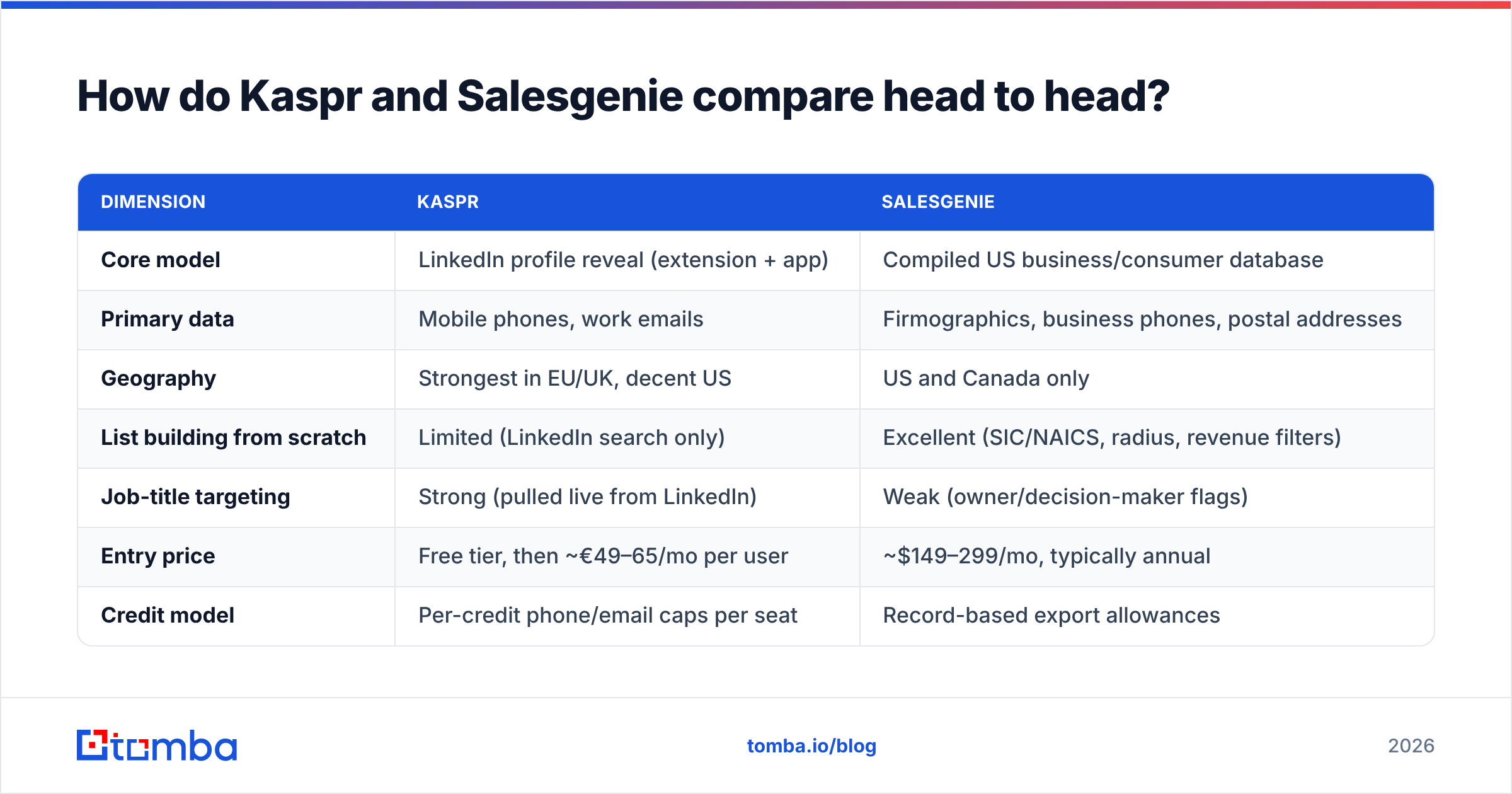
Here is the practical breakdown. Prices reflect listed 2026 rates. Both vendors negotiate, and Salesgenie quotes rather than publishes above the entry tier.
| Dimension | Kaspr | Salesgenie |
|---|---|---|
| Core model | LinkedIn profile reveal (extension + app) | Compiled US business/consumer database |
| Primary data | Mobile phones, work emails | Firmographics, business phones, postal addresses |
| Geography | Strongest in EU/UK, decent US | US and Canada only |
| List building from scratch | Limited (LinkedIn search only) | Excellent (SIC/NAICS, radius, revenue filters) |
| Job-title targeting | Strong (pulled live from LinkedIn) | Weak (owner/decision-maker flags) |
| Entry price | Free tier, then ~€49–65/mo per user | ~$149–299/mo, typically annual |
| Credit model | Per-credit phone/email caps per seat | Record-based export allowances |
| Bundled outreach | Basic sequences | Email + direct mail campaigns |
| Best-fit buyer | EU SDR doing LinkedIn-led cold calling | US rep selling to local/SMB businesses |
| Worst-fit scenario | Prospects not on LinkedIn | Modern tech/SaaS persona targeting |
Read that table as a fork, not a scoreboard. Almost no buyer has both tools on a real shortlist. If you are weighing Kaspr vs Salesgenie side by side, your ICP is probably still fuzzy. Nail that first. One column then rules itself out.
Which one has better data accuracy?#
The two tools fail in different ways. So "better" depends on what you measure.
Kaspr's issue is freshness and match rate. It reads a live LinkedIn profile, so the job title and company are usually current. Users update themselves. The risk sits in the phone and email lookup. Coverage swings by region and seniority. EU mid-market contacts resolve well. US enterprise VPs resolve less often, and so does anyone in a privacy-heavy market. Expect real mobile hit rates well below the marketing number outside Western Europe.
Salesgenie's issue is decay and specificity. The business data is genuinely good. Data Axle has spent decades checking that a company still trades. But the named contact attached to that record may be years stale. The email on file is often a generic info@ or a role account, not a person. For a direct-mail drop, that is fine. For a cold email sequence, it is a problem. Generic inboxes kill your reply rate and push up your bounce rate.
That second point burns most teams. Run any list — from either tool — through an email verifier before it touches a sending domain. A 12% bounce rate on a compiled list will damage your sender reputation faster than any subject line can save it.
What do they actually cost in 2026?#
Kaspr publishes its tiers. There is a free plan with a handful of credits, a paid single-user tier around €49–65/mo, and a business tier with bulk enrichment and integrations. The catch is the credit structure. Phone, email, and export credits are metered on their own, and heavy users hit caps mid-month. Multi-seat teams land on an annual per-seat deal that looks a lot like a small Cognism contract.
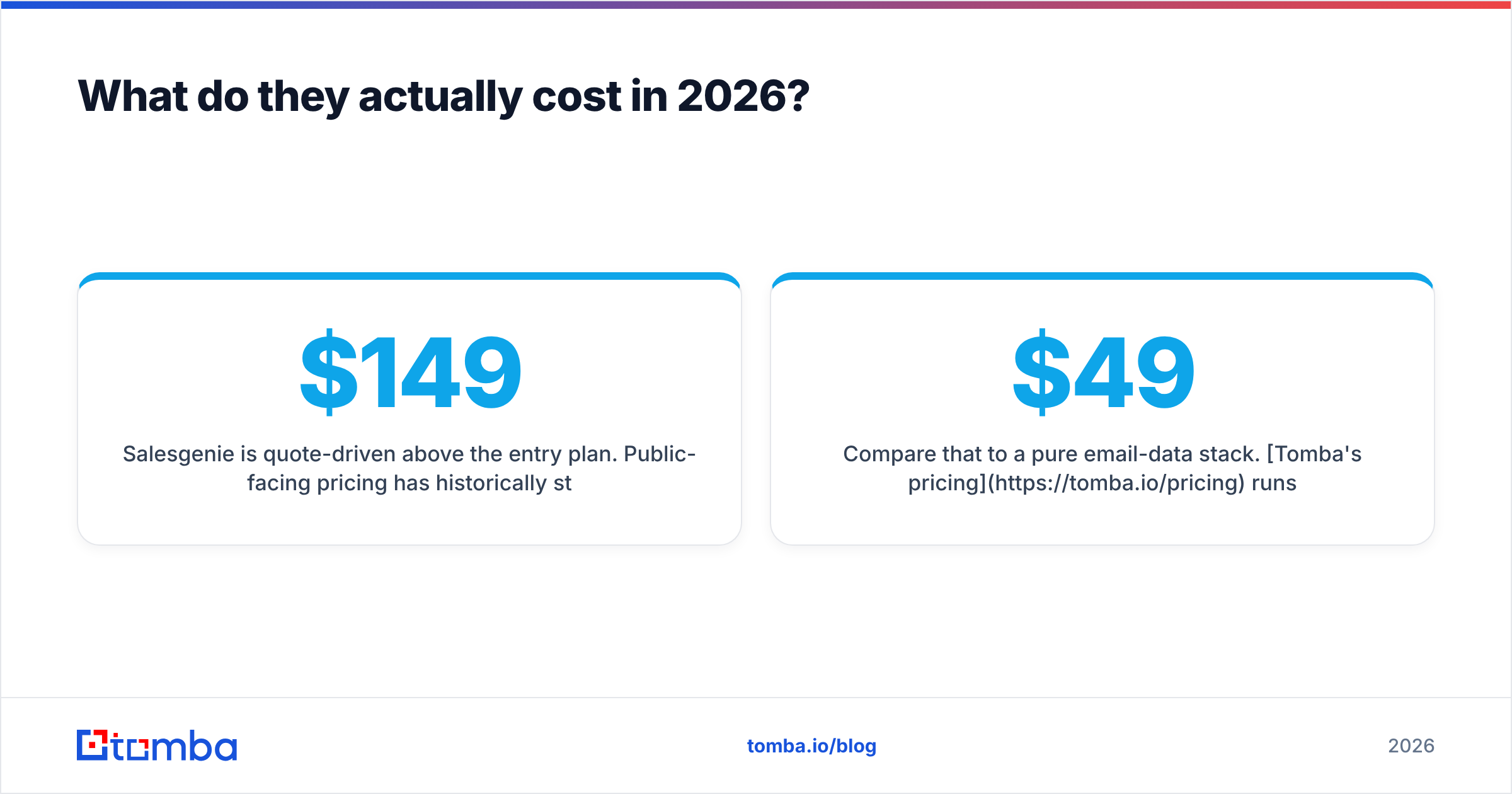
Salesgenie is quote-driven above the entry plan. Public pricing has started near $149/mo for a limited-lead plan. It climbs past $299/mo for more exports and more users. Annual terms are the norm, and lead allowances reset instead of rolling over. Reviews on G2 flag the same friction: the contract is easy to sign and hard to resize mid-term.
Now compare a pure email stack. Tomba's pricing is free for 25 searches/mo, $49/mo on Starter, $99/mo on Growth, and $249/mo on Pro. Every plan includes the finder, the verifier, and domain search, with no separate credit buckets. If email is 90% of your outbound mix, Kaspr vs Salesgenie is a choice between two tools you will only half use.

When should you pick something else entirely?#
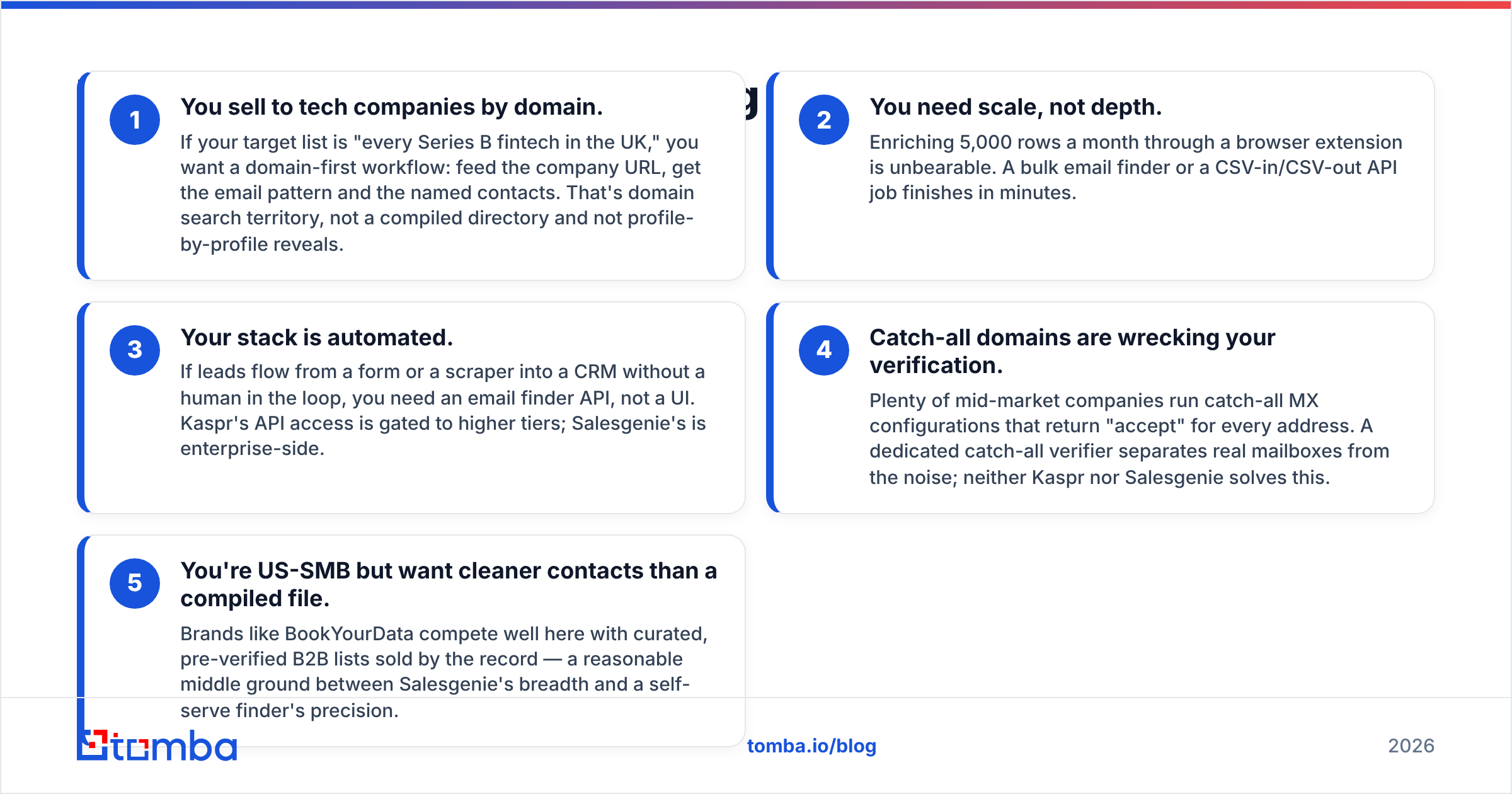
Five cases where neither tool is the right buy:
- You sell to tech companies by domain. If your list is "every Series B fintech in the UK," you want a domain-first flow. Feed the company URL, get the email pattern and the named contacts. That is domain search work, not a compiled directory and not one profile at a time.
- You need scale, not depth. Enriching 5,000 rows a month through a browser extension is brutal. A bulk email finder or a CSV-in, CSV-out API job finishes in minutes.
- Your stack is automated. If leads flow from a form or a scraper into a CRM with no human in the loop, you need an email finder API, not a UI. Kaspr gates API access to higher tiers. Salesgenie keeps it enterprise-side.
- Catch-all domains are wrecking your verification. Plenty of mid-market firms run catch-all MX records that accept every address. A catch-all verifier sorts real mailboxes from the noise. Neither tool here solves that.
- You are US-SMB but want cleaner contacts than a compiled file. Brands like BookYourData sell curated, pre-verified B2B lists by the record. That is a fair middle ground between Salesgenie's breadth and a self-serve finder's precision.
How do the integrations and workflows differ?#
Kaspr's integrations are SDR shaped: HubSpot, Pipedrive, Salesforce, Lemlist, and Zapier. The extension is the capture point. The model is simple — reveal, enrich, push, sequence. It sits next to a sequencer and a CRM, and it is close to useless without both.
Salesgenie's integrations are campaign shaped. It exports to CSV, pushes to a few CRMs, and will even run direct mail for you. Picture a local insurance agency sending a postcard drop to a ZIP-radius list. That is the Salesgenie motion. It is a marketing platform that happens to own a database.
Neither is built to sit in a data pipeline. If you want contact data flowing into a warehouse, a sheet, or an enrichment job, pick tools shaped for that: a HubSpot integration for CRM sync, a Sheets email finder for analysts who live in spreadsheets, or direct API calls for engineering-owned pipelines.
One note that saves money. Whatever you buy, do not spend it on the easy 40% of your list. Known domains with clear patterns (firstname.lastname@, f.lastname@) can be inferred and verified for a fraction of a premium credit. Save the pricey reveals for the contacts that resist.
Is Kaspr better than Salesgenie?#
For modern B2B software sales, yes. Kaspr is the more useful tool, because job-title precision and current employment data beat firmographic breadth when your ICP is a role.
For local and services-led selling in the US, no. Salesgenie wins, because those prospects do not maintain LinkedIn profiles and you cannot find those businesses any other way.
The tiebreakers, in order:
- Is your ICP a job title or a business type? Title → Kaspr. Business type → Salesgenie.
- Is your main channel phone, or mail and email? Phone → Kaspr. Mail → Salesgenie. Email → probably neither.
- Do you need Europe? Salesgenie is out. It covers the US and Canada only.
- Is your volume above ~2,000 contacts a month? Both get costly fast. Look at API-priced options.
One honest caveat on both. Compiled and scraped data decay. Industry benchmarks from firms like Gartner put B2B contact decay at roughly 25–30% a year, and job-change rates in tech run higher. Whatever you buy, budget for re-verification. A list is not a durable asset.
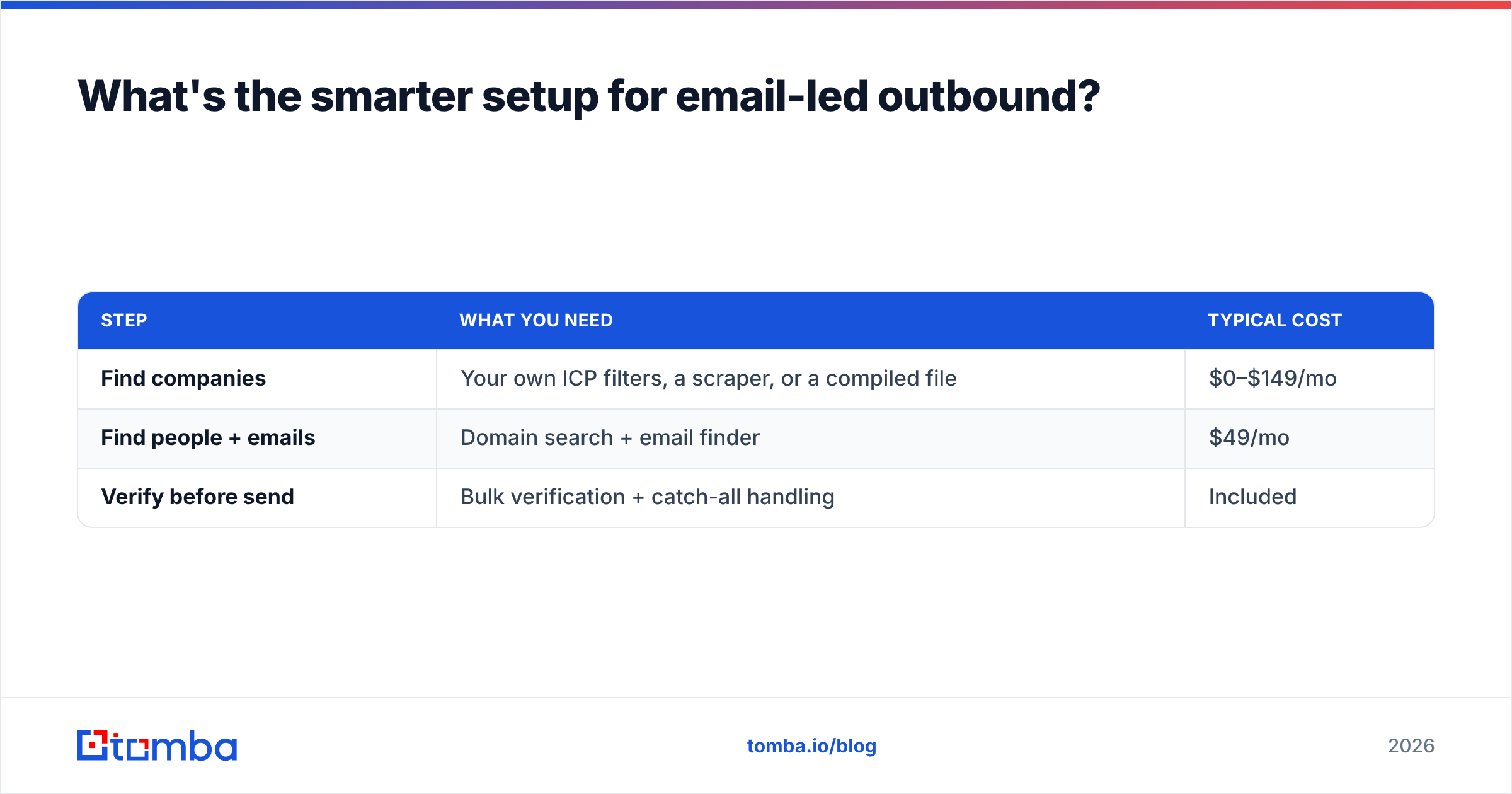
What's the smarter setup for email-led outbound?#
Split the job into three cheap steps instead of one big subscription.
| Step | What you need | Typical cost |
|---|---|---|
| Find companies | Your own ICP filters, a scraper, or a compiled file | $0–$149/mo |
| Find people + emails | Domain search + email finder | $49/mo |
| Verify before send | Bulk verification + catch-all handling | Included |
That stack covers most B2B outbound at a fraction of an annual data contract. You only need Kaspr when dialing mobiles is core to your process. You only need Salesgenie when your market is offline SMBs in North America.
If email is your channel, start with the Tomba Email Finder. Feed it a domain, a name, or a company, and get verified professional addresses back. The verifier, domain search, and catch-all checks come in the same plan. The free tier gives you 25 searches a month, so you can test your own ICP list first. Starter is $49/mo with no annual lock-in. Run 50 real target accounts through it. Then compare the hit rate with whatever quote is sitting in your inbox.
Related guides#
// get started
Find, verify and enrich your first contacts today
Start on the free plan with 25 searches a month, then scale when your team is ready.
Free plan · No credit card required · GDPR & CCPA
Get the Tomba newsletter
Product and data updates
// about the author