Kaspr vs SignalHire 2026: Which B2B Contact Tool Wins?
Kaspr leans hard on LinkedIn phone numbers. SignalHire spreads across 100+ sources. We break down coverage, pricing, GDPR posture, and which one actually belongs in your stack in 2026.
TL;DR
- Kaspr is a LinkedIn-first contact revealer built for SDRs who live in Sales Navigator and want mobile numbers fast. Its strength is European mobile coverage; its weakness is that it barely exists outside the LinkedIn tab.
- SignalHire is a broader contact-search engine — LinkedIn extension plus its own searchable database of 800M+ profiles — with better global spread but noisier phone data.
- On email accuracy, both sit in the acceptable-but-not-great band. Neither is a dedicated verification engine, so you will still bounce-check before you send.
- Pricing: Kaspr's paid entry is roughly €65/user/month (~$71) billed annually; SignalHire starts around $49/month for 350 credits. Credit mechanics differ enough that headline prices mislead.
- Verdict: pick Kaspr if your motion is cold calling European prospects off LinkedIn. Pick SignalHire if you need multi-region contacts, ATS-style recruiting search, or a bulk CSV workflow. If what you actually need is verified work emails at domain scale, neither is the cheapest path — a dedicated email finder is.
What is Kaspr and who is it built for?#
Kaspr is a Chrome extension and web app that surfaces phone numbers and email addresses for LinkedIn profiles. You open a profile or a Sales Navigator list, the widget fires, and you get contact details plus a lightweight lead-management layer (lists, notes, tasks, one-click CRM push).
Kaspr was acquired by Cognism in 2022, which matters more than most comparison posts admit. The acquisition gave Kaspr access to Cognism's compliance infrastructure and, in practice, a slice of its phone-verified dataset. That is why Kaspr punches above its weight on EMEA mobile numbers — it is riding a parent company built specifically around GDPR-compliant European B2B data and DNC-list screening.
The design assumption is narrow and deliberate: you are an SDR, you are on LinkedIn, you want to dial someone today. Everything else — enrichment, TAM building, API workflows — is secondary or absent.
Where Kaspr gets uncomfortable:
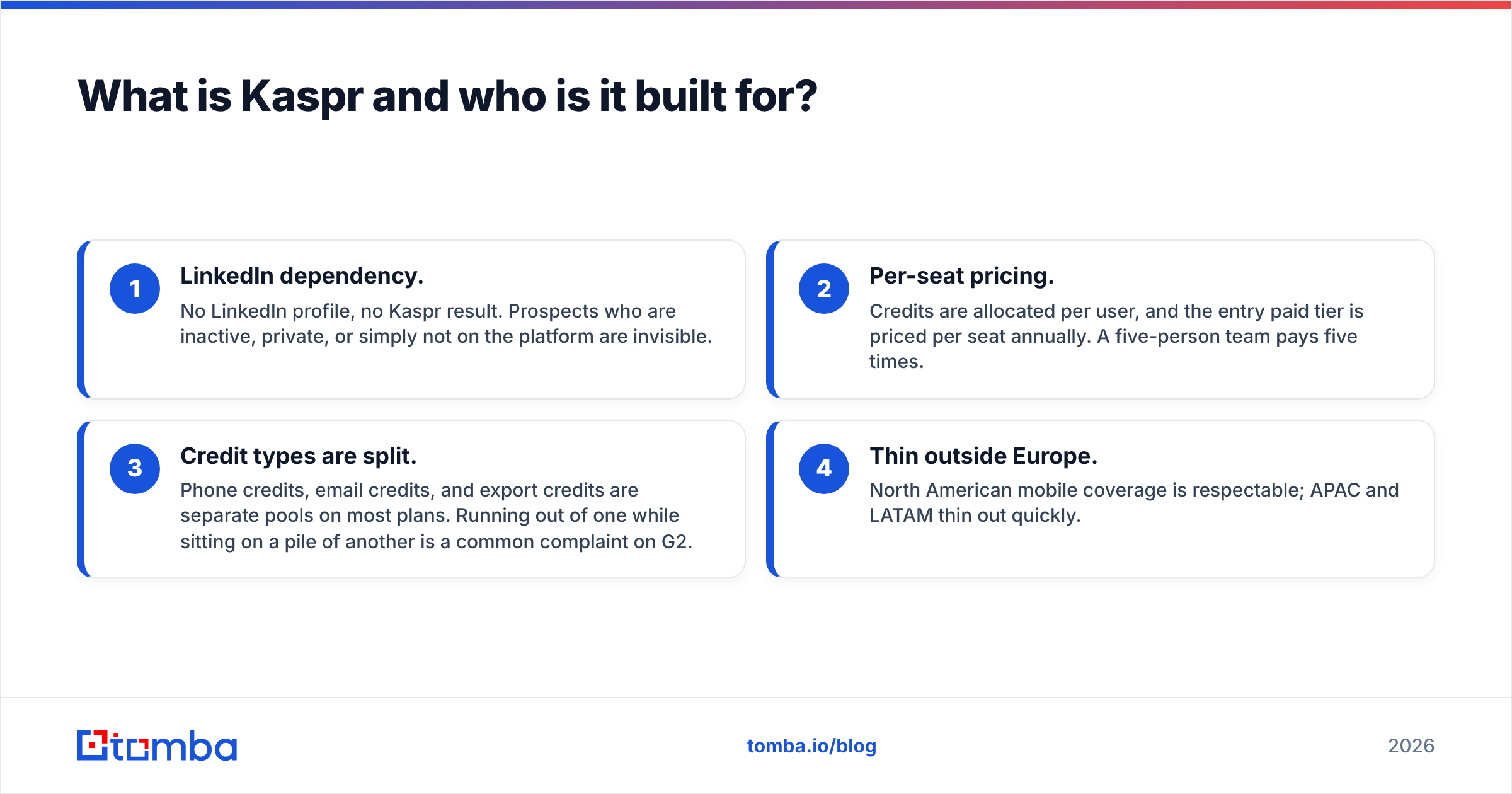
- LinkedIn dependency. No LinkedIn profile, no Kaspr result. Prospects who are inactive, private, or simply not on the platform are invisible.
- Per-seat pricing. Credits are allocated per user, and the entry paid tier is priced per seat annually. A five-person team pays five times.
- Credit types are split. Phone credits, email credits, and export credits are separate pools on most plans. Running out of one while sitting on a pile of another is a common complaint on G2.
- Thin outside Europe. North American mobile coverage is respectable; APAC and LATAM thin out quickly.
What is SignalHire and how is it different?#
SignalHire is a contact-finding platform with a much wider surface area. It has a browser extension (LinkedIn, GitHub, Facebook, Xing, Dribbble, and more), a searchable internal database it claims exceeds 800 million profiles, a bulk CSV enrichment flow, and an API.
Its origin story is recruiting, not sales. SignalHire started as a sourcing tool for talent acquisition, and the product still shows it — boolean-ish filters, candidate-style profile cards, and an ATS-friendly export structure. Sales teams adopted it because contact data is contact data, but the DNA is recruitment sourcing.
That origin produces a genuinely different trade-off versus Kaspr:
- Broader source pool. SignalHire aggregates from many public and partner sources, so it finds people Kaspr cannot see — developers with a GitHub presence but a dead LinkedIn, for example.
- Standalone search. You do not need a LinkedIn tab open. You can search the database directly by name, company, title, or location.
- Weaker phone confidence. More sources means more stale rows. SignalHire returns numbers frequently, but the hit-to-connect ratio is where users complain.

How do Kaspr and SignalHire compare head-to-head?#
Here is the side-by-side that actually matters when you are deciding. Figures reflect publicly listed pricing and vendor claims as of early 2026 — always re-check before you buy, since both vendors adjust credit bundles frequently.
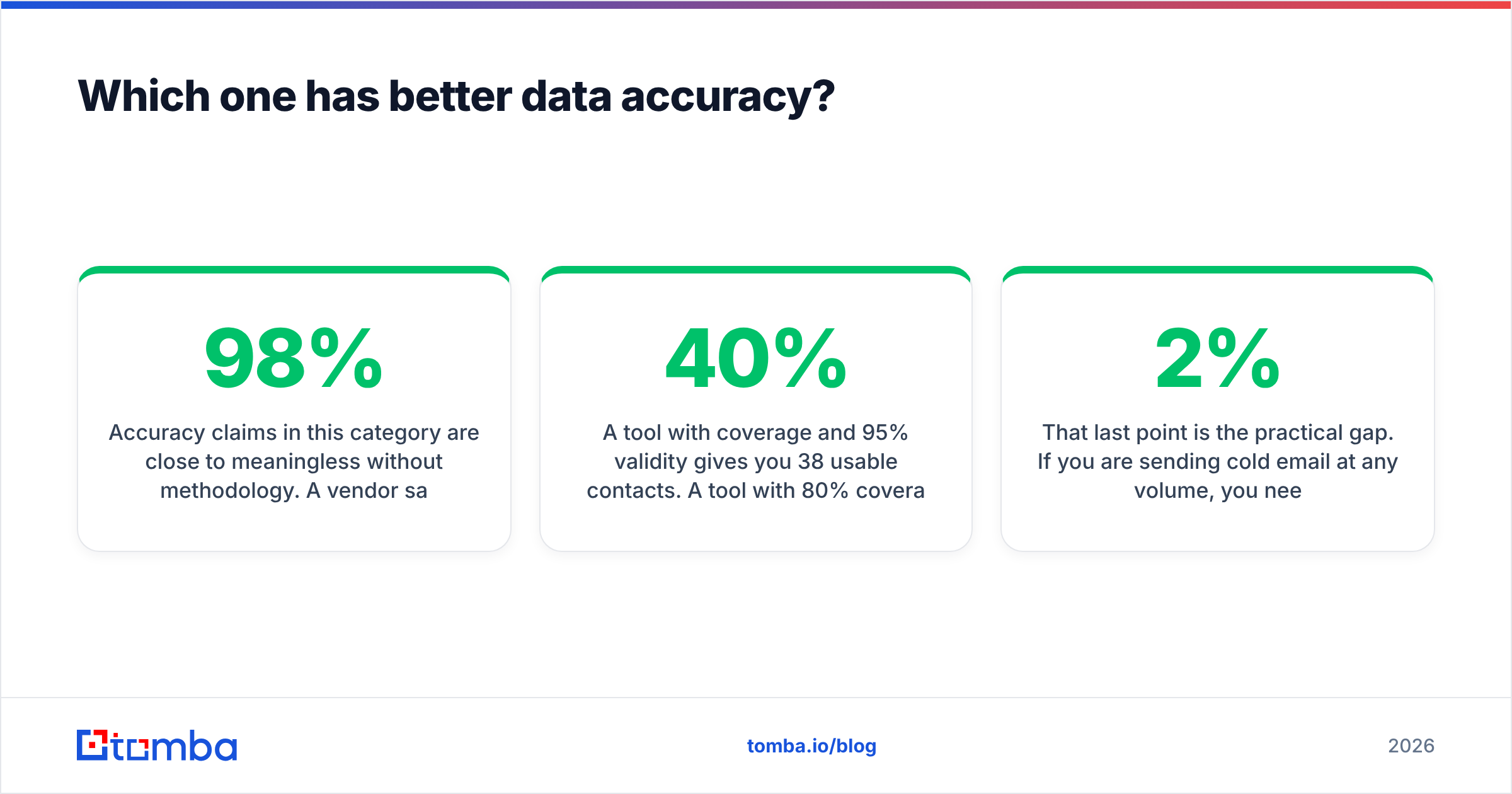
| Attribute | Kaspr | SignalHire |
|---|---|---|
| Primary use case | LinkedIn-based SDR prospecting, cold calling | Multi-source contact search, recruiting + sales |
| Database size (claimed) | ~500M profiles, 150M+ phone numbers | 800M+ profiles |
| Free tier | Yes — limited credits, LinkedIn-only, requires verified account | Yes — 5 credits/month trial-style |
| Entry paid price | ~$49/mo for 350 credits | |
| Credit model | Split pools: phone / email / export | Single credit pool, tiered volume discounts |
| Phone number strength | Strong in EMEA, good in NA | Wide but inconsistent |
| Email finding | Solid on LinkedIn-sourced profiles | Broad coverage, more catch-alls |
| Works without LinkedIn | No | Yes — native database search |
| Bulk CSV enrichment | Limited | Yes |
| API access | Available on higher tiers | Yes, all paid tiers |
| Native CRM integrations | HubSpot, Pipedrive, Salesforce, Lemlist, Aircall | HubSpot, Recruiter-focused ATS, Zapier |
| Recruiting features | None | Yes — candidate profiles, ATS export |
| GDPR posture | Strong (Cognism-backed, notification emails, DNC screening) | Standard opt-out compliance |
| Best for | European outbound calling teams | Global sourcing and recruiting |
Read that table twice before you read another review. The interesting rows are not the database sizes — every vendor inflates those — but credit model, works without LinkedIn, and GDPR posture. Those three determine whether the tool survives contact with your actual workflow.
Which one has better data accuracy?#
Short answer: Kaspr wins on phone numbers in Europe, SignalHire wins on raw coverage breadth, and neither wins on email verification.
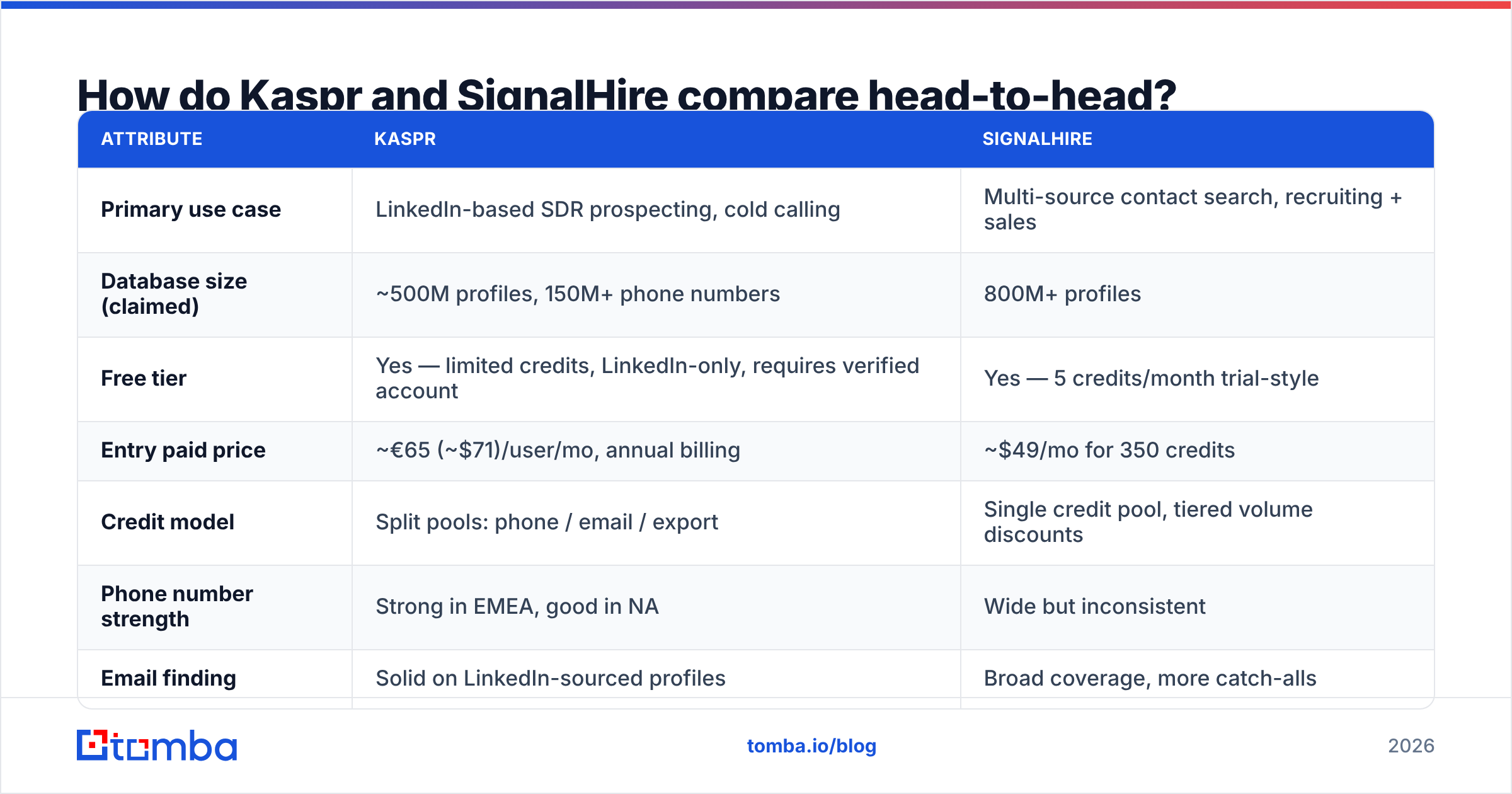
Accuracy claims in this category are close to meaningless without methodology. A vendor saying "98% accurate" usually means "98% of the records we chose to return passed our own internal check" — which quietly excludes every lookup that returned nothing. The honest metric is a two-part one:
- Coverage rate — of 100 target prospects, how many produce any contact detail?
- Validity rate — of those hits, how many are correct and currently in use?
A tool with 40% coverage and 95% validity gives you 38 usable contacts. A tool with 80% coverage and 60% validity gives you 48. The second wins on volume but burns more credits and more sender reputation. Run your own 100-row test list against both before committing to an annual contract; it costs you an afternoon and saves you a year of regret.
What field reports consistently suggest:
- Kaspr mobile numbers in France, UK, Germany, Netherlands, Spain: among the best available at this price. This is the Cognism inheritance.
- SignalHire coverage of non-LinkedIn-active profiles: genuinely useful, especially for technical roles.
- Both on email: expect meaningful catch-all and role-account noise. Neither surfaces a confidence score granular enough to segment a send list.
That last point is the practical gap. If you are sending cold email at any volume, you need a verification layer regardless of which tool you choose. Running results through an email verifier before they hit your sequencer is not optional — it is the difference between a 2% bounce rate and a burned domain. Pay attention to email deliverability mechanics here; Google and Yahoo's bulk-sender enforcement means a sustained bounce rate above 3% is now an existential risk, not a metric.
Catch-all domains deserve their own mention. Both tools will hand you addresses at domains that accept everything, which means an SMTP check returns "valid" for addresses that do not exist. A dedicated catch-all verifier is the only way to sort real inboxes from acceptance theater on those domains.
How does pricing really compare?#
Headline prices in this category are close to fiction because the credit units are not comparable. Here is what you are actually buying.
Kaspr charges per seat. The Starter tier sits near €65/user/month on annual billing, and gives you a monthly allotment of phone credits, email credits, and export credits as separate buckets. The free plan is real but constrained — LinkedIn-only, and it requires a verified LinkedIn account with genuine activity. Scaling to a team multiplies cost linearly.
SignalHire charges per credit pool, with volume tiers. Around $49 gets you 350 credits monthly; larger bundles push the per-credit cost down considerably. One credit reveals one contact's full detail set. Seats are less punitive, which matters for small teams sharing a pool.
The comparison that nobody runs: cost per verified, usable contact. Take your test list results, divide spend by the number of contacts that were both found and valid, and compare. A $49 plan returning 120 usable contacts ($0.41 each) beats a $71 plan returning 90 ($0.79 each) — unless those 90 are mobile numbers of enterprise buyers in Germany, in which case the math flips entirely.
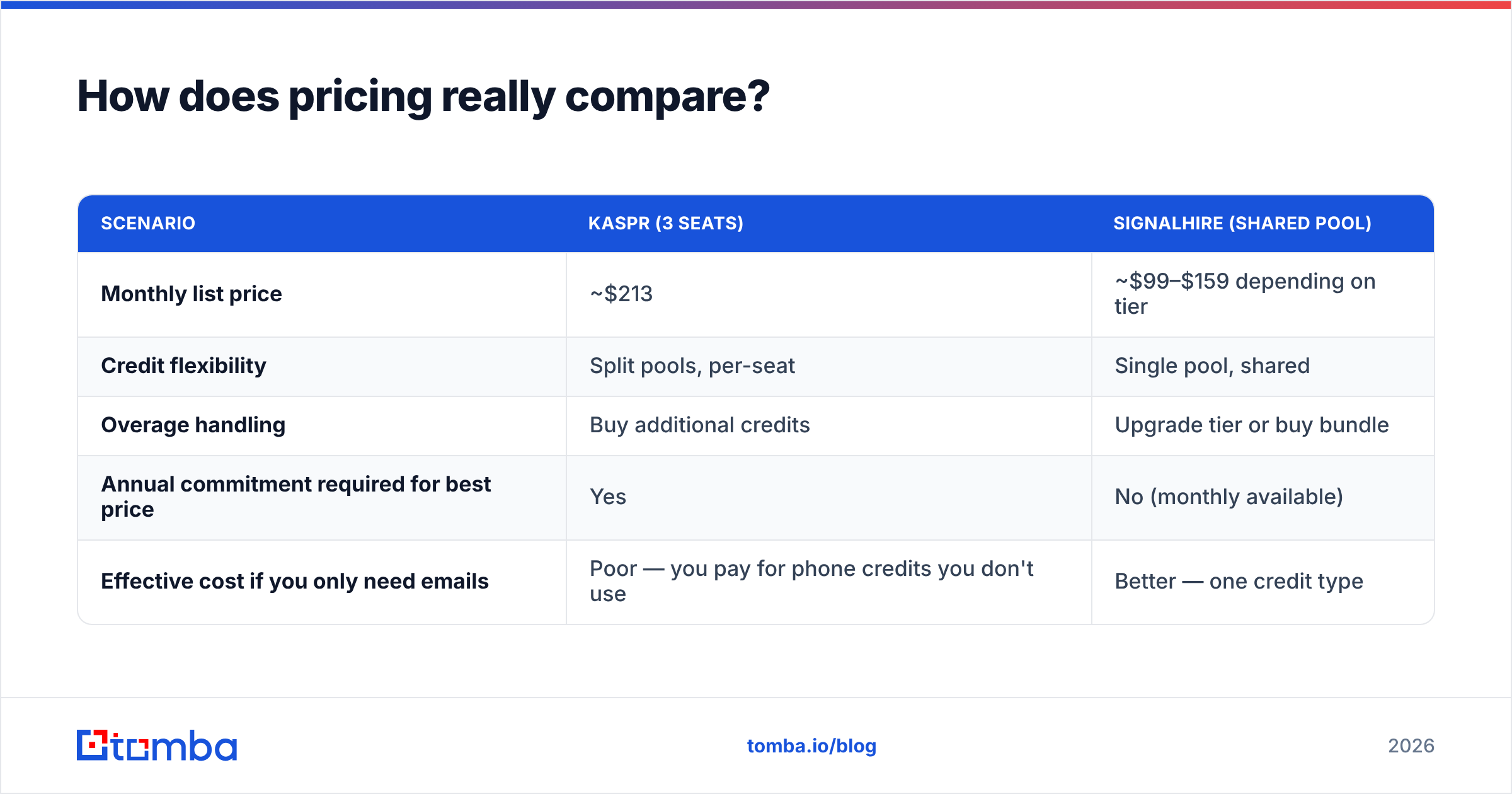
Budget reality for a three-person SDR team running 1,000 lookups a month:
| Scenario | Kaspr (3 seats) | SignalHire (shared pool) |
|---|---|---|
| Monthly list price | ~$213 | ~$99–$159 depending on tier |
| Credit flexibility | Split pools, per-seat | Single pool, shared |
| Overage handling | Buy additional credits | Upgrade tier or buy bundle |
| Annual commitment required for best price | Yes | No (monthly available) |
| Effective cost if you only need emails | Poor — you pay for phone credits you don't use | Better — one credit type |
That last row is the one that should stop you. If your motion is email-only — no dialing — you are paying both vendors for phone infrastructure you will never touch. In that case the correct comparison is not Kaspr vs SignalHire at all; it is either of them against a purpose-built email tool. Tomba pricing starts at $49/mo for the Starter plan with a free tier at 25 searches, and every credit goes toward the thing you actually need.

Which tool fits which team?#
Use this as a decision filter rather than a scorecard.
- You cold call European prospects daily. Kaspr. The EMEA mobile coverage plus Cognism's DNC screening is worth the per-seat premium, and the Aircall integration shortens the dial loop.
- You recruit technical talent. SignalHire. GitHub and multi-platform sourcing finds engineers who abandoned LinkedIn in 2019, and the ATS export structure is built for that pipeline.
- You run email-only outbound at volume. Neither, as your primary. Use a domain-based finder plus verification, and add a phone tool later only if you start dialing.
- You need contacts across APAC or LATAM. SignalHire, with tempered expectations. Kaspr's coverage falls off sharply outside Europe and North America.
- You are one person on a tight budget. SignalHire's monthly billing and shared credit pool is less punishing than an annual per-seat commitment.
- You need this inside a CRM workflow, automatically. Check API access on the tier you can afford. Kaspr gates the API higher than SignalHire does.
A note on stacking: these tools are not mutually exclusive and plenty of teams run two. The failure mode is paying full price for overlapping coverage. If you stack, use one tool as the primary bulk source and the second strictly as a fallback for misses — and instrument it so you know what the fallback is actually recovering.
What about the alternatives?#
The Kaspr vs SignalHire framing is narrower than most buyers realize. Both are contact-revealing tools optimized for one-at-a-time lookups. If your job is building lists at scale, several adjacent categories compete for the same budget.
Domain-first finders. Instead of starting from a person, you start from a company and pull the relevant contacts. Domain search inverts the workflow: give it company.com and get back the people, their roles, and the email pattern. For account-based motions this is dramatically faster than reveal-one-profile-at-a-time.
Verification-first platforms. ZeroBounce, Bouncer, and similar tools do one job extremely well. They do not find contacts; they tell you whether the ones you have will bounce. If your bounce rate is the problem, adding another finder does not help.
All-in-one sales platforms. Apollo and similar tools bundle database, sequencer, and dialer. They are cheaper per feature and worse at each one. Good for teams that want a single vendor, frustrating for teams that need best-in-class anything.
Curated B2B databases. Providers like BookYourData take a different approach — pre-built, filterable contact lists with pay-as-you-go pricing rather than credit subscriptions. If you need a clean, targeted list in one purchase rather than an ongoing seat cost, that model can be a better fit than either Kaspr or SignalHire, particularly for one-off campaigns.
Enrichment layers. If you already have records — CRM rows, webinar signups, trial users — you do not need discovery, you need completion. Data enrichment fills the gaps on contacts you already own, which is usually cheaper per record than net-new sourcing.
Worth reviewing vendor documentation directly rather than trusting any single comparison post, including this one. Check Kaspr's site and SignalHire's site for current pricing, and cross-reference user reviews on Capterra where complaints about credit mechanics tend to surface faster than on vendor-curated pages.
What should you check before you commit?#
Run this checklist against both tools during trial, with the same 100-row list:
- Coverage rate per segment. Break results down by region and seniority. Aggregate numbers hide the fact that a tool is great at mid-market US and useless at European enterprise.
- Phone validity. Actually dial 20 of them. Nothing else tells you the truth.
- Email bounce rate. Push 50 found addresses through a verifier and count the failures before you send anything.
- Credit burn per usable contact. Track how many credits produce zero results — some tools charge for misses, some don't.
- Export friction. Can you get data out cleanly, in bulk, without manual copy-paste? Test the CSV, not the demo.
- Compliance fit. If you touch EU prospects, confirm the vendor's legitimate-interest basis and notification process. Kaspr documents this more thoroughly than most.
Do not skip the dialing test. Phone data is the single largest source of buyer disappointment in this category, and it is the only claim you cannot validate from a spreadsheet.
The verdict#
Kaspr if you dial Europe. SignalHire if you source globally. Neither if you only need email.
Kaspr is the sharper instrument for a specific job: European SDRs working LinkedIn lists who need a mobile number and need it to be correct. The Cognism backing makes its compliance story and its EMEA phone data genuinely better than the price suggests. The cost is rigidity — per-seat billing, split credit pools, and total dependence on LinkedIn.
SignalHire is the more flexible tool. Broader sources, standalone search, monthly billing, a single credit pool, and a real API on every paid tier. The cost is precision — more results, less confidence in each one, and a product whose recruiting heritage means some sales workflows feel bolted on.
And if your honest answer to "do you dial?" is no, then both tools are selling you half a product. Email-first outbound wants a different stack: a finder that works from domains and names rather than LinkedIn URLs, a verifier that distinguishes catch-alls from real inboxes, and pricing where every credit goes toward the one thing you need.
That is where Tomba's Email Finder fits. Search by domain, by name and company, or in bulk; get a confidence score with sources on every result; verify in the same workflow before anything reaches your sequencer. The free tier gives you 25 searches a month to test against your own list, and the Starter plan is $49/mo — no per-seat multiplier, no split credit pools, no LinkedIn tab required. Run it against the same 100 prospects you test Kaspr and SignalHire with, and let the bounce rate decide.
Related guides#
// get started
Find, verify and enrich your first contacts today
Start on the free plan with 25 searches a month, then scale when your team is ready.
Free plan · No credit card required · GDPR & CCPA
// about the author