Kaspr vs Skrapp: Which B2B Contact Tool Wins in 2026?
Kaspr sells LinkedIn phone numbers. Skrapp sells domain-based email lists. They solve different problems at similar prices — here's which one actually fits your outbound motion, and where both fall short.
Kaspr vs Skrapp is really one question: do you dial, or do you email? Kaspr sells mobile numbers pulled from LinkedIn profiles. Skrapp sells email lists built from domains. The prices look alike. The jobs are not.
TL;DR
- Kaspr is a phone tool in an email tool's clothes. Its real value is mobile numbers pulled while you browse LinkedIn. Email coverage is thinner than dedicated finders.
- Skrapp is a domain-and-list tool. It shines when you already know the companies you want and need emails at scale from a domain or a Sales Navigator search.
- Neither one verifies properly. Both hand you addresses. Neither resolves catch-alls or gives you a verifier you would trust before a 5,000-send campaign.
- Credit models differ in ways that matter. Kaspr burns a credit per data type — email, phone, and direct dial count separately. Skrapp counts per email found. Your cost per usable contact can differ 3x.
- Pick Kaspr if you cold call. Pick Skrapp if you cold email at domain level. Need both, plus verification and an API? A finder like Tomba covers more of the job for $49/mo.
What are Kaspr and Skrapp, actually?#
They get lumped together because both live in a Chrome extension next to LinkedIn. That's where the similarity ends.
Kaspr (kaspr.io) is a contact-reveal tool built around LinkedIn profiles. You open a profile, hit the extension, and it surfaces mobile numbers, direct dials, and email addresses. Its differentiator is phone data, and it markets hard to SDR teams that dial. Cognism acquired it in 2022, which opened up a larger phone-verified data pool.
Skrapp (skrapp.io) is an email-finding tool built around domains and lists. You give it a company domain and it returns the email pattern plus the people it knows there. It also scrapes LinkedIn and Sales Navigator search results into bulk lists. Phone numbers are not its business.
Put plainly: Kaspr answers "what's this person's mobile?" and Skrapp answers "who works here and what are their emails?" Ask the wrong question of the wrong tool and both will disappoint you.

Kaspr vs Skrapp: how do they compare head to head?#
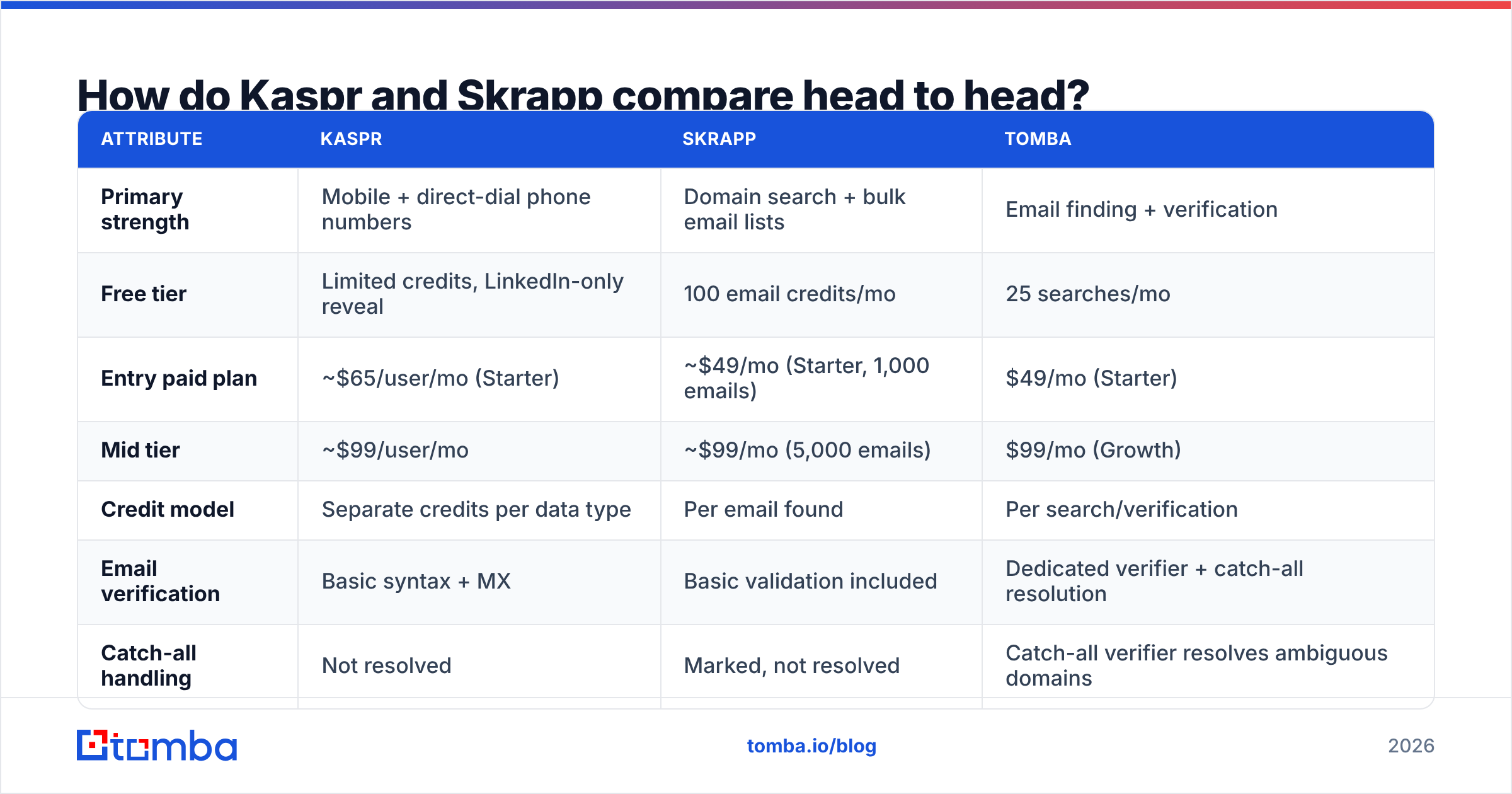
Here's the practical breakdown. Prices reflect publicly listed plans as of early 2026. Both vendors change tiers often, so check their pricing pages before you commit.
| Attribute | Kaspr | Skrapp | Tomba |
|---|---|---|---|
| Primary strength | Mobile + direct-dial phone numbers | Domain search + bulk email lists | Email finding + verification |
| Free tier | Limited credits, LinkedIn-only reveal | 100 email credits/mo | 25 searches/mo |
| Entry paid plan | ~$65/user/mo (Starter) | ~$49/mo (Starter, 1,000 emails) | $49/mo (Starter) |
| Mid tier | ~$99/user/mo | ~$99/mo (5,000 emails) | $99/mo (Growth) |
| Credit model | Separate credits per data type | Per email found | Per search/verification |
| Email verification | Basic syntax + MX | Basic validation included | Dedicated verifier + catch-all resolution |
| Catch-all handling | Not resolved | Marked, not resolved | Catch-all verifier resolves ambiguous domains |
| Bulk enrichment | Yes, CSV upload | Yes, CSV + LinkedIn lists | Bulk finder + verifier |
| Public API | Limited, higher tiers | Yes | Full REST API, CLI, MCP server |
| LinkedIn extension | Yes (core workflow) | Yes | Yes |
| Phone numbers | Core product | No | Phone finder available |
| Best for | Cold-call SDR teams | Domain-level email list building | Mixed email + verification workflows |
Two things jump out of that table.
First, Kaspr charges per seat and Skrapp charges per volume. A five-person SDR team on Kaspr Starter costs roughly $325/mo before anyone finds a single contact. The same team can share one Skrapp workspace. If you're a small team, that seat math beats every other factor.
Second, neither tool closes the verification loop. Both hand you addresses and leave the bounce risk on your desk. That's the gap that costs money later. A 6% bounce rate on a cold domain will tank your sender reputation faster than any subject-line mistake.
Which one has better data accuracy?#
It depends on the data type, and this is where most comparison posts hand-wave.
On mobile numbers, Kaspr wins outright. Skrapp doesn't compete here. Kaspr's phone coverage in Western Europe and North America is genuinely strong, fed by Cognism's phone-verification operation. Expect solid coverage on mid-market and enterprise contacts, and thinner results on SMB and non-Western regions. Reviews on G2 praise the phone data and flag patchy email results.
On business emails, Skrapp is the better of the two — with one caveat. Its strength is pattern inference. Give it a domain where it knows the format (first.last@, finitial.last@) and it will build plausible addresses for names it has never seen. That speed is also the source of its misses. An inferred address is a good guess, not a confirmed mailbox.
Here's the failure mode that catches teams out. Skrapp returns sarah.chen@acme.com because Acme uses first.last@. But Sarah is s.chen@, because there was already a Sarah Cheng. The address looks perfect, passes MX checks, and bounces. Neither tool will warn you.
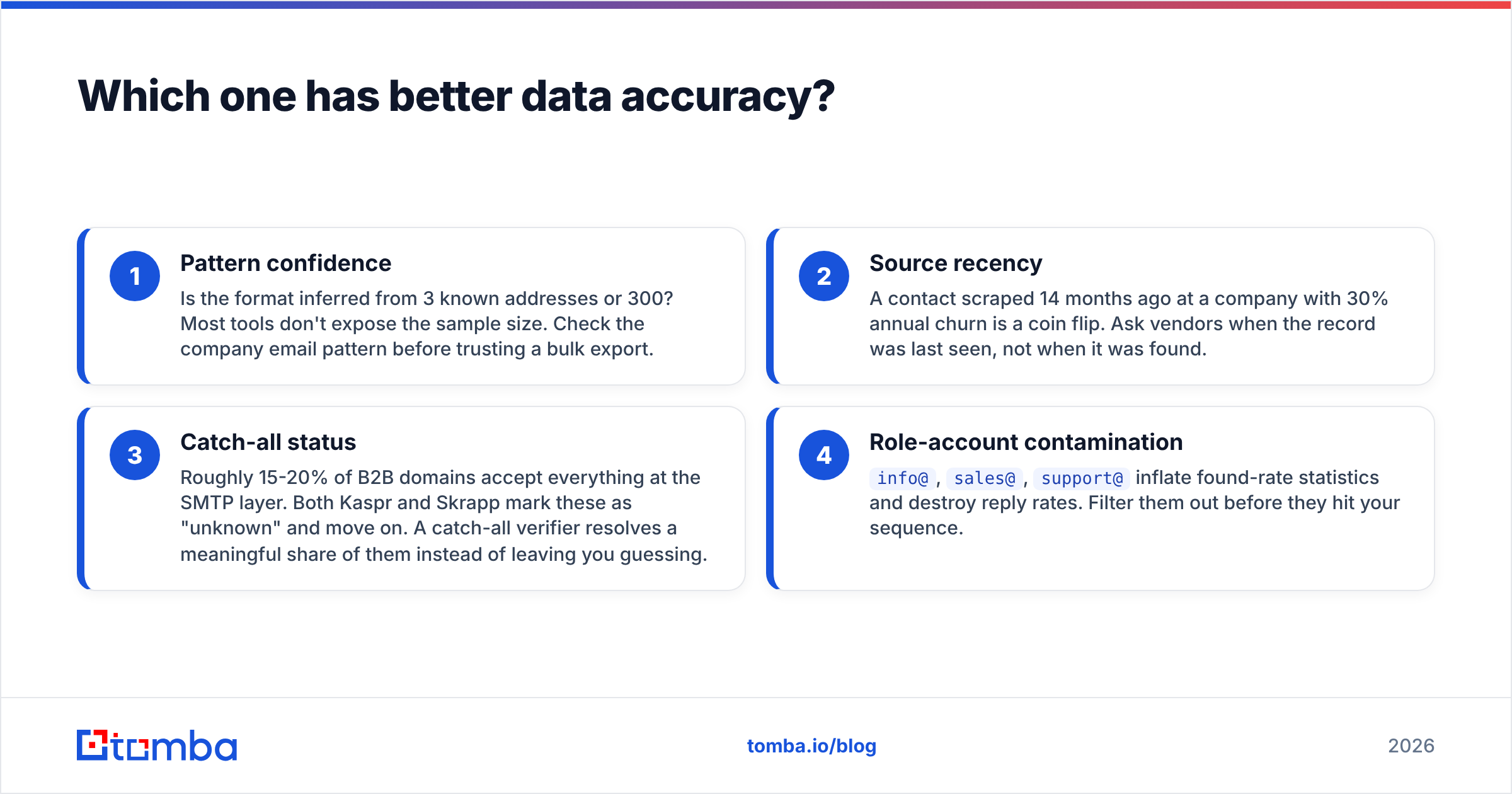
Four things decide whether a found email actually lands:
- Pattern confidence — Is the format inferred from 3 known addresses or 300? Most tools don't show the sample size. Check the company email pattern before you trust a bulk export.
- Source recency — A contact scraped 14 months ago at a company with 30% annual churn is a coin flip. Ask vendors when the record was last seen, not when it was found.
- Catch-all status — Roughly 15-20% of B2B domains accept everything at the SMTP layer. Kaspr and Skrapp both mark these "unknown" and move on. A catch-all verifier resolves a good share of them instead.
- Role-account contamination —
info@,sales@, andsupport@inflate found-rate stats and destroy reply rates. Filter them out before they hit your sequence.
Want to know how the major finders rank on raw accuracy? The annual benchmarks are worth reading. The accuracy spread between the top and bottom of the category is wider than the price spread.
Is Kaspr worth the per-seat price?#
Yes, if your team dials. No, if it doesn't.
Kaspr's pricing model is the single biggest decision factor. Per-seat licensing at $65-$99 per user makes sense when each rep makes 50+ calls a day and every connected call is worth hundreds of dollars in pipeline. It makes no sense when two people need an email address now and then.
The credit system deserves a look too. Kaspr counts phone credits, email credits, and direct-dial credits separately. Reveal a full profile — mobile, direct dial, work email — and you've spent three credits on one person. Teams that budget "1,000 credits = 1,000 contacts" get a nasty surprise in week two.

There's a compliance angle too. Kaspr runs under GDPR with a documented legitimate-interest basis and honors opt-outs. But phone data faces a higher bar than email in several countries. If you sell into Germany, France, or Spain, have your legal team read the DPA before your first dial. The Salesforce guidance on GDPR-compliant outreach is a fair starting point for policy.
Is Skrapp good enough for serious cold email?#
It's good enough to build a list. It is not good enough to send from on its own.
Skrapp's domain search is genuinely useful. Feed it 200 target accounts and it returns contacts with titles and departments, which is the exact input an account-based motion needs. The Sales Navigator export saves real hours of manual copying.
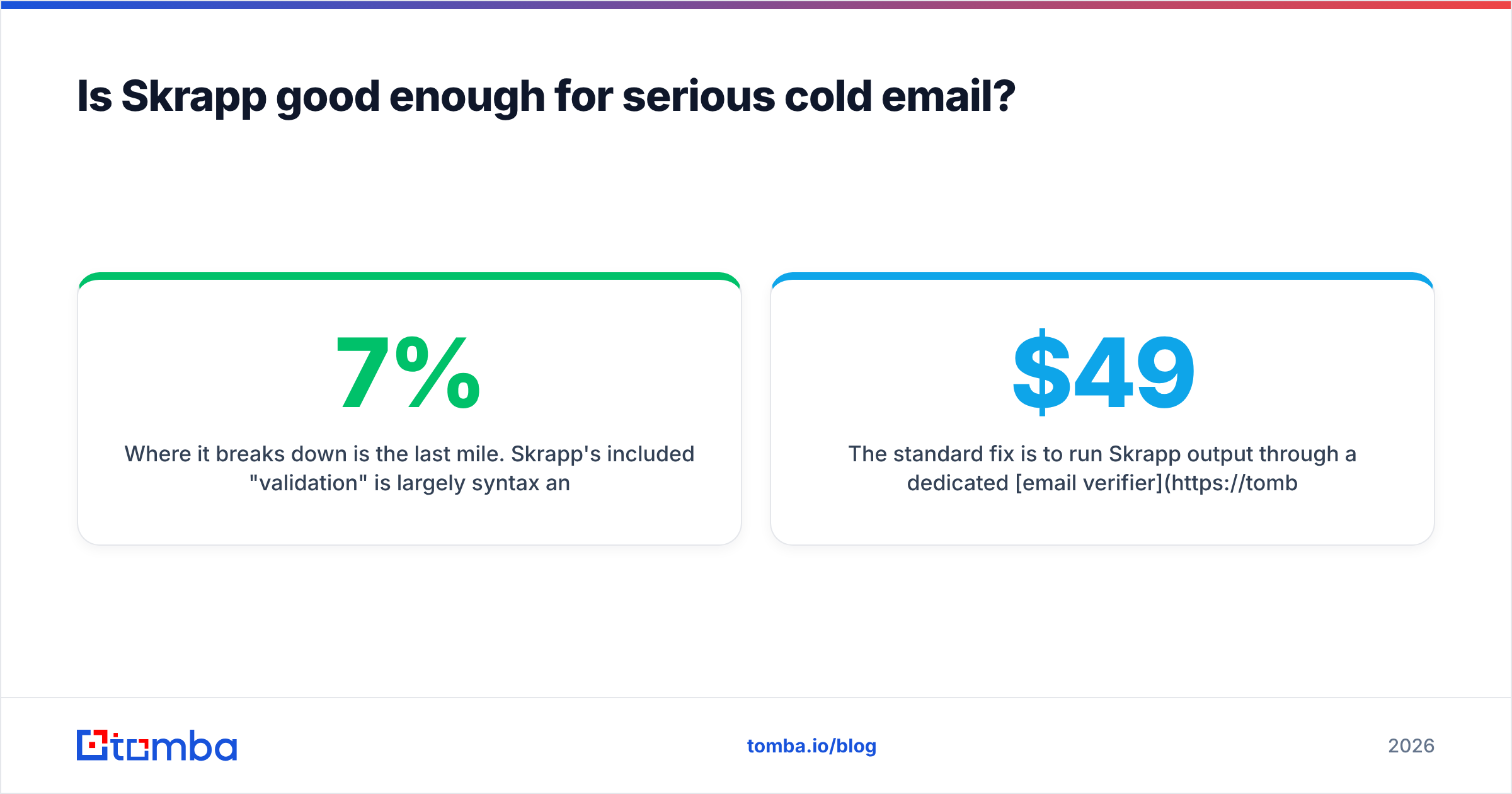
The last mile is where it breaks down. Skrapp's included "validation" is mostly syntax and MX-record checking. It confirms the domain can receive mail, not that the mailbox exists. Send 3,000 emails on that basis and you end up with a 7% bounce rate and a burned sending domain.
The standard fix is to run Skrapp output through a dedicated email verifier before import. That adds a step and a second bill. Do that math when you compare total cost. Skrapp at $49/mo plus a verifier at $30-50/mo is $80-100/mo. At that point, one tool that does both for $49/mo changes the answer.
Both Capterra and G2 carry enough verified reviews to see the pattern. Kaspr reviews praise phones and complain about email accuracy. Skrapp reviews praise volume and price and complain about bounces.
What about the alternatives neither vendor mentions?#
The Kaspr vs Skrapp framing is artificially narrow. Both are point solutions, and a modern outbound stack needs three things they only partly cover.
Coverage across identifiers. You find a prospect on LinkedIn, but you need their work email, ideally their mobile, and sometimes a reverse lookup from an email you already have. Kaspr covers LinkedIn-to-phone. Skrapp covers domain-to-email. Neither does reverse email lookup or author attribution.
Verification you'd bet a domain on. This is non-negotiable in 2026. Google and Yahoo's bulk-sender rules turned bounce rates into a hard gate. Cross 3% and delivery degrades measurably. Your finder needs a verifier that resolves catch-alls, not one that shrugs at them.
Programmatic access. If your RevOps team enriches records on CRM write, you need an API, not a Chrome extension. Skrapp offers an API. Kaspr's is gated and limited. A proper email finder API with SDK coverage, plus CLI and MCP-server access for AI agents, is table stakes for automated enrichment.
One more note. If your problem is buying a pre-built list rather than finding contacts one at a time, neither tool is the right category. Database vendors like BookYourData sell downloadable, filterable B2B lists. That's a different purchase with different economics — a complement to a finder, not a replacement.
How do you choose between them in practice?#
Run this decision sequence. It takes ten minutes and saves a wasted quarter.
- Count your dials. If your team makes more than 30 calls per rep per day, phone data is your bottleneck and Kaspr fits better. If dialing is occasional, you're paying seat fees for a feature you use twice a week.
- Check your list-building entry point. Working from a target-account list of domains? Skrapp's domain search is built for that. Working from individual LinkedIn profiles you find ad hoc? Both extensions work, and Kaspr's is smoother.
- Calculate cost per usable contact, not per credit. Apply Kaspr's multi-credit reveal model and Skrapp's bounce rate to 1,000 target contacts, then compare. The headline prices lie. The effective rates don't.
Those three steps pick the tool. The last two protect the budget.
- Price the verification layer separately. Whatever you pick, budget for verification. If that pushes a two-tool stack past $99/mo, compare consolidated options. Tomba pricing starts at $49/mo with the verifier included, and the free tier gives you 25 searches to test accuracy first.
- Test on 50 contacts you already know. The only benchmark that matters is your ICP. Take 50 contacts whose real emails you have, run them through each trial, and score the results yourself. Vendor accuracy figures are measured on the vendor's favorite data.
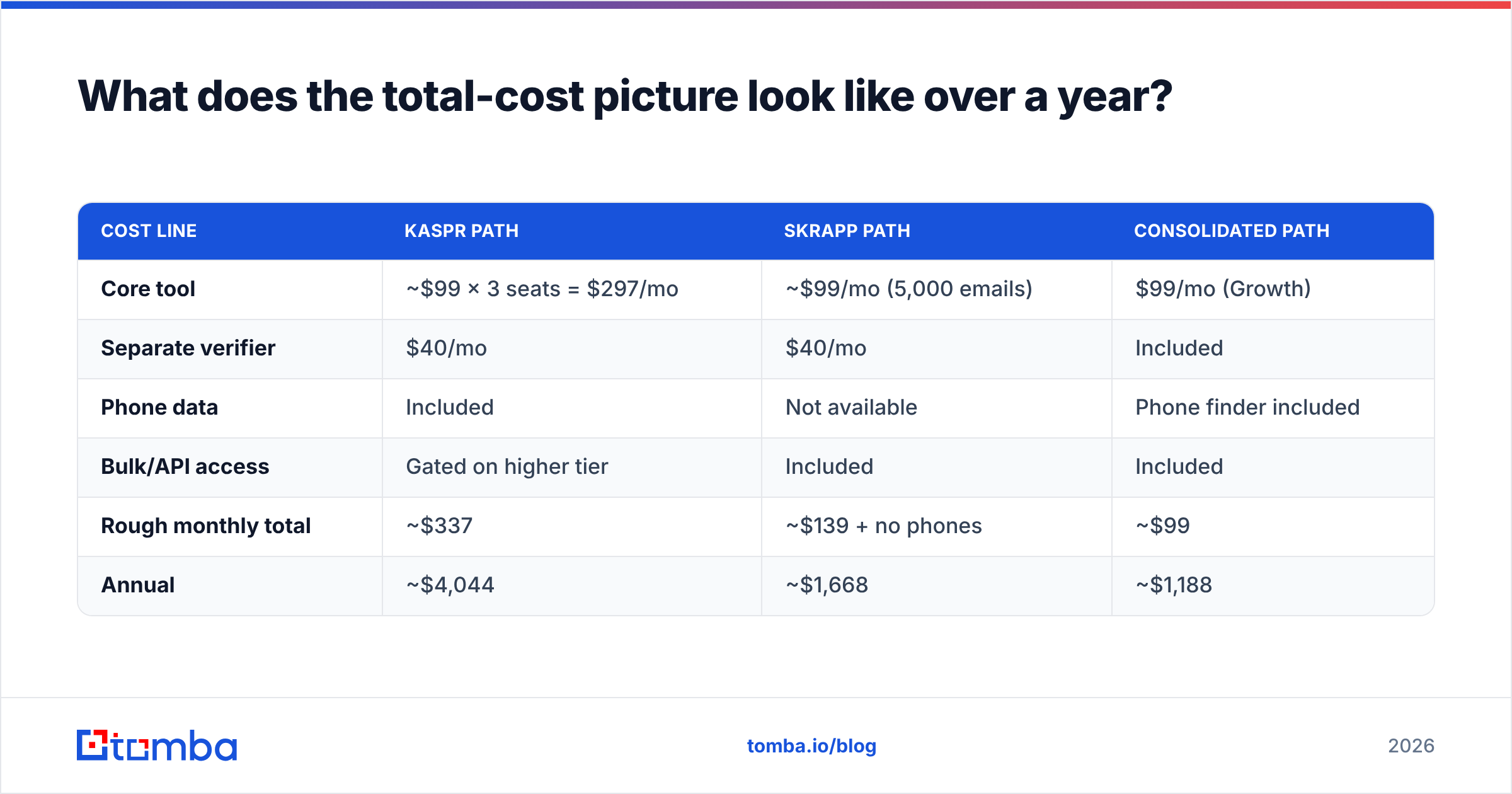
What does the total-cost picture look like over a year?#
Assume a three-person SDR team targeting 2,000 new contacts per month.
| Cost line | Kaspr path | Skrapp path | Consolidated path |
|---|---|---|---|
| Core tool | ~$99 × 3 seats = $297/mo | ~$99/mo (5,000 emails) | $99/mo (Growth) |
| Separate verifier | $40/mo | $40/mo | Included |
| Phone data | Included | Not available | Phone finder included |
| Bulk/API access | Gated on higher tier | Included | Included |
| Rough monthly total | ~$337 | ~$139 + no phones | ~$99 |
| Annual | ~$4,044 | ~$1,668 | ~$1,188 |
The point of this table isn't that one number is smallest. It's that Kaspr's per-seat model and Skrapp's missing phone layer pull in opposite directions. The right answer depends on which gap hurts your motion more. A team that lives on the phone will happily pay Kaspr's premium. A team running pure email sequences would be lighting money on fire doing the same.
Run the numbers on wasted sends too. At a 6% bounce rate across 24,000 annual contacts, you burn 1,440 sends and take a deliverability hit that suppresses the other 22,560. Verification isn't a cost line. It's the thing that makes the other cost lines work.
Frequently asked questions#
Can I use Kaspr and Skrapp together? Yes, and some teams do. Skrapp handles domain-level list building, Kaspr covers phone numbers on accounts that reach late stage. It's expensive and means two credit pools to manage, but it's valid for a genuine multi-channel motion.
Does either tool integrate with my CRM? Both offer native HubSpot and Pipedrive connections, plus Zapier. Salesforce support is stronger on Kaspr, via the Cognism relationship. Check your specific CRM version before you assume. HubSpot's integration directory is the fastest way to confirm.
Which is better for European prospecting? Kaspr for phones, by a clear margin. For email, both have decent Western European coverage but thin out in Eastern Europe and the Nordics. Test on your actual territory.
Do either offer a meaningful free tier? Skrapp's 100 free email credits per month is the more usable of the two. Kaspr's free tier is credit-limited and LinkedIn-gated. For a cleaner side-by-side, run the same 25 contacts through Tomba's free tier as a control.
The bottom line#
Kaspr vs Skrapp isn't really a head-to-head. They're adjacent tools that share a distribution channel. Choose Kaspr if your revenue comes off the phone and you can absorb per-seat pricing. Choose Skrapp if you build email lists from domains and you verify before sending.
Is your honest answer "I need accurate work emails at volume, verified, with an API behind them, and I'd rather not run two subscriptions"? That's a third category. Tomba's Email Finder does domain search, individual lookup, bulk processing, and catch-all-aware verification in one place. It starts at $49/mo, with 25 free searches to test on your own accounts. Run your 50 known contacts through it alongside the other two and let the results decide.
Related guides#
Ready to find emails that actually work?
Join 150,000+ professionals who stopped guessing and started sending. Free credits on signup — no credit card required.
Get the Tomba newsletter
Practical outbound tactics and product updates — once every two weeks.
About the author