Kaspr vs Snappy Leads: Which B2B Contact Tool Wins in 2026?
Kaspr sells LinkedIn phone numbers. Snappy Leads sells verified B2B emails at low cost. We compared coverage, pricing, GDPR exposure and data quality to find which one actually belongs in your stack.
Kaspr vs Snappy Leads is a comparison of two tools that barely overlap. One sells phone numbers pulled from LinkedIn. The other sells cheap verified work emails. Here is the short version.
TL;DR
- Kaspr is a phone-number tool wearing an email-finder costume. Its strength is mobile numbers pulled from LinkedIn profiles via a Chrome extension. Email coverage is secondary and skews European.
- Snappy Leads is a low-cost email-first finder built for volume outbound — cheaper per credit, weaker on phones, thinner on enrichment fields and integrations.
- They barely compete head-to-head. If you cold call, Kaspr wins. If you cold email at scale, Snappy Leads or a dedicated email finder wins.
- Both leave gaps: Kaspr's credit model gets expensive fast past a few hundred lookups a month; Snappy Leads has limited API depth and a smaller verification stack.
- The honest third option: a dedicated finder + verifier stack (Tomba, BookYourData, Findymail) usually beats either on cost-per-valid-contact if email is your primary channel.
Kaspr vs Snappy Leads: what does each tool do?#
Kaspr and Snappy Leads get lumped together in "B2B contact data" roundups. They solve different problems. Treat them as interchangeable and you end up paying for phone credits you never dial.
Kaspr (kaspr.io) is a LinkedIn-native contact reveal tool, acquired by Cognism in 2022. You install a Chrome extension, open a LinkedIn profile or a Sales Navigator search, and Kaspr surfaces mobile numbers, direct dials and email addresses. Its center of gravity is the phone number. It grew up serving SDR teams in France, the UK and the DACH region. Those teams dial first and email second.
Snappy Leads is a newer, leaner email-finding tool. It targets founders and small outbound teams who want verified work emails without an enterprise contract. The pitch is simple: bulk email finding and verification at a price that skips the procurement conversation. Phone data exists but isn't the product.
The mental model: Kaspr is a phone book that also has emails. Snappy Leads is an email list that also has a few phone numbers. Same shelf in the store, different jobs.

Kaspr vs Snappy Leads: features and pricing compared#
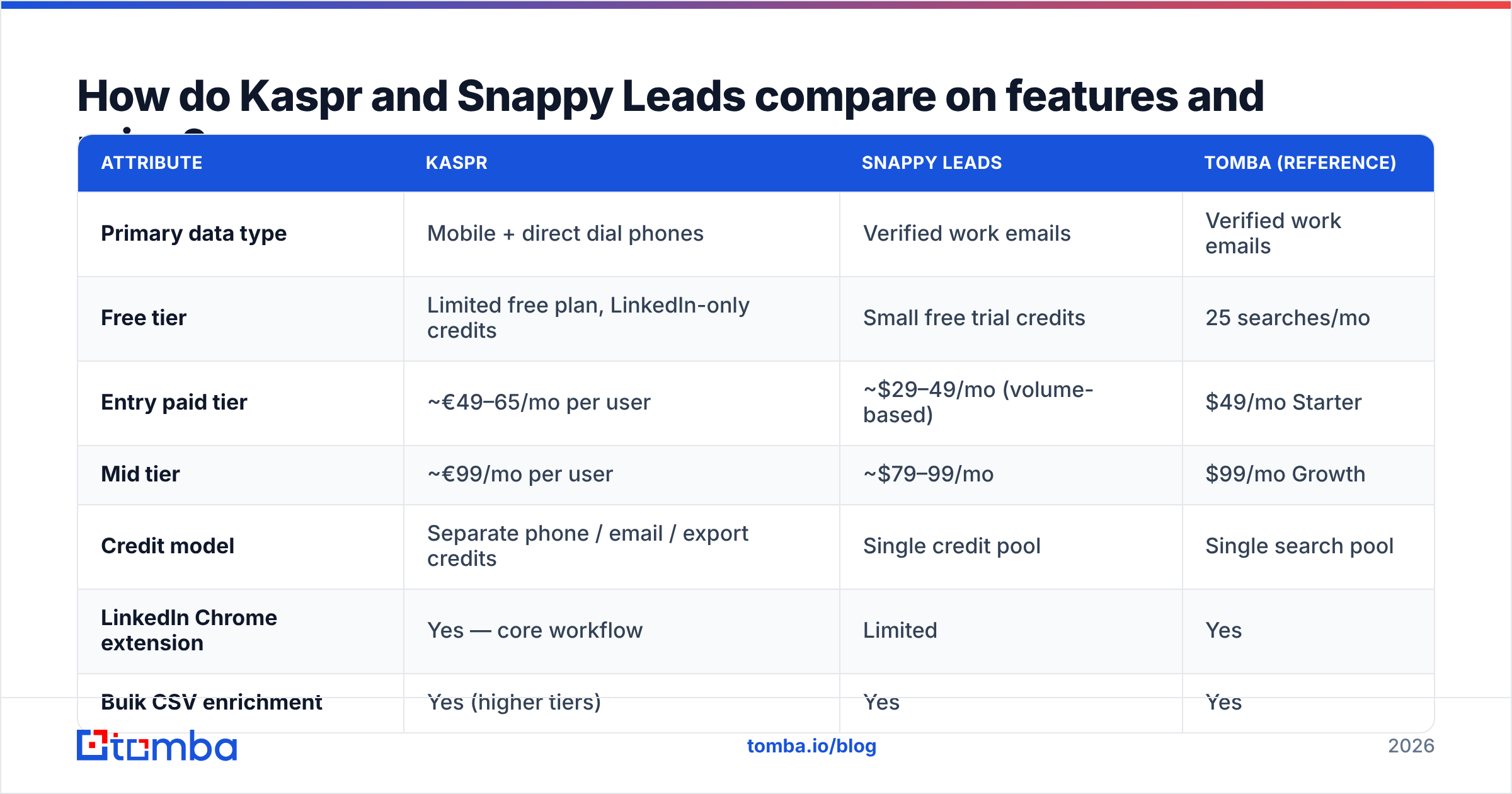
Here's the head-to-head. Pricing moves — always check the vendor page before you buy — but the structural differences are stable.
| Attribute | Kaspr | Snappy Leads | Tomba (reference) |
|---|---|---|---|
| Primary data type | Mobile + direct dial phones | Verified work emails | Verified work emails |
| Free tier | Limited free plan, LinkedIn-only credits | Small free trial credits | 25 searches/mo |
| Entry paid tier | ~€49–65/mo per user | ~$29–49/mo (volume-based) | $49/mo Starter |
| Mid tier | ~€99/mo per user | ~$79–99/mo | $99/mo Growth |
| Credit model | Separate phone / email / export credits | Single credit pool | Single search pool |
| LinkedIn Chrome extension | Yes — core workflow | Limited | Yes |
| Bulk CSV enrichment | Yes (higher tiers) | Yes | Yes |
| Public API | Yes, limited endpoints | Basic | Full REST API + CLI + MCP |
| Catch-all handling | Marks as risky | Basic | Dedicated catch-all verifier |
| Geographic strength | EMEA (FR/UK/DACH) | US + global | Global, 100+ countries |
| Best for | Cold callers, SDR teams | Budget email outbound | Email-first outbound at scale |
The most important row is credit model. Kaspr charges per user and splits credits by type. A five-person SDR team burning phone and email credits separately can quietly hit four figures a month. Snappy Leads' single pool is simpler. But the pool is smaller, and there's less transparency about what happens when a lookup returns nothing.
Five differences that actually change your workflow#
1. Where the data comes from. Kaspr's phone data leans on a community-contribution model plus licensed sources. Depth is good in Europe, patchier in APAC and LATAM. Snappy Leads relies on pattern inference plus SMTP verification, the standard approach for email-first tools. Your vendor's data sources matter more than any feature checkbox.
2. Where you work. Kaspr assumes you live inside LinkedIn Sales Navigator. Start from a company list, a conference attendee sheet or a scraped site and you're fighting the tool. Snappy Leads assumes you start with a CSV of names and domains.
3. What "verified" means. Kaspr's email verification is lighter. It flags deliverability but skips the full catch-all gauntlet. If you send to catch-all domains, add a separate catch-all verifier no matter which tool you pick.
4. Compliance posture. Kaspr publishes GDPR documentation and a notification process. That matters, because European mobile numbers are the most legally sensitive data type in B2B. Snappy Leads has a smaller compliance surface. It mostly handles business emails, which sit in a friendlier legal category under legitimate interest.
5. Integration depth. Kaspr pushes to HubSpot, Pipedrive, Salesforce, Lemlist and more. Snappy Leads covers the basics plus CSV. Neither matches a full-stack finder's integration catalog if you're building automated enrichment workflows.
Is Kaspr worth it in 2026?#
Yes — if you dial. No — if you don't.
Kaspr earns its price when a rep's day is built around conversations, not sequences. A 30% mobile hit rate on a European ICP is hard to replicate with generic databases. Revealing a number mid-LinkedIn-browse also removes the friction that kills calling discipline.
Where it breaks down:
- Cost per contact at volume. Kaspr is priced per seat with credit ceilings. Once you're enriching 2,000+ contacts a month, per-contact economics look worse than a bulk finder.
- Email coverage is the weak leg. Teams consistently report better email hit rates from dedicated finders. If you're buying Kaspr for emails, you're paying phone-tool prices for second-tier email data.
- US coverage is thinner than EMEA. If your ICP is American mid-market SaaS, run a trial against 100 known contacts before committing. Do not take a coverage claim on faith — measure it.
- Cognism overlap. Since the acquisition, the Kaspr/Cognism boundary has blurred. If you're already a Cognism customer, check whether you're paying twice for the same records.
Here's a verification method that works. Export 100 contacts whose numbers you already trust. Run them through a trial. Count exact matches. Vendor-published coverage stats are marketing; your list is truth. G2's Kaspr reviews are a reasonable sanity check on where other buyers hit walls.
Is Snappy Leads good enough for serious outbound?#
For a solo founder or a two-person team, yes. For a scaling outbound org, it's a starter tool.
The value proposition is real: verified work emails at a price that lets you test a channel before you've proven it. If you send 500–1,500 emails a month, and the alternative is a $300/mo platform, Snappy Leads makes sense.
The ceilings show up in three places:
- Verification depth. Basic SMTP verification catches obvious dead addresses. It doesn't reliably resolve catch-all domains, role accounts, or spam traps — and spam traps are what actually torch your sender reputation.
- Enrichment fields. You get email and sometimes a title. You don't get firmographics, tech stack, funding signals, or the kind of data that makes personalization non-generic.
- API and automation. If you want enrichment to run automatically when a lead enters your CRM, you need real API surface. A thin API means humans doing CSV round trips, which is a hidden cost nobody puts in the spreadsheet.
None of this is a criticism of the tool's honesty. It's priced like a starter tool because it is one. Problems only appear when teams try to run a 10,000-contact quarter on it.

Which one should you choose for your outbound motion?#
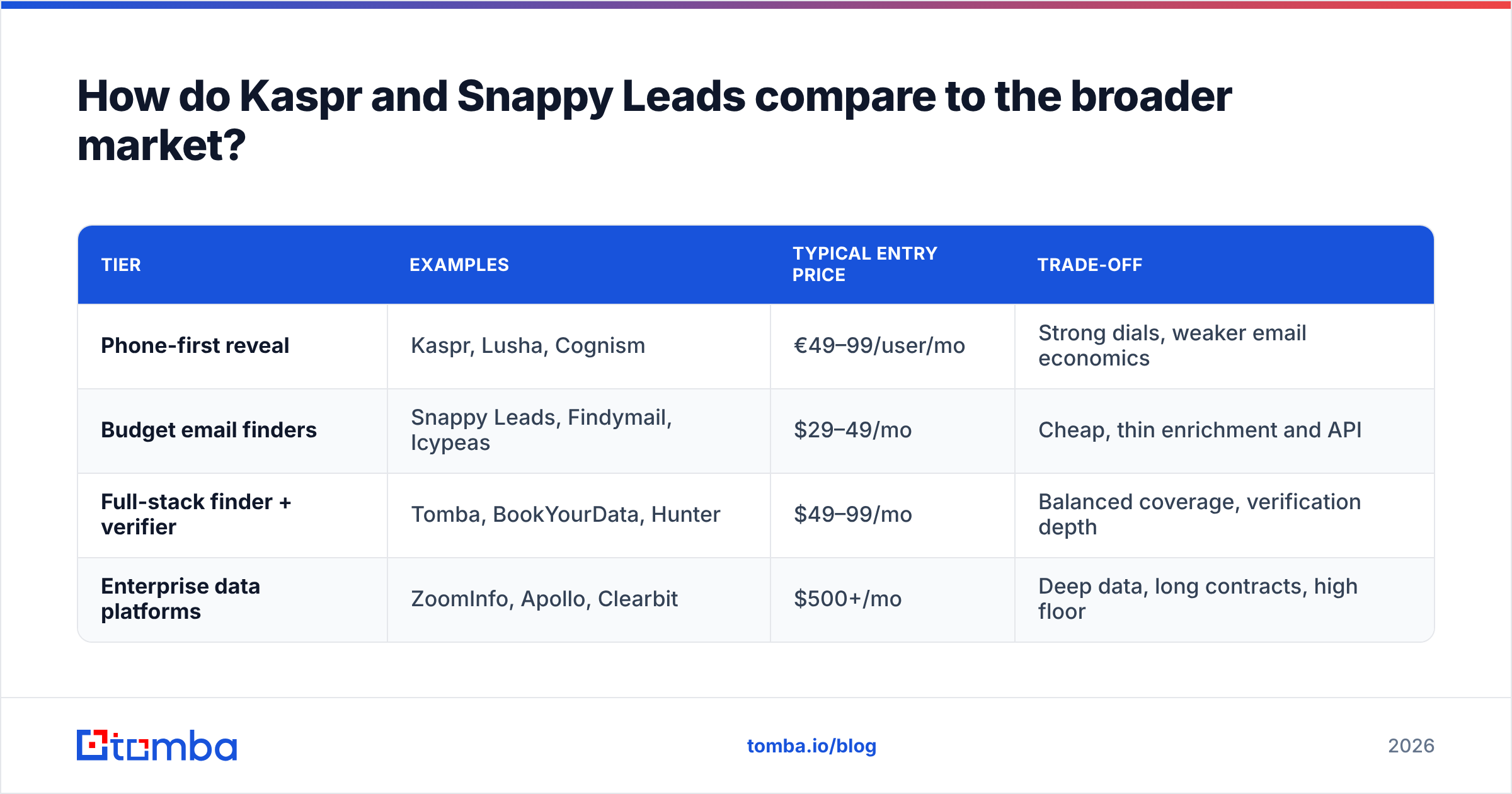
Map the tool to the channel. That's the whole decision.
| Your situation | Best pick | Why |
|---|---|---|
| European ICP, phone-first SDR team | Kaspr | Mobile coverage in EMEA is its genuine moat |
| US ICP, email-first, <1,500 sends/mo | Snappy Leads | Cheapest path to verified work emails at low volume |
| Email-first, 2,000+ contacts/mo | Dedicated finder + verifier | Per-contact cost and verification depth both matter at scale |
| Multi-channel (email + phone + LinkedIn) | Two tools, not one | Neither is strong on both legs; stop looking for a unicorn |
| Developer-led enrichment in-product | API-first vendor | Extension-first tools can't be automated cleanly |
| Heavy catch-all domains in your TAM | Finder + dedicated catch-all verification | Both tools underperform here |
The third row is where most teams land, and where most teams overpay. If email is your primary channel and you run real volume, the math favors a purpose-built email finder paired with strict verification. Paying a phone tool's premium for mediocre email data is the expensive path.
The two-tool stack that usually wins#
For teams doing genuine multi-channel outbound, the pattern that holds up:
- One email finder for domain-level and name-level discovery, with bulk processing and an API.
- One verifier — ideally the same vendor — with explicit catch-all handling before anything enters a sequence.
- One phone source (Kaspr, Cognism, Lusha) used narrowly for accounts that clear a qualification bar, not sprayed across the whole list.
- A deliverability layer — SPF, DKIM, DMARC, warmup — because the best data in the world still bounces off a bad sending domain.
Running phone credits on every prospect is the most common waste in outbound budgets. Reveal numbers only after an account earns the effort.
How do Kaspr and Snappy Leads compare to the broader market?#
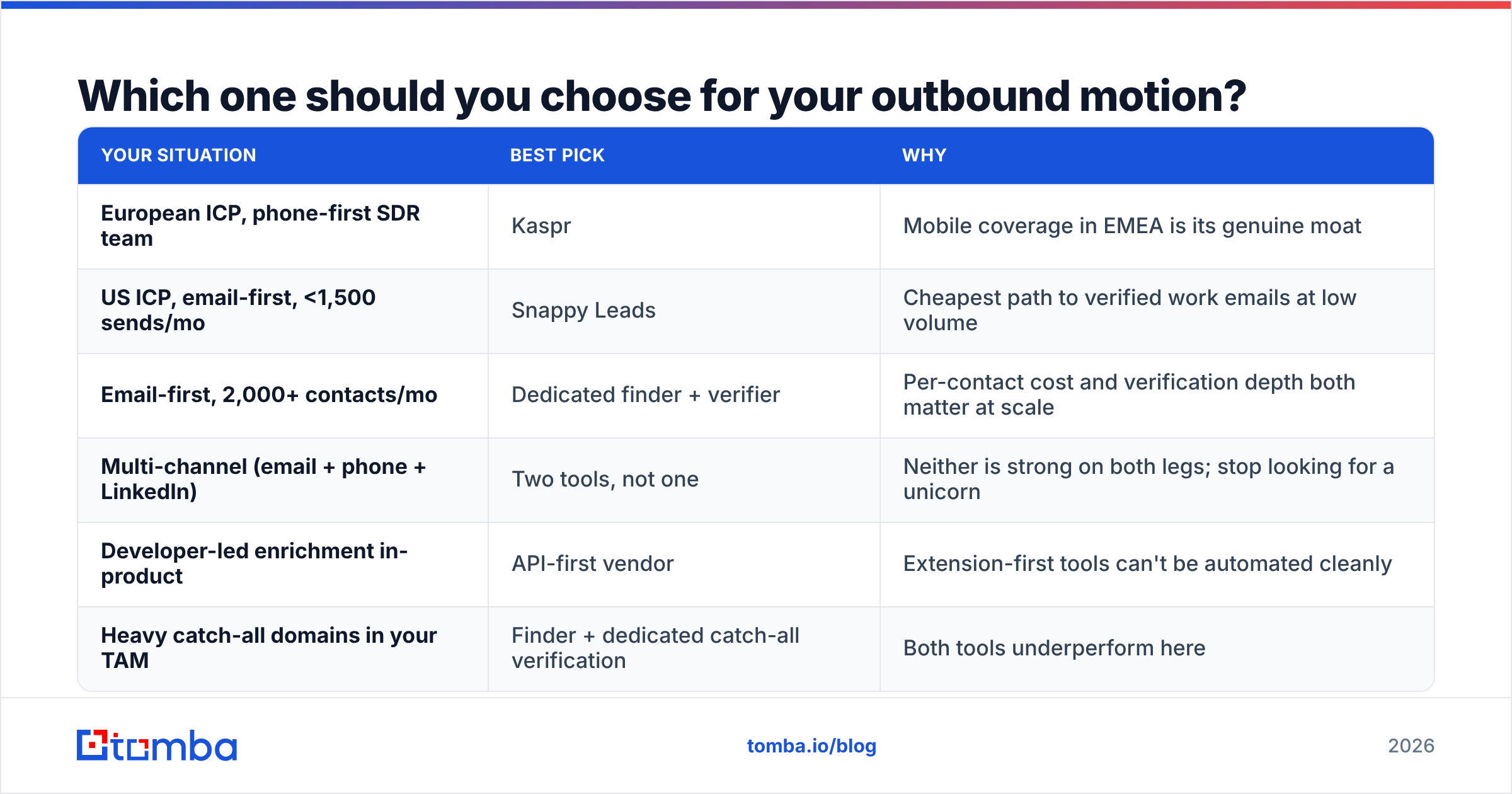
Neither tool exists in a vacuum. The B2B contact data market in 2026 breaks into four rough tiers:
| Tier | Examples | Typical entry price | Trade-off |
|---|---|---|---|
| Phone-first reveal | Kaspr, Lusha, Cognism | €49–99/user/mo | Strong dials, weaker email economics |
| Budget email finders | Snappy Leads, Findymail, Icypeas | $29–49/mo | Cheap, thin enrichment and API |
| Full-stack finder + verifier | Tomba, BookYourData, Hunter | $49–99/mo | Balanced coverage, verification depth |
| Enterprise data platforms | ZoomInfo, Apollo, Clearbit | $500+/mo | Deep data, long contracts, high floor |
BookYourData deserves a mention in the third tier. It sells pre-built, verified B2B lists with a pay-as-you-go model and an accuracy guarantee. That suits teams who'd rather buy a clean list than run discovery themselves. It's a different buying motion from Kaspr's reveal-as-you-browse workflow, and a good fit if your ICP is well defined.
Tier three often wins on cost per valid contact for one reason: discovery and verification share the same infrastructure. When your finder and verifier are separate vendors, you pay twice for the same record. You also reconcile two definitions of "valid." Tomba's pricing runs from a free tier at 25 searches to $49/mo Starter, $99/mo Growth and $249/mo Pro. Finding, verification, domain search and enrichment sit under one credit pool, which removes that reconciliation problem.
None of this makes Kaspr a bad purchase. It makes Kaspr a specific purchase. Buy it for phones, budget it for phones, measure it on connect rate — not on how many emails it happened to return.
What should you test before you buy either one?#
Run this before any contract. It takes an afternoon and saves quarters.
Build a 100-contact truth set. Real people at real companies in your actual ICP, with contact details you already know are correct.
Run both trials against it. Count exact matches, near-misses and blanks separately. A tool that returns a wrong email is worse than one that returns nothing.
Verify the winners independently. Feed every returned email through a neutral email verifier and record the bounce-risk score. Vendor-side "verified" labels are not comparable across vendors.
Calculate true cost per valid contact. Divide total monthly spend by contacts that pass independent verification, not by credits consumed. This number is usually 2–4x the headline credit price.
Test the integration you'll actually use. If enrichment has to reach your CRM automatically, build that flow during the trial. Discovering API limits after purchase is expensive.
Check compliance fit. If you contact EU citizens, confirm the vendor's lawful basis, retention policy and opt-out handling. HubSpot's GDPR resources are a decent plain-English starting point.
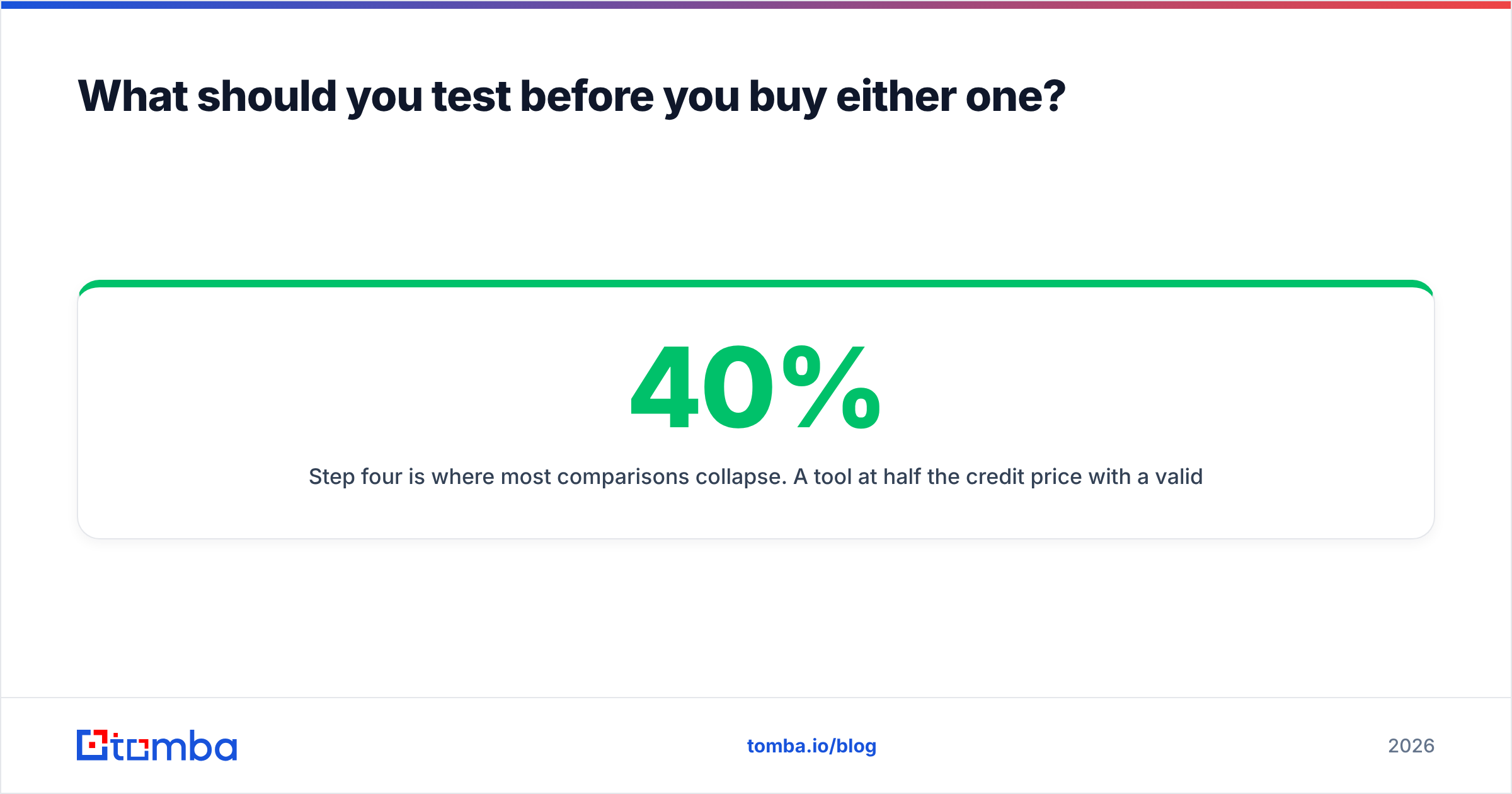
Step four is where most comparisons collapse. A tool at half the credit price with a 40% valid-contact rate costs more than a premium tool at 80%. Run the division.
Final verdict: Kaspr vs Snappy Leads#
Kaspr wins if you dial European prospects and prospect inside LinkedIn. Its mobile coverage in EMEA is a real advantage and the extension workflow is fast. Budget it as a phone tool, cap credits per rep, and ignore its email output.
Snappy Leads wins if you're early, email-first, and cost-sensitive. It does one thing at a price that lets you validate the channel. Plan to outgrow it — that's not a flaw, it's the category.
Neither wins if email is your primary channel at scale. At 2,000+ contacts a month, cost per valid contact and verification depth dominate every other factor. A purpose-built finder-plus-verifier stack beats both on that math.
If that describes you, start with the Tomba Email Finder. The free tier gives you 25 searches to run against your truth set, which is enough to measure real hit rate before you spend anything. Starter at $49/mo covers finding, verification, domain search and catch-all handling in one credit pool, with a full API when you're ready to automate. Build your 100-contact test list, run it, and let the numbers pick your vendor.
Related guides#
// get started
Find, verify and enrich your first contacts today
Start on the free plan with 25 searches a month, then scale when your team is ready.
Free plan · No credit card required · GDPR & CCPA
Get the Tomba newsletter
Product and data updates
// about the author