Kaspr vs Techsalerator: Which B2B Data Tool Wins in 2026?
Kaspr sells LinkedIn-sourced phone numbers per seat. Techsalerator sells bulk datasets per file. They solve different problems, and picking the wrong one wastes a quarter of pipeline. Here is the honest breakdown.
TL;DR
- Kaspr is a seat-based Chrome extension that pulls phone numbers and emails off LinkedIn profiles in real time. It is built for individual SDRs working a list they can see.
- Techsalerator is a bulk data vendor. You buy a dataset — a country, an industry, a firmographic slice — as a file or feed, usually under a custom quote with no public price.
- They are not really substitutes. Kaspr answers "who is this person and what is their mobile?" Techsalerator answers "give me 400,000 manufacturing contacts in DACH."
- Accuracy claims on both sides are vendor-stated and unaudited. Whichever you buy, budget for independent verification before your first send — bulk files decay faster than extension-sourced records.
- If your actual job is finding and verifying work emails at scale via API, a dedicated email finder is cheaper than either, and you can run all three in the same stack.
What is Kaspr, and who actually uses it?#
Kaspr is a prospecting data tool that lives mostly inside a browser extension. You open a LinkedIn profile, a LinkedIn Sales Navigator list, or a group of event attendees, and Kaspr surfaces the contact's phone numbers, email addresses, and company details in a side panel. You can push records straight into a CRM or a sequencing tool from there.
It was acquired by Cognism in 2022, and the product now sits in that family as the lightweight, self-serve, bottom-up option. Cognism sells annual contracts to revenue teams; Kaspr sells monthly seats to individual reps and small teams who want mobile numbers without a procurement cycle.
The defining characteristic is that Kaspr is profile-triggered. Data arrives because you looked at someone. That has two consequences worth understanding before you buy:
- Your total addressable data is whatever you can surface in LinkedIn. If your ICP is poorly represented on LinkedIn — local trades, certain manufacturing verticals, most of Japan's SMB market — Kaspr's ceiling is low regardless of how good its database is.
- Credits are consumed per reveal, per seat. Ten reps hunting the same account can each burn credits on the same contact unless your workflow deduplicates first.
For an SDR doing 40–60 targeted touches a day against LinkedIn-native buyers, that model is efficient. For a growth team building a 200,000-row TAM file, it is the wrong shape of tool entirely.
What is Techsalerator, and how does it sell data?#
Techsalerator is a data reseller and aggregator based in New York. It publishes hundreds of dataset pages — B2B contact data by country, consumer data, firmographics, technographics, mobile app data, geospatial, and more — and sells them as bulk deliveries rather than as a SaaS product you log into daily.
Delivery is typically a file (CSV, JSON, Parquet), an S3 or SFTP drop, or an API feed for larger contracts. Pricing is quote-based: you describe the slice you want, they scope volume and fields, and you get a number. There is no published self-serve tier, no credit counter, and no browser extension.
That model is genuinely useful for things Kaspr cannot do:
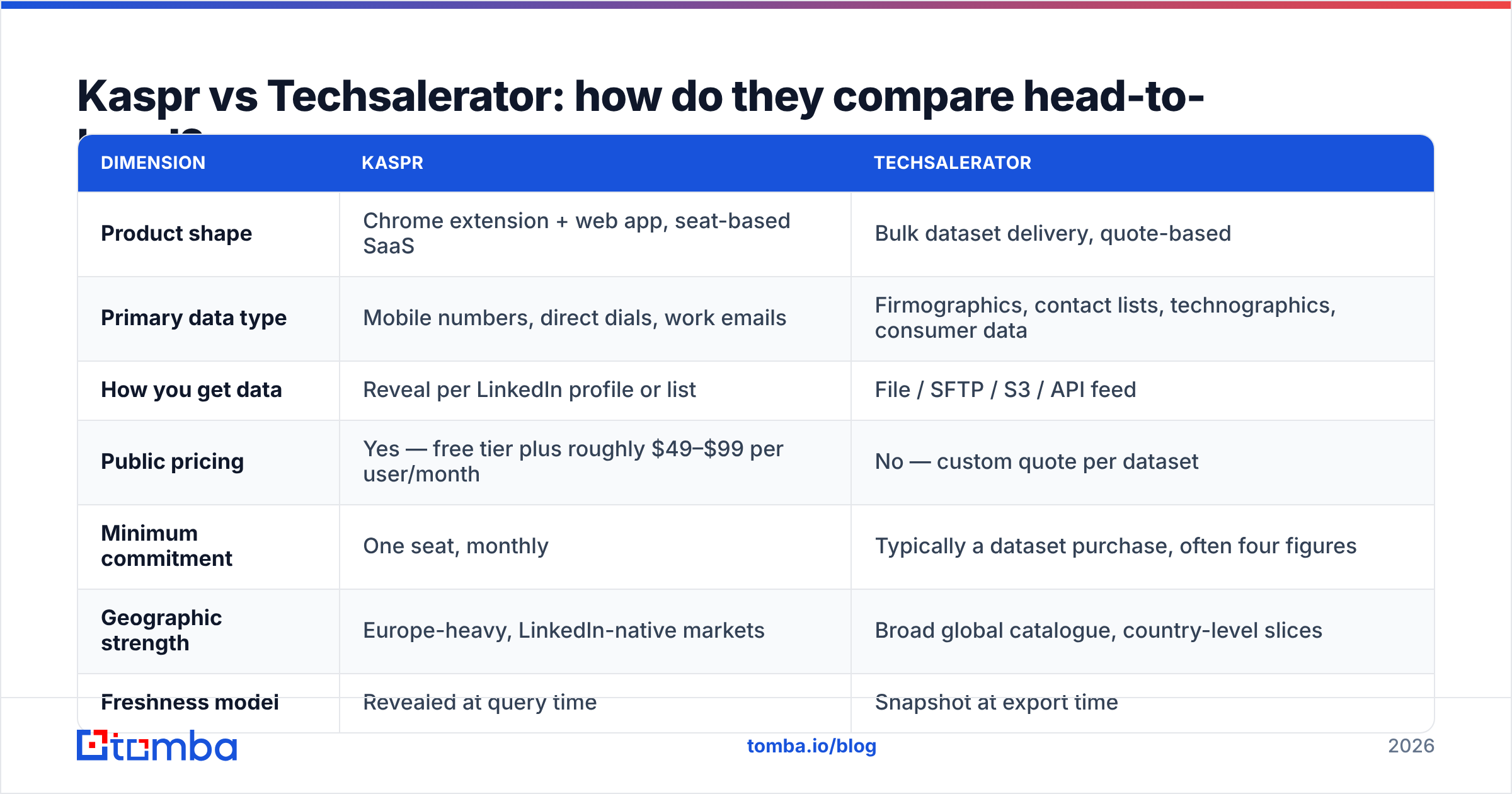
- Market sizing. You want every registered SaaS company in Brazil with 50–500 employees, whether or not anyone on LinkedIn matches.
- Data enrichment against an existing list. You already have 80,000 accounts and need revenue bands and tech stack appended.
- Coverage in regions where LinkedIn is thin. Techsalerator's country-by-country catalogue is far broader than what a LinkedIn-sourced tool can reach.
The trade-off is freshness and accountability. A bulk file is a photograph of a database on the day it was exported. B2B contact data decays at roughly 22–30% per year — people change jobs, companies rebrand, domains migrate — and a static file has no mechanism to tell you which rows went bad last Tuesday.

Kaspr vs Techsalerator: how do they compare head-to-head?#
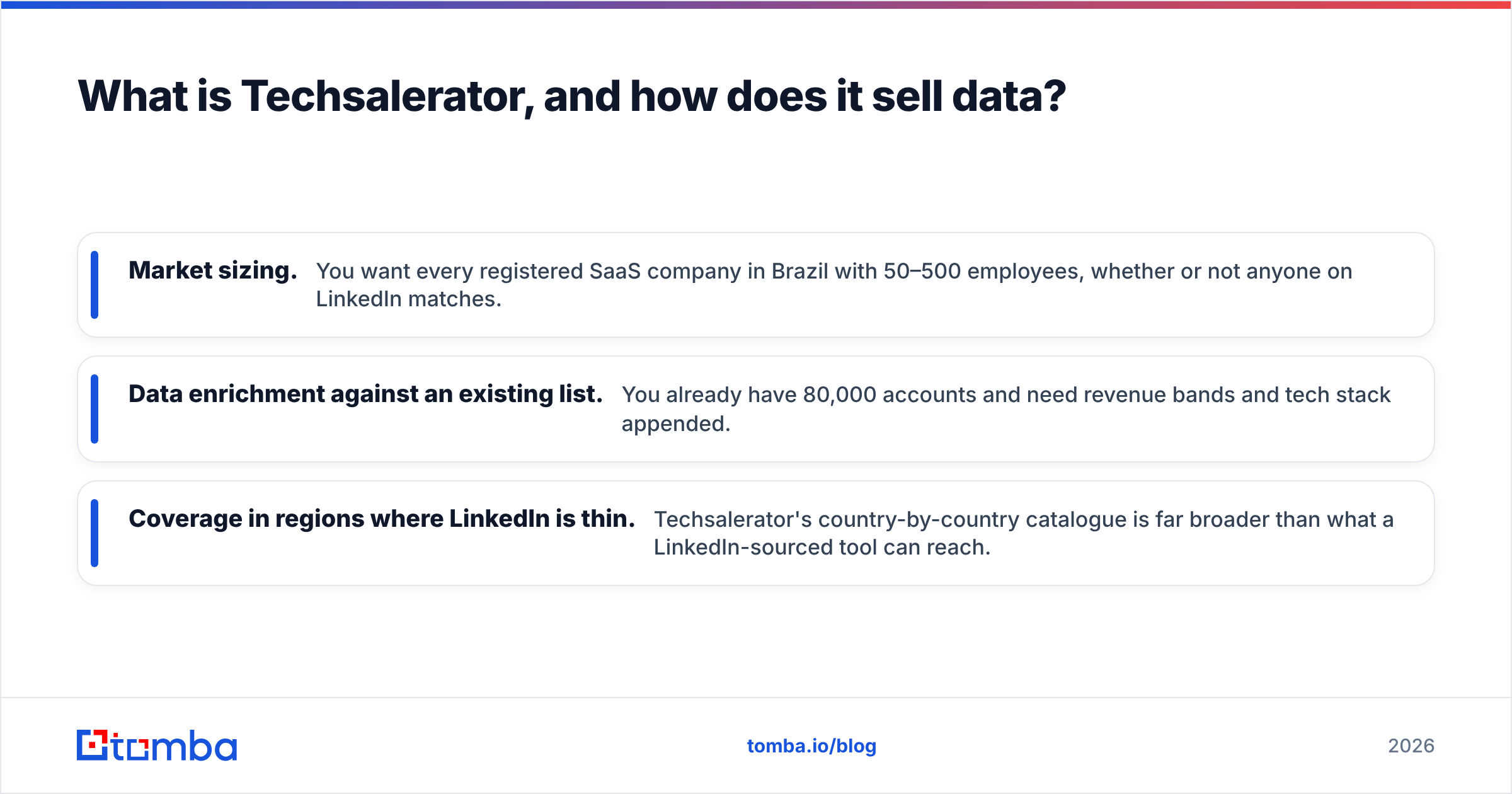
Here is the practical comparison. Prices are what the vendors publish or commonly quote at the time of writing — always confirm directly, since both change.
| Dimension | Kaspr | Techsalerator |
|---|---|---|
| Product shape | Chrome extension + web app, seat-based SaaS | Bulk dataset delivery, quote-based |
| Primary data type | Mobile numbers, direct dials, work emails | Firmographics, contact lists, technographics, consumer data |
| How you get data | Reveal per LinkedIn profile or list | File / SFTP / S3 / API feed |
| Public pricing | Yes — free tier plus roughly $49–$99 per user/month | No — custom quote per dataset |
| Minimum commitment | One seat, monthly | Typically a dataset purchase, often four figures |
| Geographic strength | Europe-heavy, LinkedIn-native markets | Broad global catalogue, country-level slices |
| Freshness model | Revealed at query time | Snapshot at export time |
| Best for | SDRs calling LinkedIn-sourced prospects | RevOps, data teams, market sizing, enrichment |
| Verification included | Some validation, vendor-stated | Varies by dataset; usually your job |
| Self-serve trial | Yes, limited free credits | No standard free trial |
Read that table as a fork, not a scoreboard. If your buying question is "how do I get the mobile number of the VP Ops I just found on LinkedIn," Techsalerator is not competing for that job. If your question is "how do I get 150,000 Nordic logistics contacts into Snowflake by Friday," Kaspr cannot do it at any price.

Which one has better data accuracy?#
Neither vendor publishes an independently audited accuracy figure, so treat every percentage you see in marketing copy as a claim rather than a measurement. What you can reason about is structural accuracy risk, and the two models fail differently.
Kaspr's risk is coverage, not correctness. Because reveals are triggered per profile and sourced partly from a contributory network, hit rates vary enormously by geography and seniority. A French SaaS director might return two mobiles and a work email. A US mid-market plant manager might return nothing. Reps report strong European mobile coverage and patchier North American results — which matches the Cognism family's historical strength in EMEA. Check the recent reviews on G2 for your specific region before committing seats; regional variance is the single most common complaint pattern.
Techsalerator's risk is decay, not coverage. A big file arrives complete and looks impressive in a spreadsheet. The problem is that nobody can tell you the export date of each individual row. If 25% of a 100,000-row file is stale and you load it straight into a sequencer, you have just pointed 25,000 sends at addresses that will bounce or land in a spam trap — and your sender reputation absorbs that damage permanently.

The practical rule for both: never send to a purchased or revealed address you have not verified yourself. Run the file through an independent email verifier first, separate the catch-all domains into their own bucket, and suppress anything unknown. A verification pass on 100,000 records costs less than one week of a damaged domain.
How does pricing really compare?#
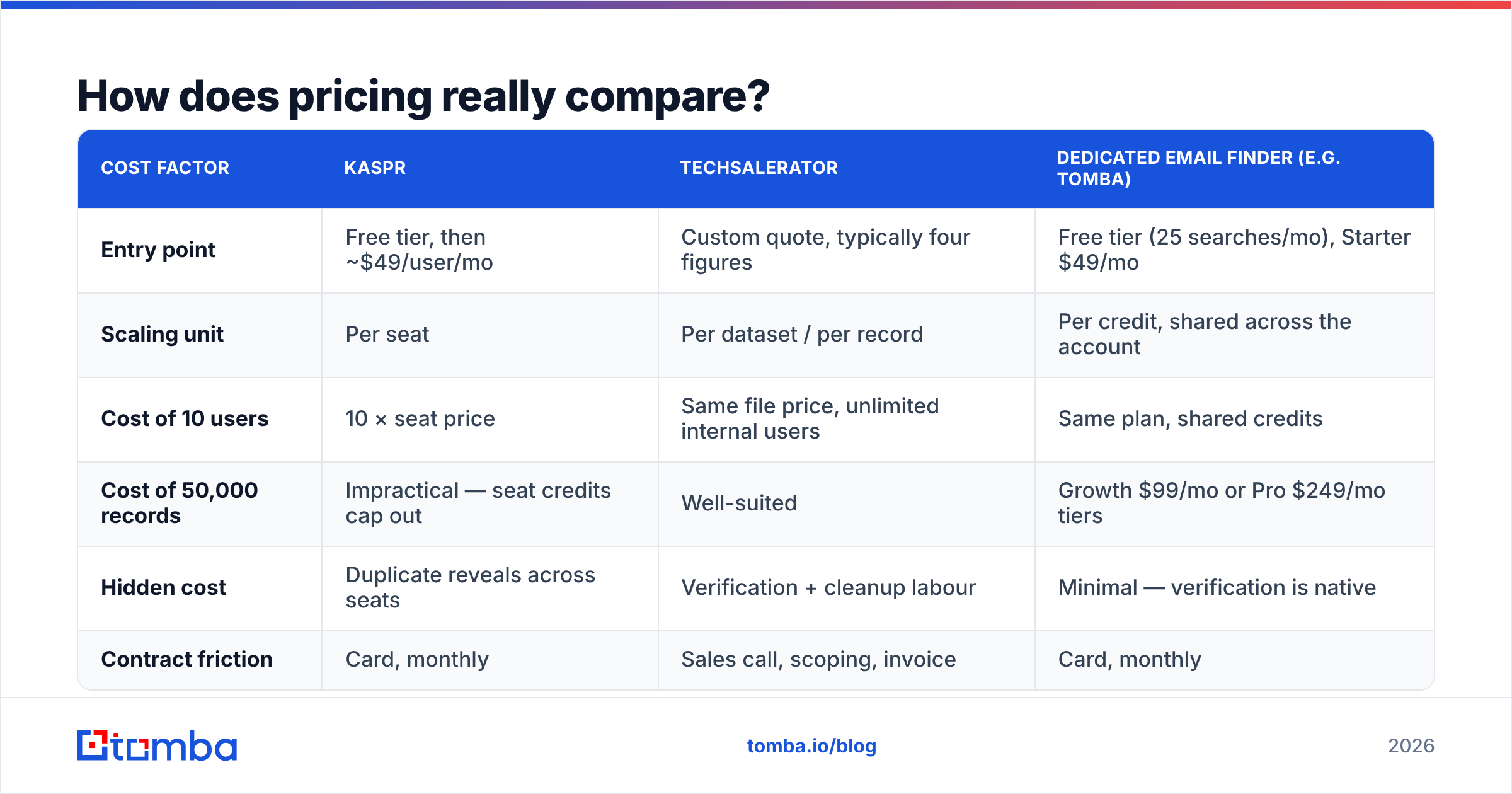
This is where the two models diverge hardest, and where teams most often miscalculate.
| Cost factor | Kaspr | Techsalerator | Dedicated email finder (e.g. Tomba) |
|---|---|---|---|
| Entry point | Free tier, then ~$49/user/mo | Custom quote, typically four figures | Free tier (25 searches/mo), Starter $49/mo |
| Scaling unit | Per seat | Per dataset / per record | Per credit, shared across the account |
| Cost of 10 users | 10 × seat price | Same file price, unlimited internal users | Same plan, shared credits |
| Cost of 50,000 records | Impractical — seat credits cap out | Well-suited | Growth $99/mo or Pro $249/mo tiers |
| Hidden cost | Duplicate reveals across seats | Verification + cleanup labour | Minimal — verification is native |
| Contract friction | Card, monthly | Sales call, scoping, invoice | Card, monthly |
Three cost traps worth naming:
- Seat math beats credit math. Kaspr's list price looks cheap until you multiply by nine reps. A shared-credit model — which is how Tomba pricing works — is usually cheaper past roughly four users doing similar volume.
- Bulk data has a labour tail. The quote is not the cost. Dedup, normalisation, verification, and suppression-list management on a six-figure file routinely consume a week of analyst time.
- Bounce cost is real money. A 12% bounce rate on a cold campaign does not just waste sends; it depresses inbox placement for every subsequent campaign from that domain for months.
Which tool fits which team?#
Use this as the decision shortcut:
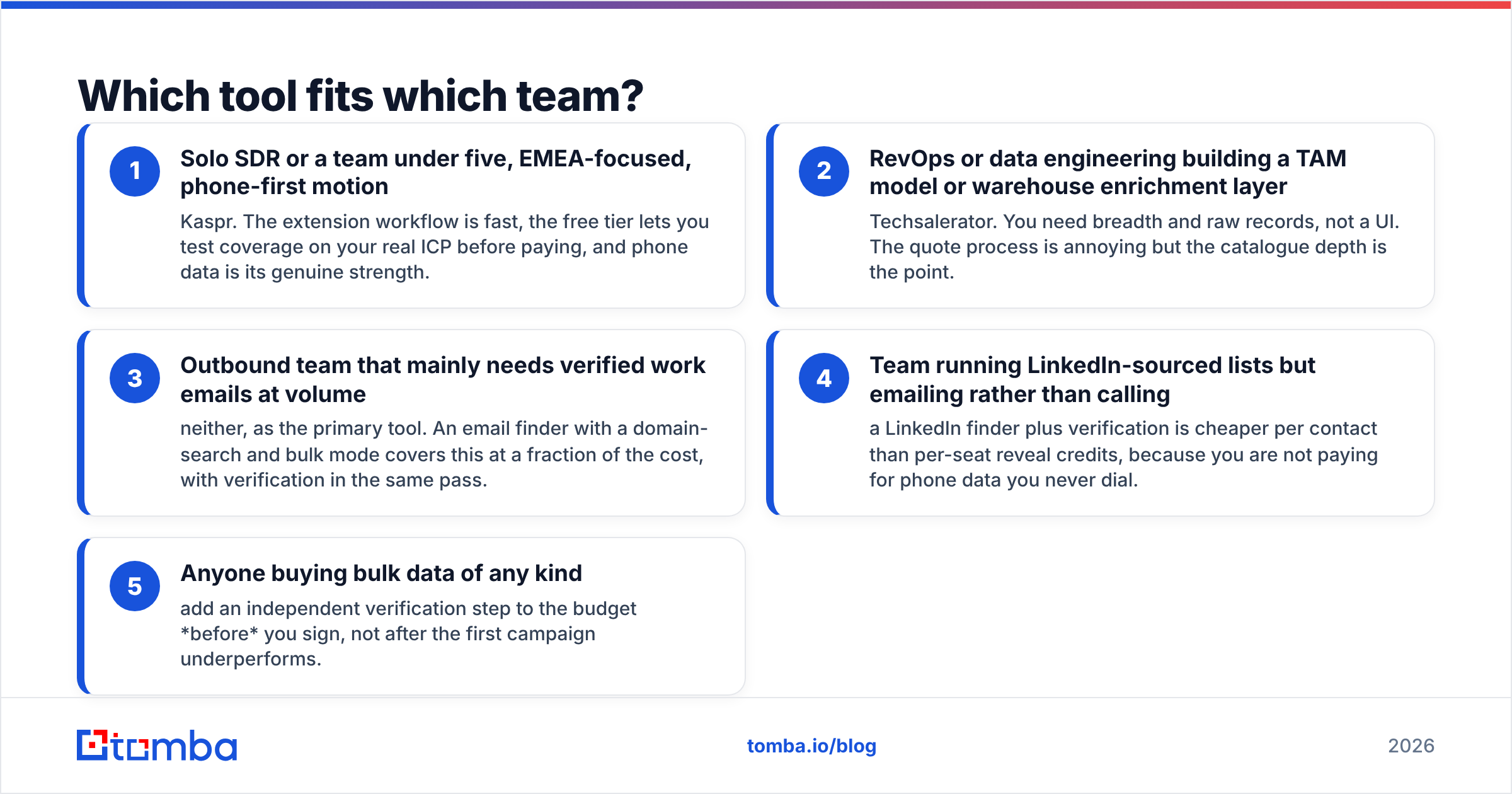
- Solo SDR or a team under five, EMEA-focused, phone-first motion — Kaspr. The extension workflow is fast, the free tier lets you test coverage on your real ICP before paying, and phone data is its genuine strength.
- RevOps or data engineering building a TAM model or warehouse enrichment layer — Techsalerator. You need breadth and raw records, not a UI. The quote process is annoying but the catalogue depth is the point.
- Outbound team that mainly needs verified work emails at volume — neither, as the primary tool. An email finder with a domain-search and bulk mode covers this at a fraction of the cost, with verification in the same pass.
- Team running LinkedIn-sourced lists but emailing rather than calling — a LinkedIn finder plus verification is cheaper per contact than per-seat reveal credits, because you are not paying for phone data you never dial.
- Anyone buying bulk data of any kind — add an independent verification step to the budget before you sign, not after the first campaign underperforms.

What about GDPR and compliance?#
Both vendors operate in a space where compliance is a real constraint, not a checkbox, and the two models carry different exposure.
Kaspr's data includes contributory elements — user-shared contacts — and personal mobile numbers, which are unambiguously personal data under the GDPR. Kaspr publishes compliance documentation and handles opt-out requests, but the legitimate-interest assessment for cold-calling a personal mobile is yours to make and document, not theirs.
Techsalerator resells aggregated data from multiple upstream sources. That makes provenance the key question: for any dataset you buy, ask for the source, the collection basis, the refresh cadence, and whether suppression lists have been applied. Get it in writing in the contract. A reseller's chain of custody is only as strong as its weakest supplier, and "we bought it from a vendor" is not a defence a regulator accepts.
Two operational habits reduce exposure regardless of vendor: keep a permanent global suppression list that survives tool changes, and prefer role-agnostic business emails over personal mobiles when the campaign allows it.
Is there a better third option?#
Often, yes — because the question most teams are actually asking is narrower than either product.
If your outbound motion is email-led, you do not need a bulk consumer-data catalogue and you do not need to pay per seat for phone reveals. You need three things: find the right address, confirm it is deliverable, and do both programmatically so your ops stack can run unattended.
That is a different product category. A focused email finder gives you domain search to map every contactable person at a target company, bulk processing for list work, and an email finder API so enrichment happens inside your workflow instead of in a spreadsheet someone forgets to update. Verification runs in the same pass, which means the bounce problem that haunts bulk files is handled before the data reaches your sequencer.
The realistic setup for a serious team in 2026 is layered, not exclusive:
- Kaspr for phone numbers on high-value, LinkedIn-visible prospects your AEs will actually dial.
- Techsalerator for one-off market-sizing or region-specific datasets you cannot build yourself.
- A dedicated finder and verifier as the always-on layer that keeps email addresses current and deliverable across all of it.
Verdict: which should you buy?#
Buy Kaspr if you are a small, phone-forward team in Europe and your reps live in LinkedIn. Start on the free tier, test coverage against 50 real accounts from your ICP, and only then count seats.
Buy Techsalerator if you need breadth that no extension can reach — a country slice, an industry census, a firmographic append — and you have the analyst time to clean what arrives. Push hard on provenance and refresh date during scoping.
Buy neither as your email layer. Both are legitimate tools with real strengths, and both leave the same gap: an ongoing, verified, API-accessible source of work email addresses that does not decay in a folder.
That is the gap Tomba was built for. Start with the free tier — 25 searches a month, no card — and run the Tomba Email Finder against the same 50 accounts you test Kaspr on. Compare hit rate and bounce rate side by side on your own ICP, not on anyone's marketing page. If the numbers hold, Starter at $49/mo covers most small teams, and the shared-credit model means adding reps does not multiply your bill.
Related guides#
// get started
Find, verify and enrich your first contacts today
Start on the free plan with 25 searches a month, then scale when your team is ready.
Free plan · No credit card required · GDPR & CCPA
// about the author