Kaspr vs Tomba (2026): Phone Data vs Email Accuracy
Kaspr sells LinkedIn phone numbers by the seat. Tomba sells verified email discovery by the credit. We break down accuracy, credit math, GDPR posture, and which one actually belongs in your stack in 2026.
TL;DR
- Kaspr is a LinkedIn-first phone finder. Its core value is mobile numbers pulled while you browse a profile, strongest in France, Benelux, DACH, and the UK. It is owned by Cognism, which shapes both its data sources and its compliance posture.
- Tomba is a domain-first email finder. You give it a company domain or a name, and it returns verified professional email addresses — plus verification, catch-all handling, enrichment, and an API that runs without a browser open.
- The pricing models are not comparable on sticker price. Kaspr charges per seat with separate phone, direct-email, and export credit buckets. Tomba charges per plan with a single pooled credit balance: Free (25 searches/mo), Starter $49/mo, Growth $99/mo, Pro $249/mo.
- Pick Kaspr if cold calling EMEA prospects is the job. Pick Tomba if email is your primary channel, you work from domain lists rather than LinkedIn tabs, or you need programmatic enrichment.
- Most teams that run both use Kaspr for dialer-ready numbers on named accounts and Tomba for bulk, API-driven email discovery and list hygiene.
What is Kaspr and who is it built for?#
Kaspr is a contact-data tool built around a Chrome extension that overlays LinkedIn. You open a profile, the sidebar fires, and it surfaces phone numbers, professional emails, and sometimes personal emails for that person. It also works on LinkedIn Sales Navigator lists and group members, so you can bulk-enrich a search result instead of clicking one profile at a time.
The company is French, founded in 2018, and was acquired by Cognism in 2022. That acquisition matters for two reasons. First, it pushed Kaspr's data quality up in Europe, where Cognism has historically been strong. Second, it anchored Kaspr's positioning as the SMB, self-serve, lower-price entry point into the Cognism family — Cognism sells annual enterprise contracts, Kaspr sells credit card signups.
Kaspr's centre of gravity is the phone number. If your SDRs live in a dialer and their day is measured in connects, that is the product they want. Everything else in the tool — the lead lists, the basic sequencing, the CRM push into HubSpot, Pipedrive, and Salesforce — exists to keep a caller moving.
The constraint is equally clear: Kaspr is LinkedIn-shaped. Your workflow starts with a profile or a Sales Navigator search. If your prospect is not on LinkedIn, or if you are working from a list of 4,000 domains from a trade show export, the extension does not have an obvious entry point.
What is Tomba and how does it differ?#
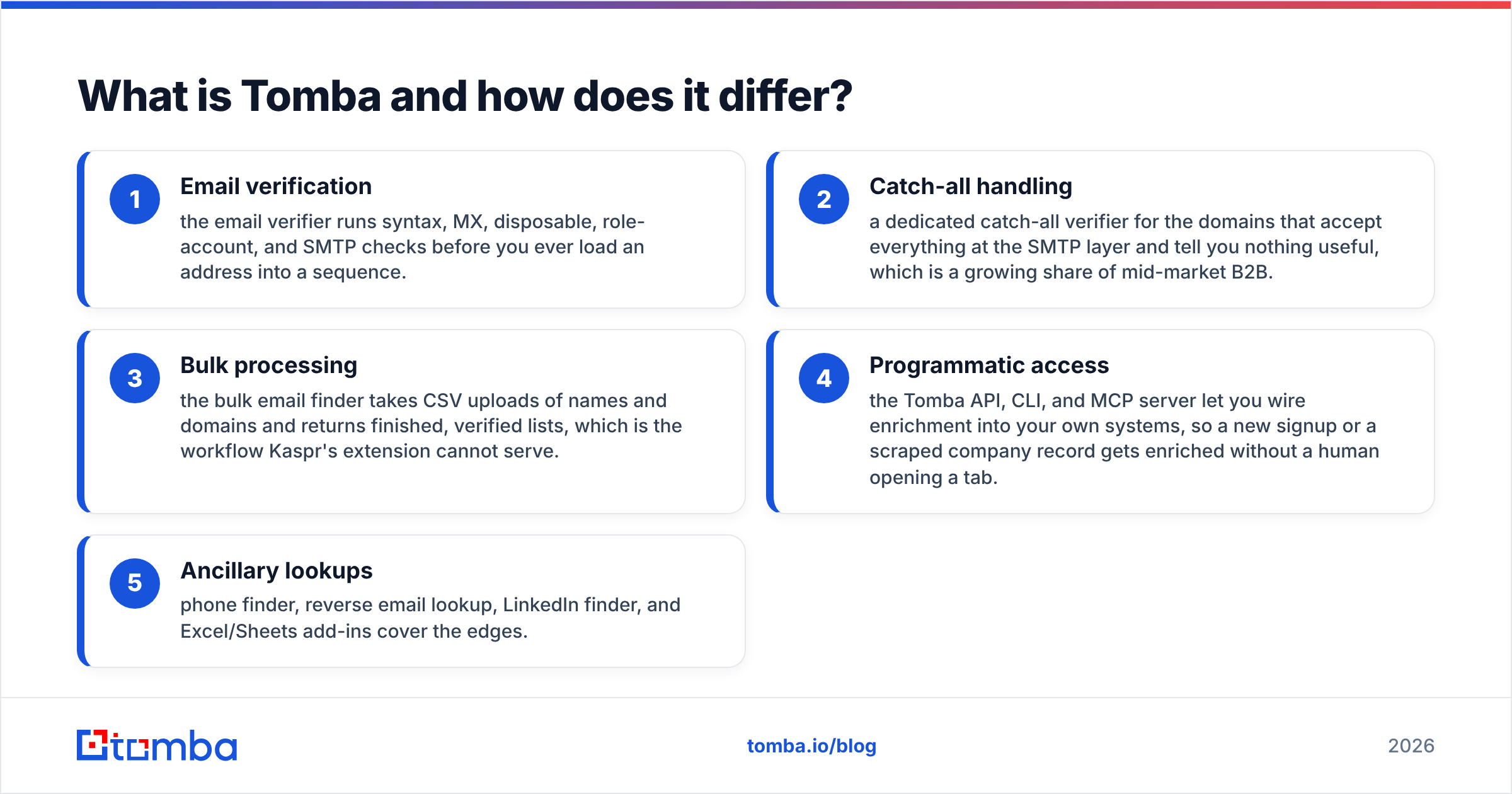
Tomba starts from the domain, not the profile. The core product is the email finder: give it a company domain plus a first and last name, and it returns the most likely professional address with a confidence score and the sources it matched against. The complementary domain search inverts that — hand it stripe.com and get back the people it knows there, grouped by department, with the company's dominant email pattern detected automatically.
Around that core sit the pieces that make email actually usable at volume:
- Email verification — the email verifier runs syntax, MX, disposable, role-account, and SMTP checks before you ever load an address into a sequence.
- Catch-all handling — a dedicated catch-all verifier for the domains that accept everything at the SMTP layer and tell you nothing useful, which is a growing share of mid-market B2B.
- Bulk processing — the bulk email finder takes CSV uploads of names and domains and returns finished, verified lists, which is the workflow Kaspr's extension cannot serve.
- Programmatic access — the Tomba API, CLI, and MCP server let you wire enrichment into your own systems, so a new signup or a scraped company record gets enriched without a human opening a tab.
- Ancillary lookups — phone finder, reverse email lookup, LinkedIn finder, and Excel/Sheets add-ins cover the edges.
So the honest framing of kaspr vs tomba is not "which is better." It is: does your pipeline start with a person on LinkedIn, or a company on a list?
How do Kaspr and Tomba compare feature by feature?#
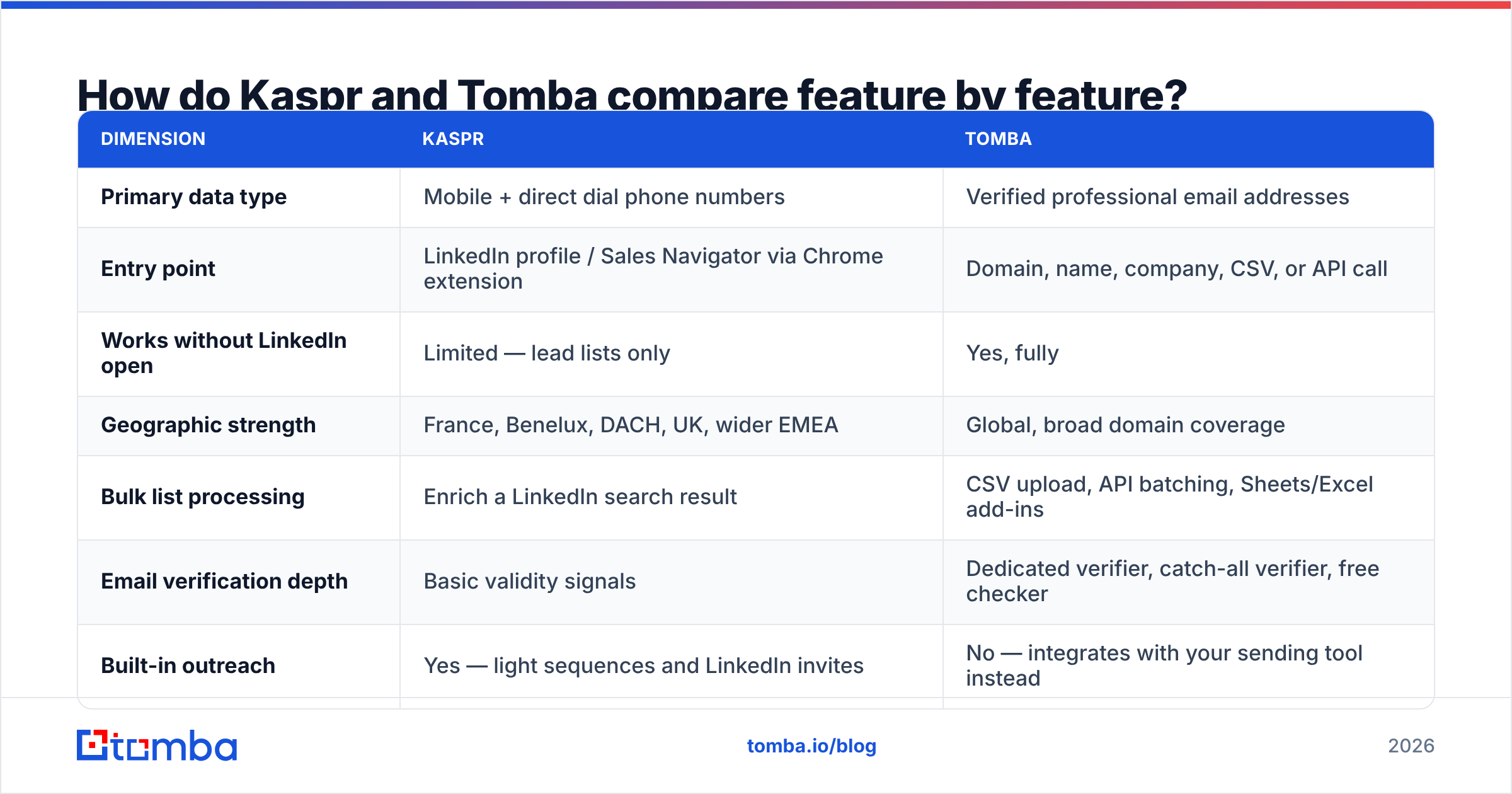
| Dimension | Kaspr | Tomba |
|---|---|---|
| Primary data type | Mobile + direct dial phone numbers | Verified professional email addresses |
| Entry point | LinkedIn profile / Sales Navigator via Chrome extension | Domain, name, company, CSV, or API call |
| Works without LinkedIn open | Limited — lead lists only | Yes, fully |
| Geographic strength | France, Benelux, DACH, UK, wider EMEA | Global, broad domain coverage |
| Bulk list processing | Enrich a LinkedIn search result | CSV upload, API batching, Sheets/Excel add-ins |
| Email verification depth | Basic validity signals | Dedicated verifier, catch-all verifier, free checker |
| Built-in outreach | Yes — light sequences and LinkedIn invites | No — integrates with your sending tool instead |
| Developer surface | REST API on higher tiers | Public API, CLI, MCP server, Zapier, Make |
| Credit model | Separate phone / direct email / export buckets, per seat | One pooled search+verify balance per account |
| Free tier | Limited monthly credits, per user | 25 searches/mo |
The row worth staring at is the credit model. Kaspr's buckets are the single most common source of surprise in reviews on G2 — teams burn phone credits fast, still have export credits left over, and discover the two do not convert into each other. Tomba's pooled balance is simpler to forecast, which is why its pricing page reads like a single number rather than a matrix.
The second row worth noting is built-in outreach. Kaspr includes lightweight sequencing; Tomba deliberately does not. If you already run Instantly, Smartlead, Lemlist, or Outreach, Tomba's abstention is a feature — you get clean data and keep your sending stack. If you are a two-person team who wants one login to do everything, Kaspr's bundling is genuinely convenient.
How accurate is each tool's data, really?#
Accuracy claims in this category are close to worthless in the abstract. Every vendor publishes a number in the 90s, and every number is measured against a sample that flatters the vendor. What matters is accuracy on your ICP, in your geography, for your channel.

A few patterns hold up across independent testing:
- Phone accuracy degrades faster than email accuracy. People change mobile numbers less often than jobs, but the link between a person and a number is reconstructed from messier sources. Expect a wider spread on phone data than on email — and expect Kaspr to do noticeably better in Western Europe than in APAC or LATAM.
- Email accuracy is mostly a verification problem, not a discovery problem. Guessing
first.last@domain.comis trivial; knowing whether that mailbox exists is the hard part. This is where a dedicated verification layer earns its keep, and where tools that return an address with no confidence signal cost you deliverability. - Catch-all domains are the real accuracy tax in 2026. A rising share of B2B domains accept all mail at the SMTP layer, which defeats naive verification. If a vendor reports catch-all addresses as "valid," its headline accuracy figure is inflated. Tomba splits these into their own category and offers the catch-all finder rather than pretending the problem does not exist.
- Bounce rate is your only real benchmark. Run 200 contacts from each tool through the same sequence, same domain, same week. The bounce delta is the answer. Everything else is marketing.
Before you trust any vendor's number, read how they source and refresh records. Tomba documents its data sources publicly; Cognism and Kaspr publish their compliance and notification process. Both are worth ten minutes of reading.
How does pricing really work on each tool?#

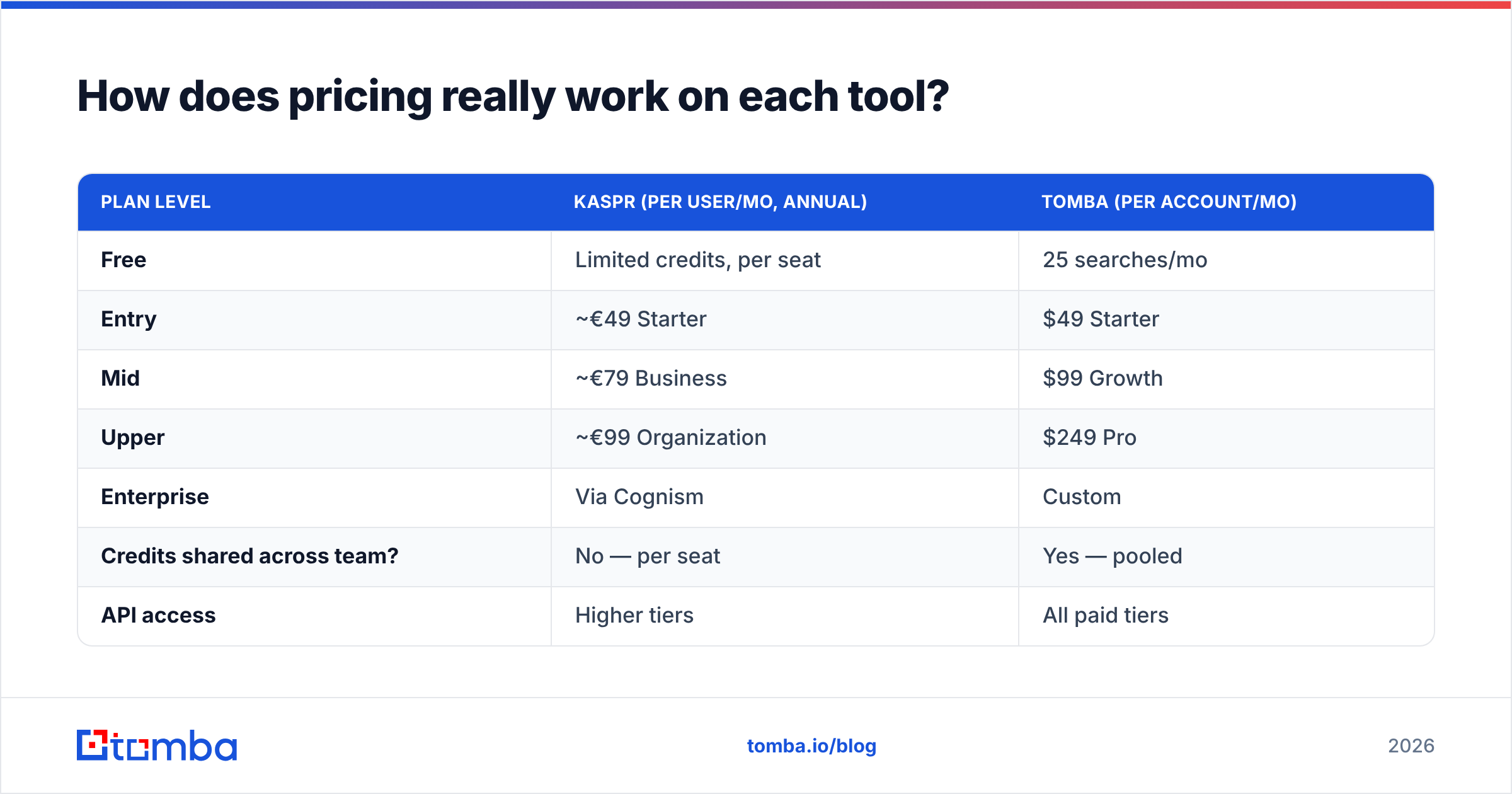
Here is the comparison people actually search for. Kaspr's published plans are per user per month, typically quoted with an annual commitment; Tomba's are per account.
| Plan level | Kaspr (per user/mo, annual) | Tomba (per account/mo) |
|---|---|---|
| Free | Limited credits, per seat | 25 searches/mo |
| Entry | ~€49 Starter | $49 Starter |
| Mid | ~€79 Business | $99 Growth |
| Upper | ~€99 Organization | $249 Pro |
| Enterprise | Via Cognism | Custom |
| Credits shared across team? | No — per seat | Yes — pooled |
| API access | Higher tiers | All paid tiers |
Always check the vendor's live pricing page before budgeting; both companies revise tiers, and annual-versus-monthly differences are significant.
The structural difference is the multiplier. A five-person SDR team on Kaspr's mid tier is five seats. The same five people sharing a Tomba Growth plan draw from one balance — the person doing research-heavy account mapping this week can consume more than the person who is heads-down calling, without anyone provisioning a new licence. For a solo founder the two look similar. At eight seats they do not.
The countervailing point, stated fairly: if every one of those five people genuinely needs mobile numbers every day, Kaspr's per-seat price buys a data type Tomba's core product is not built to deliver at the same depth. Paying per seat for something you use daily is not waste. Paying per seat for occasional use is.
Which tool fits your workflow?#
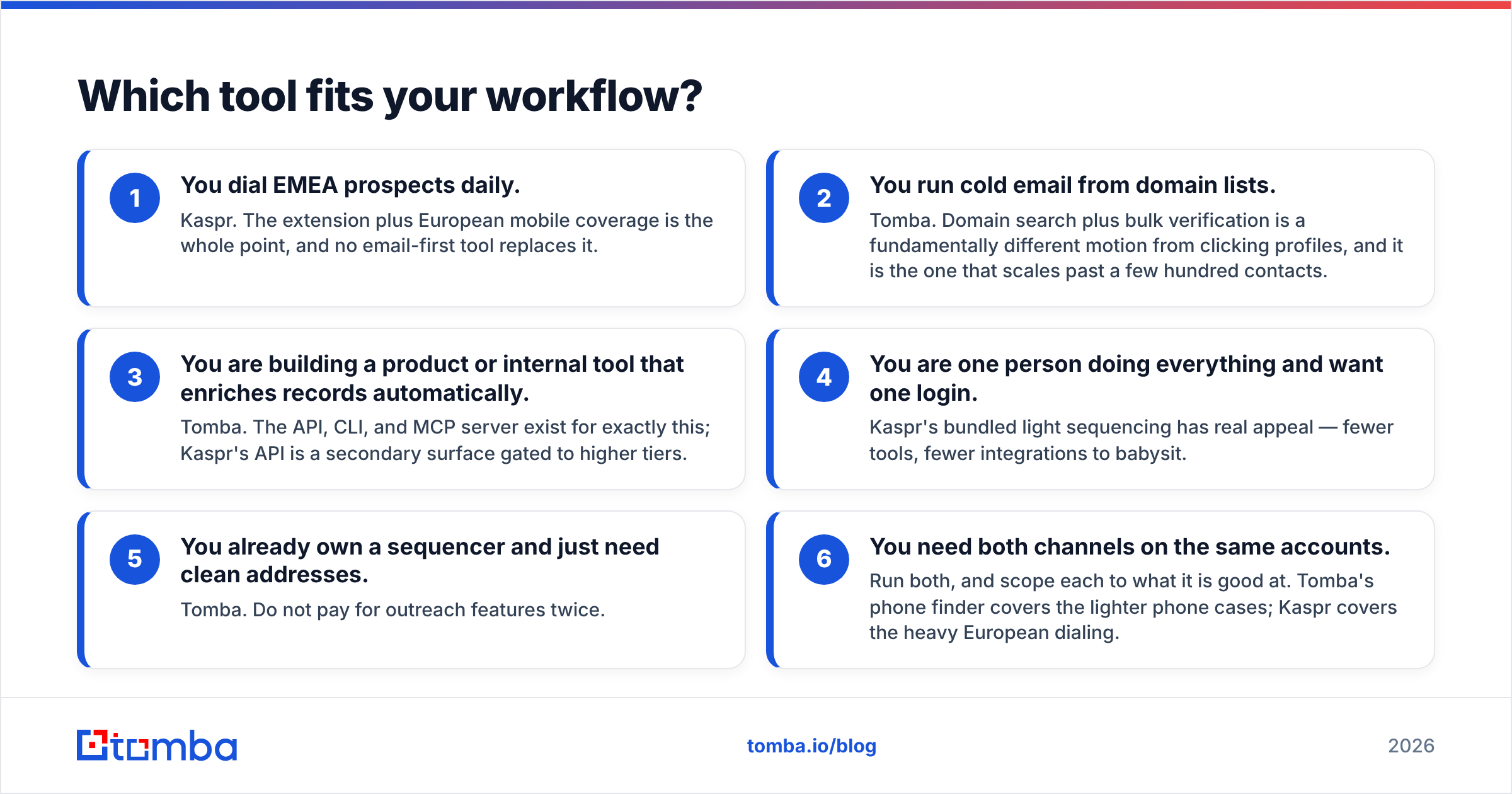
Choose based on where your day starts.
- You dial EMEA prospects daily. Kaspr. The extension plus European mobile coverage is the whole point, and no email-first tool replaces it.
- You run cold email from domain lists. Tomba. Domain search plus bulk verification is a fundamentally different motion from clicking profiles, and it is the one that scales past a few hundred contacts.
- You are building a product or internal tool that enriches records automatically. Tomba. The API, CLI, and MCP server exist for exactly this; Kaspr's API is a secondary surface gated to higher tiers.
- You are one person doing everything and want one login. Kaspr's bundled light sequencing has real appeal — fewer tools, fewer integrations to babysit.
- You already own a sequencer and just need clean addresses. Tomba. Do not pay for outreach features twice.
- You need both channels on the same accounts. Run both, and scope each to what it is good at. Tomba's phone finder covers the lighter phone cases; Kaspr covers the heavy European dialing.
Where does each tool clearly win?#
Kaspr wins on: LinkedIn-native workflow speed, European mobile number depth, GDPR-forward positioning inherited from Cognism, bundled lightweight outreach, and the simple fact that an SDR can learn it in ten minutes.
Tomba wins on: cost predictability at team size, bulk and programmatic throughput, verification depth including catch-all handling, breadth of adjacent tools (enrichment, reverse lookup, author finder, free utilities), and global rather than EMEA-weighted domain coverage.
Neither wins on: being your only data source. Every provider has coverage holes, and the teams with the best connect rates are the ones that layer two or three sources and measure bounce and connect rates per source rather than arguing about vendor accuracy claims. If your ICP is a niche vertical, a specialist database — a verticalised provider like BookYourData, for example — may beat both on that specific slice, and that is fine. Buy for coverage of your list, not for the logo.
What about compliance and data sourcing?#
Both vendors operate under GDPR, and both will tell you so. The practical questions to ask in a trial are the same for either:
- How do you notify data subjects whose records you hold, and how fast do deletion requests process?
- Where did this specific record come from, and when was it last refreshed?
- Do you distinguish personal email addresses from business ones in the export, so my team can exclude the former?
- What happens to contacts I exported if a record is later deleted upstream?
Kaspr's answers lean on Cognism's compliance infrastructure. Tomba's lean on documented public-source aggregation plus verification. Get the answers in writing during the trial rather than from a pricing page, and check how your own legal team treats personal mobile numbers under local rules — in several European jurisdictions the phone data that makes Kaspr attractive carries obligations that email does not.
Can you run both without wasting money?#
Yes, and it is the most common outcome for teams above roughly ten reps. The split that works:
- Tomba runs the list-building layer. Domain search to map accounts, bulk find plus verify to produce a clean email file, API enrichment on inbound signups and CRM records. This is machine work and should not consume seats.
- Kaspr runs the caller layer. Assign seats only to reps who dial, on named accounts that have already been qualified, so phone credits go to prospects worth a conversation rather than to speculative enrichment.
- Your sequencer stays independent. Neither tool should be the thing sending mail if you already have a warmed sending infrastructure — data tools and sending tools have different failure modes, and coupling them makes both harder to debug.
Track cost per connect for the Kaspr side and cost per verified, non-bouncing contact for the Tomba side. Those two numbers, reviewed quarterly, will tell you far more than any comparison post — including this one — about where the next dollar belongs.

The verdict#
If your team's revenue comes from conversations that start with a ringing phone in Europe, Kaspr is the more direct answer and the per-seat price is defensible. If your revenue comes from email at volume, from domain-first research, or from systems that need to enrich contacts without a human in the loop, Tomba is both cheaper per contact and structurally better suited — pooled credits, real verification, and an API on every paid tier.
Start where the risk is lowest: run the same 200 target accounts through both, compare bounce rate and connect rate after two weeks, and let the numbers decide. Tomba's free tier gives you 25 searches a month with no card, so the test costs you nothing but an afternoon.
Ready to test it on your own list? Run your next 200 target accounts through the Tomba Email Finder, verify them in the same pass, and measure the bounce rate against whatever you are using today. If the numbers hold up, scale it on the $49 Starter plan — no per-seat math required.
Related guides#
// get started
Find, verify and enrich your first contacts today
Start on the free plan with 25 searches a month, then scale when your team is ready.
Free plan · No credit card required · GDPR & CCPA
Get the Tomba newsletter
Product and data updates
// about the author