Kaspr vs Verimail (2026): Which One Fits Your Workflow?
Kaspr finds contact data on LinkedIn. Verimail cleans the emails you already have. Here is the honest breakdown of pricing, accuracy, and which one actually belongs in your 2026 outbound stack.
TL;DR
- Kaspr and Verimail are not really competitors. Kaspr is a LinkedIn-first contact finder (phones + emails). Verimail is an email verification engine that cleans lists you already own.
- Pick Kaspr if your pipeline starts with LinkedIn profiles and you need mobile numbers. Pick Verimail if your problem is bounce rate on lists you sourced elsewhere.
- Running both means two subscriptions, two credit systems, and two dashboards to reconcile — before you have sent a single email.
- If you want find + verify in one place with one credit pool, a combined platform like Tomba covers both jobs starting at $49/mo (with a free tier at 25 searches/mo).
- The real decision is not "which tool is better" — it is "which half of the data problem is actually costing me money right now."
What Are Kaspr and Verimail, Really?#
They sit at opposite ends of the same pipeline.
Kaspr is a Chrome extension and web app built around LinkedIn. You open a profile, a LinkedIn Sales Navigator list, or a LinkedIn group, click the extension, and Kaspr returns the person's professional email and — its headline feature — direct mobile phone numbers. It was acquired by Cognism in 2022 and now functions as the lighter, self-serve entry point into that ecosystem. Its natural user is an SDR or founder who prospects by browsing LinkedIn, not by uploading CSVs.
Verimail is an email validation service. You give it addresses you already have — from a form, a CRM export, a scraped list, a purchased file — and it tells you which ones are deliverable, which will hard bounce, which are role accounts (info@, sales@), which are disposable, and which sit on catch-all domains it cannot definitively confirm. It ships as a bulk uploader plus a real-time API for validating addresses at the point of signup.
The everyday analogy: Kaspr is the person who finds you phone numbers in a crowded conference hall. Verimail is the person who checks the guest list before you send 5,000 invitations. Technically, one is a data acquisition layer and the other is a data hygiene layer. Asking which is better is like asking whether a tap is better than a filter.
That distinction matters because most teams searching "kaspr vs verimail" have already made a silent assumption — that one tool will solve their whole data problem. Neither will, on its own.
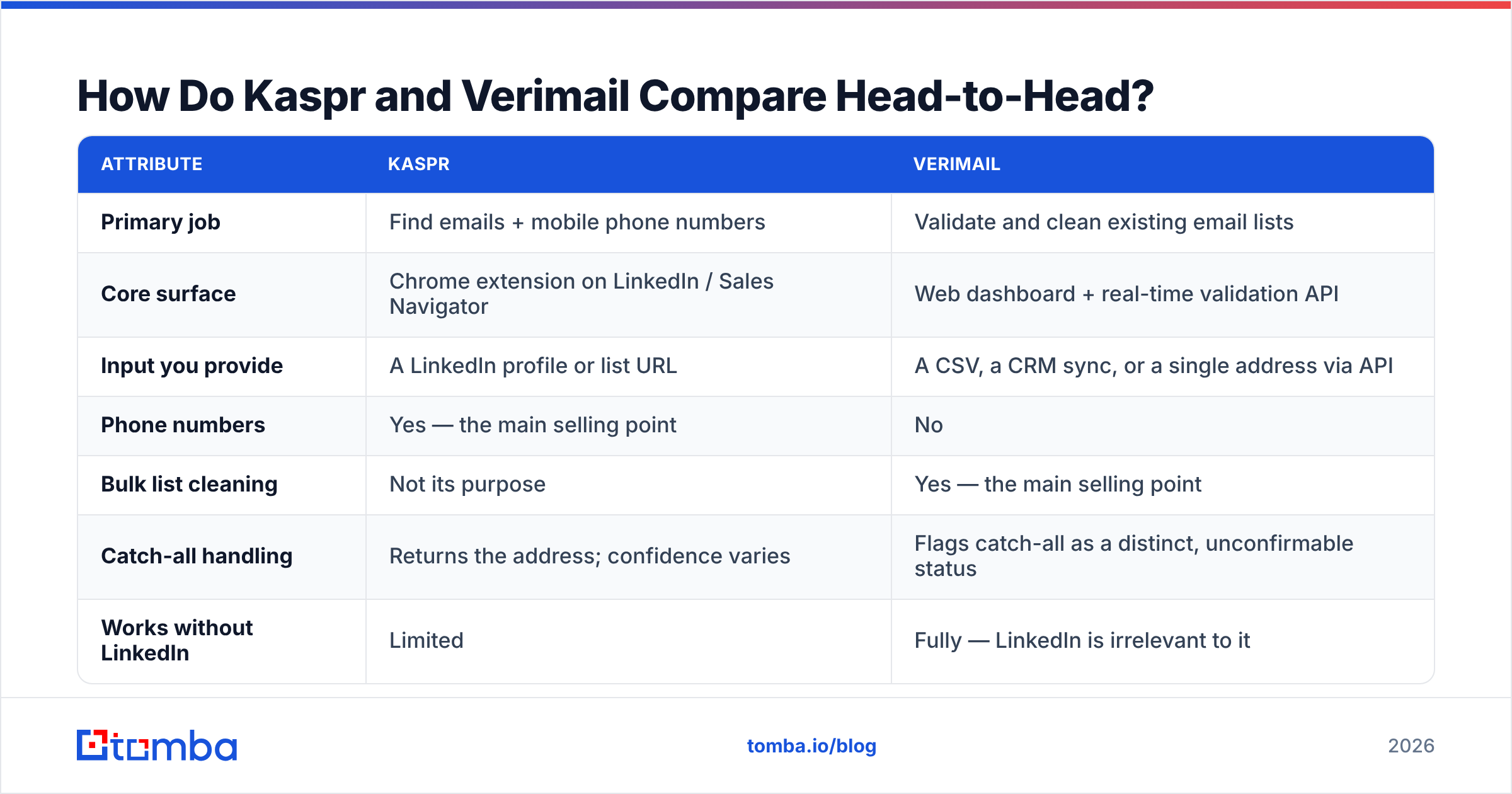
How Do Kaspr and Verimail Compare Head-to-Head?#
| Attribute | Kaspr | Verimail |
|---|---|---|
| Primary job | Find emails + mobile phone numbers | Validate and clean existing email lists |
| Core surface | Chrome extension on LinkedIn / Sales Navigator | Web dashboard + real-time validation API |
| Input you provide | A LinkedIn profile or list URL | A CSV, a CRM sync, or a single address via API |
| Phone numbers | Yes — the main selling point | No |
| Bulk list cleaning | Not its purpose | Yes — the main selling point |
| Catch-all handling | Returns the address; confidence varies | Flags catch-all as a distinct, unconfirmable status |
| Works without LinkedIn | Limited | Fully — LinkedIn is irrelevant to it |
| Typical buyer | SDR, founder-led sales, recruiter | Email marketer, RevOps, growth engineer |
| Free tier | Limited free credits (LinkedIn account required) | Small free verification allowance |
| Sits where in funnel | Top — list building | Middle — pre-send hygiene |
Read that table twice before comparing prices. Two-thirds of the rows are not overlapping features; they are different products. The only genuine overlap is that both tools touch email addresses.

What Does Kaspr Actually Do Well?#
Mobile numbers at self-serve pricing. Direct dials are the expensive part of B2B data. Enterprise providers gate them behind annual contracts with seat minimums. Kaspr sells them per credit to a single user with a credit card, which is why founders and solo SDRs like it.
Speed inside the LinkedIn workflow. If your prospecting motion is "search Sales Navigator, scroll, qualify by profile," Kaspr removes the context switch entirely. You never leave the tab. That is a real productivity gain that spec sheets do not capture.
Bulk enrichment from LinkedIn lists. You can run it across a Sales Navigator search result or a LinkedIn event attendee list rather than one profile at a time.
Where it gets uncomfortable:
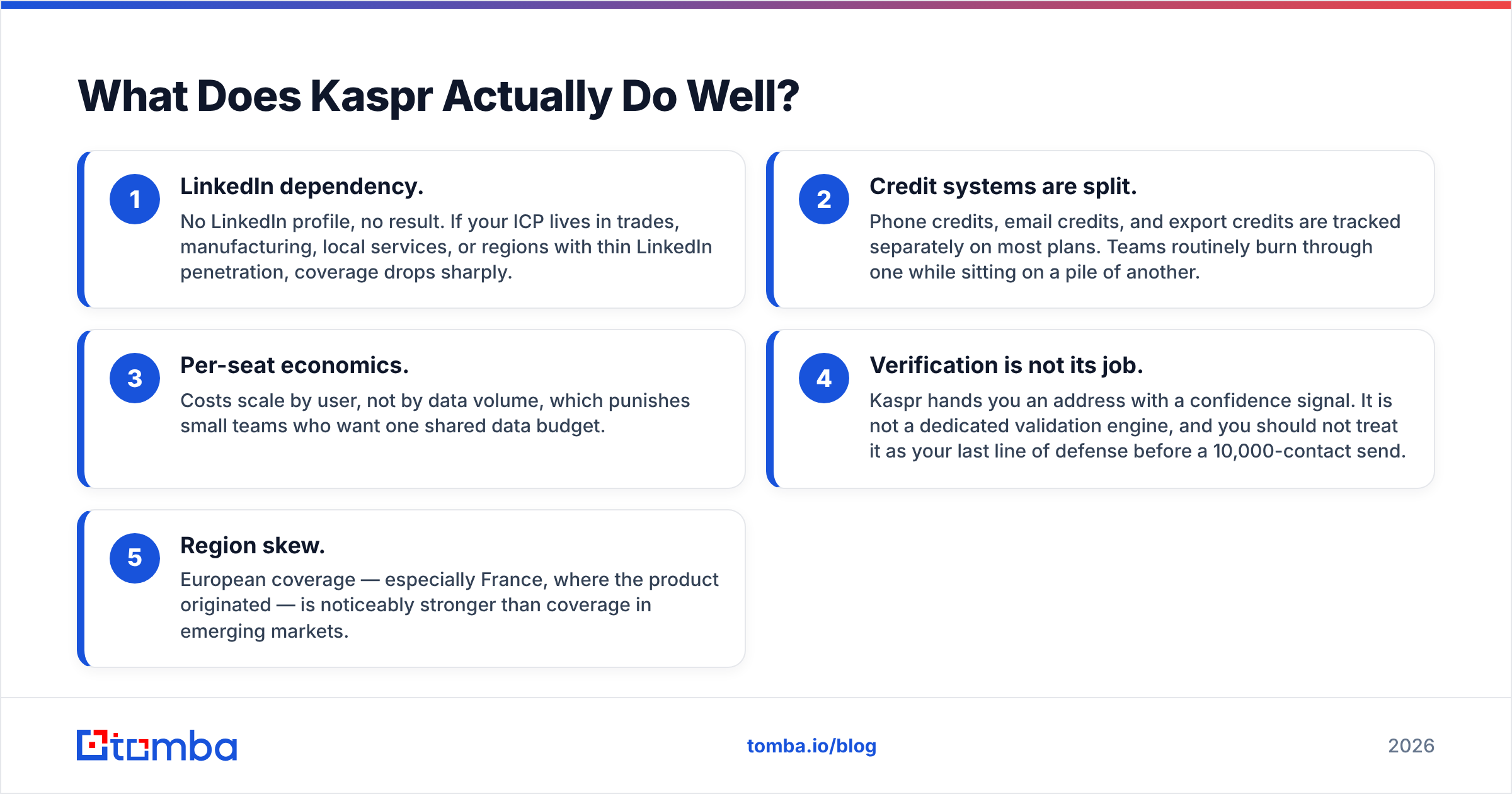
- LinkedIn dependency. No LinkedIn profile, no result. If your ICP lives in trades, manufacturing, local services, or regions with thin LinkedIn penetration, coverage drops sharply.
- Credit systems are split. Phone credits, email credits, and export credits are tracked separately on most plans. Teams routinely burn through one while sitting on a pile of another.
- Per-seat economics. Costs scale by user, not by data volume, which punishes small teams who want one shared data budget.
- Verification is not its job. Kaspr hands you an address with a confidence signal. It is not a dedicated validation engine, and you should not treat it as your last line of defense before a 10,000-contact send.
- Region skew. European coverage — especially France, where the product originated — is noticeably stronger than coverage in emerging markets.
For a broader view of LinkedIn-sourced data workflows, a LinkedIn finder that works from profile URLs without a browser extension can be a useful comparison point, since extension-based tools are subject to LinkedIn's own rate limiting and account-safety rules. You can read Kaspr's own positioning on kaspr.io.
What Does Verimail Actually Do Well?#
It answers the one question that decides your deliverability: will this bounce?
Verimail runs the standard validation stack — syntax check, domain and MX record lookup, SMTP-level mailbox probing, disposable-domain detection, role-account flagging, and catch-all identification. The output is a status per address plus a reason code, which is what you need to make an actual routing decision instead of guessing.
The parts that genuinely matter:
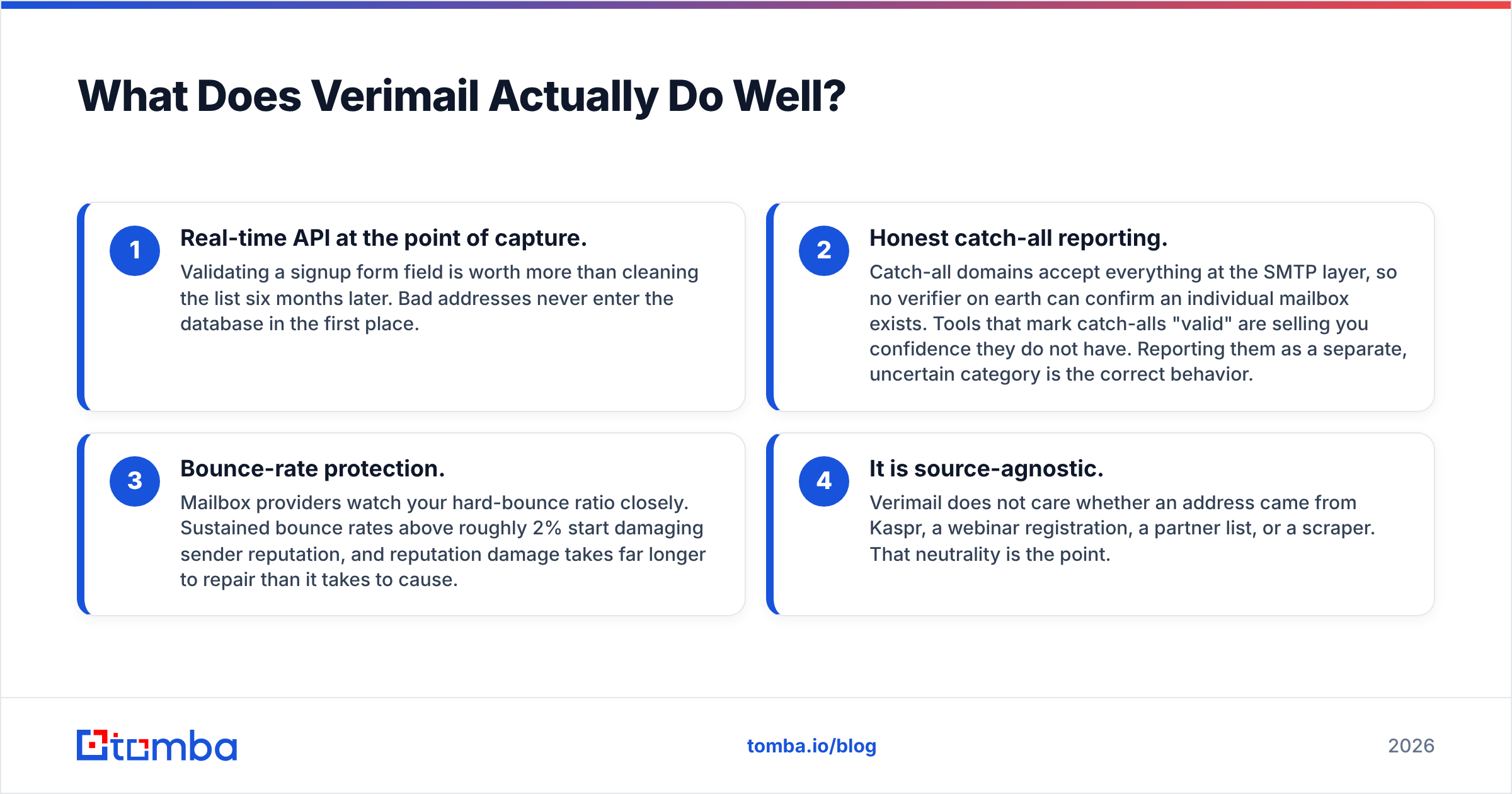
- Real-time API at the point of capture. Validating a signup form field is worth more than cleaning the list six months later. Bad addresses never enter the database in the first place.
- Honest catch-all reporting. Catch-all domains accept everything at the SMTP layer, so no verifier on earth can confirm an individual mailbox exists. Tools that mark catch-alls "valid" are selling you confidence they do not have. Reporting them as a separate, uncertain category is the correct behavior.
- Bounce-rate protection. Mailbox providers watch your hard-bounce ratio closely. Sustained bounce rates above roughly 2% start damaging sender reputation, and reputation damage takes far longer to repair than it takes to cause.
- It is source-agnostic. Verimail does not care whether an address came from Kaspr, a webinar registration, a partner list, or a scraper. That neutrality is the point.
Where it falls short: it will never hand you a new contact. If your list is empty, Verimail has nothing to work with. It also does no enrichment — no job titles, no company size, no phone numbers. It is a filter, not a tap. Check current capabilities on verimail.io.
Which One Is More Accurate — and Is That Even the Right Question?#
Accuracy means two different things here, and conflating them is how teams end up disappointed.
For Kaspr, accuracy means coverage plus correctness: out of 100 LinkedIn profiles, how many return a contact detail, and how many of those details are actually current? Coverage rates swing hard by geography and seniority. VP-level contacts at mid-market SaaS companies in Western Europe will hit far more often than operations managers at regional logistics firms.
For Verimail, accuracy means classification precision: out of 100 addresses with known outcomes, how many did it label correctly, and — the metric nobody advertises — how many deliverable addresses did it wrongly mark as invalid? That second number is the expensive one. A verifier that discards 8% of your good contacts to look tough on bounce rate is quietly deleting pipeline.

Three rules for evaluating either tool honestly:
- Test on your own ICP, never on the vendor's sample. Every provider's demo list is curated to their strongest segment.
- Use a control set of 200–300 addresses you already know are live. Measure false negatives, not just bounce reduction.
- Treat catch-alls separately. Score them as their own bucket or your accuracy numbers will be meaningless. A dedicated catch-all verifier applies pattern analysis and historical signals to raise confidence on those domains rather than pretending the uncertainty does not exist.
Anyone quoting a single "98% accurate" figure across all domains, all regions, and all seniority levels is quoting marketing, not measurement. Independent user reviews on G2 are a better sanity check than any vendor page, including this one.
How Much Do Kaspr and Verimail Cost in 2026?#
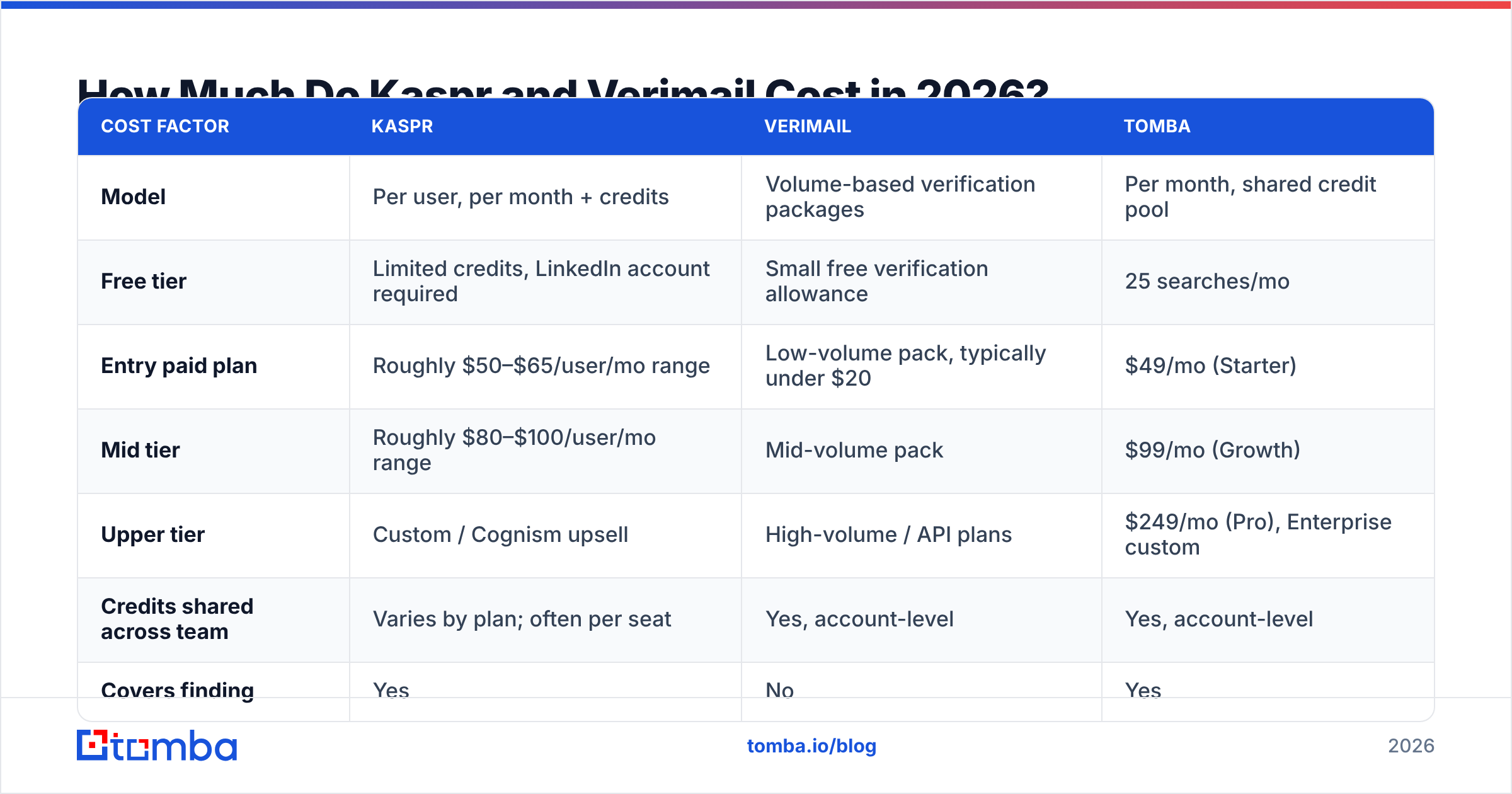
Both vendors adjust pricing regularly, so treat these as shape-of-the-market figures and confirm on the vendor pages before you buy.
| Cost factor | Kaspr | Verimail | Tomba |
|---|---|---|---|
| Model | Per user, per month + credits | Volume-based verification packages | Per month, shared credit pool |
| Free tier | Limited credits, LinkedIn account required | Small free verification allowance | 25 searches/mo |
| Entry paid plan | Roughly $50–$65/user/mo range | Low-volume pack, typically under $20 | $49/mo (Starter) |
| Mid tier | Roughly $80–$100/user/mo range | Mid-volume pack | $99/mo (Growth) |
| Upper tier | Custom / Cognism upsell | High-volume / API plans | $249/mo (Pro), Enterprise custom |
| Credits shared across team | Varies by plan; often per seat | Yes, account-level | Yes, account-level |
| Covers finding | Yes | No | Yes |
| Covers verification | Partially | Yes | Yes |
| Covers phone numbers | Yes | No | Yes, via phone finder |
The number that catches teams off guard is the stacked cost. A three-person SDR team on Kaspr plus a verification package is realistically $200–$300/mo before you add a sequencer, and you are still managing two credit balances that expire on different dates. That math is why buyers start looking at consolidated platforms — see Tomba pricing for a like-for-like comparison against the stacked figure rather than against either tool alone.
Do You Actually Need Both — or Neither?#
Here is the decision framework, in the order the questions should be asked.
Ask first: where is the leak?
- Bounce rate above 3%, list acquired elsewhere → your problem is hygiene. Verification alone fixes it. Kaspr is irrelevant to you.
- Empty pipeline, no contact list at all → your problem is acquisition. A verifier has nothing to clean. Start with a finder.
- Good list, poor connect rate, phone-heavy motion → you need direct dials. That is Kaspr's home turf.
- Both problems at once → you are the buyer who ends up paying for two tools, which is exactly when consolidation makes financial sense.
Ask second: where do your leads come from?
If 80%+ of your prospecting starts on a LinkedIn profile, Kaspr's workflow advantage is real and hard to replicate. If your leads arrive from forms, events, partner lists, or a CRM that has been accumulating cruft since 2019, Kaspr's LinkedIn-first model gives you nothing and Verimail is the obvious buy.
Ask third: how many seats?
Per-seat pricing is fine at one or two users and painful at eight. Volume-based pricing is the opposite — cheap to add people, expensive at scale. Model your actual headcount for twelve months, not today.
How Does a Combined Platform Compare to Running Both?#
The consolidation argument is not "one tool is better at everything." It is that the seam between two tools is where data quality and money leak out.
When your finder and your verifier are separate vendors, every record makes a round trip: export from tool A, reformat, upload to tool B, wait, download, re-import, reconcile against the CRM. Each hop drops fields, duplicates rows, and adds latency between "we found this person" and "we can safely contact this person." Data decays at roughly 25–30% per year in B2B; a two-week reconciliation cycle is not free.
A combined stack collapses that. Tomba's email finder returns an address, the email verifier validates it in the same pass, and bulk processing runs both across a full list from one credit pool. Phone numbers, domain-level search, and enrichment sit in the same account rather than behind separate invoices.

That said, be fair about the trade-off. Consolidation costs you best-of-breed depth. If mobile direct dials in a specific European market are the single metric your quarter depends on, a specialist that lives and dies on that dataset may out-perform any generalist. Buy the specialist for the one thing that is worth a premium, and consolidate everything else.
Which Should You Pick in 2026?#
Choose Kaspr if: your prospecting starts and ends on LinkedIn, you need mobile numbers more than you need email volume, you are one to three users, and your ICP skews European or North American white-collar.
Choose Verimail if: you already have lists, your bounce rate is the thing keeping you up at night, you need real-time validation on a signup form, and you do not need a single new contact record.
Choose neither in isolation if: you are building lists and protecting deliverability, which describes most outbound teams. Two tools, two credit systems, and a CSV shuttle between them is a workflow tax you pay every week.
A final honest note: the tools in this category converge faster than their marketing suggests. The durable differences are coverage in your specific market, how clearly the tool reports uncertainty (especially on catch-alls), and whether the pricing model matches the shape of your team. Everything else is a feature-parity race that resets every six months.
Test it against your own list, not ours. If you want to see whether one platform can replace the find-plus-verify pair, run the Tomba Email Finder on 25 contacts from your real ICP on the free tier — no card, no seat minimum — and compare the hit rate and the verification statuses against whatever you are paying for today. If the combined result beats the stacked cost, the decision makes itself.
Related guides#
// get started
Find, verify and enrich your first contacts today
Start on the free plan with 25 searches a month, then scale when your team is ready.
Free plan · No credit card required · GDPR & CCPA
// about the author