Kaspr vs Warpleads (2026): Which Lead Data Tool Wins?
Kaspr sells verified mobile numbers one LinkedIn profile at a time. Warpleads sells raw export volume by the tens of thousands. They solve opposite problems — here's which one actually fits your outbound motion, and what both cost you in 2026.
Most "Kaspr vs Warpleads" comparisons get one thing wrong: they treat these as two versions of the same product. They aren't. One is a precision tool you point at a single LinkedIn profile. The other is a firehose you point at a market segment. Picking the wrong one doesn't cost you features — it costs you an entire quarter of pipeline.
TL;DR — What's the short answer?#
- Kaspr is a LinkedIn-first contact finder built around mobile phone numbers. Best for SDRs and recruiters who work one profile at a time and need to actually dial someone.
- Warpleads is a bulk export platform built around volume. Best for cold email agencies and lead-gen shops that need 10k+ records dropped into a sequencer this week.
- Pricing models are incompatible. Kaspr charges per seat with separate phone/email credit pools. Warpleads sells flat-rate export tiers. Comparing "price per lead" between them is misleading unless you normalize for verification.
- Neither one verifies aggressively enough on its own. Both benefit from a separate verification pass before you send — bulk export especially.
- If your bottleneck is email deliverability, not phone dials, a dedicated email finder plus a verification layer usually beats both on cost per delivered contact.
What is Kaspr and who actually uses it?#
Kaspr is a B2B contact-data tool that lives primarily in a Chrome extension. You open a LinkedIn profile, click the extension, and it surfaces the person's email addresses and — its main selling point — direct mobile numbers. It was acquired by Cognism in 2022, which gave it access to a larger phone-verified dataset and a compliance posture aimed squarely at European buyers.
The typical Kaspr user is an SDR working a named-account list, or a recruiter sourcing candidates. The workflow is inherently manual: profile, click, reveal, add to sequence. Kaspr layered on lightweight workflow features — lead lists, basic automated LinkedIn invites, CRM sync to HubSpot, Pipedrive, and Salesforce — but the core value is still "give me this one person's mobile number, right now."
Two things make Kaspr distinct:
- Phone-number depth in EMEA. Most US-built databases are thin on European mobiles. Kaspr's strongest coverage is the opposite — solid across the UK, France, Germany, Benelux, and the Nordics.
- GDPR-oriented compliance workflow. Kaspr publishes a notification process for data subjects and positions itself for teams whose legal review will actually ask questions.
Where it frustrates people: the credit system. Email credits, phone credits, and export credits are separate pools on most plans, and a heavy prospecting week burns through the phone allocation fast. Per-seat pricing also means a five-person SDR team pays five times over, whether or not all five are prospecting daily.
What is Warpleads and what problem does it solve?#
Warpleads comes at B2B data from the other end. It's an export-first platform: you filter a large database by job title, industry, company size, geography, and technology signals, then export the result — often tens of thousands of rows in one go — as a CSV or straight into a cold email tool.
The flagship promise is unlimited (or very high-ceiling) exports on a flat monthly fee, which is why it gained traction with agencies and solo operators running high-volume cold email. If your model is "send 30,000 emails a month across 40 mailboxes," per-credit pricing is economically brutal. Flat-rate export solves that.
What you give up:
- Phone numbers are not the product. Warpleads is email-centric. If your motion is cold calling, this is the wrong tool entirely.
- Precision drops at scale. Filter-and-dump datasets carry more stale roles, departed employees, and role-based inboxes than profile-by-profile enrichment. That's not a Warpleads-specific flaw — it's structural to bulk export.
- Verification becomes your job. Vendors that promise unlimited volume can't afford deep SMTP verification on every row of every export. Budget for an external cleaning step.


Kaspr vs Warpleads: how do they compare head to head?#
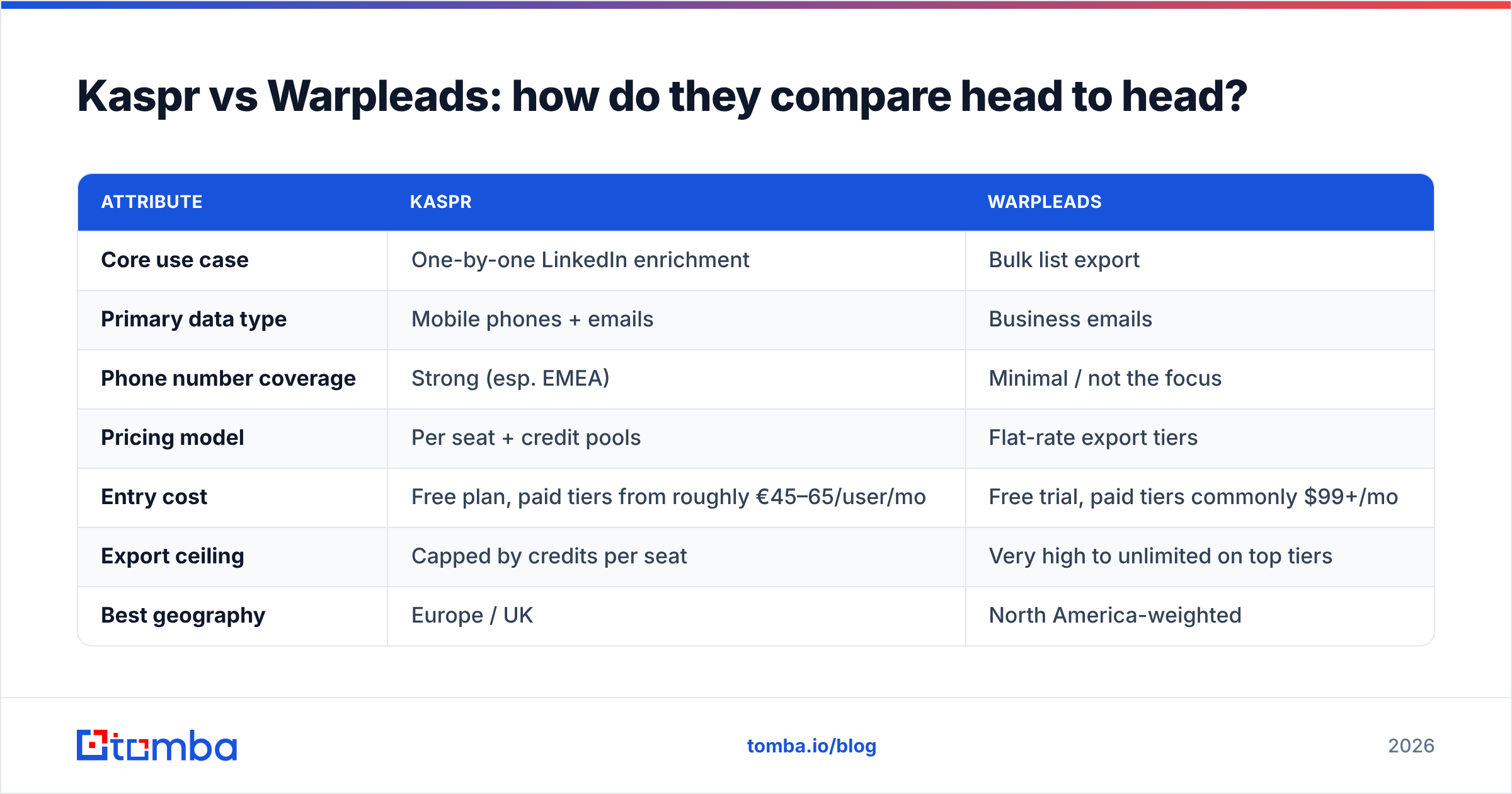
Here's the practical breakdown. Pricing reflects publicly listed plans at the time of writing — both vendors adjust tiers, so confirm on their pricing pages before you buy.
| Attribute | Kaspr | Warpleads |
|---|---|---|
| Core use case | One-by-one LinkedIn enrichment | Bulk list export |
| Primary data type | Mobile phones + emails | Business emails |
| Phone number coverage | Strong (esp. EMEA) | Minimal / not the focus |
| Pricing model | Per seat + credit pools | Flat-rate export tiers |
| Entry cost | Free plan, paid tiers from roughly €45–65/user/mo | Free trial, paid tiers commonly $99+/mo |
| Export ceiling | Capped by credits per seat | Very high to unlimited on top tiers |
| Best geography | Europe / UK | North America-weighted |
| Built-in verification | Partial, varies by record type | Light — external cleaning recommended |
| Chrome extension | Yes, central to the product | Secondary |
| CRM integrations | HubSpot, Pipedrive, Salesforce, Zapier | CSV + sequencer-focused |
| Ideal buyer | SDR team, recruiter | Cold email agency, lead-gen shop |
The table makes the real conclusion obvious: these tools barely overlap. The only genuine overlap is "business email address for a B2B contact," and that's the one capability where a specialist beats both.
Which one wins on data accuracy?#
Accuracy is the question everyone asks and almost nobody measures properly. The honest framing: accuracy depends on how the record was produced, not on which logo is on the invoice.
Kaspr's phone data leans on a contributory model plus licensed sources, refreshed against Cognism's pool. In practice, teams report solid connect rates on European mobiles and noticeably weaker results outside that footprint. Its email side is decent but not its differentiator.
Warpleads' email data is compiled and filtered at scale. Compiled data ages fastest at the individual level — roughly 25–30% of B2B contacts change roles annually, which means a static database decays measurably every quarter. A 20,000-row export is statistically guaranteed to contain thousands of records that were true six months ago and aren't now.

This is why the smart play with either tool is the same: treat the source as a candidate list, not a send list. Run every batch through an email verifier before it touches your sequencer. On a 20,000-row export, removing 15% invalid addresses is the difference between a healthy sender reputation and a domain you have to retire.
The specific killer is catch-all domains. Roughly a fifth of B2B domains accept mail for any address, so a naive validator marks them "valid" and you find out the truth from your bounce log. A catch-all verifier resolves those separately instead of guessing.
How should you pick between them?#
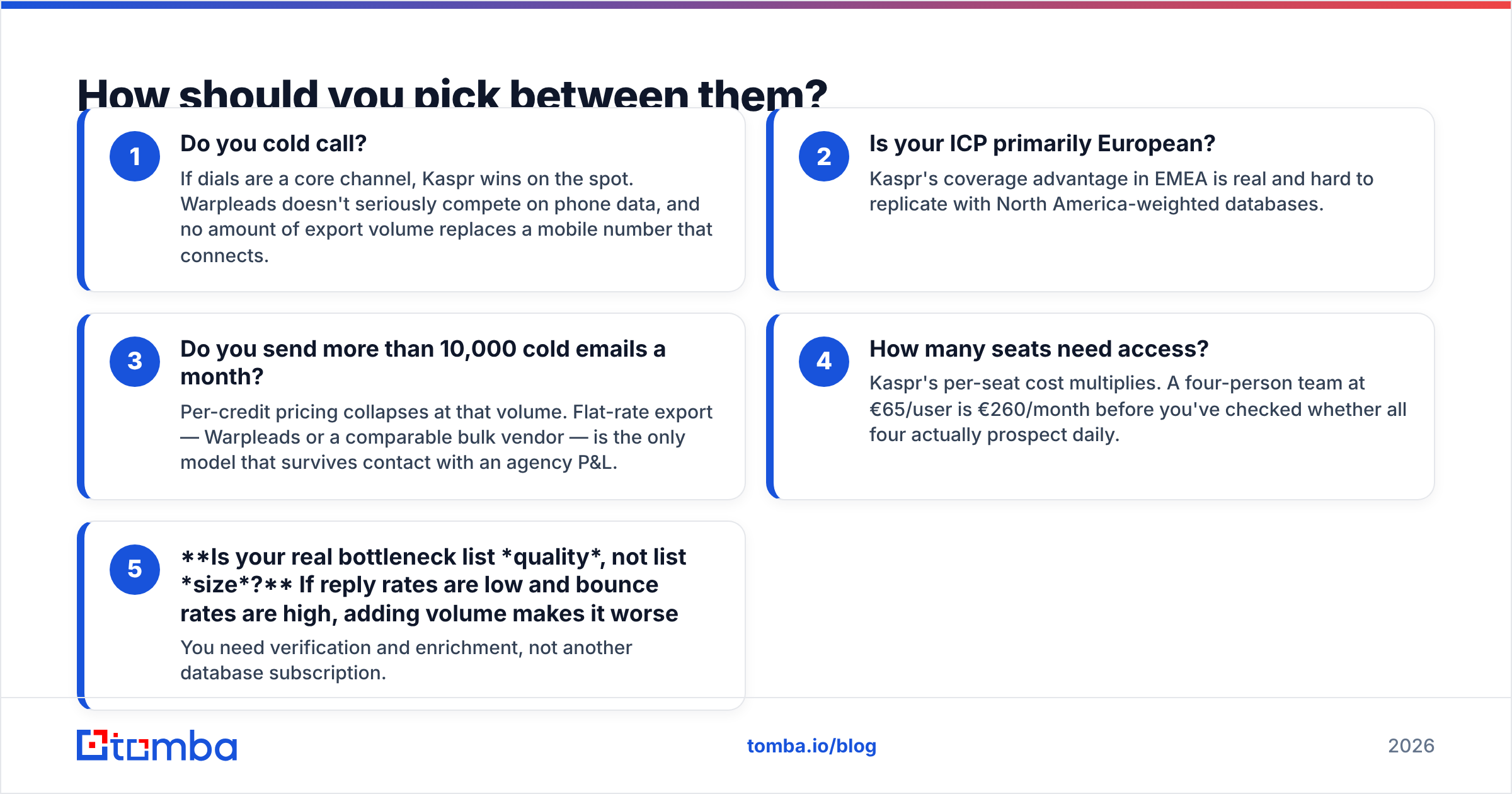
Run through these five questions in order. The first one that applies gives you your answer.
- Do you cold call? If dials are a core channel, Kaspr wins on the spot. Warpleads doesn't seriously compete on phone data, and no amount of export volume replaces a mobile number that connects.
- Is your ICP primarily European? Kaspr's coverage advantage in EMEA is real and hard to replicate with North America-weighted databases.
- Do you send more than 10,000 cold emails a month? Per-credit pricing collapses at that volume. Flat-rate export — Warpleads or a comparable bulk vendor — is the only model that survives contact with an agency P&L.
- How many seats need access? Kaspr's per-seat cost multiplies. A four-person team at €65/user is €260/month before you've checked whether all four actually prospect daily.
- Is your real bottleneck list quality, not list size? If reply rates are low and bounce rates are high, adding volume makes it worse. You need verification and enrichment, not another database subscription.
That fifth question is where most teams actually land, and it's the one neither vendor is built to answer.
Where does a dedicated email finder fit?#
Both Kaspr and Warpleads bundle email discovery into a bigger product — Kaspr into a phone-first extension, Warpleads into a volume-first exporter. If email is your primary channel, you're paying for the bundle and getting the email layer as a side dish.
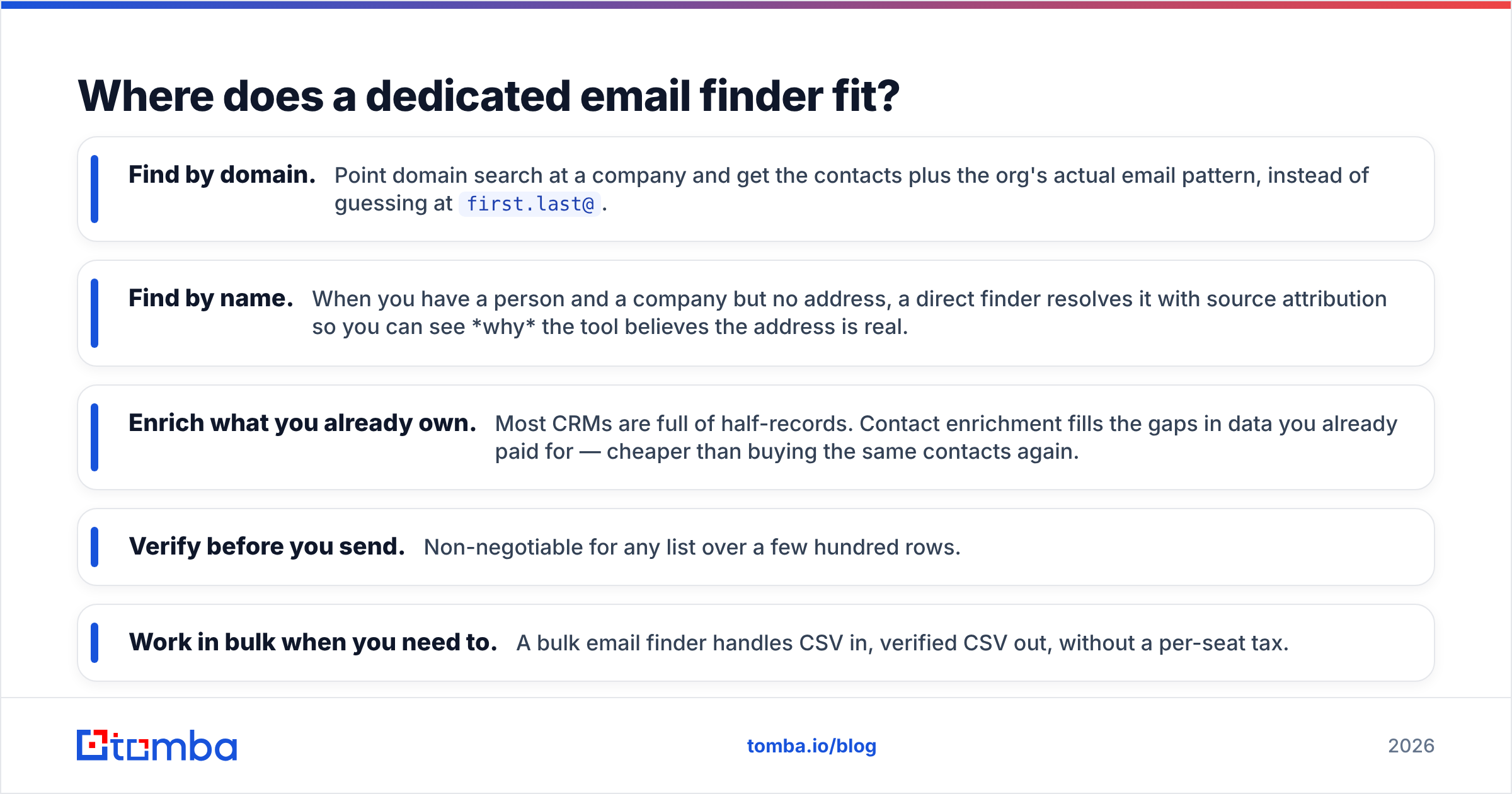
A specialist stack looks different:
- Find by domain. Point domain search at a company and get the contacts plus the org's actual email pattern, instead of guessing at
first.last@. - Find by name. When you have a person and a company but no address, a direct finder resolves it with source attribution so you can see why the tool believes the address is real.
- Enrich what you already own. Most CRMs are full of half-records. Contact enrichment fills the gaps in data you already paid for — cheaper than buying the same contacts again.
- Verify before you send. Non-negotiable for any list over a few hundred rows.
- Work in bulk when you need to. A bulk email finder handles CSV in, verified CSV out, without a per-seat tax.

For teams that want a pay-as-you-go database rather than a subscription, options like BookYourData occupy a genuinely useful middle ground — credits that don't expire monthly, priced per record. Worth a look if your prospecting is seasonal rather than continuous.
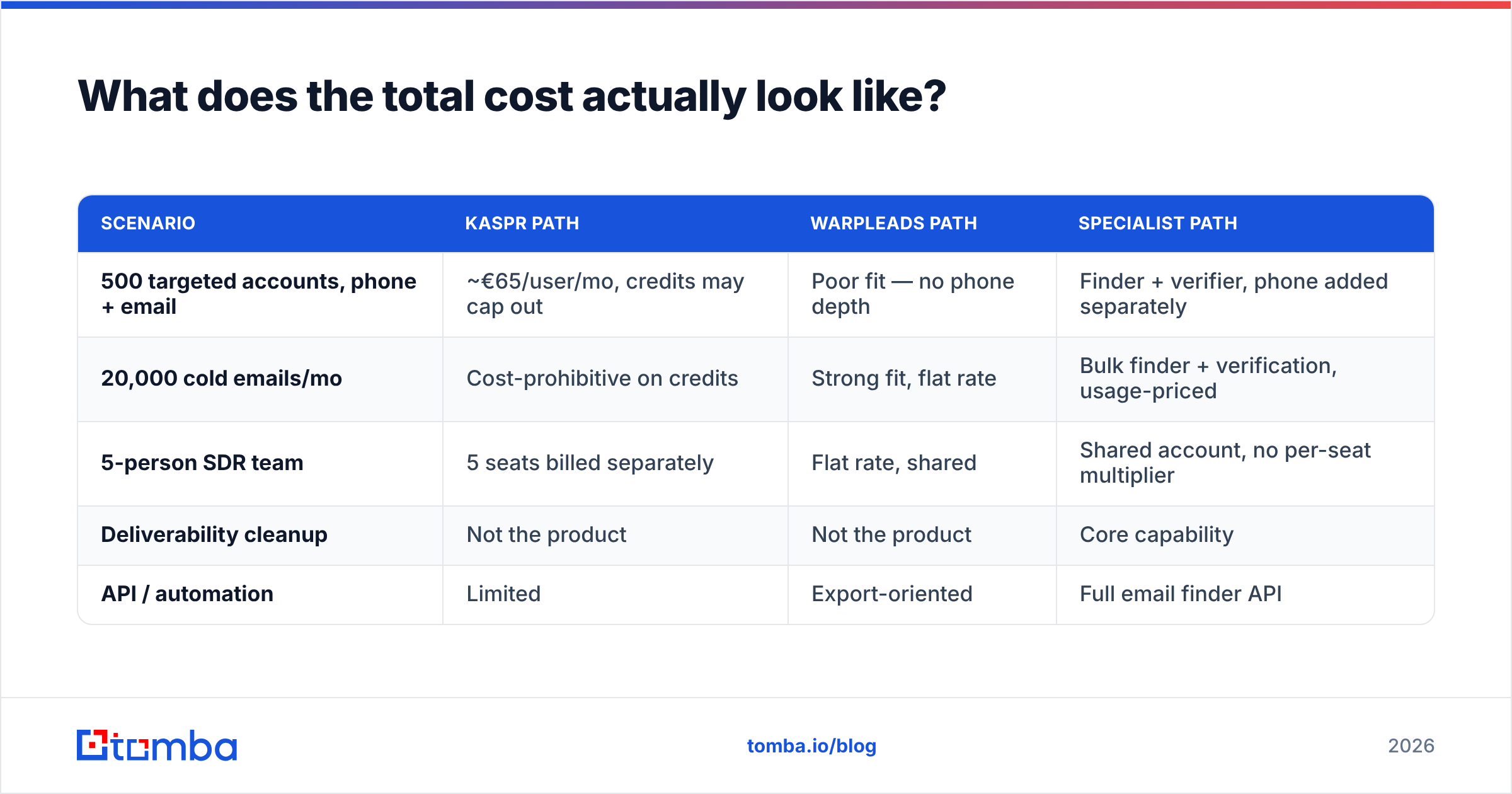
What does the total cost actually look like?#
Sticker price misleads. Normalize on cost per contact you can actually reach.
| Scenario | Kaspr path | Warpleads path | Specialist path |
|---|---|---|---|
| 500 targeted accounts, phone + email | ~€65/user/mo, credits may cap out | Poor fit — no phone depth | Finder + verifier, phone added separately |
| 20,000 cold emails/mo | Cost-prohibitive on credits | Strong fit, flat rate | Bulk finder + verification, usage-priced |
| 5-person SDR team | 5 seats billed separately | Flat rate, shared | Shared account, no per-seat multiplier |
| Deliverability cleanup | Not the product | Not the product | Core capability |
| API / automation | Limited | Export-oriented | Full email finder API |
On the specialist side, Tomba pricing starts with a free tier at 25 searches/month, then Starter at $49/mo, Growth at $99/mo, and Pro at $249/mo, with Enterprise custom. The relevant difference isn't the number — it's that credits aren't split into seat licenses, so a four-person team shares one pool instead of buying four.
What do reviewers say about each tool?#
Cross-check before you commit. Both vendors have review profiles on G2 worth reading for the pattern, not the score. What to look for specifically:
- Kaspr reviews: filter for complaints about credit exhaustion mid-month and phone accuracy outside Europe. Those are the two recurring themes, and they tell you whether your use case matches the strong side of the product.
- Warpleads reviews: filter for bounce-rate mentions. Volume tools live or die on what percentage of the export is actually deliverable, and reviewers who ran real campaigns will say so plainly.
Ignore aggregate star ratings entirely. A 4.6 from recruiters tells a European SDR nothing, and a 4.4 from agencies tells an enterprise AE nothing.
The verdict: Kaspr or Warpleads?#
Choose Kaspr if you dial phones, sell into Europe, and work accounts one at a time. The per-seat cost is justified when a single connected mobile call is worth more than a thousand unopened emails.
Choose Warpleads if you run high-volume cold email, your ICP is North America-weighted, and your unit economics require flat-rate export. Budget separately for verification — the savings on export pricing evaporate if 18% of your list bounces.
Choose neither as your only tool if your channel is email and your problem is reply rate. Volume and phone depth are both answers to questions you may not be asking. The question most outbound teams should be asking is simpler: of the addresses I send to, how many actually arrive and belong to a person who still works there?
That's a finder-and-verifier problem. Start with the Tomba Email Finder — find addresses by domain, name, or company, see the sources behind each result, and verify before you send instead of after your bounce rate tells you. The free tier covers 25 searches a month, which is enough to benchmark it against whatever export you're sitting on right now. Run the same 100 contacts through both and compare deliverability. The answer will be specific to your market, and it'll take an afternoon.
Related guides#
// get started
Find, verify and enrich your first contacts today
Start on the free plan with 25 searches a month, then scale when your team is ready.
Free plan · No credit card required · GDPR & CCPA
// about the author