Kaspr vs Webbula (2026): Which B2B Email Data Tool Wins?
Kaspr finds contacts on LinkedIn. Webbula cleans the lists you already own. They solve opposite halves of the same problem — here is which one your team actually needs in 2026, and what each really costs.
TL;DR
- Kaspr and Webbula are not really competitors. Kaspr is a LinkedIn-first contact finder (emails plus mobile numbers). Webbula is an email hygiene and enrichment vendor that grades lists you already own.
- Pick Kaspr if your bottleneck is "I have a LinkedIn profile and no phone number." Pick Webbula if your bottleneck is "I have 400,000 records and no idea which ones are spam traps."
- Kaspr is self-serve with a public free plan and per-seat pricing around €49/user/month. Webbula is quote-only, volume-priced, and sold to marketing ops teams, not to individual SDRs.
- Neither covers the full loop. Kaspr's verification is thin; Webbula cannot source a single new contact.
- If you need find and verify in one billing line with an API, a combined platform like Tomba starts at $49/month and replaces the two-vendor setup for most SMB and mid-market teams.
What are Kaspr and Webbula, exactly?#
Start here, because most "Kaspr vs Webbula" comparisons treat them as interchangeable. They are not.
Kaspr is a prospecting data tool built around a Chrome extension. You open a LinkedIn profile, a Sales Navigator list, or a LinkedIn group, and Kaspr surfaces the person's business email and — its real selling point — their direct mobile number. It was acquired by Cognism in 2022 and now sits as the lighter, self-serve, EMEA-heavy end of that portfolio. The buyer is an SDR or a small outbound team.
Webbula is an email hygiene and data quality vendor. You hand it a file. It hands the file back with every record graded: valid, invalid, disposable, role-based, bot, honeypot, spam trap, complainer, deceased, or fraudulent. It also sells email append and demographic enrichment. The buyer is a marketing ops or email deliverability manager sitting on a large, aging database.
Put simply: Kaspr adds rows to your CRM. Webbula deletes them.
Here is how the two categories differ on the dimensions that actually change your workflow:
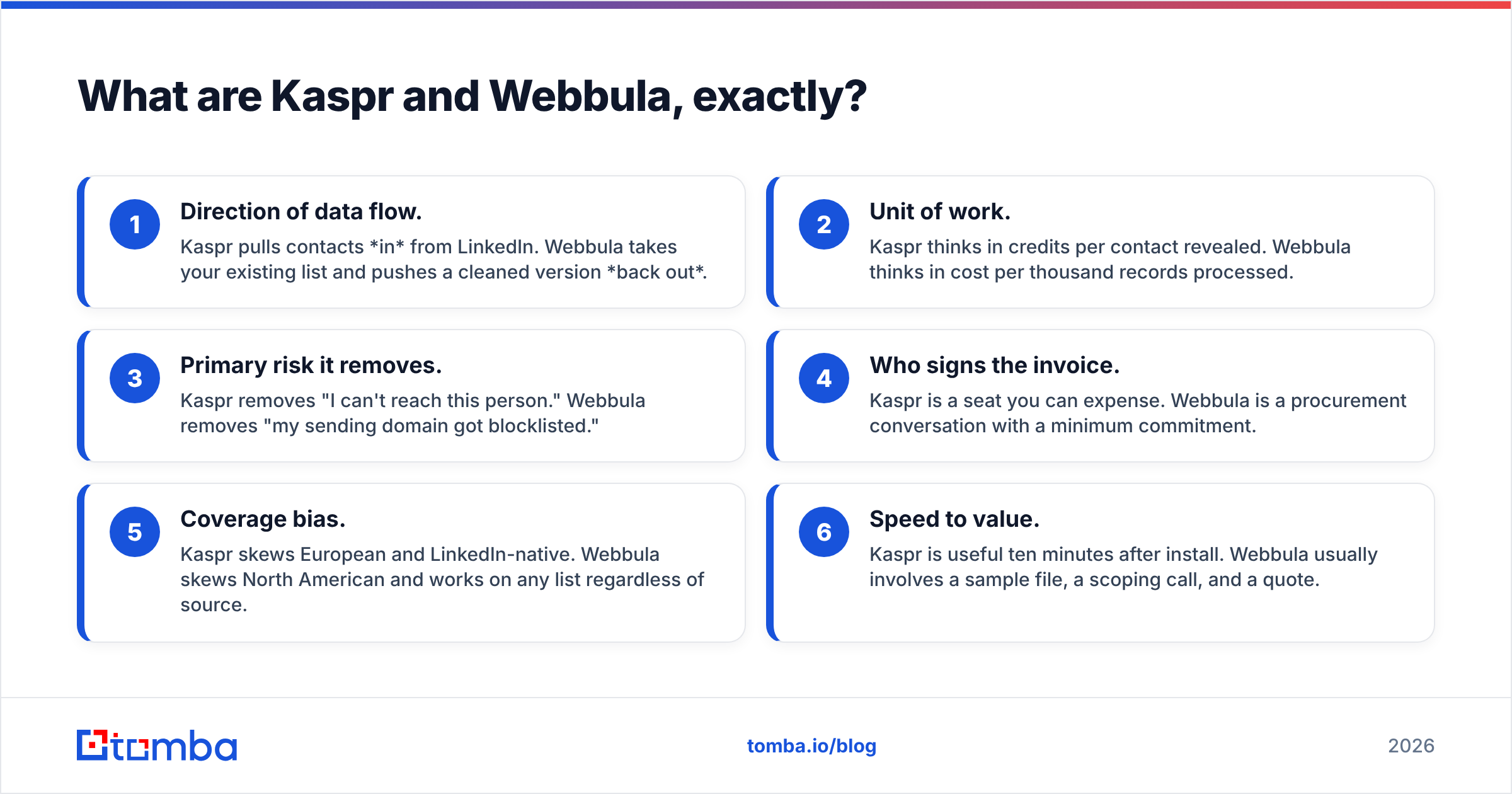
- Direction of data flow. Kaspr pulls contacts in from LinkedIn. Webbula takes your existing list and pushes a cleaned version back out.
- Unit of work. Kaspr thinks in credits per contact revealed. Webbula thinks in cost per thousand records processed.
- Primary risk it removes. Kaspr removes "I can't reach this person." Webbula removes "my sending domain got blocklisted."
- Who signs the invoice. Kaspr is a seat you can expense. Webbula is a procurement conversation with a minimum commitment.
- Coverage bias. Kaspr skews European and LinkedIn-native. Webbula skews North American and works on any list regardless of source.
- Speed to value. Kaspr is useful ten minutes after install. Webbula usually involves a sample file, a scoping call, and a quote.

How do Kaspr and Webbula compare head-to-head?#
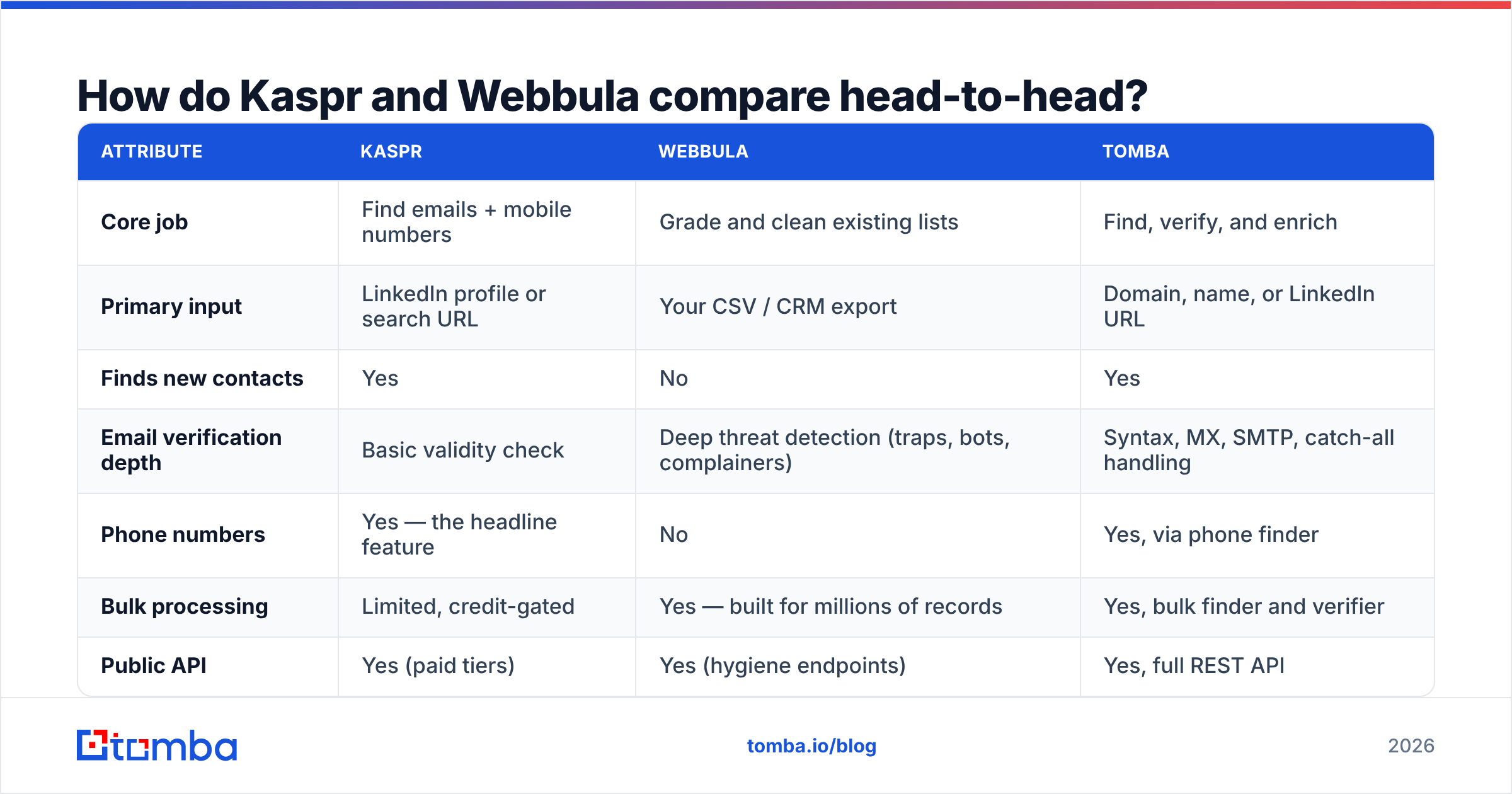
The table below is the fastest way to see why teams often end up buying both — and why a combined tool is worth considering before you do.

| Attribute | Kaspr | Webbula | Tomba |
|---|---|---|---|
| Core job | Find emails + mobile numbers | Grade and clean existing lists | Find, verify, and enrich |
| Primary input | LinkedIn profile or search URL | Your CSV / CRM export | Domain, name, or LinkedIn URL |
| Finds new contacts | Yes | No | Yes |
| Email verification depth | Basic validity check | Deep threat detection (traps, bots, complainers) | Syntax, MX, SMTP, catch-all handling |
| Phone numbers | Yes — the headline feature | No | Yes, via phone finder |
| Bulk processing | Limited, credit-gated | Yes — built for millions of records | Yes, bulk finder and verifier |
| Public API | Yes (paid tiers) | Yes (hygiene endpoints) | Yes, full REST API |
| Free tier | Yes, limited credits | No | Yes, 25 searches/month |
| Entry price | ~€49/user/month | Custom quote, volume-based | $49/month |
| Typical buyer | SDR, founder, small sales team | Marketing ops, email deliverability lead | Growth, RevOps, developers |
| Best at | LinkedIn mobile numbers in EMEA | Protecting sender reputation at scale | One stack for sourcing + verification |
Notice that the "Yes" columns almost never overlap. That is the whole story of Kaspr vs Webbula.
Is Kaspr accurate enough for cold outreach?#
Kaspr's reputation rests on phone numbers, not emails. In practice, European mobile coverage is where it consistently outperforms US-centric databases — and that is a genuine, defensible advantage. If your ICP is in France, Benelux, DACH, or the UK, Kaspr will surface direct dials that Apollo or ZoomInfo miss.
Email is a different story. Kaspr returns a business email for most LinkedIn profiles, but the validation attached to it is shallow. You get a "valid" flag, not a graded verdict. That matters because a flag based on syntax and MX records alone does not tell you whether the mailbox is a catch-all, a role account, or an abandoned address that now functions as a recycled spam trap.

That gap is exactly the one Webbula sells into. Webbula's hygiene stack was built for high-volume B2C and B2B email marketers whose entire business collapses if Gmail and Microsoft start filtering them. Its multi-source approach classifies threats a standard SMTP ping cannot see: pristine spam traps, recycled traps, honeypots, bots that inflate open rates, and serial complainers who will hit the spam button on anything.
If you are sending 500 emails a week, that level of paranoia is overkill. If you are sending 500,000 a month, it is the difference between an inbox and a blocklist. Independent reviews on G2 reflect the split cleanly: Kaspr shows up in prospecting-intelligence categories, Webbula in email-verification and data-quality categories. They rarely appear on the same shortlist by accident.
A practical middle path: run a real email verifier on everything you source, and use a dedicated catch-all verifier for the domains that refuse to answer honestly. That covers the 80% of risk most outbound teams face without a six-figure hygiene contract.
What does each one actually cost?#
This is where the two tools stop being comparable and start being budget decisions.
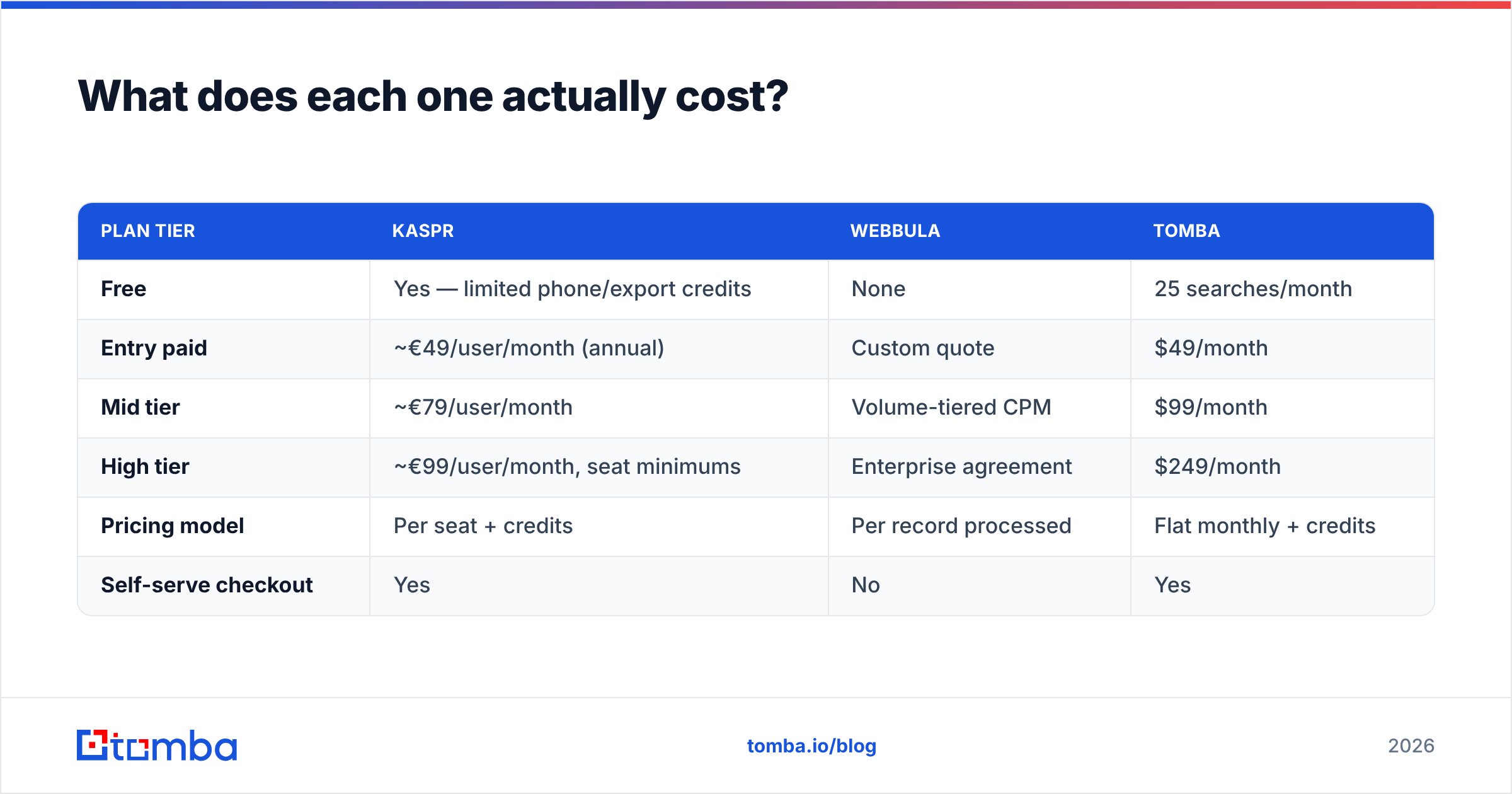
| Plan tier | Kaspr | Webbula | Tomba |
|---|---|---|---|
| Free | Yes — limited phone/export credits | None | 25 searches/month |
| Entry paid | ~€49/user/month (annual) | Custom quote | $49/month |
| Mid tier | ~€79/user/month | Volume-tiered CPM | $99/month |
| High tier | ~€99/user/month, seat minimums | Enterprise agreement | $249/month |
| Pricing model | Per seat + credits | Per record processed | Flat monthly + credits |
| Self-serve checkout | Yes | No | Yes |
Two things to flag honestly.
First, Kaspr's per-seat model scales badly for teams. Five SDRs on the mid tier is roughly €400/month before anyone has processed a bulk list, and credits reset per user rather than pooling across the team. Always confirm current numbers on Kaspr's own pricing page — EMEA vendors adjust tiers and seat minimums more often than their US counterparts.
Second, Webbula's quote-only model is not a red flag; it is normal for hygiene vendors, because a 10,000-record file and a 12-million-record file are genuinely different products. But it does mean you cannot pilot it on a Tuesday afternoon. Expect a sample-file test, a scoping call, and a minimum volume commitment.
For comparison, Tomba pricing is flat and public: Free at 25 searches, Starter at $49/month, Growth at $99/month, Pro at $249/month, Enterprise on request — with finding and verification drawing from the same account rather than two separate contracts.
Who should choose Kaspr?#
Choose Kaspr if most of these describe you:
- Your prospecting starts on LinkedIn. You live in Sales Navigator and want contact data one click away from the profile you are already reading.
- You need mobile numbers, not just emails. Cold calling is part of your motion and European coverage matters.
- You are one to five people. Per-seat pricing is tolerable at small headcount and painful above it.
- You want to start today. The free plan and self-serve checkout mean no procurement cycle.
Skip Kaspr if you need domain-wide sourcing. It is profile-first by design, so "give me every marketing contact at these 300 companies" is an awkward fit. That workflow belongs to domain search or a proper LinkedIn finder with bulk input.
Who should choose Webbula?#
Choose Webbula if most of these describe you:
- You own a large, old database. Hundreds of thousands of records collected over years, with unknown decay.
- Deliverability is a board-level problem. You have been blocklisted, or you are one bad send away from it.
- You need threat categories, not a binary. Knowing an address is a bot or a complainer changes your suppression strategy in ways "invalid" does not.
- You have budget and a procurement process. The value is real, but so is the commitment.
Skip Webbula if you have no list yet. Hygiene on an empty database is a solution without a problem — and it will not find you a single new contact.

Can you use both — and should you?#
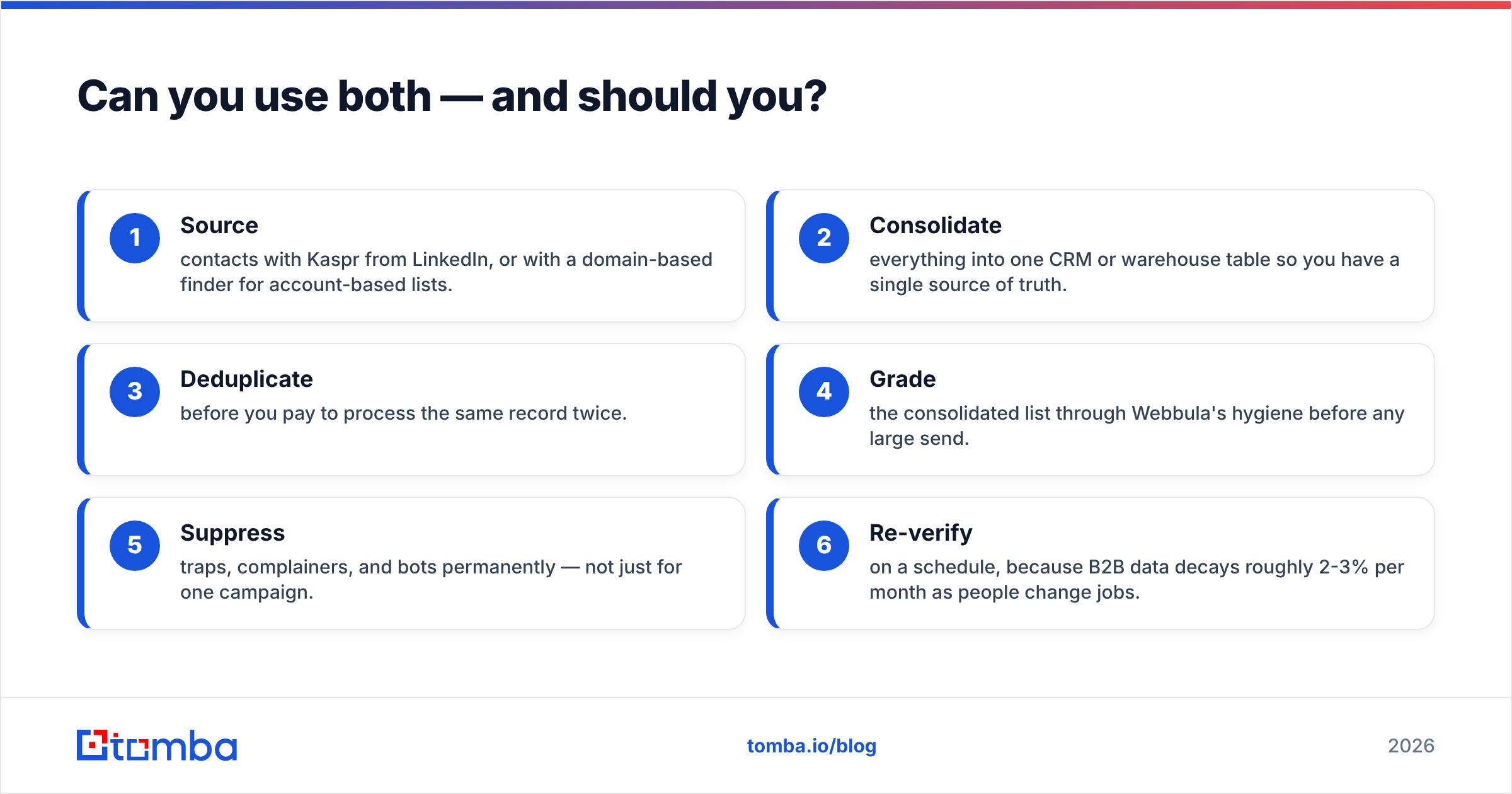
Yes, and plenty of mid-market teams do. The stacked workflow looks like this:
- Source contacts with Kaspr from LinkedIn, or with a domain-based finder for account-based lists.
- Consolidate everything into one CRM or warehouse table so you have a single source of truth.
- Deduplicate before you pay to process the same record twice.
- Grade the consolidated list through Webbula's hygiene before any large send.
- Suppress traps, complainers, and bots permanently — not just for one campaign.
- Re-verify on a schedule, because B2B data decays roughly 2-3% per month as people change jobs.
That stack works. It also means two vendors, two contracts, two data formats, and two support queues — for a job that is conceptually one pipeline.
The alternative is a single platform that covers sourcing and verification in one API. That is where Tomba sits: the email finder handles acquisition by domain, name, or LinkedIn URL; verification runs on the same credits; and the Tomba API exposes both so your engineers wire it into the CRM once instead of maintaining two integrations. You give up Webbula's deepest threat taxonomy — honest trade — and you gain a stack a two-person RevOps team can actually operate.
What about the other options on your shortlist?#
Kaspr and Webbula are rarely the only two names in the room. A few worth knowing:
- Cognism — Kaspr's parent. Same EMEA phone strength, enterprise pricing, more compliance tooling.
- ZeroBounce, Bouncer, and Clearout — self-serve verification vendors that sit between a basic validity check and Webbula's full hygiene suite. Cheaper, faster to pilot, less forensic.
- BookYourData — a strong option when you want to buy pre-built, pre-verified B2B lists rather than source them one profile at a time. Different entry point to the same outcome, and worth a look if your team would rather start from a list than build one.
- Apollo and RocketReach — broader all-in-one platforms where contact data is bundled with sequencing. More features, more surface area to manage.
The honest framing: your shortlist should be organised by job, not by brand. Sourcing tools compete with sourcing tools. Hygiene tools compete with hygiene tools. Comparing across the line produces the confusion that made you search "Kaspr vs Webbula" in the first place.
Kaspr vs Webbula: the verdict#
There is no single winner, because there is no single contest.
Kaspr wins if your problem is reach — specifically, getting European mobile numbers off LinkedIn profiles without a procurement cycle. It is fast, self-serve, and genuinely good at the narrow thing it does.
Webbula wins if your problem is risk — specifically, protecting a sending reputation across a large database where a single spam trap can cost you a quarter. Its threat classification goes deeper than mainstream verifiers, and that depth is worth paying for at scale.
Neither wins if your problem is the whole pipeline: find the contact, confirm the address is real, enrich the record, and keep it fresh without duct-taping two vendors together.
That last case is the common one. If it is yours, start with the Tomba Email Finder — search by domain, name, or LinkedIn profile, get verification built into the same result, and connect it to your CRM through one API. The free tier gives you 25 searches to test coverage on your own ICP before you spend anything, and Starter is $49/month when you are ready to scale. Run your real target accounts through it, compare the hit rate against whatever you are using now, and let the data decide.
Related guides#
// get started
Find, verify and enrich your first contacts today
Start on the free plan with 25 searches a month, then scale when your team is ready.
Free plan · No credit card required · GDPR & CCPA
// about the author