Kaspr vs Winmo 2026: Which B2B Data Tool Fits Your Team?
Kaspr sells LinkedIn-sourced mobile numbers by the seat. Winmo sells ad-industry account intelligence by the annual contract. They solve different problems — here is which one your team actually needs, and where both leave gaps.
TL;DR
- Kaspr and Winmo are not really competitors. Kaspr is a LinkedIn-first contact finder that returns mobile numbers and emails per profile. Winmo is a vertical sales-intelligence database for people selling advertising, media, and sponsorships.
- Pick Kaspr if your bottleneck is "I know who to call, I just don't have their number." It is self-serve, per-seat, and priced in the tens of dollars per user per month.
- Pick Winmo if your bottleneck is "I don't know which brand is about to move its budget." It is an annual contract in the thousands, and it only pays off inside advertising/media/agency sales.
- Neither tool is a good general-purpose email layer. Kaspr's coverage is tied to what it has seen on LinkedIn; Winmo's contact records are narrow by design and go stale between refreshes.
- Most teams that run both end up bolting on a verification and domain-level email finder to fill the gaps — that is the honest third option in this comparison.
What is Kaspr, and who actually buys it?#
Kaspr is a Chrome extension and web app that reveals contact details for people you are already looking at on LinkedIn. You open a profile, a Sales Navigator list, a group, or an event attendee list, click the widget, and Kaspr returns mobile numbers, direct dials, and email addresses it has on file. It was founded in France, acquired by Cognism in 2022, and now sits as the lighter, self-serve end of that family.
The buyer is usually an SDR, a recruiter, or a founder doing their own prospecting. The workflow is profile-by-profile or list-by-list, the output lands in Kaspr's lead lists, and from there it syncs to HubSpot, Pipedrive, Salesforce, Lemlist, or Zapier. Kaspr leans hard on GDPR and CCPA compliance in its marketing, which matters if you are prospecting into the EU — it publishes a notification process for contacted individuals.
What Kaspr is not: a market map. It does not tell you which accounts to chase. It assumes you already built the list and just need the phone number attached to it.
What is Winmo, and why is it priced so differently?#
Winmo is a sales-intelligence platform built for one industry: advertising and media. Its database tracks brands, their agency rosters, estimated media spend, category budgets, and the decision-makers who control them — CMOs, brand managers, media directors, agency account leads.
The differentiator is Winmo Edge, a predictive alert feed. Instead of "here is a contact," it tells you a brand just parted ways with its agency of record, changed CMOs, launched a review, or shifted spend into a new channel. For a media seller or sponsorship rep, that timing signal is the product. The contact record is almost a byproduct.
That is why the pricing model is different. Winmo sells annual licenses, quote-only, typically in the low-to-mid four figures per seat per year. You are not buying credits — you are buying a research team's output. If you sell ad inventory, sponsorships, ad tech, or agency services, that math can work on one closed deal. If you sell B2B SaaS to IT directors, Winmo has almost nothing for you.

Kaspr vs Winmo: how do they compare side by side?#
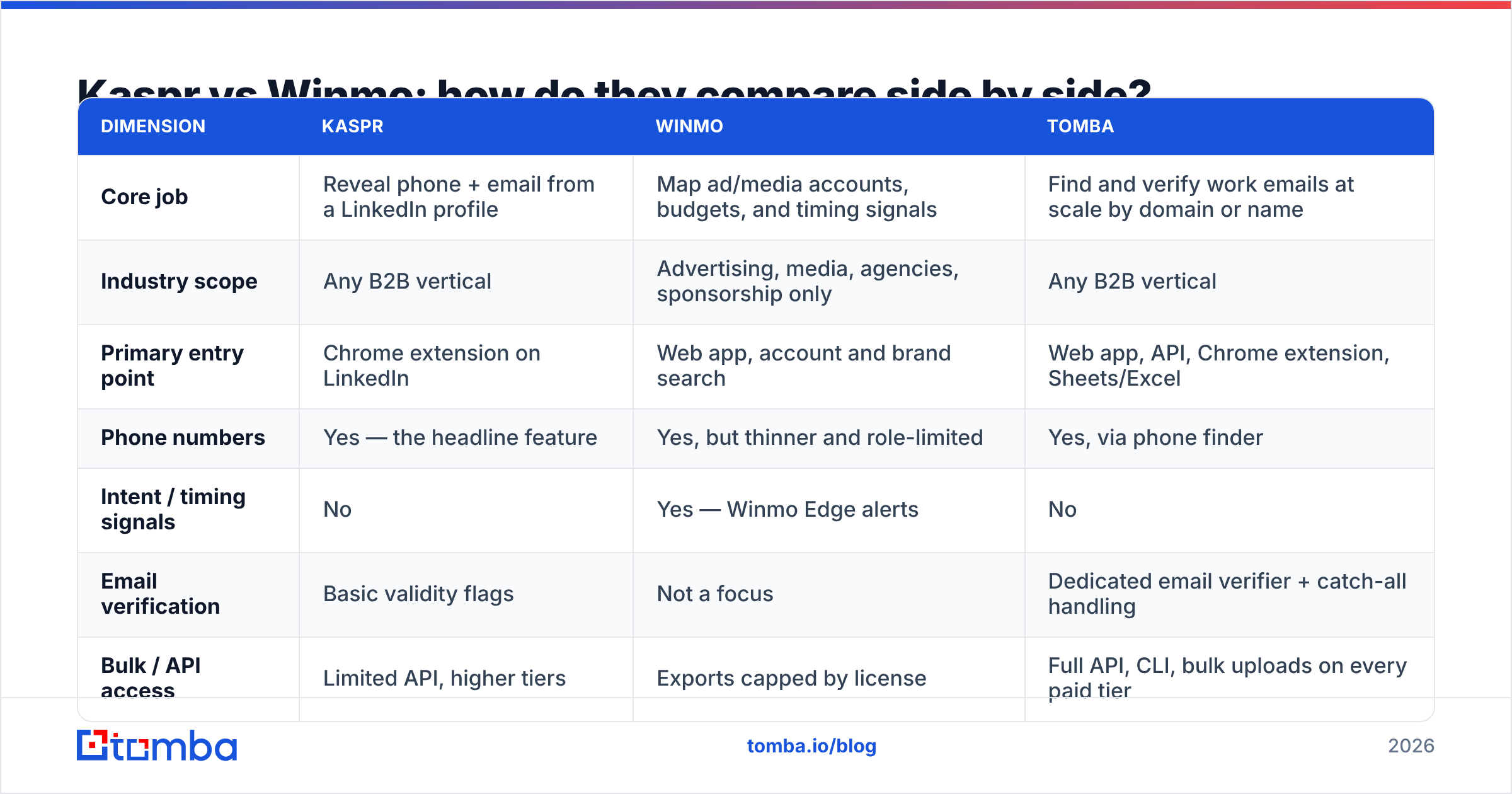
Here is the honest head-to-head, with a neutral third column so you can see where a pure data layer sits relative to both.
| Dimension | Kaspr | Winmo | Tomba |
|---|---|---|---|
| Core job | Reveal phone + email from a LinkedIn profile | Map ad/media accounts, budgets, and timing signals | Find and verify work emails at scale by domain or name |
| Industry scope | Any B2B vertical | Advertising, media, agencies, sponsorship only | Any B2B vertical |
| Primary entry point | Chrome extension on LinkedIn | Web app, account and brand search | Web app, API, Chrome extension, Sheets/Excel |
| Phone numbers | Yes — the headline feature | Yes, but thinner and role-limited | Yes, via phone finder |
| Intent / timing signals | No | Yes — Winmo Edge alerts | No |
| Email verification | Basic validity flags | Not a focus | Dedicated email verifier + catch-all handling |
| Bulk / API access | Limited API, higher tiers | Exports capped by license | Full API, CLI, bulk uploads on every paid tier |
| Pricing model | Free tier + per-seat monthly | Annual contract, quote-only | Free tier + $49/$99/$249 monthly plans |
| Realistic entry cost | ~$45–55 per user/month | Four figures per seat/year | $49/month |
| Contract commitment | Monthly or annual | Annual | Monthly or annual |
Pricing moves. Kaspr and Winmo both revise plans without much notice, so treat the numbers above as a shape, not a quote, and confirm on kaspr.io and winmo.com before you budget. Tomba's published pricing is the one column you can check in five seconds without a sales call.
Which one gives you better contact data?#
Kaspr, on volume. Winmo, on relevance — inside its vertical.
That trade-off is worth unpacking, because "better data" means four different things depending on who is asking:
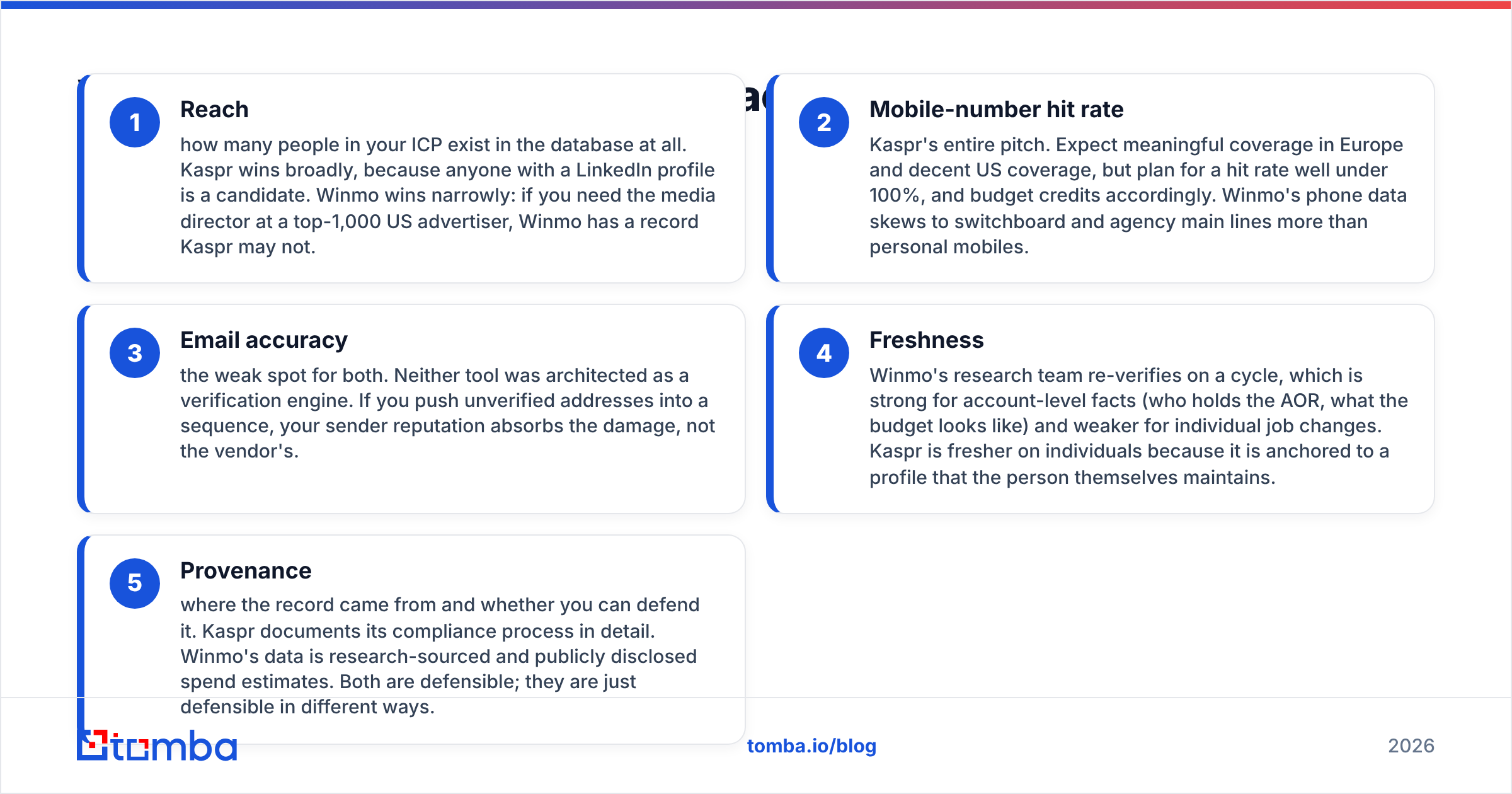
- Reach — how many people in your ICP exist in the database at all. Kaspr wins broadly, because anyone with a LinkedIn profile is a candidate. Winmo wins narrowly: if you need the media director at a top-1,000 US advertiser, Winmo has a record Kaspr may not.
- Mobile-number hit rate — Kaspr's entire pitch. Expect meaningful coverage in Europe and decent US coverage, but plan for a hit rate well under 100%, and budget credits accordingly. Winmo's phone data skews to switchboard and agency main lines more than personal mobiles.
- Email accuracy — the weak spot for both. Neither tool was architected as a verification engine. If you push unverified addresses into a sequence, your sender reputation absorbs the damage, not the vendor's.
- Freshness — Winmo's research team re-verifies on a cycle, which is strong for account-level facts (who holds the AOR, what the budget looks like) and weaker for individual job changes. Kaspr is fresher on individuals because it is anchored to a profile that the person themselves maintains.
- Provenance — where the record came from and whether you can defend it. Kaspr documents its compliance process in detail. Winmo's data is research-sourced and publicly disclosed spend estimates. Both are defensible; they are just defensible in different ways.
The practical read: Kaspr gives you more people, Winmo gives you better reasons. Neither gives you a clean, deliverable list without a verification step in between.
Is Kaspr or Winmo better for cold outbound?#
Kaspr, unless you sell to advertisers.
Cold outbound has three inputs: a list, a reason to reach out, and a working address. Kaspr solves input three and half of input one. Winmo solves input two and half of input one. Neither solves all three, which is why teams in ad sales frequently run both — Winmo to decide who and when, then a contact tool to actually get the address.
If your motion is email-led rather than phone-led, the calculus shifts again. Kaspr's value is concentrated in mobile numbers; if you never cold-call, you are paying a phone-data premium for an email you could source more cheaply. Running a domain search across your target accounts and verifying the output typically costs a fraction of a per-seat Kaspr license, and it scales past the LinkedIn profile-view limits that throttle extension-based tools.
If your motion is phone-led, invert that: Kaspr earns its price, and you only need an email layer for follow-up sequences.
What does each one cost in practice?#
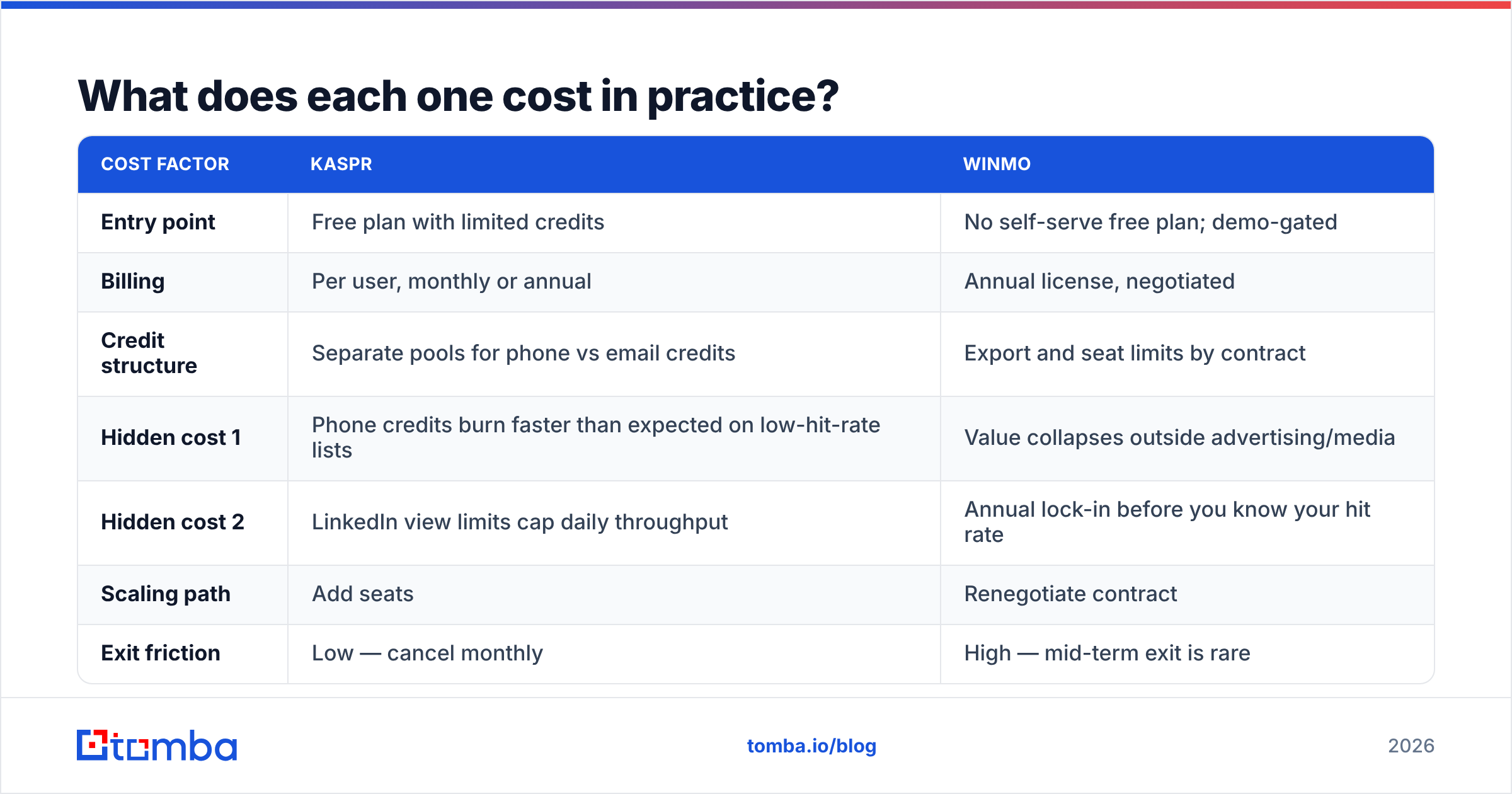
The sticker price is not the real price. Here is what actually shows up on the invoice or in the workflow:
| Cost factor | Kaspr | Winmo |
|---|---|---|
| Entry point | Free plan with limited credits | No self-serve free plan; demo-gated |
| Billing | Per user, monthly or annual | Annual license, negotiated |
| Credit structure | Separate pools for phone vs email credits | Export and seat limits by contract |
| Hidden cost 1 | Phone credits burn faster than expected on low-hit-rate lists | Value collapses outside advertising/media |
| Hidden cost 2 | LinkedIn view limits cap daily throughput | Annual lock-in before you know your hit rate |
| Scaling path | Add seats | Renegotiate contract |
| Exit friction | Low — cancel monthly | High — mid-term exit is rare |
The asymmetry matters more than the numbers. Kaspr lets you test with a free plan and churn after a month if the hit rate disappoints. Winmo asks you to commit for a year before you have run a single campaign against its alerts. That is normal for vertical intelligence products, but it means you should run the trial hard: pull 50 target accounts, check how many have current, correct decision-maker records, and extrapolate from that before signing.
Where do both tools leave gaps?#
Four gaps show up repeatedly in review threads on G2 and in practice:
- Catch-all domains. A large share of enterprise domains accept every address at the SMTP layer, so a "valid" flag means nothing. You need a dedicated catch-all verifier to separate real mailboxes from black holes, or you will quietly bounce into the void.
- Bulk enrichment of an existing CRM. Both tools are built for net-new discovery. Re-enriching 20,000 stale CRM rows is a different job — that is a bulk email finder or API problem, not an extension problem.
- Non-LinkedIn discovery. Kaspr needs a profile to work from. Plenty of buyers — operations leads, plant managers, regional franchise owners — barely use LinkedIn. Domain-level discovery finds them; profile-level discovery does not.
- Programmatic workflows. If you want contact lookup inside your own product, a scoring pipeline, or an automation in Make or Zapier, you need a real API with predictable rate limits. That is where the Tomba API and similar developer-first tools slot in underneath whichever front-end tool your reps use.
None of these are reasons to reject Kaspr or Winmo. They are reasons to stop expecting one tool to be the whole stack.
Which should you choose in 2026?#
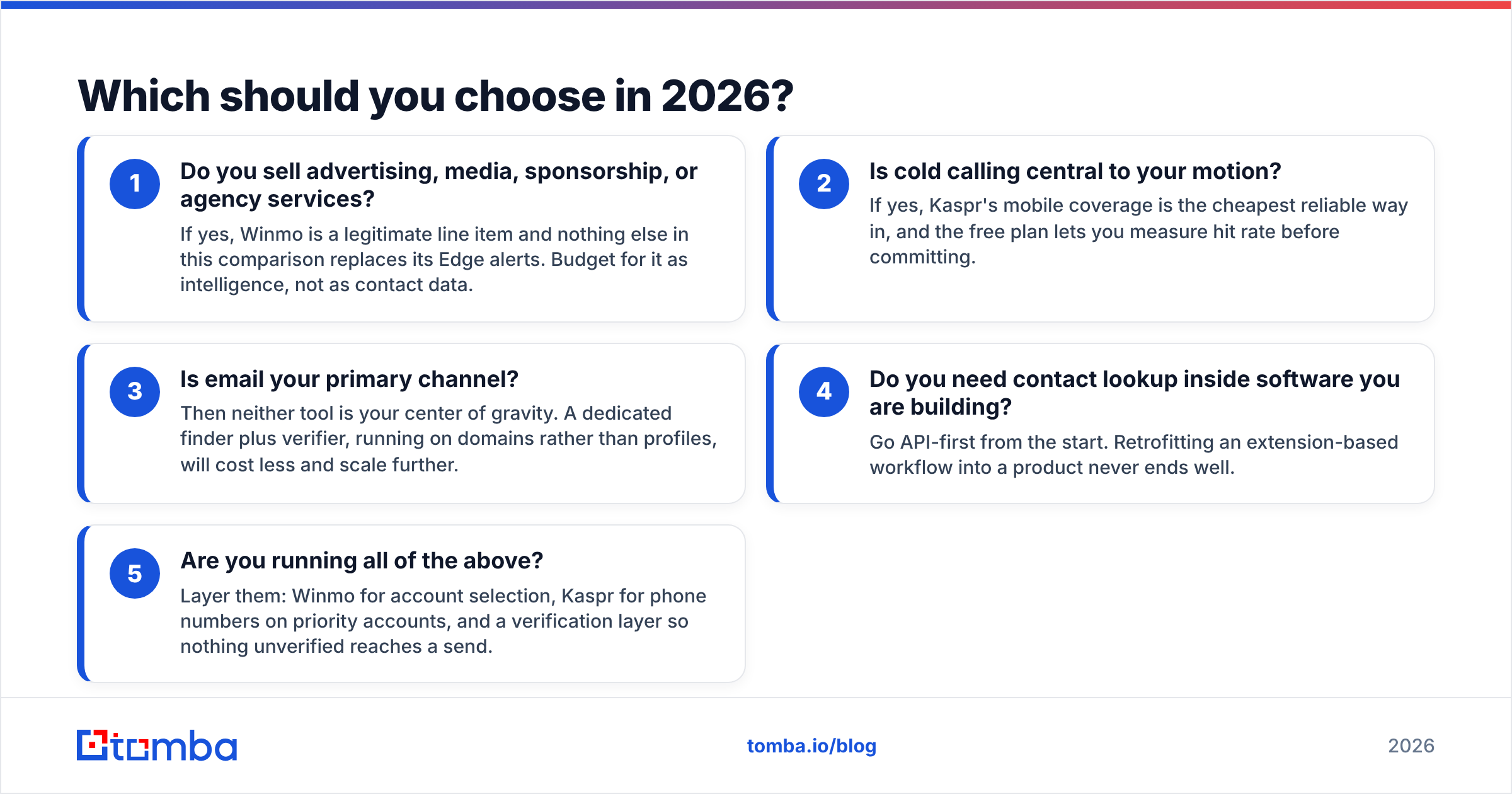
Use this decision order:
- Do you sell advertising, media, sponsorship, or agency services? If yes, Winmo is a legitimate line item and nothing else in this comparison replaces its Edge alerts. Budget for it as intelligence, not as contact data.
- Is cold calling central to your motion? If yes, Kaspr's mobile coverage is the cheapest reliable way in, and the free plan lets you measure hit rate before committing.
- Is email your primary channel? Then neither tool is your center of gravity. A dedicated finder plus verifier, running on domains rather than profiles, will cost less and scale further.
- Do you need contact lookup inside software you are building? Go API-first from the start. Retrofitting an extension-based workflow into a product never ends well.
- Are you running all of the above? Layer them: Winmo for account selection, Kaspr for phone numbers on priority accounts, and a verification layer so nothing unverified reaches a send.
A note on adjacent options: if you are evaluating these two, you are probably also looking at prebuilt list vendors like BookYourData for pay-as-you-go B2B lists, and at LinkedIn-native extraction via a LinkedIn finder. Those are complements, not substitutes — a list vendor gives you volume on demand, a profile tool gives you precision on named targets.
Kaspr vs Winmo: the short verdict#
Kaspr and Winmo answer different questions, so the "winner" depends entirely on which question is blocking your pipeline. Kaspr is the better contact tool for almost everyone, because it is cheap, self-serve, and broad. Winmo is the better intelligence tool for a specific industry, and in that industry it is close to unmatched. Comparing their price tags directly is a category error — one is a seat license, the other is a research subscription.
What both leave open is the boring, load-bearing part: getting a verified, deliverable email address for every person you decided to contact, at a volume that does not depend on how many LinkedIn profiles a rep can open in a day.
That is the part worth fixing first. Tomba's Email Finder works from a domain or a name plus company, returns a confidence score with the source, and hands off to verification before anything hits your sequencer — with a free tier at 25 searches a month and paid plans starting at $49/month, no demo call required. Run it against your next 100 target accounts alongside whichever of these two tools you are trialing, and let the bounce rate decide the argument.
Related guides#
// get started
Find, verify and enrich your first contacts today
Start on the free plan with 25 searches a month, then scale when your team is ready.
Free plan · No credit card required · GDPR & CCPA
// about the author