Kaspr vs Zintlr (2026): Which B2B Contact Finder Wins?
Kaspr sells LinkedIn-first phone numbers. Zintlr sells a searchable database with personality signals. Here's how they actually compare on accuracy, pricing, and compliance — plus when neither is the right buy.
TL;DR
- Kaspr is a LinkedIn-first Chrome extension built for SDRs who live in Sales Navigator and need mobile numbers on demand. It bills per seat, and coverage is strongest in Western Europe.
- Zintlr is a searchable B2B database with a prospecting extension and a "personality intelligence" layer. It bills more like a database subscription and is priced aggressively, with strongest coverage in India, APAC, and US mid-market.
- Neither is a serious email verification engine. Both hand you data and assume you'll validate it somewhere else — which is where most teams silently burn their domain reputation.
- If your workflow is domain-first (find every contact at 500 target companies, verify, push to CRM), a dedicated email finder plus verifier is cheaper and more accurate than either.
- Buy Kaspr for phone-heavy LinkedIn outbound. Buy Zintlr for cheap volume list-building. Buy neither if what you actually need is a clean, deliverable email list.
What are Kaspr and Zintlr?#
Kaspr is a contact-data tool that was acquired by Cognism in 2022 and now operates as its self-serve, SMB-facing product. The core experience is a Chrome extension: you open a LinkedIn profile, a Sales Navigator list, or a LinkedIn group, click the Kaspr widget, and it returns the person's email addresses and — the actual selling point — their direct dial or mobile number. Credits are consumed per reveal, and each credit type (email, phone, export) is metered separately.
Zintlr approaches the same problem from the database side. Instead of starting on a LinkedIn profile, you start with filters: industry, headcount, geography, tech stack, title. It returns a list you can export. Zintlr also markets a personality-profiling layer that infers communication style from public signals so reps can adjust their pitch — a differentiator that is genuinely interesting and genuinely hard to validate.
The practical difference: Kaspr is a reveal tool, Zintlr is a list tool. That single distinction drives almost every other trade-off below.

How do Kaspr and Zintlr compare head-to-head?#
Here's the honest side-by-side, with Tomba included as the domain-first reference point since it solves an overlapping but different problem.
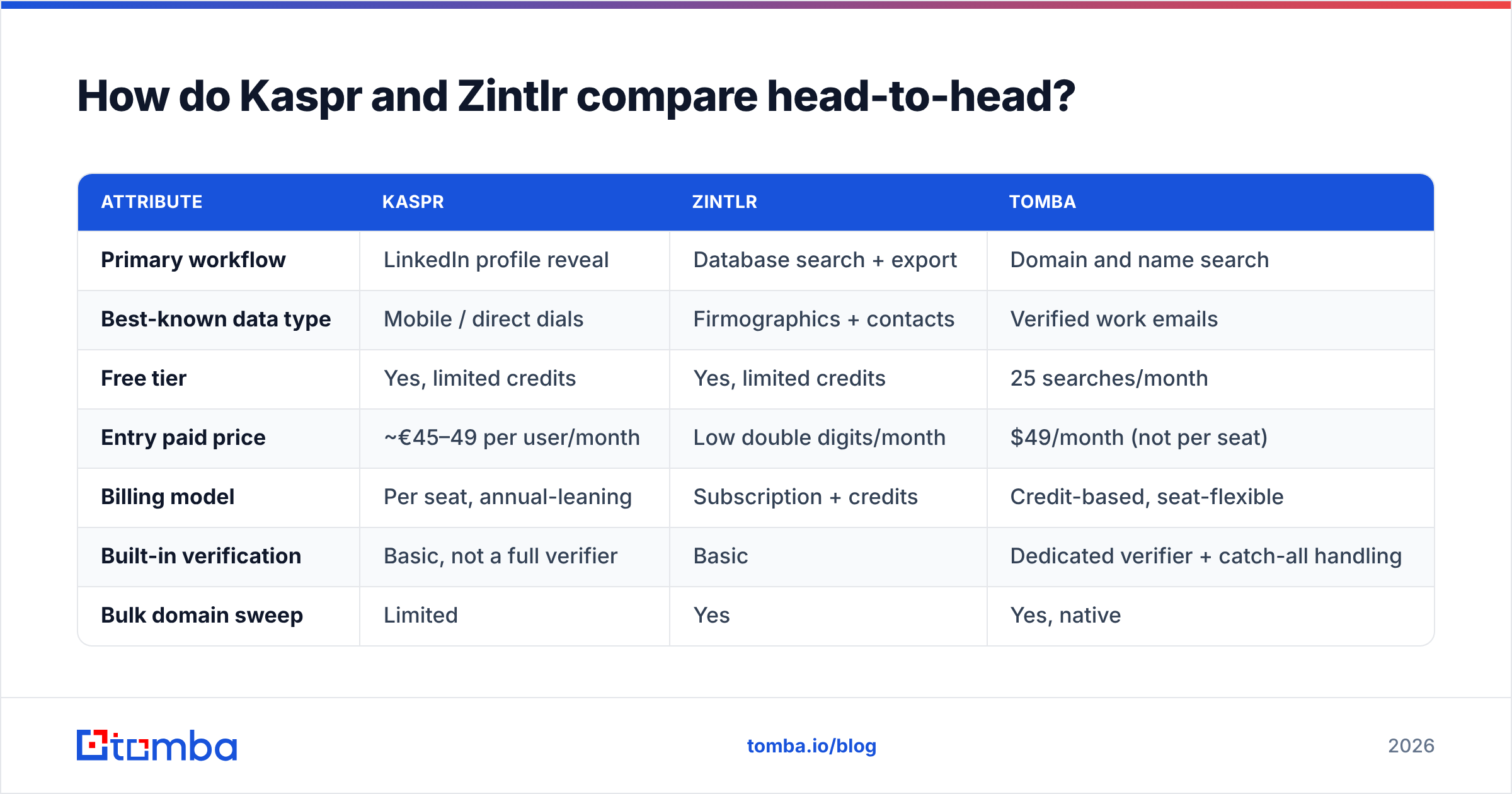
| Attribute | Kaspr | Zintlr | Tomba |
|---|---|---|---|
| Primary workflow | LinkedIn profile reveal | Database search + export | Domain and name search |
| Best-known data type | Mobile / direct dials | Firmographics + contacts | Verified work emails |
| Free tier | Yes, limited credits | Yes, limited credits | 25 searches/month |
| Entry paid price | ~€45–49 per user/month | Low double digits/month | $49/month (not per seat) |
| Billing model | Per seat, annual-leaning | Subscription + credits | Credit-based, seat-flexible |
| Built-in verification | Basic, not a full verifier | Basic | Dedicated verifier + catch-all handling |
| Bulk domain sweep | Limited | Yes | Yes, native |
| Public API | Limited on lower tiers | Available | Full REST API on all paid plans |
| Strongest geography | Western Europe | India / APAC / US SMB | Global, strongest on company domains |
| CRM sync | HubSpot, Pipedrive, Salesforce, Lemlist | HubSpot, Zapier, exports | HubSpot, Salesforce, Pipedrive, Zapier, Make |
Prices shift, so treat the figures above as a snapshot at publication and confirm on each vendor's own pricing page before you buy. What doesn't shift is the billing shape: Kaspr charges per seat, which means a five-rep team pays five times, regardless of how much data each rep pulls. Zintlr and Tomba both lean toward credit pools that a team shares.
Which one finds more accurate contact data?#
There is no single answer, because the two tools are accurate about different things.
Kaspr's phone data is its reason to exist. In practice, teams selling into France, the UK, the Netherlands, and the DACH region report the highest mobile hit rates — which tracks, given Kaspr's French origins and Cognism's European data footprint. Push the same list into US mid-market or LATAM and the direct-dial fill rate drops noticeably. Kaspr's emails are adequate, but they're a secondary output, not the product.
Zintlr's strength is breadth of records per search. You can build a 5,000-row list in an afternoon. The trade-off is that database exports age faster than on-demand reveals: a record scraped and stored nine months ago reflects a job title that may no longer exist. Every static B2B database has this problem, and the honest way to evaluate it is not to read the vendor's accuracy claim but to export 200 rows and run them through an independent email verifier before your first send.

That test is the only accuracy benchmark that matters for your business, because accuracy is segment-dependent. A tool that hits 94% on US SaaS VPs might hit 61% on German manufacturing plant managers. Run the same 200-contact sample through both vendors' trials and compare:
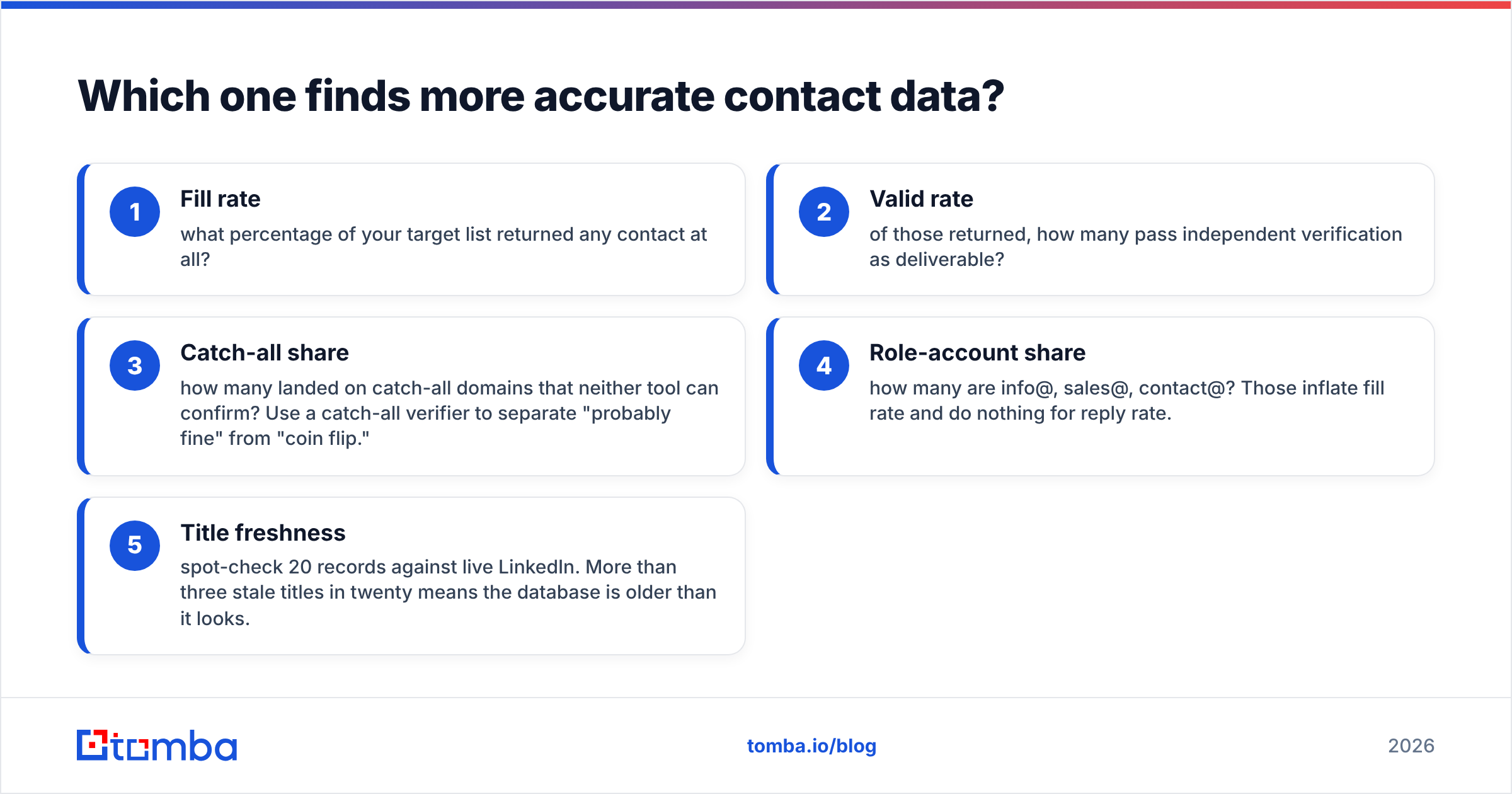
- Fill rate — what percentage of your target list returned any contact at all?
- Valid rate — of those returned, how many pass independent verification as deliverable?
- Catch-all share — how many landed on catch-all domains that neither tool can confirm? Use a catch-all verifier to separate "probably fine" from "coin flip."
- Role-account share — how many are info@, sales@, contact@? Those inflate fill rate and do nothing for reply rate.
- Title freshness — spot-check 20 records against live LinkedIn. More than three stale titles in twenty means the database is older than it looks.
A vendor that wins on fill rate and loses on valid rate is actively costing you money, because every hard bounce degrades sender reputation that took months to build.
What does each one actually cost?#
Sticker price is the least interesting part of this comparison. The cost that hurts is structural.
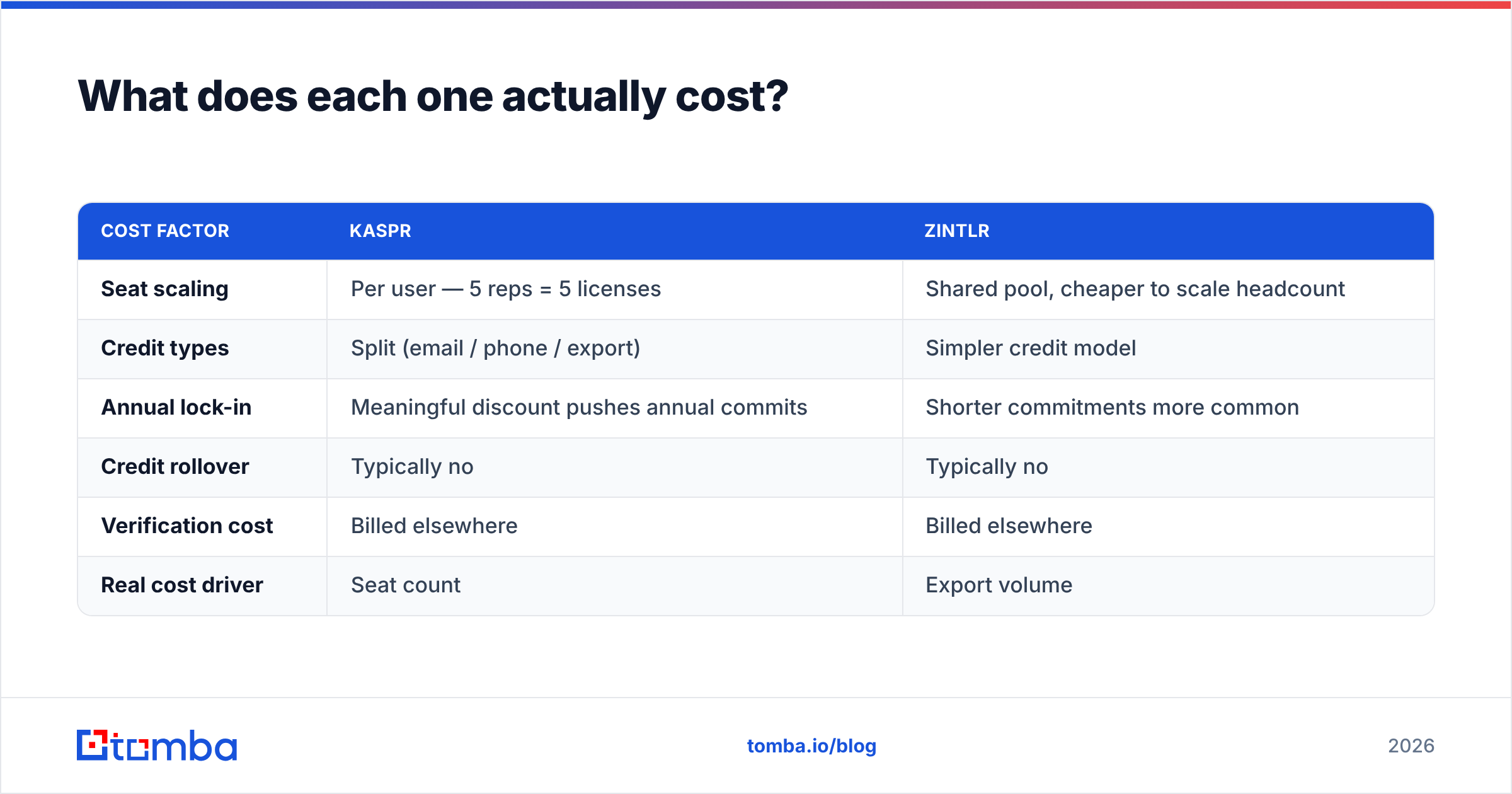
| Cost factor | Kaspr | Zintlr |
|---|---|---|
| Seat scaling | Per user — 5 reps = 5 licenses | Shared pool, cheaper to scale headcount |
| Credit types | Split (email / phone / export) | Simpler credit model |
| Annual lock-in | Meaningful discount pushes annual commits | Shorter commitments more common |
| Credit rollover | Typically no | Typically no |
| Verification cost | Billed elsewhere | Billed elsewhere |
| Real cost driver | Seat count | Export volume |
Kaspr's split credit system is the detail buyers miss. You can run out of phone credits while sitting on a pile of unused email credits, mid-quarter, with no way to convert between them. Budget for the credit type you actually consume, not the headline total.
Zintlr's risk is the opposite: cheap exports encourage volume, and volume without verification is how teams end up on a blocklist. If you're exporting 10,000 rows a month at a low price, your real cost includes the verification layer you now need — and possibly the cost of a burned sending domain if you skip it.
For reference, Tomba pricing runs Free (25 searches/month), Starter $49/month, Growth $99/month, Pro $249/month, and custom Enterprise — with verification included in the same credit pool rather than billed as a separate product. That doesn't make it the right tool for LinkedIn dialing; it makes the total-cost comparison cleaner when emails are what you need.
Is Kaspr better than Zintlr for LinkedIn prospecting?#
For profile-by-profile work, yes — with caveats.
- Kaspr wins on workflow. The extension sits where SDRs already work. No tab switch, no export, no CSV round trip. For a rep doing 40 touches a day out of Sales Navigator, that friction reduction is worth real money.
- Kaspr wins on phones. If your motion is cold calling and the email is secondary, Zintlr isn't really competing for that job.
- Zintlr wins on planning. Building a territory, sizing a segment, or mapping every company in a vertical is a database job. Kaspr can't do that well.
- Zintlr wins on cost per record. At volume, the math isn't close.
- Neither wins on LinkedIn-to-verified-email. If your goal is to turn a saved LinkedIn list into a deliverable email list, a purpose-built LinkedIn finder paired with verification produces a cleaner result than either tool's export.
One more thing worth flagging: any tool that scrapes LinkedIn carries account risk. LinkedIn's terms restrict automated data extraction, and aggressive extension use — hundreds of reveals per day from one account — is the pattern that triggers restrictions. Both vendors rate-limit for this reason. Don't let a rep treat the extension like a firehose.

What about compliance and data sourcing?#
This is where European buyers should slow down.
Kaspr's positioning under Cognism leans heavily on GDPR readiness — notification processes, DNC screening across European lists, and documented data subject request handling. If you're selling into the EU and your legal team reviews vendors, that paper trail matters and Kaspr has more of it than most self-serve tools.
Zintlr's compliance story is less documented in public. That isn't an accusation — plenty of good vendors under-invest in public compliance pages — but it means you should ask directly: where does the data come from, what's the lawful basis for processing EU records, and how are deletion requests handled? Get it in writing before you export a single European contact.
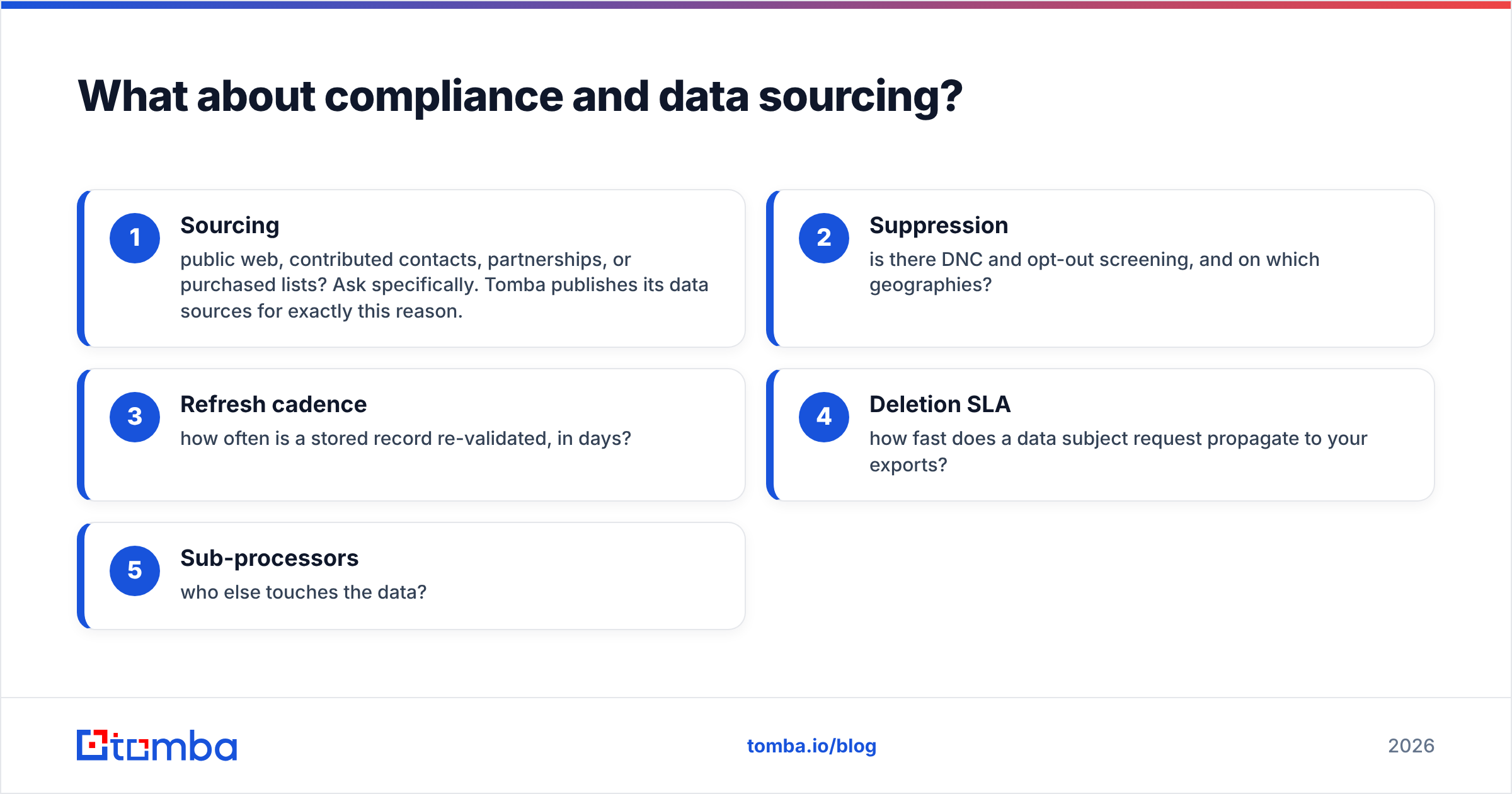
For any provider, the questions are the same:
- Sourcing — public web, contributed contacts, partnerships, or purchased lists? Ask specifically. Tomba publishes its data sources for exactly this reason.
- Suppression — is there DNC and opt-out screening, and on which geographies?
- Refresh cadence — how often is a stored record re-validated, in days?
- Deletion SLA — how fast does a data subject request propagate to your exports?
- Sub-processors — who else touches the data?
Vendors that answer these crisply are usually the ones worth buying. Check independent reviews on G2 too, filtering for reviewers in your company-size band — enterprise reviews of an SMB tool tell you almost nothing useful.
Where do both tools fall short?#
Three gaps show up repeatedly in real deployments.
Verification is an afterthought. Both tools return contacts with a confidence indicator, not a verified deliverability status. Those aren't the same thing. A 90%-confidence email that hasn't been SMTP-checked this week is still a bounce risk, and modern inbox providers punish bounce rates faster than they did two years ago.
Domain-level sweeps are weak. If your ICP is "every operations lead at these 800 companies," neither tool is optimized for that shape of work. That's a domain search job — start from the company, enumerate the people, verify, enrich.
Automation depth varies. If you want contact lookup inside a workflow — a Make scenario, an enrichment step in your CRM, a nightly job — check API availability on the specific tier you're considering, not the top tier in the docs.

| Your situation | Best pick |
|---|---|
| Cold calling European mid-market | Kaspr |
| Building large lists on a tight budget | Zintlr |
| Email-first outbound at scale | Dedicated email finder + verifier |
| Enriching an existing CRM in bulk | Database or API tool, not an extension |
| Five-plus reps sharing one credit pool | Avoid per-seat billing |
Which should you choose in 2026?#
Choose Kaspr if phones are the point, your reps work inside LinkedIn all day, you sell into Western Europe, and you have fewer than ten seats. The workflow fit is excellent and the compliance posture is above average for this price band.
Choose Zintlr if you need volume and search flexibility more than you need per-profile depth, your budget is constrained, and your target market skews toward India, APAC, or US SMB. Validate the personality-intelligence layer on your own accounts before you let it influence messaging — it's a differentiator, not a proven lift.
Choose neither if the real job is turning company lists into verified, deliverable email addresses. That's a different tool category, and paying per seat for a dialing extension to do it is the most common overspend we see in this comparison.
Whatever you pick, run the 200-contact bake-off first. Two free trials and one afternoon will tell you more than any comparison post, including this one.
Ready to test the email side properly? Start with the Tomba Email Finder free tier — 25 searches a month, no card — and run the same 200 target contacts you tested in Kaspr and Zintlr. Compare fill rate against verified valid rate, and let the bounce numbers pick your vendor.
Related guides#
// get started
Find, verify and enrich your first contacts today
Start on the free plan with 25 searches a month, then scale when your team is ready.
Free plan · No credit card required · GDPR & CCPA
Get the Tomba newsletter
Product and data updates
// about the author