Kaspr vs ZoomInfo (2026): Which B2B Data Tool Wins?
Kaspr is a $65/mo LinkedIn contact scraper. ZoomInfo is a $15K/yr data platform. We compared coverage, pricing, contract terms, and accuracy to show which one actually fits your team.
TL;DR
- Kaspr is a LinkedIn-first contact extension: you browse a profile, it reveals a phone and email. Plans start around €65/month per user with a limited free tier. It is cheap, fast, and narrow.
- ZoomInfo is a full go-to-market data platform with intent signals, org charts, technographics, and workflow automation. Real-world contracts typically land between $15,000 and $40,000+ per year with annual commitments and seat minimums.
- They are not really competitors. Kaspr solves "get me this one person's number." ZoomInfo solves "build my entire territory model and route the leads."
- Phone accuracy is the deciding factor if dialing is your motion. Kaspr's European mobile coverage is genuinely strong; ZoomInfo's US direct dial database is deeper but noisier than the marketing suggests.
- Most teams under 15 reps overbuy. A focused email finder plus a dialer usually beats a six-figure platform you use at 20% capacity.
If you are comparing Kaspr vs ZoomInfo, you are probably at one of two decision points: you need contact data for a small outbound team and want to know if the cheap tool is good enough, or you are up for ZoomInfo renewal and looking for something that costs less than a junior SDR's salary.
Both are valid. The answer depends less on which tool is "better" and more on whether your bottleneck is finding contacts or orchestrating a data operation.
What is Kaspr and who actually uses it?#
Kaspr is a Chrome extension and web app that pulls phone numbers and email addresses from LinkedIn profiles. Founded in France and acquired by Cognism in 2022, it inherited some of Cognism's compliance posture and European data depth while staying a separate, cheaper product.
The workflow is simple. You install the extension, open a LinkedIn profile or a Sales Navigator search, and Kaspr surfaces contact details in a sidebar. You can enrich a whole list, push contacts into a CRM, and run basic LinkedIn sequences.
Who it fits:
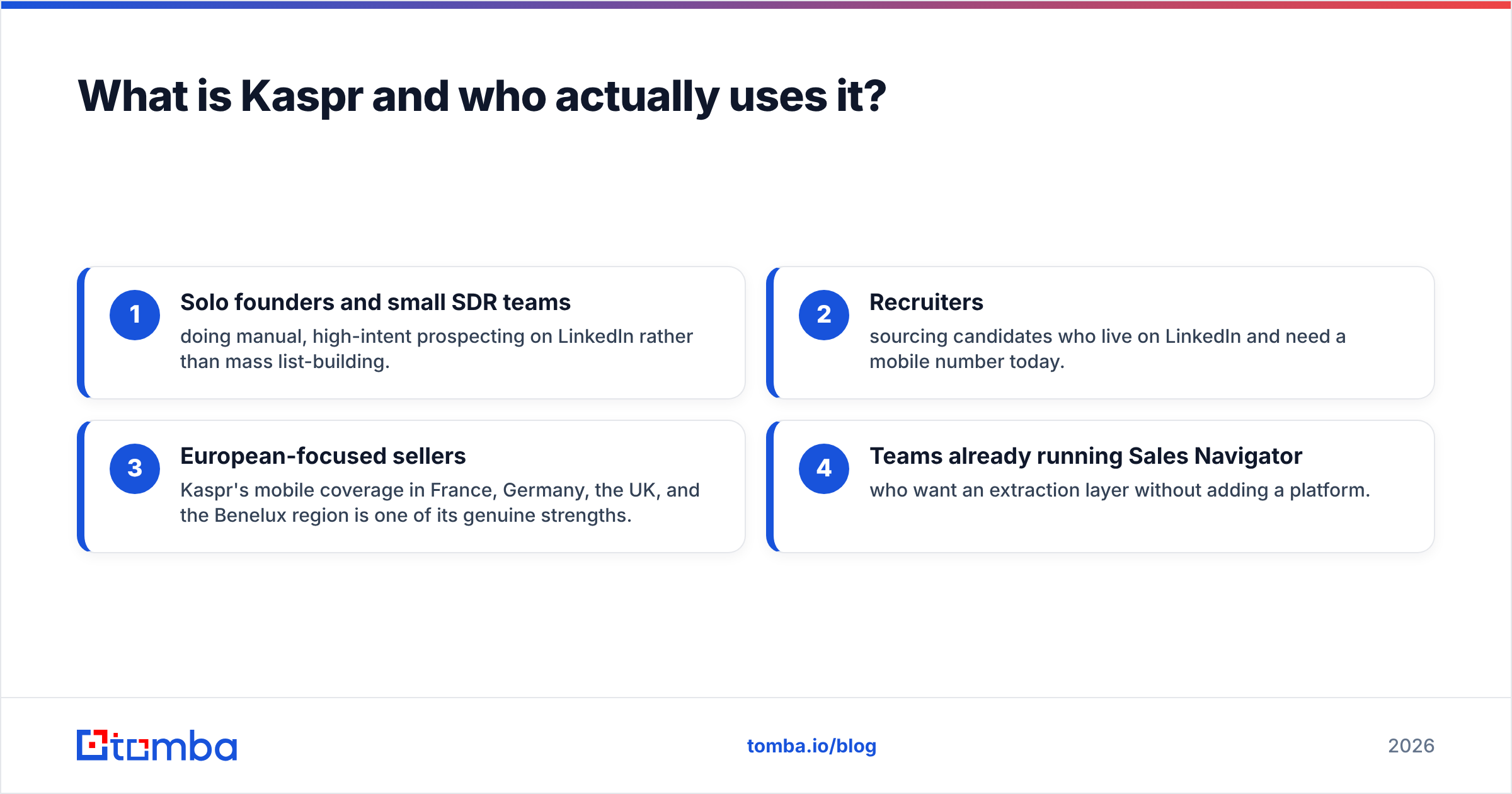
- Solo founders and small SDR teams doing manual, high-intent prospecting on LinkedIn rather than mass list-building.
- Recruiters sourcing candidates who live on LinkedIn and need a mobile number today.
- European-focused sellers — Kaspr's mobile coverage in France, Germany, the UK, and the Benelux region is one of its genuine strengths.
- Teams already running Sales Navigator who want an extraction layer without adding a platform.
Where it falls short: Kaspr's data is fundamentally reactive. If the person is not on LinkedIn, or you cannot find them there, Kaspr has nothing to give you. There is no meaningful "build me a list of every VP of Ops at 200-500 employee logistics companies in Texas" motion. You go find the profiles yourself.

What is ZoomInfo and what are you really paying for?#
ZoomInfo (now ZoomInfo Technologies, trading as GTM-focused "Copilot" suite in recent releases) is the incumbent. Its value is not any single lookup — it is the database plus the layer of decision-making software wrapped around it.
You are paying for:
- Scale. Hundreds of millions of contact records, tens of millions of company profiles, org charts, and firmographics.
- Intent data. Bombora-derived and proprietary signals telling you which accounts are researching your category right now.
- Technographics. What software an account already runs, which is how ABM teams build displacement plays.
- Workflow. Enrichment that fires automatically into Salesforce or HubSpot, lead routing, form shortening, and website visitor identification.
- WebSights and Engage. Visitor de-anonymization and a native sequencer, sold as add-ons more often than not.
The catch is packaging. Almost nothing arrives in the base plan. Intent, WebSights, Engage, API access, and export credit caps are each negotiated line items. Public reviews on G2 consistently flag two things: the data is broad, and the contract is rigid. Auto-renewal clauses, seat minimums, and multi-year terms are standard, not exceptional.
Kaspr vs ZoomInfo: how do they compare head to head?#
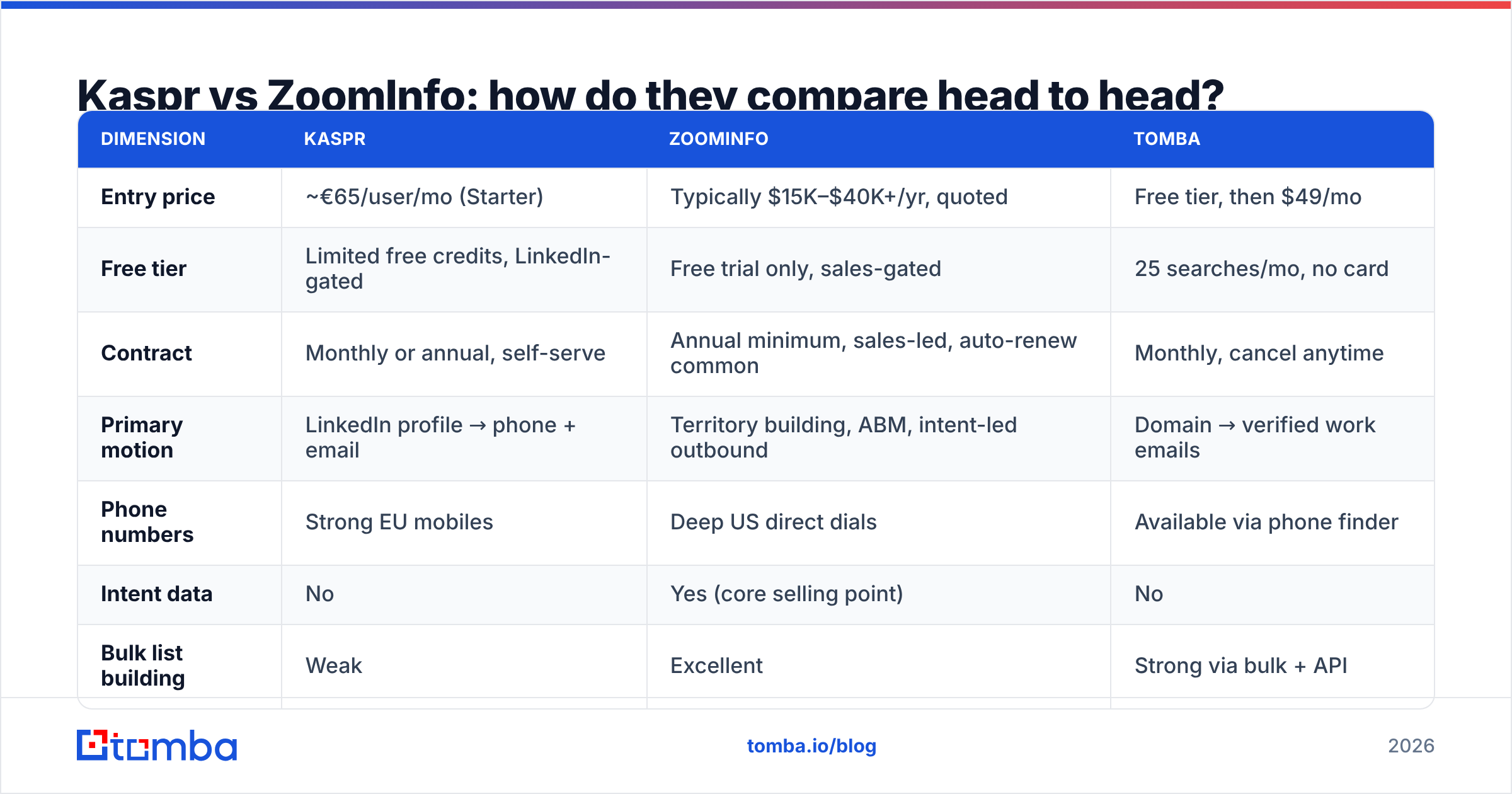
| Dimension | Kaspr | ZoomInfo | Tomba |
|---|---|---|---|
| Entry price | ~€65/user/mo (Starter) | Typically $15K–$40K+/yr, quoted | Free tier, then $49/mo |
| Free tier | Limited free credits, LinkedIn-gated | Free trial only, sales-gated | 25 searches/mo, no card |
| Contract | Monthly or annual, self-serve | Annual minimum, sales-led, auto-renew common | Monthly, cancel anytime |
| Primary motion | LinkedIn profile → phone + email | Territory building, ABM, intent-led outbound | Domain → verified work emails |
| Phone numbers | Strong EU mobiles | Deep US direct dials | Available via phone finder |
| Intent data | No | Yes (core selling point) | No |
| Bulk list building | Weak | Excellent | Strong via bulk + API |
| Email verification | Basic | Included, opaque methodology | Dedicated verifier + catch-all handling |
| API access | Limited | Add-on, priced separately | Included on paid plans |
| Best for | 1–10 reps, EU, LinkedIn-native | 25+ reps, enterprise ABM | Any size, email-led outbound |
The table clarifies the real split. Kaspr and ZoomInfo do not overlap much in capability — they overlap in the budget line they occupy. A revenue leader asking "do I need ZoomInfo?" is often really asking "can I get away with something cheaper?"
Is ZoomInfo worth the price premium?#
Sometimes. Here is the honest test.
ZoomInfo earns its cost when three or more of these are true:
- You have 25+ quota-carrying reps whose time is expensive enough that data quality compounds into real pipeline.
- Your GTM runs on account-based motions where intent and technographic filters actually change targeting decisions, not just decorate dashboards.
- You need CRM enrichment at scale — tens of thousands of stale records that must be refreshed on a schedule.
- You sell primarily into the US mid-market or enterprise, where ZoomInfo's coverage is genuinely dominant.
- You have RevOps headcount to own the platform. ZoomInfo without an administrator becomes an expensive contact lookup tool.
If fewer than three apply, you are buying a platform to use one feature. That is where the cost math breaks. Forrester and Gartner both note in their go-to-market research that data platform ROI correlates more strongly with operational maturity than with database size — the tool amplifies a process, it does not create one.
The most common failure pattern we see: a 12-person team signs a $22,000 annual deal, uses it as a glorified email finder, burns through export credits by month seven, then discovers the renewal auto-triggered 60 days before they meant to cancel.
How accurate is the data on each platform?#
Accuracy claims in this category are marketing numbers, so treat all of them skeptically — including ours.
Kaspr reports strong phone accuracy, particularly for European mobiles, because much of its data is contributed and cross-verified through its user network. That model has a real strength and a real weakness. The strength: mobile numbers that other databases simply do not have. The weakness: coverage is uneven. Profiles nobody in the network has looked up are thin, and US direct dials trail the specialist providers.
ZoomInfo runs the largest contributory network in the industry, plus web crawling, plus a research team. Breadth is unmatched. But breadth and freshness are different problems. With B2B job-change rates running roughly 20-30% annually, a database of that size always carries a meaningful stale layer. Reps routinely report contacts who left the company a year ago still showing as current.
The practical rule for both: never send to unverified data. Whatever your source, run addresses through a real-time email verifier before they enter a sequence. A 12% bounce rate will damage your sender reputation faster than any data vendor can repair it, and neither Kaspr nor ZoomInfo takes responsibility for your domain health.
Catch-all domains deserve special mention. A large share of enterprise domains accept all mail at the SMTP layer, which makes standard verification return "unknown." Neither tool handles this well. A dedicated catch-all verifier is the only way to get a defensible verdict on those addresses instead of guessing.
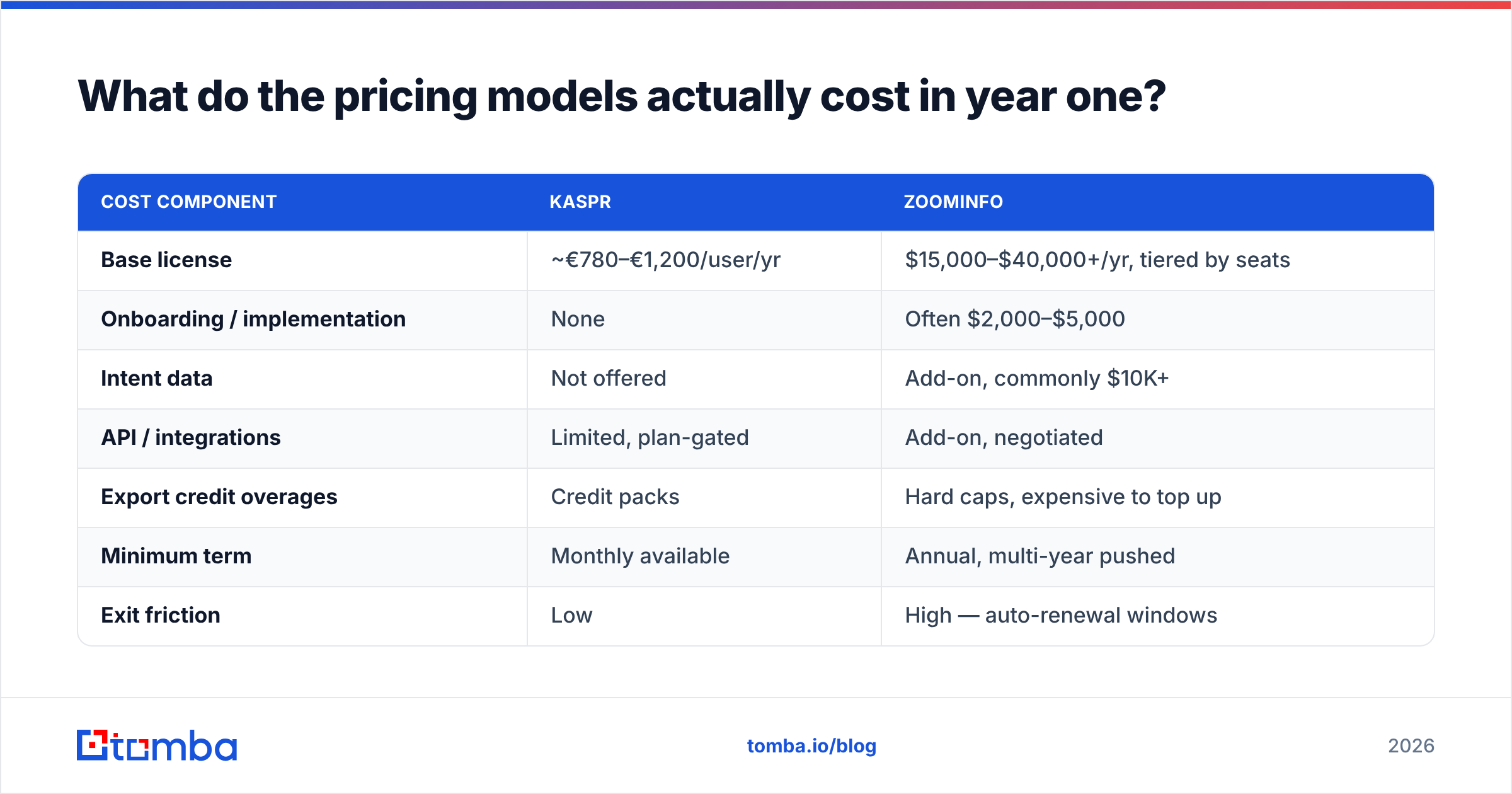
What do the pricing models actually cost in year one?#
Sticker price is not the cost. Here is the fuller picture.
| Cost component | Kaspr | ZoomInfo |
|---|---|---|
| Base license | ~€780–€1,200/user/yr | $15,000–$40,000+/yr, tiered by seats |
| Onboarding / implementation | None | Often $2,000–$5,000 |
| Intent data | Not offered | Add-on, commonly $10K+ |
| API / integrations | Limited, plan-gated | Add-on, negotiated |
| Export credit overages | Credit packs | Hard caps, expensive to top up |
| Minimum term | Monthly available | Annual, multi-year pushed |
| Exit friction | Low | High — auto-renewal windows |
For a five-person team, Kaspr lands somewhere near $4,000-6,000 annually. ZoomInfo for the same team rarely comes in under $18,000 once implementation and a single add-on are counted. That is a 3-4x delta for capabilities most five-person teams will not use.
What are the best alternatives to both?#
The Kaspr vs ZoomInfo framing assumes those are your only two options. They are not, and for a lot of teams the third option is the right one.
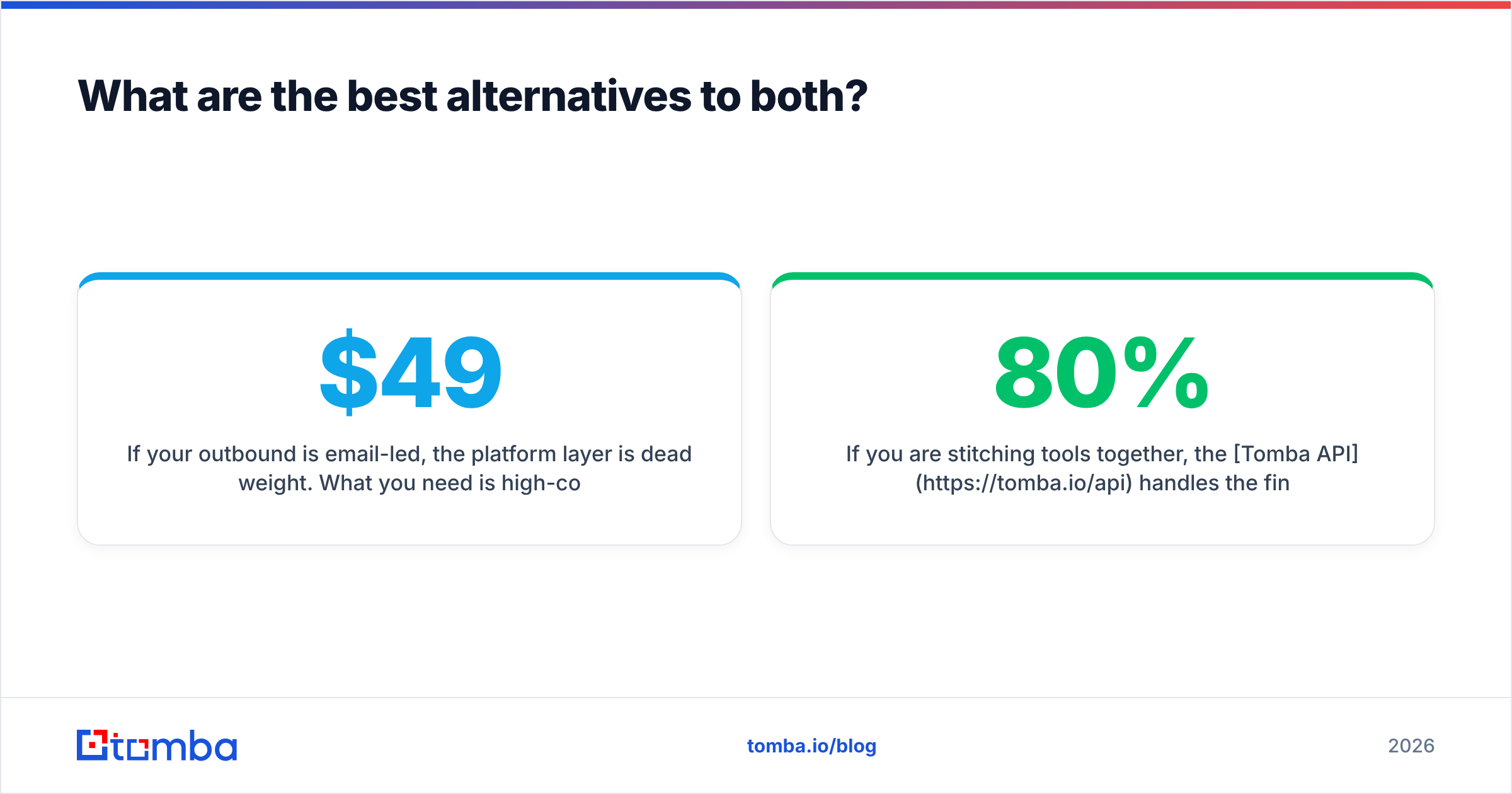
If your outbound is email-led, the platform layer is dead weight. What you need is high-confidence work emails at domain scale, verification that handles catch-alls, and an API that drops into your existing stack. That is a different, much cheaper product category — and it is where Tomba pricing sits deliberately: a free tier at 25 searches per month, Starter at $49/month, Growth at $99/month, and Pro at $249/month. No annual lock-in, no implementation fee.
If you need verified B2B contact lists with firmographic filters, BookYourData is a credible pay-as-you-go option with a bounce guarantee and no subscription requirement — a reasonable middle ground when you want list volume without a platform contract.
If you want ZoomInfo's breadth at a lower price point, Apollo, Lusha, and Cognism all compete directly. Each trades something: Apollo trades data depth for sequencing, Lusha trades scale for simplicity, Cognism trades price for compliance rigor. There is no free lunch in this category. Our breakdown of Apollo alternatives covers the trade-offs in more detail.
If you are stitching tools together, the Tomba API handles the find-and-verify step programmatically so you are not paying platform rates for what is fundamentally a lookup. Pair it with a dialer and a sequencer and you have built the 80% for a fraction of the cost.
Which should you choose?#
Decide by motion, not by feature count.
- Choose Kaspr if you are one to ten people, you prospect manually on LinkedIn, you sell into Europe, and you need mobile numbers more than you need email volume. It is the cheapest credible way to get a phone number off a profile.
- Choose ZoomInfo if you have 25+ reps, a RevOps owner, US enterprise targets, and a genuine ABM motion that consumes intent data. Negotiate hard, cap the term at one year, and put the cancellation window in your calendar the day you sign.
- Choose neither if your outbound is email-first and volume-driven. You are better served by a dedicated domain search and verification stack that costs a tenth as much and does the one job you actually need well.
The honest summary: most teams comparing these two tools are solving an email problem with a phone tool or a small-team problem with an enterprise contract. Name your bottleneck first. The right purchase becomes obvious once you do.
Start with the cheapest thing that could work. Before you sign an annual data contract, run a real test: take 100 target companies, find the decision-maker emails with the Tomba Email Finder, verify them, and send. If that fills your pipeline, you never needed the platform. The free tier gives you 25 searches a month with no card required — enough to know within a week whether you have a data problem or a process problem.
Related guides#
// get started
Find, verify and enrich your first contacts today
Start on the free plan with 25 searches a month, then scale when your team is ready.
Free plan · No credit card required · GDPR & CCPA
Get the Tomba newsletter
Product and data updates
// about the author