Key Account Management in 2026: A Practical B2B Playbook
Most KAM programs fail because they rename account executives instead of changing how accounts are selected, planned, and measured. Here is the practical version that survives contact with a real pipeline.
TL;DR
- Key account management is a structured investment program for your top 5-10% of customers — not a job title you hand to your best account executive and hope for the best.
- The single biggest failure mode is picking accounts by current revenue instead of growth potential. Big and stuck is worse than mid-sized and expanding.
- A real key account plan is one page of decisions: whitespace, buying committee map, risk register, and the next three plays. Anything longer gets written once and never opened.
- Measure share of wallet, multi-threading depth, and net revenue retention. Do not measure meetings booked — that is activity theater.
- Coverage of the buying committee is where most programs quietly break. If you have two contacts in a $400k account, you do not have an account, you have a relationship.
What is key account management?#
Key account management (KAM) is the practice of treating a small set of your highest-potential customers as a portfolio you actively invest in, rather than as tickets in a queue. You assign dedicated ownership, build a written plan per account, and run governance on a fixed cadence.
The everyday analogy: regular account management is renting out apartments — collect the rent, fix what breaks, renew the lease. Key account management is being a part-owner of the building. You care about the tenant's five-year plans, you propose renovations before they ask, and you lose money if the building's value drops.
Technically, KAM sits between sales and customer success. It inherits quota and expansion targets from sales, and renewal responsibility from CS. That dual mandate is exactly why it fails when it is bolted onto an existing AE role without changing the comp plan or the account load.
The distinction matters commercially. Gartner's research on B2B buying puts the typical enterprise buying group at six to ten people, each arriving with their own independently gathered information. A named-account rep working two contacts is covering maybe a quarter of the room. KAM exists to close that gap systematically.

How is key account management different from regular account management?#
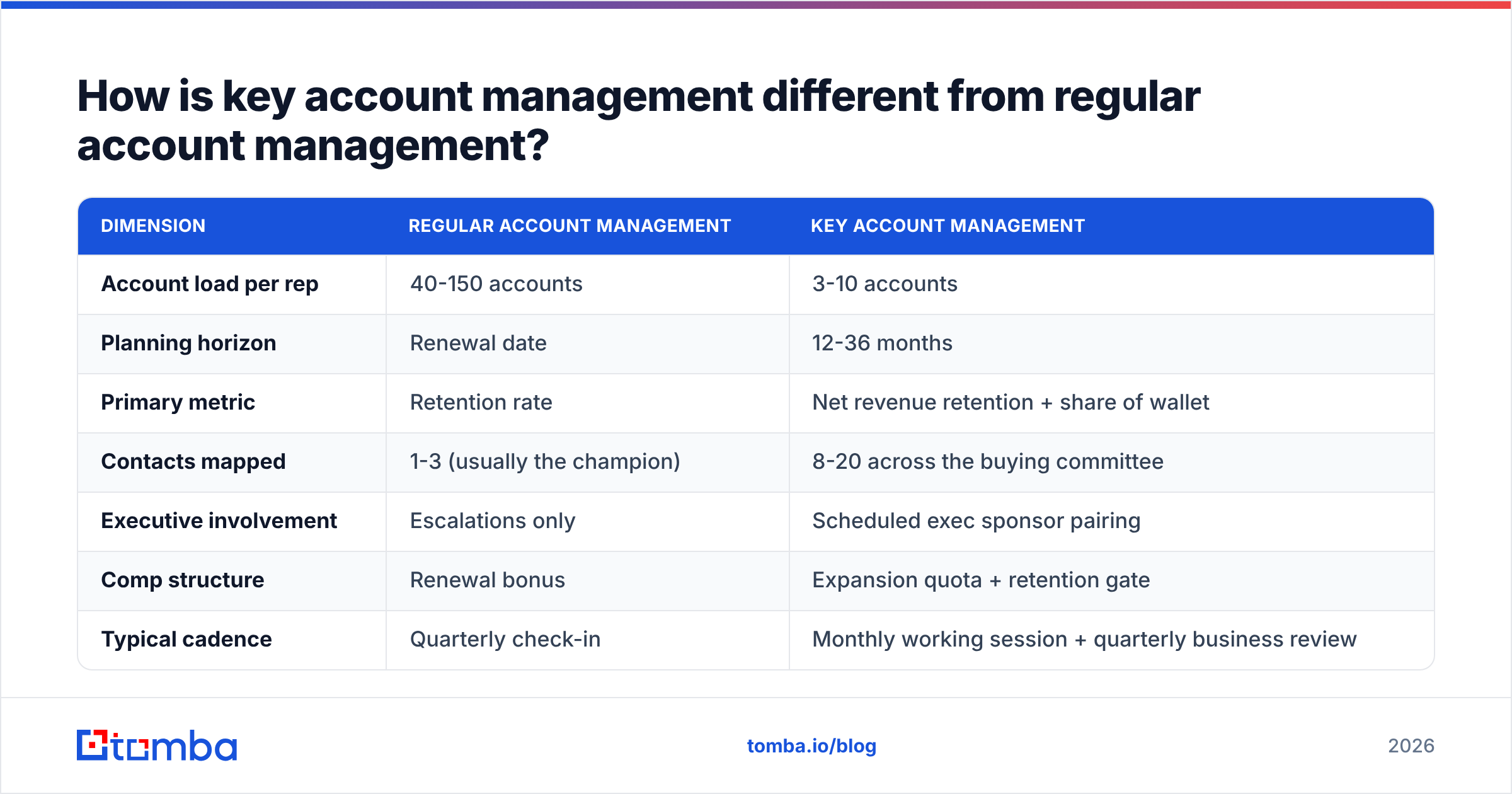
The difference is not effort. It is the unit of planning. Regular account management plans around renewals and support tickets. KAM plans around the account's business outcomes and your share of their spend.
| Dimension | Regular account management | Key account management |
|---|---|---|
| Account load per rep | 40-150 accounts | 3-10 accounts |
| Planning horizon | Renewal date | 12-36 months |
| Primary metric | Retention rate | Net revenue retention + share of wallet |
| Contacts mapped | 1-3 (usually the champion) | 8-20 across the buying committee |
| Executive involvement | Escalations only | Scheduled exec sponsor pairing |
| Comp structure | Renewal bonus | Expansion quota + retention gate |
| Typical cadence | Quarterly check-in | Monthly working session + quarterly business review |
| Data requirement | CRM hygiene | Org charts, enrichment, buying signals |
Read that table as a budget statement. Cutting account load from 100 to 8 means one KAM costs you what twelve named-account reps used to cover. That only pays back if the accounts selected actually have room to grow. Which brings us to selection.
How do you choose which accounts are "key"?#
Choose on potential, not size. The most common mistake is sorting your customer list by ARR descending and drawing a line at row 20. That list is full of accounts that are already fully penetrated — you have every seat, every module, every region. There is nothing left to sell, so your most expensive sales resource spends the year defending a flat number.
Score candidates on five factors and require a minimum threshold on each:
- Unrealized whitespace — Which products, business units, and geographies have they not bought? If you cannot name at least $150k of credible unsold scope, it is not a key account. It is a renewal.
- Strategic fit — Does their roadmap need what is on yours? An account that is drifting toward a use case you are deprecating is a slow loss, not a growth bet.
- Access to power — Can you get a meeting with someone who controls budget within 30 days? If every path runs through one procurement contact, your ceiling is already set.
- Reference and market weight — Does their logo move deals in their segment? Some accounts are worth investment for the pipeline they unlock elsewhere.
- Delivery health — Are they actually getting value today? Investing KAM headcount into an account with an unhappy implementation team is throwing good money after bad.
Score each 1-5, weight whitespace and access to power double, and take the top decile. Then cap the list. If you have 30 sellers and 30 "key" accounts per seller, you have a naming convention, not a program.
Re-score annually. Accounts graduate off the list when whitespace closes, and that is a success, not a demotion. Say so publicly or your team will fight to keep dead accounts on their plan.
What goes into a key account plan?#
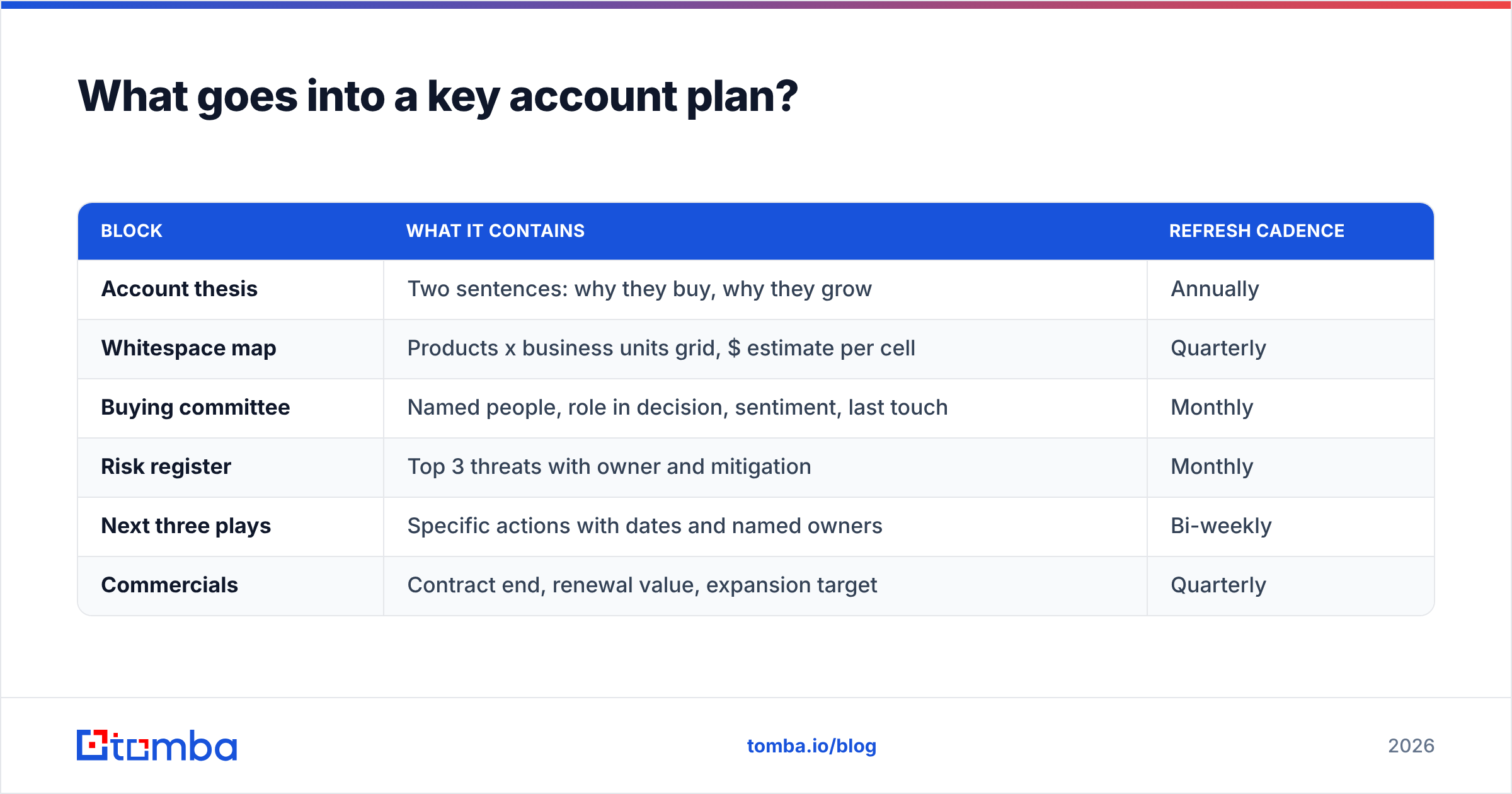
One page. Six blocks. If the template runs to eleven slides, it becomes an annual compliance exercise that nobody reads in March.
| Block | What it contains | Refresh cadence |
|---|---|---|
| Account thesis | Two sentences: why they buy, why they grow | Annually |
| Whitespace map | Products x business units grid, $ estimate per cell | Quarterly |
| Buying committee | Named people, role in decision, sentiment, last touch | Monthly |
| Risk register | Top 3 threats with owner and mitigation | Monthly |
| Next three plays | Specific actions with dates and named owners | Bi-weekly |
| Commercials | Contract end, renewal value, expansion target | Quarterly |
The buying committee block is the one that determines whether the rest is fiction. You need names, titles, reporting lines, and contact details for the people who influence the decision — including the ones who never take your calls. That usually means going and finding them rather than waiting for your champion to make introductions, because champions introduce you to allies, not to skeptics.
This is a data problem more than a relationship problem. A practical workflow: pull the org structure from LinkedIn, run a domain search against the account's domain to see the full set of discoverable contacts and the company's email pattern, then push the verified rows into your CRM as account contacts with a role tag. For accounts with multiple subsidiaries, run each subsidiary domain separately — the email patterns often differ after an acquisition and that is where coverage silently breaks.
Keep sentiment honest. A three-state field (advocate / neutral / blocker) beats a 1-10 score because nobody argues about what a 6 means. And record the last meaningful touch, not the last automated email — a marketing nurture send is not coverage.
Why do most key account programs fail?#
They fail in five recognizable ways, and four of the five are management decisions rather than execution problems.
The rename. Leadership retitles senior AEs as "strategic account directors," changes nothing about account load or comp, and declares a KAM program. Six months later everyone is still working inbound renewals because that is what the comp plan pays for. Fix: change the comp plan first, the title second.
Single-threading. The program runs on one champion per account. When that person gets promoted, reorganized, or leaves — and in B2B software roughly one in four contacts churns out of role annually — the account resets to zero. Fix: set a hard minimum of contacts mapped per account tier and inspect it in the pipeline review.
Planning without inspection. Plans get built in January and opened in December. Fix: put the "next three plays" block on the agenda of every monthly one-on-one. If a play has not moved in two cycles, it was never a real play.
Stale contact data. The plan says you have nine contacts. Four have left. Two bounce. You find out during a campaign send, which also dents your sender reputation. Fix: re-verify key account contact lists quarterly with an email verifier and treat bounce rate on named accounts as a data-quality signal, not a copy problem.
Executive sponsorship on paper. A VP is listed as the exec sponsor and has never met the customer. Fix: require two logged sponsor-to-sponsor touches per year, or remove the sponsor field entirely — an empty field is more honest than a false one.

What metrics actually tell you a KAM program is working?#
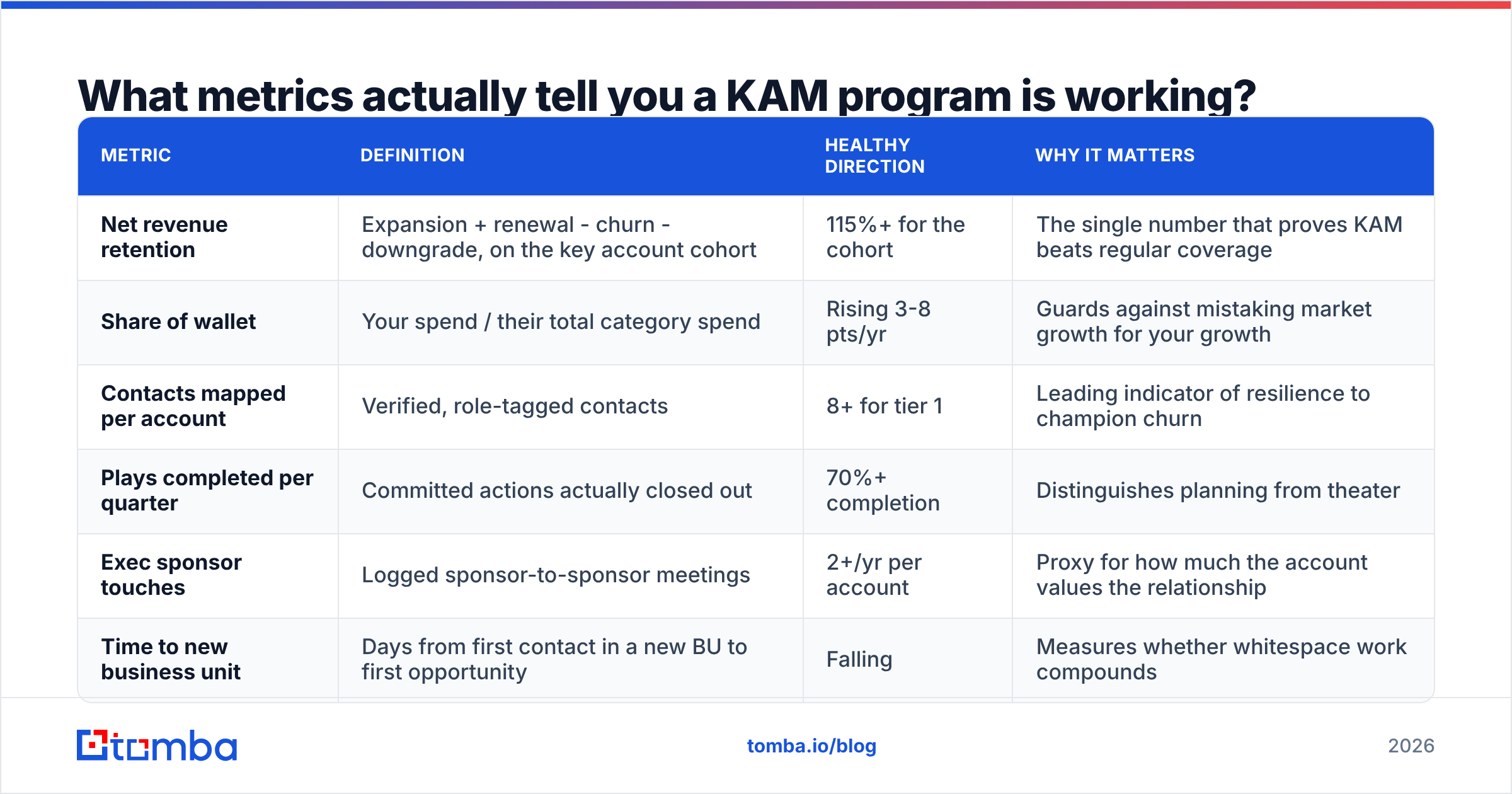
Four outcome metrics and two leading indicators. Resist adding more — a KAM dashboard with 14 tiles gets ignored exactly as fast as an eleven-slide plan.
| Metric | Definition | Healthy direction | Why it matters |
|---|---|---|---|
| Net revenue retention | Expansion + renewal - churn - downgrade, on the key account cohort | 115%+ for the cohort | The single number that proves KAM beats regular coverage |
| Share of wallet | Your spend / their total category spend | Rising 3-8 pts/yr | Guards against mistaking market growth for your growth |
| Contacts mapped per account | Verified, role-tagged contacts | 8+ for tier 1 | Leading indicator of resilience to champion churn |
| Plays completed per quarter | Committed actions actually closed out | 70%+ completion | Distinguishes planning from theater |
| Exec sponsor touches | Logged sponsor-to-sponsor meetings | 2+/yr per account | Proxy for how much the account values the relationship |
| Time to new business unit | Days from first contact in a new BU to first opportunity | Falling | Measures whether whitespace work compounds |
Share of wallet is the hardest and the most valuable. You rarely get the denominator handed to you, so estimate it: headcount in the relevant function, publicly stated budget, tooling seen in their stack, and what peer accounts of similar size spend with you. A rough estimate that gets revisited quarterly beats a precise metric you never compute.
One measurement trap worth naming: do not judge the program on bookings in year one. Buying committees in enterprise accounts take three to four quarters to reshape. Judge year one on coverage and plan execution, year two on revenue. If leadership cannot commit to that, do not launch the program — launch a named-account motion instead and call it what it is.
What tools does a key account team actually need?#
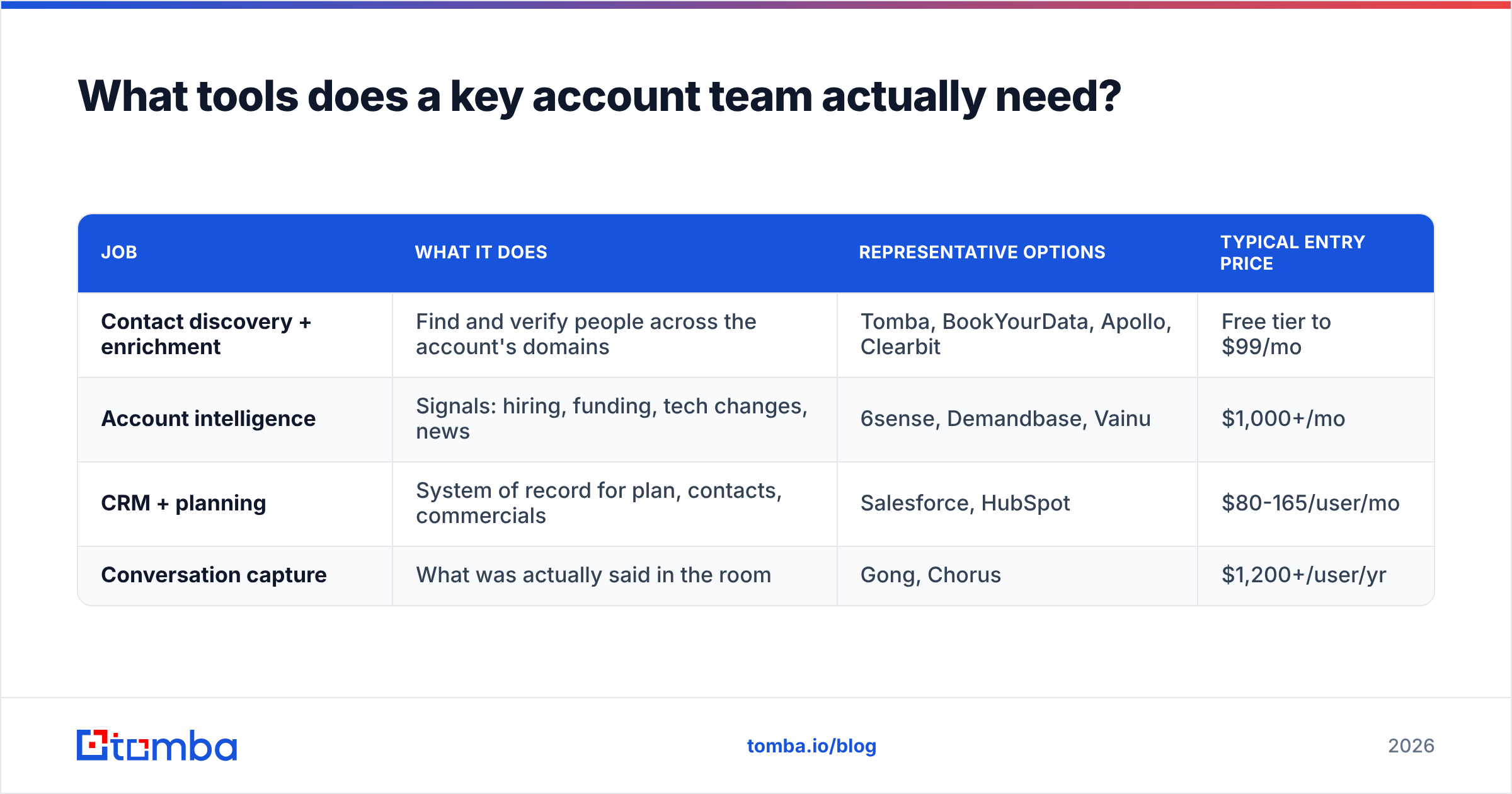
Fewer than vendors would like you to believe. The stack has four jobs: know who is in the account, know what they are doing, record what you decided, and prove the revenue.
| Job | What it does | Representative options | Typical entry price |
|---|---|---|---|
| Contact discovery + enrichment | Find and verify people across the account's domains | Tomba, BookYourData, Apollo, Clearbit | Free tier to $99/mo |
| Account intelligence | Signals: hiring, funding, tech changes, news | 6sense, Demandbase, Vainu | $1,000+/mo |
| CRM + planning | System of record for plan, contacts, commercials | Salesforce, HubSpot | $80-165/user/mo |
| Conversation capture | What was actually said in the room | Gong, Chorus | $1,200+/user/yr |
Start at the top row. Contact discovery is where most KAM plans are actually failing, and it is the cheapest gap to close. Tomba's pricing runs a free tier at 25 searches per month, Starter at $49/mo, Growth at $99/mo, and Pro at $249/mo, with the email finder, verifier, and enrichment sharing one credit pool — see Tomba pricing for the full breakdown. BookYourData takes a different angle with pre-built, pay-as-you-go contact lists, which suits teams that want a bulk contact drop for a defined set of target accounts rather than an ongoing API. Both are reasonable; the choice depends on whether your motion is continuous discovery or periodic list-building.
Account intelligence platforms are the row where teams overspend earliest. A $1,000/mo signal tool is worth it when you have 200 target accounts and a team that acts on alerts within 48 hours. With 25 key accounts and a monthly cadence, a rep reading the customer's earnings call and job board covers most of the same ground. G2's category listings are useful for scoping options, but pilot against your actual account list before signing an annual deal.
For CRM, the deciding factor is whether your plan fields live where the reps already work. A key account plan stored in a shared drive is a document. The same plan as CRM objects is a system — you can report on it, inspect it, and alert on staleness. HubSpot's account-based marketing tooling and Salesforce's account planning objects both handle this; the mistake is running the plan in slides alongside a CRM nobody updates.
How do you run the operating cadence?#
Three meetings, fixed calendar, no exceptions. Cadence is what turns a plan into a program.
- Bi-weekly play review (30 min, KAM + manager) — Walk the "next three plays" only. What moved, what is stuck, what is the unblock. No account storytelling.
- Monthly account working session (60 min, KAM + CS + solution lead) — Update the buying committee map and the risk register. Every new contact gets verified and role-tagged before it enters the plan.
- Quarterly business review with the customer (90 min, includes exec sponsors) — Value delivered, their roadmap, your roadmap, commercial next steps. Send the deck 48 hours early so the meeting is a conversation, not a readout.
Two rules make the cadence stick. First, the manager prepares by reading the plan, not by asking the rep to summarize it — that is the only forcing function that keeps plans current. Second, every meeting ends with owners and dates written into the plan before anyone leaves the call. Actions captured in someone's notebook are actions that do not exist.
If you are building the account map from scratch, front-load it. Block two days per key account to research the org, discover and verify contacts, and draft the whitespace grid. That upfront cost is what makes the next twelve months of cadence productive rather than exploratory.
Where should you start if you have no KAM program today?#
Pick five accounts. Not your five biggest — your five with the most credible unsold scope. Build a one-page plan for each, map at least eight verified contacts per account, and run the cadence for two quarters. Compare NRR on those five against a matched control group of similar accounts under standard coverage. If the gap is real, expand. If it is not, you learned that for the price of one quarter instead of one headcount year.
The work that makes or breaks this is unglamorous: knowing who is actually in the room and being able to reach them. Tomba's Email Finder covers that layer — find contacts by domain, name, or company across every subsidiary in the account, verify before you send, and push clean, role-tagged rows into the CRM where your account plans live. Start on the free tier with 25 searches a month, map one key account end to end, and see how much of your buying committee you were missing.
Related guides#
// get started
Find, verify and enrich your first contacts today
Start on the free plan with 25 searches a month, then scale when your team is ready.
Free plan · No credit card required · GDPR & CCPA
Get the Tomba newsletter
Product and data updates
// about the author