Key Account Management Plan: A 2026 Framework That Works
Most key account plans are slide decks nobody reopens. Here is the framework, template structure, and cadence that actually keeps revenue in your biggest accounts — plus how to tell a real plan from theater.
TL;DR
- A key account management plan is a living operating document for your top 5–20 customers — not an annual slide deck. If it is not edited monthly, it is decoration.
- The seven parts that matter: account intelligence, relationship map, whitespace analysis, risk register, growth plays, mutual success plan, and a review cadence with owners and dates.
- Pick accounts by expansion potential and strategic fit, not by current revenue alone. Your biggest logo is often your most saturated one.
- The single most common failure is a stale relationship map. Champions move roles every 18–24 months; if you cannot name and reach the new buying committee, the plan is fiction.
- Measure the plan, not the account: plan freshness, coverage of the buying committee, whitespace converted, and net revenue retention on planned accounts vs. unplanned ones.
What is a key account management plan?#
A key account management plan is a documented strategy for growing and defending a specific high-value customer relationship. It records what you know about the account, who you know inside it, where the untapped revenue sits, what could kill the renewal, and exactly who is doing what by when.
Think of it like a flight plan rather than a travel brochure. A brochure describes a destination and sits in a drawer. A flight plan gets filed, checked against weather, and amended mid-route — and if you ignore it, someone notices immediately.
That distinction is the whole game. Most companies already have a "key account plan" template. Most of those templates are a 14-slide deck built in Q4, presented once at a kickoff, and never opened again. Meanwhile the CFO who championed you leaves in March, procurement consolidates vendors in June, and you find out in the renewal call in November.
A real plan has three properties a deck does not:
- It has owners and dates. Every play has a named person and a due date, not "the account team."
- It has a refresh cadence. Monthly light touch, quarterly deep review.
- It is queryable. It lives where the data lives — your CRM, your account planning tool, a shared doc — not in a personal folder.

Which accounts belong in the plan?#
Not your top 20 by revenue. That is the lazy cut, and it systematically over-invests in saturated accounts and under-invests in the ones with room to grow.
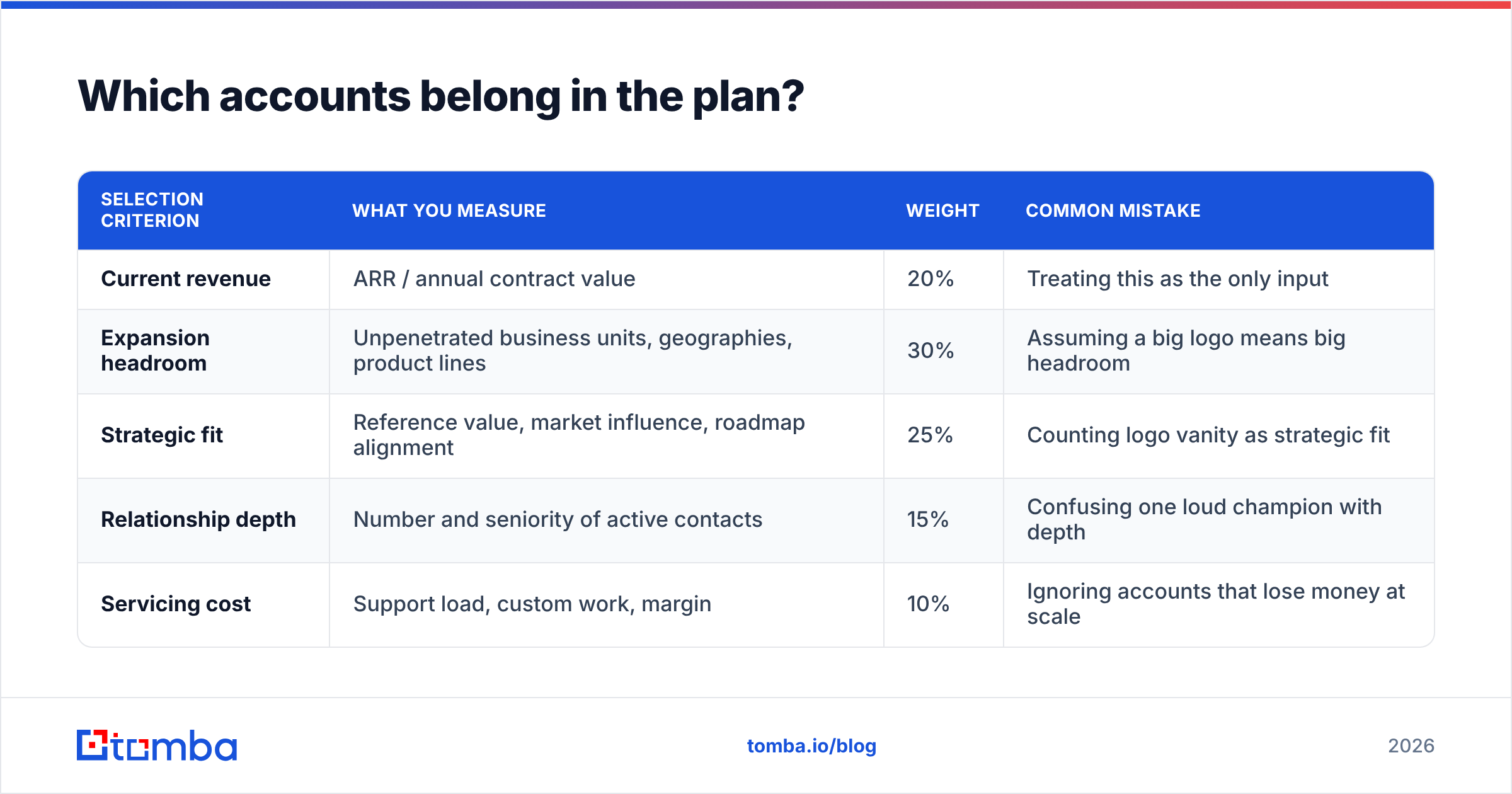
Score candidates on four axes and rank by the composite:
| Selection criterion | What you measure | Weight | Common mistake |
|---|---|---|---|
| Current revenue | ARR / annual contract value | 20% | Treating this as the only input |
| Expansion headroom | Unpenetrated business units, geographies, product lines | 30% | Assuming a big logo means big headroom |
| Strategic fit | Reference value, market influence, roadmap alignment | 25% | Counting logo vanity as strategic fit |
| Relationship depth | Number and seniority of active contacts | 15% | Confusing one loud champion with depth |
| Servicing cost | Support load, custom work, margin | 10% | Ignoring accounts that lose money at scale |
A useful sanity check: if an account scores high on revenue and low on everything else, it belongs in a retention motion, not a key account plan. Key account management is an investment program. You are allocating scarce senior time. Spend it where the second and third dollar are available, not just the first.
Most teams land on 5–10 accounts per key account manager. Beyond twelve, plan quality collapses — there simply are not enough hours to keep relationship maps current across more than that.
What goes inside the plan? The seven-part structure#
Here is the structure that survives contact with an actual QBR. Each section is short by design. If a section runs past one screen, it has become a report instead of a plan.
- Account intelligence — Org structure, business unit map, fiscal calendar, publicly stated strategic priorities (pull these from the latest earnings call or annual report, not from your own notes), current vendors in adjacent categories, and recent leadership changes.
- Relationship map — Every named contact in the buying committee with role, influence rating, sentiment, last touch date, and who on your side owns the relationship. Mark the gaps in red. The gaps are the plan.
- Whitespace analysis — A grid of their business units × your product lines, with each cell marked as sold, in-pipeline, qualified-out, or untouched. Untouched cells are your growth backlog.
- Risk register — Champion departure risk, contract consolidation risk, competitive displacement, product gaps flagged in support tickets, budget-cycle risk. Each risk gets a likelihood, an impact, and a mitigation owner.
- Growth plays — Three to five specific, dated initiatives tied to whitespace cells or to a stated customer priority. "Expand into EMEA" is not a play. "Run a 45-minute workshop with the Frankfurt ops director in week 3 of February, introduced by our current London champion" is a play.
- Mutual success plan — The part you build with the customer. Their outcomes, their metrics, their milestones, co-signed. This is the single strongest predictor of renewal because it converts your plan from a sales artifact into a joint commitment.
- Cadence and governance — Who meets, how often, what gets reviewed, and what triggers an escalation.
Write all seven for every named account. If you cannot fill section 2 or 3 with specifics, you do not have enough account knowledge to justify the investment yet — that itself is the first play.
How do you keep the relationship map from going stale?#
This is where most key account management plans quietly die, so it deserves its own section.
The average B2B buying committee now involves 6–10 stakeholders, and executive tenure in many functions runs under two years. Gartner's research on B2B buying behavior has consistently shown that buying groups are larger and more distributed than sellers assume. Practically: the map you built in January is wrong by June, and nobody tells you.
Three mechanics that keep it honest:
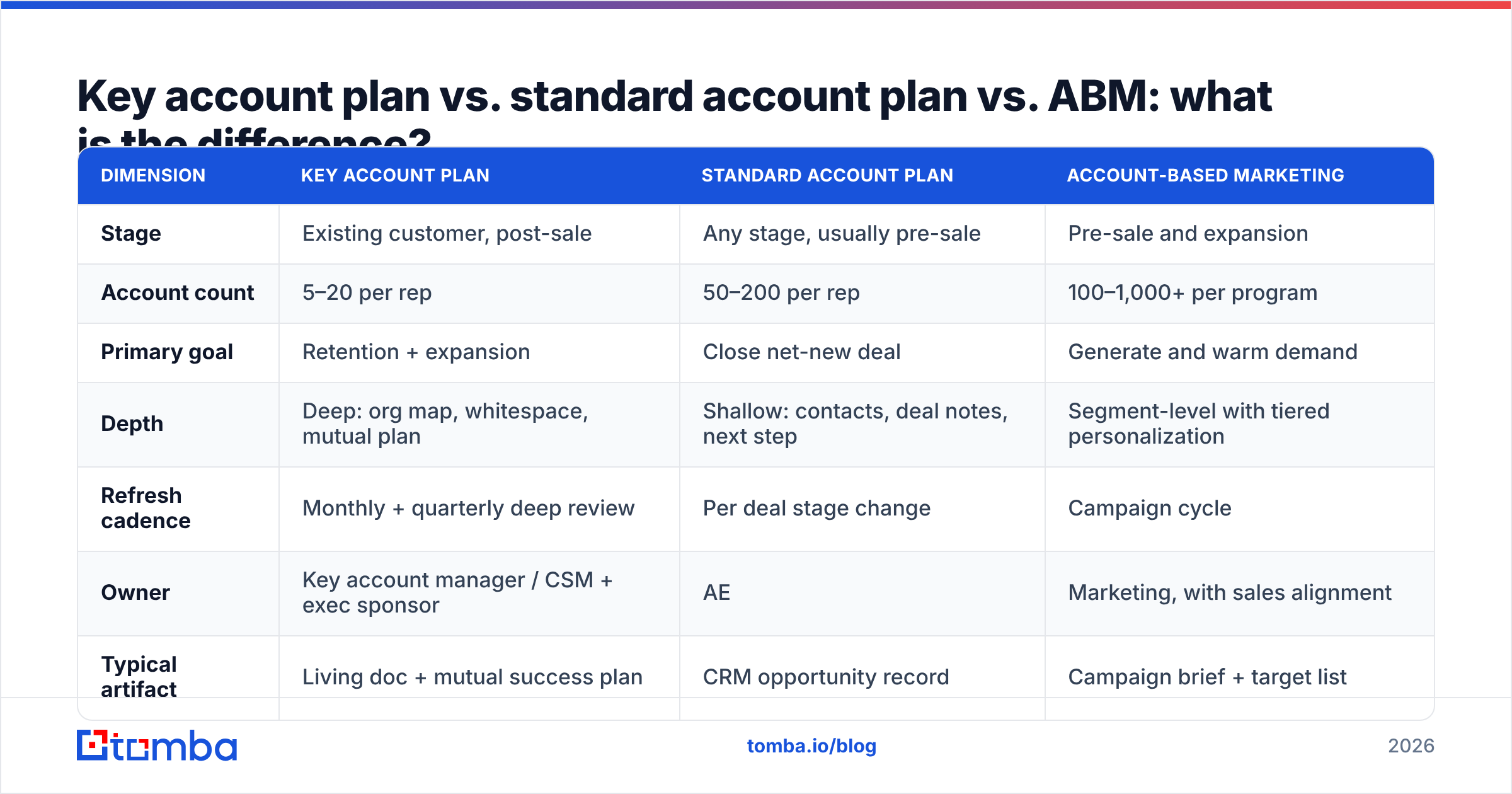
- Tie map freshness to the CRM, not to memory. Every contact record gets a "last verified" date. Anything over 120 days shows up on a stale-contact report that the account manager has to clear before the quarterly review.
- Monitor for role changes continuously. LinkedIn job-change alerts catch the obvious ones. For the rest, re-run contact discovery against the account domain on a schedule — a quarterly domain search across your top accounts surfaces new names in relevant functions before they show up in a meeting invite you were not on.
- Verify before you reach out. A bounced email to a newly promoted VP is a bad first impression and a deliverability hit. Run new contacts through an email verifier before they enter any sequence, and check catch-all domains separately — large enterprises run catch-all configurations far more often than SMBs, which means standard verification returns "unknown" exactly where your key accounts live.
When a champion leaves, you have roughly one quarter before institutional memory of your value evaporates. The plan should have a pre-written champion-departure playbook: who you contact, what proof of value you send, and which executive on your side makes the introduction call.
Key account plan vs. standard account plan vs. ABM: what is the difference?#
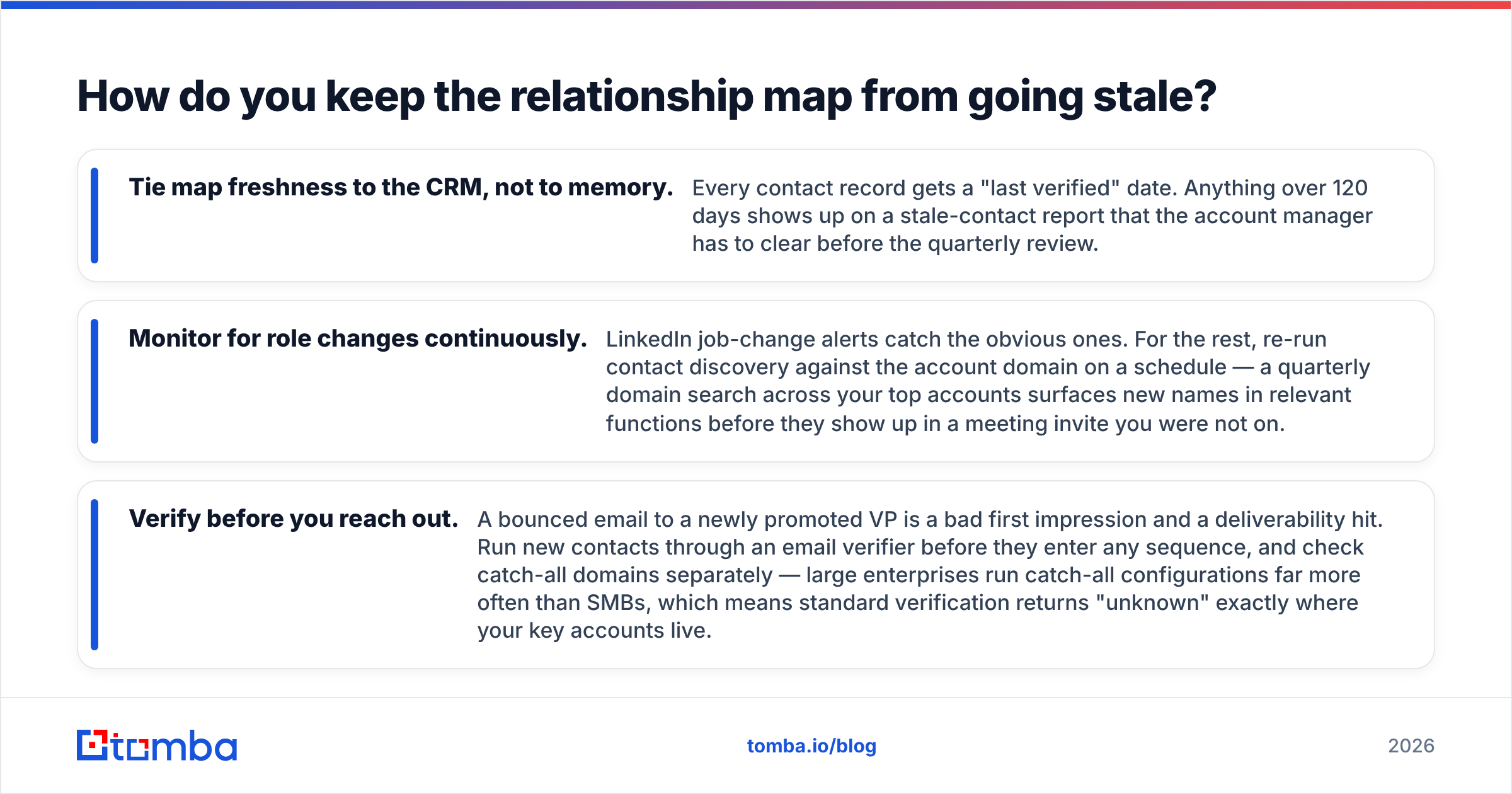
These three get used interchangeably and they are not the same thing.
| Dimension | Key account plan | Standard account plan | Account-based marketing |
|---|---|---|---|
| Stage | Existing customer, post-sale | Any stage, usually pre-sale | Pre-sale and expansion |
| Account count | 5–20 per rep | 50–200 per rep | 100–1,000+ per program |
| Primary goal | Retention + expansion | Close net-new deal | Generate and warm demand |
| Depth | Deep: org map, whitespace, mutual plan | Shallow: contacts, deal notes, next step | Segment-level with tiered personalization |
| Refresh cadence | Monthly + quarterly deep review | Per deal stage change | Campaign cycle |
| Owner | Key account manager / CSM + exec sponsor | AE | Marketing, with sales alignment |
| Typical artifact | Living doc + mutual success plan | CRM opportunity record | Campaign brief + target list |
| Success metric | NRR, share of wallet, exec relationship count | Win rate, cycle length | Engagement, pipeline created |
The practical takeaway: a key account plan is the only one of the three where the customer co-authors part of the document. If your "key account plan" is entirely internal, you are running a detailed standard account plan and calling it something fancier.
How do you run the cadence without drowning in meetings?#
Cadence is where good intentions go to die. The fix is to make most of the rhythm asynchronous and reserve live time for decisions.
A cadence that holds up in practice:
- Weekly, 10 minutes, async. Account manager updates the risk register and logs any new contact or role change. No meeting.
- Monthly, 30 minutes, live. Account team reviews growth plays: what shipped, what slipped, what is blocked. One decision per blocked play.
- Quarterly, 90 minutes, live. Full plan review with the executive sponsor. Whitespace re-scored, relationship map audited against the stale-contact report, next quarter's plays committed.
- Semi-annual, with the customer. Mutual success plan review. Their metrics, their milestones, their assessment of your performance. Bring data, not slides about yourself.
- Annual. Re-run account selection. Some accounts graduate out of the program; some earn their way in.
The executive sponsor is not optional and is not ceremonial. The point of the sponsor is that when a risk escalates — a competitive displacement attempt, a procurement consolidation — you have a peer-level relationship already warm on your side. Sponsors introduced during a crisis are worth very little.
What metrics prove the plan is working?#
Measure two layers: whether the plan is being maintained, and whether planned accounts outperform.
Plan health metrics (leading):
- Plan freshness — percentage of key accounts edited in the last 30 days. Target above 90%. This is the canary. When freshness drops, every other number follows within two quarters.
- Buying committee coverage — named, verified contacts in each required role divided by total roles in the committee. Target 80%+ for tier-one accounts.
- Multi-threading depth — number of active relationships per account, and how many are at director level or above. Single-threaded accounts are renewal risks regardless of how happy that one contact is.
- Whitespace conversion rate — untouched cells that became pipeline this quarter.
Outcome metrics (lagging):
- Net revenue retention on planned accounts vs. unplanned — this is the number that justifies the program's existence to the CFO. If planned accounts do not out-retain the rest of the book by a meaningful margin, your plans are theater.
- Share of wallet — your spend divided by their estimated total category spend.
- Executive relationship count — a proxy for durability.
- Time-to-recovery after champion loss — how many days until a new verified champion is engaged.
Run the comparison honestly. Pick a control group of similar-sized accounts without formal plans and compare NRR over four quarters. HubSpot's ongoing sales research and vendor comparisons on G2 are useful for benchmarking the tooling, but your own control-group comparison is worth more than any published average, because it controls for your product, your segment, and your team.
What data does a key account plan actually need?#
More than your CRM holds by default. The plan is only as good as the contact and company data underneath it, and enterprise accounts are exactly where CRM data rots fastest — more contacts, faster reorgs, more subsidiaries.
What you need to keep current, and where it comes from:
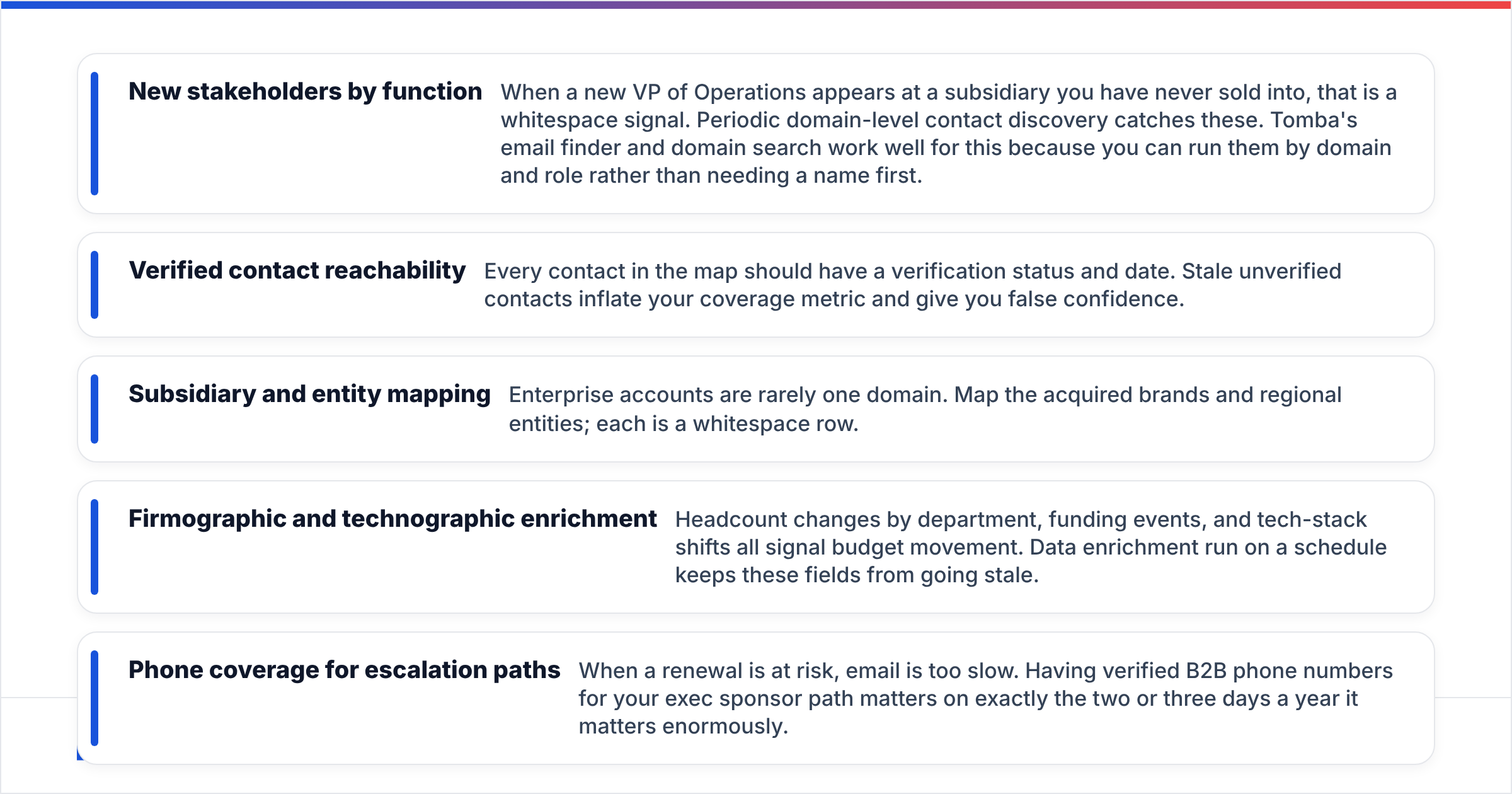
- New stakeholders by function — When a new VP of Operations appears at a subsidiary you have never sold into, that is a whitespace signal. Periodic domain-level contact discovery catches these. Tomba's email finder and domain search work well for this because you can run them by domain and role rather than needing a name first.
- Verified contact reachability — Every contact in the map should have a verification status and date. Stale unverified contacts inflate your coverage metric and give you false confidence.
- Subsidiary and entity mapping — Enterprise accounts are rarely one domain. Map the acquired brands and regional entities; each is a whitespace row.
- Firmographic and technographic enrichment — Headcount changes by department, funding events, and tech-stack shifts all signal budget movement. Data enrichment run on a schedule keeps these fields from going stale.
- Phone coverage for escalation paths — When a renewal is at risk, email is too slow. Having verified B2B phone numbers for your exec sponsor path matters on exactly the two or three days a year it matters enormously.
For teams running this at scale across dozens of key accounts, the practical setup is a scheduled refresh: export the account domain list monthly, run bulk discovery and verification, diff against the existing contact records, and surface new or changed contacts for the account manager to triage. Tomba's API and bulk tools exist for exactly this pattern, and Tomba pricing starts with a free tier of 25 searches per month before the Starter plan at $49/mo — enough to pilot the workflow on a handful of accounts before committing budget.
If your key accounts are enterprise buyers with verified-list requirements, a curated database like BookYourData is a reasonable complement for filling in net-new contacts at scale; pair it with verification so the records entering your plan carry a confidence score.
What are the most common key account plan mistakes?#
- Confusing activity with progress. Twelve touchpoints a quarter with the same champion is one relationship, not twelve.
- Writing the plan without the customer. If the mutual success plan section is blank, you are guessing at their priorities. Ask them.
- Treating the plan as a forecast document. Forecast lives in the pipeline. The plan is about the account, including the parts with no open opportunity.
- No named executive sponsor. Or worse, a sponsor who has never met anyone at the account.
- Over-templating. A 40-field template gets filled with filler. Seven sections, short, honest, current.
- Skipping the risk register because things are going well. Accounts rarely churn from a slow decline; they churn from a specific event — a reorg, a new CPO, a budget freeze — that was visible a quarter earlier to anyone watching.
Where do you start if you have no plan today?#
Pick three accounts. Not twenty. Three.
For each one, spend a focused two hours: build the relationship map from your CRM, verify every contact, run a domain search to find the names you are missing, mark the whitespace grid, and write three dated plays. Book the executive sponsor into a quarterly slot. Then schedule the monthly 30-minute review and actually hold it.
After one quarter, compare those three against three similar accounts with no plan. If the difference is visible, roll it out. If it is not, your plans were probably decks — go back and check whether they had owners, dates, and a customer-co-authored section.
Start with the data layer. A key account management plan is only as reliable as the contacts inside it, and enterprise org charts change faster than most CRMs do. Use the Tomba Email Finder to discover and verify the stakeholders you are missing across your top accounts — search by domain and role, verify before outreach, and keep your relationship map current instead of correcting it in the renewal call. The free tier covers 25 searches a month, which is enough to map your first three key accounts this week.
Related guides#
Ready to find emails that actually work?
Join 150,000+ professionals who stopped guessing and started sending. Free credits on signup — no credit card required.
Get the Tomba newsletter
Practical outbound tactics and product updates — once every two weeks.
About the author