Kickbox vs Apollo.io: Email Verification or Prospecting?
Kickbox verifies the emails you already have. Apollo.io finds new ones. Here is where each tool actually earns its cost, where the overlap is fake, and what a single-vendor stack looks like instead.
TL;DR
- Kickbox and Apollo.io are not competitors. Kickbox is a verification API that judges emails you already own; Apollo.io is a prospecting database that hands you emails, phone numbers, and a sequencer.
- If your problem is "my bounce rate is 6% and my domain is getting throttled," Kickbox solves it. If your problem is "I have no list," Apollo does.
- Buying both is the common outcome — and the common overspend. Apollo seats are priced per user per month whether or not the rep prospects that week; Kickbox credits stack on top.
- Apollo's contact data is broad but noisy at the long tail, which is exactly why teams bolt a verifier onto it.
- A single-vendor finder-plus-verifier stack (Tomba, Findymail, Hunter) covers the same two jobs for most SMB and mid-market teams at a lower blended cost per usable contact.
What does Kickbox actually do?#
Kickbox is an email verification service. You give it an address, it gives you back a verdict: deliverable, undeliverable, risky, or unknown, plus a "sendex" quality score and flags for role accounts, free providers, disposable domains, and accept-all (catch-all) servers.
That's the whole product surface, and the narrowness is the point. Kickbox has been doing SMTP-level validation since 2015, it publishes an uptime record, and it is one of the few verifiers that will actually talk to you about how it handles accept-all domains instead of silently marking everything "risky." It also sells a deliverability/inbox-placement product, but the verification API is what people buy.
What Kickbox will never do is find you an address. Feed it an empty CRM and you get an empty result set. It is a quality gate, not a supply line.
Think of it as a bouncer at the door of your sending infrastructure. Great bouncer. Doesn't bring guests.
What does Apollo.io actually do?#
Apollo.io is the opposite shape: a wide go-to-market platform built on a contact database of roughly 275 million contacts and 70 million companies, with a Chrome extension, filters for 65+ attributes, intent signals, a dialer, email sequences, and a lightweight CRM.
Apollo's pitch is consolidation. Find the account, find the person, get the email and mobile, drop them into a sequence, log the activity — without leaving one tab. For a team that has no data vendor and no sequencer, that's a real jump in velocity.
The cost of that width is depth. Apollo's email data is crowd-contributed and machine-inferred at scale, which means coverage is excellent for US software mid-market and degrades noticeably for smaller companies, EU markets, and non-English domains. Apollo does include verification of its own records, but "verified by the vendor that also supplied the record" is a conflict of interest most deliverability leads don't fully trust — which is precisely why Kickbox exists in so many Apollo shops.
Is Kickbox vs Apollo.io even the right comparison?#
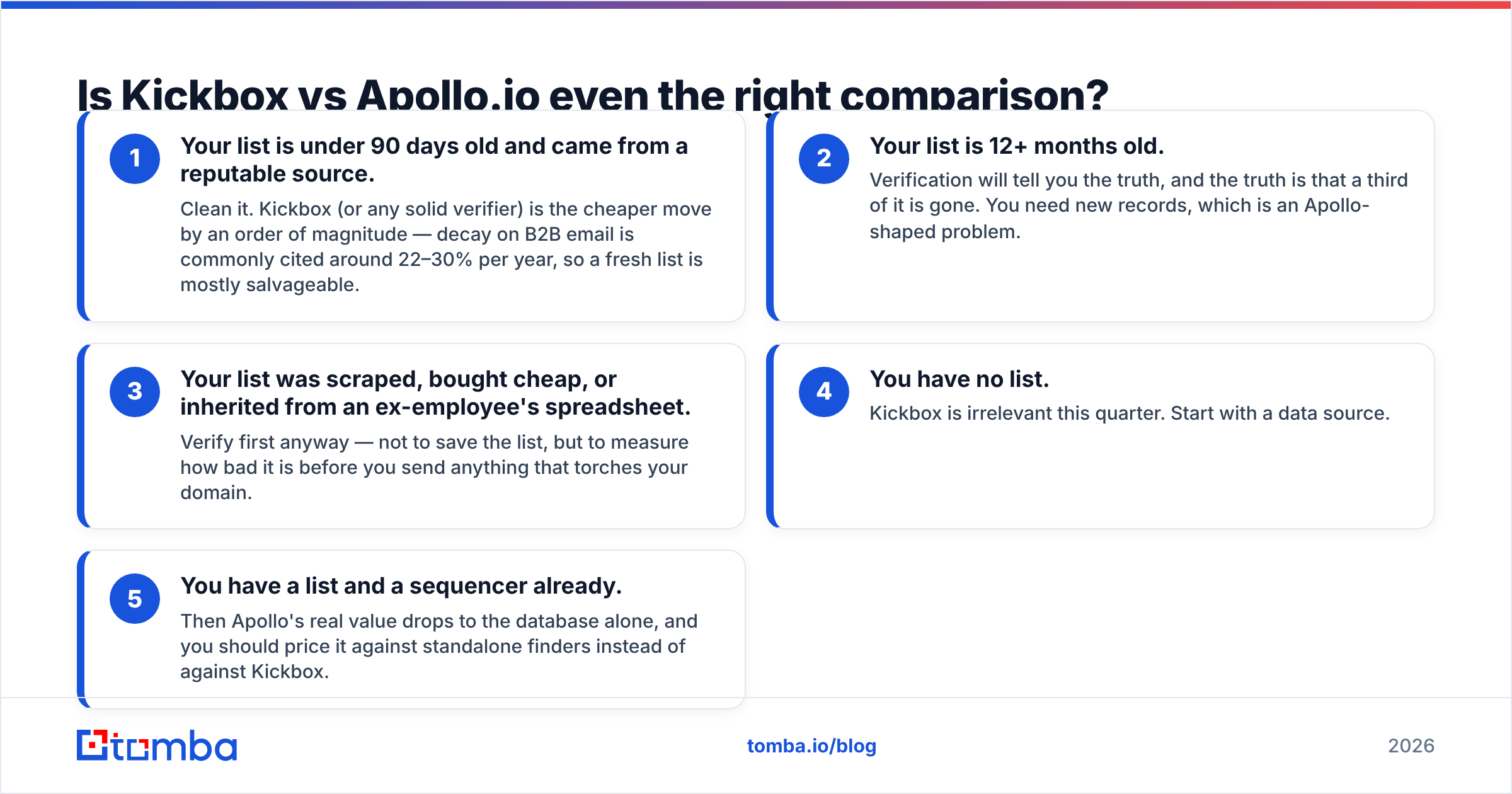
Only in one narrow scenario: you already have a list, and you are deciding whether to spend on cleaning it or on replacing it.
That decision comes down to list age and list origin.
- Your list is under 90 days old and came from a reputable source. Clean it. Kickbox (or any solid verifier) is the cheaper move by an order of magnitude — decay on B2B email is commonly cited around 22–30% per year, so a fresh list is mostly salvageable.
- Your list is 12+ months old. Verification will tell you the truth, and the truth is that a third of it is gone. You need new records, which is an Apollo-shaped problem.
- Your list was scraped, bought cheap, or inherited from an ex-employee's spreadsheet. Verify first anyway — not to save the list, but to measure how bad it is before you send anything that torches your domain.
- You have no list. Kickbox is irrelevant this quarter. Start with a data source.
- You have a list and a sequencer already. Then Apollo's real value drops to the database alone, and you should price it against standalone finders instead of against Kickbox.
Most teams sit in scenario 2 or 5, which is where the "buy both" reflex kicks in — and where the math starts to hurt.
How do Kickbox and Apollo.io compare on price and scope?#
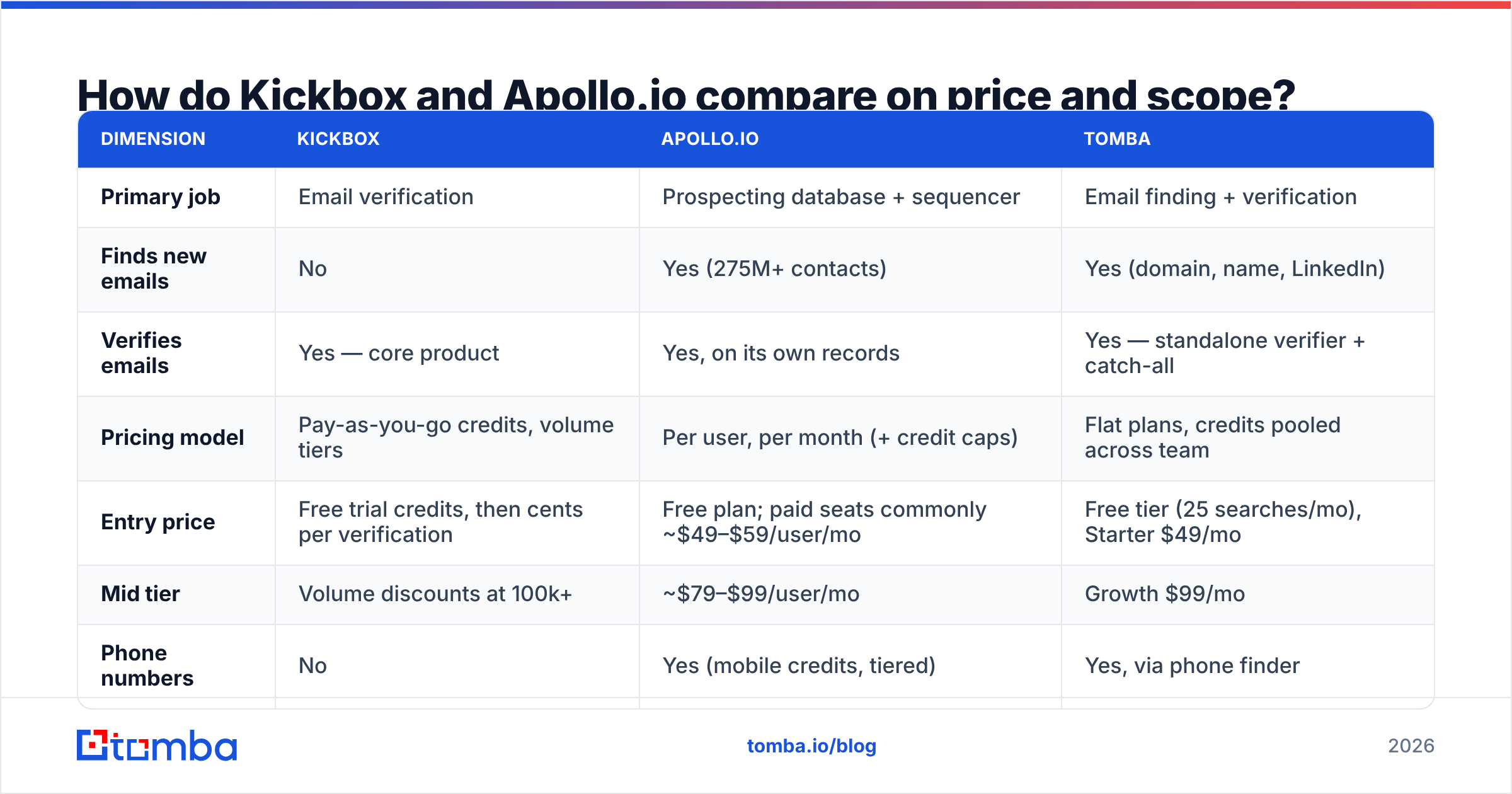
Pricing changes often on both sides; treat these as shapes, not quotes, and confirm on the vendors' own pages before you sign anything.
| Dimension | Kickbox | Apollo.io | Tomba |
|---|---|---|---|
| Primary job | Email verification | Prospecting database + sequencer | Email finding + verification |
| Finds new emails | No | Yes (275M+ contacts) | Yes (domain, name, LinkedIn) |
| Verifies emails | Yes — core product | Yes, on its own records | Yes — standalone verifier + catch-all |
| Pricing model | Pay-as-you-go credits, volume tiers | Per user, per month (+ credit caps) | Flat plans, credits pooled across team |
| Entry price | Free trial credits, then cents per verification | Free plan; paid seats commonly ~$49–$59/user/mo | Free tier (25 searches/mo), Starter $49/mo |
| Mid tier | Volume discounts at 100k+ | ~$79–$99/user/mo | Growth $99/mo |
| Phone numbers | No | Yes (mobile credits, tiered) | Yes, via phone finder |
| Sequencer / dialer | No | Yes | No — integrates with your sender |
| API depth | Strong, verification only | Broad, rate-limited by plan | Finder + verifier + enrichment API |
| Best for | Protecting deliverability on lists you own | Teams with no data source and no sequencer | Teams that need accurate addresses without seat pricing |
The line that matters in that table is pricing model. Kickbox scales with volume — you pay for what you verify, and a quiet month costs nothing. Apollo scales with headcount — five reps means five seats, whether they prospect 500 contacts or 50. Credit caps sit on top, so heavy exporters hit ceilings that force an upgrade for reasons unrelated to how many people are logged in.

Which one has better data accuracy?#
They're measuring different things, so compare each against its own benchmark.
For Kickbox, accuracy means: does the verdict match reality when you send? Good verifiers land in the 97–99% range on clean, non-catch-all mailboxes. Where they diverge is accept-all domains, which is now a large and growing share of corporate email because Microsoft 365 tenants frequently accept everything at the SMTP layer and reject later. A verifier that returns "unknown" on 20% of your list hasn't failed technically — it just handed the decision back to you. Kickbox is honest about this boundary, which is more than some competitors manage, but it doesn't make the problem go away. If catch-all resolution is your bottleneck, look at a dedicated catch-all verifier rather than assuming any generic tool solves it.
For Apollo, accuracy means: is this the right person's current address? Third-party reviews on G2 consistently praise coverage and consistently flag stale records and wrong mobile numbers, particularly outside the US. Apollo's own bounce guarantees apply to specific record classes, not to everything you export.

The practical read: Apollo's inferred addresses and a verifier's verdict disagree often enough that running exports through a second opinion is standard practice. That second opinion costs money. Budget for it — or pick a finder that verifies before it returns the record, so you're not paying twice for one contact.
Where does the two-vendor stack break down?#
Three places, in order of how often they bite.
Credits don't pool. Apollo seats include export credits per user. Kickbox credits sit in a separate wallet. You end up with a rep who's out of exports on the 14th and 40,000 unused verification credits that can't help her.
Nobody owns the handoff. Exports land in a CSV, get verified in a browser tab, get re-uploaded to the sequencer. Every step is a place where somebody sends the unverified file by mistake. If your workflow lives in a spreadsheet anyway, an Excel email finder or Sheets add-on that finds and validates in place removes the CSV round-trip entirely.
You pay twice for the same contact. One credit to source it, one credit to verify it, and a meaningful share of those contacts fail verification — so you're paying full sourcing price for records you throw away. At a 15% failure rate, your real cost per usable contact is about 18% higher than the sticker price suggests, before you count the verification spend.

What are the alternatives to running both?#
A few honest options, depending on where your pain actually is.
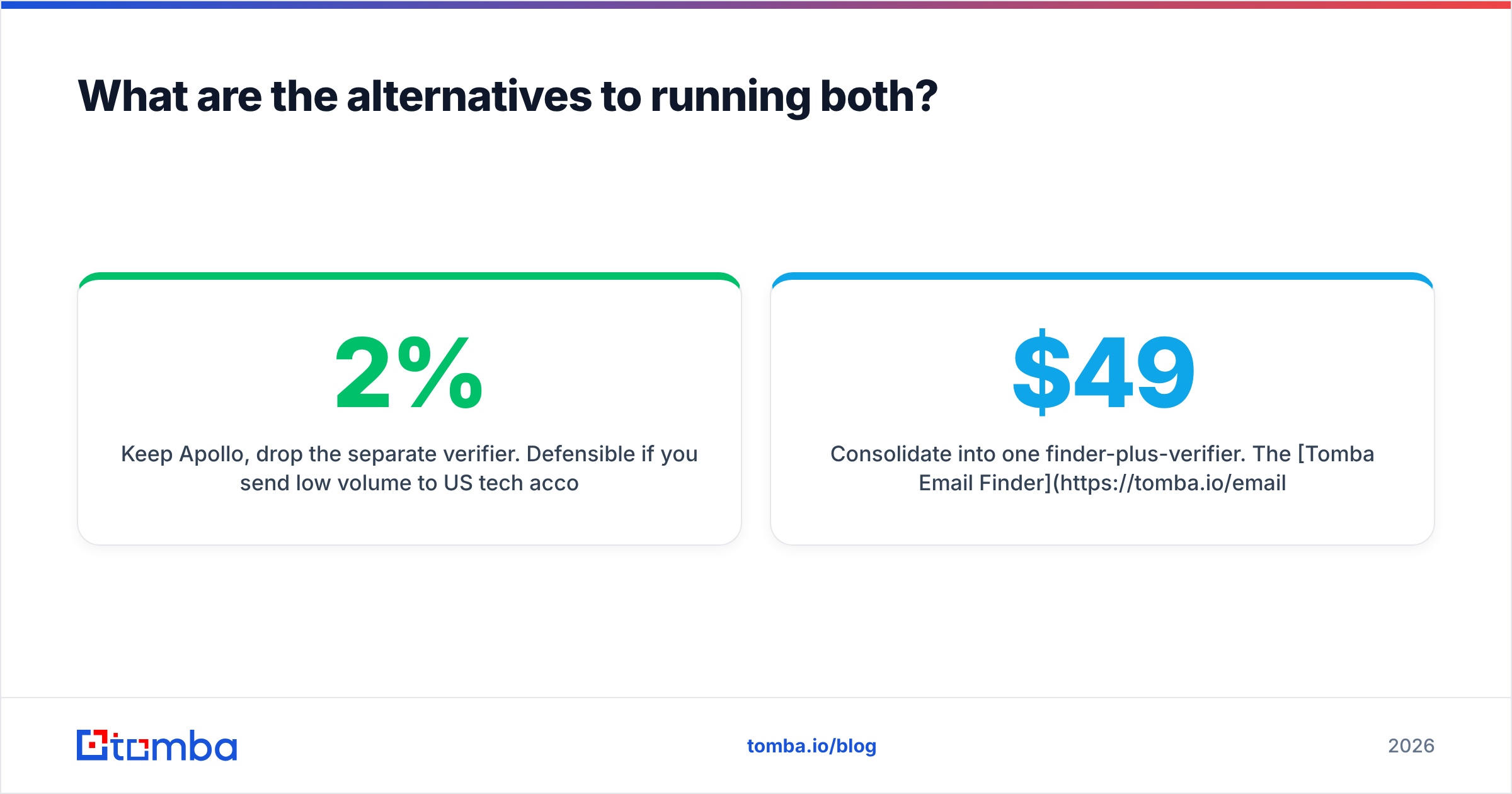
- Keep Apollo, drop the separate verifier. Defensible if you send low volume to US tech accounts and your bounce rate already sits under 2%. Check Google Postmaster Tools before you decide; don't guess.
- Keep Kickbox, swap the data source. If you like your verifier and only need addresses, standalone finders are far cheaper than seat-priced platforms. Tools like Tomba, Findymail, and Hunter charge for lookups rather than logins. BookYourData is worth a look too if you want pay-as-you-go, pre-verified B2B records without a subscription — it's a genuinely different buying model from Apollo's seat math.
- Consolidate into one finder-plus-verifier. The Tomba Email Finder runs the lookup and the validation in the same call, so the record that reaches your sequencer has already been through SMTP checks, catch-all handling, and pattern confidence scoring. Pricing is flat and credits pool across the team: free tier at 25 searches/month, Starter at $49/mo, Growth at $99/mo, Pro at $249/mo. Full Tomba pricing is public — no seat multiplier.
- Keep both, but move the verification upstream. If you're committed to Apollo, at least verify at export time via API instead of in monthly batch cleanups. Stale verdicts are barely better than no verdicts.
How should you decide in the next hour?#
Run this sequence. It takes about 45 minutes and replaces three weeks of opinion.
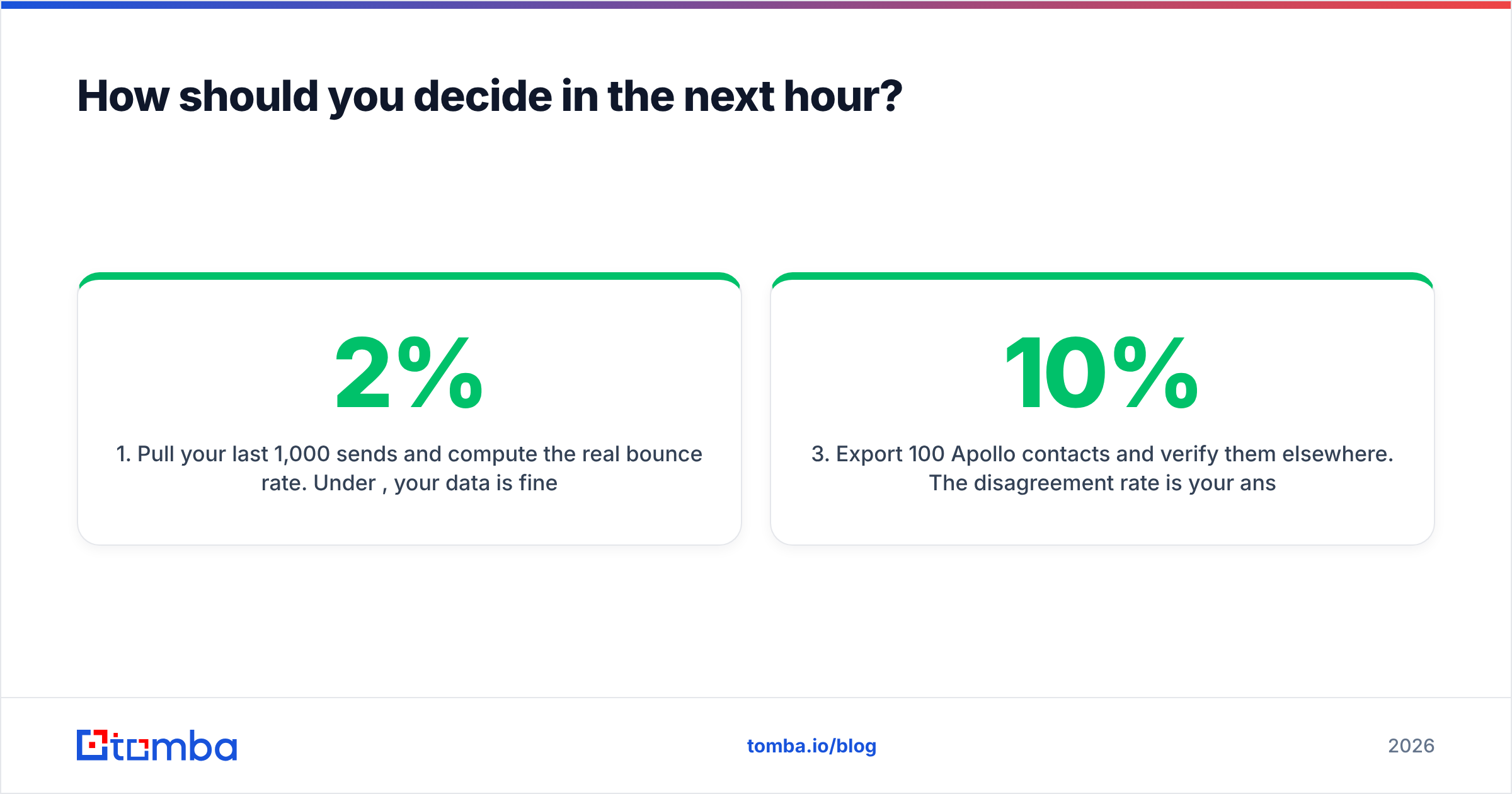
- Pull your last 1,000 sends and compute the real bounce rate. Under 2%, your data is fine and this whole comparison is academic. Over 4%, you have a verification problem today.
- Count how many reps actually prospect weekly. Apollo's price is headcount times seat cost. If two of your six reps do all the sourcing, you're funding four idle seats.
- Export 100 Apollo contacts and verify them elsewhere. The disagreement rate is your answer on whether you need a second opinion at all. Anything above 10% justifies the extra layer.
- Check your catch-all exposure. If more than a quarter of your target domains are accept-all, pick tooling that resolves them specifically rather than returning "risky."
- Price per usable contact, not per credit. Sourcing cost plus verification cost, divided by contacts that survive both. That's the only number that compares vendors of different shapes.
So, Kickbox or Apollo.io?#
Neither, if you only pick one and expect it to do both jobs.
Buy Kickbox when you own a list, you send real volume, and deliverability is the constraint. It's a focused, well-run verification service and there's nothing wrong with it.
Buy Apollo.io when you have no data source and no sequencer, your ICP is US-centric, and you'd rather have one platform than four tools — accepting that you'll likely verify its output before you send.
Buy neither when your actual need is "accurate B2B email addresses, without paying per seat or per vendor." That's the gap a dedicated finder fills, and it's the most common situation among teams who end up searching for this comparison in the first place.
Want to see the disagreement rate for yourself? Take 50 of your existing contacts, run them through the email verifier, then use the Tomba Email Finder to source 50 fresh ones on the same domains and compare what survives. The free tier covers the test, no card required — and the result will tell you more about your stack than any vendor comparison page, including this one.
Related guides#
// get started
Find, verify and enrich your first contacts today
Start on the free plan with 25 searches a month, then scale when your team is ready.
Free plan · No credit card required · GDPR & CCPA
// about the author