Kipplo Pros and Cons (2026): An Honest B2B Data Review
Kipplo sells verified emails, phones and account intelligence at a lower price than the big B2B databases. Here is where it genuinely wins, where it falls short, and which teams should look elsewhere.
TL;DR
- Kipplo is a B2B account intelligence platform: contact and company search, list building, CSV enrichment, a LinkedIn Chrome extension, and an API — priced well below ZoomInfo-class tools.
- The strongest pros are price (self-serve tiers roughly $34–$69/mo), ease of use, GDPR/CCPA posture, and a no-charge-for-bad-data policy on contact accuracy.
- The most common cons in public reviews are a dated interface, a thin integration catalog, and export/credit limits that bite once you move past small list-building.
- Kipplo is a good fit for small GTM teams building targeted lists by job title and firmographics. It is a weaker fit if you need deep CRM automation or a developer-first enrichment pipeline.
- If your bottleneck is finding and verifying work emails at scale rather than browsing a database, a dedicated finder plus verifier stack is usually cheaper and more accurate.
What is Kipplo?#
Kipplo is a B2B contact and account intelligence platform. You search a database of companies and people by firmographics and job title, reveal verified emails and phone numbers, build lists, and push or export them into whatever you use for outreach. The official site positions it as a replacement for a whole prospecting stack rather than a single-purpose finder.
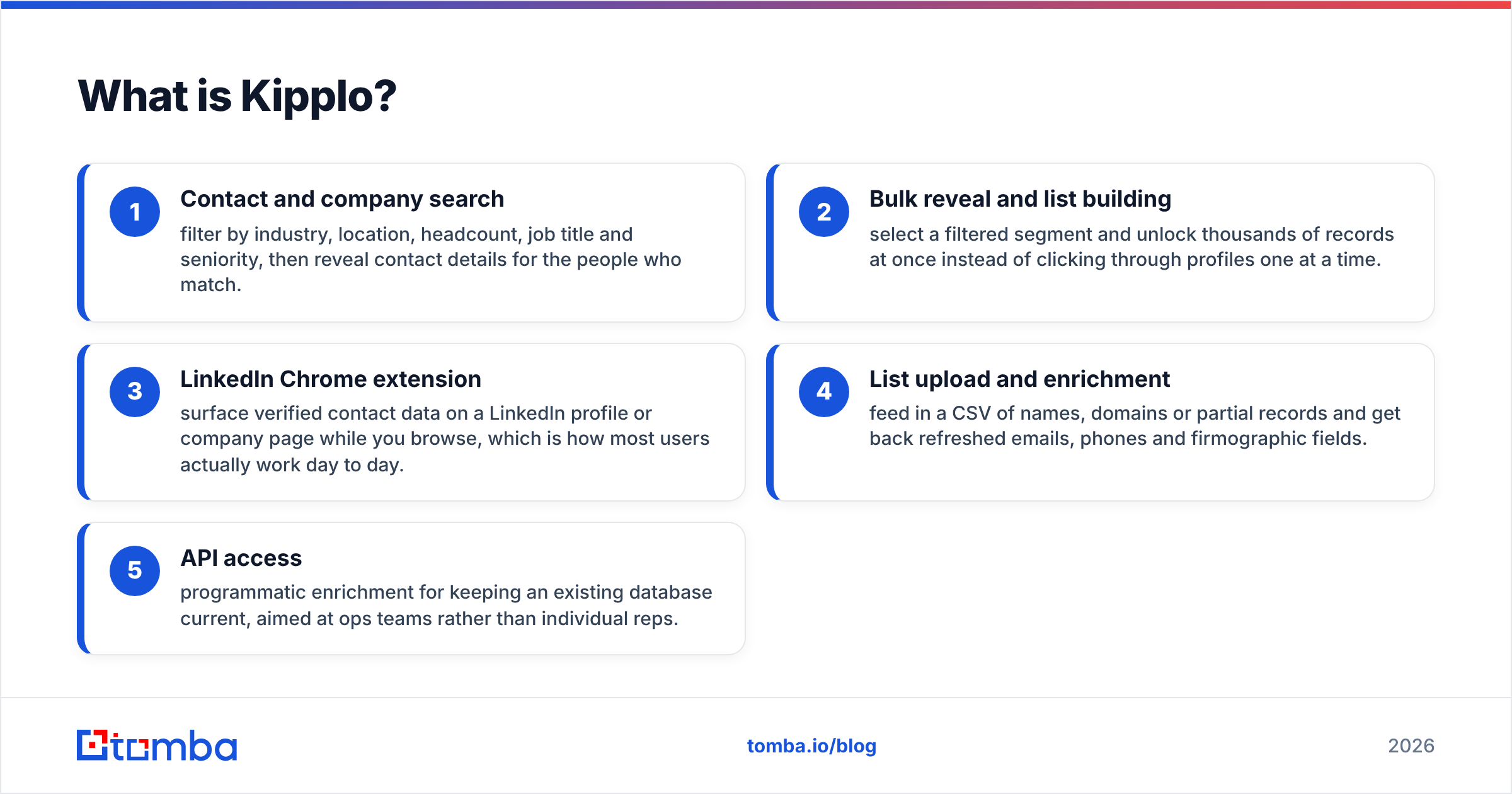
The product breaks down into five pieces:
- Contact and company search — filter by industry, location, headcount, job title and seniority, then reveal contact details for the people who match.
- Bulk reveal and list building — select a filtered segment and unlock thousands of records at once instead of clicking through profiles one at a time.
- LinkedIn Chrome extension — surface verified contact data on a LinkedIn profile or company page while you browse, which is how most users actually work day to day.
- List upload and enrichment — feed in a CSV of names, domains or partial records and get back refreshed emails, phones and firmographic fields.
- API access — programmatic enrichment for keeping an existing database current, aimed at ops teams rather than individual reps.
That shape matters for the pros and cons discussion. Kipplo is a database-first tool: its value comes from browsing and filtering a pre-built index. That is a different product philosophy from a query-first email finder, which takes a name and a domain you already have and resolves the address on demand. Neither is better in the abstract. They fail in different places, and the failure modes are the whole story when you are comparing tools.

What are Kipplo's biggest pros?#
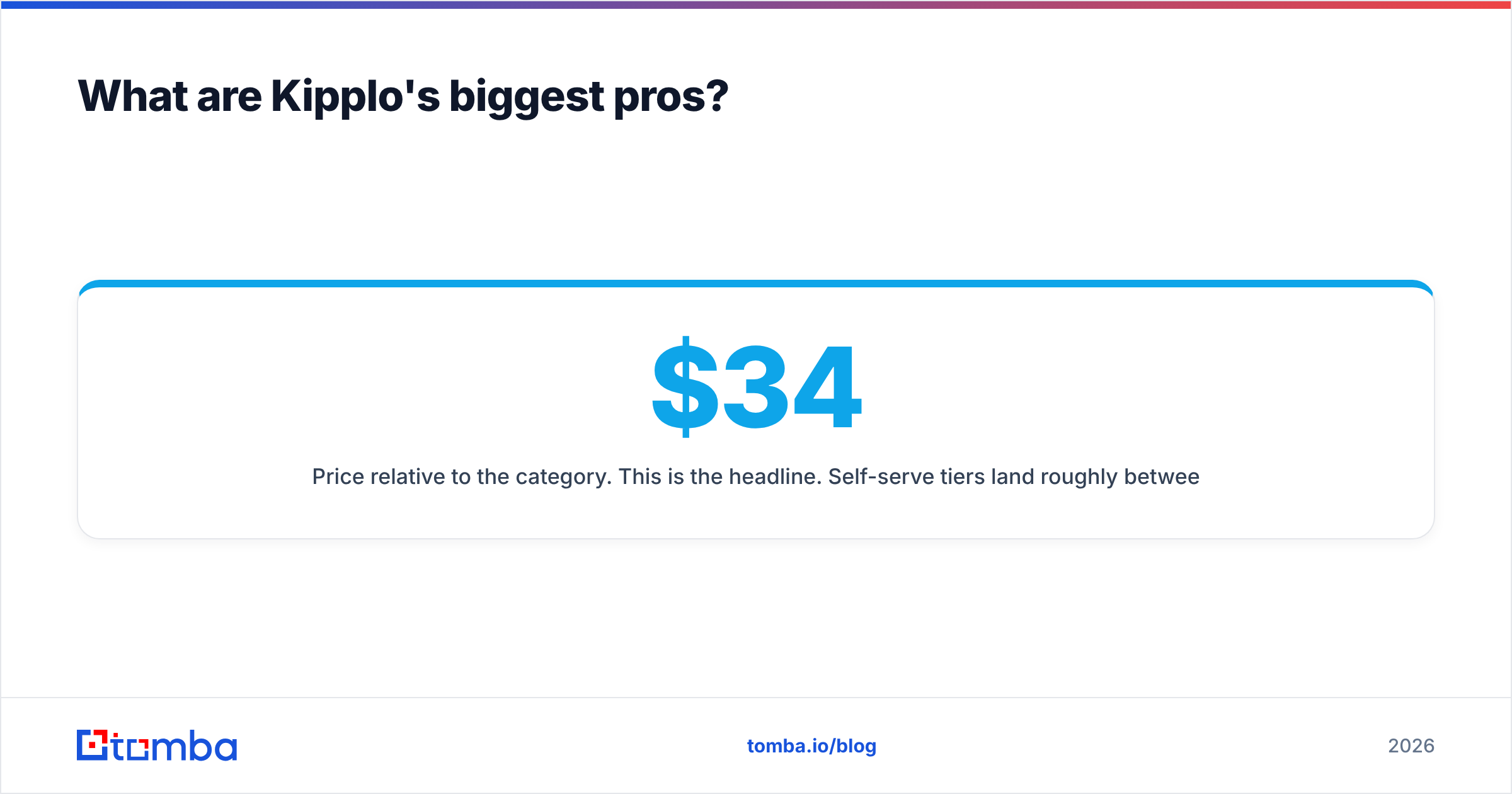
Price relative to the category. This is the headline. Self-serve tiers land roughly between $34 and $69 per month depending on the plan, with an annual discount and a free trial, per the vendor's pricing page and third-party listings on Capterra. The comparison set here is not other $50 tools — it is enterprise data platforms that quote five figures a year with a mandatory annual contract and a sales call before you see a number. Against that benchmark, Kipplo is genuinely cheap.
No charge for inaccurate contacts. Kipplo's accuracy guarantee is that you are not billed for data that does not check out. This is a meaningful pro because it shifts some risk back onto the vendor. Most credit-based providers happily burn a credit on a record that bounces, which means your effective cost per usable contact is always higher than the sticker price suggests.
Low learning curve. Reviews on G2 and elsewhere consistently point at ease of use. Filters are legible, the extension does the obvious thing, and a new SDR can build a first list without a training session. That sounds soft, but tool adoption is where most data purchases quietly die.
Compliance posture. GDPR and CCPA alignment is stated explicitly. If you are selling into the EU or UK, having a documented lawful basis and a deletion path is not optional, and plenty of cheap scraped-data vendors simply do not have one.
Coverage breadth for common ICPs. For mainstream B2B segments — SaaS, agencies, manufacturing, professional services in North America and Western Europe — the database holds up. You will find directors and VPs at mid-market companies without much fuss.
What are Kipplo's cons?#
The interface feels behind. This is the single most repeated criticism in public reviews, and it is fair. The UI works, but it does not feel like a 2026 product. Saved searches, bulk operations and list management are more clicking than they should be. If you live in the tool for four hours a day, that friction compounds.
Integrations are thin. Reviewers ask for more native connections, and the catalog is short compared with platforms that ship first-party HubSpot, Salesforce, Pipedrive, Outreach and Salesloft sync. You can work around it with CSVs or the API, but "export to CSV, reshape columns, import to CRM" is a workflow that leaks data quality on every hop. If your team lives inside a CRM, check the specific connector you need before buying.
Credit math gets expensive at volume. A $34 entry tier is not a $34 tier if your monthly list-building need blows through the included reveals in week two. Bulk reveal is a genuine feature, and it is also the fastest way to discover where your plan's ceiling actually is. Model your real monthly volume against the reveal allowance before you commit to annual billing.

Database-first coverage gaps. Any pre-built index has an edge. Very small companies, newly founded startups, non-English-speaking markets and niche verticals are where database tools thin out. If your ICP is "700 boutique logistics firms in Southeast Asia", expect a lower match rate than the marketing copy implies — and that is true of every database vendor, not just this one.
Verification is not a substitute for your own check. Vendor-side verification happens at index time. The record may have been accurate when it was crawled and stale by the time you reveal it. Roughly two to three percent of B2B contacts churn every month, which compounds fast on an older record. Running exports through an independent email verifier before you load a sequence is cheap insurance.
How accurate is Kipplo's data in practice?#
Accuracy claims in this category are close to unfalsifiable as published, because every vendor tests against a sample that flatters its own coverage. What you can do is run your own bake-off, and it takes about an hour.
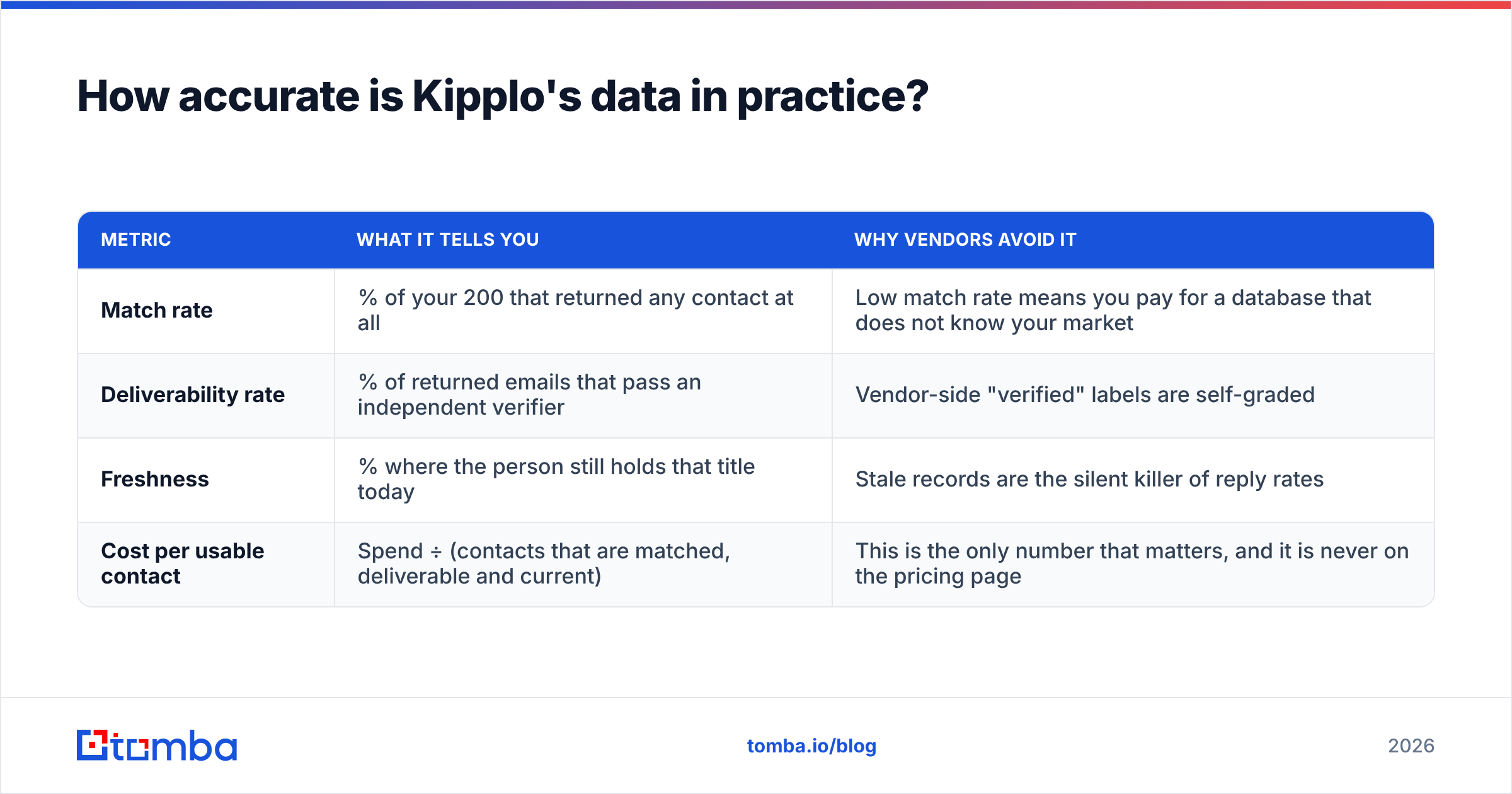
Take 200 contacts from your actual ICP — not a generic sample. Split them across the tools you are evaluating. Then measure three numbers, not one:
| Metric | What it tells you | Why vendors avoid it |
|---|---|---|
| Match rate | % of your 200 that returned any contact at all | Low match rate means you pay for a database that does not know your market |
| Deliverability rate | % of returned emails that pass an independent verifier | Vendor-side "verified" labels are self-graded |
| Freshness | % where the person still holds that title today | Stale records are the silent killer of reply rates |
| Cost per usable contact | Spend ÷ (contacts that are matched, deliverable and current) | This is the only number that matters, and it is never on the pricing page |
A tool with a 40% match rate and 98% deliverability can easily beat a tool with an 80% match rate and 82% deliverability, depending on what a bounce costs you. On a cold domain, bounces above roughly 2% start damaging sender reputation, and the cost of that is not measured in credits.

The practical takeaway: treat any provider's verified flag as a first pass, not a final answer. Re-verify immediately before send, and use a catch-all verifier for domains that accept everything, since those are the records where every vendor's confidence score is least reliable.
How does Kipplo compare to the alternatives?#
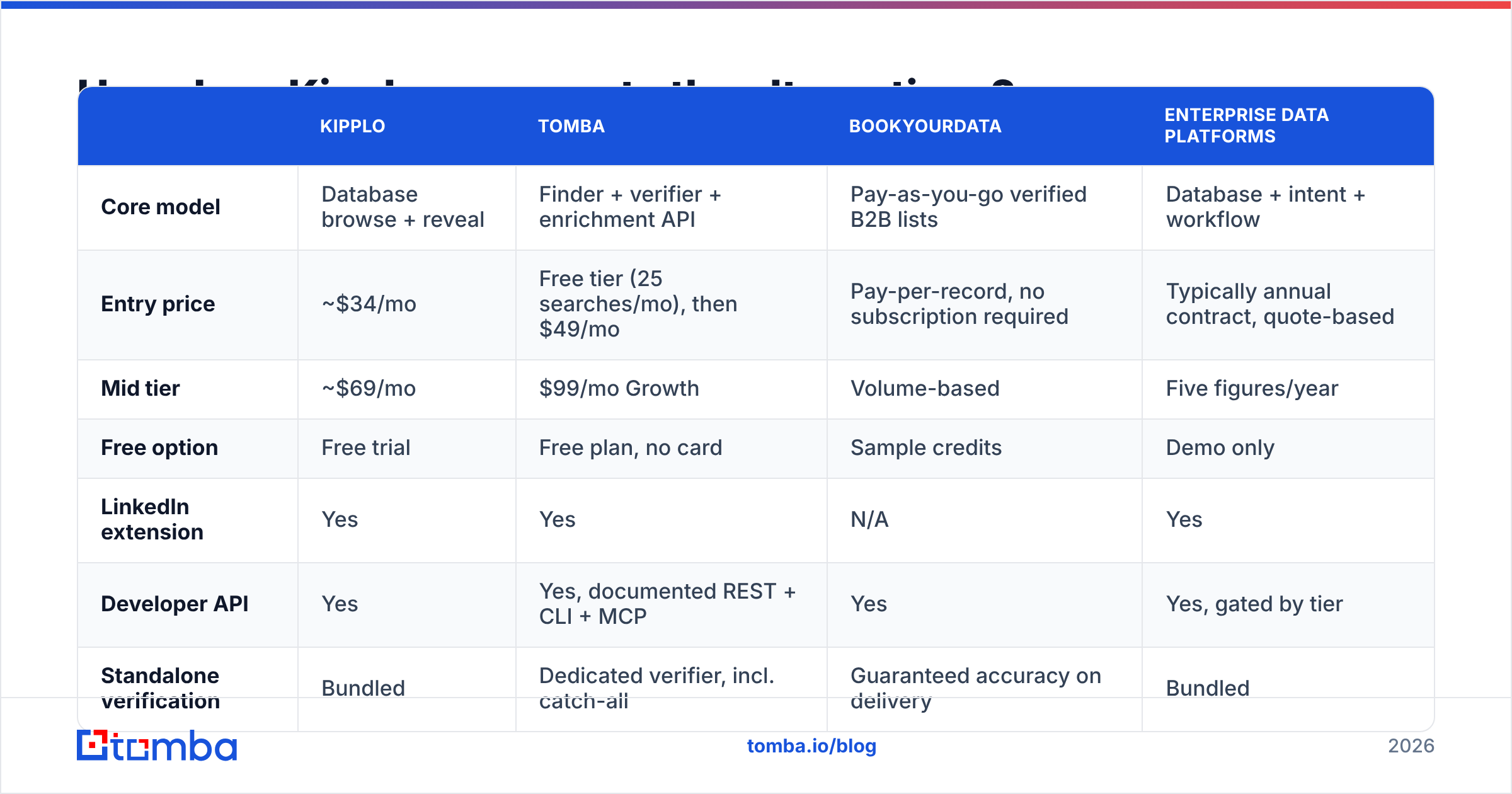
Here is an honest side-by-side of the options teams usually shortlist alongside Kipplo. Prices are published self-serve rates as of 2026 and change often — verify before you buy.
| Kipplo | Tomba | BookYourData | Enterprise data platforms | |
|---|---|---|---|---|
| Core model | Database browse + reveal | Finder + verifier + enrichment API | Pay-as-you-go verified B2B lists | Database + intent + workflow |
| Entry price | ~$34/mo | Free tier (25 searches/mo), then $49/mo | Pay-per-record, no subscription required | Typically annual contract, quote-based |
| Mid tier | ~$69/mo | $99/mo Growth | Volume-based | Five figures/year |
| Free option | Free trial | Free plan, no card | Sample credits | Demo only |
| LinkedIn extension | Yes | Yes | N/A | Yes |
| Developer API | Yes | Yes, documented REST + CLI + MCP | Yes | Yes, gated by tier |
| Standalone verification | Bundled | Dedicated verifier, incl. catch-all | Guaranteed accuracy on delivery | Bundled |
| Best for | Small GTM teams list-building by title | Teams that need accurate emails on demand at scale | Buyers who want a clean list without a subscription | Large orgs needing intent + governance |

A few notes on reading that table honestly.
Kipplo versus enterprise platforms is not a close fight on features, and it is not supposed to be. You are trading intent data, org charts and governance for a bill that is two orders of magnitude smaller. For most teams under 20 reps, that trade is correct.
Kipplo versus BookYourData is a subscription-versus-purchase question. BookYourData is strong when you know exactly which segment you want and would rather buy a verified list outright than rent database access month to month, with accuracy guaranteed on what you receive. Kipplo is stronger when your targeting changes weekly and you want to keep re-querying.
Kipplo versus a finder-plus-verifier stack comes down to whether you already have your target list. If your prospecting starts from a company list, a conference attendee export, or LinkedIn Sales Navigator, you do not need to browse a database — you need to resolve names to addresses. That is where domain search and bulk finding win on cost per usable contact, because you only pay for lookups you actually wanted.
Who should buy Kipplo, and who should skip it?#
Buy it if:
- You are a 2–15 person sales or founder-led GTM team with no data budget to speak of.
- Your prospecting motion is "filter by title and industry, build a list, export."
- Your reps work primarily inside LinkedIn and want a reveal extension that just works.
- You are selling into EU markets and need a vendor with a documented compliance position.
Skip it if:
- Your workflow depends on native two-way CRM sync and the connector you need is not there.
- You need intent signals, technographic triggers or org-chart depth to prioritize accounts.
- You are running high-volume programmatic enrichment and want API-first economics with predictable per-call pricing.
- Your ICP sits in a long tail — micro-businesses, emerging markets, very new companies — where any pre-built database thins out.
The honest summary: Kipplo is a competent, affordable, slightly unpolished tool that does the main job. The pros are real and the cons are the ordinary cons of a lean product competing on price. Nothing here disqualifies it. What should decide the purchase is your own bake-off numbers, not a review — including this one.
What should you do before you commit?#
Run the 200-contact test above against your real ICP. Take the free trial, take a competitor's free tier, and compare cost per usable contact rather than cost per credit. Then check three practical things: whether the export format matches your CRM's import schema, whether the reveal allowance survives one realistic month of prospecting, and whether bounce rate on a 50-contact test send stays under 2%.
If that test shows your real gap is resolving known people to deliverable addresses rather than browsing a database, start with the Tomba Email Finder. The free plan gives you 25 searches a month with no card, paid plans start at $49/mo, and every result can be pushed straight through catch-all-aware verification before it reaches your sequence. Compare the Tomba plans against your Kipplo trial numbers and let the cost per usable contact decide.
Related guides#
// get started
Find, verify and enrich your first contacts today
Start on the free plan with 25 searches a month, then scale when your team is ready.
Free plan · No credit card required · GDPR & CCPA
// about the author