Kipplo vs Mattermark (2026): Which B2B Data Tool Wins?
Kipplo and Mattermark both promise company intelligence, but they solve different problems, and neither one hands you a verified inbox. Here is the honest 2026 breakdown.
TL;DR
- Mattermark is the known quantity. It built its name on startup and growth signals: funding rounds, headcount trends, web traffic, and its proprietary Growth Score. It is a research and targeting tool, not an outbound engine.
- Kipplo is the low-information option. It markets itself around lead generation and contact data, but public documentation, pricing pages, and third-party reviews are thin compared with Mattermark. Treat every claim as unverified until you run a trial.
- Neither tool is primarily an email verifier. Both surface companies and, to varying degrees, people. Neither is built to guarantee that the address you export will actually accept mail.
- Pick by job, not by brand. Company research and market mapping favor Mattermark. Cheap, fast contact pulls favor a dedicated finder. Enterprise firmographic depth favors neither.
- Budget reality: a verified-contact layer like Tomba pricing starts at $49/mo with a free tier, which is usually cheaper than paying a market-intelligence platform for contact data it was never designed to own.
What are Kipplo and Mattermark?#
Start with the honest framing, because the two products are not natural twins.
Mattermark launched in 2012 as a "Bloomberg terminal for startups." It aggregated signals about private companies (funding history, employee growth, web and mobile traffic, news mentions) and compressed them into a single Growth Score you could sort and filter on. VCs used it for deal sourcing. Sales teams used it to find companies that had just raised money and therefore had budget. It raised roughly $17M, was acquired by FullContact in 2017, changed hands again afterward, and continues to operate under the Mattermark brand. Ownership churn matters here: it affects roadmap velocity and how fresh the underlying crawls are.
Kipplo is the newer and far quieter entrant. It positions around B2B lead generation and contact discovery rather than investment research. The problem for a buyer is verifiability: at the time of writing there is very little independent coverage, few third-party reviews on sites like G2, and no widely cited public pricing. That is not automatically a red flag, plenty of good tools start small, but it changes how you should evaluate it. With Mattermark you can read a decade of public commentary. With Kipplo you have to generate your own evidence.
So the real question behind "kipplo vs mattermark" is usually: do I need company intelligence, or do I need contactable people? Those are different purchases.

How do Kipplo and Mattermark compare head-to-head?#
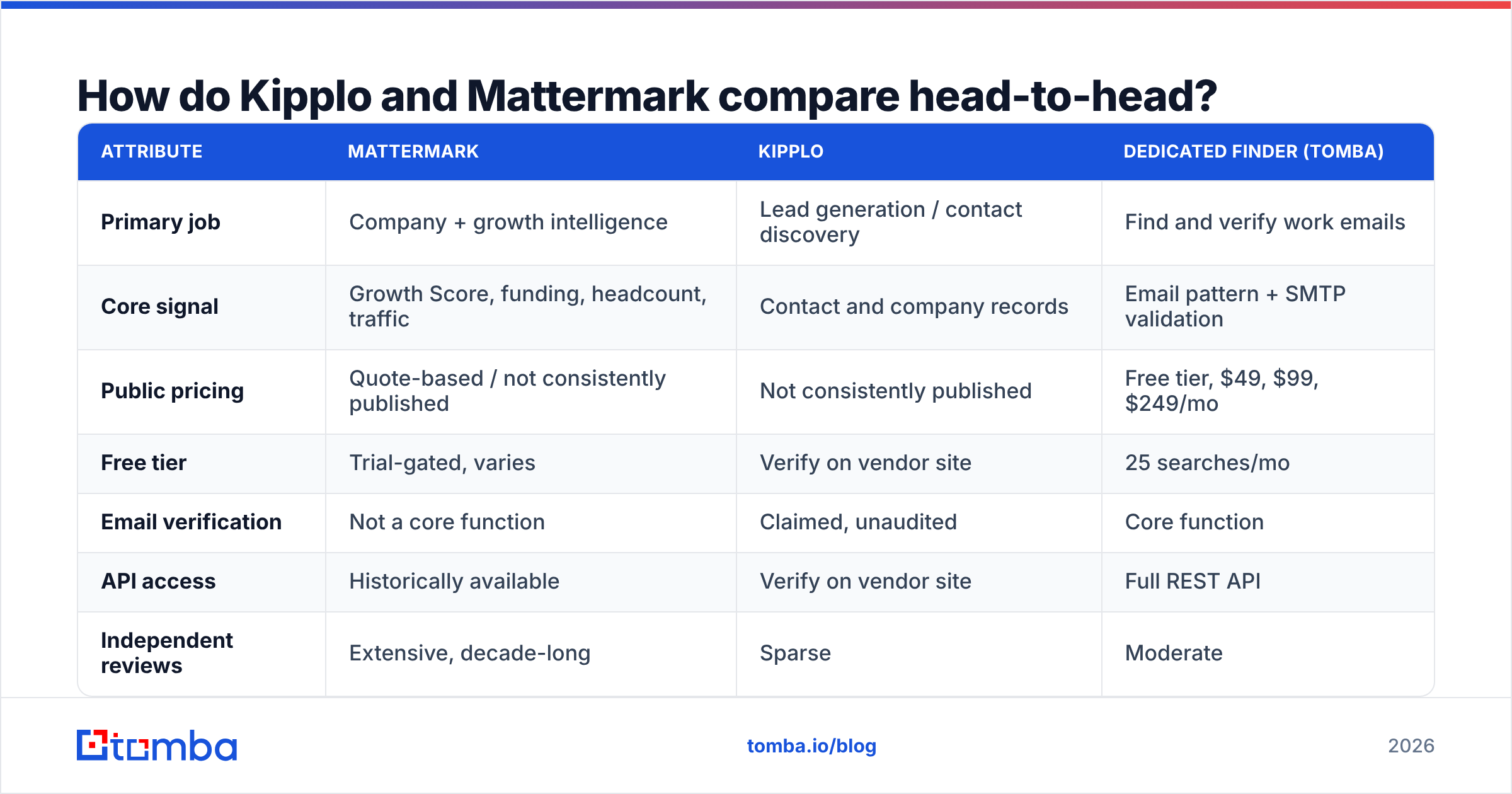
Here is the practical comparison. Where a vendor does not publish a number, this table says so rather than inventing one, because guessed pricing is how procurement decisions go wrong.
| Attribute | Mattermark | Kipplo | Dedicated finder (Tomba) |
|---|---|---|---|
| Primary job | Company + growth intelligence | Lead generation / contact discovery | Find and verify work emails |
| Core signal | Growth Score, funding, headcount, traffic | Contact and company records | Email pattern + SMTP validation |
| Public pricing | Quote-based / not consistently published | Not consistently published | Free tier, $49, $99, $249/mo |
| Free tier | Trial-gated, varies | Verify on vendor site | 25 searches/mo |
| Email verification | Not a core function | Claimed, unaudited | Core function |
| API access | Historically available | Verify on vendor site | Full REST API |
| Independent reviews | Extensive, decade-long | Sparse | Moderate |
| Best for | Market mapping, deal sourcing | Untested, budget pilots | Outbound and enrichment |
The pattern that falls out of the table: Mattermark answers which companies should I care about, a finder answers who do I email and will it bounce, and Kipplo claims to sit somewhere in between without enough public evidence to place it precisely.
What does Mattermark actually do well?#
Three things, and they are worth paying for if they match your job.
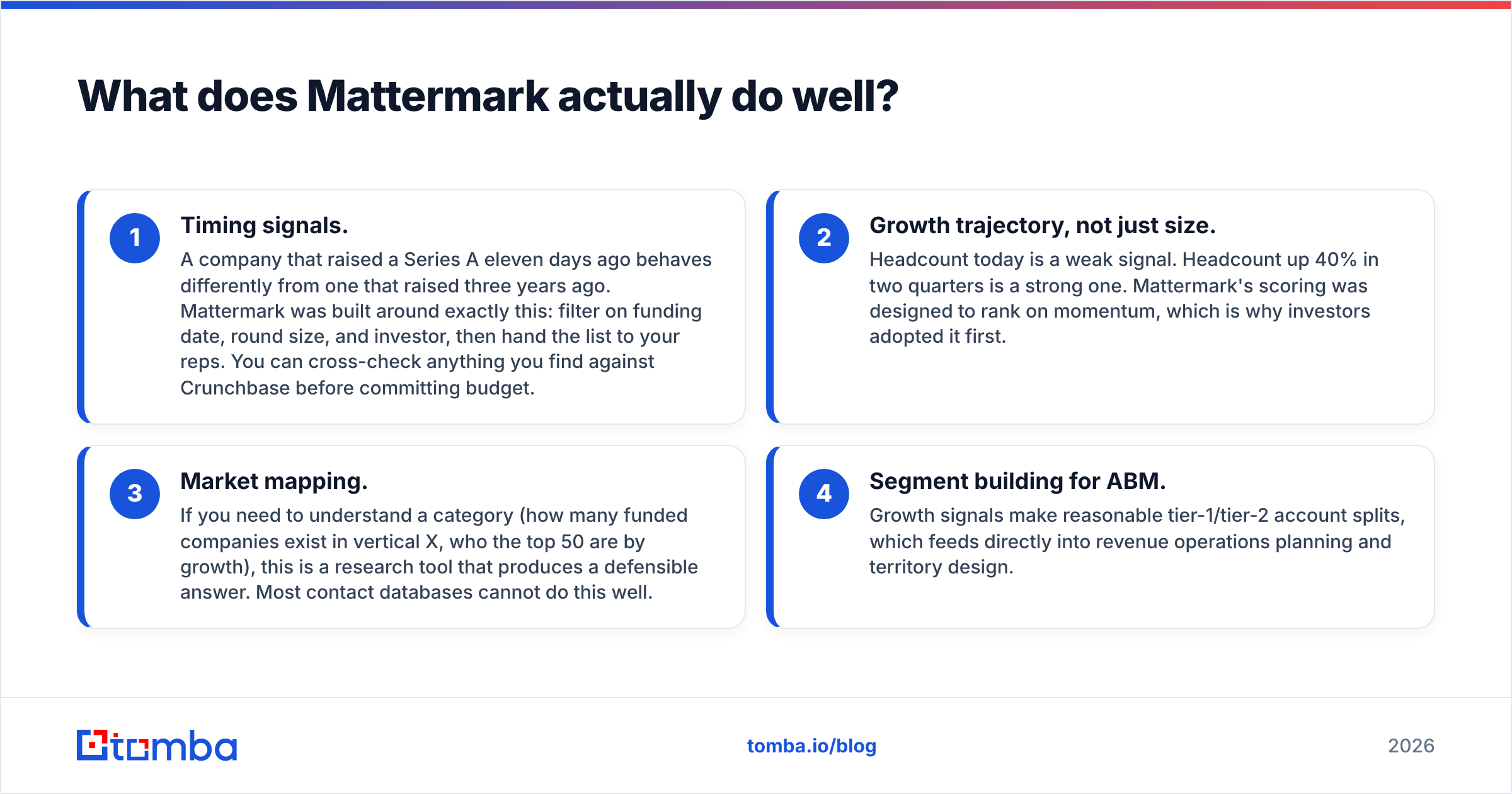
- Timing signals. A company that raised a Series A eleven days ago behaves differently from one that raised three years ago. Mattermark was built around exactly this: filter on funding date, round size, and investor, then hand the list to your reps. You can cross-check anything you find against Crunchbase before committing budget.
- Growth trajectory, not just size. Headcount today is a weak signal. Headcount up 40% in two quarters is a strong one. Mattermark's scoring was designed to rank on momentum, which is why investors adopted it first.
- Market mapping. If you need to understand a category (how many funded companies exist in vertical X, who the top 50 are by growth), this is a research tool that produces a defensible answer. Most contact databases cannot do this well.
- Segment building for ABM. Growth signals make reasonable tier-1/tier-2 account splits, which feeds directly into revenue operations planning and territory design.
What Mattermark does not do well: hand you a clean, deliverable inbox for the VP of Engineering at each of those companies. That was never the product. Teams that try to run outbound straight out of a market-intelligence export usually discover the gap the hard way, in their bounce rate.
What is Kipplo built for?#
Based on how it presents itself, Kipplo aims at the prospecting end: pull companies, pull contacts, export, send. That is a crowded segment with well-documented incumbents, which means the burden of proof is on the newcomer.
If you are evaluating it, run this as a structured pilot rather than a demo:
- Overlap test. Take 200 accounts you already know well. See what percentage Kipplo returns at all, and what percentage of those records match reality on the fields you care about (title, seniority, location).
- Freshness test. Pick 25 contacts you know changed jobs in the last six months. A database that still lists all 25 at their old employer is telling you its refresh cadence.
- Deliverability test. Export 100 emails and run them through an independent email verifier. If more than 5% come back invalid or risky, the "verified" label is marketing, not engineering.
- Catch-all handling. Ask directly how catch-all domains are classified. Tools that silently mark every catch-all as valid inflate their accuracy number by a lot.
- Exit test. Confirm you can export your data without an enterprise upgrade. Lock-in on a young vendor is a real risk.
That five-test protocol costs you an afternoon and protects you from a twelve-month contract. Run the same tests on Mattermark for the fields it claims, and you will have a genuinely comparable dataset instead of two sales decks.
Which one gives you contactable leads?#
Neither, reliably, and this is the single most important finding in a Kipplo vs Mattermark evaluation.
Market-intelligence platforms optimize for company-level truth. Their crawlers care whether a funding round happened, not whether first.last@ is the active pattern at that domain this quarter. Contact fields are usually a bolt-on, sourced from partners, and refreshed on a slower cycle than the firmographic data around them.
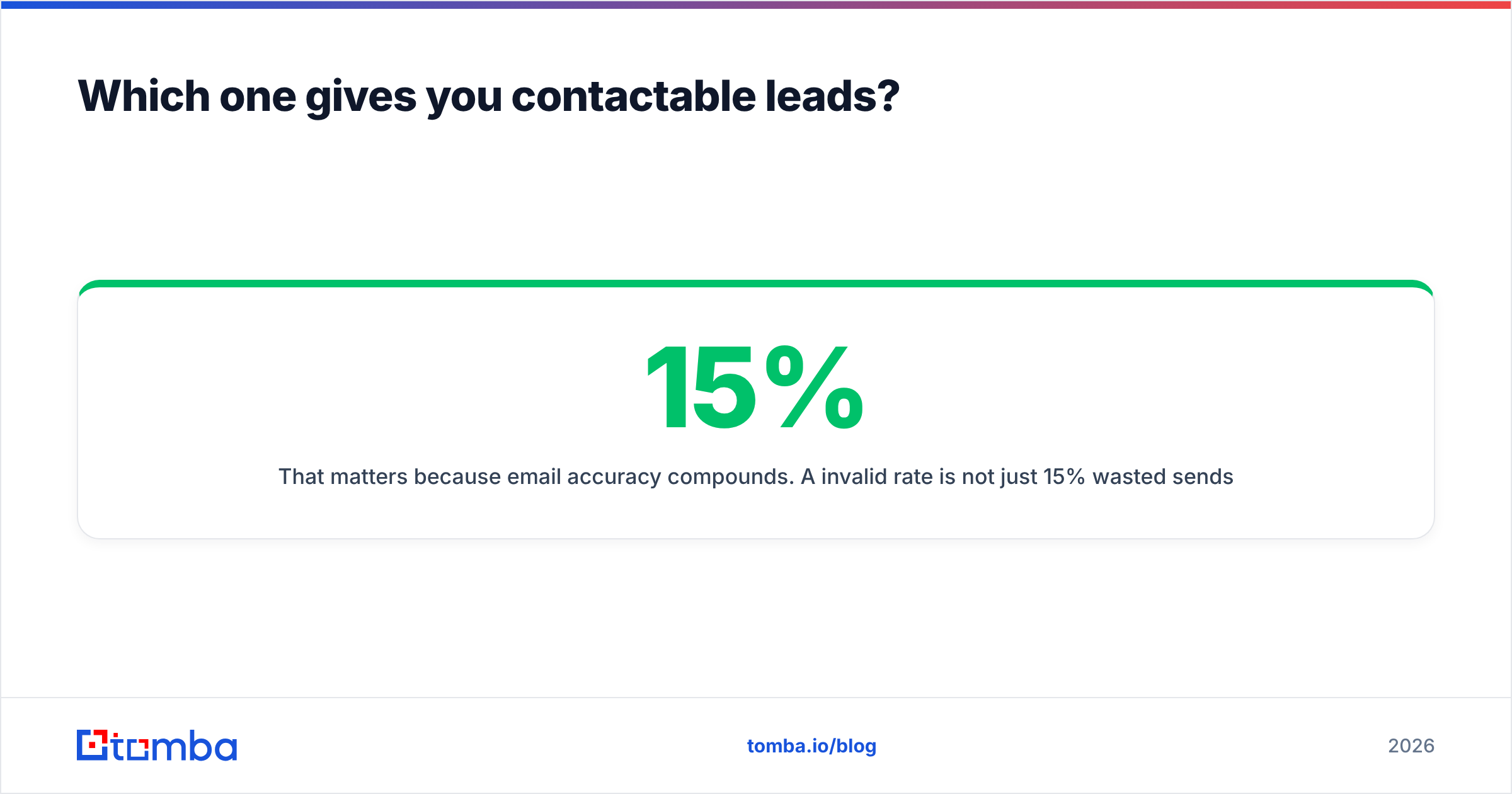
That matters because email accuracy compounds. A 15% invalid rate is not just 15% wasted sends. It is a hit to sender reputation, which suppresses inbox placement for the 85% that were valid. Two weeks of that and your whole domain underperforms.
The architecture most teams land on splits the job in two:
- Layer 1, targeting: a signal tool (Mattermark, or intent data, or your own product usage) decides which accounts deserve attention this month.
- Layer 2, contact resolution: a specialist finds and verifies the actual humans at those accounts, at the moment you need them, via API rather than a stale quarterly export.
For layer 2, a domain search takes the company domains your intelligence tool surfaced and returns the people plus the verified pattern. Pulling contacts on demand rather than exporting everything up front also keeps your CRM cleaner, since you are not importing 40,000 rows you will never touch.

How do pricing and contracts compare?#
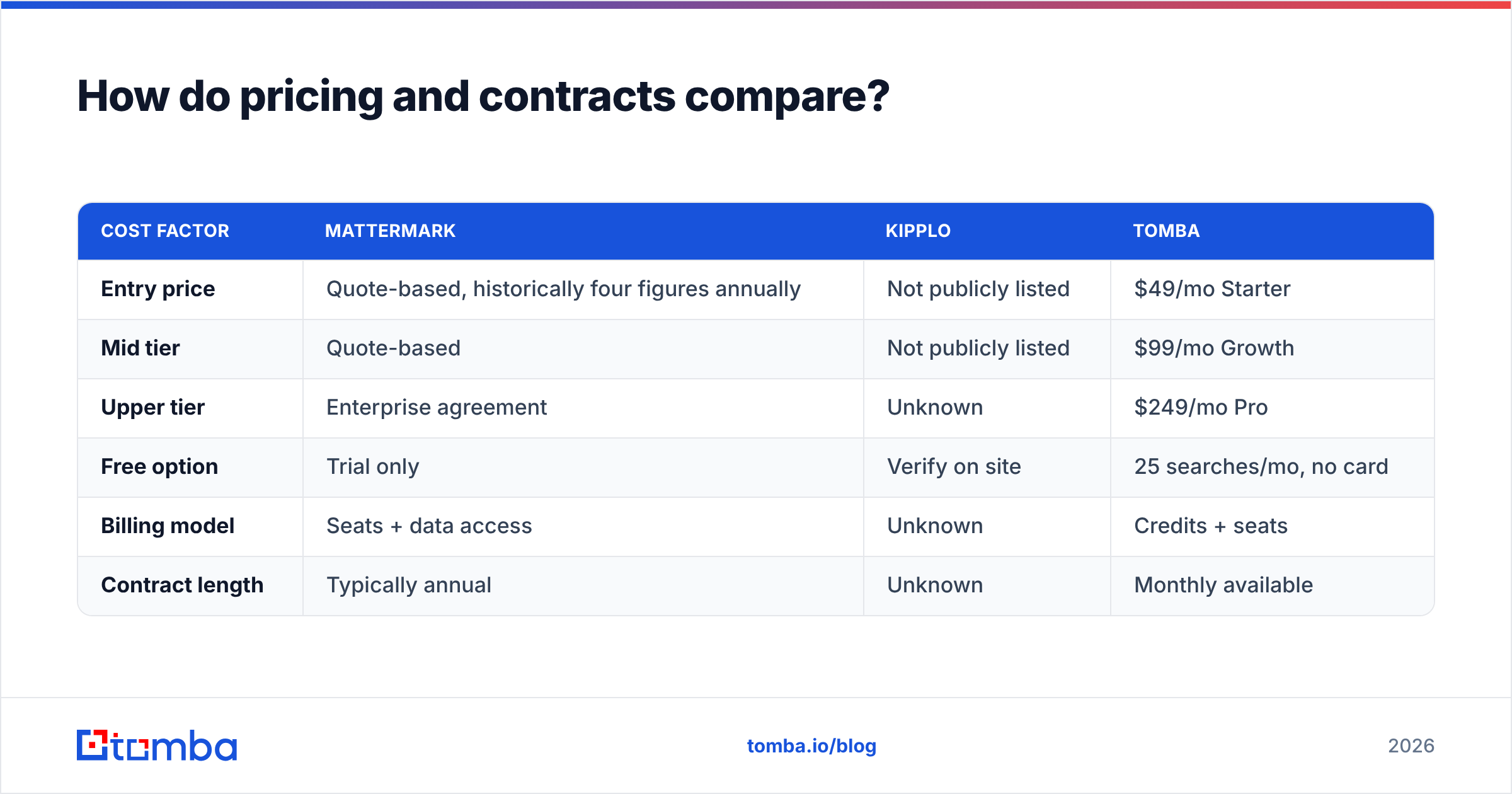
This is where "kipplo vs mattermark" gets frustrating for buyers: neither publishes pricing the way modern SaaS does. Expect a demo call, a seat-based quote, and an annual commitment.
| Cost factor | Mattermark | Kipplo | Tomba |
|---|---|---|---|
| Entry price | Quote-based, historically four figures annually | Not publicly listed | $49/mo Starter |
| Mid tier | Quote-based | Not publicly listed | $99/mo Growth |
| Upper tier | Enterprise agreement | Unknown | $249/mo Pro |
| Free option | Trial only | Verify on site | 25 searches/mo, no card |
| Billing model | Seats + data access | Unknown | Credits + seats |
| Contract length | Typically annual | Unknown | Monthly available |
Two practical notes. First, quote-based pricing is not inherently bad, but it means your cost is a function of how well you negotiate, not what the product costs to run. Ask for the per-record or per-seat breakdown in writing. Second, if you only need a few thousand verified emails a month, a credit-based finder is almost always the cheaper line item, and you can start on a free tier to size your real usage before committing anything.
If your need is a prebuilt, filtered list rather than ongoing discovery, a list vendor such as BookYourData is a reasonable third path and worth pricing alongside both tools. It solves a narrower problem, but it solves it directly.
What should you check before you buy?#
Six checks, in the order that saves you the most money:
- Define the job in one sentence. "I need to know which funded companies to target" and "I need 2,000 verified emails a month" are different purchases. Writing it down stops you from buying a research tool to do outbound.
- Demand a raw sample export. Not a dashboard screenshot. A CSV of 100 real records in your ICP, with every field you plan to use. Vendors who will not do this are hiding coverage gaps.
- Verify independently. Never accept a vendor's own accuracy claim about its own data. Run the sample through a neutral checker such as a free email checker and compute your own number.
- Check the refresh cadence. Ask when each field was last updated, per record. "Quarterly" on job titles means roughly 5-7% of your contacts are wrong the day you export, given normal B2B churn.
- Price the API, not just the seats. If you plan to enrich inside your CRM or workflow tool, the API tier is your real cost. Compare it against a dedicated data enrichment endpoint before you sign.
- Confirm compliance posture. GDPR and CCPA handling, opt-out mechanics, and data provenance. For any vendor without a long public track record, this is non-negotiable due diligence, not a formality.
Which should you pick in 2026?#
Choose Mattermark if your primary job is research: mapping a market, sourcing investments, or building account tiers from growth signals. It has a decade of public track record and its Growth Score concept is still genuinely useful for timing. Just do not expect it to solve contact deliverability.
Choose Kipplo only after a paid pilot. The product may be excellent, but you cannot currently validate that from the outside, and a vendor without independent reviews should earn your budget through a scoped test rather than a demo. Run the five tests above, insist on monthly billing for the first term, and confirm data export rights.
Choose neither, and buy the layers separately, if you are running outbound at volume. Use a signal source to pick accounts, then resolve contacts with a tool whose entire business is accuracy. That split usually costs less than one all-in-one seat and performs better, because each layer is doing what it was actually built to do.
A note on the all-in-one temptation: platforms that promise signals, contacts, verification, and sequencing in one subscription tend to be strong at one of those and adequate at the rest. The question worth asking a rep is simply "which of these four is your core engineering investment?" The honest ones answer it.
Where does Tomba fit?#
Squarely in layer 2, and deliberately not in layer 1. Tomba does not try to score startup growth or replace market research. It finds work email addresses and tells you whether they will accept mail, including on catch-all domains, with an API and a credit model that scales down as easily as it scales up.
If your Kipplo vs Mattermark evaluation ends with "good targeting, unreliable contacts," that is the gap to close. Start with the Tomba Email Finder on the free tier, run your existing export through it, and compare the verified-deliverable count against what your current vendor claimed. Twenty-five searches is enough to see the difference, and if the numbers hold up, the $49/mo Starter plan costs less than the bounces you are already paying for.
Related guides#
// get started
Find, verify and enrich your first contacts today
Start on the free plan with 25 searches a month, then scale when your team is ready.
Free plan · No credit card required · GDPR & CCPA
// about the author