Kipplo vs Pipileads: Which B2B Lead Tool Wins in 2026?
Kipplo and Pipileads both promise verified B2B contacts, but they solve different halves of the problem. Here is an honest breakdown of coverage, accuracy, pricing and API access — plus when a third option makes more sense.
TL;DR
- Kipplo and Pipileads are both small, relatively young B2B contact tools. Neither publishes the kind of third-party audited accuracy data that established vendors do, so treat every marketing claim from either as unverified until you test it on your own list.
- Kipplo positions itself around lead lists and prospect discovery; Pipileads leans toward pipeline-oriented lead capture and enrichment. They overlap, but they are not the same purchase.
- The decision that actually matters is not "which brand" — it is whether you need a finder (get me the email for this person at this company) or a list builder (give me 5,000 contacts matching these filters).
- Pricing pages for both change frequently and neither is transparent about credit rollover, per-seat costs, or what happens to unverified results. Always ask before you commit annually.
- If you want published pricing, a documented API, and verification built into the same platform, a mature email-finding stack like Tomba is the safer default — free tier at 25 searches/month, Starter at $49/mo.
What are Kipplo and Pipileads?#
Both tools sit in the same crowded shelf: B2B contact data. That category now holds hundreds of vendors, and G2's sales intelligence category alone lists well over a hundred products competing for the same outbound budget.
Kipplo markets itself as a prospecting and lead-list tool. The pitch is familiar: filter by industry, company size, role and geography, then export contacts with emails attached. The value proposition is breadth — you come in with an ICP definition and leave with a list.
Pipileads approaches it from the pipeline side. The emphasis is on capturing and enriching leads as they move toward your CRM, rather than on bulk discovery. If Kipplo is "fill the top of the funnel," Pipileads is closer to "make the leads you already have usable."
That distinction matters more than any feature checklist, because it determines whether the tool is even solving your problem. A team with a working demand-gen motion and 3,000 half-complete records does not need a list builder. A founder-led sales team with zero pipeline does not need an enrichment layer on top of nothing.
One honest caveat up front: neither vendor has the documentation footprint of an Apollo, a Clearbit, or a ZoomInfo. Public API docs, published SLAs, security pages, and independently verified accuracy benchmarks are thin or absent for both. That is not automatically disqualifying — plenty of good tools start small — but it does mean your evaluation has to be empirical rather than research-driven. You test, you measure, you decide.

How do Kipplo and Pipileads compare at a glance?#
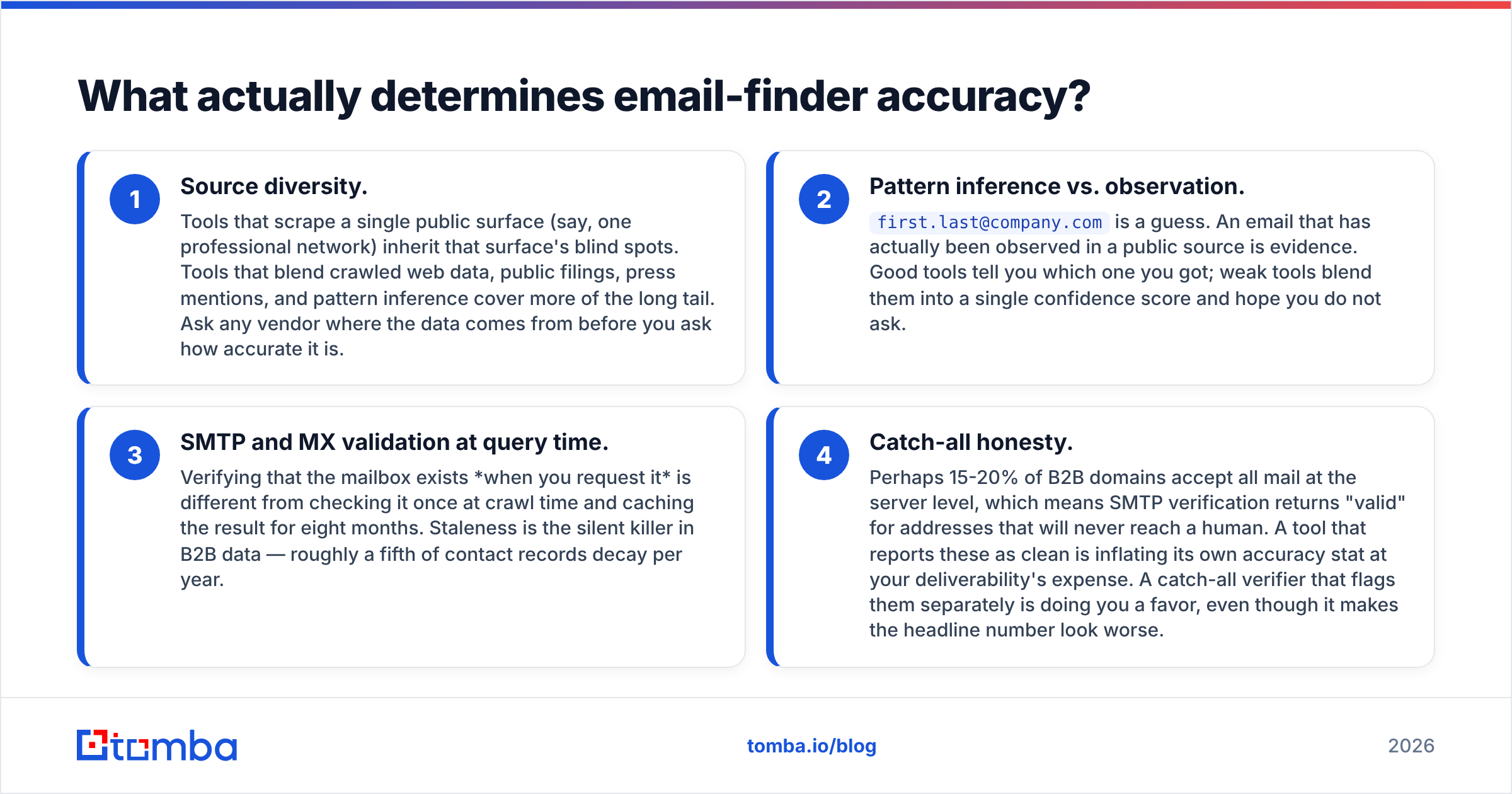
Here is the head-to-head on the dimensions that change your workflow. Where a vendor does not publish a figure, this table says so rather than inventing one — that gap is itself a data point.
| Attribute | Kipplo | Pipileads | Tomba (reference) |
|---|---|---|---|
| Primary job | Lead list building / prospect discovery | Lead capture and enrichment toward CRM | Email finding + verification |
| Published pricing | Not consistently public; quote-driven | Not consistently public; quote-driven | Public: Free, $49, $99, $249, Enterprise |
| Free tier | Limited trial credits | Limited trial credits | 25 searches/month, no card |
| Built-in email verification | Unclear / partial | Unclear / partial | Yes, separate verifier + catch-all handling |
| Documented public API | Not publicly documented | Not publicly documented | Yes, REST API with SDKs |
| Bulk processing | Yes (list export) | Limited | Yes, bulk finder and bulk verify |
| Catch-all domain handling | Not documented | Not documented | Dedicated catch-all verifier |
| Native integrations | Small set | Small set | HubSpot, Salesforce, Pipedrive, Zapier, Sheets |
| Best fit | Cold list generation | Enriching inbound/partial records | Accuracy-sensitive outbound at any volume |
The pattern you should notice: on the workflow rows, Kipplo and Pipileads differ from each other. On the infrastructure rows — API, verification, catch-all logic, published pricing — they are similar to each other and behind the established players. That is the real trade-off you are making when you pick a smaller vendor.
What actually determines email-finder accuracy?#
Accuracy claims in this category are close to meaningless unless you know how they were measured. A vendor that returns a result only when it is 98% confident will report a higher "accuracy" number than one that returns a best-guess pattern match — while giving you far fewer usable contacts. Both numbers can be technically true and completely uncomparable.

There are four mechanics that separate a genuinely accurate finder from one that just looks accurate:
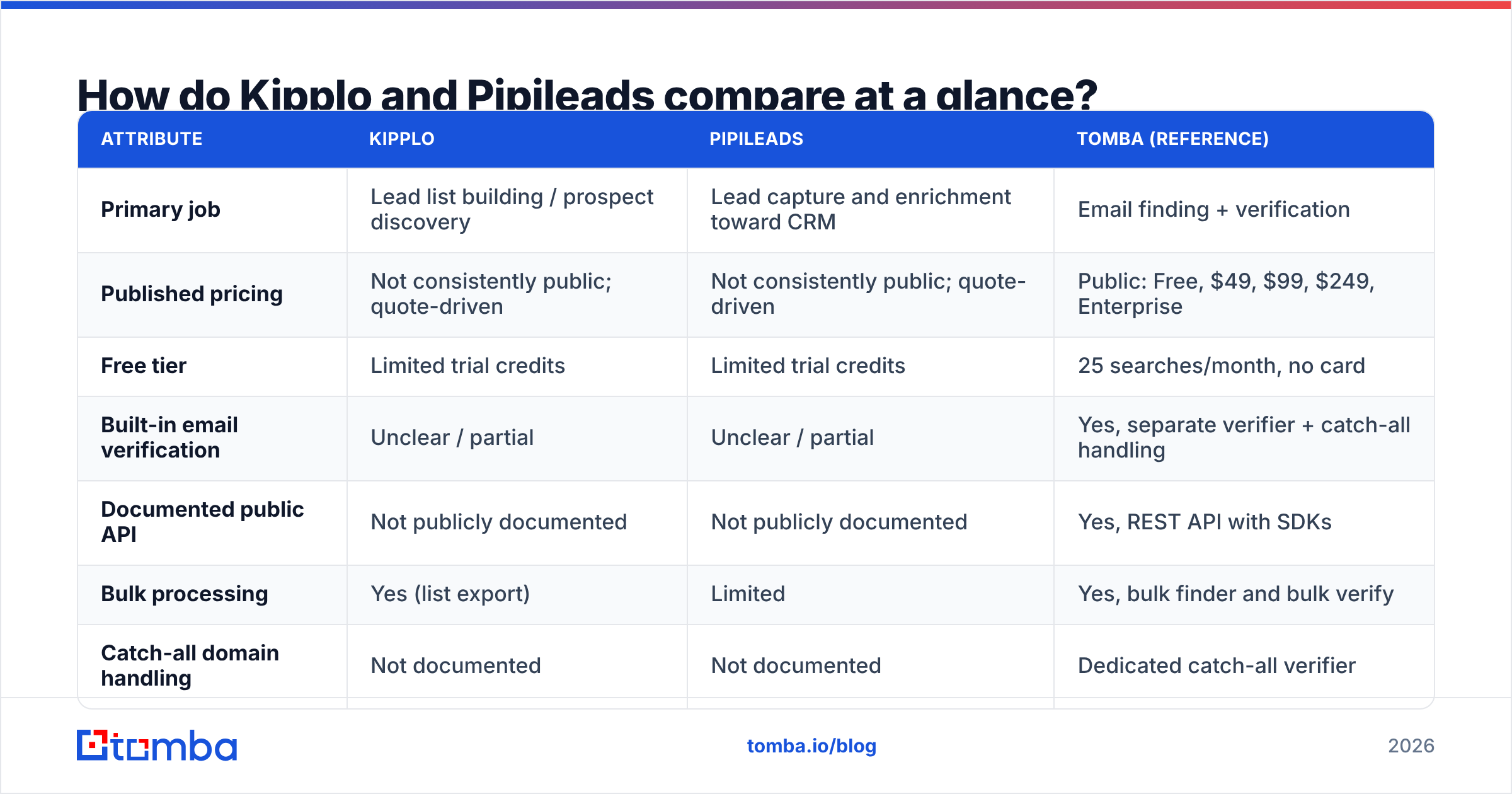
- Source diversity. Tools that scrape a single public surface (say, one professional network) inherit that surface's blind spots. Tools that blend crawled web data, public filings, press mentions, and pattern inference cover more of the long tail. Ask any vendor where the data comes from before you ask how accurate it is.
- Pattern inference vs. observation.
first.last@company.comis a guess. An email that has actually been observed in a public source is evidence. Good tools tell you which one you got; weak tools blend them into a single confidence score and hope you do not ask. - SMTP and MX validation at query time. Verifying that the mailbox exists when you request it is different from checking it once at crawl time and caching the result for eight months. Staleness is the silent killer in B2B data — roughly a fifth of contact records decay per year.
- Catch-all honesty. Perhaps 15-20% of B2B domains accept all mail at the server level, which means SMTP verification returns "valid" for addresses that will never reach a human. A tool that reports these as clean is inflating its own accuracy stat at your deliverability's expense. A catch-all verifier that flags them separately is doing you a favor, even though it makes the headline number look worse.
Neither Kipplo nor Pipileads publishes enough methodology detail to score them on these four points from the outside. So do it yourself: take 200 contacts you already have confirmed emails for, run them through each trial, and measure both hit rate and correctness. That test takes an afternoon and beats every review site.
How do pricing and credits compare?#
This is where smaller vendors in the category tend to get uncomfortable. Quote-driven pricing is not inherently bad, but it correlates strongly with three things that cost you money later: per-seat charges layered on top of credits, credits that expire monthly with no rollover, and credits consumed even when the tool returns nothing usable.
Before you sign with either Kipplo or Pipileads, get written answers to these:
- Does a failed search consume a credit? Some tools charge for the attempt, not the result. On a hard-to-find ICP, this doubles your effective cost per contact.
- Do credits roll over month to month? Outbound volume is lumpy. A tool that zeroes your balance every 30 days punishes the way real teams actually work.
- Is verification included or metered separately? If finding costs one credit and verifying costs another, your real per-contact price is double the advertised number.
- What is the per-seat cost at year two? Introductory pricing for a two-person team rarely survives contact with a five-person team.
- Can you export what you paid for? Some list tools restrict CSV export or watermark it by plan. Check before, not after.
For comparison, Tomba's pricing is fully public: a free tier with 25 searches per month, Starter at $49/mo, Growth at $99/mo, Pro at $249/mo, and custom Enterprise. You can model your cost per contact before you talk to anyone. That transparency is not a small thing when you are comparing three vendors and two of them will only give you a number on a call.
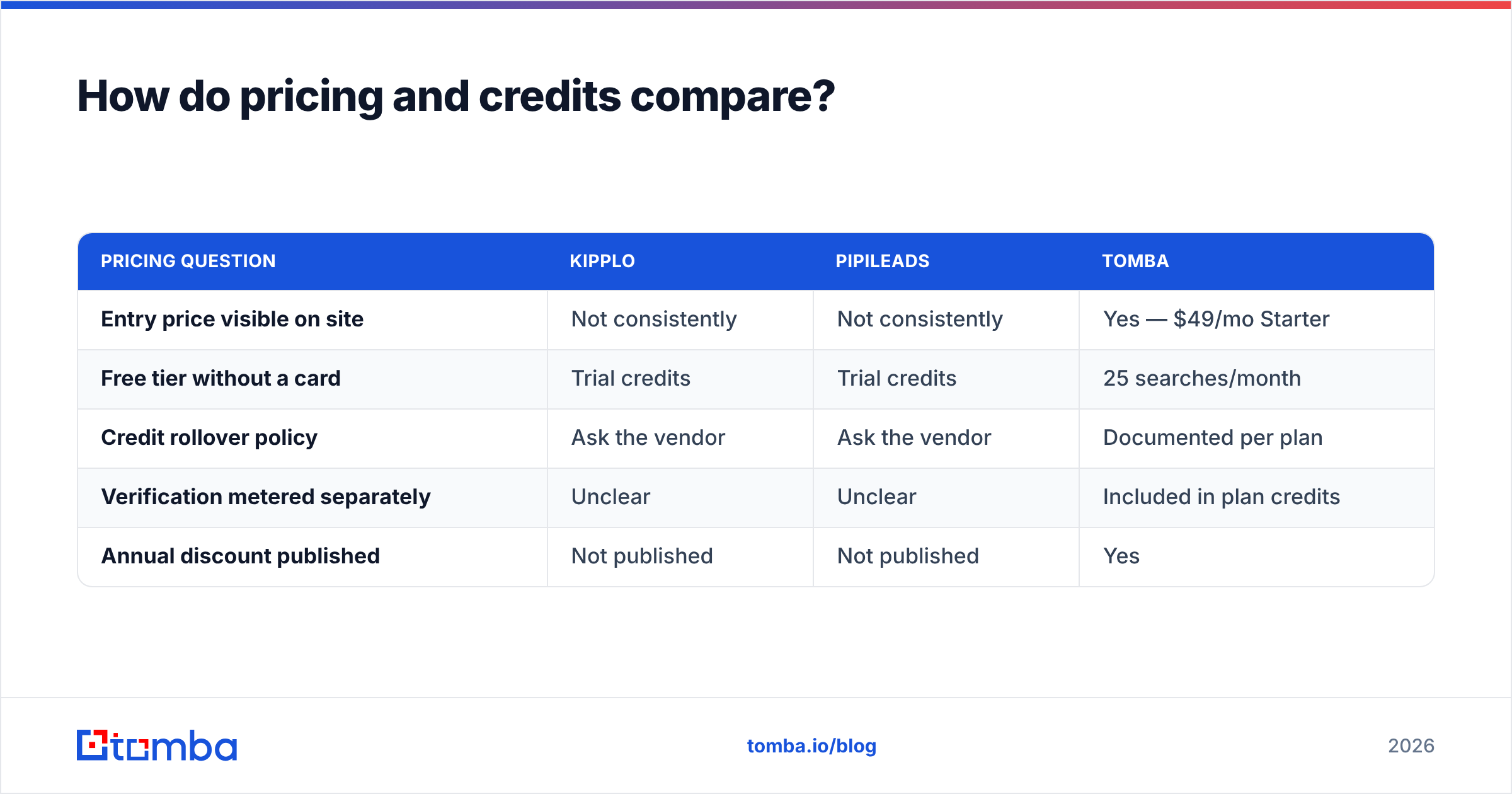
| Pricing question | Kipplo | Pipileads | Tomba |
|---|---|---|---|
| Entry price visible on site | Not consistently | Not consistently | Yes — $49/mo Starter |
| Free tier without a card | Trial credits | Trial credits | 25 searches/month |
| Credit rollover policy | Ask the vendor | Ask the vendor | Documented per plan |
| Verification metered separately | Unclear | Unclear | Included in plan credits |
| Annual discount published | Not published | Not published | Yes |
Which one should you pick for your use case?#
Rather than declaring a universal winner, match the tool to the motion:
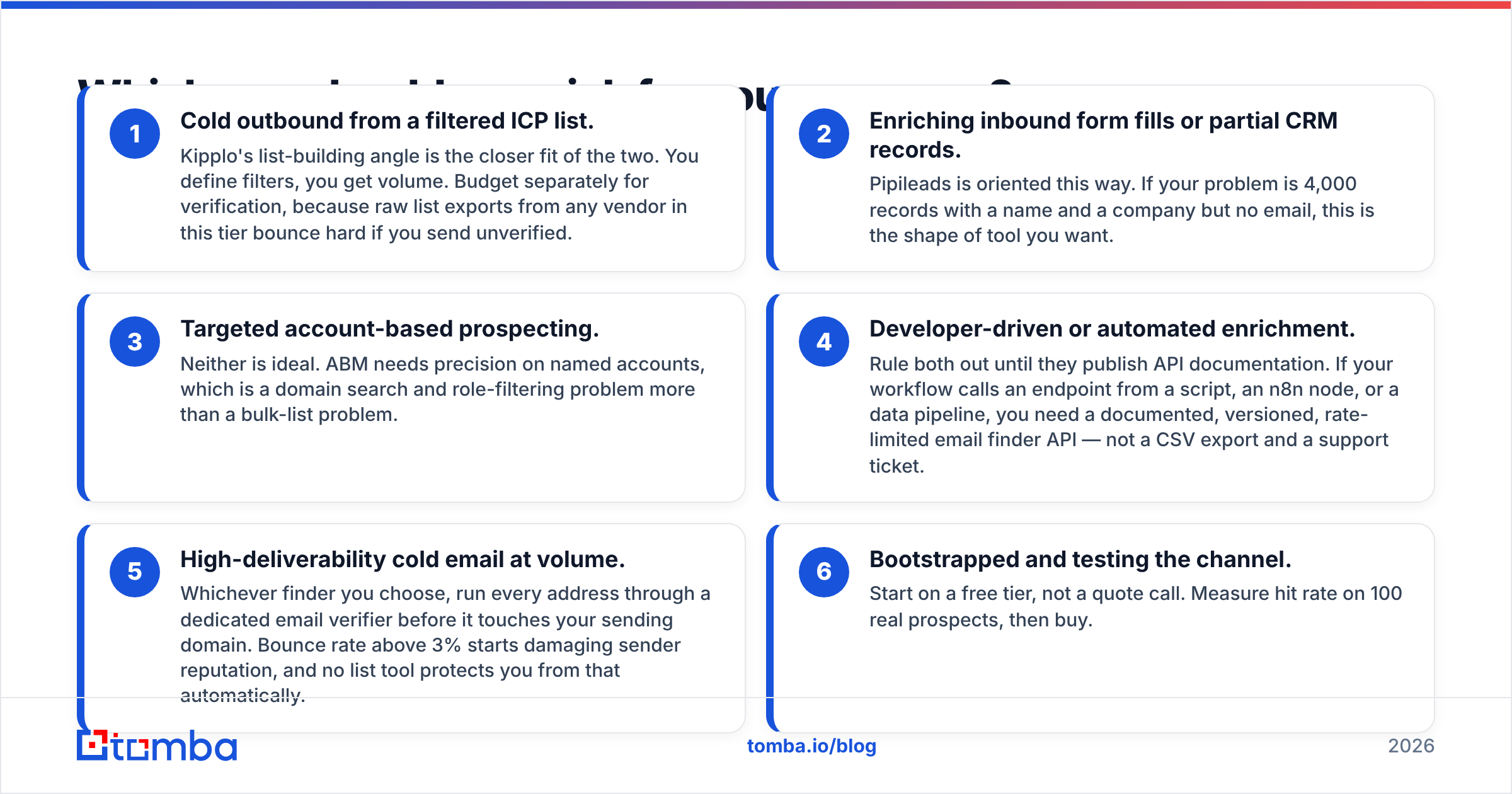
- Cold outbound from a filtered ICP list. Kipplo's list-building angle is the closer fit of the two. You define filters, you get volume. Budget separately for verification, because raw list exports from any vendor in this tier bounce hard if you send unverified.
- Enriching inbound form fills or partial CRM records. Pipileads is oriented this way. If your problem is 4,000 records with a name and a company but no email, this is the shape of tool you want.
- Targeted account-based prospecting. Neither is ideal. ABM needs precision on named accounts, which is a domain search and role-filtering problem more than a bulk-list problem.
- Developer-driven or automated enrichment. Rule both out until they publish API documentation. If your workflow calls an endpoint from a script, an n8n node, or a data pipeline, you need a documented, versioned, rate-limited email finder API — not a CSV export and a support ticket.
- High-deliverability cold email at volume. Whichever finder you choose, run every address through a dedicated email verifier before it touches your sending domain. Bounce rate above 3% starts damaging sender reputation, and no list tool protects you from that automatically.
- Bootstrapped and testing the channel. Start on a free tier, not a quote call. Measure hit rate on 100 real prospects, then buy.

Is there a better third option?#
Honestly, for most teams comparing these two, yes — and it is not a knock on either vendor. The reason is structural: Kipplo and Pipileads each solve one half of the job, so you end up buying two tools anyway. A finder without verification produces bounces. An enricher without discovery produces nothing when your pipeline is empty.

The consolidated alternatives worth putting on the shortlist:
- Tomba — email finder, verifier, domain search, catch-all verifier, phone finder and enrichment on one platform with a public API and published pricing. Strongest when accuracy and cost predictability matter more than raw database size.
- Apollo.io — very large database plus sequencing, but the all-in-one bundle means you pay for a sales engagement platform whether you use it or not. Reviews on Capterra's lead generation category consistently flag data quality variance on smaller markets.
- BookYourData — a solid pay-as-you-go option when you want a purchased list rather than a search subscription, with straightforward per-record pricing and no seat commitment. Different buying model, genuinely useful for one-off campaigns.
- Clearbit / HubSpot Breeze Intelligence — strongest when you are already deep in HubSpot's ecosystem and want enrichment native to the CRM. Overkill if you just need emails.
The evaluation shortcut: list the jobs you need done — discover, find, verify, enrich, export, automate — and count how many vendors it takes to cover them. Two tools at $60 each is not cheaper than one at $99 once you add the integration work, the duplicate records, and the second contract renewal.
What should your evaluation process actually look like?#
Give yourself one week and follow this sequence:
- Build a 200-row truth set. Contacts where you already know the correct email — past customers, replied prospects, colleagues at partner companies. This is your answer key.
- Run the same 200 through every trial. Same input format, same day. Record hit rate (how many returned an address) and precision (how many were correct).
- Send a 50-address test campaign from a warmed secondary domain and log real bounce rate. This catches the catch-all problem that no tool's dashboard will show you.
- Time the workflow. How many clicks from "I want contacts at these 20 accounts" to "CSV in my sequencer"? Multiply by your weekly volume.
- Price it at your real volume, not the tier you hope to stay on. Ask about overage rates explicitly.
Teams that run this test almost always end up choosing differently than they would have from the feature comparison alone. Hit rate and precision move in opposite directions across vendors, and the winner depends entirely on how forgiving your ICP is.
The bottom line#
Kipplo vs Pipileads is a real choice only if you already know which half of the problem you have. Kipplo for list building, Pipileads for enriching what you have got. Neither is a complete outbound data stack on its own, and neither currently gives you the pricing transparency or API documentation that a team scaling past a few thousand contacts a month will need.
If you would rather not stitch two half-solutions together, start with the layer everything else depends on: getting the right address, confirmed. The Tomba Email Finder finds professional emails by domain, name, or company, runs verification in the same workflow, flags catch-all domains instead of hiding them, and exposes all of it through a documented API. Test it free with 25 searches a month — no card, no sales call — and run it against the same truth set you use for every other vendor on your shortlist. Let the hit rate decide.
Related guides#
// get started
Find, verify and enrich your first contacts today
Start on the free plan with 25 searches a month, then scale when your team is ready.
Free plan · No credit card required · GDPR & CCPA
// about the author