Kipplo vs Prosperfleet Valgen: Which B2B Data Tool Wins
Three prospecting platforms, three very different billing models. Here is how Kipplo, Prosperfleet and Valgen actually compare on data accuracy, credits, API access and total cost — and who should pick which.
Kipplo vs Prosperfleet Valgen is a fight about billing models, not feature lists. All three sell the same thing — B2B contact data — and charge for it in three different ways. Here is how they compare on accuracy, credits, API access and real cost per contact.
TL;DR
- Kipplo, Prosperfleet and Valgen sit in the same bucket — B2B contact data and email discovery — but they monetise very differently: per-seat, per-credit, and quote-only enterprise contracts.
- Accuracy claims from any vendor in this category are marketing numbers until you test them on your ICP. Run the same 200-row sample through all three before you sign anything.
- The biggest cost difference is rarely the sticker price. It is credit burn on failed lookups, annual-only contracts, and API access being locked behind a higher tier.
- If you need transparent pricing, a real free tier and a documented API on day one, a self-serve tool like Tomba (free tier, then $49/mo) removes the procurement cycle entirely.
- Verdict: Valgen-style enterprise suites win on breadth, Prosperfleet-style credit models win on flexibility, Kipplo-style per-seat tools win on simplicity. Most sub-20-person teams overbuy.
What are Kipplo, Prosperfleet and Valgen?#
All three are B2B prospecting data platforms. The job is identical: you give the tool a person, a company, or a domain, and it returns business contact details — work email, sometimes a direct dial, sometimes firmographic enrichment on top.
Where they diverge is packaging.
Kipplo positions as the lightweight, seat-based option: one price per user per month, a browser extension, a Chrome-first workflow, and a cap on lookups per seat. It is the tool an SDR installs on Monday and uses without a kickoff call.
Prosperfleet leans credit-based. You buy a pool of credits, spend them across email lookups, verification and enrichment, and top up when you run dry. That model is honest about the fact that not every lookup succeeds. But it also makes your monthly cost variable, which finance teams dislike.
Valgen is the enterprise-shaped one: bundled intent signals, CRM sync, admin controls, and pricing that is negotiated rather than published. You get a demo, a discovery call, and a quote. Breadth is the selling point; speed to first value is not.
That three-way split — seat, credit, contract — is the real comparison. The feature lists converge; the commercial models do not.

How should you compare prospecting tools fairly?#
Most "X vs Y" pages compare feature checkboxes. Checkboxes lie. Here is the order that actually predicts which tool you will still be paying for in twelve months.
Start with the three data-quality tests:
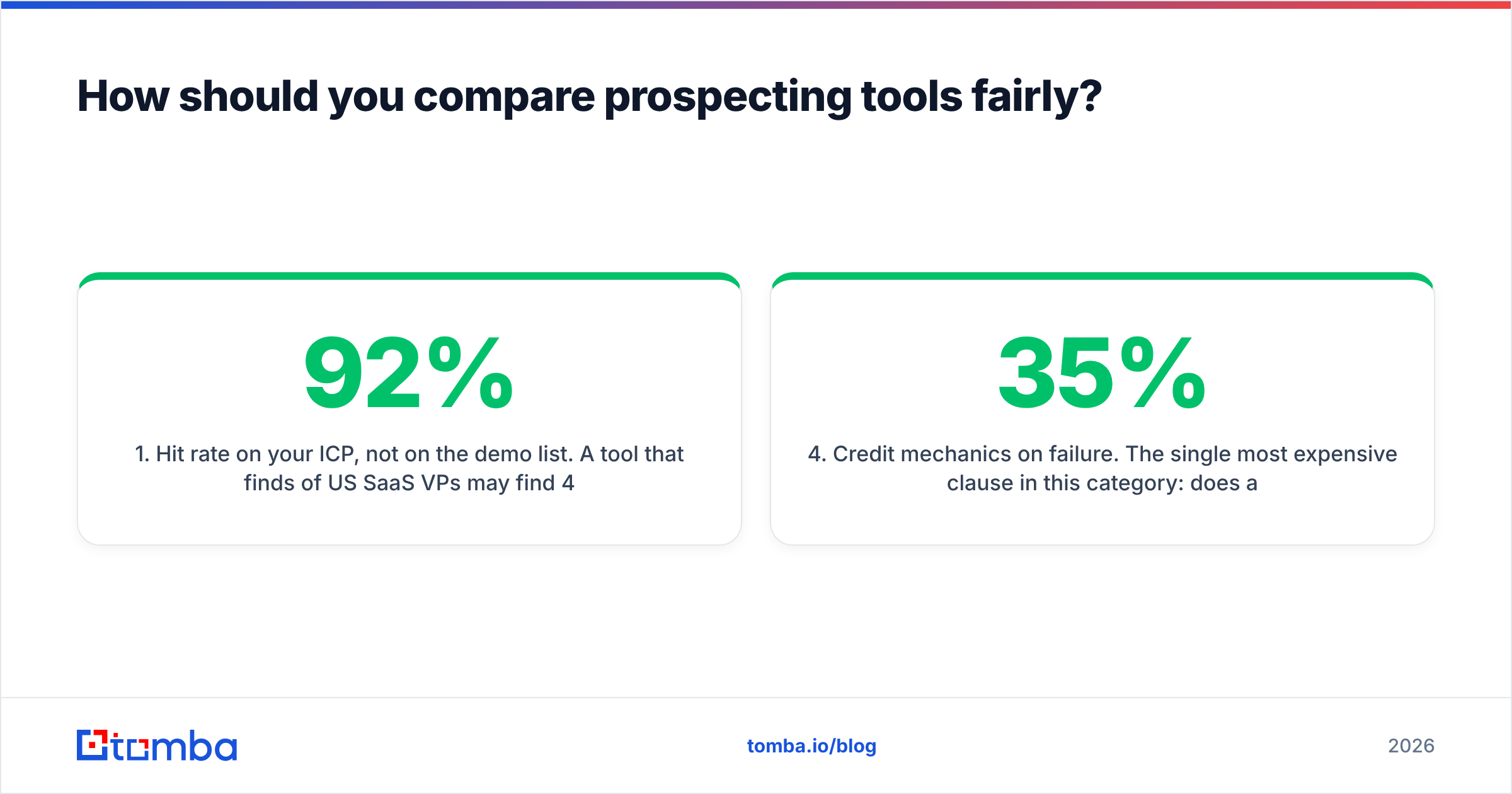
- Hit rate on your ICP, not on the demo list. A tool that finds 92% of US SaaS VPs may find 40% of German mid-market operations managers. Vendors demo the segment they're strong in. Bring your own list.
- Verification quality, not just find rate. A returned email is worthless if it bounces. Ask what percentage of returned addresses are marked "valid" versus "accepted-all", and whether the tool charges you for both. Pair any finder with an independent email verifier before your first send.
- Catch-all handling. Roughly a fifth of B2B domains accept everything at the SMTP layer. Tools that dump catch-alls into "valid" inflate their accuracy number and destroy your sender reputation. A dedicated catch-all verifier is the honest way to handle these.
Then price the three commercial terms that decide your real bill:
- Credit mechanics on failure. This is the most expensive clause in the category: does a failed lookup consume a credit? Multiply "yes" by a 35% miss rate. Your effective cost per contact jumps by half.
- API and export access by tier. If the API sits two tiers above the plan you can afford, the tool cannot be automated, and you have bought a manual data-entry job.
- Exit cost. Can you export everything you have found, in CSV, without a support ticket? If not, you are renting your own pipeline.
Score each vendor 1–5 on those six lines. The winner is usually not the one with the longest feature page.
Kipplo vs Prosperfleet Valgen: how do they compare head to head?#
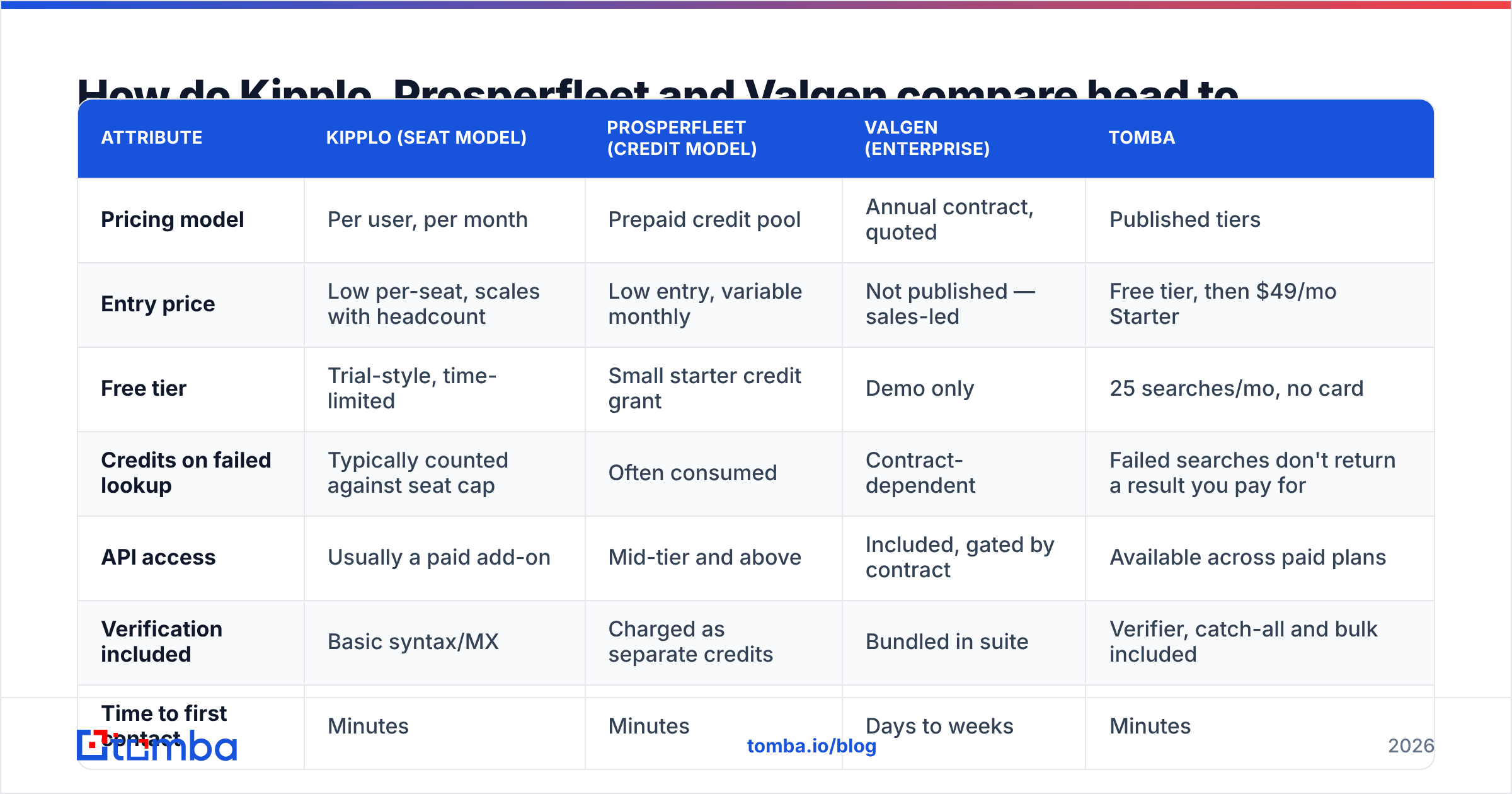
Here is the structural comparison. All three publish pricing inconsistently, so check current numbers on each vendor's site before you budget. This category re-prices roughly twice a year.
| Attribute | Kipplo (seat model) | Prosperfleet (credit model) | Valgen (enterprise) | Tomba |
|---|---|---|---|---|
| Pricing model | Per user, per month | Prepaid credit pool | Annual contract, quoted | Published tiers |
| Entry price | Low per-seat, scales with headcount | Low entry, variable monthly | Not published — sales-led | Free tier, then $49/mo Starter |
| Free tier | Trial-style, time-limited | Small starter credit grant | Demo only | 25 searches/mo, no card |
| Credits on failed lookup | Typically counted against seat cap | Often consumed | Contract-dependent | Failed searches don't return a result you pay for |
| API access | Usually a paid add-on | Mid-tier and above | Included, gated by contract | Available across paid plans |
| Verification included | Basic syntax/MX | Charged as separate credits | Bundled in suite | Verifier, catch-all and bulk included |
| Time to first contact | Minutes | Minutes | Days to weeks | Minutes |
| Best fit | 1–5 SDRs, simple workflows | Spiky, campaign-based usage | 50+ seats, RevOps-led | Lean teams that need API + volume |

The table makes the trade-off visible. Seat models punish growth: every new hire is a full-price seat, whether they run 20 lookups or 2,000. Credit models punish unpredictability in the other direction. A big Q4 push blows through the pool, and you buy top-ups at worse unit economics. Enterprise contracts remove both problems and replace them with a procurement cycle and a floor you cannot go below.
If your team is under ten people, the enterprise route almost never pays back. Independent buyer reviews on G2's sales intelligence category show the same pattern repeatedly: small teams rating enterprise suites highly on data depth and poorly on value for money.
Which one has the most accurate data?#
Nobody can answer that for you, and any blog that gives you a single percentage is guessing.
Accuracy in this category is segment-dependent. Coverage is built from different source mixes: crawled web data, contributed CRM data, partner feeds, SMTP inference. Each mix is strong in a different region and company-size band. A vendor quoting "98% accuracy" is almost always quoting a deliverability rate on the subset of addresses it chose to return. Everything it was unsure about was filtered out first. So two vendors can both be telling the truth and still disagree by 30 points on your list.

Run this test instead. It takes an afternoon:
- Take 200 real target contacts from your ICP — same companies, same seniority, same geography as your live campaign.
- Run the identical list through each tool's free tier or trial.
- Record three numbers per tool: found rate (how many returned any address), confident rate (how many were flagged valid rather than risky or catch-all), and bounce rate after a real send to a 50-contact subset.
- Divide total spend by confident, non-bouncing contacts. That is your true cost per usable contact.
Teams that run this test are routinely surprised. The tool with the highest found rate is often not the tool with the lowest cost per usable contact, because it returns guesses. HubSpot's sales research team has made a similar point for years about list hygiene: bad data compounds downstream through reply rates, rep trust and forecast accuracy.
For a fast benchmark before you commit to any trial, a straightforward email finder with a genuine free tier gives you a control group without a sales call.
What does each tool actually cost per usable contact?#
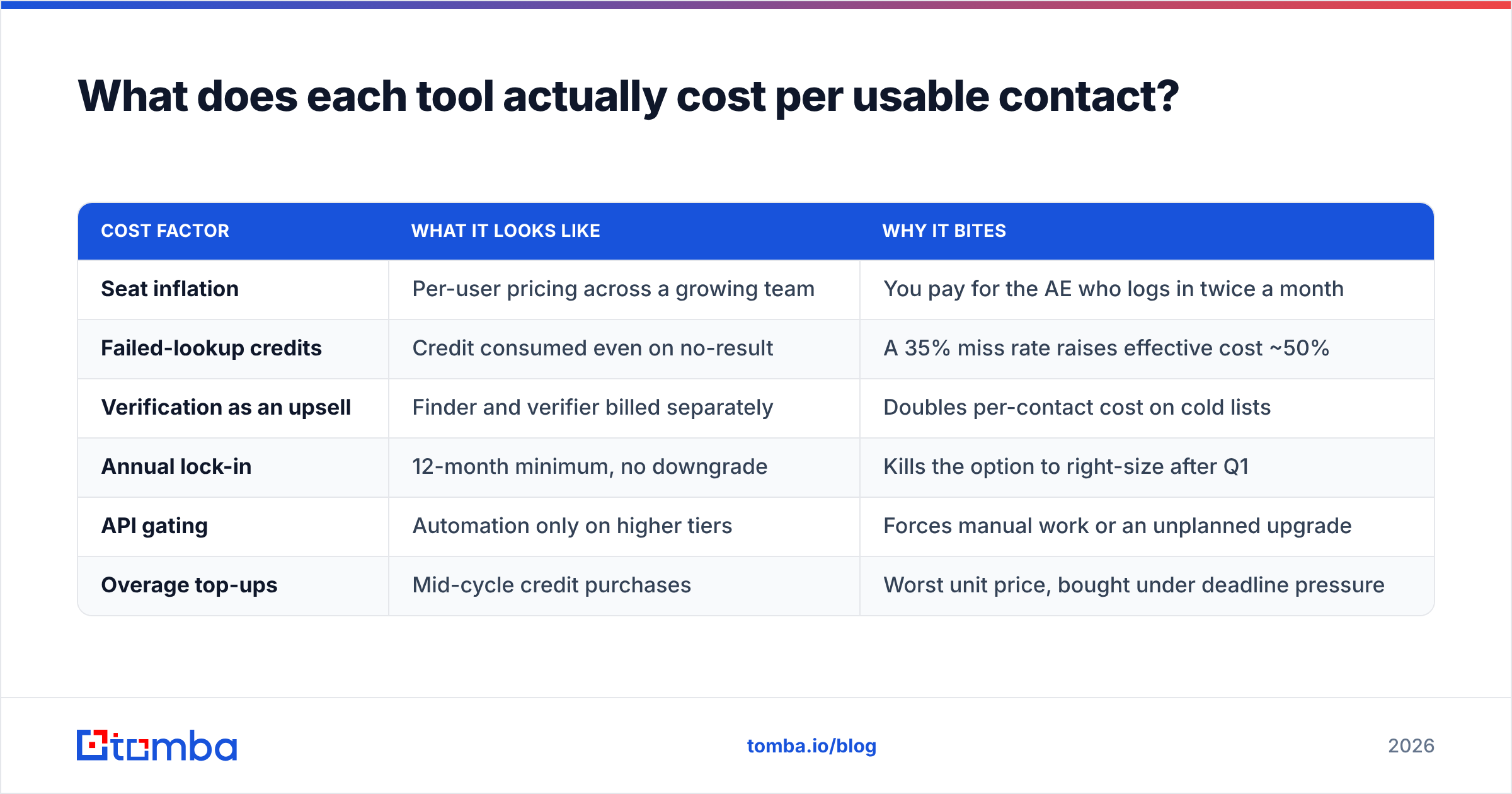
Sticker price is the least useful number in this comparison. Model it properly.
| Cost factor | What it looks like | Why it bites |
|---|---|---|
| Seat inflation | Per-user pricing across a growing team | You pay for the AE who logs in twice a month |
| Failed-lookup credits | Credit consumed even on no-result | A 35% miss rate raises effective cost ~50% |
| Verification as an upsell | Finder and verifier billed separately | Doubles per-contact cost on cold lists |
| Annual lock-in | 12-month minimum, no downgrade | Kills the option to right-size after Q1 |
| API gating | Automation only on higher tiers | Forces manual work or an unplanned upgrade |
| Overage top-ups | Mid-cycle credit purchases | Worst unit price, bought under deadline pressure |
Work an example. Say you need 3,000 verified contacts a quarter. On a credit model where failures are billed and verification is separate, you might buy 6,000+ credits to land 3,000 confident addresses. On a seat model, you hit the per-seat lookup cap in week six and either add seats or stop prospecting. On an enterprise contract, the unit price is lower but the floor is annual.
Transparent tiering is the counterweight. Tomba pricing publishes the whole ladder — free tier at 25 searches/month, Starter $49/mo, Growth $99/mo, Pro $249/mo, Enterprise on request. You can model the same 3,000-contact quarter in a spreadsheet before you talk to anyone. That is not a knock on quote-based vendors; large orgs with custom compliance needs genuinely require contracts. It is a knock on buying one when you have eleven employees.

Is Kipplo better than Prosperfleet for outbound teams?#
It depends entirely on how spiky your usage is.
Pick a Kipplo-style seat model if: your reps prospect continuously at a predictable daily volume, you have five or fewer people touching the tool, and browser-extension workflow matters more than bulk processing. Predictable billing is worth real money to a small finance function.
Pick a Prosperfleet-style credit model if: your prospecting is campaign-shaped — three heavy weeks, then a quiet month — or if one RevOps person runs enrichment centrally for the whole team. Credits map to that shape far better than seats do. Just confirm, in writing, whether failed lookups are billed.
Pick a Valgen-style enterprise suite if: you need intent data, territory management, SSO, DPAs and a named CSM, and you have the headcount to amortise it. Below roughly 25 seats, the admin overhead outweighs the feature depth.
There is a fourth path people forget: skip the platform for part of the job. If you need a static list of a known segment rather than a lookup engine, a prebuilt database vendor such as BookYourData is a legitimate and often cheaper route for one-off list builds. It pairs well with a verification step of your own. Use the right instrument for the job instead of forcing one subscription to do everything.
Kipplo vs Prosperfleet Valgen: where does Tomba fit?#
Honestly: as the control group, and often as the replacement.
Tomba is narrower than an enterprise suite. There is no intent scoring, no territory engine, no forecasting layer. What it does cover is the part of the stack these three all charge for — finding a work email from a name and domain, verifying it, resolving catch-alls, searching a whole company domain, and enriching the result. Prices are published, and the API is on paid plans rather than reserved for the top tier.
Three practical consequences:
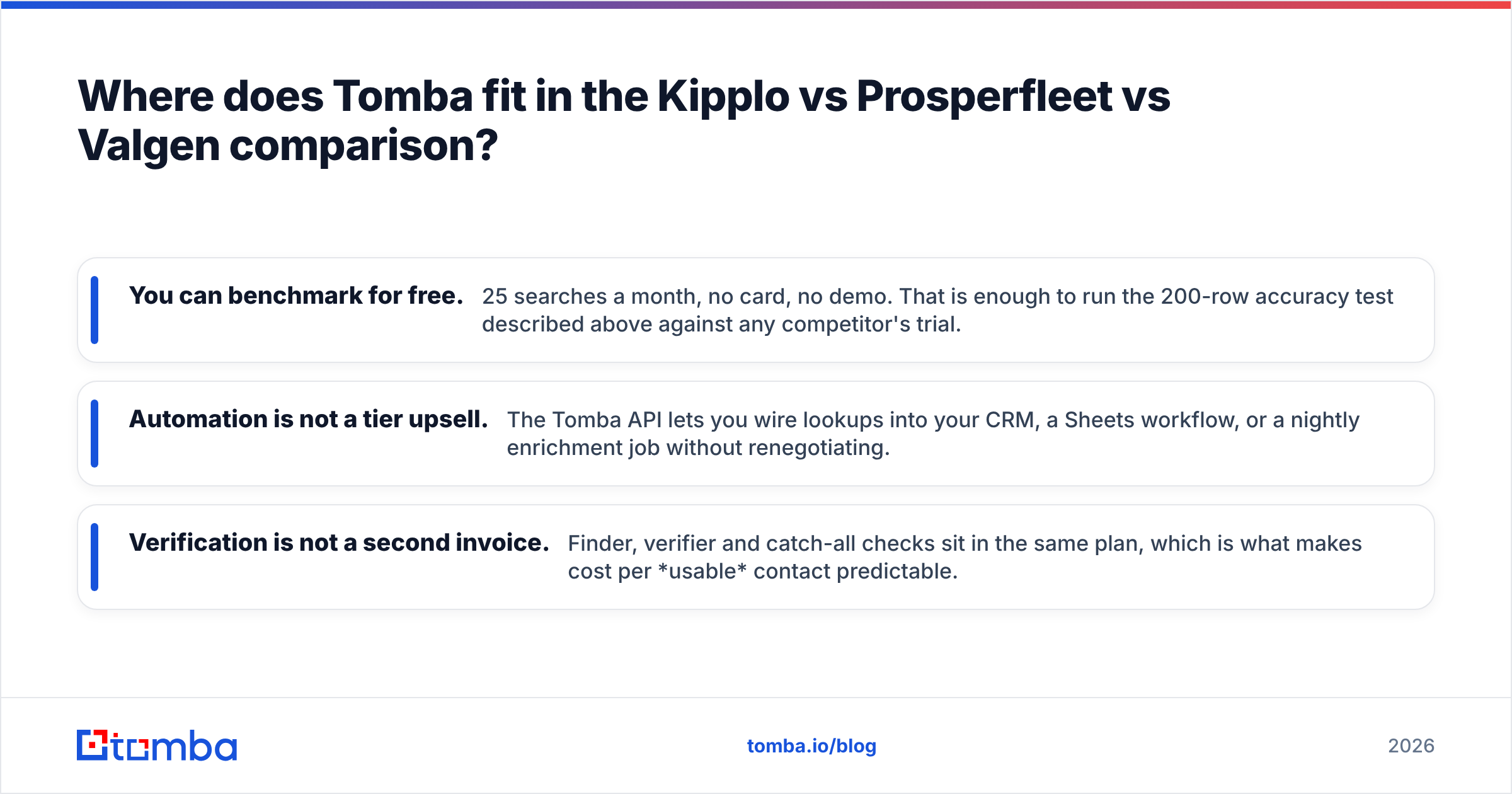
- You can benchmark for free. 25 searches a month, no card, no demo. That is enough to run the 200-row accuracy test described above against any competitor's trial.
- Automation is not a tier upsell. The Tomba API lets you wire lookups into your CRM, a Sheets workflow, or a nightly enrichment job without renegotiating.
- Verification is not a second invoice. Finder, verifier and catch-all checks sit in the same plan, which is what makes cost per usable contact predictable.
Where Tomba is the wrong answer: if you genuinely need buying-intent signals, ABM orchestration, or a procurement-approved MSA with a named enterprise vendor, buy the enterprise suite. Nobody wins by under-buying either.
What should you do before you sign anything?#
Run a two-week bake-off. The Kipplo vs Prosperfleet Valgen call should come from your own numbers, not from a vendor deck. Give each of the three the identical 200-contact list, identical timeframe, identical sending setup. Measure found rate, confident rate, bounce rate and true cost per usable contact. Ask each vendor, in writing, three questions: are failed lookups billed, which tier unlocks the API, and can I export everything on exit.
Then buy the cheapest tool that clears your accuracy bar. Switching costs in lead generation tooling are low, and data freshness decays fast. Optimise for the twelve months in front of you, not for the five-year platform story.
Start the bake-off with a free control group. Run your 200-row ICP sample through the Tomba Email Finder on the free tier — 25 searches, no credit card, no demo call — and use the found, confident and bounce numbers as your baseline. If the baseline wins, you have already solved the problem for $49/mo. If it does not, you now have real data to negotiate with instead of a vendor's slide.
Related guides#
// get started
Find, verify and enrich your first contacts today
Start on the free plan with 25 searches a month, then scale when your team is ready.
Free plan · No credit card required · GDPR & CCPA
// about the author