Kipplo vs RampedUp: Which B2B Contact Data Tool Wins in 2026?
Kipplo and RampedUp both sell B2B contact data, but they solve different problems. Here is an honest breakdown of pricing models, accuracy, verification depth, and API access — plus when neither is the right pick.
TL;DR
- Kipplo and RampedUp are not the same category of product. Kipplo positions itself as a lightweight contact-finding and outbound tool; RampedUp is a CRM-attached data enrichment and prospecting layer built around Salesforce and HubSpot workflows.
- RampedUp wins if your data problem lives inside your CRM. Its value is refreshing stale records, appending firmographics, and flagging job changes — not feeding a cold-email machine.
- Kipplo wins if you want a simple find-and-export loop without an annual contract or a seat-based commitment.
- Neither publishes the kind of verification depth (SMTP-level checks, catch-all handling, bounce guarantees) that cold outbound actually requires. Budget for a separate email verifier either way.
- The cheapest honest path for most teams in 2026 is a dedicated finder + verifier stack starting at $49/mo, with a free tier to test accuracy before you commit.
What are Kipplo and RampedUp?#
Start with the conclusion: these two tools compete for budget, not for the same job.
Kipplo sits in the lightweight prospecting tier. The pitch is speed — look up a person or a company, get a work email, push it into a list or a sequence. Tools in this tier win on time-to-first-contact and lose on depth. There is no expectation that Kipplo becomes your system of record.
RampedUp comes from the opposite direction. It grew up as a data enrichment and sales-intelligence layer that lives inside your CRM. Its natural buyer is a RevOps lead who opens Salesforce, sees 40,000 contacts with missing titles, dead phone numbers, and people who left two years ago, and needs that fixed on a schedule. You can read the vendor's own framing on rampedup.io.
That difference drives everything else. Here is how the two product shapes actually break down:
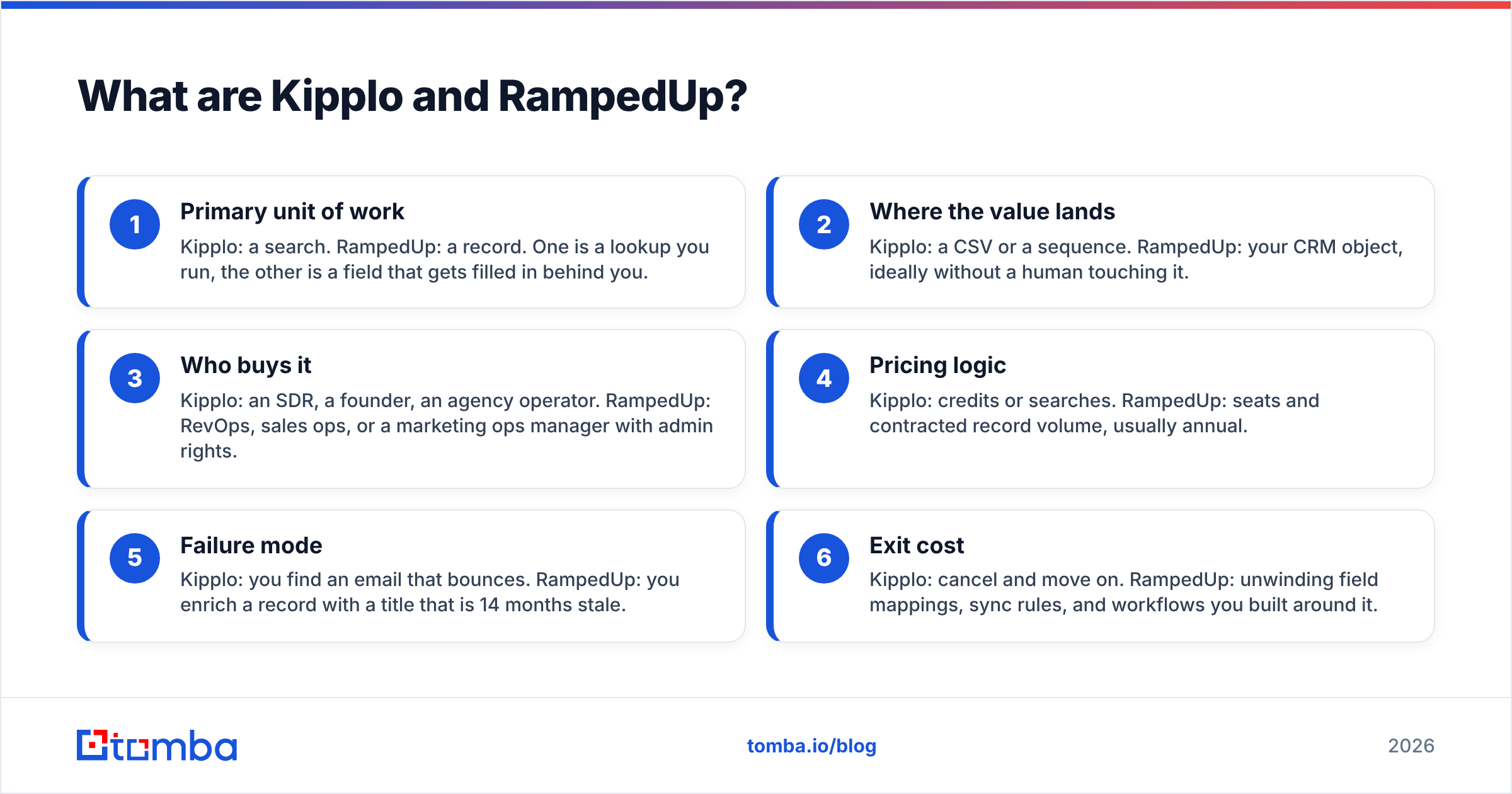
- Primary unit of work — Kipplo: a search. RampedUp: a record. One is a lookup you run, the other is a field that gets filled in behind you.
- Where the value lands — Kipplo: a CSV or a sequence. RampedUp: your CRM object, ideally without a human touching it.
- Who buys it — Kipplo: an SDR, a founder, an agency operator. RampedUp: RevOps, sales ops, or a marketing ops manager with admin rights.
- Pricing logic — Kipplo: credits or searches. RampedUp: seats and contracted record volume, usually annual.
- Failure mode — Kipplo: you find an email that bounces. RampedUp: you enrich a record with a title that is 14 months stale.
- Exit cost — Kipplo: cancel and move on. RampedUp: unwinding field mappings, sync rules, and workflows you built around it.
If you are evaluating "kipplo vs rampedup" as a single either/or decision, that framing is usually the first mistake. The real question is whether your bottleneck is finding new people or maintaining people you already have.

How do Kipplo and RampedUp compare on data accuracy?#
Accuracy claims in this market are close to meaningless without a definition, so here is the one that matters: what percentage of emails you export actually accept mail, and what percentage of those reach a human who still works there?
Those are two different failure modes, and the two tools fail differently.
Kipplo-style finders generate and validate candidate addresses from patterns, public sources, and crawled data. When a domain uses a predictable format (first.last@), hit rates look excellent. When it does not — or when the domain is catch-all, which accepts everything and tells you nothing — the confidence score becomes a guess dressed up as a number.
RampedUp-style enrichment platforms have a different weakness: recency. A record can be perfectly formatted, perfectly deliverable, and still point at someone who changed jobs in Q3. Enrichment vendors buy, license, and aggregate data; the refresh cadence on that data is the single most important spec, and it is almost never published in a way you can audit.

How to test this yourself in 30 minutes, regardless of which vendor you are looking at:
- Pull 100 contacts you already know are good (current customers, closed-won accounts, people you emailed last month).
- Strip the emails out and run the remaining name + domain pairs through each tool.
- Score three buckets: exact match, wrong-but-deliverable, and not found.
- Then run every returned address through an independent verifier. The gap between "the tool said valid" and "the verifier said valid" is your real accuracy number.
Most buyers skip step four. That is why bounce-rate surprises show up in week three, after the annual contract is signed.
For a deeper look at how source data affects hit rate, Tomba documents its own data sources publicly — a reasonable standard to hold any vendor to before you buy.
Is Kipplo cheaper than RampedUp?#
Almost certainly yes on paper, and that comparison is still the wrong one.
Credit-based finders and seat-based enrichment platforms price on different axes. A finder charges you for volume of lookups. An enrichment platform charges you for seats plus contracted record counts, usually on an annual commit with a sales call in the middle. A $50/month tool and a $12,000/year platform can both be "expensive" depending on what you waste.
Pricing and packaging change often in this category. Treat the table below as a structural comparison — confirm current numbers on each vendor's own page before you buy.

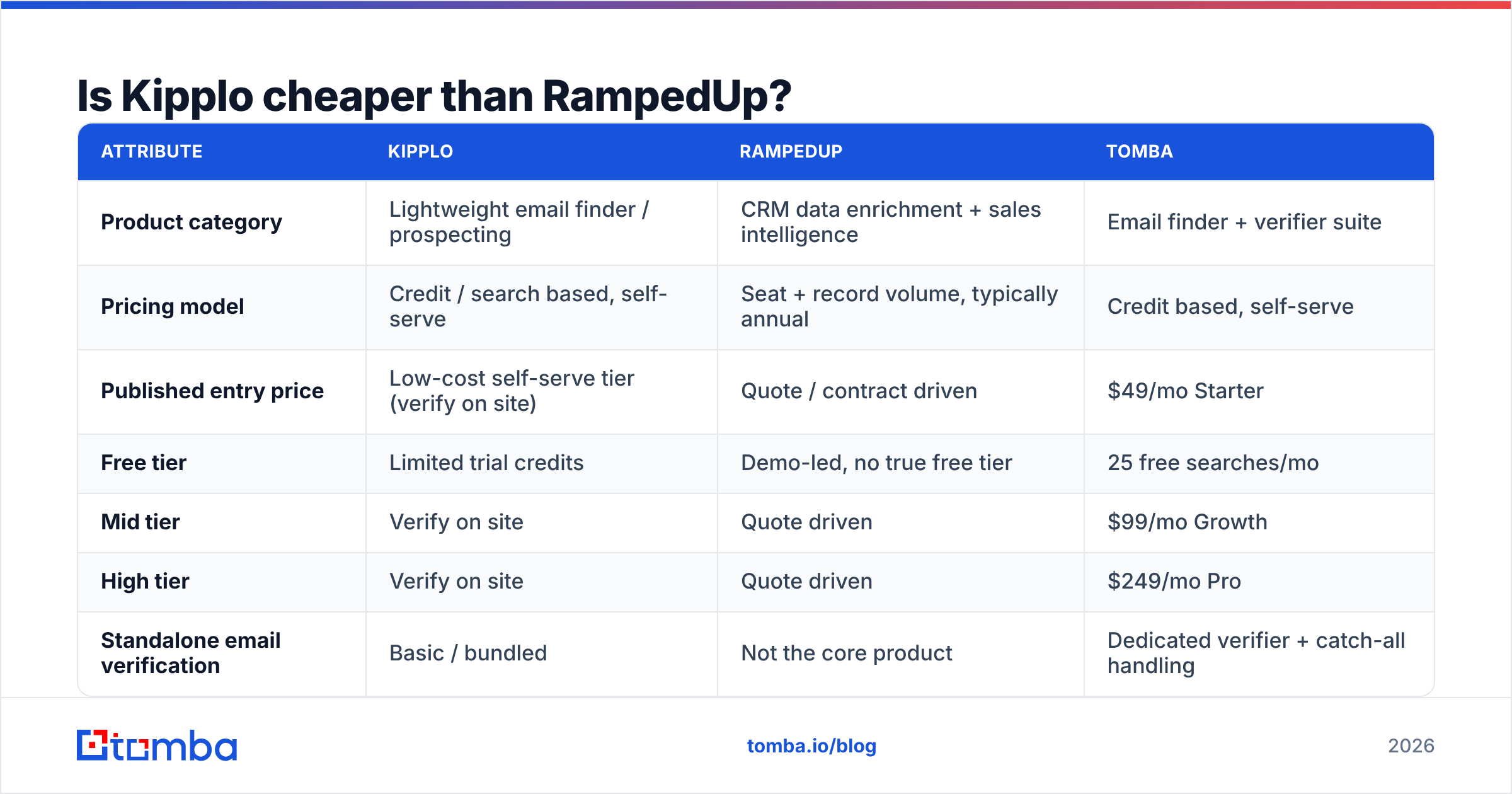
| Attribute | Kipplo | RampedUp | Tomba |
|---|---|---|---|
| Product category | Lightweight email finder / prospecting | CRM data enrichment + sales intelligence | Email finder + verifier suite |
| Pricing model | Credit / search based, self-serve | Seat + record volume, typically annual | Credit based, self-serve |
| Published entry price | Low-cost self-serve tier (verify on site) | Quote / contract driven | $49/mo Starter |
| Free tier | Limited trial credits | Demo-led, no true free tier | 25 free searches/mo |
| Mid tier | Verify on site | Quote driven | $99/mo Growth |
| High tier | Verify on site | Quote driven | $249/mo Pro |
| Standalone email verification | Basic / bundled | Not the core product | Dedicated verifier + catch-all handling |
| Catch-all domain resolution | Limited | Not addressed | Dedicated catch-all verifier |
| Public API | Limited | Available for enrichment sync | Full REST API, CLI, MCP server |
| Native CRM enrichment | Basic export / integrations | Core strength (Salesforce, HubSpot) | Via integrations + API |
| Bulk processing | Yes | Batch enrichment jobs | Bulk finder + bulk verify |
| Best for | Fast one-off prospecting | Cleaning an existing CRM at scale | Outbound teams needing find + verify in one place |
| Contract friction | None | Sales call, annual commit typical | None, month-to-month |
The pattern in that table is the actual takeaway. Kipplo competes on friction — sign up, search, export. RampedUp competes on coverage of a workflow you would otherwise build manually. Tomba competes on accuracy per dollar across the find-and-verify loop, with transparent pricing and no gate between you and the product.
Which one is better for cold email?#
RampedUp is not built for cold email, and pretending otherwise is how teams burn a domain.
Enrichment platforms optimize for field completeness. Cold email optimizes for deliverability. Those goals diverge fast: a fully enriched record with a title, a company size, a LinkedIn URL, and a technographic tag is worthless if the email bounces. And bounces are not a soft cost — sustained bounce rates above roughly 2% push you into spam-folder territory with Google and Microsoft, and the damage to sender reputation takes weeks to repair.
Kipplo is closer to the right shape for outbound, but lightweight finders tend to under-invest in the unglamorous half of the problem: SMTP-level validation, MX record checks, role-account detection, disposable domain filtering, and catch-all resolution. Address syntax is trivial to check; whether a mailbox actually exists requires a real conversation with the receiving server, which is why SMTP behavior matters more than any confidence score in a UI.
A workable cold-email stack in 2026 looks like this:
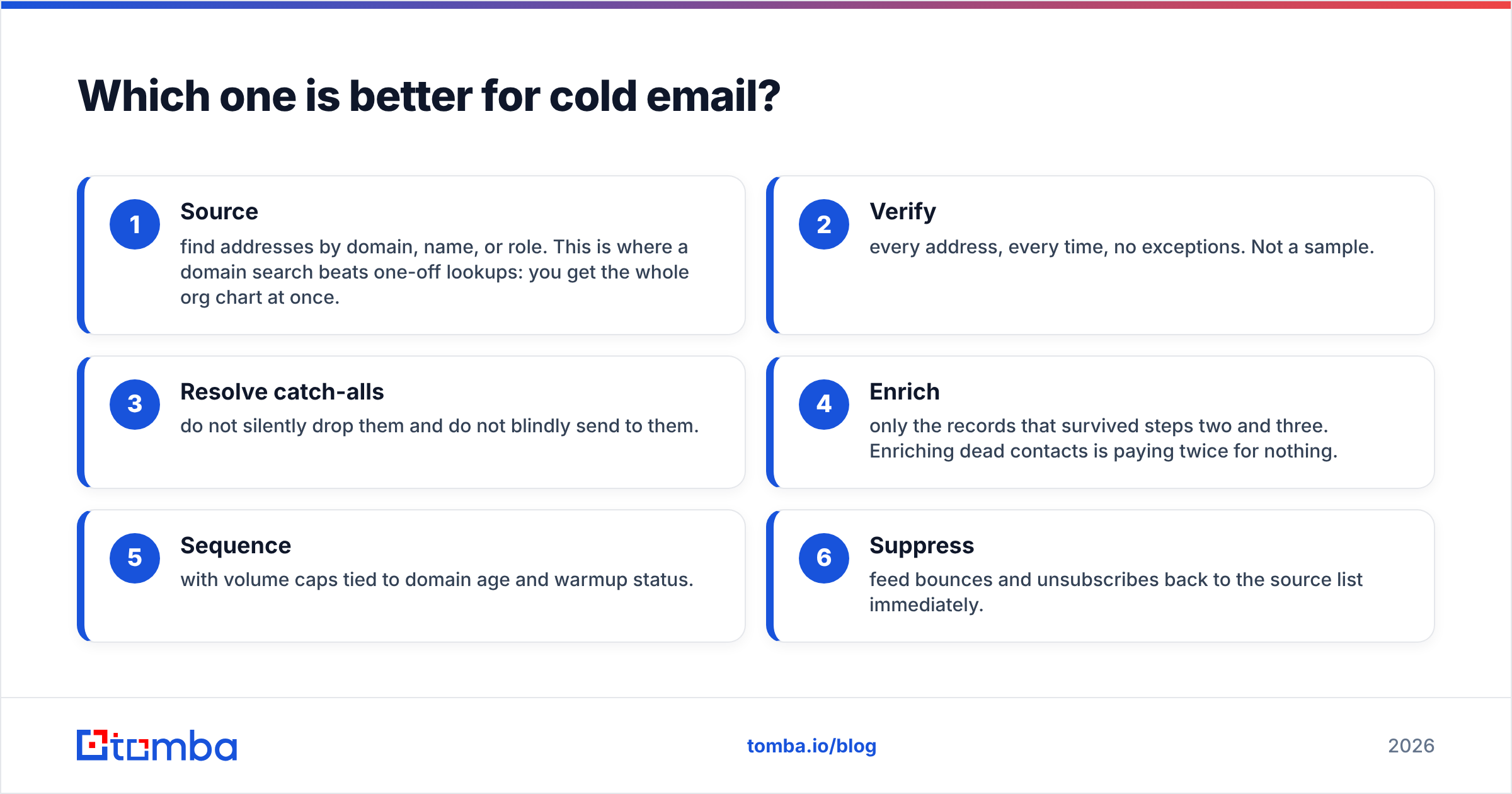
- Source — find addresses by domain, name, or role. This is where a domain search beats one-off lookups: you get the whole org chart at once.
- Verify — every address, every time, no exceptions. Not a sample.
- Resolve catch-alls — do not silently drop them and do not blindly send to them.
- Enrich — only the records that survived steps two and three. Enriching dead contacts is paying twice for nothing.
- Sequence — with volume caps tied to domain age and warmup status.
- Suppress — feed bounces and unsubscribes back to the source list immediately.
Notice that steps one through three are finder-and-verifier work, and step four is enrichment work. That is the honest division between these two vendors: Kipplo touches steps one and two, RampedUp touches step four. Neither covers the full loop.
What about catch-all domains and verification?#
This is where most "kipplo vs rampedup" evaluations quietly fall apart.
A catch-all domain accepts mail to any address at that domain — ceo@, jhdkfhs@, everything. The SMTP server returns a positive response regardless, so a standard verification check cannot tell you whether the mailbox is real. Depending on the vertical, catch-alls can be 20-35% of your enterprise list. Two bad responses to that:
- Drop them all. You delete a third of your addressable market, including a disproportionate share of your best-fit enterprise accounts.
- Send to them all. Your bounce rate spikes unpredictably and your domain reputation absorbs the hit.
The correct response is probabilistic resolution — combining pattern confidence, historical engagement signals, and secondary sources to grade catch-alls into tiers rather than a binary. That is a dedicated capability, which is why Tomba ships a separate catch-all verifier rather than folding it into a generic "valid/invalid" flag. If neither Kipplo nor RampedUp gives you a clear answer on this during your evaluation, assume it is unhandled and plan accordingly.
What should you actually buy?#
Match the tool to the bottleneck, not to the demo that impressed you most.
Buy RampedUp if: your CRM is the asset and it is decaying. You have thousands of records with missing fields, you need job-change alerts on your existing contacts, and you have the ops resources to own field mappings and sync rules. The annual commit is defensible when the alternative is a contractor doing manual research.
Buy Kipplo if: you need addresses now, your volume is modest, you do not want a procurement conversation, and you are comfortable bolting on a separate verification step before anything gets sent.
Buy a dedicated finder + verifier stack if: outbound volume is the point. You need hit rate, bounce protection, and an email finder API you can wire into your own pipeline without paying per seat.
Buy a prebuilt list instead if: your ICP is narrow, stable, and well-defined — a curated provider like BookYourData can be a legitimately faster path than running lookups one domain at a time, especially for first-time market entry where you need volume immediately.
Two more things worth checking before any of those, because they are cheap to verify and expensive to discover late:
- Export rights. Some enrichment contracts restrict what you can do with data outside the platform. Read that clause.
- Overage behavior. Does the tool hard-stop, auto-upgrade, or bill you for the excess? This is the single most common surprise line item in this category.
Peer reviews on G2 and Capterra are useful for one specific thing here: filter to reviews from companies your size, and read the one- and two-star ones first. Ignore the aggregate score — it is mostly a function of how aggressively each vendor runs review campaigns.
How do you run a fair head-to-head test?#
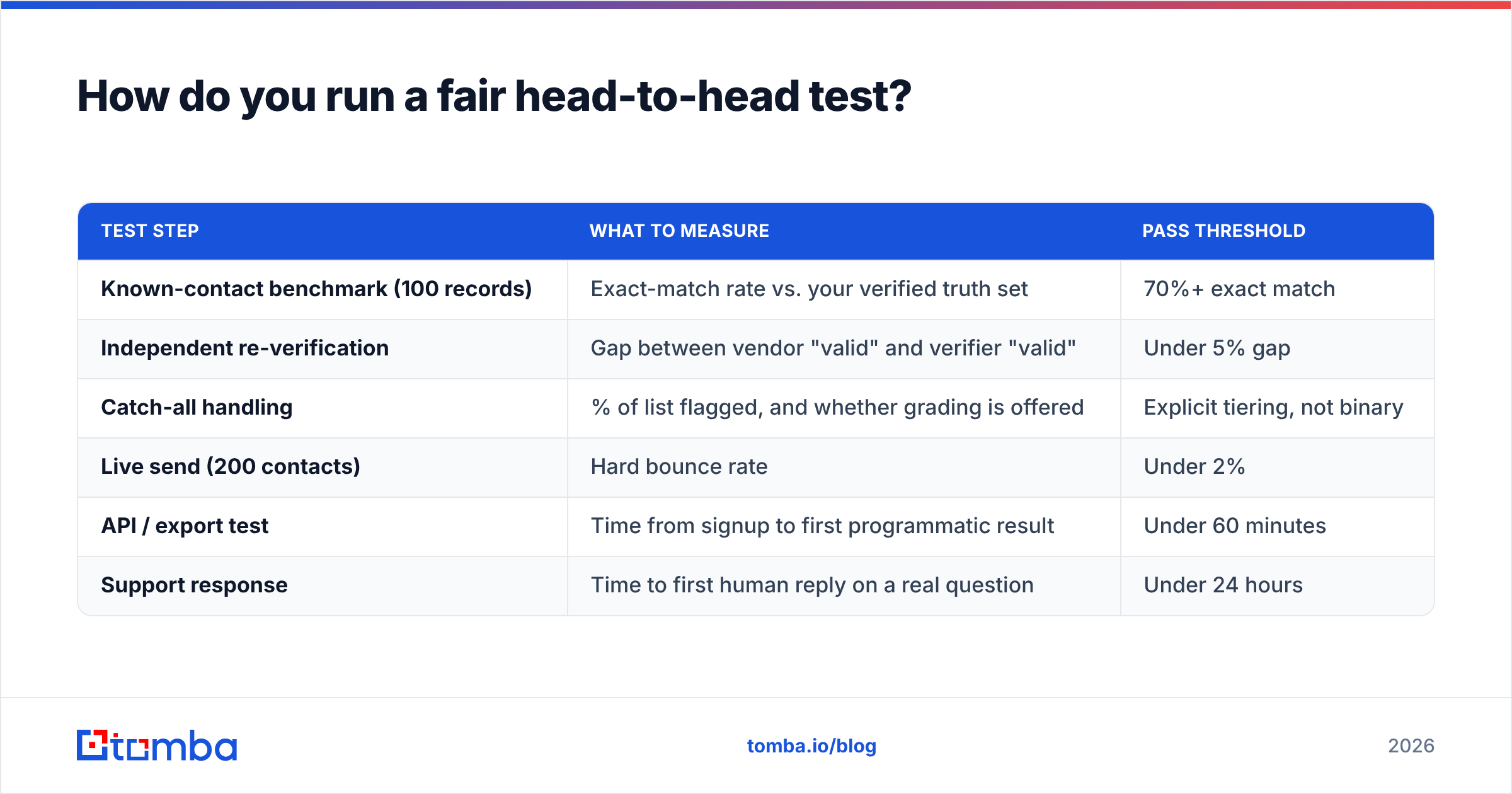
Give yourself one week and a fixed scoring sheet. Vendors will happily fill that week with demos if you let them; do not let them.
| Test step | What to measure | Pass threshold |
|---|---|---|
| Known-contact benchmark (100 records) | Exact-match rate vs. your verified truth set | 70%+ exact match |
| Independent re-verification | Gap between vendor "valid" and verifier "valid" | Under 5% gap |
| Catch-all handling | % of list flagged, and whether grading is offered | Explicit tiering, not binary |
| Live send (200 contacts) | Hard bounce rate | Under 2% |
| API / export test | Time from signup to first programmatic result | Under 60 minutes |
| Support response | Time to first human reply on a real question | Under 24 hours |
Run every tool through the same sheet. The results are usually less flattering and far more decisive than any comparison page — including this one.
Frequently asked questions#
Is Kipplo a direct RampedUp competitor? Not really. They overlap on "we give you B2B contact data" and diverge on everything else. Kipplo is a self-serve lookup tool; RampedUp is a CRM-attached enrichment layer with a sales-led motion.
Can I use both? Yes, and some teams do — Kipplo or a finder for net-new prospecting, RampedUp for keeping existing CRM records current. Just make sure you are not paying twice for the same records, which happens more often than anyone admits.
Do I still need a separate email verifier? Yes. Treat any in-product "valid" flag as a first pass, not a guarantee. Independent verification before send is the cheapest insurance in outbound.
What is the cheapest way to test accuracy without committing? Start with free tiers. Tomba's free plan includes 25 searches per month, which is enough to run a small known-contact benchmark before any card comes out.
Ready to test the find-and-verify loop properly? Run your own benchmark with the Tomba Email Finder — 25 free searches a month, no sales call, no annual commit. Pull addresses by domain, name, or company, verify them in the same workflow, and compare the hard-bounce numbers against whatever Kipplo or RampedUp quotes you. If the data holds up, paid plans start at $49/mo; if it does not, you have lost nothing but an afternoon.
Related guides#
// get started
Find, verify and enrich your first contacts today
Start on the free plan with 25 searches a month, then scale when your team is ready.
Free plan · No credit card required · GDPR & CCPA
// about the author