Kipplo vs Smarte (2026): Which B2B Contact Data Tool Wins?
Kipplo and Smarte both promise verified B2B contacts, but they solve different problems. Here is the honest breakdown of coverage, accuracy, verification depth, pricing models and who each one actually fits.
TL;DR
- Kipplo is the lighter, self-serve option: you sign up, search, export, and you are running within an hour. It fits founders, agencies and small outbound teams who want contacts without a procurement cycle.
- Smarte is the heavier GTM-data play: firmographics, technographics, intent signals and CRM hygiene, generally sold through a sales conversation rather than a credit-card checkout.
- Neither tool wins on "who has more records." The number that matters is usable, verified contacts per dollar after bounces and duplicates are stripped out.
- If your core job is find the right person's email and confirm it is deliverable, a dedicated finder-plus-verifier stack (Tomba, from $49/mo with a free tier) usually beats both on cost per usable lead.
- Run the same 100-contact test list through every shortlisted tool before signing anything. Vendor-published accuracy numbers are marketing; your list is evidence.
What are Kipplo and Smarte, and why are they compared?#
They get compared because they sit on opposite ends of the same shelf: B2B contact data for outbound teams.
Think of it like buying flour. Kipplo is the bag at the corner shop — you walk in, pay, walk out, bake tonight. Smarte is the wholesale supplier — better unit economics at volume, more grades to choose from, but you are talking to a rep and signing a contract before a single kilo moves.
Technically: Kipplo positions itself as a self-serve B2B lead and contact discovery tool. You search by company, role or domain, pull emails, export to CSV or push into a sequencer. The value proposition is speed and low friction.
Smarte positions itself as a GTM data and intelligence platform. Contact data is one layer; the pitch extends to account-level firmographics, technographic filters, intent signals and keeping CRM records from rotting. The value proposition is breadth of signal and enrichment at the account level, not just an email address.
That difference decides almost everything downstream — pricing model, onboarding time, who on your team owns it, and what "good" looks like.
A warning before you read any comparison table, including this one: both vendors adjust packaging, credit definitions and plan names regularly. Treat every published figure — theirs and ours — as a starting point to verify on the vendor's own pricing page and in a trial, not as a fixed fact.
How do Kipplo and Smarte actually differ?#
Here are the five dimensions that separate them in practice:
- Buying motion. Kipplo leans self-serve — card in, credits out. Smarte leans sales-assisted, which usually means a demo, a scoped quote and an annual commitment. If you need to start Tuesday, that gap matters more than any feature.
- Data shape. Kipplo optimises for the contact record: name, title, company, email. Smarte optimises for the account record with contacts attached: industry, size, tech stack, buying signals, then the people inside.
- Verification depth. Contact tools differ enormously here. Some return a "found" email with no deliverability check. Others run SMTP-level validation and flag catch-all domains separately. Ask each vendor directly: is verification included, is it charged separately, and how do you handle catch-all domains?
- Workflow surface. How many places can the data land? Chrome extension, CRM sync, spreadsheet add-on, API, bulk CSV. A tool with a great database and a bad export path costs your ops person hours every week.
- Credit economics. This is where budgets quietly die. A credit that is consumed on every search attempt is a completely different product from a credit consumed only on a verified, returned contact. Read that clause before you compare prices.

Which has better data accuracy?#
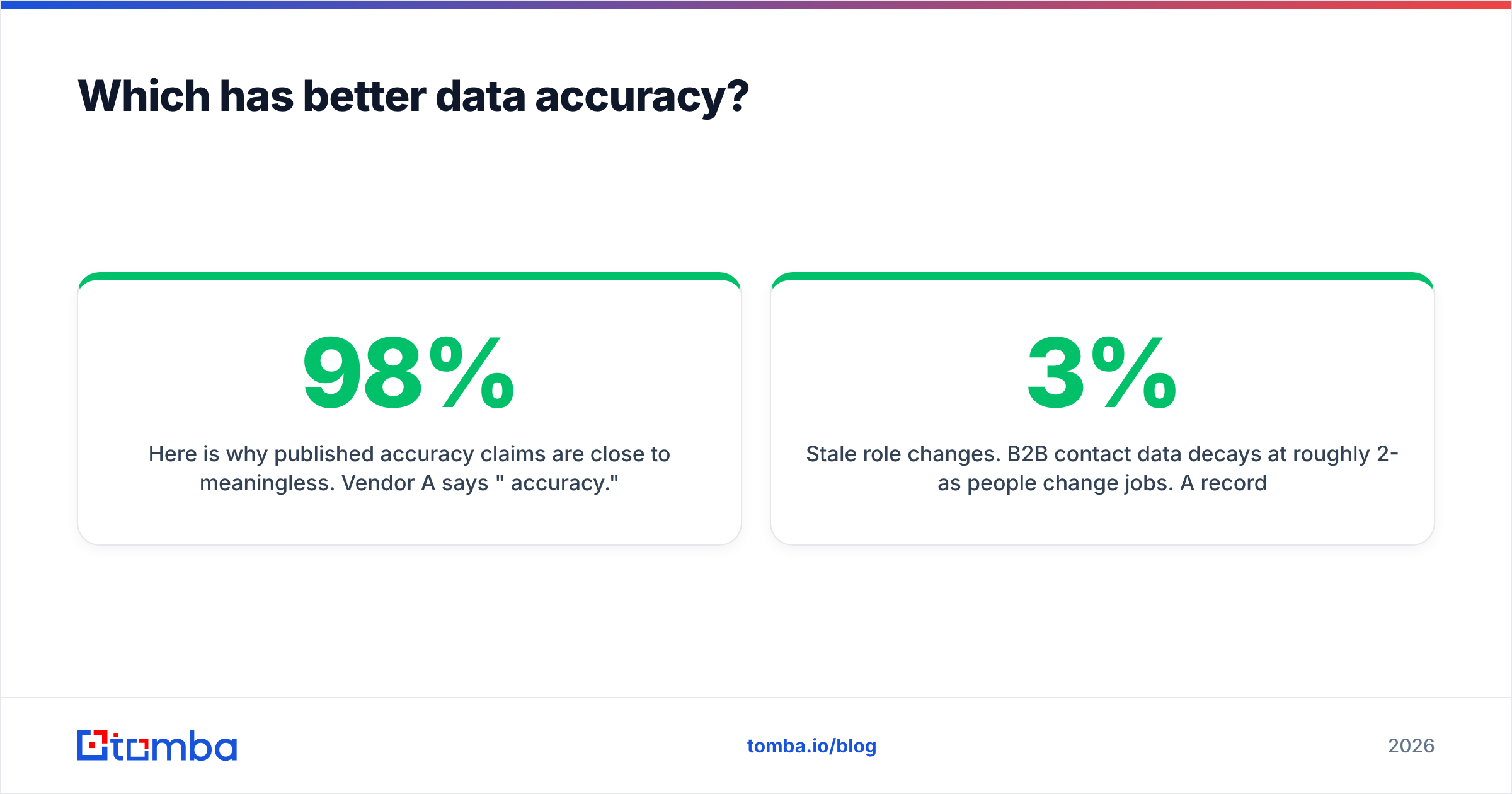
Neither vendor will publish a number you should trust without testing, and that is true of every player in this market — including us.
Here is why published accuracy claims are close to meaningless. Vendor A says "98% accuracy." That figure is usually calculated as of the emails we returned and marked valid, this share did not bounce in our internal sample. It says nothing about coverage — how many of your target contacts the tool found at all. A tool that returns an email for 30% of your list with 98% accuracy delivers fewer usable contacts than a tool that returns 70% at 92% accuracy.

So measure two things, always together:
- Match rate — of 100 target contacts you uploaded, how many came back with an email at all?
- Bounce rate on send — of those returned, how many actually hard-bounced in your ESP?
Multiply them. If Kipplo returns 64 emails from 100 rows and 6 bounce, you have 58 usable contacts. If Smarte returns 51 and 2 bounce, you have 49. Now divide each by what you paid. That single ratio — cost per usable contact — resolves most "which tool is better" arguments in about twenty minutes.
Two accuracy traps that inflate both vendors' numbers:
- Catch-all domains. Roughly a fifth to a third of B2B domains accept mail to any address at the SMTP layer, so a naive validator marks everything as valid. Those addresses can still bounce or land nowhere. If a tool does not separate catch-all from confirmed-valid, its accuracy figure is inflated by construction. A dedicated catch-all verifier exists precisely because this category needs different handling.
- Stale role changes. B2B contact data decays at roughly 2-3% per month as people change jobs. A record that was perfect in January is a coin flip by autumn. Ask when each record was last re-verified, not when it was first collected.
Independent user reviews on G2's lead intelligence category are a useful sanity check on both vendors' claims, mainly because complaints about coverage gaps in specific regions surface there long before they appear in any sales deck.
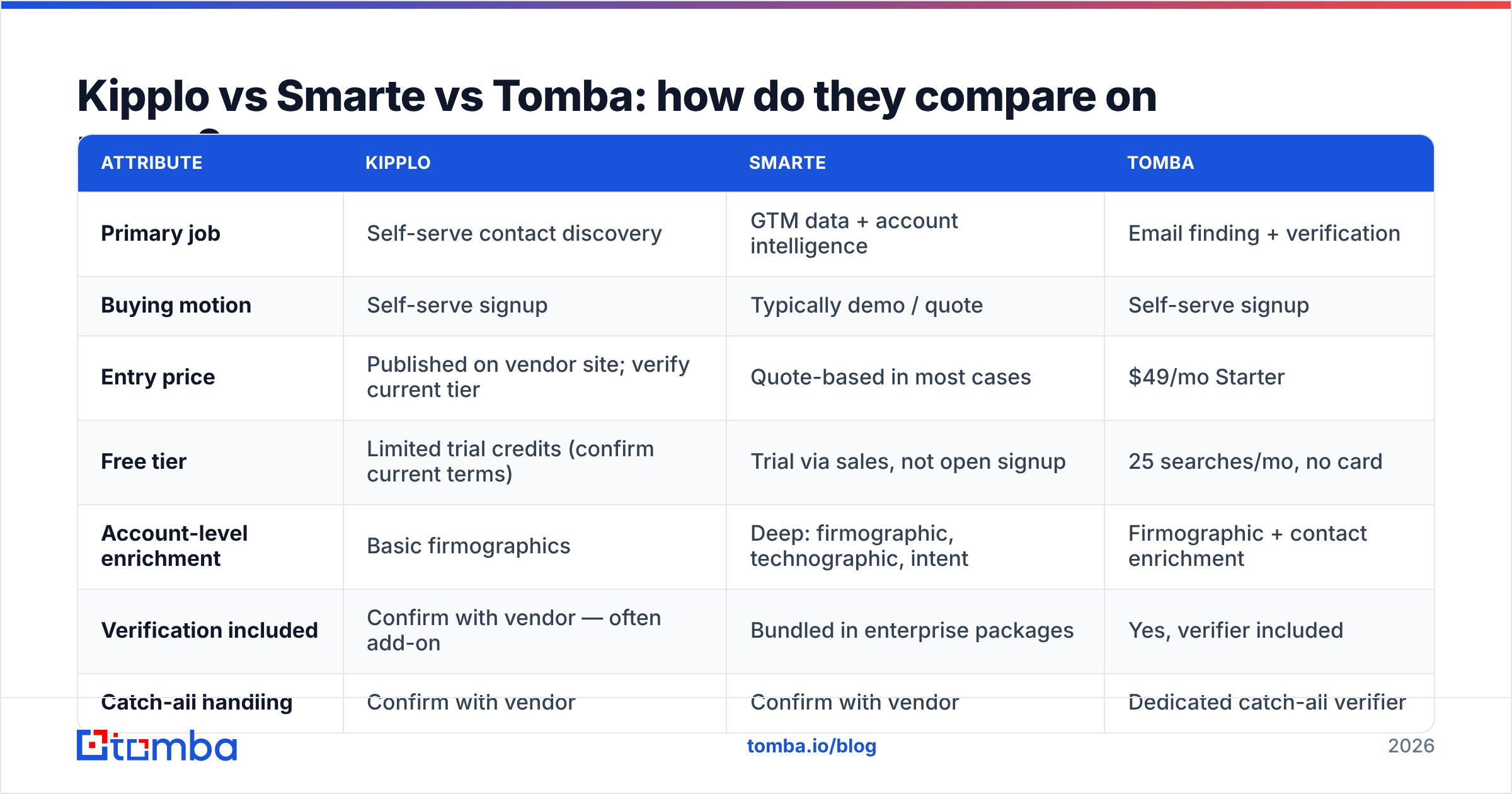
Kipplo vs Smarte vs Tomba: how do they compare on paper?#

| Attribute | Kipplo | Smarte | Tomba |
|---|---|---|---|
| Primary job | Self-serve contact discovery | GTM data + account intelligence | Email finding + verification |
| Buying motion | Self-serve signup | Typically demo / quote | Self-serve signup |
| Entry price | Published on vendor site; verify current tier | Quote-based in most cases | $49/mo Starter |
| Free tier | Limited trial credits (confirm current terms) | Trial via sales, not open signup | 25 searches/mo, no card |
| Account-level enrichment | Basic firmographics | Deep: firmographic, technographic, intent | Firmographic + contact enrichment |
| Verification included | Confirm with vendor — often add-on | Bundled in enterprise packages | Yes, verifier included |
| Catch-all handling | Confirm with vendor | Confirm with vendor | Dedicated catch-all verifier |
| API access | Available on higher tiers | Enterprise tiers | All paid tiers, documented |
| Bulk CSV processing | Yes | Yes | Yes, bulk finder + verifier |
| Best fit | Small teams, agencies, fast starts | Mid-market/enterprise RevOps | Teams optimising cost per verified email |
Read that table as a map of shapes, not a scoreboard. Smarte is not "worse" because it is quote-based; enterprise RevOps teams frequently need exactly that — negotiated terms, security review, a named CSM, contractual data-provenance guarantees. Kipplo is not "worse" because it is lighter; a three-person agency running 400 emails a week does not need intent scoring and will never use it.
The failure mode is buying the wrong shape: a two-person startup signing an enterprise data contract it cannot consume, or a 40-rep sales org trying to run territory planning off CSV exports.
What about pricing and hidden costs?#
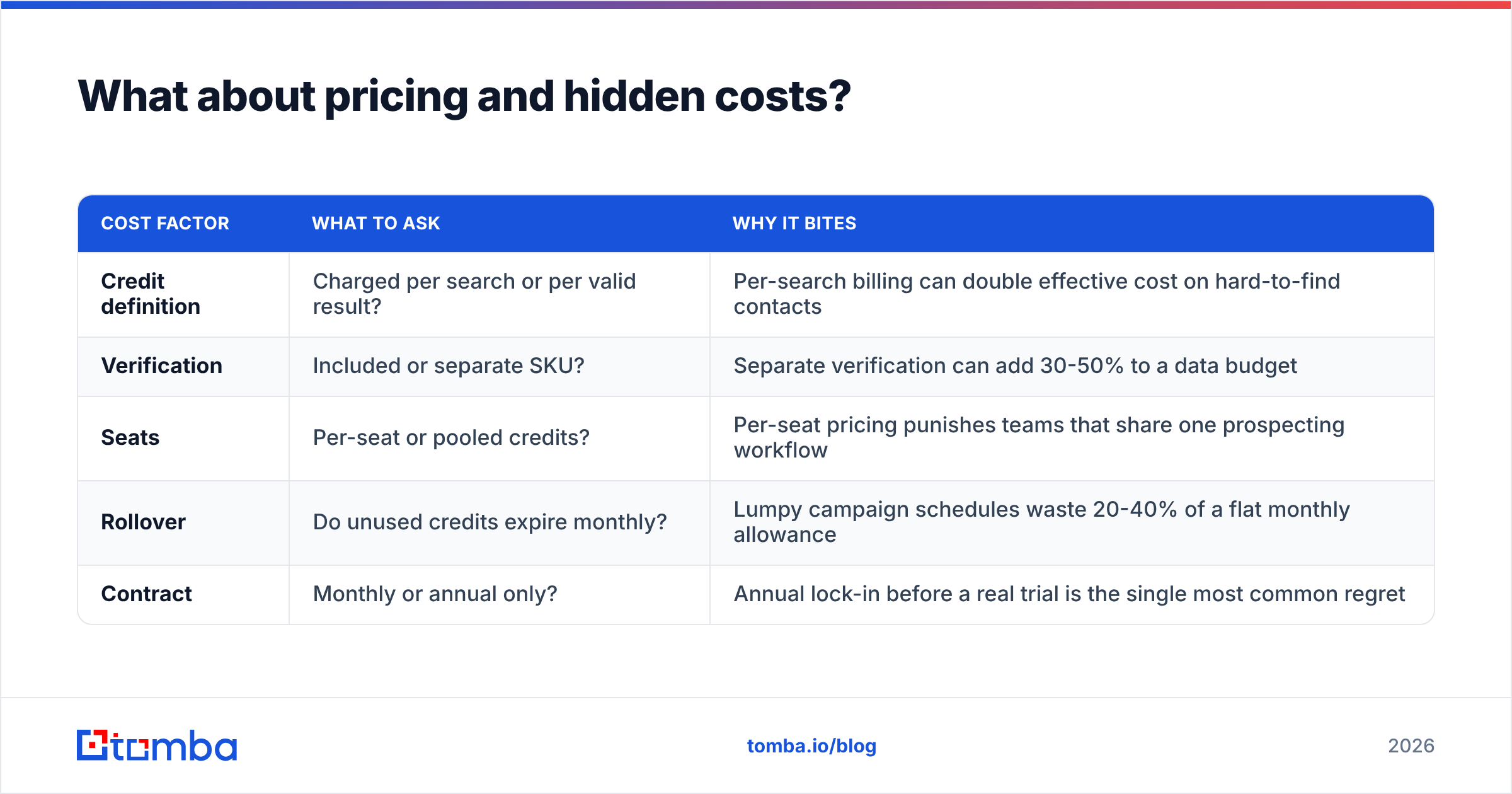
The sticker price is rarely the real price. Four line items decide your actual spend:
| Cost factor | What to ask | Why it bites |
|---|---|---|
| Credit definition | Charged per search or per valid result? | Per-search billing can double effective cost on hard-to-find contacts |
| Verification | Included or separate SKU? | Separate verification can add 30-50% to a data budget |
| Seats | Per-seat or pooled credits? | Per-seat pricing punishes teams that share one prospecting workflow |
| Rollover | Do unused credits expire monthly? | Lumpy campaign schedules waste 20-40% of a flat monthly allowance |
| Contract | Monthly or annual only? | Annual lock-in before a real trial is the single most common regret |
For reference on the third column of the earlier table: Tomba pricing runs a free tier at 25 searches per month, Starter at $49/mo, Growth at $99/mo, Pro at $249/mo, and custom Enterprise. Verification sits alongside the finder rather than behind a separate contract, which is the specific line item that most often surprises teams comparing quote-based platforms.
If you want to check the broader market before committing, Capterra's sales intelligence category lists pricing models side by side and is updated more often than most vendor comparison pages.

Is compliance a real differentiator here?#
Yes, and it is the dimension buyers under-weight most.
Any vendor selling B2B contact data in Europe needs a defensible legal basis for processing, a working data-subject request process and clear documentation of where records come from. Under the GDPR, "we bought it from a broker" is not a complete answer, and your legal team will eventually ask.
Three questions to put in writing to both Kipplo and Smarte:
- Provenance: where does each record originate — public web, contributed CRM data, partner networks, or purchased lists? Tools that publish their data sources make this easy; tools that deflect should worry you.
- Deletion: what is the process and SLA when a contact requests removal, and does it propagate to already-exported data?
- Suppression: can you upload a do-not-contact list that the platform enforces at export time?
Enterprise platforms like Smarte typically have mature answers here because their buyers demand them during security review. Lighter self-serve tools vary widely. This is not a "big vendor good, small vendor bad" rule — it is a "get it in writing" rule.
Which should you choose?#
Match the tool to the job, in this order:
- You need contacts this week, budget under $100/mo, no procurement process. Kipplo's self-serve motion fits. So does a finder-plus-verifier stack. Skip anything quote-based.
- You have a RevOps function, a CRM with 50k+ accounts, and territory planning depends on firmographic and intent filters. Smarte's account-level depth is the right shape, and the sales-assisted motion buys you negotiated terms and support.
- Your bottleneck is specifically "find this person's email and confirm it is deliverable." You do not need a GTM intelligence platform; you need a precise email finder and a real email verifier in the same workflow, ideally with an API so it runs without human clicking.
- You are running high-volume outbound and bounce rate is hurting sender reputation. Verification quality outranks database size. Test catch-all handling explicitly before you commit.
- You genuinely cannot tell from the outside. Run the bake-off. Same 100 rows, three tools, one week, compare usable contacts per dollar. It costs a day and saves a year of contract regret.
A practical middle path that most teams miss: you do not have to buy one platform for everything. Use the account-intelligence platform for targeting and account selection, then run the resulting contact list through a dedicated finder and verifier before it touches your sequencer. Splitting the job usually costs less than buying one vendor's premium tier to cover both, and it isolates the part of the pipeline where accuracy compounds — deliverability.
How should you run the test?#
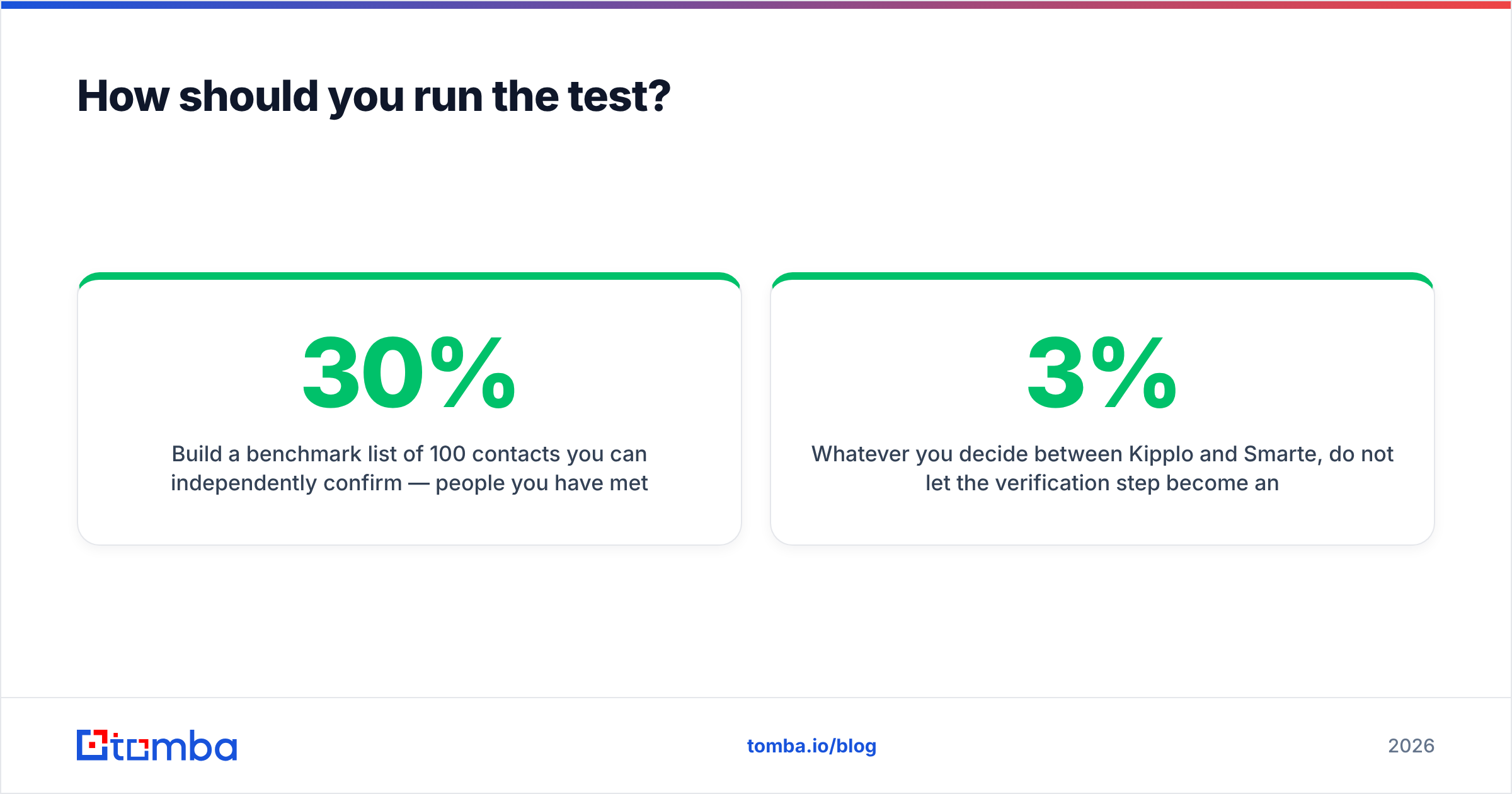
Build a benchmark list of 100 contacts you can independently confirm — people you have met, customers, contacts already in your CRM with confirmed emails. Include a deliberate mix: 30% enterprise, 30% mid-market, 20% SMB, 20% non-US. Most tools look excellent on US enterprise and fall apart on 40-person companies in Portugal.
Then measure four columns per vendor: match rate, confirmed-correct rate against your known-good data, catch-all share, and credits consumed. Send a small warm-up batch through your ESP and record actual bounces. Use a bulk email finder workflow so the test is one upload rather than 100 manual searches, and keep the raw CSVs — they become your renewal negotiation leverage twelve months later.
Whatever you decide between Kipplo and Smarte, do not let the verification step become an afterthought. Bounce rates above 3% damage sender reputation in ways that take weeks to repair, and no amount of database breadth compensates for landing in spam.
Ready to benchmark? Run your test list through the Tomba Email Finder alongside whichever platform you are evaluating. The free tier gives you 25 searches per month with no card required — enough to see your real match rate and bounce rate before anyone asks you to sign a contract.
Related guides#
// get started
Find, verify and enrich your first contacts today
Start on the free plan with 25 searches a month, then scale when your team is ready.
Free plan · No credit card required · GDPR & CCPA
// about the author