Kipplo vs Sparklane: Which B2B Prospecting Tool Wins in 2026?
Kipplo and Sparklane both promise better B2B leads, but they solve different problems at very different price points. Here is an honest breakdown of data coverage, pricing transparency, GDPR fit, and when a cheaper contact-data layer beats both.
TL;DR
- Sparklane is the more established platform: an AI-driven lead generation and predictive scoring suite built around European (heavily French) company data, sold enterprise-style with quote-based pricing.
- Kipplo is the lighter, newer, self-serve-leaning option. Public documentation is thin, so treat any spec you read — here or anywhere — as something to confirm on a demo call before you sign.
- Neither publishes transparent per-seat pricing, which is the single biggest practical difference between these two and commodity contact-data tools.
- If your bottleneck is scoring and prioritising accounts you already know about, Sparklane is the stronger fit. If it is finding and verifying reachable contacts at volume, a dedicated data layer costs a fraction of either.
- Most teams end up running a hybrid: an intent/scoring platform for account selection, plus a cheap, accurate email finder for the contact layer underneath it.
What are Kipplo and Sparklane, exactly?#
They get compared because they land in the same buying conversation — "we need better B2B leads" — but they are not the same category of product.
Sparklane (sparklane-group.com) is a sales intelligence and predictive lead generation platform with strong roots in the French and wider European market. Its pitch is not "here is a database, go search it." It is "here are the accounts most likely to buy from you next quarter, ranked, with the business signals that justify the ranking." Think company data, business signals (funding, hiring, legal filings, news), and a scoring model layered on top.
Kipplo positions itself further down the stack: a leaner B2B prospecting and contact-data tool aimed at teams who want to build lists and reach people without an enterprise procurement cycle. Being honest about the limits of public information here matters — Kipplo publishes far less detail than Sparklane does, has a much thinner review footprint on sites like G2, and does not advertise a standard price card. If a vendor's specs are not public, the only responsible thing a comparison post can do is tell you to verify them directly rather than invent numbers.
That asymmetry is itself a finding. One of these tools has a decade of public case studies, analyst mentions, and reviews behind it. The other is an early-stage bet.
How does Sparklane actually work?#
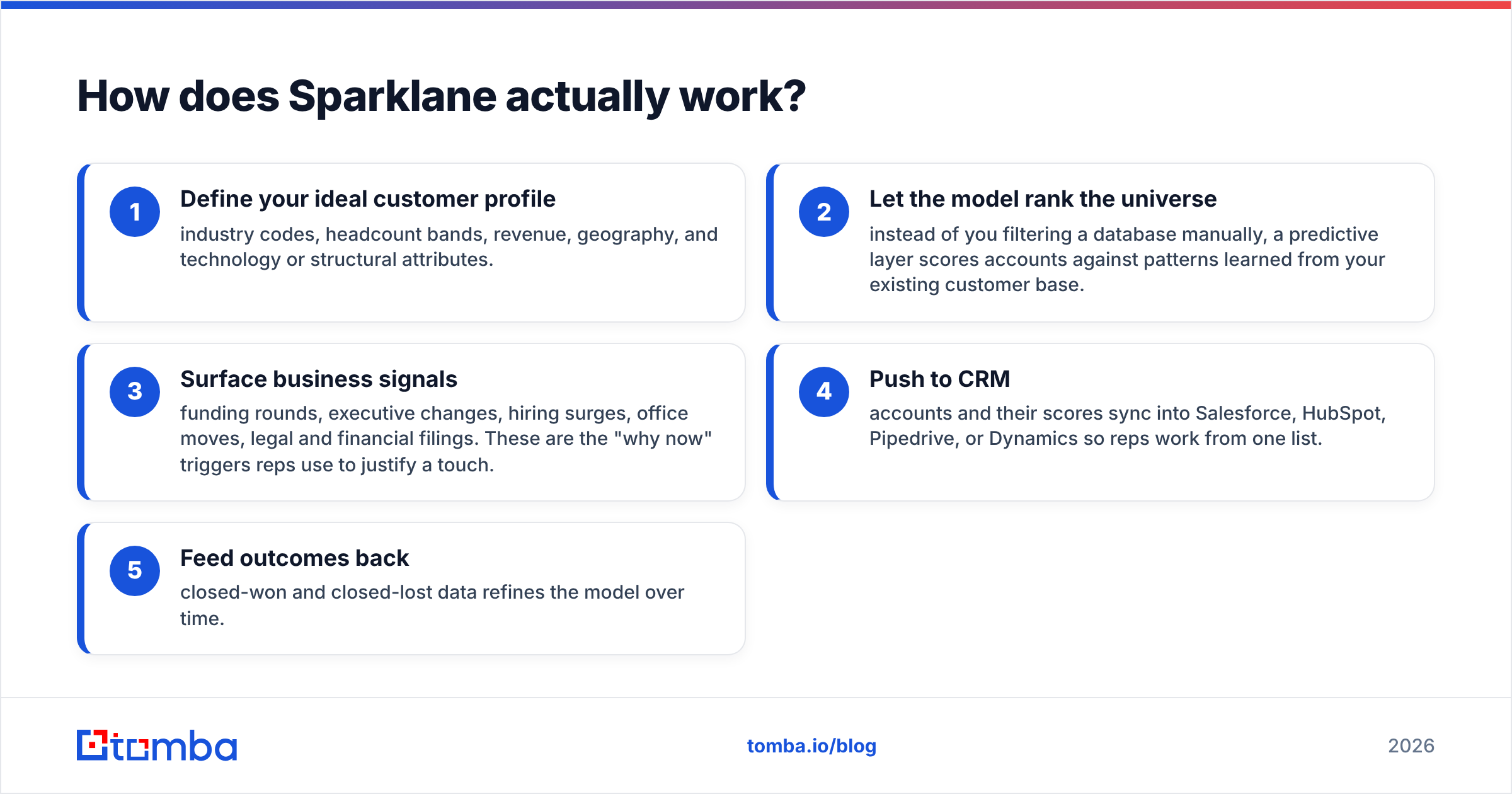
Sparklane's workflow runs roughly in this order:
- Define your ideal customer profile — industry codes, headcount bands, revenue, geography, and technology or structural attributes.
- Let the model rank the universe — instead of you filtering a database manually, a predictive layer scores accounts against patterns learned from your existing customer base.
- Surface business signals — funding rounds, executive changes, hiring surges, office moves, legal and financial filings. These are the "why now" triggers reps use to justify a touch.
- Push to CRM — accounts and their scores sync into Salesforce, HubSpot, Pipedrive, or Dynamics so reps work from one list.
- Feed outcomes back — closed-won and closed-lost data refines the model over time.
The strength is account selection. If you sell into the French mid-market and your reps waste hours deciding who to call, Sparklane removes that decision. The weakness is the same as most predictive platforms: the model is only as good as the CRM history you feed it, and contact-level data (direct emails, mobile numbers) is usually thinner than the company-level data.

How does Kipplo work, and what do we actually know?#
Kipplo's model is closer to conventional self-serve prospecting: search for companies and people, build a list, export or push it into your sequencing tool. The appeal is speed and a lower entry cost than an enterprise scoring platform.
What you should verify on a call, because it is not reliably documented publicly:
- Database size and refresh cadence. Ask for record counts by region, not globally. A "200M contacts" headline means nothing if only 3M sit in your target country.
- Where the data comes from. Scraped, contributed, licensed, or generated? This determines both accuracy and your legal exposure.
- Verification method. Is a returned email SMTP-verified at the moment of export, or served from a cache that could be a year old?
- Credit rollover and overage pricing. The two clauses that quietly double the real cost of most data contracts.
- Deletion and opt-out handling. Under GDPR, you inherit responsibility for the personal data you process, regardless of who sold it to you.
If a vendor cannot answer those five in writing, that tells you more than any feature grid will.
Kipplo vs Sparklane: how do they compare feature by feature?#
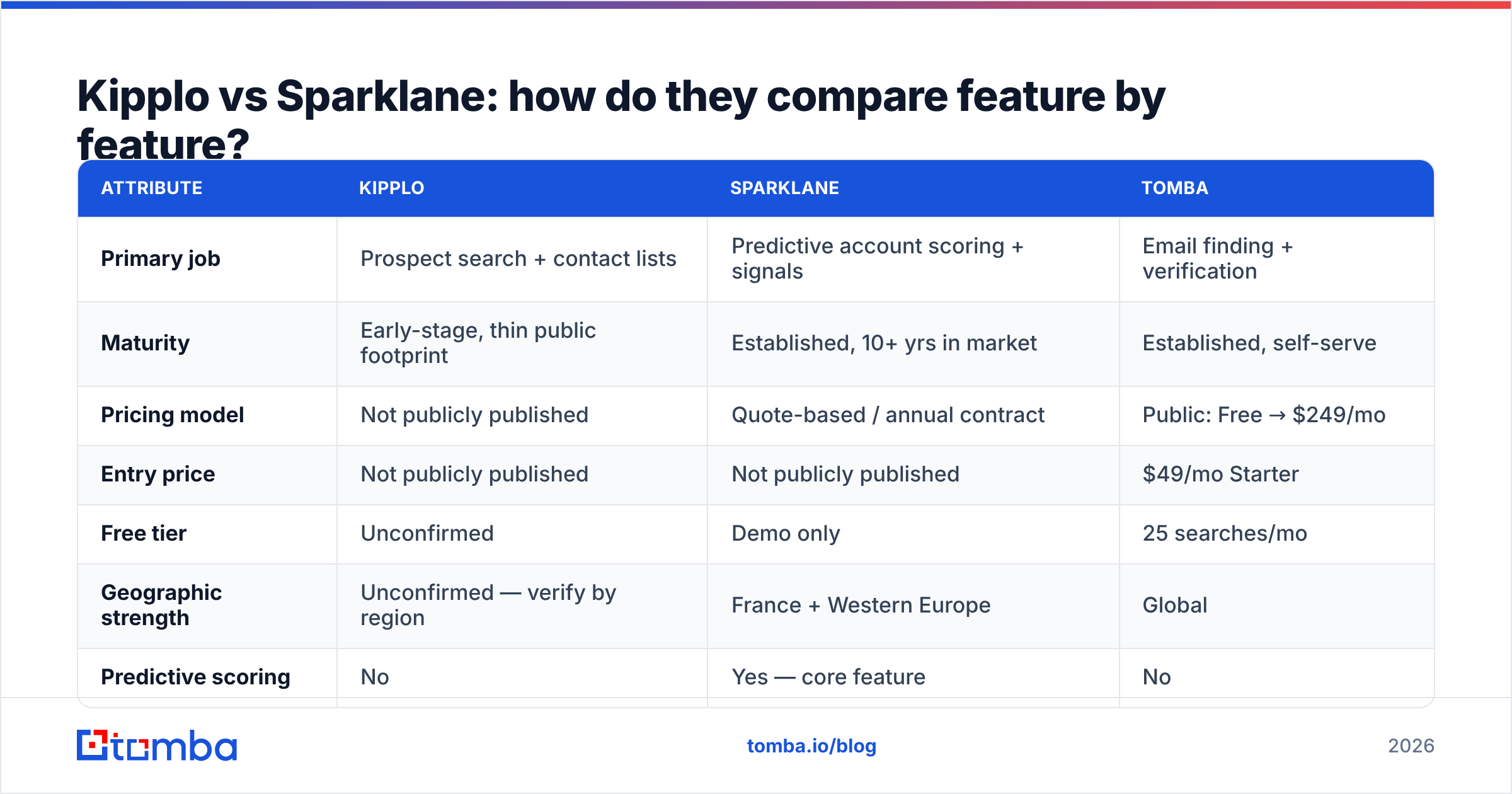
Here is the practical comparison. Where a value is not publicly published, it says so — because "not published" is honest information, and a fabricated number is not.
| Attribute | Kipplo | Sparklane | Tomba |
|---|---|---|---|
| Primary job | Prospect search + contact lists | Predictive account scoring + signals | Email finding + verification |
| Maturity | Early-stage, thin public footprint | Established, 10+ yrs in market | Established, self-serve |
| Pricing model | Not publicly published | Quote-based / annual contract | Public: Free → $249/mo |
| Entry price | Not publicly published | Not publicly published | $49/mo Starter |
| Free tier | Unconfirmed | Demo only | 25 searches/mo |
| Geographic strength | Unconfirmed — verify by region | France + Western Europe | Global |
| Predictive scoring | No | Yes — core feature | No |
| Business signals (funding, hiring) | Limited | Yes — core feature | No |
| Email verification | Unconfirmed | Not the core product | Yes — dedicated verifier |
| Catch-all handling | Unconfirmed | Not applicable | Dedicated catch-all verifier |
| API access | Unconfirmed | Enterprise tiers | Yes, on all paid plans |
| Time to first list | Same day (self-serve) | 2-6 weeks (sales cycle) | Minutes |
| Best for | SMB teams wanting a cheap list tool | Mid-market/enterprise EU sales orgs | Anyone who needs reachable emails |
The pattern is clear once you lay it out: these products overlap in marketing language and barely overlap in function.
Which one has better data coverage and accuracy?#
Sparklane wins on company-level depth in Europe. Its data model is built on official registries and structured business filings, which in France and neighbouring markets are unusually rich — legal status, financials, filings, corporate structure. For account selection in that footprint, it is genuinely hard to beat with a generic global database.
Kipplo's coverage is the open question. Without published, third-party-verified coverage numbers, the only defensible test is your own: take 200 accounts you already know — ideally ones where you have verified contact details — and run them through a trial. Measure three things:
- Match rate: what percentage of your 200 returned any contact at all?
- Accuracy: of those, how many emails were correct? Bounce-test them; do not trust the vendor's own confidence score.
- Freshness: how many contacts had left the company? Spot-check 20 on LinkedIn.
Run the same 200 through any alternative you are considering. This single exercise settles more arguments than a month of feature-grid comparisons, and it costs you an afternoon.
One caveat worth naming: predictive platforms and prospecting databases both tend to be weakest exactly where you need them strongest — direct contact details for senior decision-makers at small companies. That gap is why a standalone verification layer keeps showing up in stacks that already pay for a sales intelligence suite. Running exports through an email verifier before they hit your sequencer is a five-minute step that protects your sending domain from the 8-15% of stale records almost every database carries.
How does pricing compare, and what will you really pay?#
Neither vendor publishes a price card, which puts both in the "book a demo" bucket. That is not automatically a red flag — enterprise data is genuinely priced per use case — but it has real consequences:
- You cannot budget before a sales cycle. Expect two to six weeks from first call to signature with Sparklane; likely faster with Kipplo, but still a conversation rather than a checkout page.
- Annual commitments are the default. Monthly billing on enterprise data platforms is rare and usually carries a premium.
- Seat-based pricing scales badly. If you have eight reps but only two people who actually build lists, per-seat pricing punishes you for the other six.
- Credits expire. Ask directly whether unused credits roll over. Most do not.
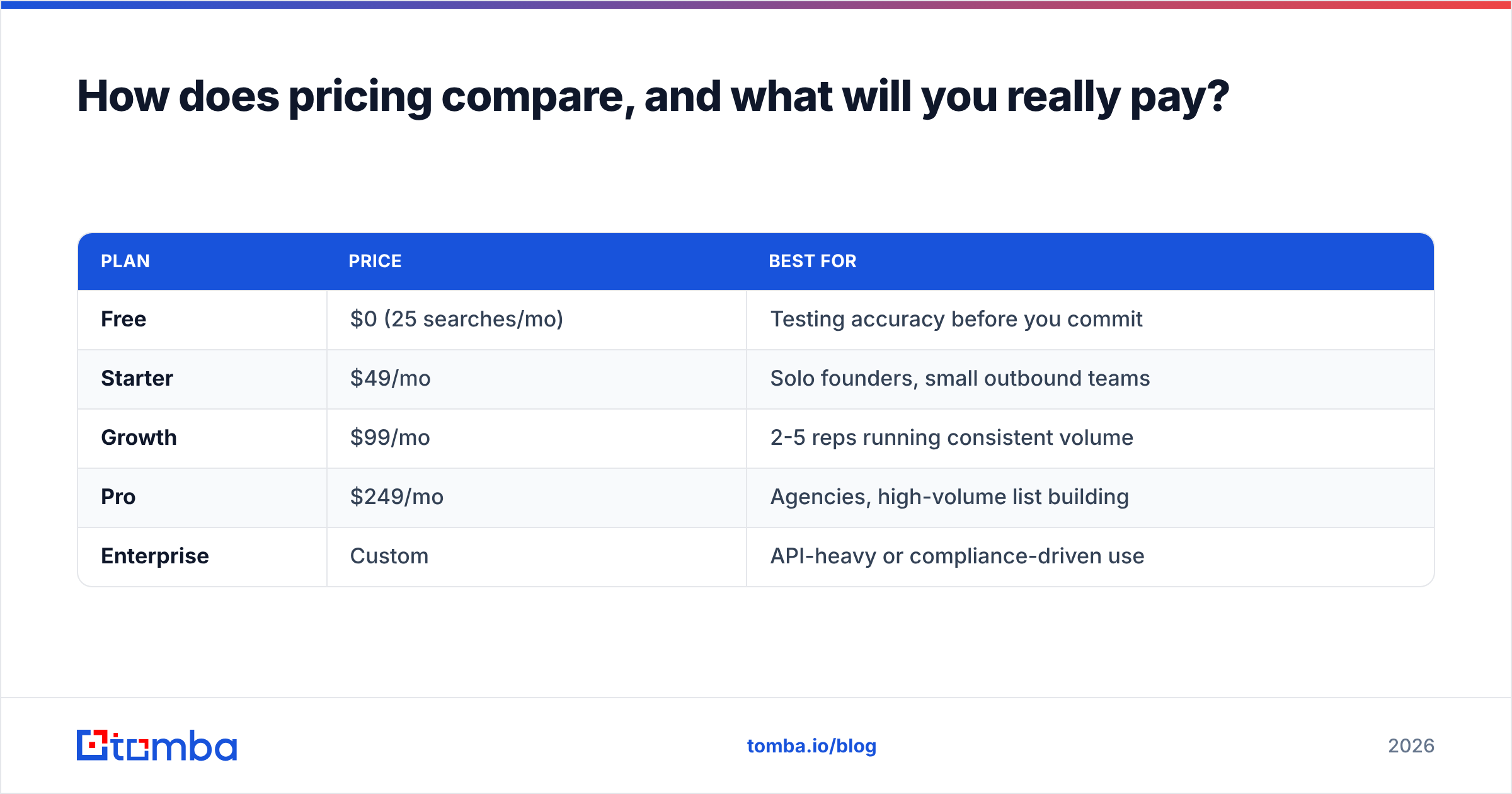
For reference, here is what transparent pricing looks like in the contact-data layer:
| Plan | Price | Best for |
|---|---|---|
| Free | $0 (25 searches/mo) | Testing accuracy before you commit |
| Starter | $49/mo | Solo founders, small outbound teams |
| Growth | $99/mo | 2-5 reps running consistent volume |
| Pro | $249/mo | Agencies, high-volume list building |
| Enterprise | Custom | API-heavy or compliance-driven use |
Full Tomba pricing is public, which means you can model your cost per verified contact before you talk to anyone. That is the honest structural difference between these product categories — not that one is "better value," but that one lets you calculate value in advance.

Who should choose Sparklane?#
Pick Sparklane if most of these are true:
- Your market is France or Western Europe. This is where its registry-grade company data is strongest, and where a global database will feel shallow by comparison.
- You have CRM history worth modelling. Predictive scoring needs a few hundred closed deals minimum to produce rankings better than a good analyst with filters.
- Account selection is your bottleneck, not contact discovery. If reps already know who to call and just cannot reach them, scoring solves the wrong problem.
- You can absorb an enterprise sales cycle and an annual contract. Both time and budget.
- Compliance is a board-level concern. European-domiciled vendors with registry-sourced data generally make procurement and legal reviews easier.
Who should choose Kipplo?#
Consider Kipplo if:
- You want a lower-friction alternative to an enterprise platform and are comfortable being an early customer.
- You value responsiveness over roadmap maturity. Smaller vendors ship faster and actually answer support tickets — a real advantage that rarely appears in feature grids.
- You are willing to run the 200-account test and make the call on evidence rather than marketing.
- Your use case is list building, not account intelligence. Do not buy a prospecting tool expecting predictive scoring.
Be clear-eyed about the trade-off: less public validation means more diligence on you. Ask for three reference customers in your segment and actually call them.
Where do both fall short?#
Both tools share a blind spot, and it is the same one almost every "all-in-one" platform has: the last mile of contact data.
A perfectly scored account is worthless if the email you have for its VP of Operations bounces. And bounces are not just a lost touch — they damage sender reputation, which quietly suppresses deliverability for every other email you send that month. A 12% bounce rate on a 2,000-contact campaign is not a 12% loss; it is the start of a domain reputation problem that takes weeks to unwind.
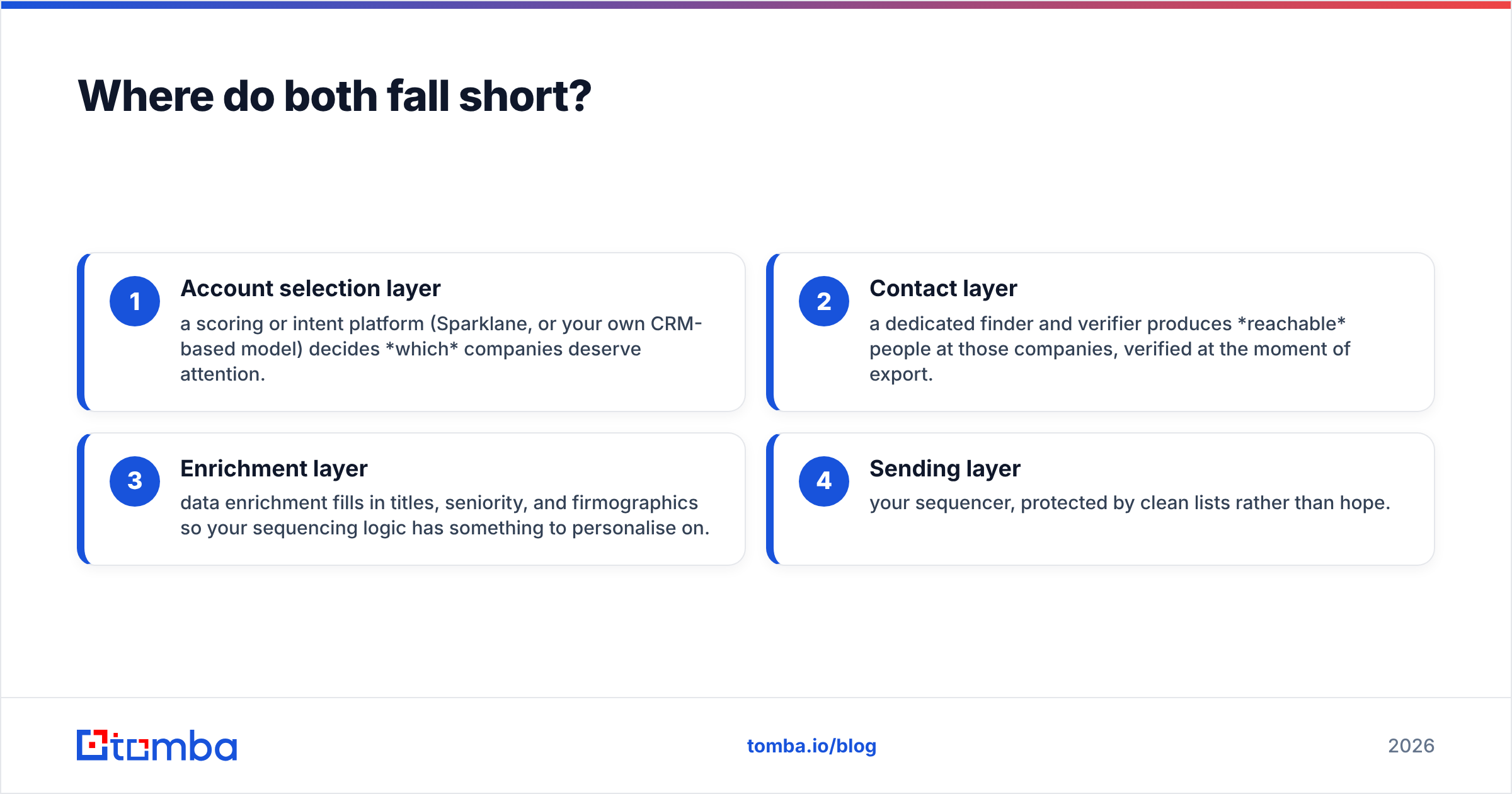
This is why the strongest stacks separate the two jobs:
- Account selection layer — a scoring or intent platform (Sparklane, or your own CRM-based model) decides which companies deserve attention.
- Contact layer — a dedicated finder and verifier produces reachable people at those companies, verified at the moment of export.
- Enrichment layer — data enrichment fills in titles, seniority, and firmographics so your sequencing logic has something to personalise on.
- Sending layer — your sequencer, protected by clean lists rather than hope.
Buying one vendor for all four sounds efficient and almost never is. The contact layer is where accuracy compounds, and it is also the cheapest layer to get right.
Is there a cheaper third option?#
Yes — if your actual problem is contact data rather than account scoring.
Tomba sits deliberately in that narrow lane: find the email, verify it, hand it off. A domain search returns every discoverable address at a company with the pattern and confidence score attached. The verifier checks syntax, MX records, and SMTP acceptance, and a separate catch-all verifier handles the domains that accept everything and tell you nothing. The Tomba API means none of this has to be manual once you have tested it.
It does not score accounts. It does not tell you who raised a Series B last week. If you need those things, buy a platform that does them — and layer the contact data underneath, rather than paying enterprise rates for a mediocre version of it.
For teams also comparing against other vendors in this space, note that credible options exist at both ends: BookYourData and similar list providers serve buyers who want pay-as-you-go volume without a subscription, which is a legitimately different buying motion from either Kipplo or Sparklane.
What is the verdict on Kipplo vs Sparklane?#
Sparklane is the safer institutional choice for European mid-market and enterprise sales organisations that need account prioritisation and can justify an annual contract. It has the track record, the data depth in its home markets, and the CRM integrations to be a system of record.
Kipplo is the higher-variance choice: potentially cheaper and faster to adopt, but with materially less public evidence behind it. Run the 200-account test, get references, and get the coverage numbers for your specific region in writing.
And for either path, budget separately for the contact layer. The most common mistake in this comparison is assuming the winner also solves email discovery and verification. Neither does it well enough to skip a dedicated tool.
Start with the layer that breaks first. Before you commit to a multi-month platform evaluation, find out whether your reachability problem is actually a targeting problem. Run 25 free searches through the Tomba Email Finder, bounce-test the results against your current provider, and see how much of your pipeline gap closes with nothing more than accurate contact data. If it closes, you just saved yourself an enterprise contract. If it does not, you now know exactly what to demo for.
Related guides#
// get started
Find, verify and enrich your first contacts today
Start on the free plan with 25 searches a month, then scale when your team is ready.
Free plan · No credit card required · GDPR & CCPA
// about the author