Kipplo vs Stirista: Which B2B Data Platform Wins in 2026?
One is a self-serve prospecting tool priced per credit. The other is an enterprise identity-graph vendor that quotes you on a call. Here is how Kipplo and Stirista actually differ, and which one your outbound team should buy.
Kipplo vs Stirista is not a fair fight. It is a routing question. Do you need contacts to email? Or audiences to run ads against? Pick the lane first. The tool follows.
TL;DR
- Kipplo vs Stirista is a false matchup. Kipplo sells self-serve prospecting data. Stirista sells identity data and ad audiences.
- Need a few thousand verified B2B contacts a month for cold email? Stirista is the wrong buy. You would wait weeks for data you could put on a card.
- Need to match offline records to hashed IDs, push audiences into CTV, or add fields to a consumer file? Kipplo cannot do that.
- Kipplo shares little public detail as of 2026. Treat any coverage number in a deck as a claim, not a fact. Test it yourself.
- For most outbound teams, the honest answer is neither. Buy a focused finder and verifier (Tomba starts at $49/mo). Add a big data partner later, once ad audiences become a real line item.
Kipplo vs Stirista: what are these two tools?#
They solve different problems. Both get filed under "B2B data."
Stirista is an older identity and audience data firm. Its core asset is an identity graph. Think of it as a giant address book. It ties one person to many keys: a work email, a home address, a device, a cookie. Stirista uses that map four ways: to build ad audiences, to add fields to your records, to match identities, and to push lists into TV, display, and social. Read their own pitch at stirista.com. The buyer is a marketing ops or demand-gen lead. The sale starts with a call and ends with a contract.
Kipplo is the newer, lighter option. It is a self-serve B2B contact tool. You search for prospects, pull work emails and phone numbers, and export a list. Nobody calls you. The shape is common in this market: filters, credits, CSV export, a Chrome plugin, an API.
One caveat on the Kipplo vs Stirista matchup. Kipplo leaves a thin public trail. There are few outside reviews. There is no widely cited coverage audit. Prices move. That is not an accusation, since every vendor starts somewhere. But it should change how you buy. Sample-test first. Do not accept a coverage claim you cannot repeat on your own list.
New to these terms? The B2B glossary covers identity resolution, data append, and the rest of the words these vendors use.
Kipplo vs Stirista: how do they compare head-to-head?#
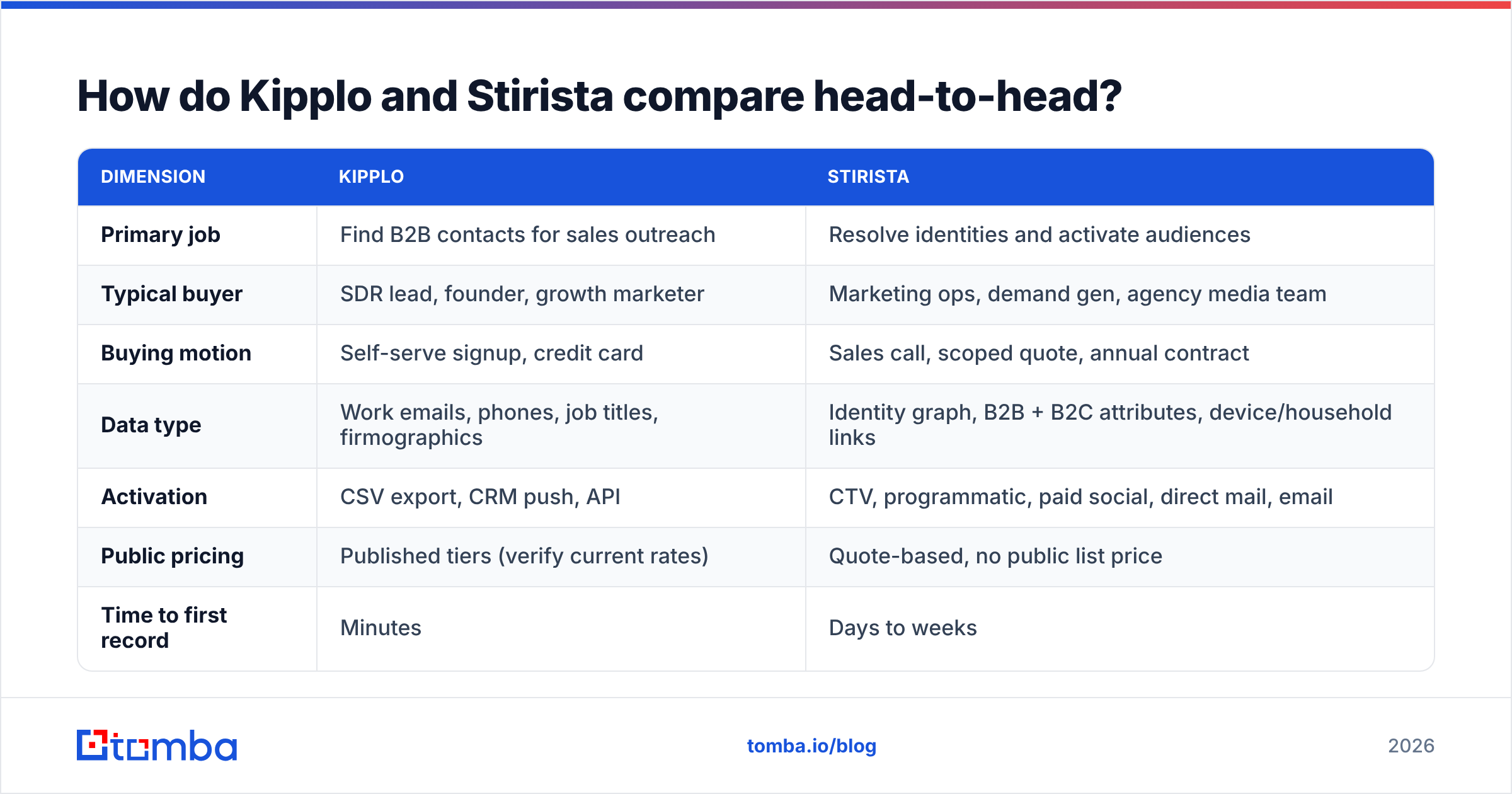
| Dimension | Kipplo | Stirista |
|---|---|---|
| Primary job | Find B2B contacts for sales outreach | Resolve identities and activate audiences |
| Typical buyer | SDR lead, founder, growth marketer | Marketing ops, demand gen, agency media team |
| Buying motion | Self-serve signup, credit card | Sales call, scoped quote, annual contract |
| Data type | Work emails, phones, job titles, firmographics | Identity graph, B2B + B2C attributes, device/household links |
| Activation | CSV export, CRM push, API | CTV, programmatic, paid social, direct mail, email |
| Public pricing | Published tiers (verify current rates) | Quote-based, no public list price |
| Time to first record | Minutes | Days to weeks |
| Compliance surface | Standard B2B contact data | Consumer data — GDPR/CPRA scrutiny is much higher |
| Best for | Outbound lists under ~50K/year | Multi-channel campaigns needing one identity spine |
Read that table as a map, not a scoreboard. The winner of Kipplo vs Stirista depends on your next quarter. Are you sending 8,000 cold emails? Or reaching the same 200,000 accounts on five channels without counting them twice?
Kipplo vs Stirista: which one has better data coverage?#
Coverage is the wrong question on its own. Split it into five. Each vendor wins a different one.
- Work email coverage. Kipplo's home turf. It finds
first.last@company.comfor a named person at a named firm. Stirista supplies work emails too, but it wins on breadth, not precision. - Consumer and household fields. Stirista wins here, and it is not close. Age bands, income bands, buying signals, offline-to-online links. Kipplo does not compete here, and does not claim to.
- Exact identity matching. Upload a 500K-row CRM file, want hashed emails or device IDs back? That is an identity graph job. Prospecting tools return records, not match rates.
- Depth outside the US. Both thin out past North America and Western Europe. Test APAC and LATAM before you sign. Most vendor numbers fall apart there.
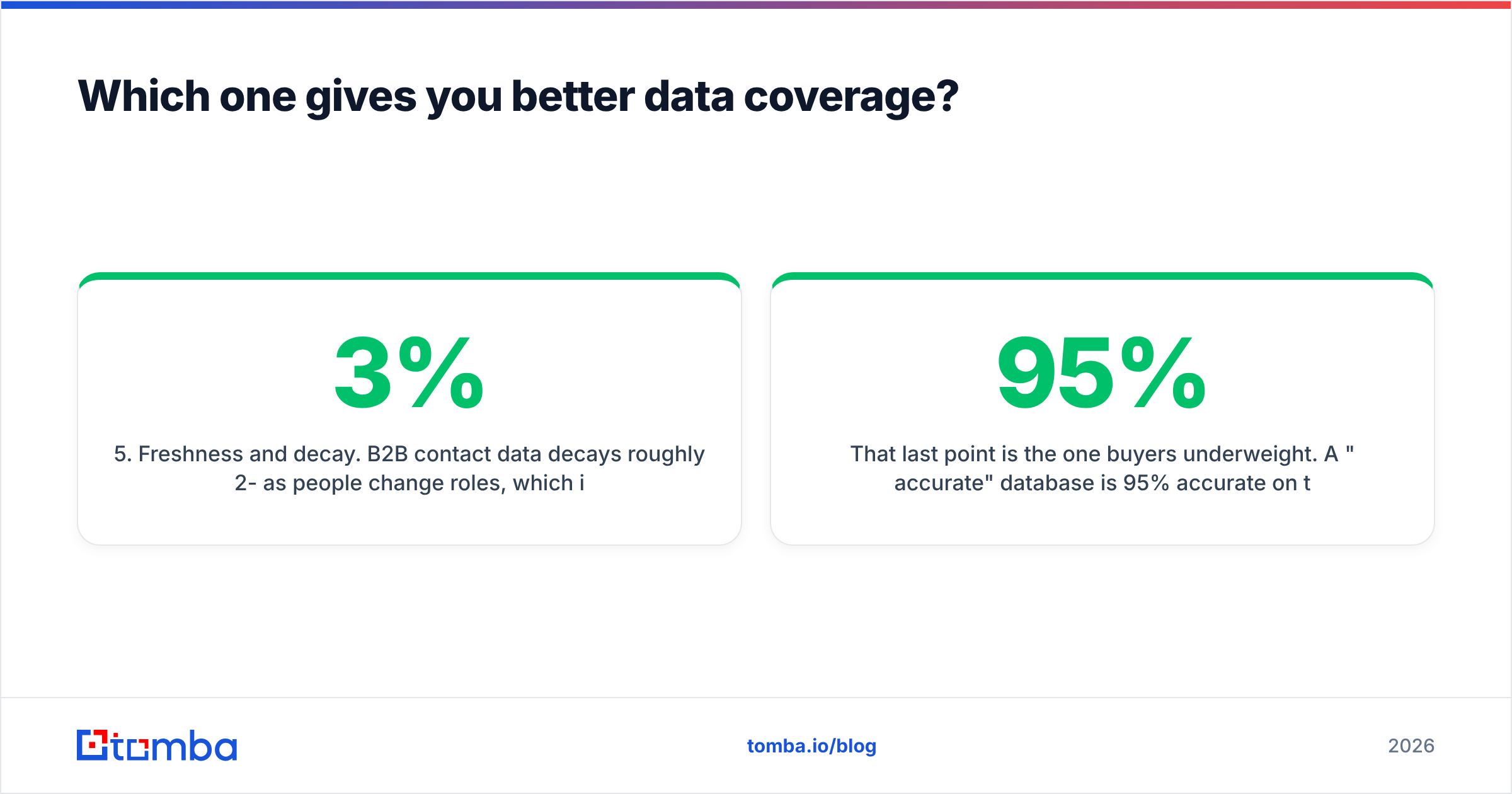
- Freshness. B2B contact data goes stale at roughly 2-3% a month, or 25-30% a year. You are buying a snapshot that is already aging.
That last point is the one buyers miss. A "95% accurate" list was 95% accurate the day it was built. What matters is whether you re-check it at send time. Run any bought list through an email verifier before the first send. It costs less than the damage from a 12% bounce rate. It is also the highest-return step in the chain, no matter which vendor you pick.
Kipplo vs Stirista pricing: what does each one cost?#
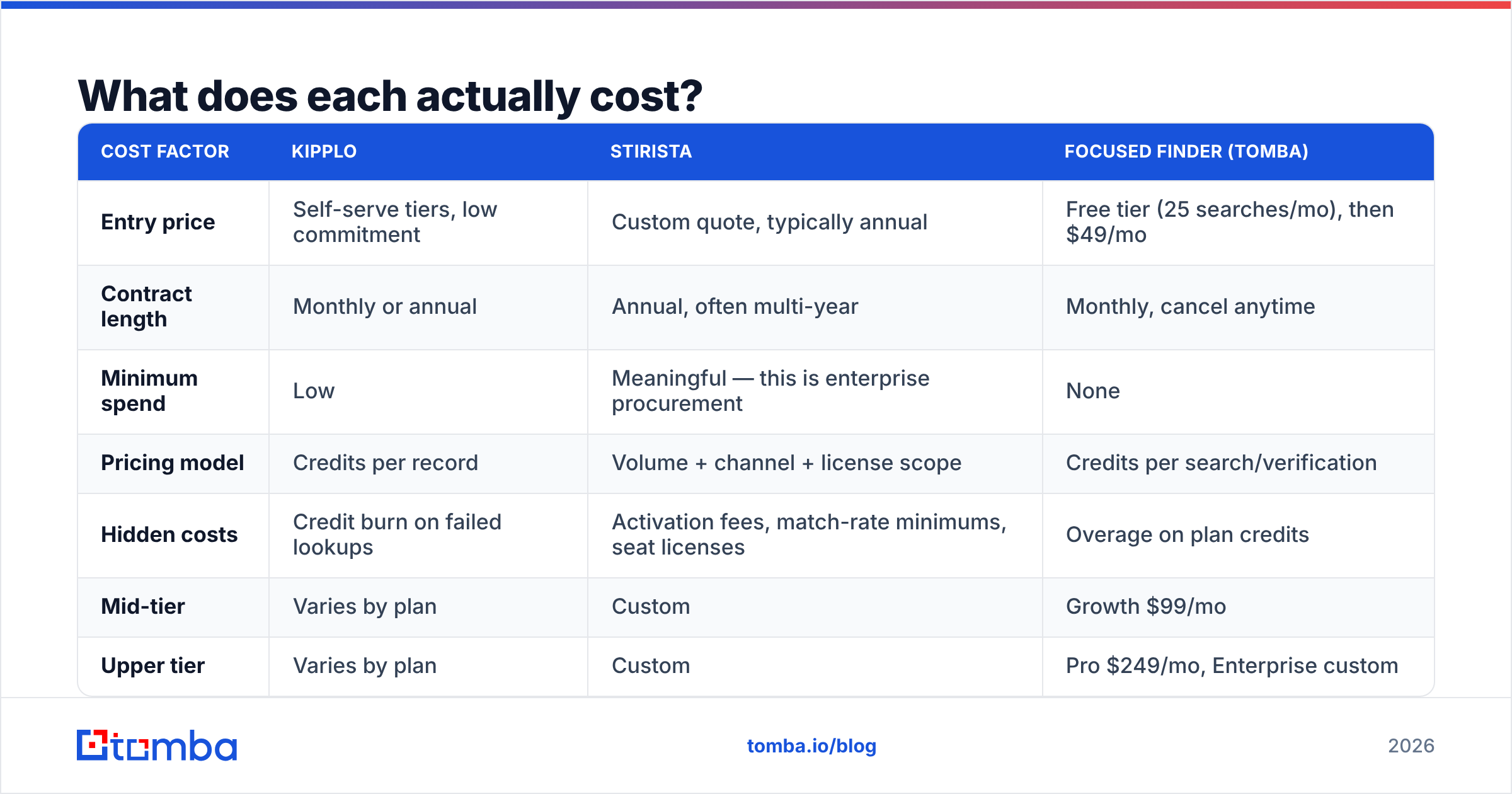
| Cost factor | Kipplo | Stirista | Focused finder (Tomba) |
|---|---|---|---|
| Entry price | Self-serve tiers, low commitment | Custom quote, typically annual | Free tier (25 searches/mo), then $49/mo |
| Contract length | Monthly or annual | Annual, often multi-year | Monthly, cancel anytime |
| Minimum spend | Low | Meaningful — this is enterprise procurement | None |
| Pricing model | Credits per record | Volume + channel + license scope | Credits per search/verification |
| Hidden costs | Credit burn on failed lookups | Activation fees, match-rate minimums, seat licenses | Overage on plan credits |
| Mid-tier | Varies by plan | Custom | Growth $99/mo |
| Upper tier | Varies by plan | Custom | Pro $249/mo, Enterprise custom |
The shape of the bill matters more than any single number. Kipplo charges you per record. Stirista charges you for a relationship: scope, license terms, channel rights, match minimums. That second model is better when you run paid media at scale. You want the contract, the DPA, and a named account manager. It is worse when you are one SDR building a list this week.
A quick check on the math. Say your team needs 3,000 verified contacts a month. On the self-serve side, that is a two- or three-figure bill. Hand the same ask to an enterprise data vendor and you get a scoping call, a legal review, and a five-figure annual floor. Neither is wrong. They are priced for different buyers. Compare the self-serve end with Tomba pricing to sanity-check any quote that lands in your inbox.
Is Stirista overkill for a small outbound team?#
Yes. And that is not a knock on Stirista.
An identity graph costs a lot to build and keep fresh. You pay for it whether or not you use the parts that justify it. If your whole go-to-market is "SDRs send sequences from a list," you will use maybe 10% of it. The rest is dead weight on the invoice.
Signs you really do need the enterprise tier:
- You run paid media against your CRM, and match rates drive ROAS.
- You have offline touchpoints — events, direct mail, retail — that must line up with digital.
- You work in a regulated field and need proof of where the data came from, not a link to a terms page.
- Your audience is consumer, not just job-title B2B.
Fewer than two of those true? Buy the cheap thing. Revisit in a year.
Is Kipplo reliable enough for enterprise GTM?#
Run the test. Do not trust the deck.
Any newer prospecting vendor deserves the same three-step check, Kipplo included. Accuracy claims on marketing pages are close to meaningless across this whole category.
- Build a 200-row control list from your real ICP. Not a random sample. Mix company sizes, job levels, and at least two regions outside the US.
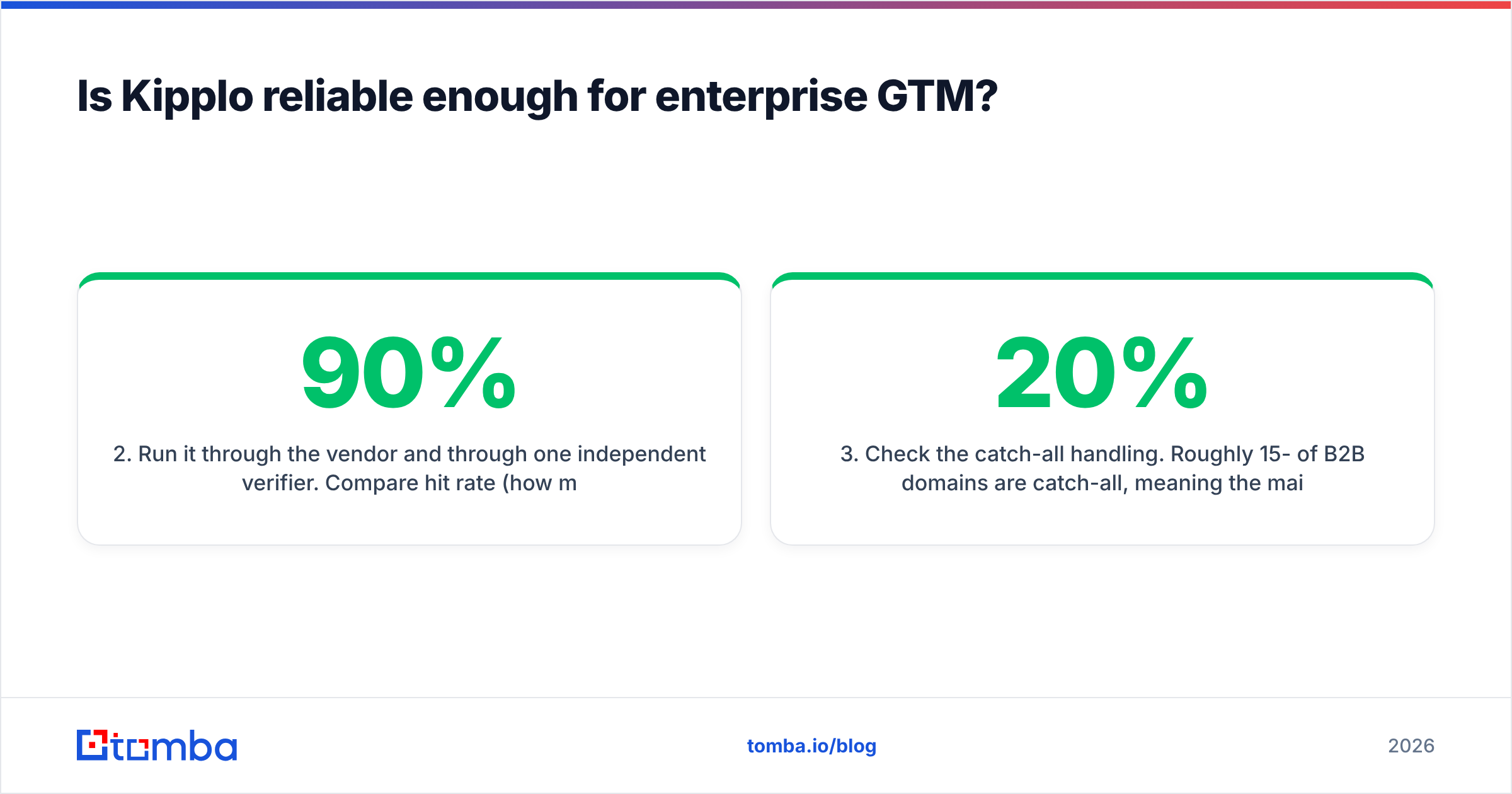
- Run it through the vendor and one outside verifier. Compare hit rate with valid rate. Hit rate is how many records come back. Valid rate is how many survive checking. A vendor at 90% hit and 70% valid is worse than one at 65% and 96%.
- Check how it handles catch-all domains. About 15-20% of B2B domains are catch-all. The mail server accepts everything, so a standard check tells you nothing. Vendors that mark these "valid" are padding their numbers. A catch-all verifier is the only way to get a real read.

Buyers skip step 3 all the time. Then they blame the sequencer when replies dry up. Mailbox providers judge sender reputation partly on bounces. A list padded with unknown catch-alls hurts the domain you send everything else from. That harm outlives the contract.
On vendor risk in general: check G2 and Capterra for outside reviews (g2.com is the usual first stop). Ask for a DPA before you sign. Confirm where the data came from. The data broker supply chain is murky by default. "We license from partners" is not a good enough answer in a regulated field.
Where does a dedicated email finder fit?#
In most stacks, under both of them.
Here is the pattern that works. Use a broad database to find people. Then use a focused finder and verifier for the last mile. Big databases answer "who are the 400 VPs of Engineering at Series B fintechs." They are weaker at "does Sarah Chen's work email still work today?" Those are two different jobs. One vendor rarely does both well.
That is where Tomba fits. The email finder turns a name plus a domain into a checked address. Domain search pulls every address it can find at a company. Data enrichment fills the gaps your CRM is missing after import. The free tier is 25 searches a month. Starter is $49/mo, Growth $99/mo, Pro $249/mo. That is small enough to run next to any larger contract, and cheap enough to use as an outside accuracy check.
It is worth naming the rest of the field too. BookYourData is a good pick if you want pay-as-you-go verified lists with no subscription. It competes on a different axis: you buy a list, not a lookup. If you think in lists rather than lookups, it may fit you better than either name in this comparison.
Kipplo vs Stirista: which should you pick in 2026?#
Pick Stirista if your problem is identity across channels. You activate audiences on CTV, display, and social. You need match rates against a first-party file. Or your data needs run into consumer fields. The contract overhead is real. It is the price of something self-serve tools cannot do.
Pick Kipplo if you want fast, low-commitment access to B2B contacts, and you are willing to check the data yourself. Run the 200-row test first. If the valid rate holds up on your ICP, the low friction is worth a lot.
Pick neither as your whole stack if your sales team is under 20 people. Buy a finder. Buy verification. Buy a sequencer. Skip the big data contract until ad audiences show up as a real line in your plan. Most teams that sign a large data deal in year one pay for coverage they never query.
In every case, verify at send time. Whatever you buy decays. The vendor does not control that. Your pre-send hygiene does.
Ready to test data quality yourself?#
Before you sign, run both vendors' output through an outside check. Start with the Tomba Email Finder. You get 25 free searches a month, and no card is needed. Run the same 200-contact control list you would use in a bake-off. You will see hit rate, valid rate, and catch-all flags side by side in minutes. That beats any accuracy claim on a pricing page. If the numbers hold, Starter at $49/mo covers most small outbound teams.
Related guides#
// get started
Find, verify and enrich your first contacts today
Start on the free plan with 25 searches a month, then scale when your team is ready.
Free plan · No credit card required · GDPR & CCPA
Get the Tomba newsletter
Product and data updates
// about the author