Kipplo vs Vainu (2026): Which B2B Data Tool Should You Pick?
Kipplo and Vainu both promise better B2B company data, but they solve different problems at very different price points. Here is the honest breakdown, plus where a dedicated email finder beats both.
Kipplo vs Vainu is a common search, but the two tools do different jobs. Vainu sells company intelligence. Kipplo sells fast, self-serve lists. This guide scores Kipplo vs Vainu on data coverage, price, and fit. It also shows where a cheap email finder beats both.
TL;DR
- Vainu is a company-intelligence platform, not a contact database. It is strong on firm data and buying signals. Nordic and European registry data is unusually deep.
- Kipplo is the newer, lighter, self-serve option. It targets teams that want lists and contact data without a sales call. Its public docs and review footprint are thin next to Vainu's.
- Neither tool is mainly an email finder. Both give you accounts and attributes. You still need a check step before anything hits a sending inbox.
- The pricing models differ. Vainu sells annual, quoted contracts. Kipplo leans on low-friction plans. Confirm current numbers, because they move.
- The cheapest honest setup for most SMB outbound teams: pick accounts with one of these tools. Then add a dedicated email finder like Tomba for the contact layer. The free tier is real, and Starter is $49/mo.
Kipplo vs Vainu: what does each tool do?#
Both show up when you search for a B2B company data platform. But they sit at opposite ends of the category.
Vainu is a Finnish sales-intelligence company. It has sold company data since the mid-2010s. Its pitch is depth. It pulls in company registries, financial filings, news, job posts, and website tech signals. Then it turns all of that into filters and triggers. Say you want every SaaS company in Sweden with 50-200 staff that posted a new engineering role last month. Vainu is built for that question.
Kipplo is the newer entrant. It markets to smaller outbound teams that want lists and contact data without a buying committee. On the surface, that makes Kipplo vs Vainu a fair fight. Both promise better prospect data. Underneath, they are different buys. One is a platform decision. The other is a tool decision.
One honest caveat first. Vainu has a decade of public reviews, docs, and case studies. You can audit them yourself on G2's sales intelligence category. Kipplo's public footprint is much smaller. That does not make it a bad product. Every good tool starts that way. But verify claims and pricing on a trial. Do not take any blog post as gospel, including this one.
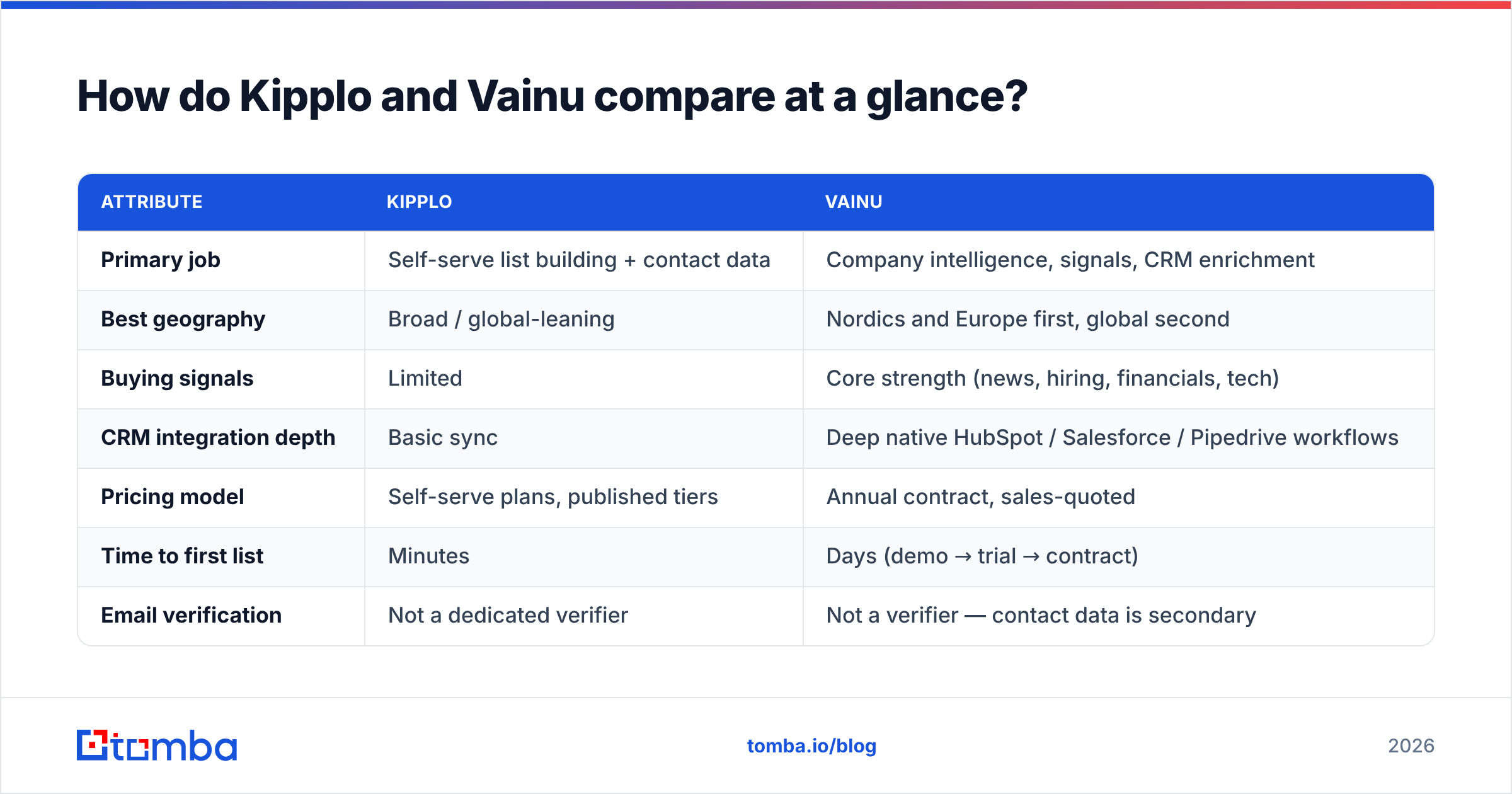
Kipplo vs Vainu at a glance#
| Attribute | Kipplo | Vainu |
|---|---|---|
| Primary job | Self-serve list building + contact data | Company intelligence, signals, CRM enrichment |
| Best geography | Broad / global-leaning | Nordics and Europe first, global second |
| Buying signals | Limited | Core strength (news, hiring, financials, tech) |
| CRM integration depth | Basic sync | Deep native HubSpot / Salesforce / Pipedrive workflows |
| Pricing model | Self-serve plans, published tiers | Annual contract, sales-quoted |
| Time to first list | Minutes | Days (demo → trial → contract) |
| Email verification | Not a dedicated verifier | Not a verifier — contact data is secondary |
| Who it fits | 1-10 rep outbound teams, founders | Mid-market to enterprise RevOps and marketing |
The table makes the real choice visible. You are not picking between two versions of the same thing. You are picking between "I need a list today" and "I need my CRM to know something my rivals don't."

What is Vainu actually good at?#
Vainu earns its price in four spots.
- European and Nordic coverage. Most US-built vendors treat Finland, Sweden, Norway, and Denmark as rounding errors. Vainu is built from those registries outward. So revenue, legal entity data, and ownership records are far more exact there.
- Trigger-based prospecting. Vainu's core loop is not "give me a list." It is "tell me when a company is worth calling." Funding rounds, new leaders, new offices, tech changes. If timing drives your motion, that is the part you pay for.
- CRM enrichment at the account level. Vainu is made to sit inside HubSpot or Salesforce and keep account records fresh. It is not a CSV export tool. RevOps teams treat it as plumbing, which is why it sells as an annual contract.
- Traceable sources. Registry data can be traced back to a filing. That matters in regulated fields. It also matters the first time a legal team asks where your data came from.
Where Vainu falls short: person-level contact data. It will tell you a company is worth a call. It will often name the person who runs the right team. It will not hand you a verified work email for that person at scale. That is a scope line, not a flaw. But teams who buy it as a contact database are the ones who churn.
What is Kipplo actually good at?#
Kipplo's edge is low friction.
- No gatekeeping. You can sign up, build a list, and export it. No discovery call, no security review, no annual commitment. For a two-person team testing a new segment, that beats a small accuracy gain.
- Small, predictable spend. Self-serve tools cap your risk. If the segment flops, you cancel. With a quoted annual deal, you learn in month three and pay through month twelve.
- Contact-first workflow. Kipplo is built to hand you people you can email, not accounts you can watch. That is the opposite of Vainu. It also matches how most early outbound runs.
- Faster loops. List, sequence, measure, adjust. You can run that loop every week on a self-serve tool.
Where Kipplo falls short: depth and proof. A smaller vendor has a smaller data pipeline. It has less regional focus and fewer published accuracy numbers. So run a sample test first. Pull 200 records in your real ICP, check them yourself, and measure the true hit rate.
Which one has better data coverage for your market?#
The honest answer depends on where your buyers are. Test it. Do not trust it.
Here is the framework to apply to any B2B data purchase.
- Define a control set. Take 50 accounts you know well. Customers, closed-lost deals, rivals' logos. You know the truth for these.
- Run both tools against it. Match rate first: how many of the 50 does each tool even hold? Then check the fields: staff count, revenue band, tech stack, industry code.
- Check contact depth on its own. A match on the company means little if you cannot reach a human. Count the decision-maker emails each tool returns. Then check them with an outside email verifier instead of the vendor's own valid flag.
- Score freshness, not just presence. A 2023 record with the wrong headcount is worse than no record. It sends a rep in with the wrong pitch.
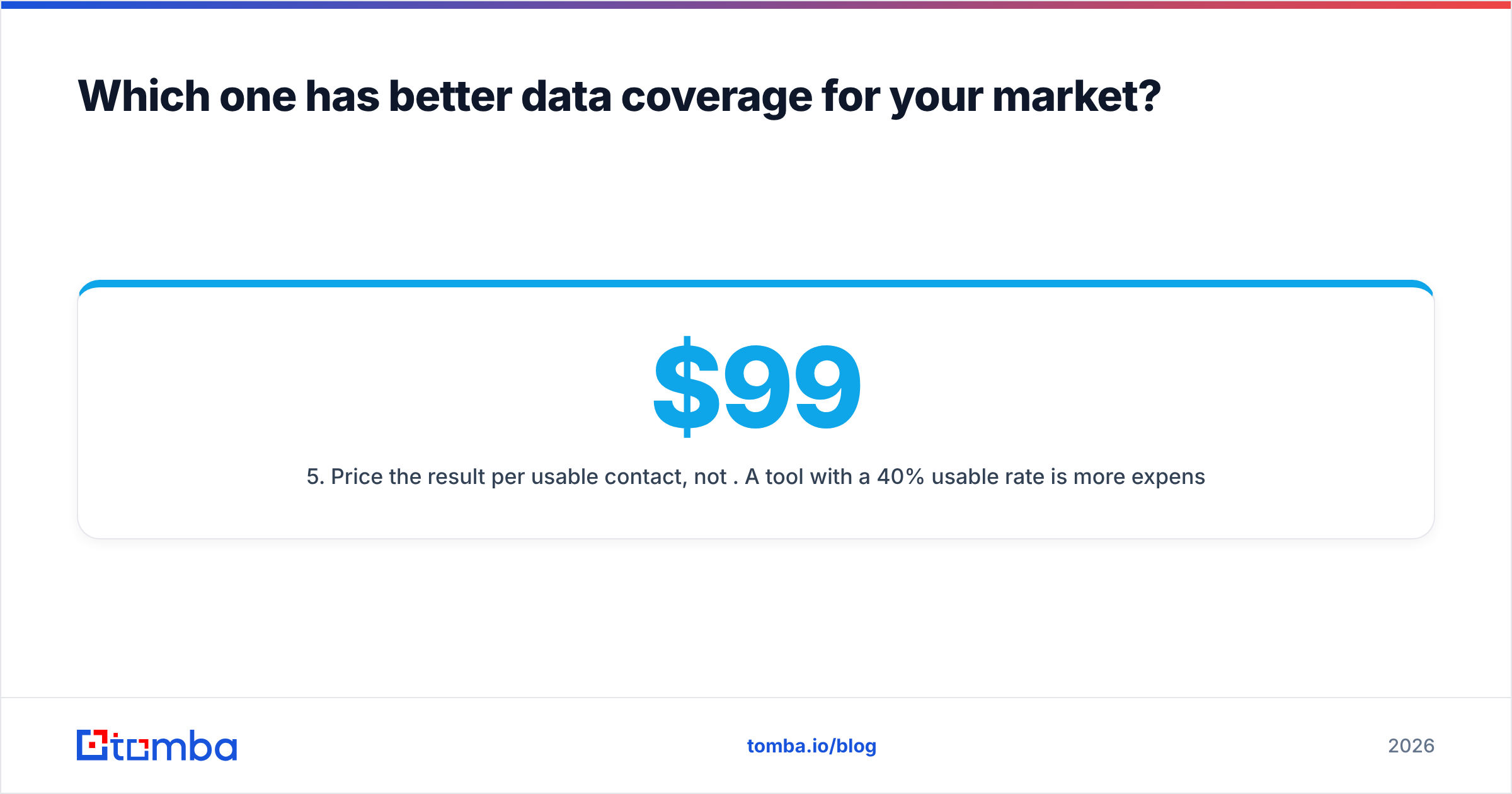
- Price the result per usable contact, not per credit. A $99/mo tool with a 40% usable rate costs more than a $249/mo tool with a 90% rate.
Most teams skip step 5 and buy on sticker price. That is the top reason data budgets get cut the next year.
Kipplo vs Vainu pricing: how do the plans compare?#
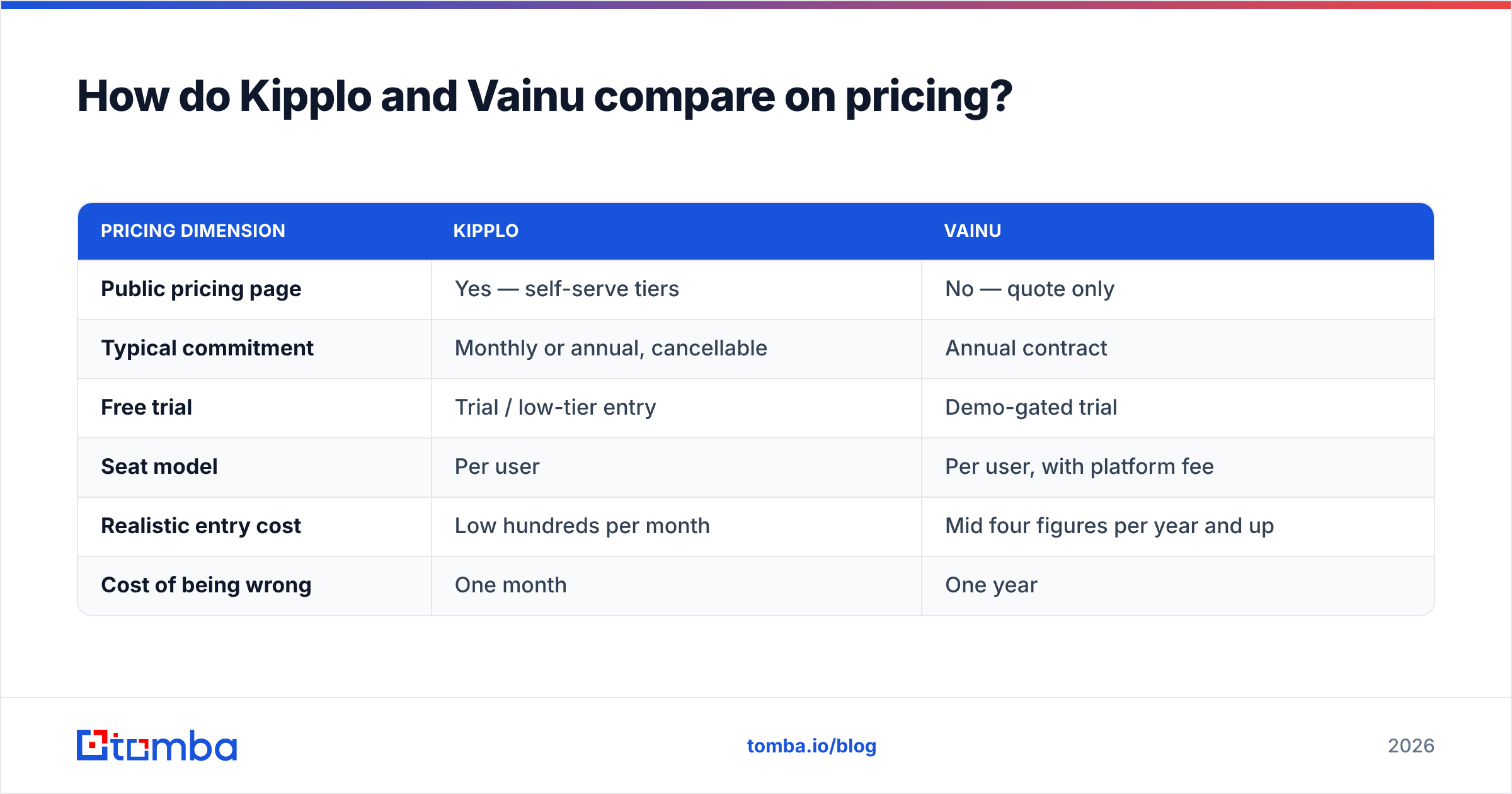
| Pricing dimension | Kipplo | Vainu |
|---|---|---|
| Public pricing page | Yes — self-serve tiers | No — quote only |
| Typical commitment | Monthly or annual, cancellable | Annual contract |
| Free trial | Trial / low-tier entry | Demo-gated trial |
| Seat model | Per user | Per user, with platform fee |
| Realistic entry cost | Low hundreds per month | Mid four figures per year and up |
| Cost of being wrong | One month | One year |
Two practical notes. First, check the current numbers on each vendor's own pricing page before you budget. Self-serve tiers here change a few times a year, and anything a third party prints ages fast. Second, weigh the option of unbundling. Maybe your only real need is reaching people. Then a focused contact tool plus a signal source you already own can replace a platform contract. LinkedIn, job boards, and your own product data all count. That is the logic behind testing a Vainu alternative instead of renewing by default.

Where do both tools leave a gap?#
Both leave the same gap: the deliverable email address.
Vainu is upfront about it. Company intelligence is the product. Kipplo goes further into contact data. But like most all-in-one tools, it treats verification as a checkbox, not a craft. The result is the same in both cases. A rep exports a list, loads it into a sequence, and watches the bounce rate climb past 5%. At that point you are paying with your domain reputation. Neither platform is built to protect it.
The fix is boring and cheap. Add a find-and-verify step between list building and sending.
- Find the right address from a name and domain with a dedicated email finder. Do not accept the guess that came bundled with the list.
- Verify every address. That includes catch-all domains, which most verifiers mark "unknown" and reps then mail anyway.
- Enrich what is missing with a focused data enrichment pass. Do not re-buy the whole record.
- Automate the loop with the Tomba API. The check then runs on write into your CRM, not by hand before each campaign.
Keeping bounce rate under 2% is not a nice-to-have. HubSpot's sales research and every big inbox provider say the same thing. Sender reputation compounds. One bad list can cost you a quarter of recovery.
Kipplo vs Vainu: which should you choose?#
Pick based on the shape of your motion, not the feature grid.
Choose Vainu if:
- Your ICP sits in the Nordics, DACH, or Benelux
- Timing beats volume, and you sell into events like funding, hiring, or expansion
- You have a RevOps function that will really use enrichment inside the CRM
- You can sign an annual contract without it being a budget crisis
Choose Kipplo if:
- You need lists this week and have no time for a buying cycle
- Your team is under ten reps, and spend flexibility beats data depth
- Your ICP is broad and global rather than region-specific
- You are still testing segments and need to be able to cancel
Choose neither — and unbundle — if:
- You already know your target accounts and just need the right people inside them
- Your bottleneck is deliverability, not discovery
- You want per-lookup economics instead of a platform fee
- You are running lean, and $49/mo matters
That third case is more common than vendors admit. Plenty of teams buy a full platform to solve what is really an email-address problem.
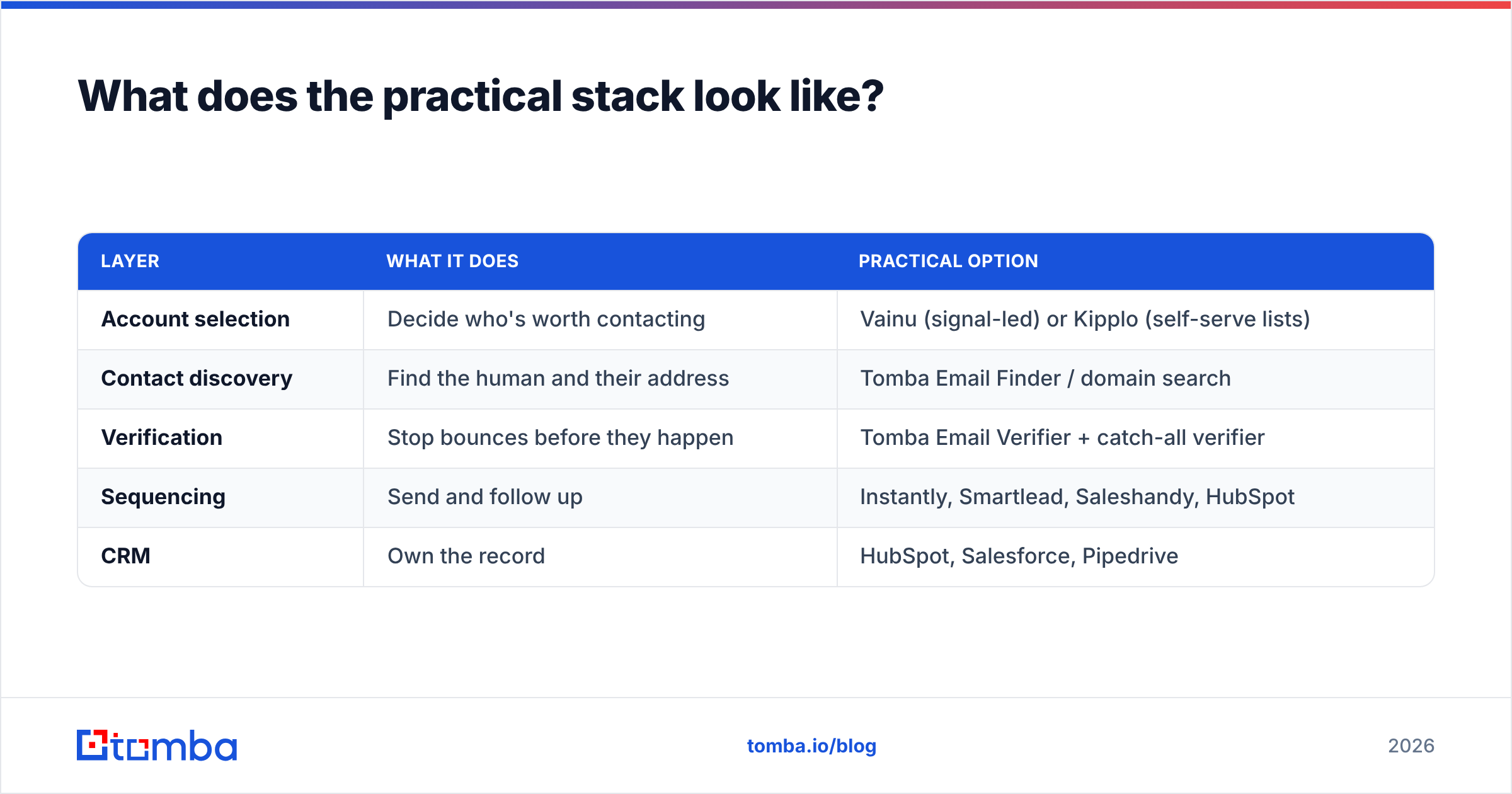
What does the practical stack look like?#
A setup that works for most B2B firms under 50 staff in 2026:
| Layer | What it does | Practical option |
|---|---|---|
| Account selection | Decide who's worth contacting | Vainu (signal-led) or Kipplo (self-serve lists) |
| Contact discovery | Find the human and their address | Tomba Email Finder / domain search |
| Verification | Stop bounces before they happen | Tomba Email Verifier + catch-all verifier |
| Sequencing | Send and follow up | Instantly, Smartlead, Saleshandy, HubSpot |
| CRM | Own the record | HubSpot, Salesforce, Pipedrive |
One rule holds it together: keep the discovery layer and the verify layer apart. Bundling them into one vendor feels tidy. It usually costs you accuracy. The bundled verifier has no reason to tell you the bundled finder was wrong.
The bottom line#
Here is the Kipplo vs Vainu verdict. Vainu wins on depth, signals, and European accuracy, and it charges for it. Kipplo wins on speed, self-serve access, and low commitment. Its track record is shorter, so test it before you scale spend. Neither one replaces a dedicated contact-accuracy layer.
If reps cannot reach the people they already found, start there. Tomba's Email Finder gives you 25 free searches a month. Test it against your own control list. Paid plans run $49/mo Starter, $99/mo Growth, and $249/mo Pro. No quote call, no annual lock-in. Check the full Tomba pricing page, run 50 known contacts through it, then compare the cost per usable contact with the platform quote in your inbox. The numbers will make the choice for you.
Related guides#
// get started
Find, verify and enrich your first contacts today
Start on the free plan with 25 searches a month, then scale when your team is ready.
Free plan · No credit card required · GDPR & CCPA
Get the Tomba newsletter
Product and data updates
// about the author