Kitt AI vs Zintlr: Which B2B Data Tool Wins in 2026?
Kitt AI and Zintlr both promise better prospect data, but they solve different problems and price very differently. Here is the honest head-to-head, plus how to run a 100-contact bake-off before you sign anything.
Kitt AI vs Zintlr comes down to one question: do you want better data, or less work? Both tools sell prospect contacts. They solve different problems, and they bill in very different ways.
TL;DR
- Kitt AI sells smarts and automation on top of contact data. Zintlr sells contact data plus a personality layer. They overlap. They are not the same buy.
- Neither one posts clear self-serve pricing today. Both send real buyers to a demo. That makes a side-by-side cost check harder than it should be.
- Data accuracy is the metric that matters. Trust no vendor's number. Run your own 100-contact test against a list you already know.
Those three points frame the cost math. The next two frame the pick.
- If your real job is "get valid work emails for a list of people and companies," a dedicated email finder plus verifier (Tomba, or peers like BookYourData) usually costs less. It also bounces less than a full suite.
- The Kitt AI vs Zintlr pick depends on team size. Zintlr for cheap volume prospecting at growth-stage teams. Kitt AI for AI workflows on top of a stack you already own. Tomba when deliverability and API access come first.
What are Kitt AI and Zintlr?#
Most Kitt AI vs Zintlr shortlists start here. Short version: Zintlr is a prospect database with a psychology twist. Kitt AI is an AI layer that tries to do the prospecting for you.
Zintlr is a B2B prospecting and sales data platform. You search a contact database by company, role, place and tech stack. You pull emails and phone numbers. Then you push them into your sequencer or CRM. Its hook is "personality intelligence" — a guess at how each prospect behaves, meant to help you tune your message. It leans toward volume. It is priced low for small teams, which is why it shows up on lists of budget Apollo alternatives.
Kitt AI sits in the newer "AI sales agent" bucket. It does not sell you a search box and charge per credit. It sells an outcome. The agent researches an account, builds a contact set, drafts the outreach, and hands a warm-ish lead to a rep. The pitch is fewer tools and fewer manual steps. The catch is the same for every AI agent in 2026. The data sets the ceiling, and most agents license that data rather than build it.
That gap is the whole comparison. One tool is closer to the raw material. The other is closer to the cooked dish. Pick the wrong one for your problem and you overpay.
One caveat, stated plainly. Neither vendor posts a full self-serve price list the way Tomba or BookYourData do. Everything below about cost reflects public info at the time of writing. Confirm the current numbers with each vendor before you budget.
Kitt AI vs Zintlr: how do they compare head-to-head?#
Here is the practical view. Not feature-checkbox theater — the traits that move your monthly bill and your bounce rate.
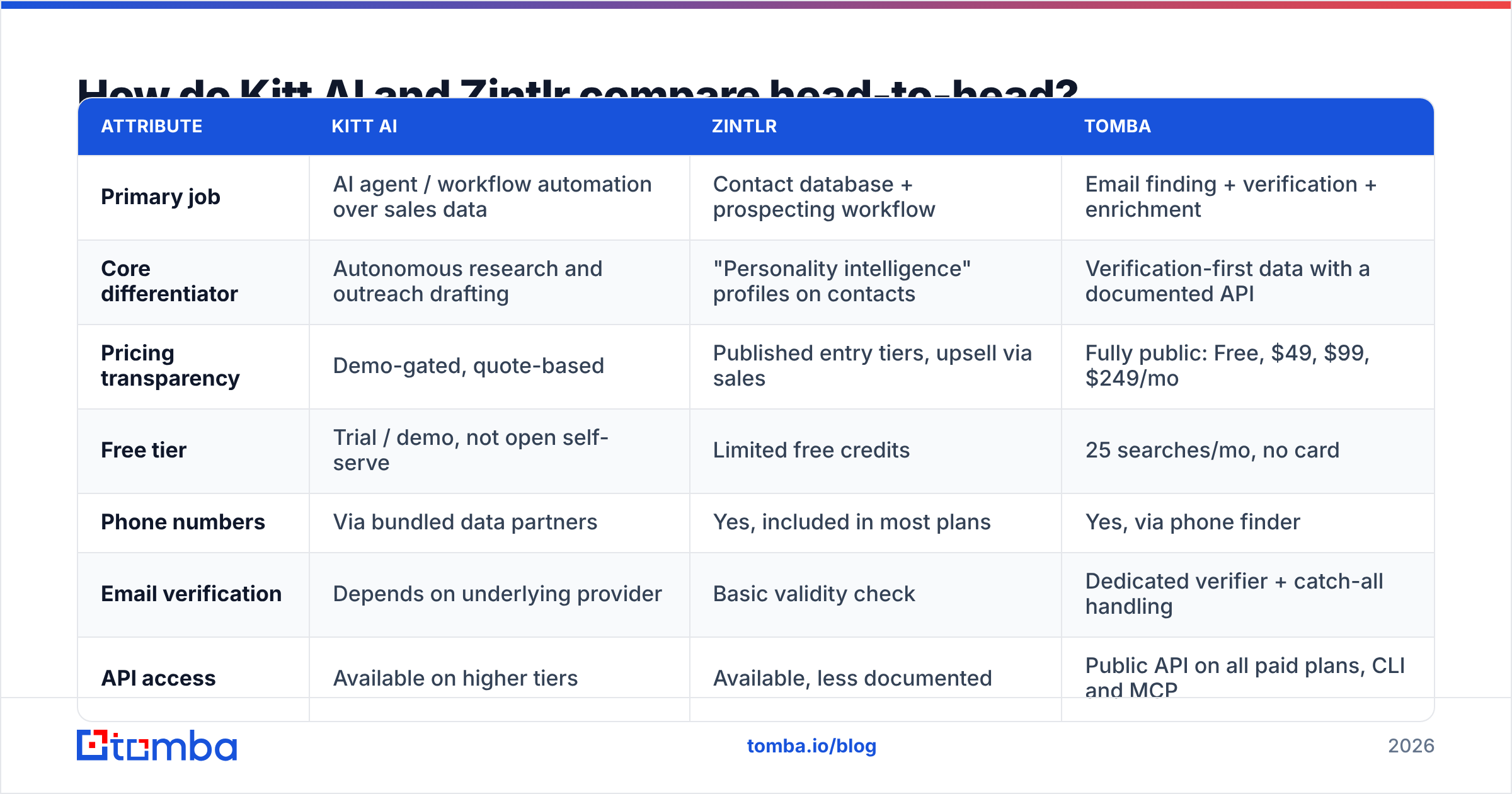
| Attribute | Kitt AI | Zintlr | Tomba |
|---|---|---|---|
| Primary job | AI agent / workflow automation over sales data | Contact database + prospecting workflow | Email finding + verification + enrichment |
| Core differentiator | Autonomous research and outreach drafting | "Personality intelligence" profiles on contacts | Verification-first data with a documented API |
| Pricing transparency | Demo-gated, quote-based | Published entry tiers, upsell via sales | Fully public: Free, $49, $99, $249/mo |
| Free tier | Trial / demo, not open self-serve | Limited free credits | 25 searches/mo, no card |
| Phone numbers | Via bundled data partners | Yes, included in most plans | Yes, via phone finder |
| Email verification | Depends on underlying provider | Basic validity check | Dedicated verifier + catch-all handling |
| API access | Available on higher tiers | Available, less documented | Public API on all paid plans, CLI and MCP |
| Best for | Teams consolidating tooling into one AI workflow | Budget-conscious high-volume prospecting | Deliverability-sensitive outbound and enrichment pipelines |
| Weakest point | Opaque cost, data quality inherited from partners | Inference-based personality claims are hard to audit | Not a sequencer — you still need a sending tool |

Two rows in that table do most of the budget damage. The first is pricing transparency. When a vendor hides the number, you bargain with no anchor. The quote you get tracks how big your logo looks, not how much data you use. The second is email verification. Tools that treat checking as a checkbox will hand you an address that reads fine and died eight months ago.

What does Zintlr actually do well?#
Volume, price, and a fresh angle on personal touch.
Zintlr's entry price sits under most big sales data platforms. That matters a lot if you are a two-person sales team running 2,000 touches a month. The filters cover the usual axes: headcount, industry, title, location, tech stack. Export to CSV or a sequencer is simple. In a Kitt AI vs Zintlr trial, this is where Zintlr pulls ahead.
The personality layer is the part reviewers argue about. On G2's sales intelligence category, buyers rank data accuracy above every personal-touch feature. A personality guess also cannot be checked at the level of one human. Treat it as a soft hint for tone, not a fact. It can break a tie when you choose between a stat and a story. It is not a reason to buy a platform.
Zintlr gets weaker at the top end. Docs depth, compliance paperwork, coverage outside its best markets, and API polish all trail the big players. Say your ops team must wire contact data into a warehouse and a CRM with audit trails. Budget extra build time for that.
What does Kitt AI actually do well?#
Compression. It folds four steps into one.
The best case for any AI sales agent in 2026 is the tabs it removes. A rep used to jump between a database, a research tab, a writing tool and a sequencer. Now the work sits in one screen. HubSpot's own research keeps finding that reps spend a minority of the week selling. Tool switching eats a chunk of the rest — their sales blog digs into the pattern.
If Kitt AI's flow matches how your team already sells, the time savings are real. Account research that took fifteen minutes per prospect turns into a quick edit. At SDR pay, that is easy ROI.
The honest risks:
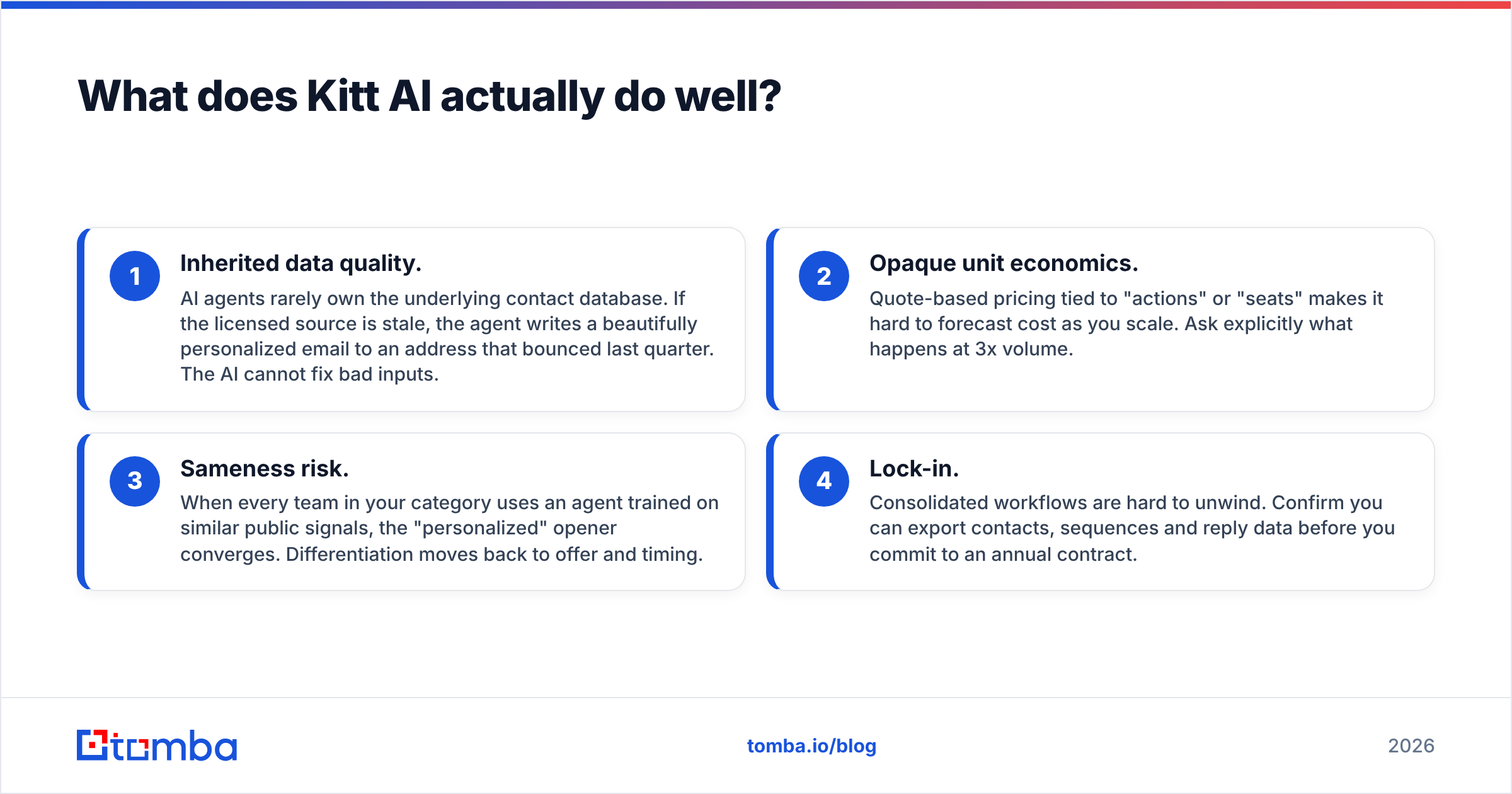
- Inherited data quality. AI agents rarely own the contact database. If the source is stale, the agent writes a lovely note to an address that bounced last quarter. The AI cannot fix bad inputs.
- Opaque unit economics. Quotes tied to "actions" or "seats" make cost hard to forecast. Ask what happens at 3x volume.
- Sameness risk. Every team in your category feeds its agent the same public signals. The "personal" opener converges. Offer and timing become the edge again.
- Lock-in. Bundled workflows are hard to unwind. Confirm you can export contacts, sequences and reply data before you sign for a year.
How accurate is the data, and how do you test it?#
Trust no accuracy claim — ours included. Run the test yourself. It takes an afternoon.

Here is the bake-off we hand to every team weighing contact data. Run it for Kitt AI vs Zintlr, and for any third tool on your list:
- Build a 100-row control list. Pick real people at real target companies whose emails you already know. Past customers, partners and event guests work well. This is your answer key.
- Run the same list through each tool. Same names, same domains, same day. Record match rate and accuracy rate on their own. One asks if you got an address. The other asks if it was right.
- Verify every returned address on neutral ground. Use a third party so the tool is not grading its own homework. A standalone email verifier gives you a clean second read on validity and catch-all status.
Those three steps give you a clean score. The next three turn that score into a decision.
- Segment the results. Break the score down by company size and region. Most tools are strong on US mid-market SaaS and weak on European SMBs or APAC. Your ICP is what counts, not the blended average.
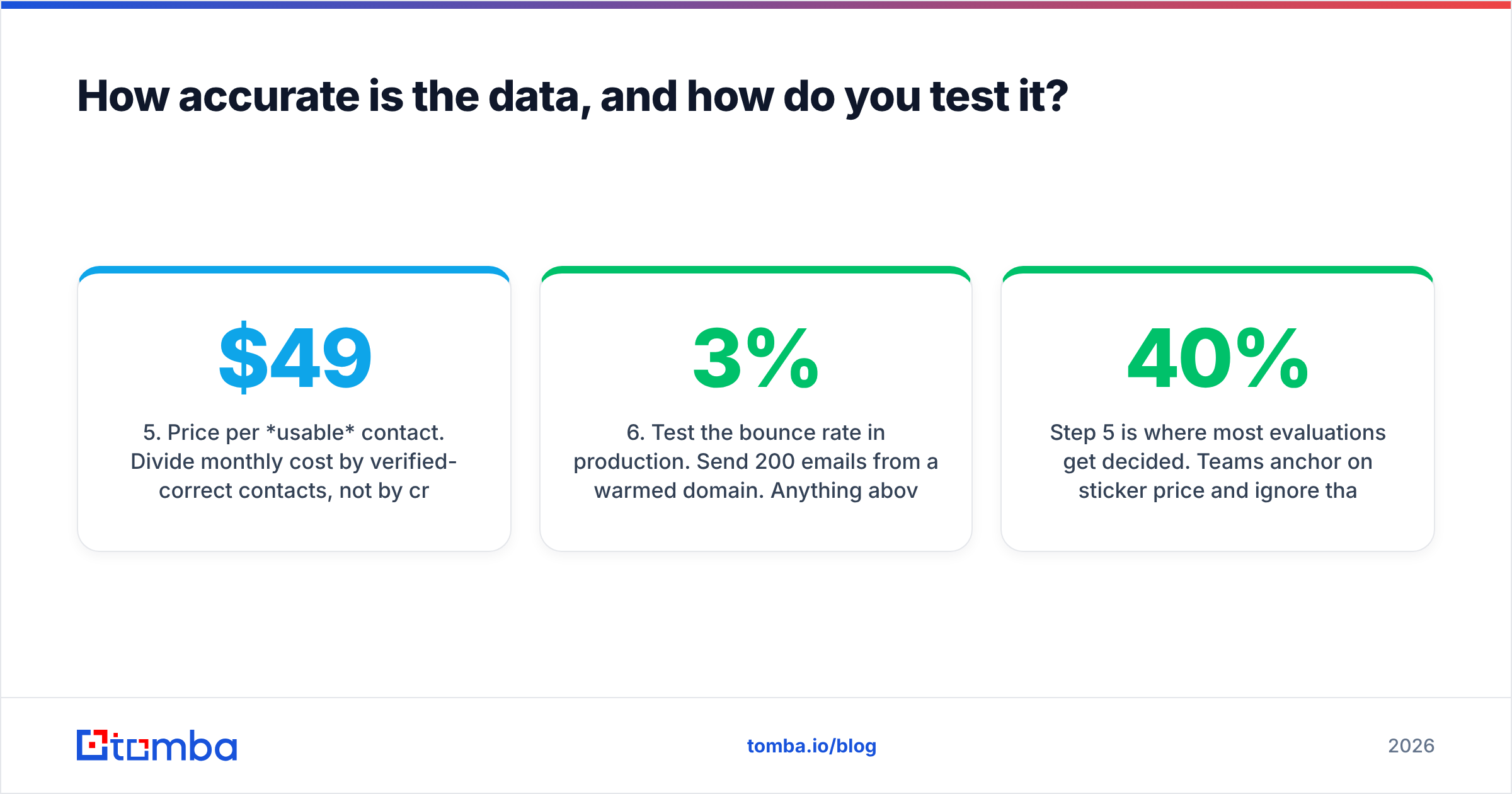
- Price per usable contact. Divide monthly cost by verified-correct contacts, not by credits. A $49 tool at 85% accuracy beats a $200 tool at 60%. The gap only widens as you scale.
- Test the bounce rate in production. Send 200 emails from a warmed domain. Over 3% hard bounces is a data problem, not a copy problem. It will drag your sender reputation down fast.
Step 5 decides most of these bake-offs. Teams anchor on sticker price. They ignore that 40% of a cheap list is junk. The cheap list was never cheap.
What about pricing and hidden costs?#
Budget for three line items, not one: data, verification, and sending.
Pricing is where Kitt AI vs Zintlr stops being a feature debate. Zintlr's entry tiers are low enough to be a real edge for early-stage teams. Credit caps and per-seat costs climb as you add reps. Kitt AI is quote-driven. Assume the premium bracket typical of AI agents, and assume pressure to sign for a year.
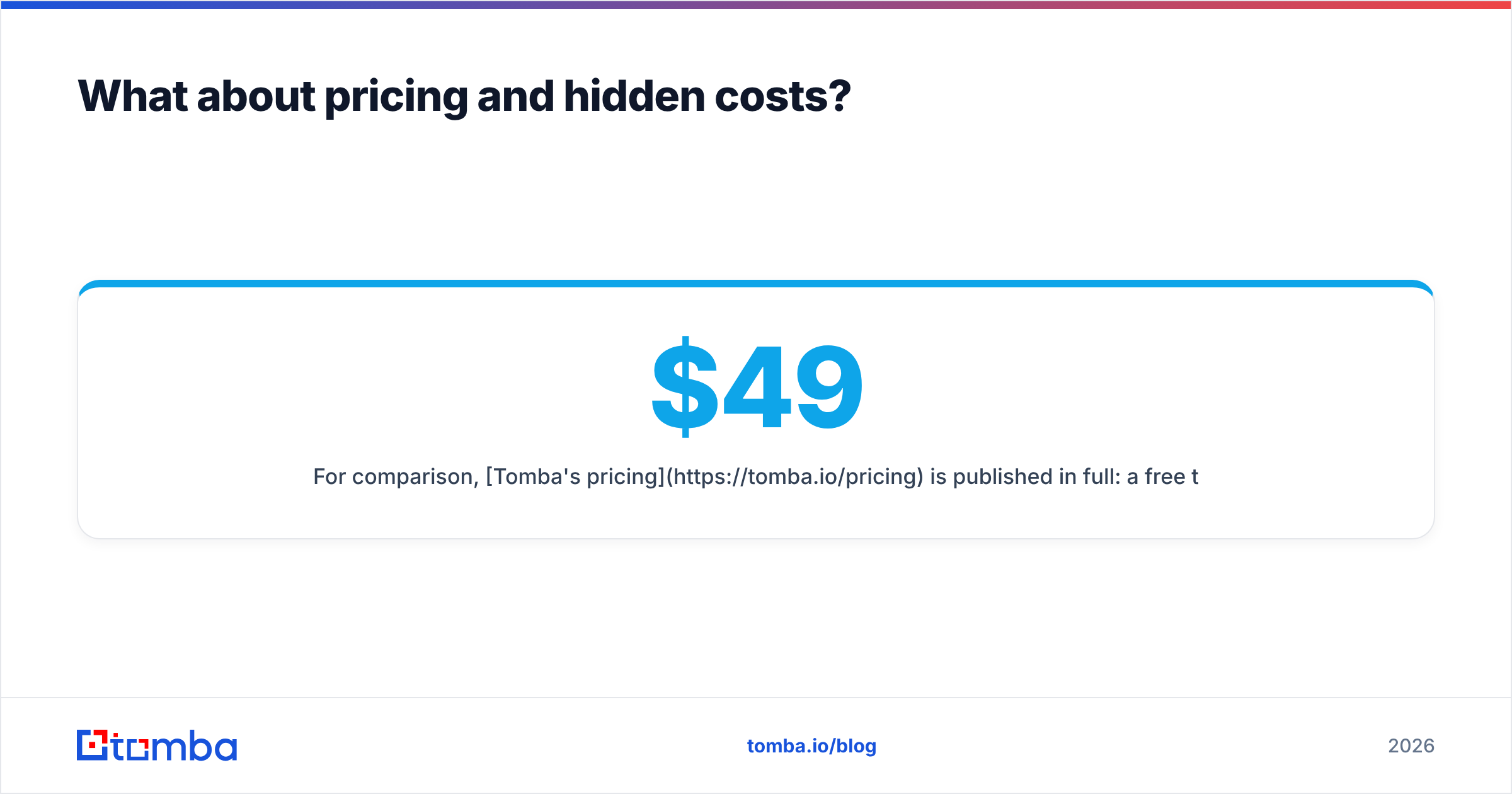
For contrast, Tomba's pricing is public in full. There is a free tier at 25 searches a month, Starter at $49/mo, Growth at $99/mo, Pro at $249/mo, and custom Enterprise. That is not a minor detail. You can model cost per verified contact in a spreadsheet before you ever talk to a rep.
The hidden costs to dig into on any demo:
- Credit rollover. Do unused credits expire monthly? Most do.
- Charges for misses. Are you billed for searches that return nothing, or only for delivered contacts?
- Verification as an upsell. Is validity checking included, or a separate SKU?
- Seat minimums. Many AI agent products price a floor of three to five seats.
- Export limits. Some platforms cap CSV exports to push you toward their own sequencer.
Which should you choose — and is there a third option?#
The Kitt AI vs Zintlr call gets easier once you name your bottleneck.
Choose Zintlr if you are a small, price-sensitive team. It fits high-volume outbound in its core regions, and you can search it yourself without a procurement cycle.
Choose Kitt AI if rep time is your bottleneck, not data cost. You need budget for premium tooling. You are also trading price clarity for a shorter workflow, so do it with open eyes.
Choose neither if your real problem is smaller than both products. Many teams weighing this category do not need a full suite. They need valid work emails for a list they already have. That is a cheaper buy. A focused email finder with a bulk email finder mode and a documented API covers it for a fraction of suite pricing. BookYourData is a fair peer if you would rather buy ready-made lists than search for them.
The multi-tool stack is usually the right answer and rarely the pitched one. No vendor gains by telling you so. A data source, a verifier and a sequencer, each picked on merit, beat an all-in-one on both cost and bounce rate. The only tax is integration. With Zapier, HubSpot and Salesforce connectors plus data enrichment endpoints, that tax stays small.
What is the final Kitt AI vs Zintlr verdict?#
The verdict: no universal winner, and anyone who claims one is selling. Zintlr wins on price per contact for self-serve prospecting. Kitt AI wins on time per rep for teams that can afford it. Both lose to a purpose-built data pipeline when deliverability is the core problem.
Run the 100-contact bake-off. Price it per usable contact. Sign nothing annual until you have seen bounce data from your own live send.
Say the test comes back with "we mostly need reliable emails, not another platform." Start with the Tomba Email Finder. The free tier gives you 25 searches a month with no card. That is enough to run the accuracy test above against your own control list. If the numbers hold up, Starter at $49/mo with full API access costs less than one month of any demo-gated suite.
Related guides#
// get started
Find, verify and enrich your first contacts today
Start on the free plan with 25 searches a month, then scale when your team is ready.
Free plan · No credit card required · GDPR & CCPA
Get the Tomba newsletter
Product and data updates
// about the author