Kitt AI vs ZoomInfo: Which GTM Platform Wins in 2026?
Kitt AI sells autonomous prospecting agents. ZoomInfo sells the biggest B2B database in the market. We break down pricing, contracts, data accuracy and the cheaper third path most teams end up taking.
TL;DR
- Different products, same budget line. Kitt AI sells an AI agent layer that researches accounts and drafts outreach. ZoomInfo sells the contact and intent database underneath it. Teams compare them because both show up as "the prospecting line item," not because they do the same job.
- ZoomInfo wins on breadth. Hundreds of millions of contacts, intent signals, org charts, technographics, and deep CRM sync. Nothing in the AI-agent category matches that depth today.
- Kitt AI wins on speed to first touch. If your problem is "my reps don't research accounts," an agent layer fixes that faster than another database seat.
- Pricing is the real decision. ZoomInfo is annual, quote-only, and commonly lands in five figures with auto-renewal clauses. Kitt AI is also quote-driven and does not publish a transparent list price.
- Most teams over-buy. If 80% of your usage is "get me a verified email for this person at this company," a pay-per-credit email finder at $49/mo does that specific job for a fraction of a platform contract.

What is Kitt AI, and what does it actually do?#
Kitt AI sits in the AI-native GTM category — the wave of tools that replaced "give the rep a list" with "give the rep a researched, drafted, prioritized play." The pitch across this category is consistent: an agent monitors your ICP, watches for triggers (funding, hiring, tech changes, job moves), assembles a research brief, and produces outreach that references something real instead of "I saw you're in SaaS."
What that means practically:
- Account research is automated, not outsourced. The agent reads the site, the job posts, the press, and the LinkedIn activity, then summarizes why this account matters now.
- Sequencing is contextual. Instead of one template blasted to 2,000 people, you get variant messaging per segment or per trigger.
- Humans stay in the approval loop. Most serious buyers in 2026 run agents in draft mode, not send mode, because one bad autonomous send burns a domain.
- Data is usually rented, not owned. This is the critical architectural point: agent-layer tools typically license or resolve contact data from third-party providers rather than operating a proprietary database at ZoomInfo's scale.
That fourth point is why "Kitt AI vs ZoomInfo" is a slightly unfair framing. One is a reasoning layer. The other is the substrate.
A practical caveat before you compare spec sheets: Kitt AI does not publish a public price list or a public data-coverage methodology. Treat any number a rep quotes you as negotiable, and insist on a coverage test against your actual ICP list before signing anything.
What is ZoomInfo, and why is it still the default?#
ZoomInfo is the incumbent. It is a publicly traded company with a database built from a mix of contributory network data, web crawling, licensed sources, and human research, and it is the tool most enterprise sales orgs have already standardized on. You can read the corporate background on ZoomInfo's own site and the company history on Wikipedia.
The reason it stays entrenched has nothing to do with AI:
- Coverage at the long tail. Mid-market manufacturing companies in Ohio with 60 employees. That is where thin databases fall apart and ZoomInfo usually does not.
- Org charts and hierarchy. Knowing who reports to whom is genuinely hard data to assemble, and ZoomInfo assembles it.
- Intent data. Bidstream and co-op intent that tells you an account is researching your category. Imperfect, directionally useful, and hard to replicate.
- Admin gravity. Once ZoomInfo is wired into Salesforce enrichment rules, lead routing, and territory design, ripping it out is a RevOps project, not a purchasing decision.
The counterweight is commercial, not technical. Buyer reviews on G2 consistently raise the same three complaints: annual contracts with limited flexibility, auto-renewal terms that catch teams off guard, and credit models that force you to buy for peak usage rather than average usage.
Kitt AI vs ZoomInfo: how do they compare head-to-head?#
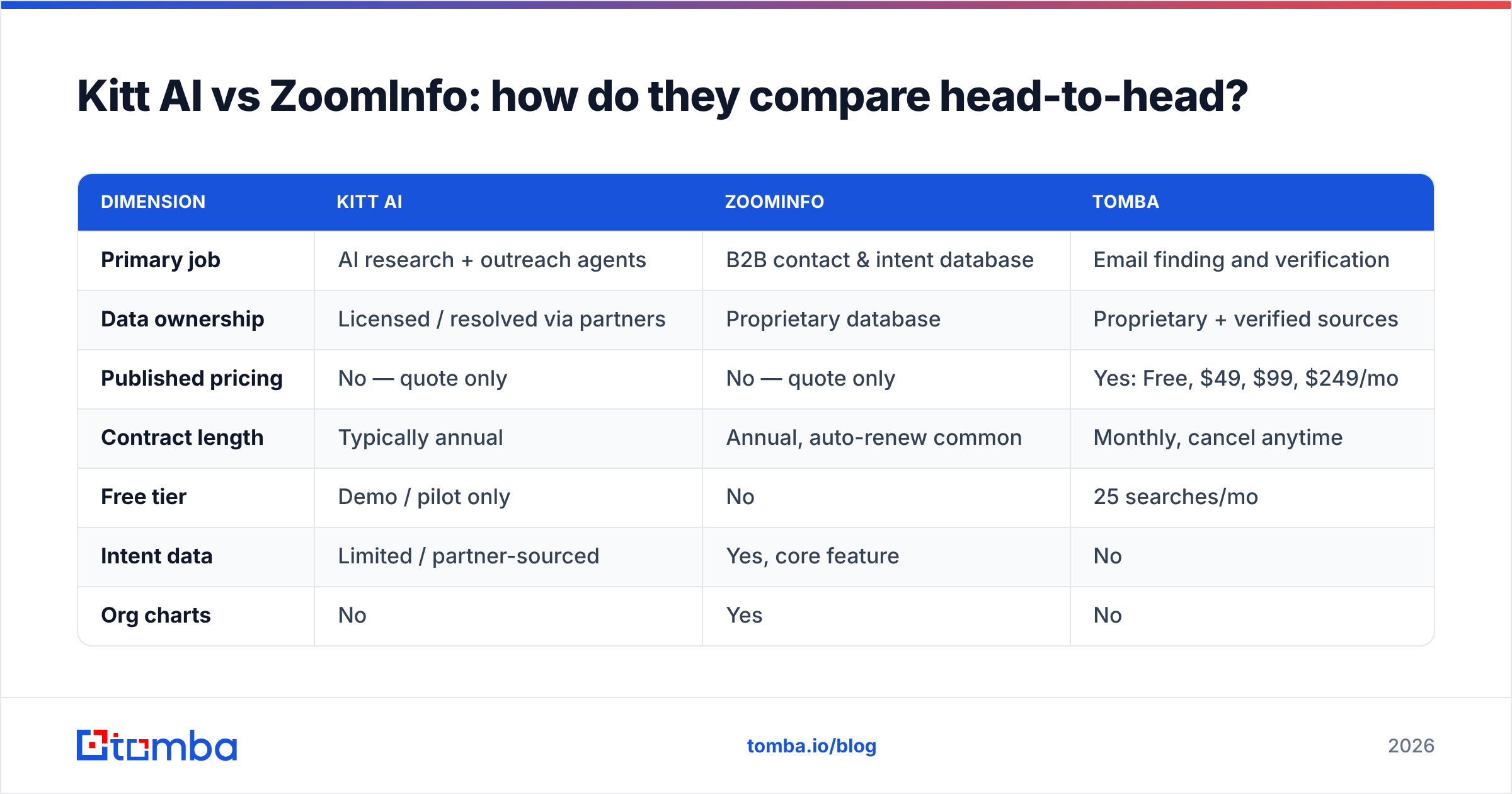
| Dimension | Kitt AI | ZoomInfo | Tomba |
|---|---|---|---|
| Primary job | AI research + outreach agents | B2B contact & intent database | Email finding and verification |
| Data ownership | Licensed / resolved via partners | Proprietary database | Proprietary + verified sources |
| Published pricing | No — quote only | No — quote only | Yes: Free, $49, $99, $249/mo |
| Contract length | Typically annual | Annual, auto-renew common | Monthly, cancel anytime |
| Free tier | Demo / pilot only | No | 25 searches/mo |
| Intent data | Limited / partner-sourced | Yes, core feature | No |
| Org charts | No | Yes | No |
| Email verification | Depends on provider | Included, basic | Core product, SMTP + catch-all |
| API access | Yes | Yes, enterprise tiers | Yes, all paid plans |
| Best for | Small teams that need research done | Enterprise GTM standardization | Precise, low-cost contact sourcing |
Read that table as three different budget philosophies rather than three competing products. ZoomInfo is a platform bet. Kitt AI is a productivity bet. A dedicated finder is a unit-economics bet.
How do the pricing models really differ?#
This is where most evaluations go sideways, because only one of the three publishes numbers.
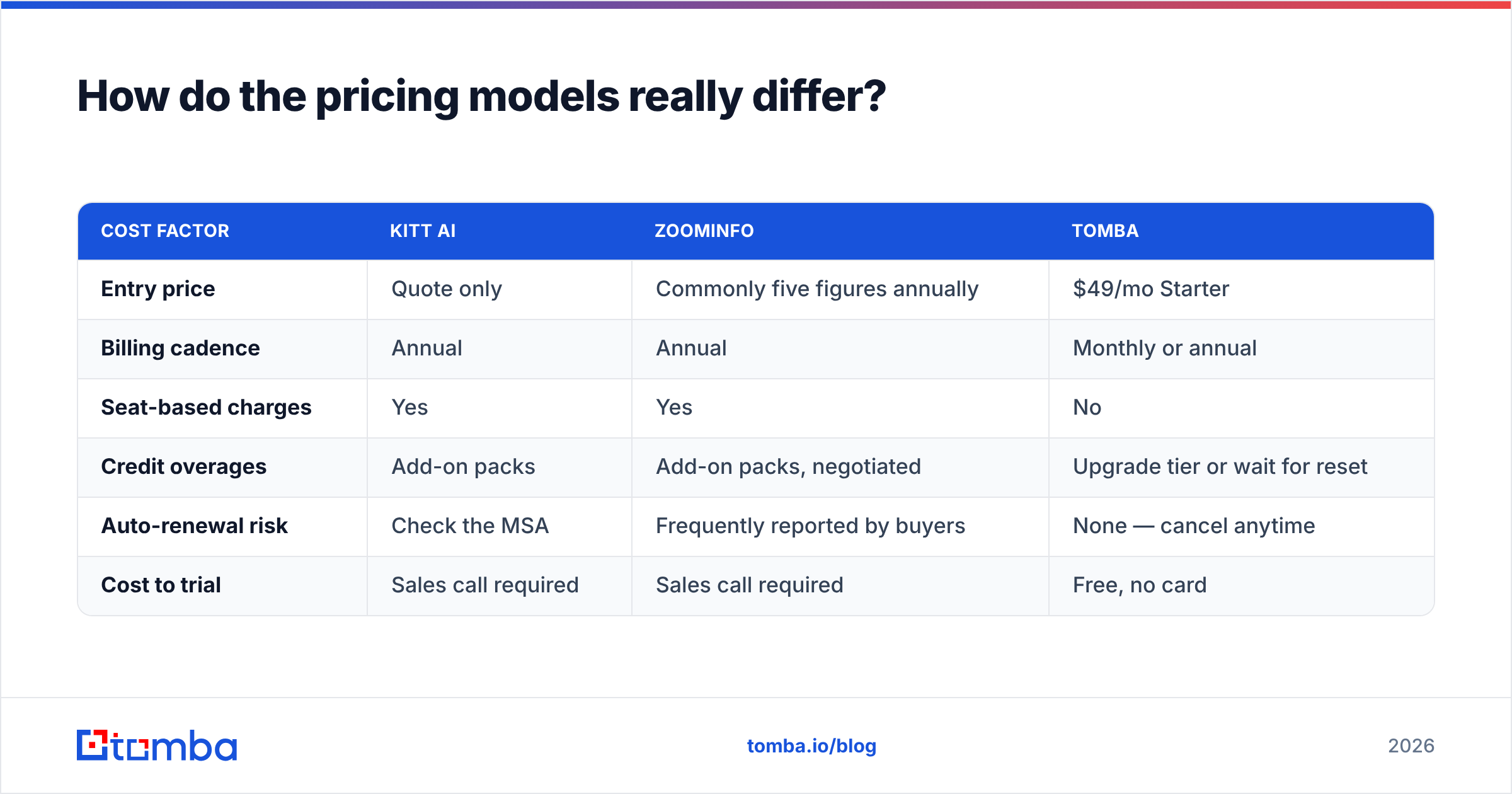
| Cost factor | Kitt AI | ZoomInfo | Tomba |
|---|---|---|---|
| Entry price | Quote only | Commonly five figures annually | $49/mo Starter |
| Billing cadence | Annual | Annual | Monthly or annual |
| Seat-based charges | Yes | Yes | No |
| Credit overages | Add-on packs | Add-on packs, negotiated | Upgrade tier or wait for reset |
| Auto-renewal risk | Check the MSA | Frequently reported by buyers | None — cancel anytime |
| Cost to trial | Sales call required | Sales call required | Free, no card |
Two practical implications:
One: you cannot benchmark what you cannot price. If both vendors require a sales call before revealing cost, you are negotiating without a reference point. Bring one. Run the same 500-contact ICP list through a transparent tool like Tomba first, calculate your real cost per verified contact, then walk into the enterprise call with that number.
Two: peak-usage pricing is the hidden tax. Platform contracts are sized for your busiest quarter. If your team finds 4,000 contacts in Q1 and 900 in Q3, you paid for 16,000 and used 8,000. Credit-based Tomba pricing lets you scale the tier up and down against actual demand.

Which one has better data accuracy?#
Accuracy is a two-part question that vendors deliberately merge into one number.
- Coverage is "does the record exist in the database?" ZoomInfo wins this outright at the long tail and in enterprise accounts.
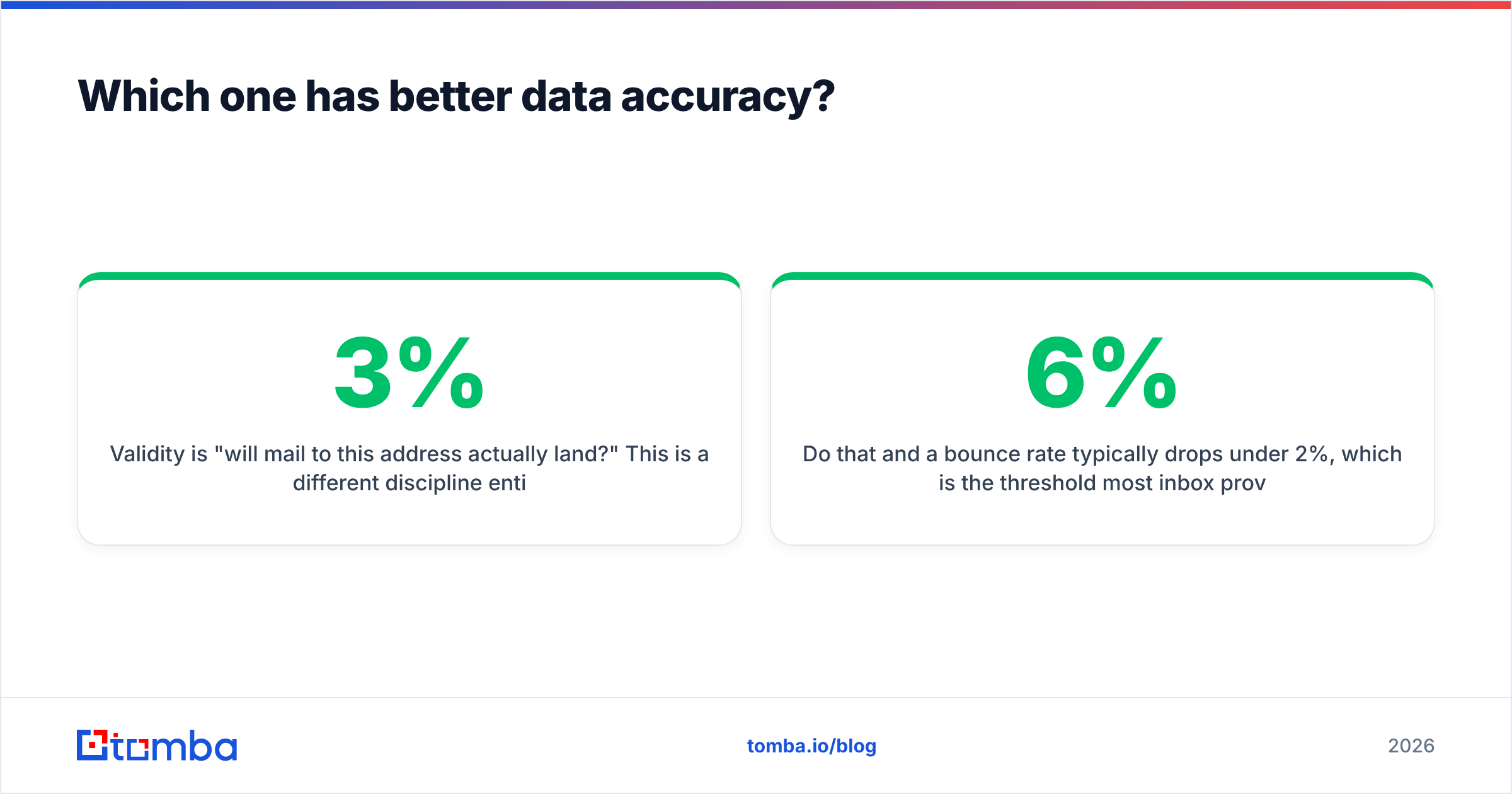
- Validity is "will mail to this address actually land?" This is a different discipline entirely, and it decays fast — B2B contact data goes stale at roughly 2–3% per month as people change roles.
A database can have excellent coverage and mediocre validity at the same time. That is the single most common surprise in a first ZoomInfo quarter: the record is there, the title is right, the email bounces because the person left in March.
The fix is not a better database. The fix is a verification step between export and send. Run every list — regardless of source — through an email verifier before it touches your sequencer. Specifically:
- Syntax and domain checks kill obvious garbage for free.
- SMTP handshake confirms the mailbox accepts mail.
- Catch-all detection flags domains that accept everything, which is where naive verifiers report false positives.
- Role-account filtering strips info@, sales@, and support@ that tank your reply rate and your sender reputation.
- Recency scoring deprioritizes records that haven't been re-confirmed in 90+ days.
Do that and a 6% bounce rate typically drops under 2%, which is the threshold most inbox providers use before they start throttling you.
Who should pick Kitt AI?#
Choose the agent layer if these describe you:
- Your reps have lists but no research time. The bottleneck is message quality per account, not contact volume.
- You sell into a narrow, high-ACV ICP. 300 named accounts where personalization moves the needle far more than another 50,000 records.
- You already own a data source. If ZoomInfo, Apollo, or a finder API is in place, an agent layer stacks on top of it cleanly.
- You can tolerate opacity. No public pricing and no published coverage methodology means you're buying on trust and pilot results.
Do not choose it if your problem is "we cannot find contact details for the people we want to reach." An agent with bad inputs produces confident, well-written emails to addresses that bounce.
Who should pick ZoomInfo?#
Choose ZoomInfo if:
- You need org charts and intent. No credible cheaper substitute exists for hierarchy data at scale.
- You have 15+ reps and a RevOps function. The admin overhead only amortizes with headcount.
- Your territories are built on firmographic filters. Slicing by revenue band, employee count, and technographic install base is exactly what the platform is for.
- Procurement prefers one large contract to six small ones. Sometimes the consolidation itself is the value.
Skip it if you are under ten reps, if your ICP is concentrated in a handful of verticals you already know by name, or if your annual contact volume is under roughly 20,000 records. At that size the math rarely clears.
Is there a cheaper third path that beats both on cost per contact?#
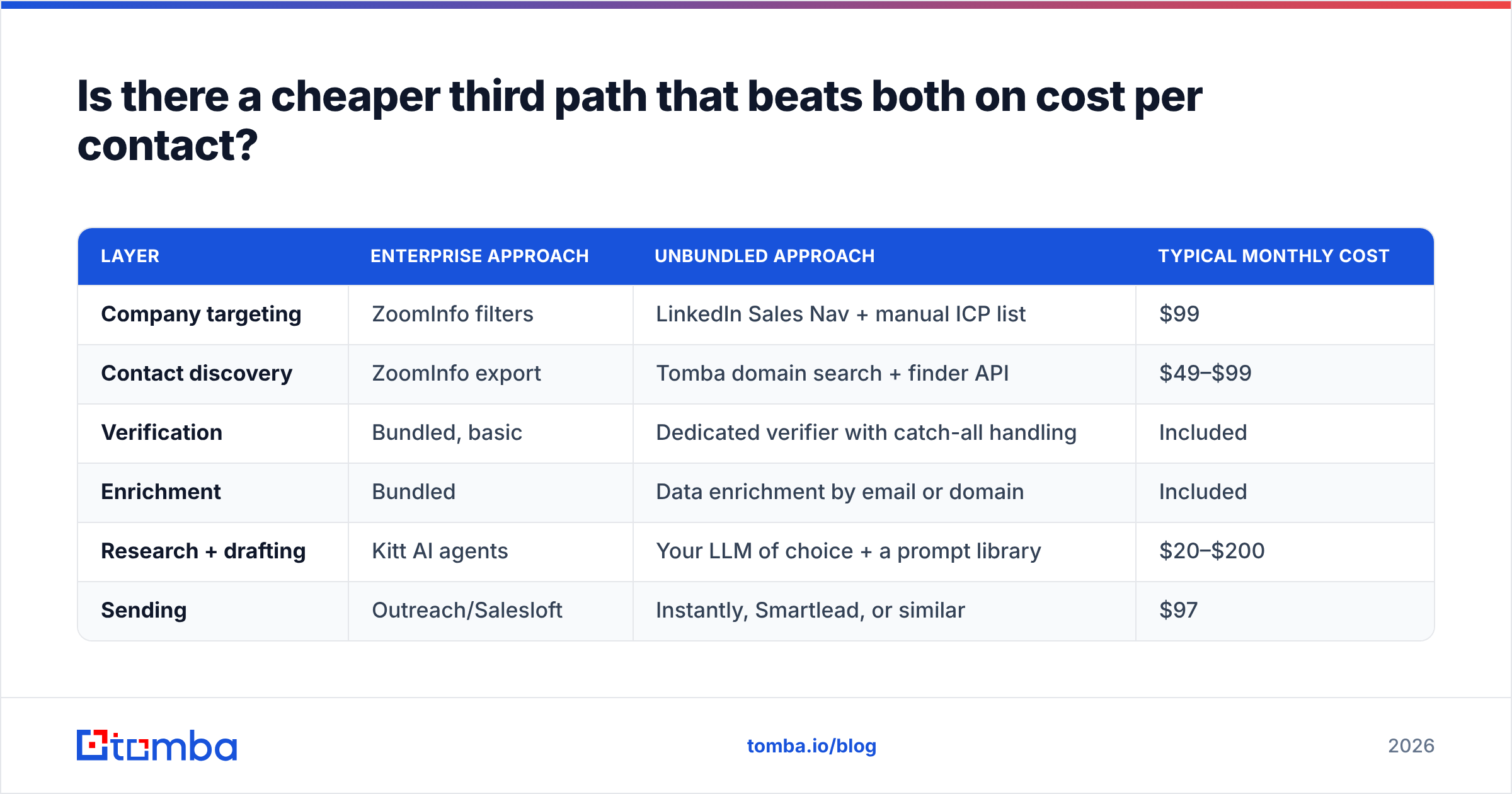
Yes, and it is what a meaningful share of teams actually run: an unbundled stack.
| Layer | Enterprise approach | Unbundled approach | Typical monthly cost |
|---|---|---|---|
| Company targeting | ZoomInfo filters | LinkedIn Sales Nav + manual ICP list | $99 |
| Contact discovery | ZoomInfo export | Tomba domain search + finder API | $49–$99 |
| Verification | Bundled, basic | Dedicated verifier with catch-all handling | Included |
| Enrichment | Bundled | Data enrichment by email or domain | Included |
| Research + drafting | Kitt AI agents | Your LLM of choice + a prompt library | $20–$200 |
| Sending | Outreach/Salesloft | Instantly, Smartlead, or similar | $97 |
The unbundled stack trades convenience for control. You maintain more integrations. In exchange you pay for what you use, you can swap any layer in a week instead of at renewal, and you never fund a database seat for a rep who left in February.
The honest counterargument: unbundling has a real operational cost. If you don't have someone who enjoys wiring tools together, a single platform contract is a legitimate purchase of that person's time. Decide which cost you'd rather pay.
What should you ask before signing either contract?#
Bring these to the demo. The answers separate a good fit from an expensive lesson.
- "What is my cost per usable contact?" Not per credit. Per contact that passes verification and belongs to a live employee.
- "What happens to my credits at renewal?" Do they roll over, expire, or reset? Get it in writing.
- "What is the notice period for non-renewal?" Thirty, sixty, or ninety days before term end — calendar it the day you sign.
- "Can I run a coverage test on my own list?" Hand over 200 real target accounts. If coverage is under 60%, the platform is not built for your market.
- "Who owns the data if I leave?" Export rights and post-termination use vary meaningfully between vendors.
- "What's your bounce guarantee?" Some vendors credit back invalid records. Most don't unless you ask.
Kitt AI vs ZoomInfo: what's the verdict?#
There isn't a single winner, because they solve adjacent problems. If your reps are staring at a full list and writing weak emails, an AI agent layer like Kitt AI is the right spend. If your reps are staring at an empty list because you can't identify or reach the right accounts, ZoomInfo's coverage is what you're buying. If your reps have the list, know the message, and simply need reliable contact details without a five-figure commitment, neither platform is the efficient answer.
Start with the cheapest layer that unblocks you. Most teams discover the expensive platform was solving a problem they didn't actually have.
Before you sign a multi-year GTM contract, price the alternative. Tomba's Email Finder gives you 25 free searches a month with no card, no sales call, and no annual commitment — enough to run a real coverage test against your own ICP list this afternoon. Paid plans start at $49/mo, include verification and enrichment, and cancel whenever you want. Run the test, get your true cost per verified contact, and walk into your next renewal call with a number instead of a hope.
Related guides#
// get started
Find, verify and enrich your first contacts today
Start on the free plan with 25 searches a month, then scale when your team is ready.
Free plan · No credit card required · GDPR & CCPA
Get the Tomba newsletter
Product and data updates
// about the author