Kleio Pricing, Reviews, Pros and Cons: The 2026 Breakdown
Kleio sells outcomes, not a price list. Here is how its quote-based pricing actually works, what buyers praise and complain about, and when a flat-rate data tool costs less.
TL;DR
- Kleio is sold as an AI-assisted outbound and prospecting layer, and like most tools in that category it quotes per account rather than publishing a flat price list. Expect a demo before you see a number.
- The recurring praise in buyer reviews is speed of setup and the quality of AI-drafted outreach. The recurring complaint is cost predictability: seat minimums, annual commitments, and credit overages that are hard to forecast in month one.
- Quote-based pricing is not a scam, but it shifts the burden of evaluation onto you. Ask for the per-seat rate, the credit rate, the overage rate, and the renewal uplift in writing before you sign anything.
- If your bottleneck is contact data rather than AI copy, a flat-rate finder like Tomba ($49/mo Starter, free tier at 25 searches) usually covers the same job for a fraction of the annual spend.
- Best fit: funded teams with 3+ SDRs who want an all-in-one motion. Worst fit: solo founders and small agencies who need 2,000 verified emails a month and nothing else.
What is Kleio and who is it for?#
Kleio sits in the AI sales assistant category: software that combines prospect research, contact data, and AI-generated outreach into a single workflow, so a rep spends less time assembling a list and more time in conversations. That category has exploded since 2024, and it is now one of the fastest-moving segments on G2's sales intelligence grid.
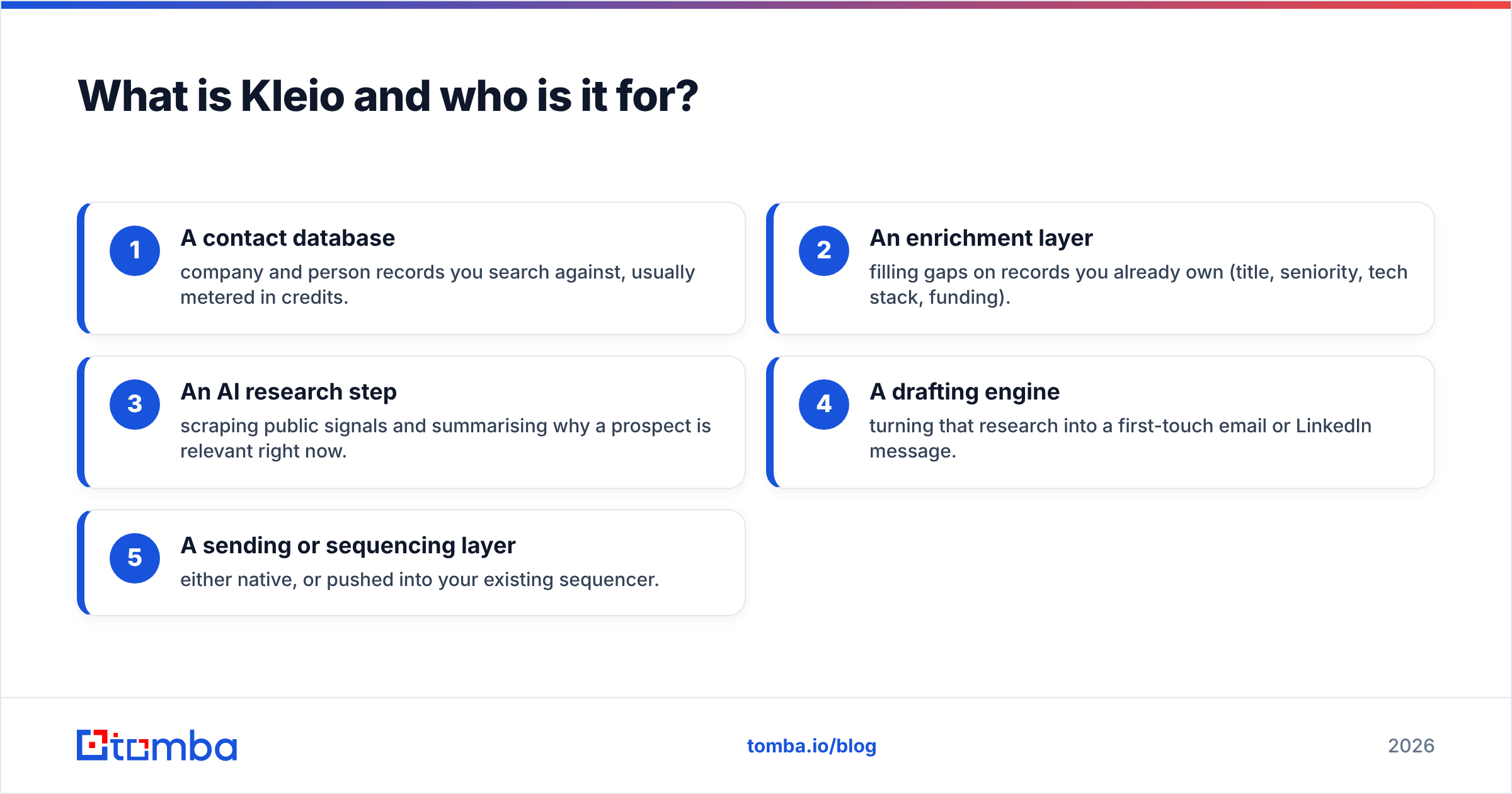
The important thing to understand before you look at any number is the shape of the product, because the shape determines the pricing model. Tools in this category typically bundle five things:
- A contact database — company and person records you search against, usually metered in credits.
- An enrichment layer — filling gaps on records you already own (title, seniority, tech stack, funding).
- An AI research step — scraping public signals and summarising why a prospect is relevant right now.
- A drafting engine — turning that research into a first-touch email or LinkedIn message.
- A sending or sequencing layer — either native, or pushed into your existing sequencer.
Each of those five is a separate cost driver, and vendors meter them differently. That is precisely why a public price list is rare here: a customer who uses the database heavily and the AI lightly costs the vendor something very different from the reverse. A single published number would either overcharge one group or lose money on the other.
So when you see "contact us for pricing," it is usually not evasiveness. It is a genuine consumption problem. What matters is whether the vendor is transparent once you are in the room.
How does Kleio pricing actually work?#
The pricing model to expect, based on how comparable AI-SDR platforms structure contracts in 2026, breaks into four components. Confirm each of these with a Kleio rep directly — vendor pricing shifts quarterly, and anything you read on a blog (including this one) is a starting point for the conversation, not a quote.
1. Platform fee. A base subscription that covers the workspace, integrations, and admin. This is often where the annual commitment lives.
2. Per-seat licence. Charged per active rep. Ask whether inactive or read-only seats (a manager who only views reporting) are billed at the same rate. Many vendors will carve those out if you ask, and almost none volunteer it.
3. Credits. Metered consumption for lookups, enrichments, and AI generations. The trap is that these are frequently pooled but not equivalent: one verified email might cost 1 credit, a phone number 5, and a full AI research pass 10. A "10,000 credit" plan can be a 1,000-prospect plan in practice.
4. Overages and rollover. What happens when you burn through the pool in week three? Some vendors auto-bill at a punitive rate, some soft-cap you, and some let unused credits roll. This single clause causes more billing disputes than any other line in the contract.
This is the standard consumption-plus-seats model that dominates modern SaaS sales tooling, and it is worth understanding on its own terms before you evaluate any specific vendor.
What should you ask on the pricing call?#
- What is the all-in first-year cost for our exact seat count, not the list price?
- What is the credit cost of each individual action, itemised?
- What is the overage rate, and can we hard-cap it?
- What is the contractual renewal uplift ceiling?
- Is there a month-to-month option, and what is the premium for it?
- What happens to our enriched data if we churn — do we keep the export?
Get answers in writing. A rep who will not itemise the credit table is telling you something useful.
What do Kleio reviews say — the honest pros and cons?#
Strip away the marketing on both sides and the review pattern for AI-SDR platforms is remarkably consistent. Here is what tends to hold up and what tends to bite.
The pros:
- Time-to-first-campaign is genuinely fast. Teams routinely report going from signup to live sequence in under a week, versus a month of stitching together a data tool, an enrichment tool, and a sequencer.
- AI research quality beats generic merge tags. A first line referencing a real funding round or job posting outperforms
{{company}}personalisation, and buyers notice the reply-rate difference. - One vendor, one invoice, one support queue. For a RevOps lead managing eleven tools, consolidation has real operational value that does not show up on a feature matrix.
- Onboarding tends to be hands-on. Quote-based vendors usually bundle implementation support, because their retention depends on you succeeding in the first 90 days.
The cons:
- Cost predictability is the number one complaint. Credit burn in month one is almost always higher than the estimate, because reps over-enrich while they are learning the tool.
- Data coverage is uneven by region and seniority. Every provider is strong somewhere and thin somewhere else. US mid-market tech is well covered almost everywhere; EMEA SMB and non-English markets are where coverage claims get tested.
- AI copy drifts toward sameness. If three competitors in your space use the same class of tool, your "personalised" opener starts to look like everybody else's. That erodes response rate over quarters, not weeks.
- Annual lock-in punishes wrong guesses. If you size for six reps and hire two, you pay for six.
- You are renting the data, not owning it. Check the export and post-termination clauses carefully.

Is Kleio worth it compared to the alternatives?#
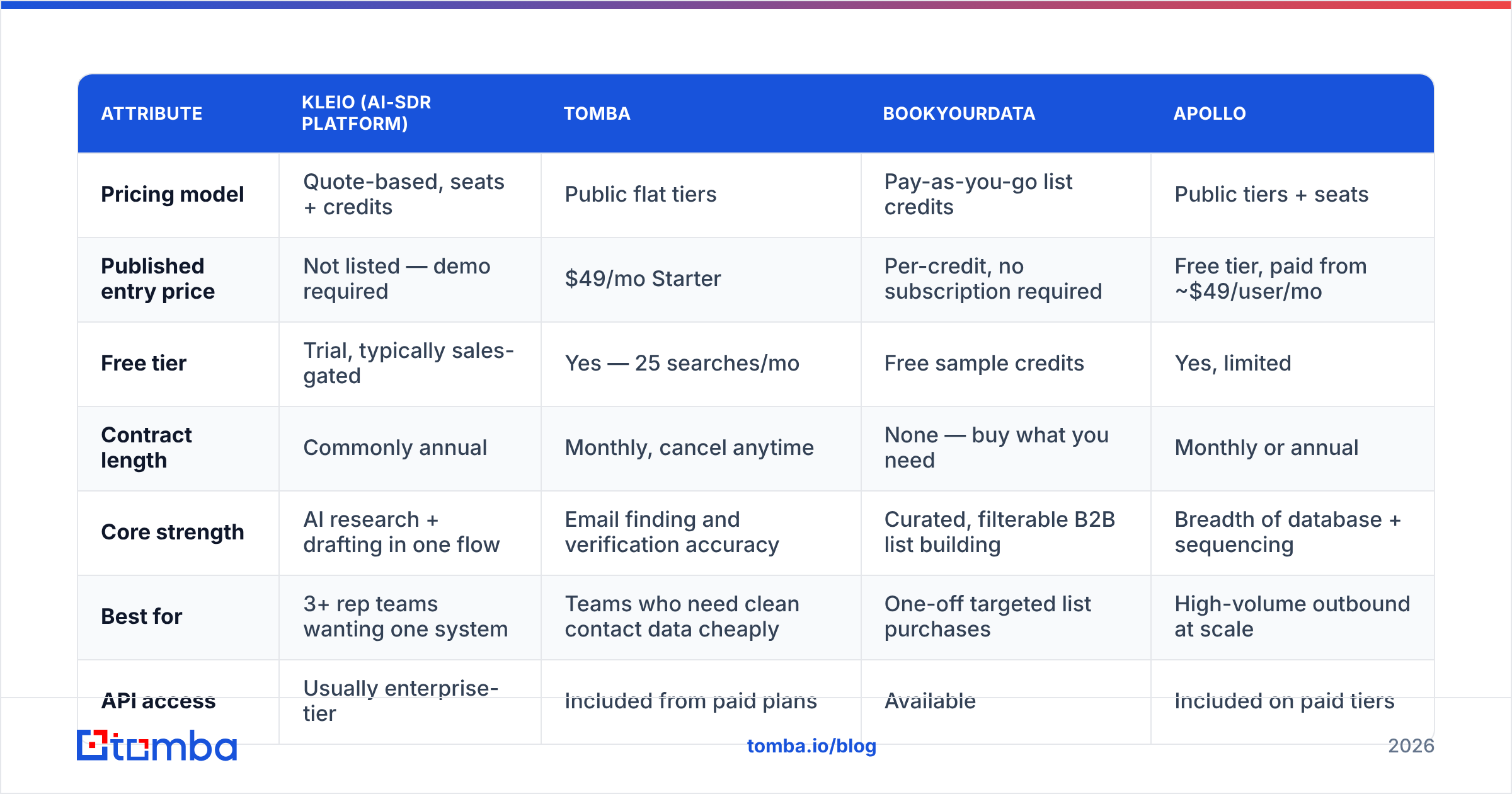
The honest answer depends entirely on which of the five layers you actually need. Here is how the options stack up on the attributes that drive total cost.
| Attribute | Kleio (AI-SDR platform) | Tomba | BookYourData | Apollo |
|---|---|---|---|---|
| Pricing model | Quote-based, seats + credits | Public flat tiers | Pay-as-you-go list credits | Public tiers + seats |
| Published entry price | Not listed — demo required | $49/mo Starter | Per-credit, no subscription required | Free tier, paid from ~$49/user/mo |
| Free tier | Trial, typically sales-gated | Yes — 25 searches/mo | Free sample credits | Yes, limited |
| Contract length | Commonly annual | Monthly, cancel anytime | None — buy what you need | Monthly or annual |
| Core strength | AI research + drafting in one flow | Email finding and verification accuracy | Curated, filterable B2B list building | Breadth of database + sequencing |
| Best for | 3+ rep teams wanting one system | Teams who need clean contact data cheaply | One-off targeted list purchases | High-volume outbound at scale |
| API access | Usually enterprise-tier | Included from paid plans | Available | Included on paid tiers |
| Biggest risk | Credit overage, seat lock-in | Narrower than a full sales suite | List quality varies by vertical | Data freshness at volume |
Two honest notes on that table. First, BookYourData solves a genuinely different problem — if you need 5,000 verified contacts in a specific vertical once, a pay-as-you-go list purchase with no subscription is a perfectly rational buy, and cheaper than any platform commitment. Second, Apollo and Kleio-class tools overlap heavily, so if you are evaluating one you should price the other; many teams find an Apollo alternative plus a dedicated finder beats either on total cost.
When is a flat-rate data tool the better buy?#
Run this test before you take the demo: write down the single sentence that describes your bottleneck.
If the sentence is "my reps do not know what to say," an AI-SDR platform is a defensible purchase. That is the problem it was built for.
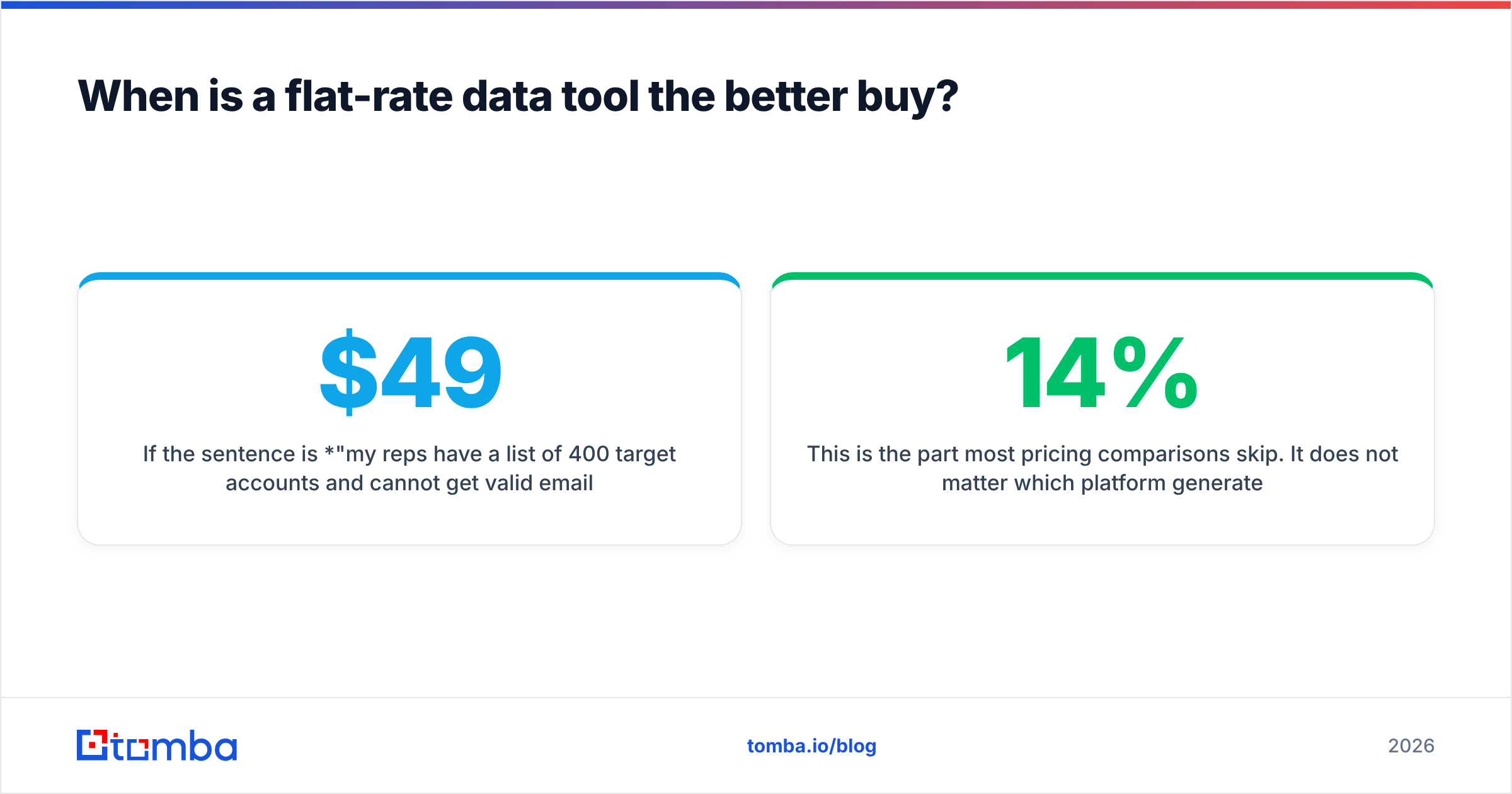
If the sentence is "my reps have a list of 400 target accounts and cannot get valid email addresses for the decision-makers," you have a data problem, and you are about to pay platform prices to solve it. A dedicated email finder plus a verification pass handles that for a flat monthly fee with no seat math. Tomba's published pricing runs Free (25 searches/mo), Starter $49/mo, Growth $99/mo, Pro $249/mo, with Enterprise quoted — and the entire ladder is visible without a sales call.
The cost gap matters at small scale. A three-seat AI-SDR contract with a platform fee and a credit pool routinely lands in five figures annually. A finder-plus-verifier stack for the same three reps is a few thousand. If your reps already write well — many founder-led sales teams do — the expensive layer is the one you do not need.
What about deliverability?#
This is the part most pricing comparisons skip. It does not matter which platform generated your list if 14% of it bounces. Bounce rates above 3% will damage sender reputation fast, and no amount of AI personalisation recovers an inbox that has been filtered. Whatever you buy, run the final list through an email verifier before the first send. HubSpot's own sales resources make the same point: list hygiene compounds more than copy quality over a full quarter.
If you are running lists in the thousands, a bulk email finder pass is faster than verifying inside a sequencer, and it keeps the cleanup cost off your platform credit pool.
How should you negotiate a quote-based contract?#
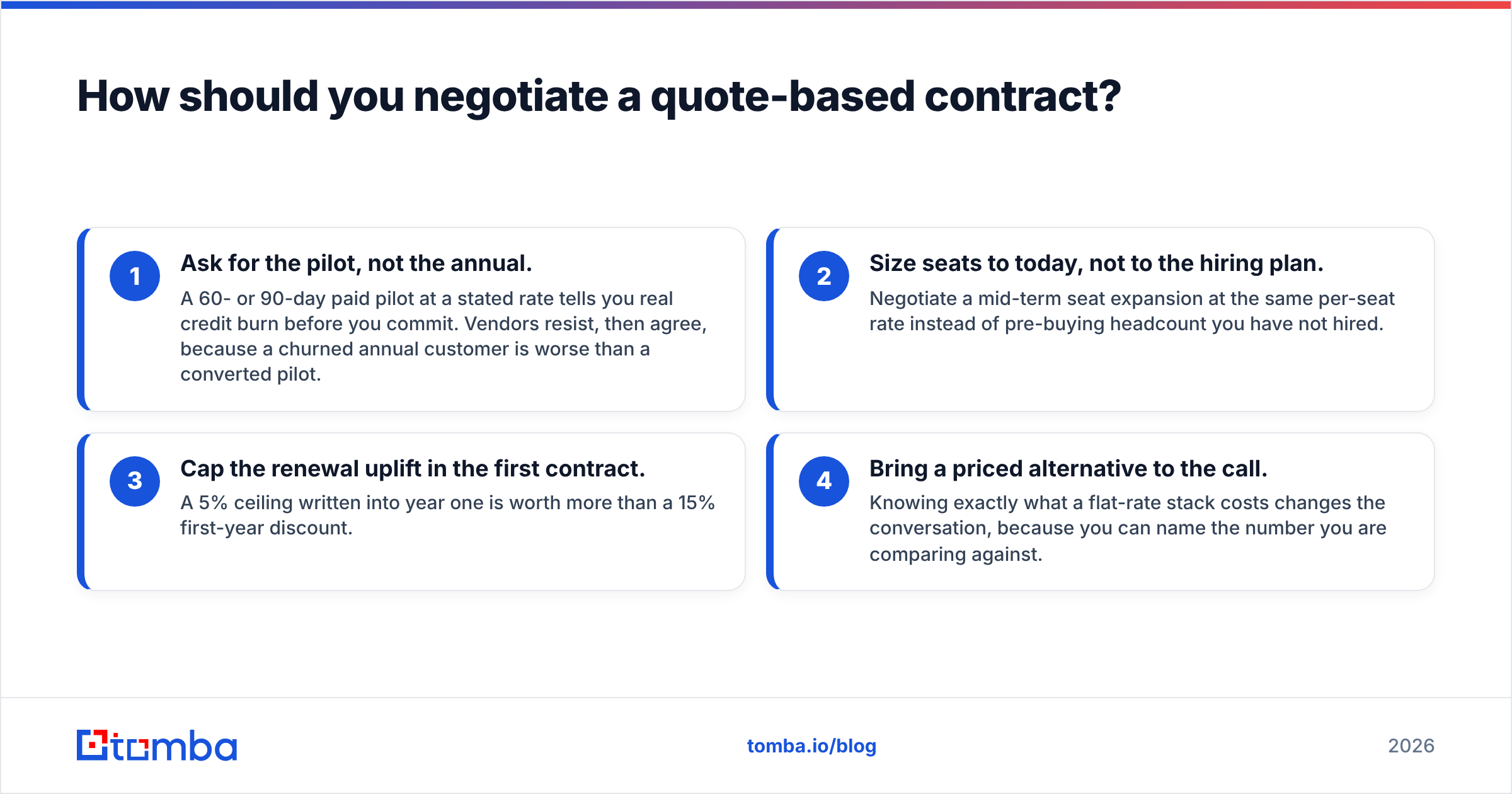
Four practical moves that consistently work:
- Ask for the pilot, not the annual. A 60- or 90-day paid pilot at a stated rate tells you real credit burn before you commit. Vendors resist, then agree, because a churned annual customer is worse than a converted pilot.
- Size seats to today, not to the hiring plan. Negotiate a mid-term seat expansion at the same per-seat rate instead of pre-buying headcount you have not hired.
- Cap the renewal uplift in the first contract. A 5% ceiling written into year one is worth more than a 15% first-year discount.
- Bring a priced alternative to the call. Knowing exactly what a flat-rate stack costs changes the conversation, because you can name the number you are comparing against.
Independent review platforms like Capterra are useful here, but read the one- and two-star reviews first — billing complaints cluster there, and they tell you which clause to negotiate.
Frequently asked questions#
Does Kleio publish public pricing? Like most AI-SDR platforms, expect a demo-gated quote rather than a self-serve price page. Confirm current terms with the vendor directly.
Is there a free plan? Trials in this category are typically sales-assisted rather than self-serve. If you need a genuinely free starting point for contact data, tools with published free tiers are the simpler path.
Can you cancel monthly? Ask explicitly. Annual commitments are the norm, and the month-to-month option usually carries a 15-25% premium when it exists at all.
Will it replace my sequencer and my data provider? Partly. Most teams keep at least one dedicated data source for coverage gaps, which means the "all-in-one" saving is smaller than the pitch suggests.
The bottom line#
Kleio-class platforms are worth it when your problem is the whole outbound motion and you have the headcount to amortise a platform fee. They are poor value when your problem is narrower than that, which for most teams under ten reps, it is.
Before you book the demo, price the alternative honestly. If what you actually need is accurate, verified contact data at a predictable monthly cost, start with the Tomba Email Finder — 25 free searches a month, $49/mo when you outgrow it, and no sales call required to find out what it costs.
Related guides#
// get started
Find, verify and enrich your first contacts today
Start on the free plan with 25 searches a month, then scale when your team is ready.
Free plan · No credit card required · GDPR & CCPA
Get the Tomba newsletter
Product and data updates
// about the author