9 Best Klue Alternatives in 2026 for Competitive Intel
Klue is strong at battlecards but priced for enterprise budgets and staffed like an enterprise program. Here are nine Klue alternatives — full platforms, lightweight trackers, and a build-it-yourself stack — with honest fit notes.
TL;DR
- Klue is a competitive enablement platform: it collects competitor signals, turns them into battlecards, and pushes those cards into Salesforce, Slack, and your CRM. It is good at that job.
- The two common reasons teams shop for Klue alternatives are cost (Klue doesn't publish pricing; buyers consistently report five-figure annual contracts) and staffing — the platform assumes someone owns competitive intel full time.
- Crayon is the closest like-for-like swap. Kompyte (now part of Semrush) is the mid-market option. Contify and AlphaSense serve research-heavy teams. Similarweb and Owler cover the cheap "just watch them" end.
- Gong and Chorus are not CI tools, but they answer the one question battlecards usually get wrong: which competitors actually come up in your deals.
- If your real goal is win rate rather than a content library, a lean stack — AI research, call recordings, and a contact data layer like Tomba's email finder — gets you 70% of the value for a rounding error of the budget.
What does Klue actually do?#
Klue sits in a category its founders helped name: competitive enablement. It's not a research database and it's not a sales-training tool. It's the pipe between what your competitors are doing and what your reps say on a call.
Three things happen inside it. First, ingestion: Klue crawls competitor sites, pricing pages, job boards, review sites, news, and — importantly — lets your team submit field intel from deals. Second, curation: a human (usually product marketing) triages those signals into battlecards. Third, distribution: the cards surface in Salesforce, Slack, Teams, Chrome, and increasingly inside AI assistants, so a rep hitting a "we're also looking at Competitor X" objection has an answer without opening a new tab.
That third step is why Klue wins deals against generic research tools. Intel nobody reads is a newsletter. Intel that appears in the opportunity record is enablement. If you want the vendor's own framing, klue.com lays out the product; G2's competitive intelligence category is the better place to read unfiltered reviews.

Why do teams look for Klue alternatives?#
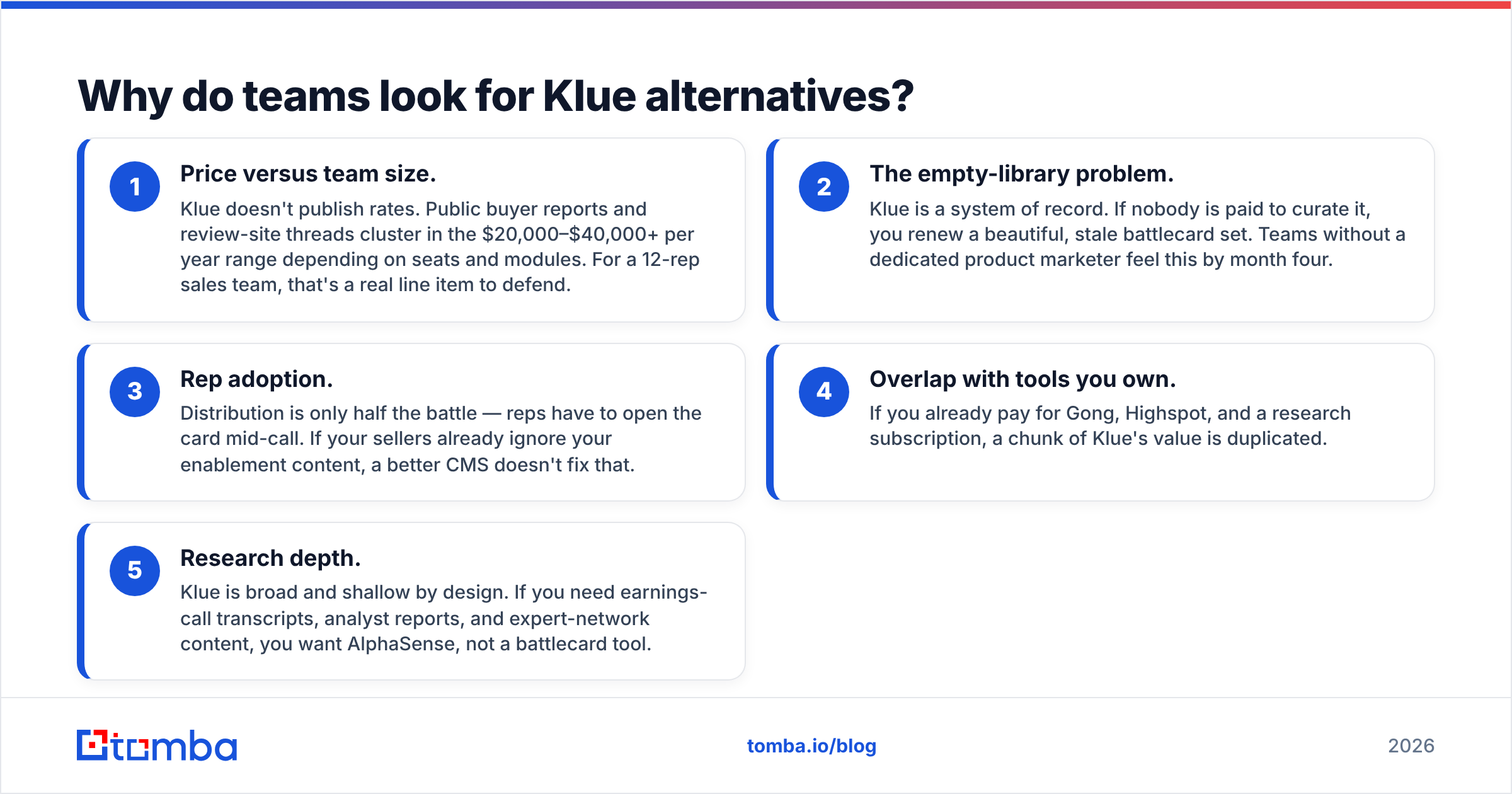
Not because it's bad. Almost every churn story lands on one of five things:
- Price versus team size. Klue doesn't publish rates. Public buyer reports and review-site threads cluster in the $20,000–$40,000+ per year range depending on seats and modules. For a 12-rep sales team, that's a real line item to defend.
- The empty-library problem. Klue is a system of record. If nobody is paid to curate it, you renew a beautiful, stale battlecard set. Teams without a dedicated product marketer feel this by month four.
- Rep adoption. Distribution is only half the battle — reps have to open the card mid-call. If your sellers already ignore your enablement content, a better CMS doesn't fix that.
- Overlap with tools you own. If you already pay for Gong, Highspot, and a research subscription, a chunk of Klue's value is duplicated.
- Research depth. Klue is broad and shallow by design. If you need earnings-call transcripts, analyst reports, and expert-network content, you want AlphaSense, not a battlecard tool.
Be honest about which one applies to you. If the answer is #2 or #3, switching vendors will not help — the alternative you need is a person, not a platform.
How do the main Klue alternatives compare?#
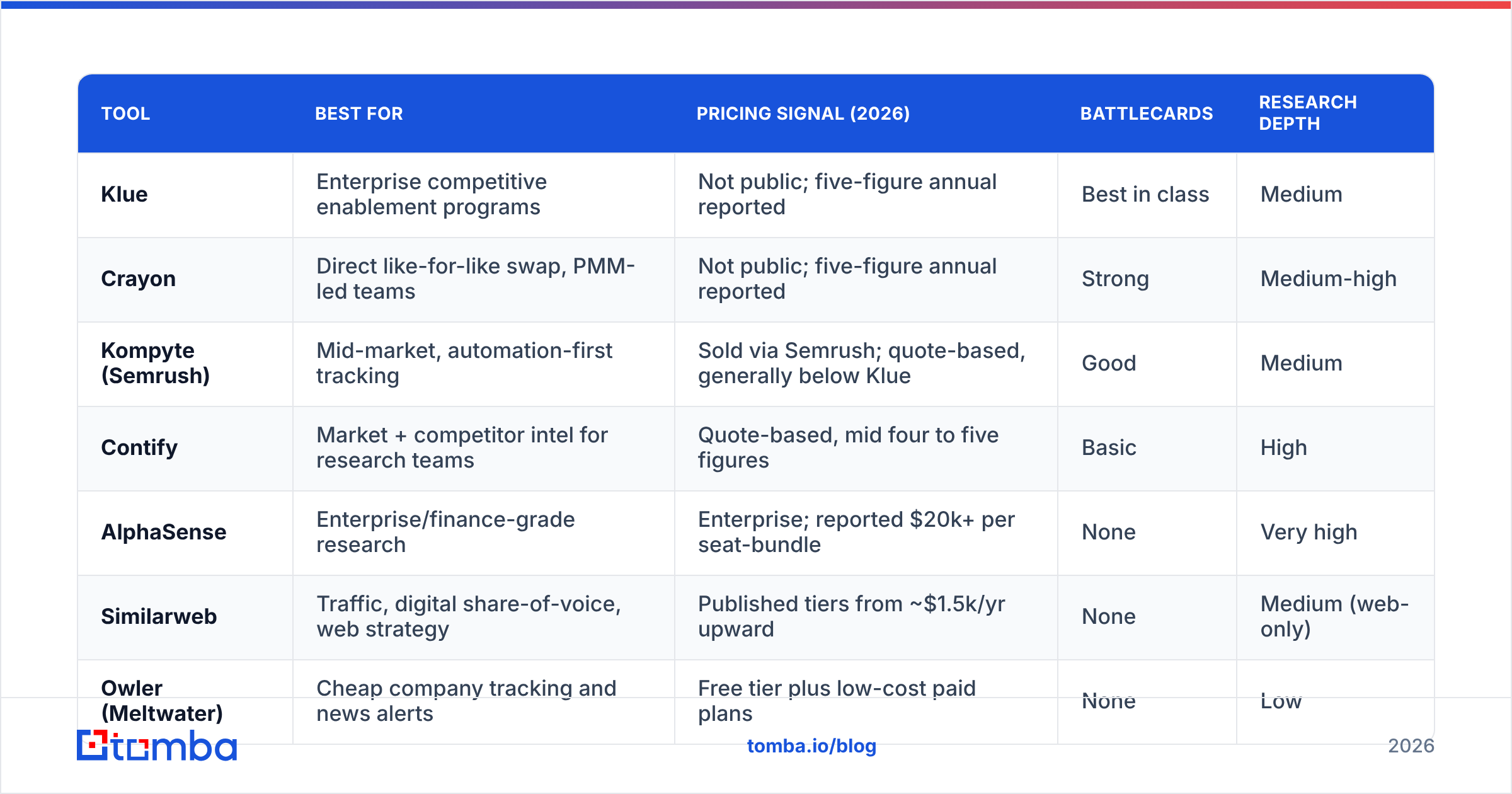
| Tool | Best for | Pricing signal (2026) | Battlecards | Research depth |
|---|---|---|---|---|
| Klue | Enterprise competitive enablement programs | Not public; five-figure annual reported | Best in class | Medium |
| Crayon | Direct like-for-like swap, PMM-led teams | Not public; five-figure annual reported | Strong | Medium-high |
| Kompyte (Semrush) | Mid-market, automation-first tracking | Sold via Semrush; quote-based, generally below Klue | Good | Medium |
| Contify | Market + competitor intel for research teams | Quote-based, mid four to five figures | Basic | High |
| AlphaSense | Enterprise/finance-grade research | Enterprise; reported $20k+ per seat-bundle | None | Very high |
| Similarweb | Traffic, digital share-of-voice, web strategy | Published tiers from ~$1.5k/yr upward | None | Medium (web-only) |
| Owler (Meltwater) | Cheap company tracking and news alerts | Free tier plus low-cost paid plans | None | Low |
| Gong / Chorus | What competitors are mentioned in real deals | Quote-based, per-seat | Deal-level cards | Low (first-party only) |
| DIY AI + data stack | Lean teams, founders, sub-20-rep orgs | Roughly $100–$400/mo all-in | Manual | Depends on you |
Pricing for most of this category is quote-only, so treat the figures above as direction, not gospel — the number you get depends on seats, modules, and how badly the rep needs the quarter.
Which Klue alternative fits which team?#
Crayon — the straight swap#
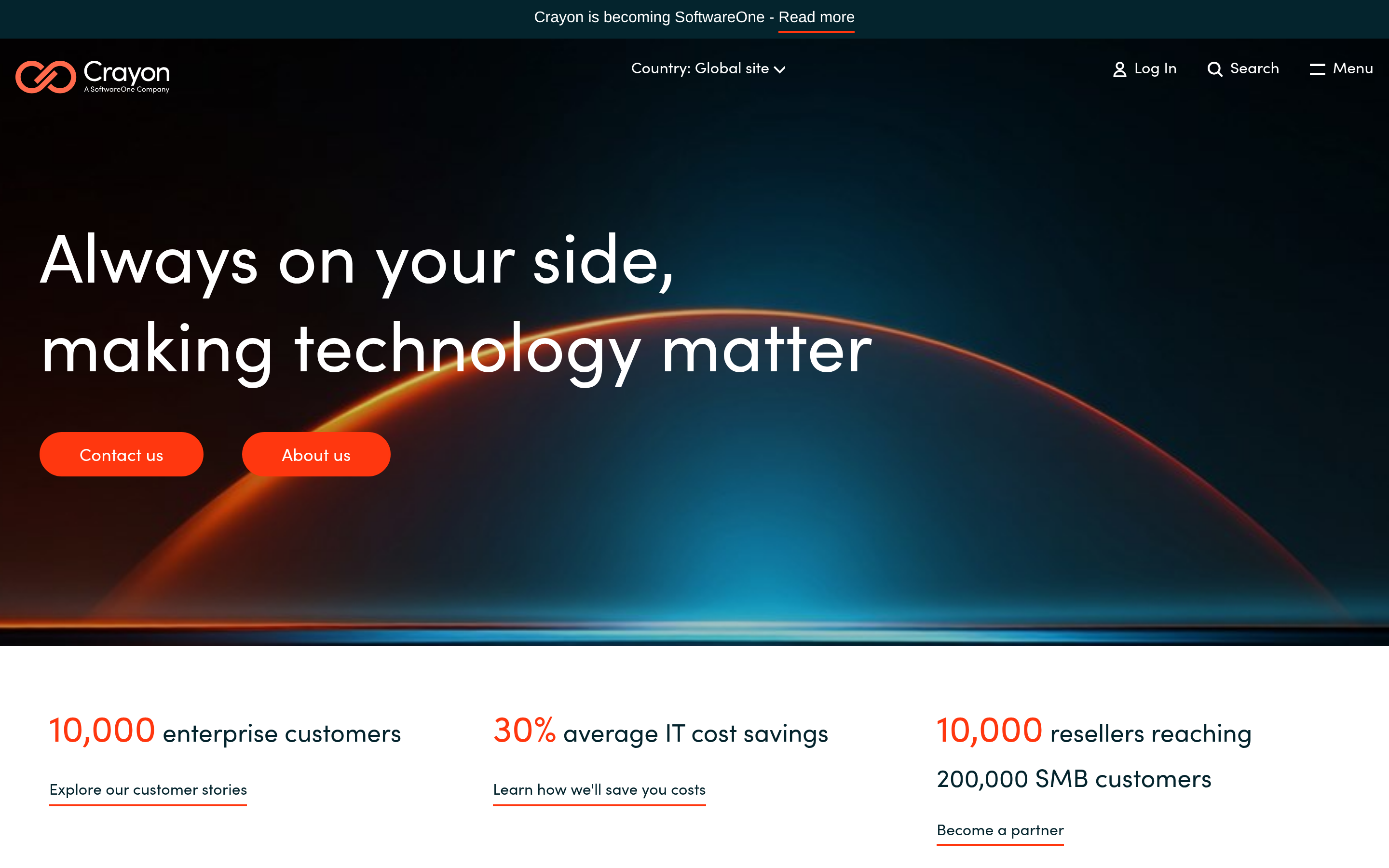
Crayon is the other name in every competitive enablement shortlist, and the feature comparison is close enough that the decision usually comes down to the demo and the discount. Crayon leans slightly more toward automated capture volume and change tracking; Klue leans slightly more toward curation workflow and distribution polish. If you already run a Klue-shaped program and you're unhappy with the account team rather than the category, Crayon is the lowest-friction move. Expect similar budget, though.
Kompyte — the mid-market pick#
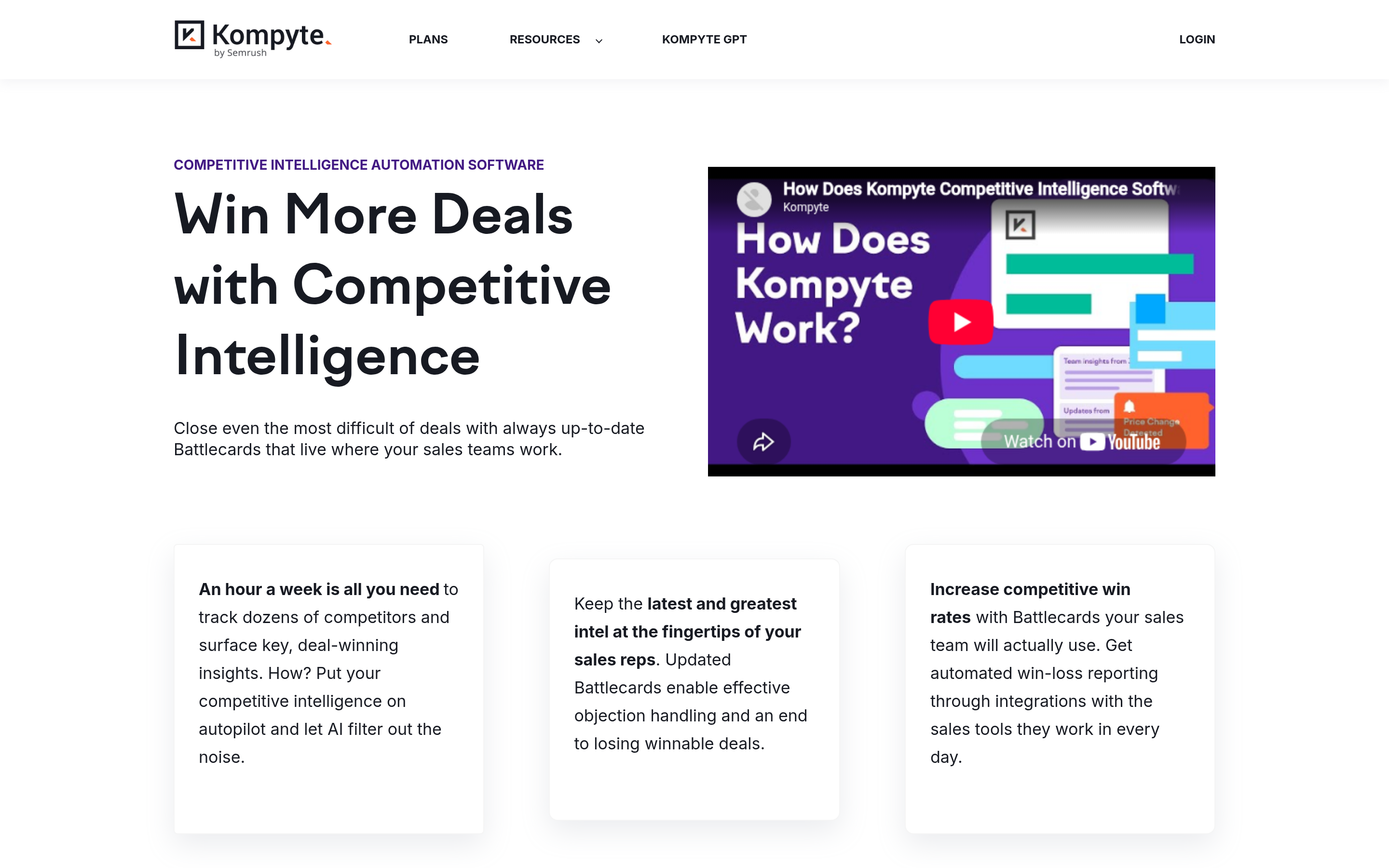
Kompyte was acquired by Semrush and now sits inside that ecosystem. It does the core loop — track competitor pages, ads, pricing, and content; generate battlecards; sync to CRM — with more automation and less required human curation than Klue. That trade matters: it means a marketing manager can run it at 20% of a full-time job. It's the most common answer when someone says "Klue but we're 40 people." Because it's bundled through Semrush, you may also collapse an SEO tool line item into the same contract.
Contify — for research teams, not sales teams#
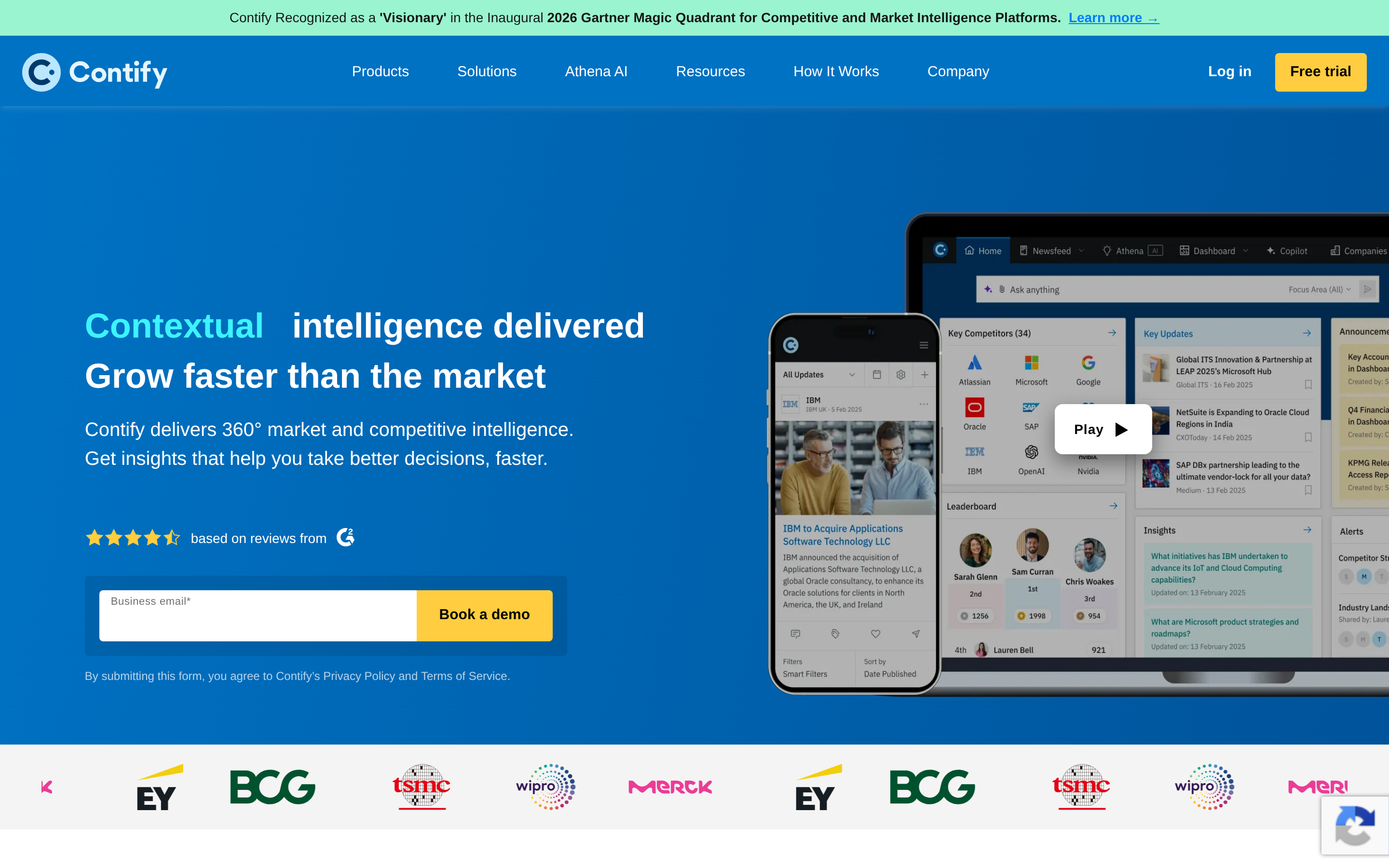
Contify is a market and competitive intelligence platform aimed at analysts. Taxonomy, custom feeds, newsletters, and intel distribution to many stakeholders — not just sellers. If your output is a monthly intel briefing for leadership rather than a card that pops up in an opportunity, Contify is a better shape than Klue and usually a smaller invoice.
AlphaSense — when depth is the whole point#

AlphaSense is a different category wearing similar clothes. It indexes earnings calls, filings, broker research, and expert-call transcripts with strong semantic search. You will not get a battlecard out of it. You will get the actual sentence a competitor's CFO said about margin pressure. Strategy, corp dev, and product teams love it. It is enterprise-priced.
Similarweb and Owler — the cheap perimeter#
Neither replaces Klue. Both replace a chunk of what people actually use Klue for. Similarweb tells you whether a competitor's traffic, paid spend, and keyword footprint are growing. Owler gives you free-to-cheap company profiles, funding news, and headcount signals. Together they cost a fraction of a CI platform and answer "are they beating us?" reasonably well — they just won't answer "what do I say on the call?"
Gong or Chorus — the reality check#
Every competitive program should start here. Conversation intelligence tells you which competitors are named in your pipeline, at what stage, and what happened to those deals. Most teams discover their battlecard library is weighted toward the competitor they fear, not the one that actually costs them revenue. If you can only buy one thing, buy the tool that measures the problem before you buy the tool that solves it.
Can you build a competitive intelligence stack yourself?#
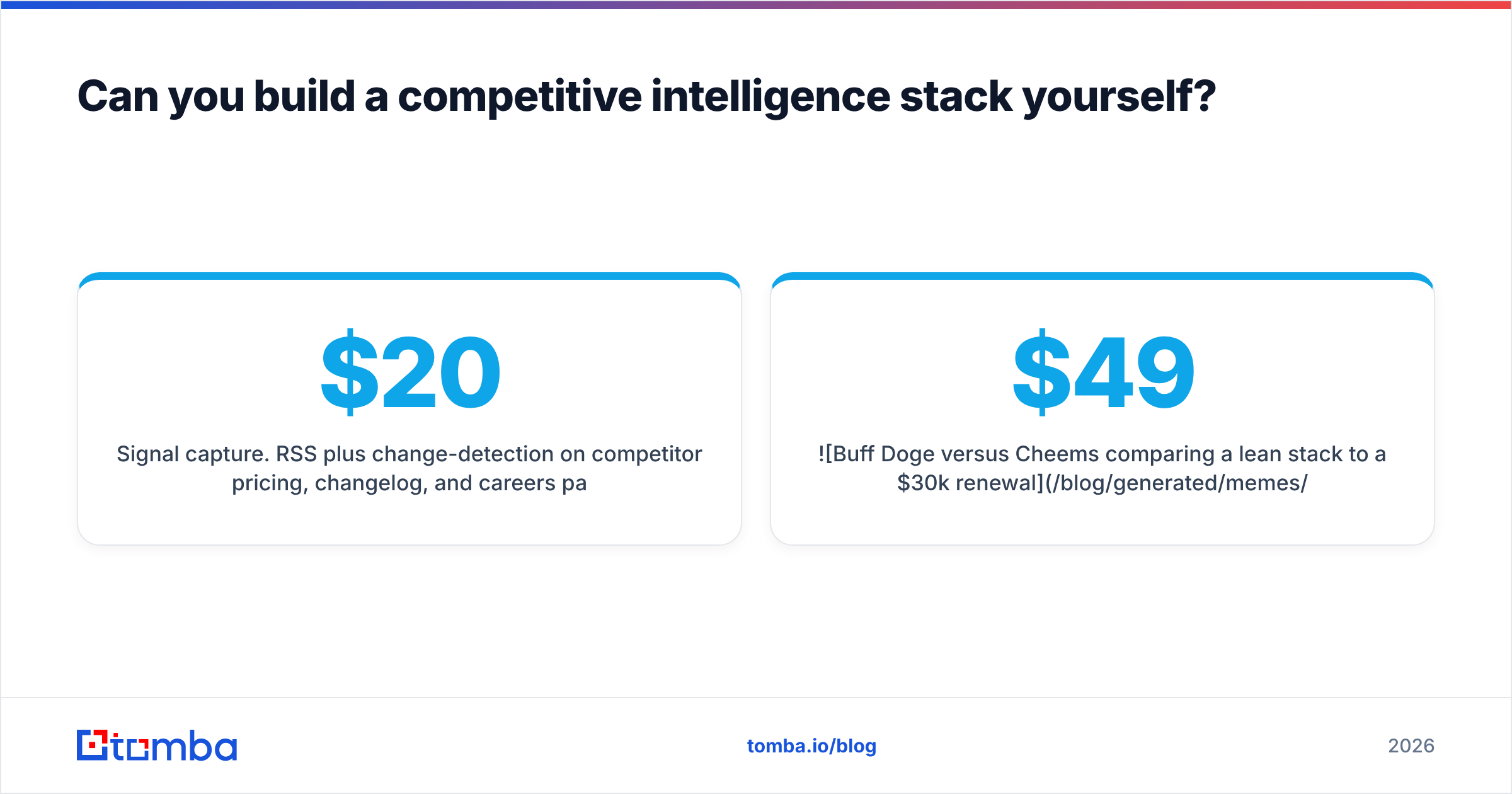
Yes — and for teams under about 20 reps, it's usually the right call. The platform value of Klue is workflow and storage. Both are replaceable when your competitor set is five names, not fifty.
A workable DIY stack in 2026 looks like this:
- Signal capture. RSS plus change-detection on competitor pricing, changelog, and careers pages. Free to ~$20/mo. Job postings are the single most underrated leak — hiring three enterprise AEs in DACH tells you the roadmap before the press release does.
- Synthesis. An AI assistant with web access summarising the week's changes into a short brief. This is the step that used to require a headcount and now takes 20 minutes on Friday.
- Storage and distribution. A Notion or Google Doc battlecard per competitor, linked directly from the CRM opportunity record. Ugly, free, and used — which beats elegant and ignored.
- Deal evidence. Your call recordings, tagged by competitor. This is where the real objections live, not on the competitor's website.
- Contact and account data. The layer most DIY stacks forget. Knowing a competitor launched a partner program is trivia until you can reach the people affected by it.
That last point is where a data provider earns its keep. When you learn a rival has raised prices, sunset a product, or laid off a support team, the play is to contact their customers — fast. That means resolving company domains to real, deliverable inboxes and phone numbers. Tools like domain search and data enrichment turn an intel signal into a contactable list the same afternoon. Website visitor reveal closes the other loop: you can see which companies are comparison-shopping you right now instead of guessing.

What should you check before you switch?#
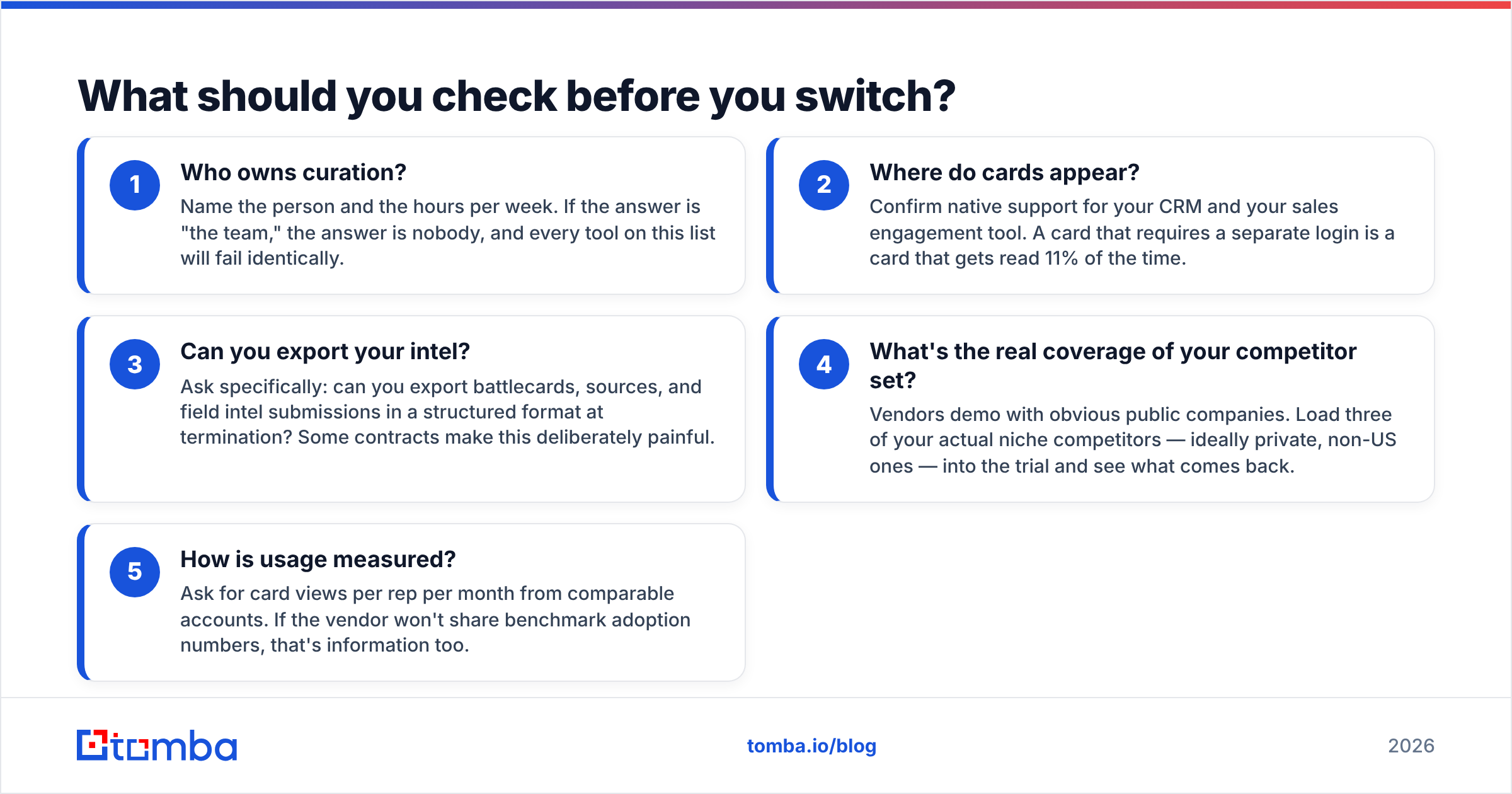
Switching CI platforms is a migration, not a purchase. Five questions to settle in writing before signing anything:
- Who owns curation? Name the person and the hours per week. If the answer is "the team," the answer is nobody, and every tool on this list will fail identically.
- Where do cards appear? Confirm native support for your CRM and your sales engagement tool. A card that requires a separate login is a card that gets read 11% of the time.
- Can you export your intel? Ask specifically: can you export battlecards, sources, and field intel submissions in a structured format at termination? Some contracts make this deliberately painful.
- What's the real coverage of your competitor set? Vendors demo with obvious public companies. Load three of your actual niche competitors — ideally private, non-US ones — into the trial and see what comes back.
- How is usage measured? Ask for card views per rep per month from comparable accounts. If the vendor won't share benchmark adoption numbers, that's information too.
Run that list against Klue as well as the alternative. Half the time the incumbent survives on question 3 alone, and you renegotiate instead of migrating.
Is Klue still worth it in 2026?#
For a company with a dedicated competitive function, 15+ named competitors, and a sales org large enough that inconsistent messaging costs real deals — yes. Klue's distribution and curation workflow are genuinely better than a Notion page, and the ROI math works when a single saved enterprise deal covers the contract.
For everyone else, the honest answer is that the category has commoditised at the low end. AI summarisation removed most of the manual research cost that justified the original price point. A sub-50-person GTM team can run credible competitive intel on a few hundred dollars a month and a recurring Friday calendar block. Crayon and Kompyte fight over the middle; the bottom is now DIY; the top belongs to AlphaSense and Klue.
Pick based on where your bottleneck is. If it's research, buy depth. If it's rep behaviour, buy distribution. If it's neither — if you simply don't know who you're losing to — start with your own call data before you spend a dollar on a platform.
Turn competitive signals into pipeline#
Competitive intelligence only pays when it ends in a conversation. A competitor raising prices, losing a key integration, or quietly shrinking their support team is a buying trigger — but only if you can reach the right person at the accounts affected within days, not quarters.
That's the gap Tomba Email Finder closes. Feed it a company domain and a name and get a verified business email back, with catch-all handling and bulk processing when the list is a hundred accounts deep instead of one. Plans start free with 25 searches a month, then $49/mo on Starter and $99/mo on Growth — see Tomba pricing for the full breakdown. Whichever Klue alternative you land on, the intel is only worth what you do with it next.
Related guides#
// get started
Find, verify and enrich your first contacts today
Start on the free plan with 25 searches a month, then scale when your team is ready.
Free plan · No credit card required · GDPR & CCPA
// about the author