Knowlarity Pricing Reviews Pros and Cons: 2026 Guide
Knowlarity sells cloud telephony on quotes, not price tags. Here is how the billing actually stacks up, what reviewers keep complaining about, and when a cheaper stack wins.
Knowlarity pricing reviews pros and cons, in one page. Here is what the plans cost, what buyers praise, and what they warn you about.
TL;DR
- Knowlarity is a cloud phone platform. It sells IVR, virtual numbers, toll-free lines, click-to-call, a cloud contact center and the WhatsApp Business API. It is strongest in India, Southeast Asia and the Middle East. Ozonetel bought it in 2023.
- There is no public price list. Every quote is built from four or five line items. That is why buyers get surprised at renewal.
- Reviewers praise uptime, IVR options and local number coverage. They complain about slow support, thin reporting and unclear bills.
- It fits teams with heavy inbound call volume in those regions. It is a poor fit if you want simple per-seat pricing you can read on a web page.
- Phones are only half the job. A dialer with bad numbers just burns minutes faster. Fix the contact data first.
What is Knowlarity and who actually uses it?#
Knowlarity is a cloud phone provider. It started in 2009 and sits in Gurugram, India. Think of it as phone plumbing you rent instead of build. You rent numbers, route calls in the cloud, record them, and push the data into your CRM. Ozonetel bought the company in 2023. Ozonetel is another Indian cloud contact center firm, so you are buying into a combined product family.
The typical buyer is not a five-person startup in Berlin. It is a 50 to 500 person team with real inbound call volume. Think an edtech admissions desk, a hospital chain, a lender, a logistics firm or a D2C support line. Most sit in India, the UAE, Singapore or the Philippines. That regional pull matters more than any feature list. Need an Indian toll-free number with the right paperwork? Knowlarity handles that far better than a US-first vendor.
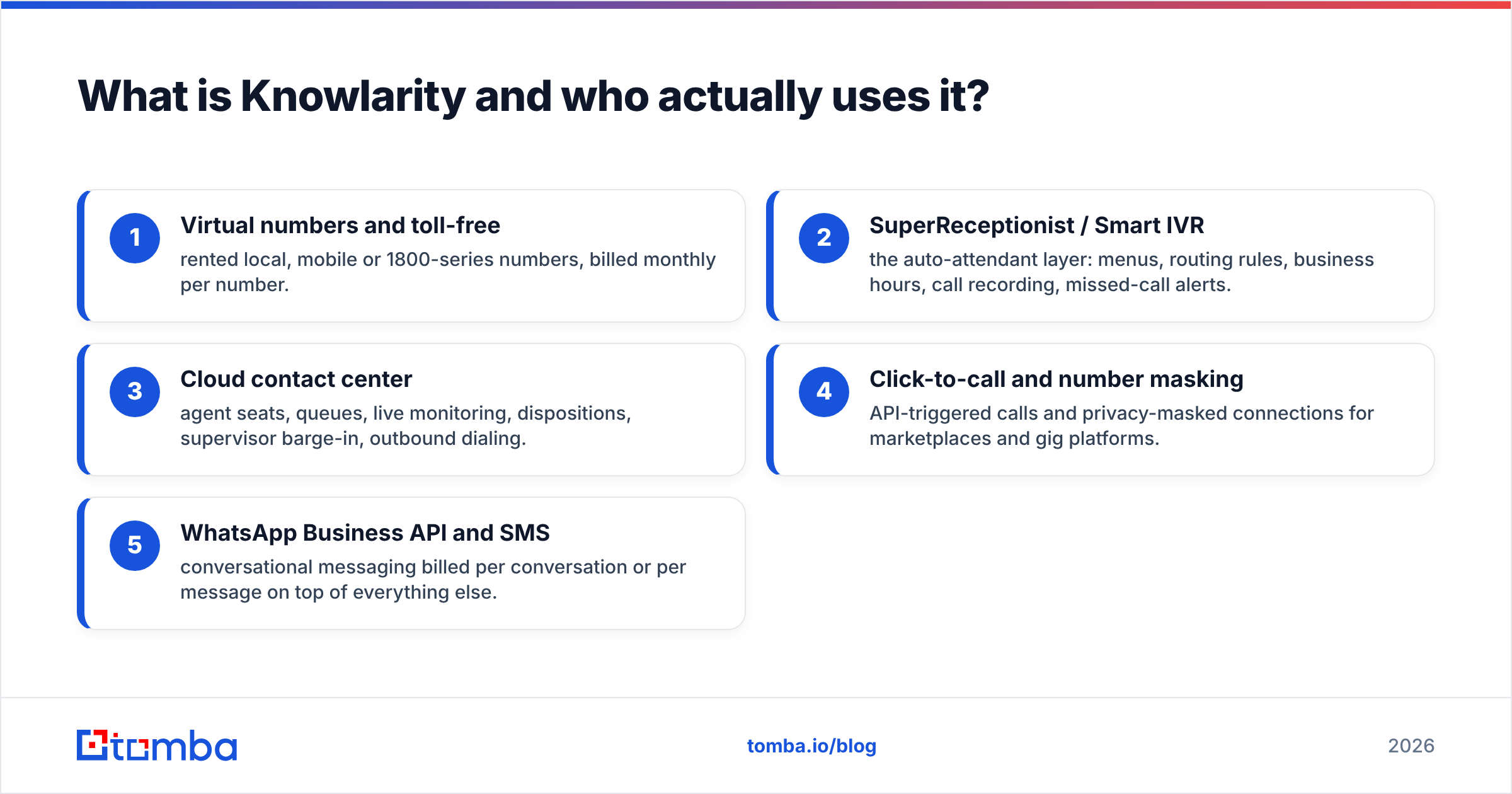
The product has five modules. Your quote depends on which ones you turn on:
- Virtual numbers and toll-free — rented local, mobile or 1800 numbers. Billed monthly, per number.
- SuperReceptionist / Smart IVR — the auto-attendant. Menus, routing rules, business hours, call recording and missed-call alerts.
- Cloud contact center — agent seats, queues, live monitoring, dispositions, supervisor barge-in and outbound dialing.
- Click-to-call and number masking — calls fired from an API, plus masked numbers for marketplaces and gig apps.
- WhatsApp Business API and SMS — messaging billed per conversation or per message, on top of the rest.
Most rivals bundle two or three of those into one per-seat price. Knowlarity usually does not. Keep that in mind before you read a proposal.
Knowlarity pricing reviews pros and cons: how the billing works#
Short answer: you get a built bill, not a plan. There is no published $49 tier. Sales sets the price. It moves with country, volume and contract length, and Indian entities are usually quoted in INR. Treat any number on a third-party listicle as a stale guess.
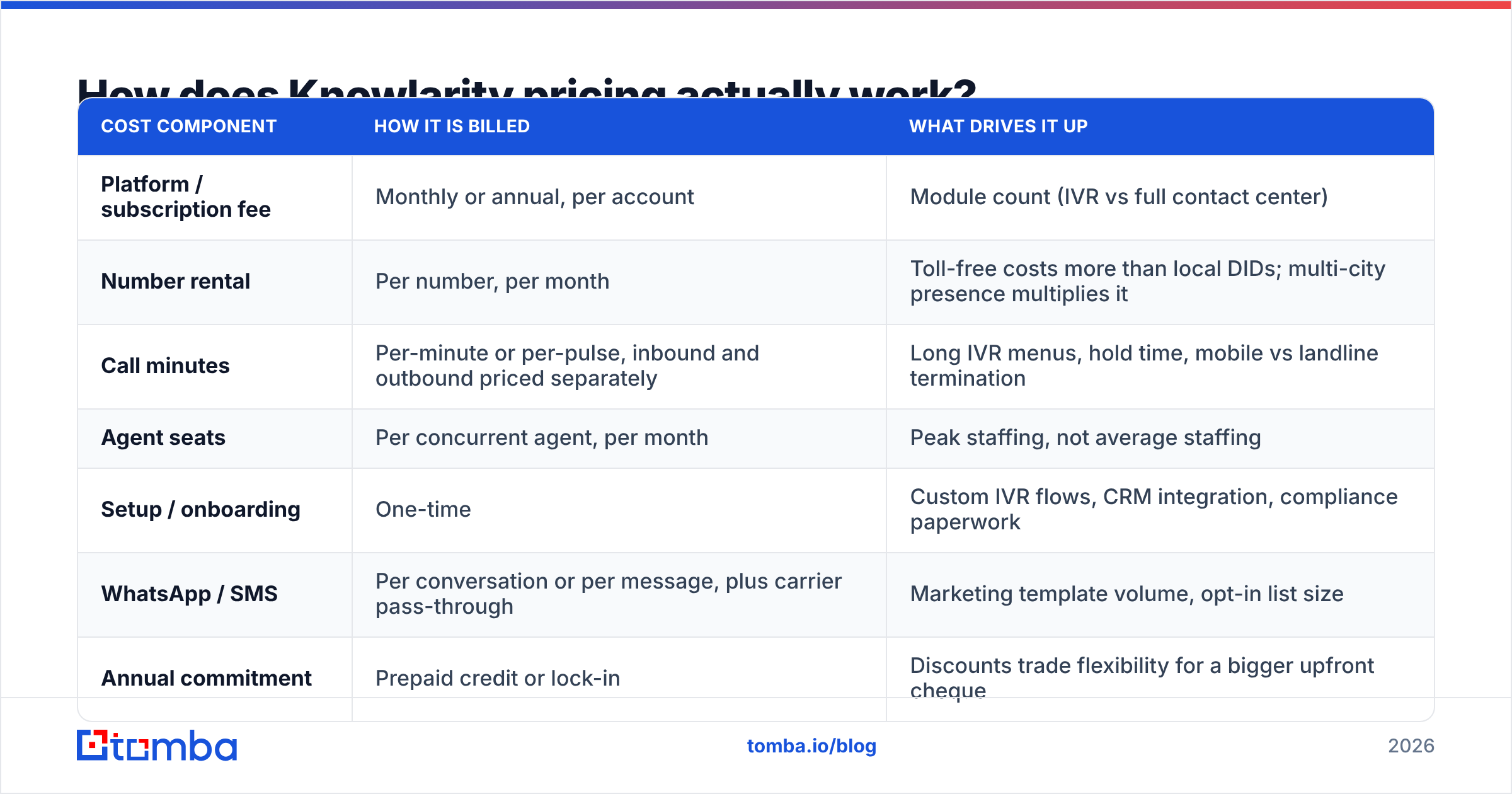
You can still plan around the structure. Buyers describe quotes made of these parts:
| Cost component | How it is billed | What drives it up |
|---|---|---|
| Platform / subscription fee | Monthly or annual, per account | Module count (IVR vs full contact center) |
| Number rental | Per number, per month | Toll-free costs more than local DIDs; multi-city presence multiplies it |
| Call minutes | Per-minute or per-pulse, inbound and outbound priced separately | Long IVR menus, hold time, mobile vs landline termination |
| Agent seats | Per concurrent agent, per month | Peak staffing, not average staffing |
| Setup / onboarding | One-time | Custom IVR flows, CRM integration, compliance paperwork |
| WhatsApp / SMS | Per conversation or per message, plus carrier pass-through | Marketing template volume, opt-in list size |
| Annual commitment | Prepaid credit or lock-in | Discounts trade flexibility for a bigger upfront cheque |
Two things follow. First, your minute cost decides whether this is cheap or expensive. It is also the number buyers model worst. A team running 8,000 outbound minutes a month should care far more about per-minute rates than about the subscription line. Second, prepaid credit expires. Several buyers report balances lapsing at the end of a term. That is a real cost, and it never shows up in the proposal.
Ask for the quote split into those seven rows before you compare anything. One blended monthly number cannot be benchmarked against Ozonetel, Exotel, Twilio or MyOperator. That is usually the point.

Wait — that placeholder belongs here:

What do Knowlarity reviews say in 2026?#
Scores on G2 and Capterra are good but lopsided. Core call handling rates high. Everything around it rates lower.
What reviewers keep praising:
- Call quality and uptime in its home regions. This is the part that would sink the product if it broke. It rarely does.
- IVR flexibility. Multi-level menus, time-of-day routing and language handling. Most changes need no developer.
- Local numbers and compliance. The vendor already knows the paperwork for Indian toll-free and DID numbers. That saves weeks.
- Call recording and basic analytics. Reliable enough for QA and for settling disputes.
What reviewers keep criticising:
- Slow support. The most common complaint by volume. Tickets that need the carrier can drag, and big accounts get better service.
- Shallow reporting. Dashboards cover the basics. Teams that want cohort views or agent scorecards export to a BI tool.
- Billing clarity. Buyers report odd pulse rounding, add-ons on invoices, and minutes that do not match the dashboard.
- Dated UI. It works. Nobody buys this for the interface.
- Contract friction. Annual prepay and cancellation terms come up often enough to be a pattern, not an outlier.
Filter what you read. A gripe about one carrier route or one onboarding rep is noise. Gripes about billing and reporting are product-level, so they will apply to you too.
What are the pros and cons of Knowlarity?#
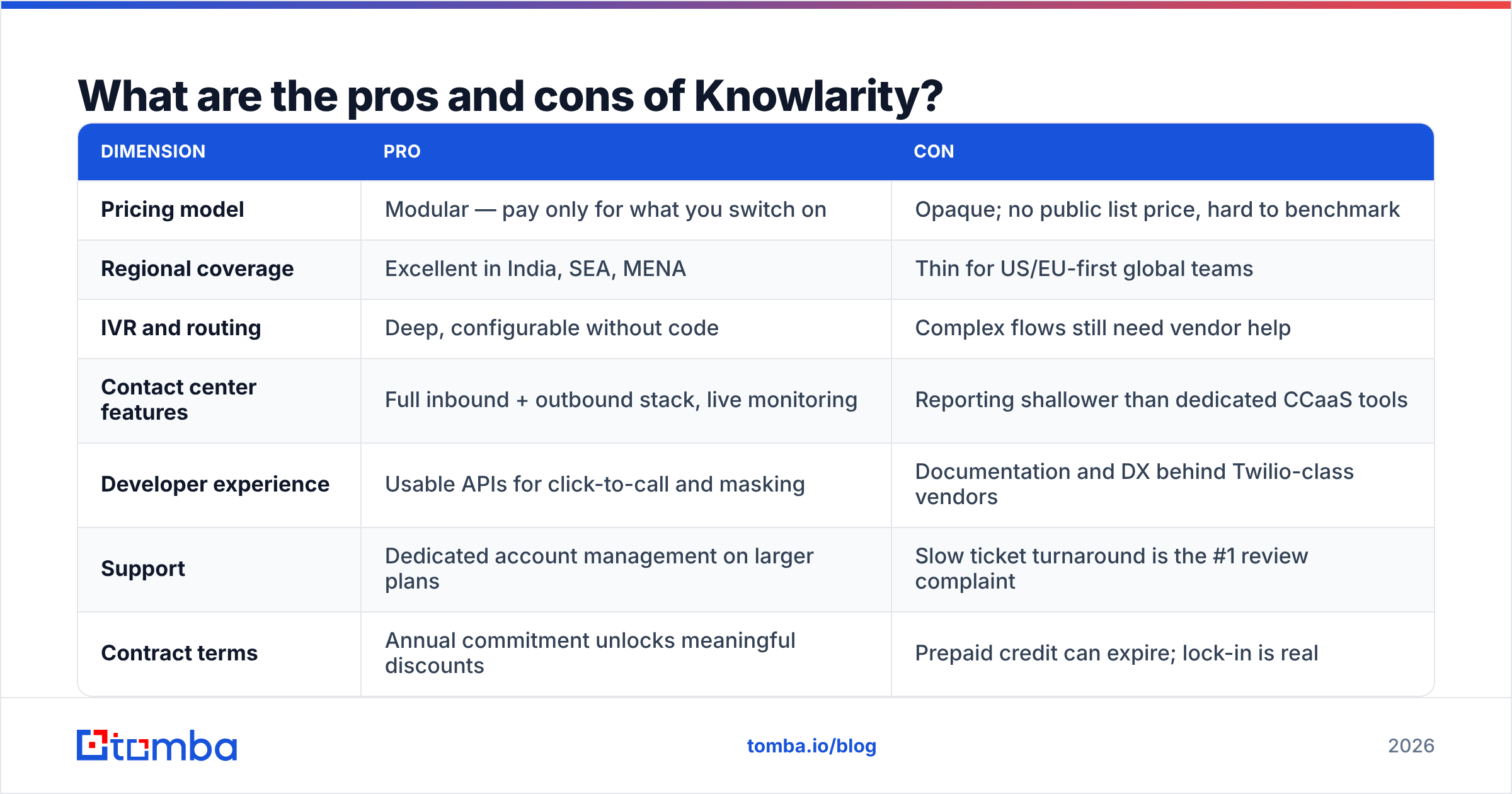
| Dimension | Pro | Con |
|---|---|---|
| Pricing model | Modular — pay only for what you switch on | Opaque; no public list price, hard to benchmark |
| Regional coverage | Excellent in India, SEA, MENA | Thin for US/EU-first global teams |
| IVR and routing | Deep, configurable without code | Complex flows still need vendor help |
| Contact center features | Full inbound + outbound stack, live monitoring | Reporting shallower than dedicated CCaaS tools |
| Developer experience | Usable APIs for click-to-call and masking | Documentation and DX behind Twilio-class vendors |
| Support | Dedicated account management on larger plans | Slow ticket turnaround is the #1 review complaint |
| Contract terms | Annual commitment unlocks meaningful discounts | Prepaid credit can expire; lock-in is real |
| Onboarding | Vendor handles number compliance paperwork | Setup fees and multi-week timelines are common |
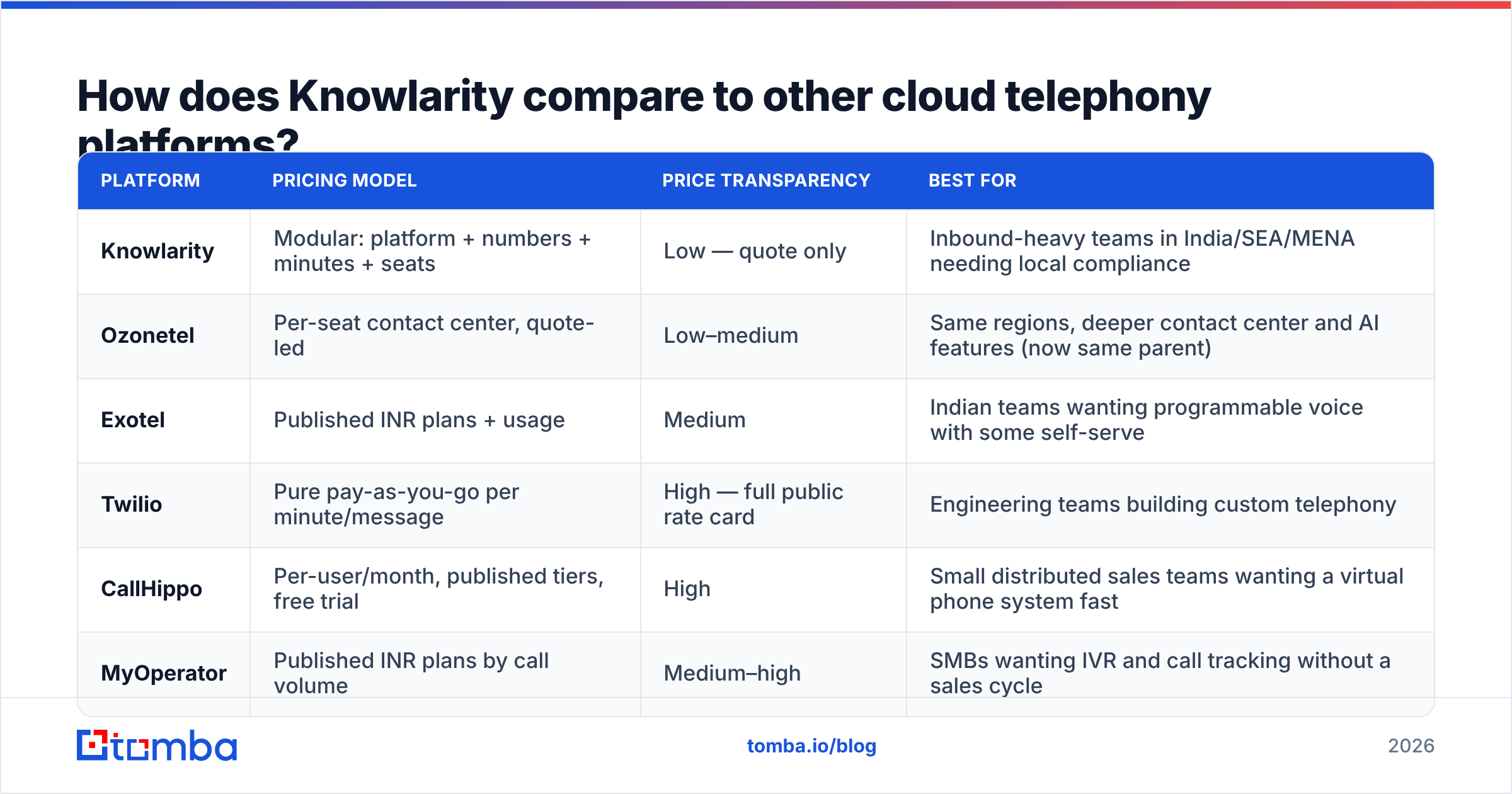
How does Knowlarity compare to other cloud telephony platforms?#
Knowlarity sits in the middle of a barbell. At one end sit developer-first, pay-as-you-go APIs. At the other sit self-serve, per-seat business phone tools. Knowlarity is a managed regional platform that borrows from both.
| Platform | Pricing model | Price transparency | Best for |
|---|---|---|---|
| Knowlarity | Modular: platform + numbers + minutes + seats | Low — quote only | Inbound-heavy teams in India/SEA/MENA needing local compliance |
| Ozonetel | Per-seat contact center, quote-led | Low–medium | Same regions, deeper contact center and AI features (now same parent) |
| Exotel | Published INR plans + usage | Medium | Indian teams wanting programmable voice with some self-serve |
| Twilio | Pure pay-as-you-go per minute/message | High — full public rate card | Engineering teams building custom telephony |
| CallHippo | Per-user/month, published tiers, free trial | High | Small distributed sales teams wanting a virtual phone system fast |
| MyOperator | Published INR plans by call volume | Medium–high | SMBs wanting IVR and call tracking without a sales cycle |
Does your finance team refuse to sign anything it cannot model? Then Twilio's public rate card or a per-seat tool wins on process alone, even if Knowlarity costs less in absolute terms. Do local compliance and a managed relationship matter more? Then the quote-led vendors earn their keep. Both views are fair. They are just different ways to buy. For background on the category, the cloud communications overview on Wikipedia is a neutral primer. Knowlarity's own site and Ozonetel show how the combined portfolio is sold today.
Who should buy Knowlarity — and who should skip it?#
Buy it if:
- Your call volume is mostly inbound. You need solid IVR routing more than outbound dialing power.
- You work in India, the UAE, Singapore or nearby markets. You need local or toll-free numbers with clean compliance.
- You want a vendor that runs onboarding for you, rather than handing you API docs.
- You have the volume to negotiate. Roughly 20 seats or five-figure monthly minutes beats the self-serve options.
Skip it if:
- You want to sign up with a card today and be live in an hour.
- Your buying committee needs a published price list to approve anything.
- You are a US or EU team with no regional need. You would pay a relationship premium for coverage you never use.
- Your main job is outbound cold calling at volume with tight CRM sequencing. That is a different category, and sales engagement tools do it better.
One more test. Ask for per-minute rates, pulse rounding, credit expiry and the cancellation window in writing. A vendor that answers all four is one you can plan around. A vendor that dodges them has told you something.
How do you feed a dialer with contacts that actually connect?#
Here is the part buyers miss. The cost of a call is not the per-minute rate. It is the rate divided by your connect rate. Dial a list where a third of the numbers are dead, reassigned or wrong-department, and a $0.01 plan behaves like a $0.03 plan. No amount of haggling fixes that.
B2B phone data goes stale fast. People change jobs. Companies change carriers. Direct dials get reassigned. Switchboard numbers scraped from a website drop you at reception. If half your dial time goes to numbers that were never going to connect, the phone contract is the wrong thing to fix.
Three fixes, in order of impact:
- Validate before you dial. Run the list through a phone validator. It strips bad formats, dead lines and wrong-country numbers before they reach the dialer.
- Get direct dials, not switchboards. A phone finder returns the contact's own line. That beats a main number and a gatekeeper every time.
- Enrich so the call has a reason to exist. Contact enrichment adds role, seniority, company size and tech stack. Relevance lifts your connect-to-conversation rate more than any dialer feature.
Do all three and your cost per conversation falls. You never have to renegotiate a line of the quote. It also makes the quote easier to size, because fewer wasted minutes means fewer minutes to buy.
What should you do next?#
Get the itemised quote. Model your real minute volume. Compare it with a published rate card so you can see the managed-service premium. That is the honest core of the Knowlarity pricing reviews pros and cons story: a competent platform with a real regional moat, sold in a way that makes it hard to judge.
Then fix the input side. Clean the contact list before your next outbound push. Tomba's Email Finder returns verified professional email addresses by name, domain or company. The free tier gives you 25 searches a month, so you can test accuracy on your own accounts. Paid plans start at $49 a month — see Tomba pricing for the full breakdown. Pair verified email with validated direct dials, and your dialer stops being an expense line and starts being a pipeline line.
Related guides#
// get started
Find, verify and enrich your first contacts today
Start on the free plan with 25 searches a month, then scale when your team is ready.
Free plan · No credit card required · GDPR & CCPA
// about the author