Kommo Pricing, Reviews, Pros and Cons: A 2026 Buyer's Guide
Kommo advertises $15 per user per month, but it bills a year upfront and caps contacts by tier. Here's what Kommo actually costs, what reviewers praise, and where it breaks down.
TL;DR
- Kommo starts at $15 per user per month on the Base plan, but there is no month-to-month option — you pay 12 months upfront, so a 5-seat team's real entry cost is roughly $900 at signup, not $75.
- The plan you actually need is usually Advanced ($25/user/mo), because Salesbot and pipeline automation — the reason most teams pick Kommo — are not on Base.
- Reviewers on G2 and Capterra consistently praise the WhatsApp, Instagram and Telegram inbox and consistently complain about support responsiveness, contact caps, and a dated interface.
- The biggest hidden costs are not Kommo's fault: Meta's WhatsApp Business API conversation fees and third-party integrations in the Kommo marketplace sit on top of the seat price.
- Kommo is a strong fit for messenger-led SMB sales in LATAM, MENA and SEA. It is a weak fit for outbound teams that need a native data layer — you will still need a separate email finder to fill the pipeline.
What is Kommo and who is it actually for?#
Kommo is a messaging-first sales CRM — the product formerly known as amoCRM, rebranded in 2022. The core idea is simple: instead of treating email as the primary channel and bolting chat on afterwards, Kommo puts WhatsApp, Instagram DMs, Telegram, Facebook Messenger and live chat into one unified inbox, then wires every conversation to a deal card in a drag-and-drop pipeline.
Think of it like a restaurant that decided the pass — not the dining room — is the center of the building. Every other CRM designs around the contact record and adds channels at the edges. Kommo designs around the conversation and attaches the record to it.
That design choice tells you who it is for:
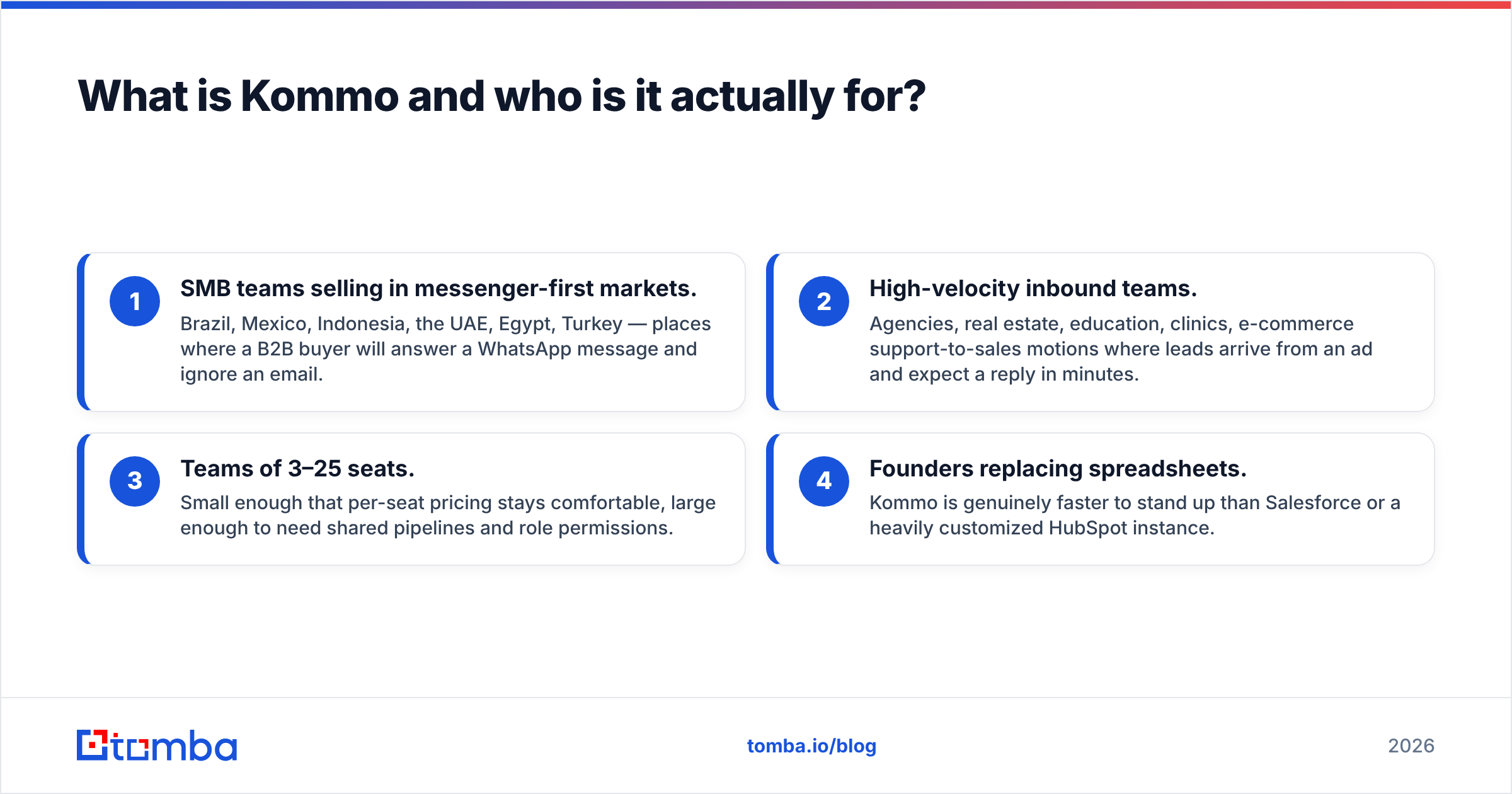
- SMB teams selling in messenger-first markets. Brazil, Mexico, Indonesia, the UAE, Egypt, Turkey — places where a B2B buyer will answer a WhatsApp message and ignore an email.
- High-velocity inbound teams. Agencies, real estate, education, clinics, e-commerce support-to-sales motions where leads arrive from an ad and expect a reply in minutes.
- Teams of 3–25 seats. Small enough that per-seat pricing stays comfortable, large enough to need shared pipelines and role permissions.
- Founders replacing spreadsheets. Kommo is genuinely faster to stand up than Salesforce or a heavily customized HubSpot instance.
Who it is not for: enterprise RevOps teams needing deep forecasting and territory management, product-led companies needing usage-based scoring, and outbound-heavy teams that live in sequences and deliverability dashboards. Those buyers end up in HubSpot, Pipedrive, or a dedicated sales engagement stack.
How much does Kommo cost in 2026?#
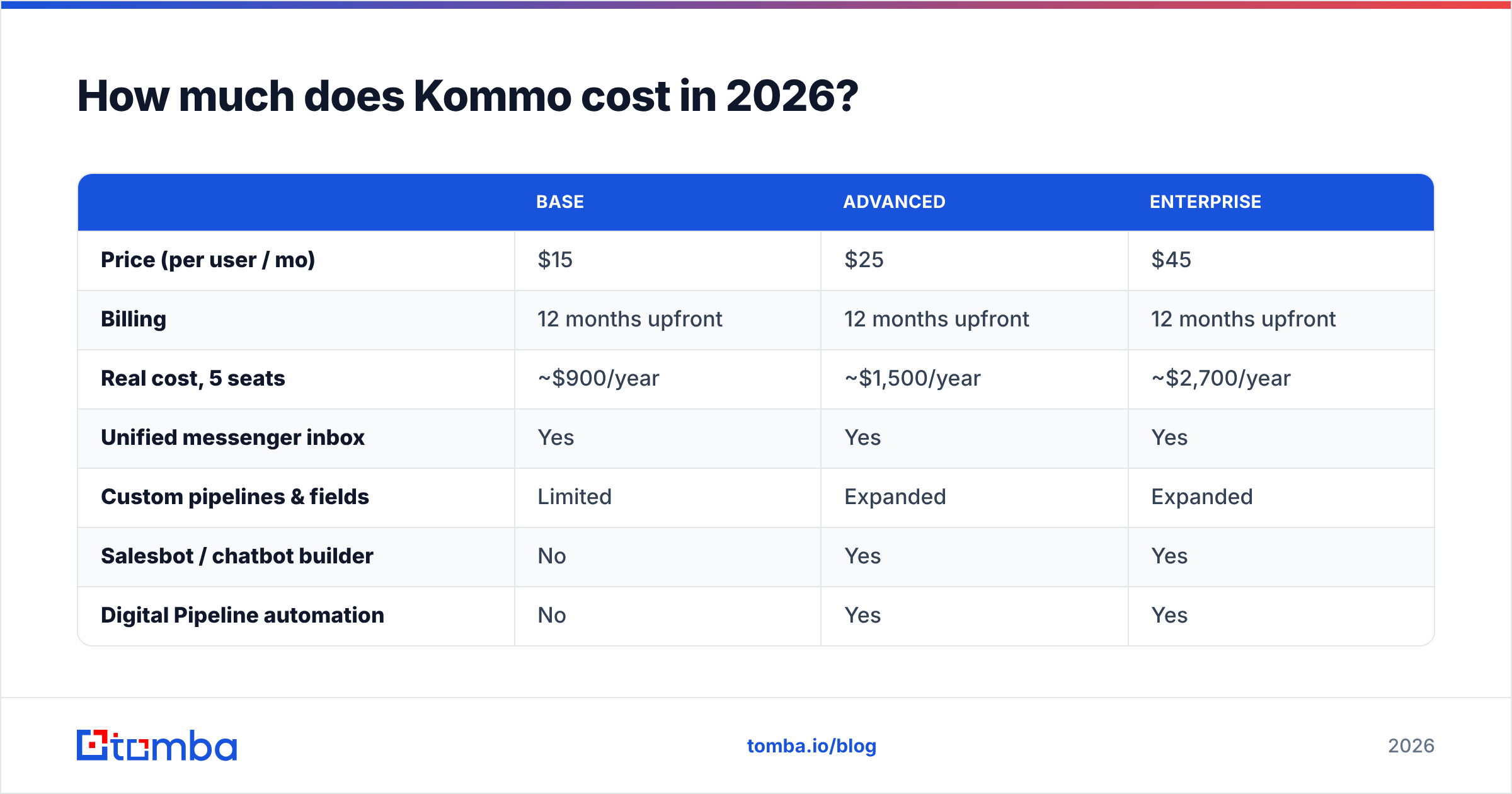
Kommo runs three public per-seat tiers plus a 14-day free trial. There is no permanently free plan, and — this is the part buyers miss — no monthly billing option. Every plan is quoted at a monthly rate but charged as a 12-month term.
| Base | Advanced | Enterprise | |
|---|---|---|---|
| Price (per user / mo) | $15 | $25 | $45 |
| Billing | 12 months upfront | 12 months upfront | 12 months upfront |
| Real cost, 5 seats | ~$900/year | ~$1,500/year | ~$2,700/year |
| Unified messenger inbox | Yes | Yes | Yes |
| Custom pipelines & fields | Limited | Expanded | Expanded |
| Salesbot / chatbot builder | No | Yes | Yes |
| Digital Pipeline automation | No | Yes | Yes |
| Lead scoring | No | No | Yes |
| Contact limit | Lowest tier cap | Higher cap | Highest cap |
| Periodic data backup | No | No | Yes |
| Free trial | 14 days | 14 days | 14 days |
Two notes before you build a budget on this table. First, plan contents shift — always confirm the current feature split on Kommo's own pricing page before you sign. Second, the cheap tier is a trap for most buyers: Base gives you the inbox and the pipeline, but the automation layer that makes Kommo worth owning (Salesbot, Digital Pipeline triggers) starts at Advanced. Budget $25/user/mo as your realistic floor.
Is the annual-only billing a dealbreaker?#
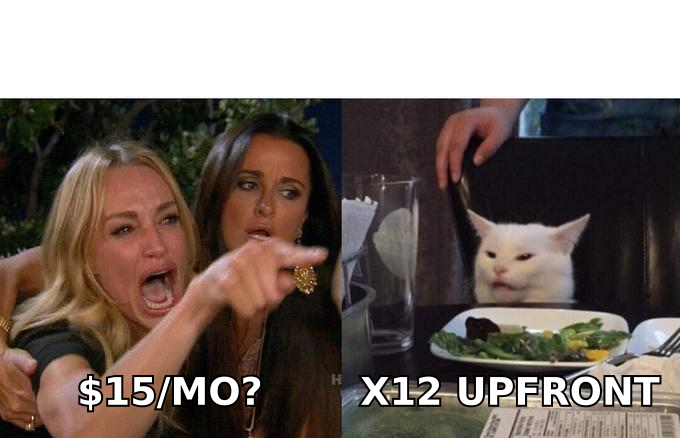
It depends on your risk tolerance, not your budget. Paying a year upfront is standard for annual discounts — what is unusual is that there is no monthly escape hatch at any price. A 10-seat Advanced deployment means a $3,000 commitment made on the strength of a 14-day trial.
Two weeks is enough time to test the inbox. It is not enough time to test whether your reps will actually keep deal stages current in month four. If you are unsure, run the trial with your two most process-resistant reps, not your two best.
What are Kommo's hidden costs?#
The seat price is the smallest line item in a mature Kommo deployment. Here is where the rest of the money goes:
- WhatsApp Business API conversation fees. If you connect WhatsApp through the official Meta API — which you should, for compliance and scale — Meta charges per conversation window, and rates vary sharply by country. A Brazilian marketing conversation costs meaningfully more than a service reply. This can exceed your entire Kommo bill in a high-volume support-to-sales motion.
- Marketplace and third-party widgets. Kommo's integration marketplace is large, and a chunk of the useful widgets (advanced telephony, document generation, regional payment gateways, extended WhatsApp features) are sold by third-party vendors with their own monthly fees.
- Contact and storage overage. Each plan caps stored contacts and file storage. Teams importing a large historical database hit the ceiling faster than expected, which forces a tier upgrade for a reason that has nothing to do with features.
- Implementation partners. Kommo runs a partner network, and non-trivial Salesbot flows plus multi-pipeline setups are routinely outsourced. Budget a one-time $500–$3,000 if your process is complex.
- Telephony minutes. Click-to-call requires a connected provider. Numbers and minutes are separate.
- The data layer. Kommo stores contacts; it does not source them. Outbound teams add a prospecting and verification tool on top — which is a real recurring line item, not an optional one.
What do Kommo reviews actually say?#
Aggregate ratings on G2 and Capterra land Kommo in respectable territory — generally in the 4.2–4.6 range across a few hundred reviews. The interesting part is the pattern in the text, not the star average.
What reviewers praise, repeatedly:
- The unified messenger inbox is the single most-cited strength. Teams that were juggling three phones and a shared Instagram login describe it as transformative.
- Setup speed. Most reviewers report being operational in days, not the weeks a Salesforce or Dynamics rollout consumes.
- Salesbot. The no-code chatbot builder handles qualification and first-touch routing well enough that small teams report cutting response time from hours to seconds.
- Price relative to feature depth, especially outside North America.
What reviewers complain about, repeatedly:
- Support. This is the loudest recurring negative. Slow ticket turnaround and inconsistent answers appear across both platforms and across years, which suggests a structural issue rather than a bad quarter.
- Interface age. The UI carries visible amoCRM DNA. Functional, dense, not modern.
- Contact limits and upgrade pressure. Several reviewers describe hitting caps sooner than anticipated.
- WhatsApp connection instability. Disconnections and re-authentication loops come up often enough to plan for.
- Reporting depth. Adequate for pipeline hygiene, thin for revenue analytics. Teams doing serious revenue operations export to a BI tool.
One honest caveat on review data: Kommo's user base skews heavily toward non-English markets, so English-language review sites under-represent its actual satisfaction profile. Read the Portuguese and Spanish reviews if you can.
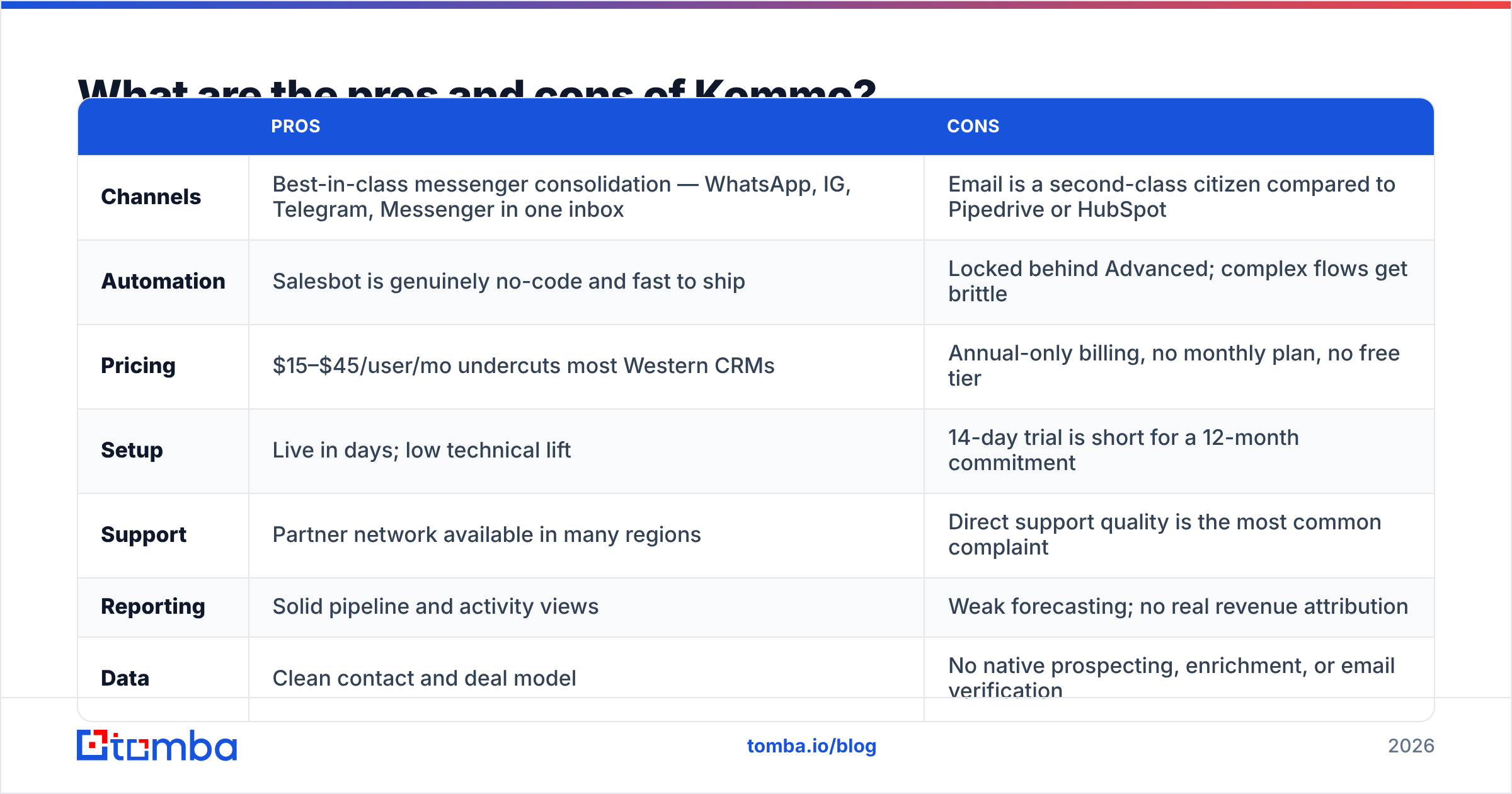
What are the pros and cons of Kommo?#
| Pros | Cons | |
|---|---|---|
| Channels | Best-in-class messenger consolidation — WhatsApp, IG, Telegram, Messenger in one inbox | Email is a second-class citizen compared to Pipedrive or HubSpot |
| Automation | Salesbot is genuinely no-code and fast to ship | Locked behind Advanced; complex flows get brittle |
| Pricing | $15–$45/user/mo undercuts most Western CRMs | Annual-only billing, no monthly plan, no free tier |
| Setup | Live in days; low technical lift | 14-day trial is short for a 12-month commitment |
| Support | Partner network available in many regions | Direct support quality is the most common complaint |
| Reporting | Solid pipeline and activity views | Weak forecasting; no real revenue attribution |
| Data | Clean contact and deal model | No native prospecting, enrichment, or email verification |
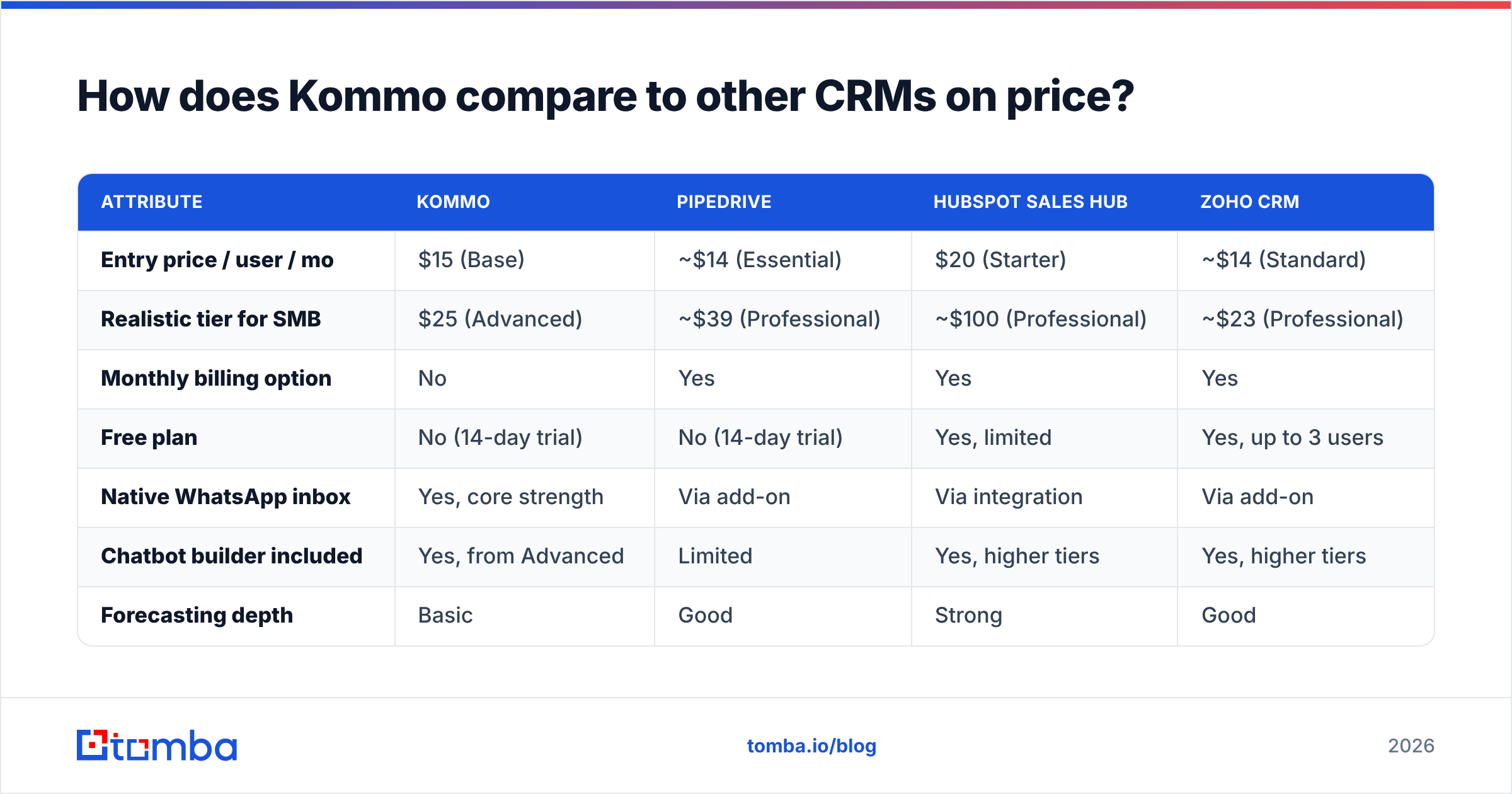
How does Kommo compare to other CRMs on price?#
Per-seat price alone is misleading, because the CRMs differ in what a seat includes. Here is a like-for-like view at the tier most SMBs actually buy:
| Attribute | Kommo | Pipedrive | HubSpot Sales Hub | Zoho CRM |
|---|---|---|---|---|
| Entry price / user / mo | $15 (Base) | ~$14 (Essential) | $20 (Starter) | ~$14 (Standard) |
| Realistic tier for SMB | $25 (Advanced) | ~$39 (Professional) | ~$100 (Professional) | ~$23 (Professional) |
| Monthly billing option | No | Yes | Yes | Yes |
| Free plan | No (14-day trial) | No (14-day trial) | Yes, limited | Yes, up to 3 users |
| Native WhatsApp inbox | Yes, core strength | Via add-on | Via integration | Via add-on |
| Chatbot builder included | Yes, from Advanced | Limited | Yes, higher tiers | Yes, higher tiers |
| Forecasting depth | Basic | Good | Strong | Good |
| Best for | Messenger-led SMB sales | Pipeline-first outbound | Full GTM alignment | Budget-conscious generalists |
The takeaway: Kommo is not the cheapest CRM on a sticker basis, and it never was. It wins when the messenger inbox is the product you are actually buying. If your buyers live in email, HubSpot or Pipedrive will give you more per dollar. If your buyers live in WhatsApp, nothing on that list touches Kommo.
Is Kommo worth it in 2026?#
Short answer: yes, if at least two of these are true.
- Your leads arrive in a messenger. Ads-to-WhatsApp, Instagram DMs, Telegram groups. This is the whole thesis.
- Your team is 3–25 people. Below three, a shared inbox may still be fine. Above twenty-five, the reporting ceiling starts to hurt.
- You can commit a year. If you can't, buy something with monthly billing and revisit.
- You sell in a region where Kommo's partner network is strong. LATAM, MENA, SEA, Eastern Europe. Local partners meaningfully offset the direct-support complaints.
Say no if you need forecast accuracy for a board, if your motion is email-led outbound, or if you are still validating your sales process and need the freedom to switch tools next quarter.
What Kommo doesn't do — and what to pair it with#
Here is the gap nobody writes about in a pricing review: Kommo is a system of record, not a system of supply.
It will organize every conversation you already have. It will not create the next one. There is no native prospecting database, no email verification, no enrichment layer. An empty Kommo pipeline stays empty until something fills it.
For inbound-only teams that is fine — the ads fill it. For anyone doing outbound, you need three things Kommo doesn't ship:
- A way to find decision-maker contact details from a company domain or a name. That is what a domain search does — you give it a company website, it returns the people and their verified work emails.
- Verification before send. Importing unverified addresses into any CRM poisons your email deliverability and inflates your contact count against Kommo's caps. Run an email verifier pass first.
- Enrichment on existing records. Half-complete contact cards are the default state of every CRM after six months. Contact enrichment backfills job titles, company data, and missing channels.
Budget for that layer explicitly. Teams that don't end up with a $1,500/year CRM containing 400 stale rows.
FAQ#
Does Kommo have a free plan? No. There is a 14-day free trial across all tiers, but no permanently free version. Zoho and HubSpot both offer free tiers if that is a hard requirement.
Can I pay Kommo monthly? No. All plans bill for a 12-month term upfront. Factor the full-year figure into your decision, not the monthly rate.
What happens if I exceed my contact limit? You are prompted to upgrade to a higher tier. Clean and deduplicate your list before importing — a bulk verify pass usually removes enough dead records to keep you a tier down.
Is Kommo the same as amoCRM? Yes. Kommo is the rebranded international version of amoCRM, relaunched under the new name in 2022. Older reviews under the amoCRM name still largely describe the same product.
Does Kommo include email finding or verification? No. Kommo stores and organizes contacts you already have. Sourcing and validating new ones requires a separate tool.
Fill the pipeline before you pay for the pipeline. Kommo is a good home for conversations you're already having — but if your team does any outbound at all, the constraint isn't your CRM, it's contact data. Tomba's Email Finder returns verified, decision-maker work emails from a company domain or a name, with confidence scores and sources attached, so what lands in your Kommo pipeline is real. Start free with 25 searches a month, then scale at $49/mo on Starter — see full Tomba pricing for Growth and Pro tiers.
Related guides#
// get started
Find, verify and enrich your first contacts today
Start on the free plan with 25 searches a month, then scale when your team is ready.
Free plan · No credit card required · GDPR & CCPA
// about the author