Kompyte Pricing Reviews Pros and Cons: A 2026 Buyer's Guide
Kompyte doesn't publish a price list, so buyers negotiate blind. Here's what teams actually pay, what G2 reviewers praise and complain about, and when a leaner competitive-intel stack wins.
Looking for Kompyte pricing reviews pros and cons in one place? Here it is. Kompyte hides its price list, so buyers walk into demos blind. This guide covers the reported numbers, the honest review sentiment, and the trade-offs — in plain language.
TL;DR
- Kompyte is a competitive intelligence automation platform. It tracks competitor websites, pricing pages, ads, job posts and review profiles.
- It then pushes battlecards into Slack, your CRM, and enablement tools. Semrush acquired Kompyte in late 2022, and it now sits inside that ecosystem.
- Kompyte pricing is quote-only. There is no public price list, no self-serve checkout, and no free tier. Buyers consistently report annual contracts, not month-to-month.
- Reported deal sizes cluster in the low five figures per year for mid-market teams, with seat counts and tracked-competitor counts as the main price levers. Treat any number you see online — including the ranges below — as a reported range, not an official rate card.
The short verdict:
- The pros are real: automated change detection, genuinely good battlecards, strong Slack and CRM delivery. The cons are also real: noisy alerts before tuning, a setup curve measured in weeks, and pricing opacity that makes budgeting hard.
- Competitive intelligence tells you who you're up against. It does not hand you contactable buyers. Most teams that buy Kompyte still need a separate contact-data layer — and that's where a tool like the Tomba Email Finder does a job Kompyte was never built to do.
What is Kompyte and who actually buys it?#
Think of Kompyte as a surveillance camera pointed at your competitors' storefronts. Instead of a human checking 14 competitor pricing pages every Monday, a crawler watches them continuously and pings you the moment something moves — a new tier, a dropped feature, a fresh case study, a hiring spree in a new region.
That raw signal then gets packaged into battlecards: one-page "here's how we beat them" documents that reps can pull up mid-call. Kompyte automates both halves — the collection and the packaging — which is the core pitch. You can read the vendor's own framing on the Kompyte site.
The buyer profile is fairly narrow:
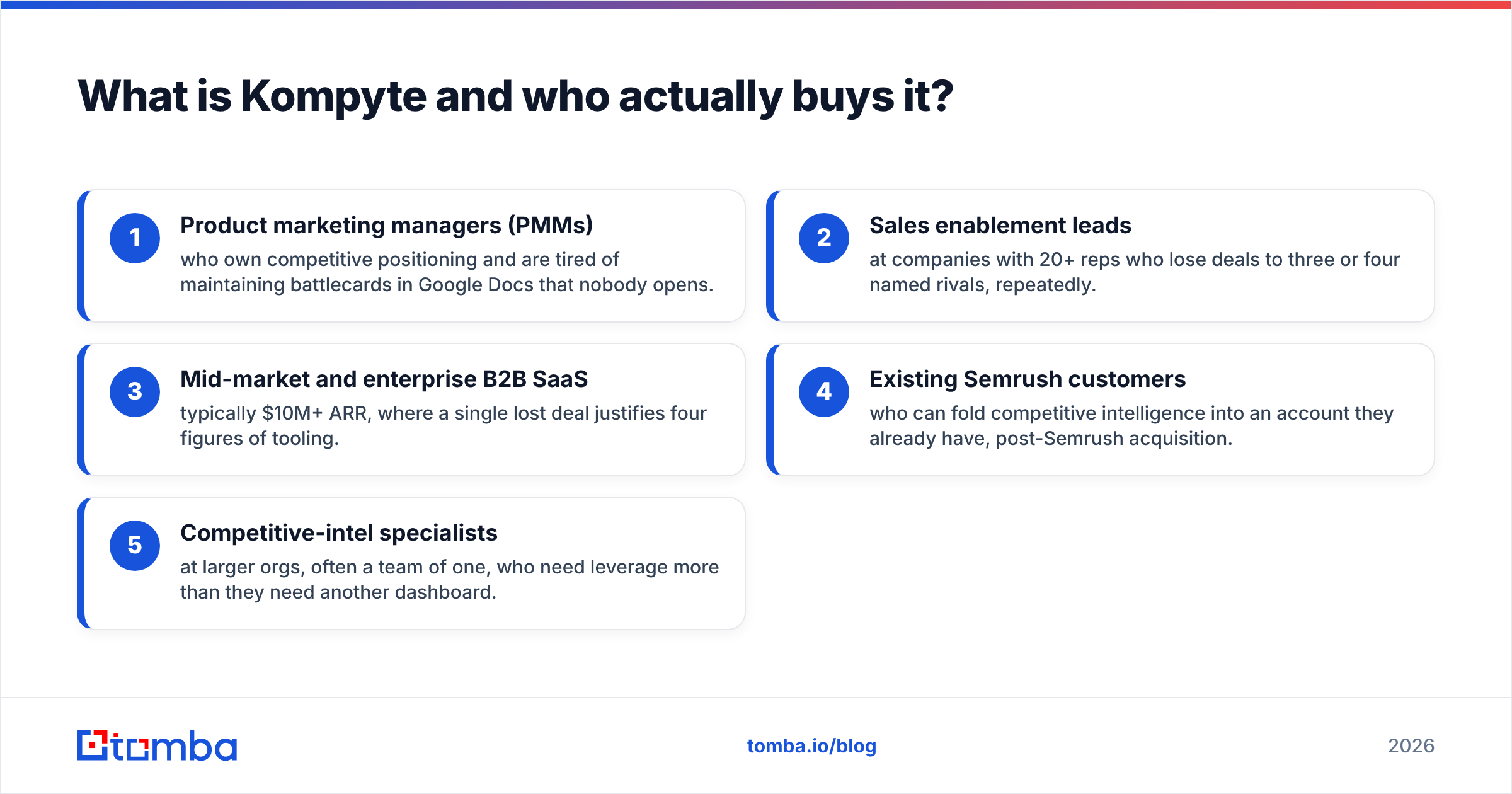
- Product marketing managers (PMMs) who own competitive positioning and are tired of maintaining battlecards in Google Docs that nobody opens.
- Sales enablement leads at companies with 20+ reps who lose deals to three or four named rivals, repeatedly.
- Mid-market and enterprise B2B SaaS — typically $10M+ ARR, where a single lost deal justifies four figures of tooling.
- Existing Semrush customers who can fold competitive intelligence into an account they already have, post-Semrush acquisition.
- Competitive-intel specialists at larger orgs, often a team of one, who need leverage more than they need another dashboard.
If you're a five-person startup selling into a fragmented market with no clear rivals, Kompyte is overkill. If your reps say "we lose to the same two vendors every quarter and I can't explain why," you're the target customer.
How much does Kompyte pricing actually cost in 2026?#
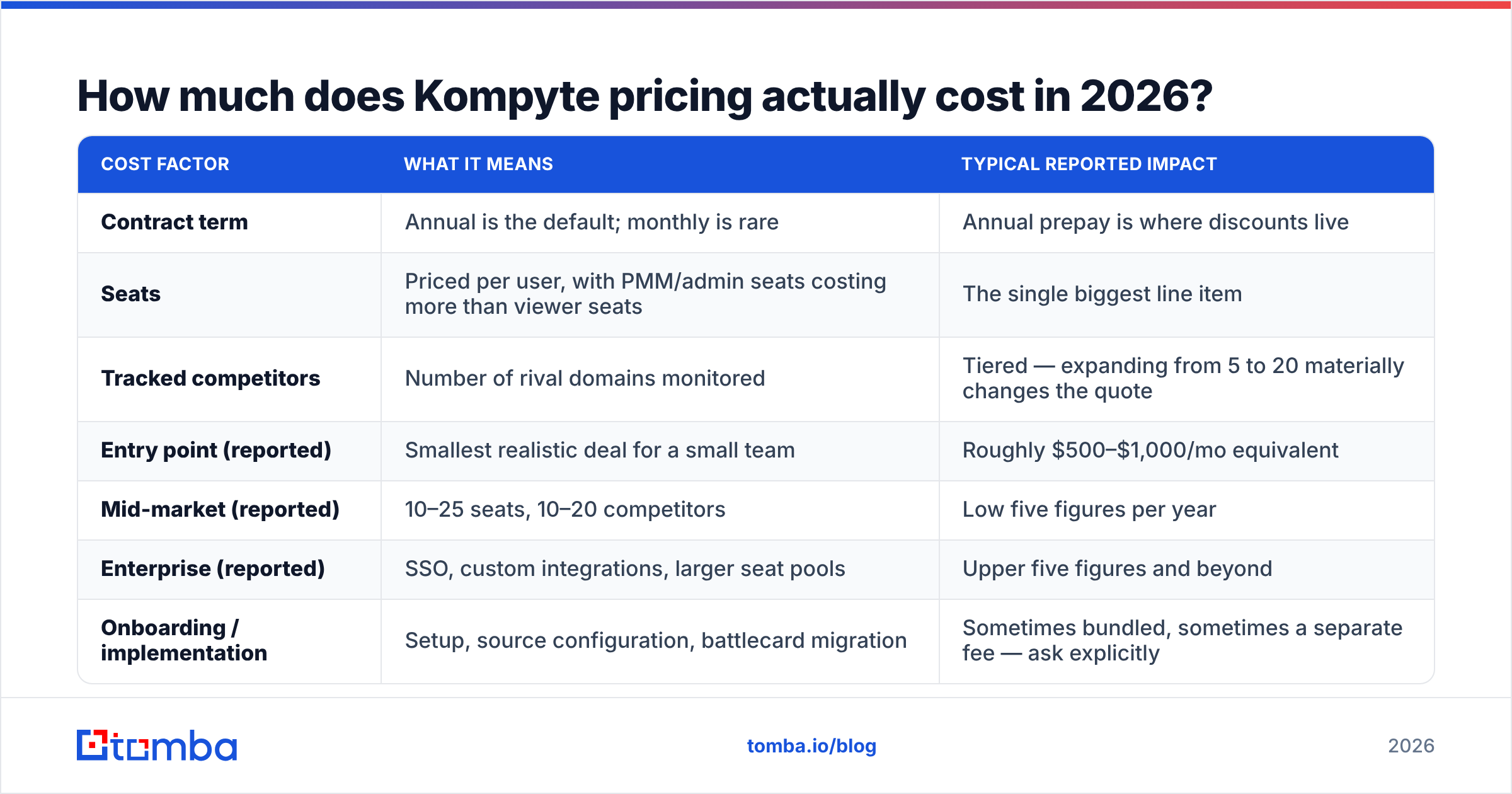
Kompyte does not publish pricing. Every path on the site leads to a demo request, and quotes are built per account. That's normal for competitive intelligence tooling — Crayon and Klue do the same — but it means you cannot benchmark yourself against a public rate card before your first call.
Here's what buyers and review aggregators consistently report. These are reported ranges, not official list prices — Kompyte has never confirmed them publicly, and your quote will depend on negotiation, timing, and whether you bundle with Semrush.
| Cost factor | What it means | Typical reported impact |
|---|---|---|
| Contract term | Annual is the default; monthly is rare | Annual prepay is where discounts live |
| Seats | Priced per user, with PMM/admin seats costing more than viewer seats | The single biggest line item |
| Tracked competitors | Number of rival domains monitored | Tiered — expanding from 5 to 20 materially changes the quote |
| Entry point (reported) | Smallest realistic deal for a small team | Roughly $500–$1,000/mo equivalent |
| Mid-market (reported) | 10–25 seats, 10–20 competitors | Low five figures per year |
| Enterprise (reported) | SSO, custom integrations, larger seat pools | Upper five figures and beyond |
| Onboarding / implementation | Setup, source configuration, battlecard migration | Sometimes bundled, sometimes a separate fee — ask explicitly |
Three practical negotiation notes:
- Ask what happens at renewal. Quote-only vendors frequently discount year one aggressively and true-up in year two. Get the year-two rate in writing.
- Seat inflation is the trap. A quote built for 8 seats looks cheap until enablement wants to give every AE read access. Model your realistic 18-month seat count, not today's.
- Bundling matters now. Because Kompyte sits under Semrush, existing Semrush customers have reported more flexible commercial conversations. Mention your current spend.
What do Kompyte reviews say — the honest version?#
Review sentiment on G2 and comparable directories is broadly positive but clusters around a specific shape: people like the output, and they underestimate the input.
What reviewers consistently praise:
- Change detection actually works. Reviewers repeatedly call out catching a competitor's pricing change or new product page before their own team heard about it from a prospect. That's the moment the tool pays for itself.
- Battlecards get used. Because cards surface in Slack and inside the CRM rather than living in a wiki, adoption is better than the Google Doc baseline most teams are replacing.
- Support responsiveness. Onboarding contacts and CSMs get named positively in a meaningful share of reviews.
- Breadth of sources. Websites, ad libraries, job boards, review sites, social — the coverage is wider than a homegrown scraper.
What reviewers consistently complain about:
- Noise before tuning. Out of the box, the alert volume is high. Teams describe two to six weeks of pruning before the signal-to-noise ratio is usable. Nobody says this is impossible; plenty say it was unexpected.
- It needs an owner. A tool that generates competitive insight without a human to curate it becomes an ignored Slack channel. Reviews that describe failure almost always describe an unstaffed deployment.
- Pricing opacity. "Had to go through sales just to get a number" is a recurring theme in lower-scored reviews.
- UI/reporting rough edges. Custom reporting and some filtering flows draw mild criticism relative to competitors.
- Post-acquisition uncertainty. A subset of reviewers note roadmap ambiguity since the Semrush acquisition. Others see the parent company as a stability plus. Both readings appear.
The fair summary: Kompyte is a good product that punishes passive ownership. Buy it with a named owner and a 90-day tuning plan, or don't buy it.
What are Kompyte's biggest pros and cons side by side?#
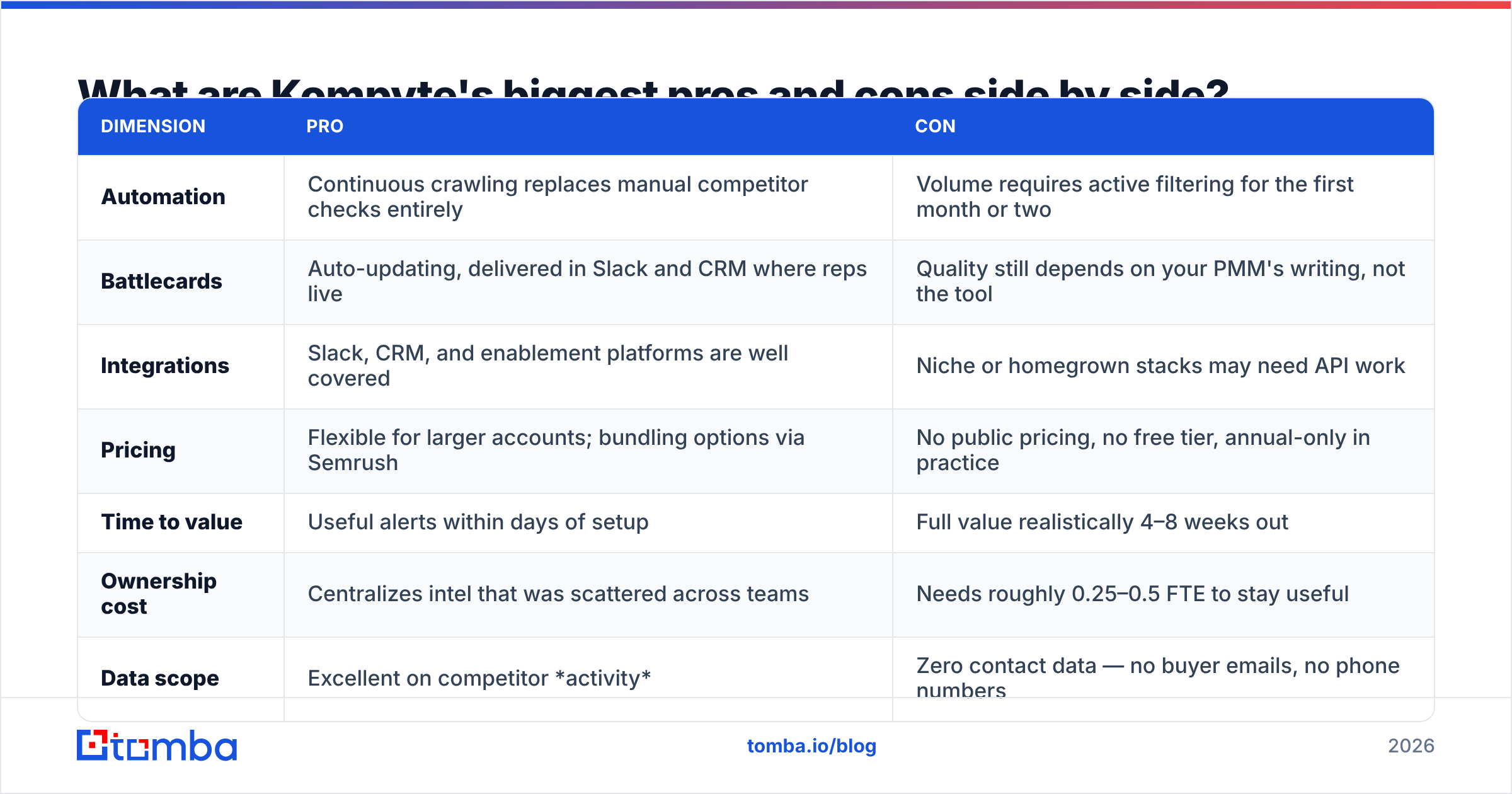
| Dimension | Pro | Con |
|---|---|---|
| Automation | Continuous crawling replaces manual competitor checks entirely | Volume requires active filtering for the first month or two |
| Battlecards | Auto-updating, delivered in Slack and CRM where reps live | Quality still depends on your PMM's writing, not the tool |
| Integrations | Slack, CRM, and enablement platforms are well covered | Niche or homegrown stacks may need API work |
| Pricing | Flexible for larger accounts; bundling options via Semrush | No public pricing, no free tier, annual-only in practice |
| Time to value | Useful alerts within days of setup | Full value realistically 4–8 weeks out |
| Ownership cost | Centralizes intel that was scattered across teams | Needs roughly 0.25–0.5 FTE to stay useful |
| Data scope | Excellent on competitor activity | Zero contact data — no buyer emails, no phone numbers |
That last row is the one most buyers miss at signature time, and it's the main reason Kompyte lands in a stack rather than replacing one.
How does Kompyte compare to Crayon, Klue, and cheaper options?#
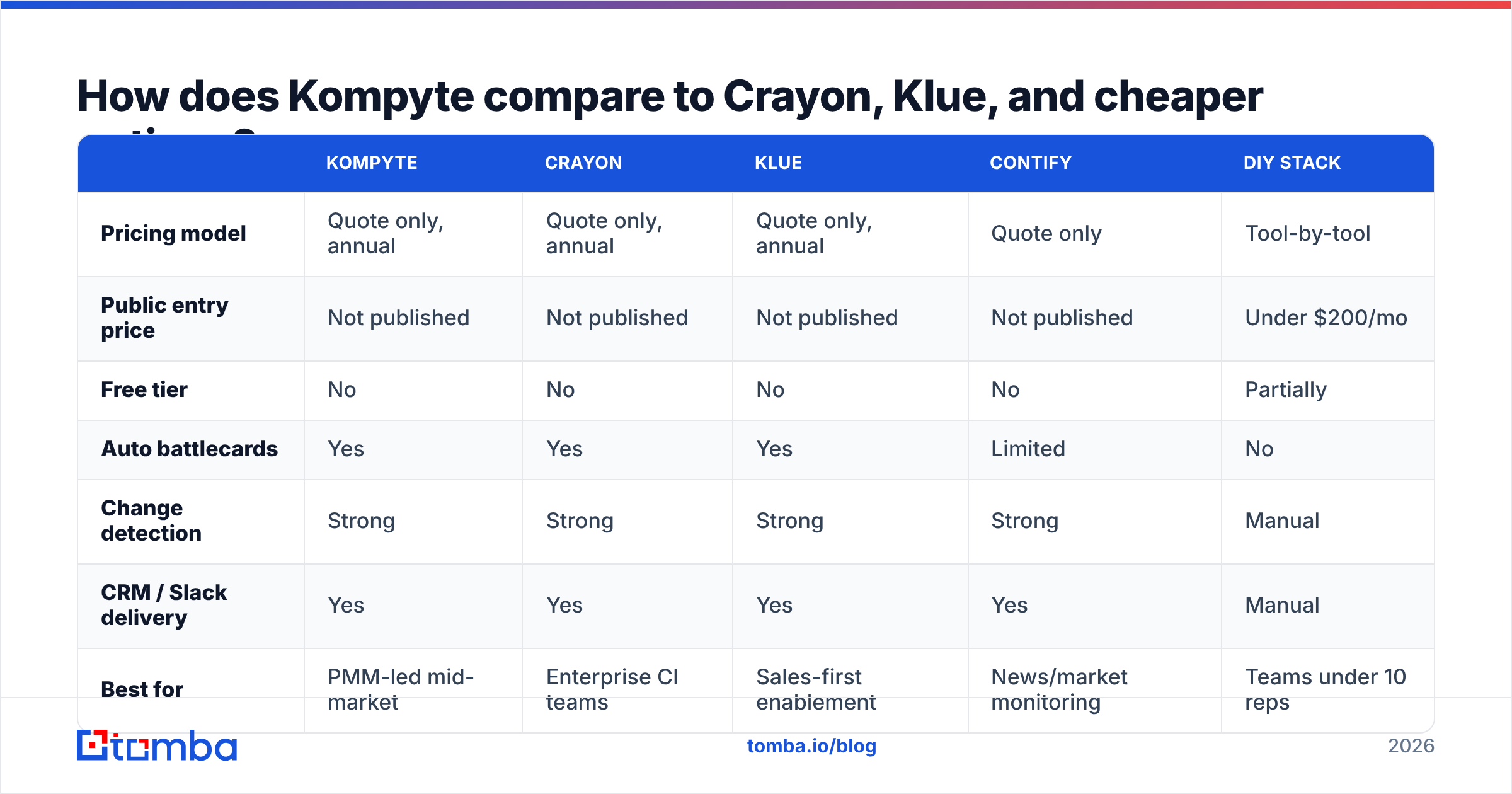
Competitive intelligence tooling splits into three tiers: full CI platforms, monitoring-only tools, and DIY stacks. Here's where the main options land.
| Kompyte | Crayon | Klue | Contify | DIY stack | |
|---|---|---|---|---|---|
| Pricing model | Quote only, annual | Quote only, annual | Quote only, annual | Quote only | Tool-by-tool |
| Public entry price | Not published | Not published | Not published | Not published | Under $200/mo |
| Free tier | No | No | No | No | Partially |
| Auto battlecards | Yes | Yes | Yes | Limited | No |
| Change detection | Strong | Strong | Strong | Strong | Manual |
| CRM / Slack delivery | Yes | Yes | Yes | Yes | Manual |
| Best for | PMM-led mid-market | Enterprise CI teams | Sales-first enablement | News/market monitoring | Teams under 10 reps |
| Setup effort | Medium–high | High | Medium | Medium | Low but ongoing |
| Contact data included | No | No | No | No | No |
The honest verdict on tier choice: Kompyte, Crayon, and Klue are close enough that the decision usually comes down to which sales team the demo impressed and which quote came back lower. Klue skews toward rep-facing enablement, Crayon toward analyst-grade CI depth, and Kompyte toward PMM workflow automation with the widest automated source coverage for the money most buyers report.
If you have fewer than ten reps, the DIY column is not embarrassing. Website change monitoring, an ad library, a job-board alert, and a maintained Notion battlecard folder will cover 70% of the value for under $200/month. You'll spend the difference in hours instead.

Is Kompyte worth it for your team?#
Run this five-question test before you book the demo. It weighs the Kompyte pricing reviews pros and cons above against your own situation.
- Do you lose deals to named competitors? If your loss reasons are "no decision" and "budget," competitive intel won't fix your pipeline. Fix qualification first.
- Do you have a named owner? Not "product marketing will get to it." A specific person with recurring time blocked. No owner, no purchase.
- Can you defend the cost with one deal? If your ACV is $8,000 and you'd need to win six extra deals a year to break even, the math is thin. If your ACV is $60,000, one saved deal covers it.
- Do your reps currently use any battlecard? If adoption of your existing doc is zero, automating a document nobody reads produces an automated document nobody reads.
- Is contact data already solved? Kompyte tells you which competitor just launched a migration offer. It won't tell you which 400 people at their customer accounts to email about it.
Score four or five yes answers and Kompyte is a defensible buy. Score two, and you're buying a dashboard.
What do you actually need alongside a CI platform?#
Competitive intelligence and prospecting data are two different fuels. Kompyte is the radar; it shows you where the other ships are. It doesn't give you an engine.
A realistic 2026 competitive-displacement motion needs four layers:
- Signal — Kompyte (or Crayon/Klue) telling you a rival just hiked pricing, sunset a feature, or drew a wave of negative reviews.
- Account identification — figuring out which companies are exposed to that change. Tools like website visitor reveal surface accounts already researching you after a competitor stumbles.
- Contact data — the actual named buyers at those accounts, with verified work emails. This is where a domain search plus an email verifier pass does the heavy lifting: find everyone in the relevant department, then drop anything that would bounce.
- Enrichment and routing — role, seniority, and firmographics so your sequence isn't one-size-fits-all. Contact enrichment fills the gaps your CRM left empty.
The cost asymmetry here is worth noticing. A CI platform is a low-five-figure annual commitment with a quote-only sales process. The contact-data layer that makes its output actionable starts at a published $49/month on Tomba's Starter plan. A free tier gives you 25 searches to test accuracy first — the full breakdown sits on the Tomba pricing page. Transparent pricing on one layer doesn't make the other layer bad. It just means you can budget half your stack without a discovery call.
One caution on sequencing: don't buy competitive intelligence before you've verified you can reach buyers at all. Teams that sign a CI contract while still running 40% bounce rates are optimizing the wrong constraint. Clean your list, confirm deliverability, then add signal on top.
What are the most common Kompyte pricing questions?#
Does Kompyte have a free trial? There's no self-serve free trial or free tier. Access typically starts with a guided demo and, for qualified accounts, a scoped pilot. Ask for a pilot explicitly — it's the closest thing available.
Is Kompyte cheaper now that Semrush owns it? Not automatically. Bundling leverage exists if you're already a Semrush customer, but the acquisition didn't produce a public price list or a self-serve tier.
Can you pay monthly? Reported contracts are overwhelmingly annual. Monthly, when offered, tends to carry a meaningful premium.
What's the real total cost of ownership? License plus roughly a quarter to a half of a full-time person to curate alerts, maintain battlecards, and drive adoption. Budget the human, or the license is wasted.
Is there a cheaper path to the same outcome? For small teams, yes — monitoring tools plus a disciplined weekly review. For teams above ~20 reps, the manual version breaks down and the platform earns its keep.
Kompyte pricing reviews pros and cons: the bottom line#
Kompyte is a capable competitive intelligence platform with one structural annoyance. You can't know what it costs until you talk to sales. What you pay hinges on seats and tracked competitors.
Reviews are positive from teams that staffed the deployment, and mixed from teams that didn't. The pros are real: automated detection, usable battlecards, strong delivery into Slack and CRM. The cons are just as real: alert noise, setup time, quote-only pricing, and zero contact data. All of them are knowable before you sign.
Before you commit five figures to knowing more about your competitors, make sure you can actually reach the buyers you're trying to take from them. Start with the Tomba Email Finder: find verified work emails by name, company, or domain, test it free with 25 searches a month, and scale to Starter at $49/month when the motion proves out. Intelligence you can't act on is just expensive reading.
Related guides#
// get started
Find, verify and enrich your first contacts today
Start on the free plan with 25 searches a month, then scale when your team is ready.
Free plan · No credit card required · GDPR & CCPA
// about the author