Kwanzoo Pricing, Reviews, Pros and Cons: 2026 Buyer's Guide
Kwanzoo sells account-based GTM, visitor de-anonymization and ABM ads on a quote-only model. Here is how the pricing actually works, what reviewers praise and complain about, and when a cheaper stack beats it.
TL;DR
- Kwanzoo does not publish a public price list. Every deal runs through a demo, a scoping call, and an annual contract — so "Kwanzoo pricing" is really "Kwanzoo quoting."
- Buyers consistently report five-figure annual commitments once visitor de-anonymization, intent data, and ABM ad delivery are bundled. Treat any number you find on a listicle as unverified until you see it on your own quote.
- Reviews are strongest on person-level website visitor identification and hands-on service, weakest on onboarding time, reporting depth, and contract flexibility.
- The platform makes sense if you run true account-based GTM with a defined target account list and paid media budget. It is overkill if you just need contact data and verified emails.
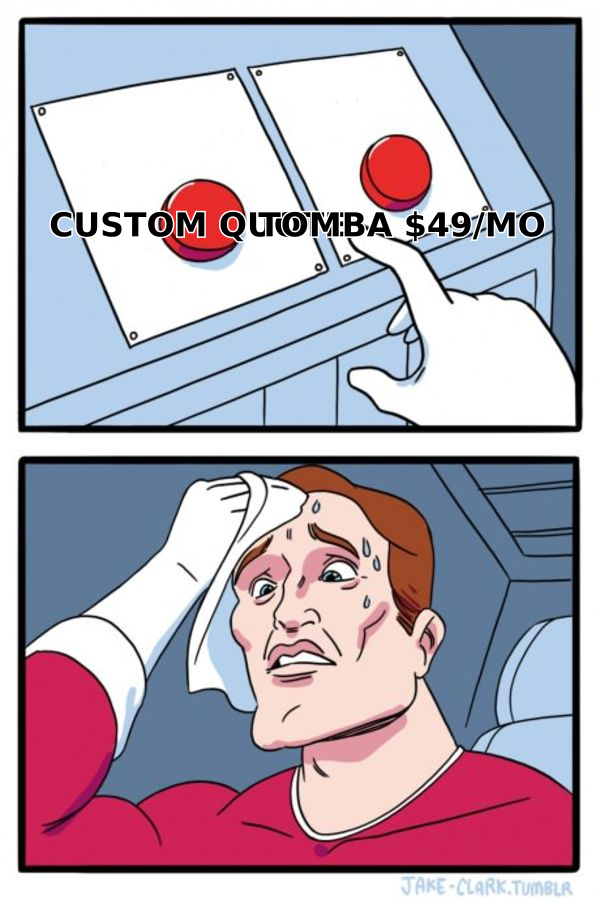
- If your actual bottleneck is "we can't reach the right person," a $49/mo data stack solves that. If it's "we don't know which accounts are in-market," that's where Kwanzoo earns its price.
What is Kwanzoo, and who is it actually for?#
Kwanzoo is a B2B account-based go-to-market platform. Think of it less as a database and more as a control tower: it sits over your target account list, watches who visits your site, layers in intent signals, and then pushes those accounts into advertising and sales plays.
The product surface has expanded over the years, but the pieces most buyers evaluate are:
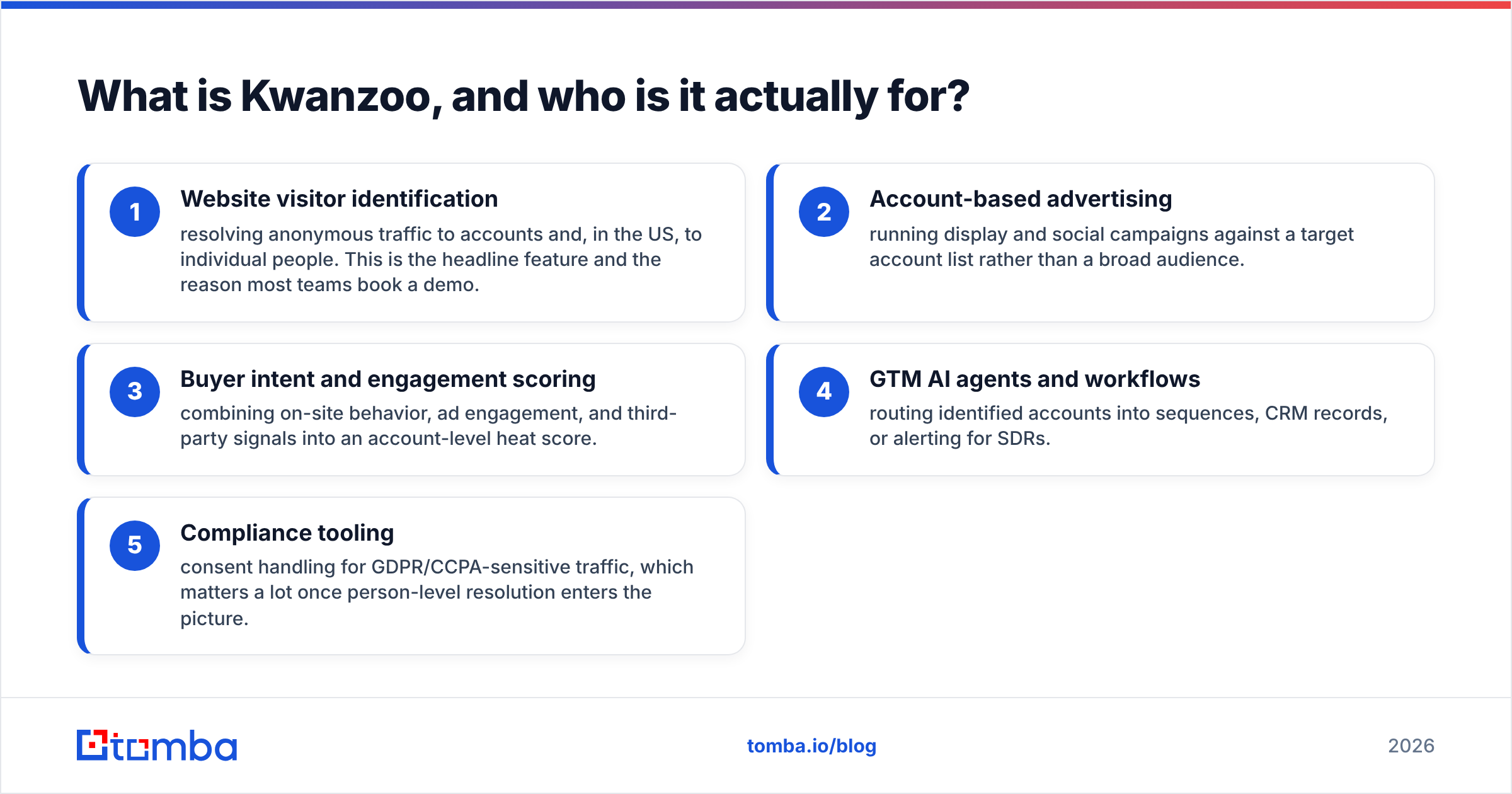
- Website visitor identification — resolving anonymous traffic to accounts and, in the US, to individual people. This is the headline feature and the reason most teams book a demo.
- Account-based advertising — running display and social campaigns against a target account list rather than a broad audience.
- Buyer intent and engagement scoring — combining on-site behavior, ad engagement, and third-party signals into an account-level heat score.
- GTM AI agents and workflows — routing identified accounts into sequences, CRM records, or alerting for SDRs.
- Compliance tooling — consent handling for GDPR/CCPA-sensitive traffic, which matters a lot once person-level resolution enters the picture.
The honest fit profile: mid-market and enterprise teams with a named account list, an existing paid media budget, and a marketing ops person who can own the deployment. Kwanzoo's own positioning on kwanzoo.com leans enterprise ABM, and the pricing model follows.
Who it is not for: a three-person outbound team that needs 2,000 verified emails this quarter. That's a different problem with a two-order-of-magnitude cheaper answer.
How does Kwanzoo pricing work in 2026?#
Short answer: quote-only, annual, and modular. There is no self-serve checkout, no published starter tier, and no free plan you can swipe a card for. You get a price after a scoping call that establishes traffic volume, number of target accounts, which modules you want, and whether you need person-level resolution.
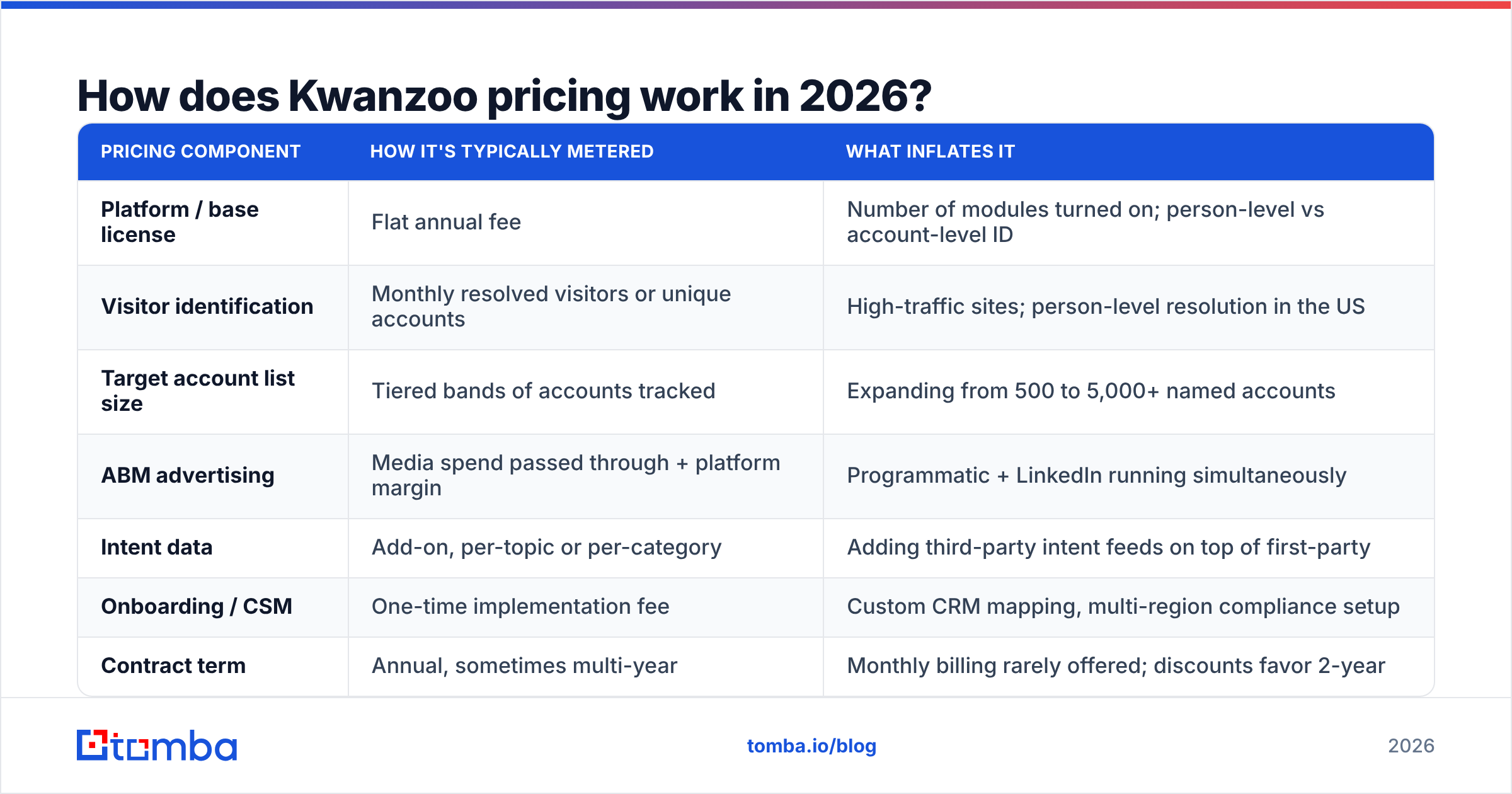
Here is the structure buyers describe, mapped to what actually drives the number:
| Pricing component | How it's typically metered | What inflates it |
|---|---|---|
| Platform / base license | Flat annual fee | Number of modules turned on; person-level vs account-level ID |
| Visitor identification | Monthly resolved visitors or unique accounts | High-traffic sites; person-level resolution in the US |
| Target account list size | Tiered bands of accounts tracked | Expanding from 500 to 5,000+ named accounts |
| ABM advertising | Media spend passed through + platform margin | Programmatic + LinkedIn running simultaneously |
| Intent data | Add-on, per-topic or per-category | Adding third-party intent feeds on top of first-party |
| Onboarding / CSM | One-time implementation fee | Custom CRM mapping, multi-region compliance setup |
| Contract term | Annual, sometimes multi-year | Monthly billing rarely offered; discounts favor 2-year |
Two things follow from that table. First, the "price" you're quoted on the call is rarely the price you pay in month 12 — visitor volume and account-list growth both push it up. Second, the media pass-through line is the one most teams underestimate. If you're running ABM ads through the platform, your invoice includes ad spend that has nothing to do with software value.
A note on numbers you'll find elsewhere. Several aggregator sites list specific Kwanzoo starting prices. I can't verify those against a current rate card, and vendors in this category revise pricing quietly. Directional buyer reports put entry engagements in the low-to-mid four figures per month, with fuller ABM deployments landing well into five figures annually. Use that as a budgeting sanity check, not a quote. Ask for the rate card in writing, and ask specifically what happens when you exceed your resolved-visitor allotment.
What do Kwanzoo reviews actually say?#
Review volume for Kwanzoo is thinner than for the category giants, which is itself a data point — you're relying on fewer independent voices. Scanning G2 and comparable directories, the sentiment clusters cleanly.
What reviewers praise:
- Person-level visitor resolution. This is the recurring hero feature. Teams that previously saw "someone at Acme visited" now see a name and a role, which changes what an SDR can do with the signal.
- Responsive, hands-on support. Smaller vendor, senior people on the calls. Multiple reviewers mention direct access to the team rather than a ticket queue.
- Willingness to customize. Custom audience definitions, custom CRM field mapping, and bespoke reporting come up as things the team will actually build.
- Compliance posture. Reviewers in regulated or EU-exposed businesses note that consent handling was taken seriously rather than hand-waved.
What reviewers criticize:
- Time to value. Onboarding is not a weekend. Tag deployment, account list ingestion, CRM mapping, and campaign setup routinely stretch across weeks.
- UI and reporting depth. Several reviews describe the interface as functional but dated, with analysts exporting to a BI tool rather than living in the dashboard.
- Opaque pricing. The single most common complaint in this category, and Kwanzoo isn't exempt: buyers dislike not being able to self-qualify before a sales call.
- Match-rate reality. Person-level identification rates vary enormously by traffic mix. US B2B desktop traffic resolves far better than EU mobile traffic. Ask for your expected match rate, not the case-study number.
None of that makes it a bad product. It makes it a product where the quality of your pilot determines whether the contract is a good idea.
What are the pros and cons of Kwanzoo?#
- Pro — genuine first-party signal. Identifying your own visitors is the highest-intent data you can get. Nobody's intent feed beats "this person read your pricing page twice."
- Pro — one vendor across ID, intent, and media. Consolidation has real operational value versus stitching three tools and a Zapier chain.
- Pro — enterprise-grade compliance handling. Important if your traffic includes EU visitors and you want person-level anything.
- Con — quote-only, annual-only. You commit before you have production evidence of match rates on your own traffic.
- Con — cost scales with success. More traffic and more target accounts mean a bigger renewal. Budget for that curve.
- Con — requires a functioning ABM motion. The platform surfaces accounts. It does not write your plays, staff your SDRs, or fix a weak offer.
The pattern here is standard for account-based platforms: high ceiling, high floor. If you don't have the operational maturity to act on account signals within 24 hours, the signal decays and the ROI argument collapses.
What hidden costs should you budget for?#
Four line items that rarely appear in the first proposal:
- Implementation and onboarding fees. Often one-time, often negotiable, almost never zero on enterprise deals.
- Overage on resolved visitors. Traffic spikes from a product launch or a conference push can blow through the monthly allotment. Get the overage rate in writing.
- Enrichment you still have to buy. Identifying a visitor is not the same as having a verified work email and a direct dial. Many teams pair a visitor-ID platform with a separate data enrichment layer to make the contact actionable.
- Internal ops time. The real cost of a platform like this is a half-FTE of marketing ops attention for the first quarter. Price that at your loaded rate and add it to the comparison.
That third point deserves emphasis. A resolved identity without a deliverable email address is a lead you can't contact. Before you sign anything, ask what percentage of identified people come with a verified, sendable email — and whether that's included or a per-record add-on.
How does Kwanzoo compare to alternatives in 2026?#
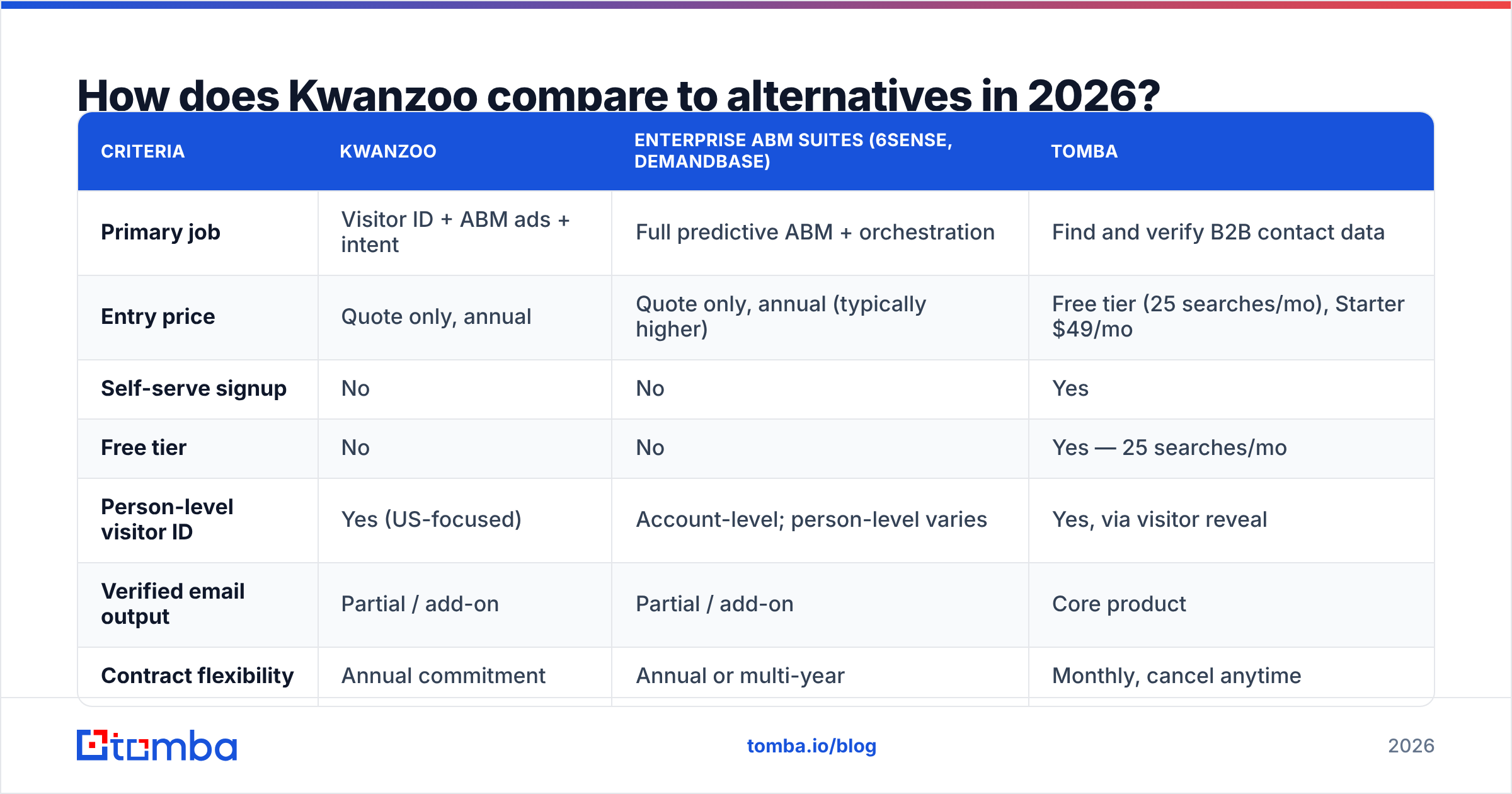
Different buyers land in different places depending on whether the core problem is identification, targeting, or reachability. Here's the honest layout:
| Criteria | Kwanzoo | Enterprise ABM suites (6sense, Demandbase) | Tomba |
|---|---|---|---|
| Primary job | Visitor ID + ABM ads + intent | Full predictive ABM + orchestration | Find and verify B2B contact data |
| Entry price | Quote only, annual | Quote only, annual (typically higher) | Free tier (25 searches/mo), Starter $49/mo |
| Self-serve signup | No | No | Yes |
| Free tier | No | No | Yes — 25 searches/mo |
| Person-level visitor ID | Yes (US-focused) | Account-level; person-level varies | Yes, via visitor reveal |
| Verified email output | Partial / add-on | Partial / add-on | Core product |
| Contract flexibility | Annual commitment | Annual or multi-year | Monthly, cancel anytime |
| Time to first value | Weeks | Weeks to months | Minutes |
| Best for | Mid-market ABM with media budget | Enterprise demand gen at scale | Outbound teams that need reachable contacts |
Read that table as a fork, not a ranking. If your GTM is genuinely account-based — target list, air cover, multi-threaded plays — a platform like Kwanzoo or a larger ABM suite is the right shape of tool, and comparing it to a data provider is comparing a CRM to a phone.
But a surprising number of teams book ABM demos when their actual failure mode is simpler: they have the account list already, and they can't reach anyone inside those accounts. That's a data problem. Tomba pricing starts free and moves to $49/mo Starter, $99/mo Growth, and $249/mo Pro — which means you can test the hypothesis for the cost of one enterprise demo's worth of calendar time.

Is Kwanzoo worth it for your team?#
Buy it if you have a defined target account list of 500+ accounts, a paid media budget of at least a few thousand a month, US-heavy web traffic, an SDR team that can respond to signals same-day, and executive patience for a 60-90 day ramp. Under those conditions, first-party visitor intelligence is one of the highest-leverage purchases in B2B marketing.
Skip it if any of these are true: your traffic is under roughly 5,000 monthly B2B visitors (not enough signal to justify the fee), your traffic is predominantly EU or mobile (match rates degrade), you have no media budget (you'll pay for half a platform), or your sales motion is founder-led and opportunistic rather than account-based.
The in-between case is the most common: you want to know who's on your site, but you're not ready for an annual ABM contract. That's where a lighter stack earns its keep — website visitor reveal to identify the traffic, then an email verifier to make sure the contact you extract is actually deliverable before it hits a sequence.
How do you pilot Kwanzoo without overcommitting?#
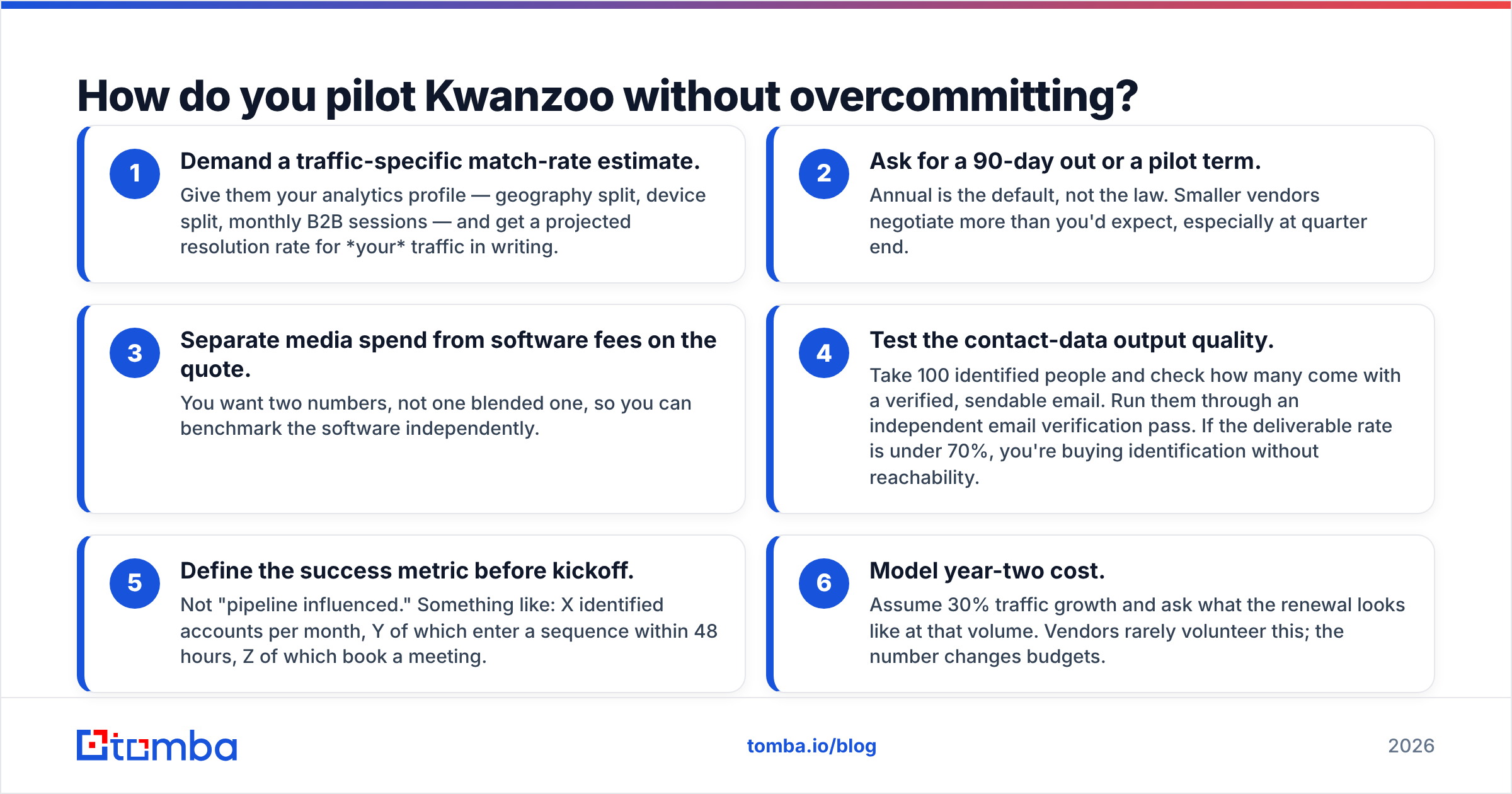
Run this checklist before you sign:
- Demand a traffic-specific match-rate estimate. Give them your analytics profile — geography split, device split, monthly B2B sessions — and get a projected resolution rate for your traffic in writing.
- Ask for a 90-day out or a pilot term. Annual is the default, not the law. Smaller vendors negotiate more than you'd expect, especially at quarter end.
- Separate media spend from software fees on the quote. You want two numbers, not one blended one, so you can benchmark the software independently.
- Test the contact-data output quality. Take 100 identified people and check how many come with a verified, sendable email. Run them through an independent email verification pass. If the deliverable rate is under 70%, you're buying identification without reachability.
- Define the success metric before kickoff. Not "pipeline influenced." Something like: X identified accounts per month, Y of which enter a sequence within 48 hours, Z of which book a meeting.
- Model year-two cost. Assume 30% traffic growth and ask what the renewal looks like at that volume. Vendors rarely volunteer this; the number changes budgets.
If steps 1 and 4 come back weak, you've learned something valuable for the price of two meetings. Gartner's broader research on ABM technology selection makes the same point in more words: the platform rarely fails, the operational readiness does.
The bottom line#
Kwanzoo is a credible account-based GTM platform with a real differentiator in person-level visitor identification and a pricing model that demands homework. The quote-only structure isn't a scam — it's how this category works — but it does shift the burden onto you to model the true cost, including overages, media pass-through, implementation, and the enrichment layer you'll still need.
Before you commit five figures to knowing who visited, make sure you can actually reach them. That's the cheaper half of the problem and the one that gates every downstream metric.
Start there. Tomba Email Finder turns a name and a company domain into a verified, deliverable work email — free for your first 25 searches, $49/mo on Starter, with no annual contract and no scoping call. Test it against your existing account list this afternoon. If reachability turns out to be your real bottleneck, you'll have solved it before the ABM demo calendar invite even lands.
Related guides#
// get started
Find, verify and enrich your first contacts today
Start on the free plan with 25 searches a month, then scale when your team is ready.
Free plan · No credit card required · GDPR & CCPA
// about the author