LAARC Objection Handling: The 5-Step Framework That Works
LAARC turns an objection from a wall into a discovery question. Here is how each of the five steps actually sounds on a live call, how it compares to LAER and Feel-Felt-Found, and where it quietly fails.
TL;DR
- LAARC stands for Listen, Acknowledge, Assess, Respond, Confirm — a trust-based objection framework from the academic selling literature, not a rebuttal script.
- The step almost everyone skips is Assess. Without it you answer an objection the buyer never actually made.
- LAARC beats Feel-Felt-Found on complex B2B deals because it forces a diagnostic question before the pitch resumes.
- It fails in three predictable places: true no-budget situations, wrong-persona calls, and reps who use "Assess" as a stalling tactic.
- Half of the objections you hear on cold outreach are data problems — wrong title, wrong company, stale contact — not persuasion problems.
What is LAARC objection handling?#
LAARC is a five-step sequence for responding to a sales objection: Listen, Acknowledge, Assess, Respond, Confirm. It comes out of the trust-based selling tradition popularized in Ingram, LaForge, Avila, Schwepker and Williams' Professional Selling textbooks, and it was designed as a deliberate alternative to the rebuttal-library approach that dominated 1980s sales training.
The distinction matters. A rebuttal library says: when the buyer says X, you say Y. LAARC says: when the buyer says X, you do not yet know what X means, so find out before you answer.
That single change — inserting a diagnostic beat between the objection and the response — is the entire reason the framework survived into modern B2B selling. Buyers have gotten better at pattern-matching canned responses. Gartner's research on the B2B buying journey shows buying groups now spend the majority of their process without a rep in the room, which means by the time someone raises an objection to you, they have usually already discussed it internally. You are hearing a compressed summary of a longer conversation. Answering the summary is a mistake.
How does each LAARC step actually work?#
Here is the sequence with the behavior that defines each step — and the failure mode that kills it.
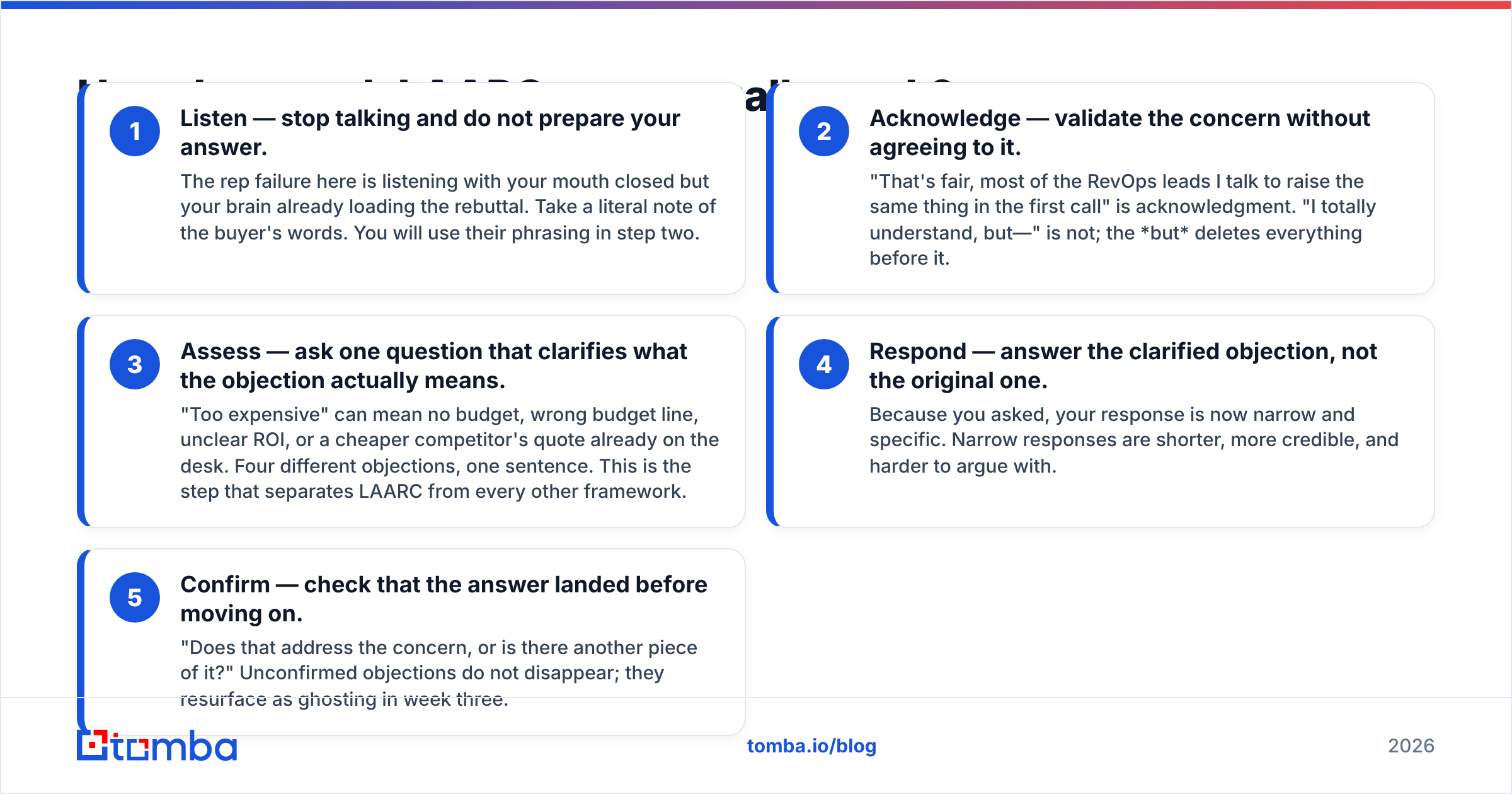
- Listen — stop talking and do not prepare your answer. The rep failure here is listening with your mouth closed but your brain already loading the rebuttal. Take a literal note of the buyer's words. You will use their phrasing in step two.
- Acknowledge — validate the concern without agreeing to it. "That's fair, most of the RevOps leads I talk to raise the same thing in the first call" is acknowledgment. "I totally understand, but—" is not; the but deletes everything before it.
- Assess — ask one question that clarifies what the objection actually means. "Too expensive" can mean no budget, wrong budget line, unclear ROI, or a cheaper competitor's quote already on the desk. Four different objections, one sentence. This is the step that separates LAARC from every other framework.
- Respond — answer the clarified objection, not the original one. Because you asked, your response is now narrow and specific. Narrow responses are shorter, more credible, and harder to argue with.
- Confirm — check that the answer landed before moving on. "Does that address the concern, or is there another piece of it?" Unconfirmed objections do not disappear; they resurface as ghosting in week three.
The rhythm on a live call is roughly: two seconds of silence, one sentence of acknowledgment, one question, one short answer, one confirmation. Under thirty seconds total. Reps who learn LAARC from a slide deck tend to turn it into a two-minute monologue, which defeats the point.
Is LAARC better than LAER, Feel-Felt-Found, or Sandler?#
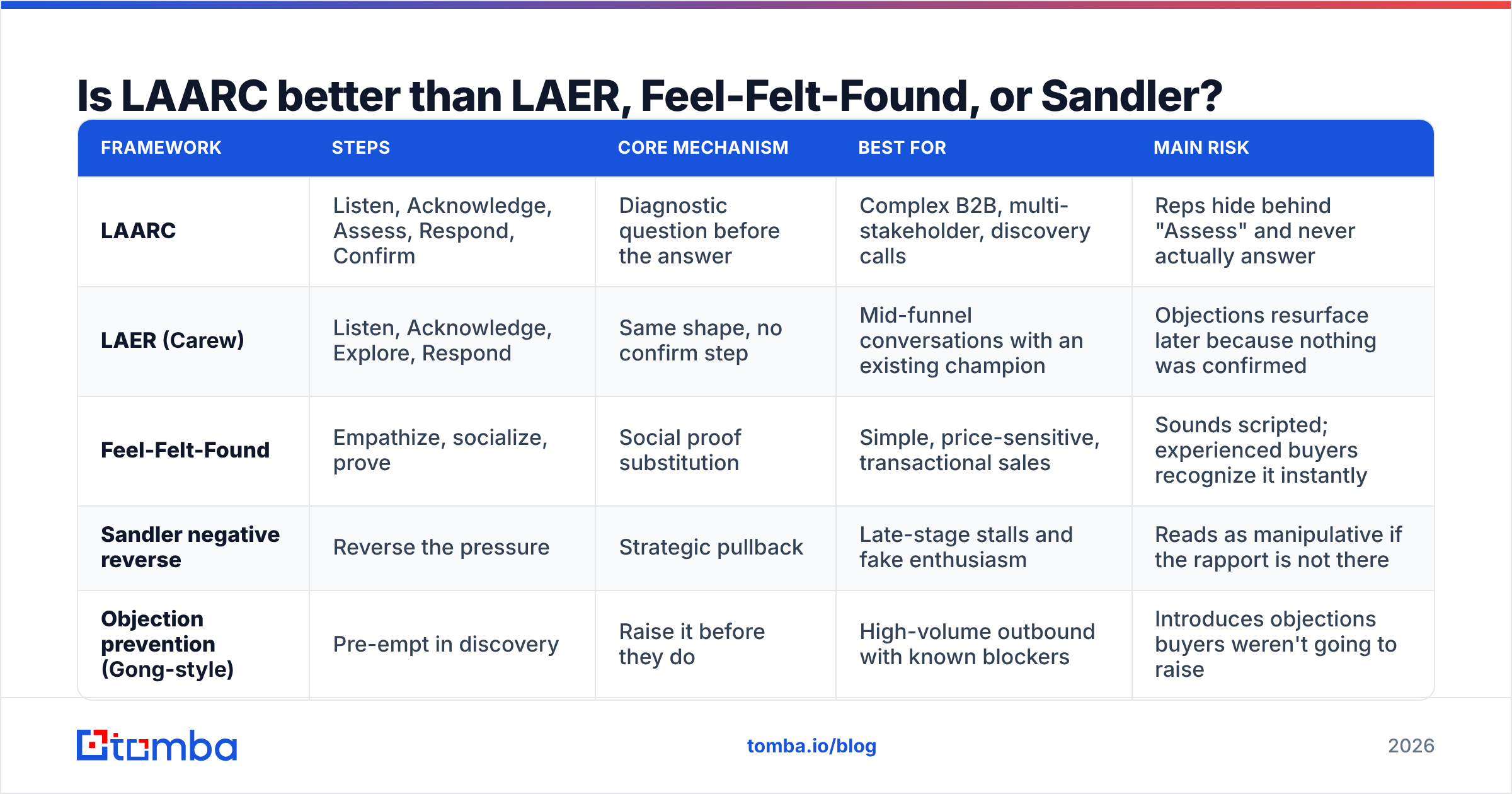
Not universally. Each framework optimizes for a different call type. Here is an honest comparison.
| Framework | Steps | Core mechanism | Best for | Main risk |
|---|---|---|---|---|
| LAARC | Listen, Acknowledge, Assess, Respond, Confirm | Diagnostic question before the answer | Complex B2B, multi-stakeholder, discovery calls | Reps hide behind "Assess" and never actually answer |
| LAER (Carew) | Listen, Acknowledge, Explore, Respond | Same shape, no confirm step | Mid-funnel conversations with an existing champion | Objections resurface later because nothing was confirmed |
| Feel-Felt-Found | Empathize, socialize, prove | Social proof substitution | Simple, price-sensitive, transactional sales | Sounds scripted; experienced buyers recognize it instantly |
| Sandler negative reverse | Reverse the pressure | Strategic pullback | Late-stage stalls and fake enthusiasm | Reads as manipulative if the rapport is not there |
| Objection prevention (Gong-style) | Pre-empt in discovery | Raise it before they do | High-volume outbound with known blockers | Introduces objections buyers weren't going to raise |
The practical read: use LAARC as your default on any call where the deal has more than one stakeholder, and keep Feel-Felt-Found for fast transactional cycles where a three-second empathy beat is all the room you have. HubSpot's breakdown of common sales objections is a solid companion library — just treat it as raw material for the Respond step, never as a substitute for Assess.
What does LAARC sound like against real objections?#
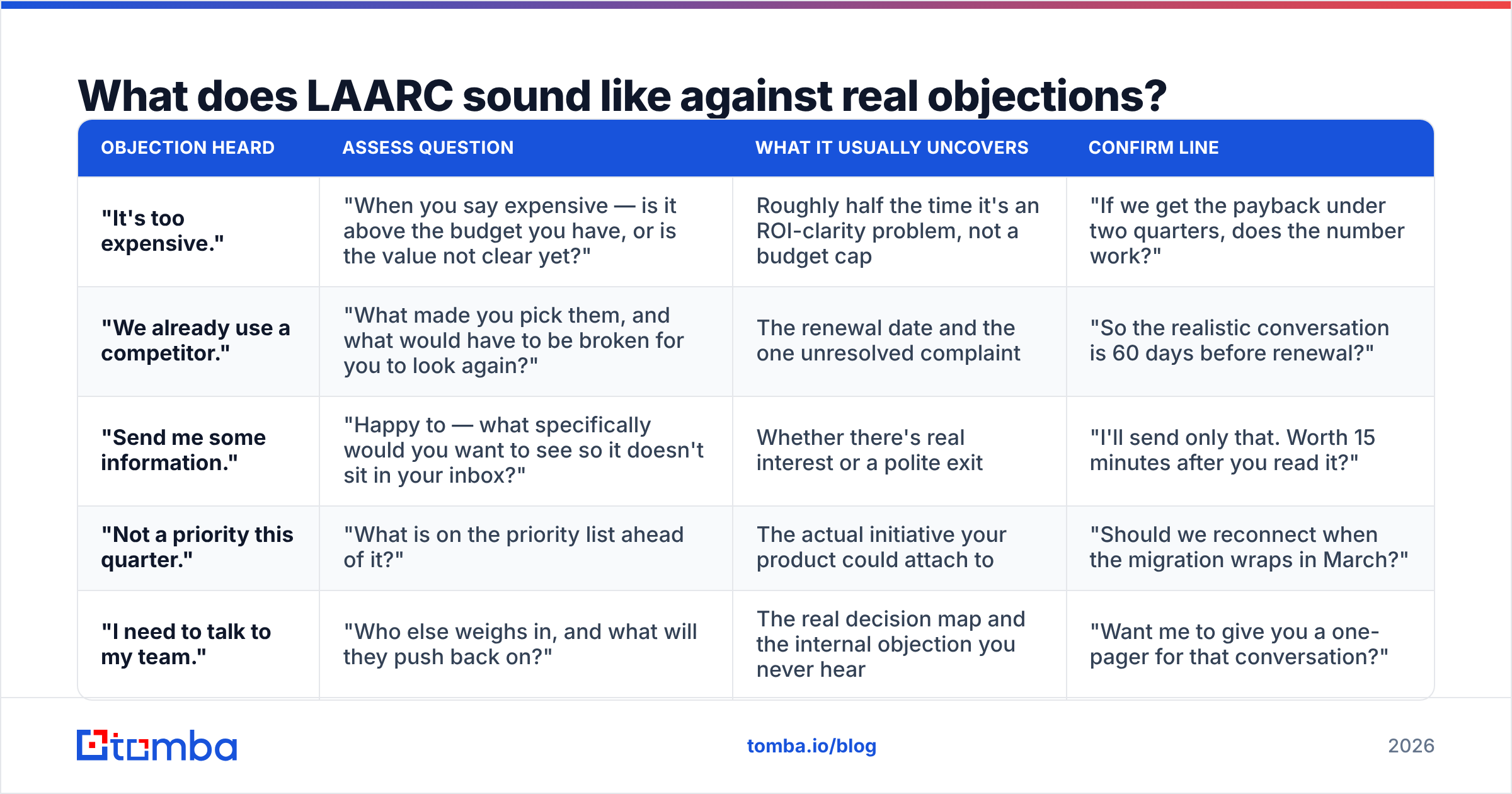
The Assess question is the hard part to improvise, so build a small bank of them. Four objections you will hear this week:
| Objection heard | Assess question | What it usually uncovers | Confirm line |
|---|---|---|---|
| "It's too expensive." | "When you say expensive — is it above the budget you have, or is the value not clear yet?" | Roughly half the time it's an ROI-clarity problem, not a budget cap | "If we get the payback under two quarters, does the number work?" |
| "We already use a competitor." | "What made you pick them, and what would have to be broken for you to look again?" | The renewal date and the one unresolved complaint | "So the realistic conversation is 60 days before renewal?" |
| "Send me some information." | "Happy to — what specifically would you want to see so it doesn't sit in your inbox?" | Whether there's real interest or a polite exit | "I'll send only that. Worth 15 minutes after you read it?" |
| "Not a priority this quarter." | "What is on the priority list ahead of it?" | The actual initiative your product could attach to | "Should we reconnect when the migration wraps in March?" |
| "I need to talk to my team." | "Who else weighs in, and what will they push back on?" | The real decision map and the internal objection you never hear | "Want me to give you a one-pager for that conversation?" |
Notice that every Assess question is open, short, and non-defensive. None of them contain the word "but." None of them re-pitch. The moment your clarifying question contains a product claim, the buyer hears a rebuttal and stops giving you information.
Where does LAARC break down?#
Three places, and being honest about them makes the framework more useful, not less.
When the objection is true. If the prospect has no budget until the next fiscal year, no amount of assessing changes that. LAARC's job here is to get you to a clean, dated follow-up instead of burning ten minutes proving them wrong. A good rep runs LAARC, discovers the constraint is real in twenty seconds, and books a calendar reminder for October.
When you are talking to the wrong person. Assess questions asked of someone with no authority produce confident, useless answers. You will get a crisp explanation of why the company won't buy from a person who was never going to decide. This is a targeting failure that no call framework repairs.
When Assess becomes avoidance. Some reps discover that asking questions feels safer than giving answers and end up interrogating the buyer. The tell is a call where the prospect asks "so what does it cost?" three times. Assess is one question. Sometimes two. Never four.
There is a fourth, less-discussed failure: LAARC assumes the objection is voiced. In modern B2B, most objections are silent — the prospect simply doesn't reply. No framework handles an unspoken objection, which is why the front end of your process matters more than your rebuttal skill.
How do you make LAARC stick across a team?#
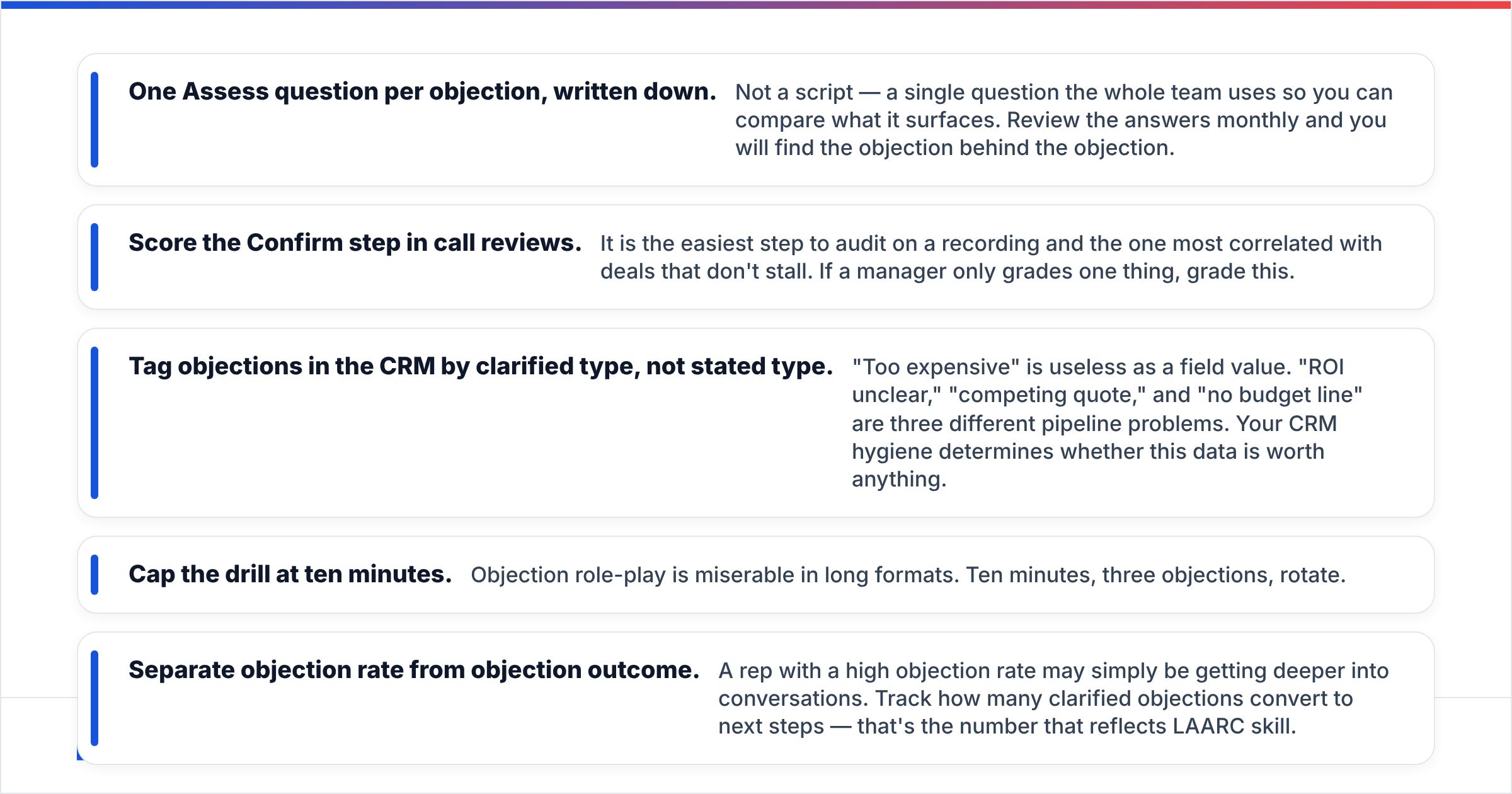
Frameworks die in the gap between the training session and the Tuesday call block. What survives:
- One Assess question per objection, written down. Not a script — a single question the whole team uses so you can compare what it surfaces. Review the answers monthly and you will find the objection behind the objection.
- Score the Confirm step in call reviews. It is the easiest step to audit on a recording and the one most correlated with deals that don't stall. If a manager only grades one thing, grade this.
- Tag objections in the CRM by clarified type, not stated type. "Too expensive" is useless as a field value. "ROI unclear," "competing quote," and "no budget line" are three different pipeline problems. Your CRM hygiene determines whether this data is worth anything.
- Cap the drill at ten minutes. Objection role-play is miserable in long formats. Ten minutes, three objections, rotate.
- Separate objection rate from objection outcome. A rep with a high objection rate may simply be getting deeper into conversations. Track how many clarified objections convert to next steps — that's the number that reflects LAARC skill.
Teams reviewing tooling for call recording and coaching can compare options on G2's sales engagement category rather than taking a vendor's word for it.
Do better prospects mean fewer objections?#
Yes — and this is the least glamorous finding in objection handling. A meaningful share of the pushback on cold outreach is not persuasion resistance. It's the prospect telling you, politely, that you targeted them wrong.
"We don't handle that here" means you had the wrong department. "I left that company two years ago" means your list was stale. "Who is this?" means the email or number you found was never verified. None of those are objections in the LAARC sense. They are data defects wearing an objection costume, and running a five-step framework against them wastes everyone's time.
The fix sits upstream of the call:
- Verify contactability before the sequence starts. A pass through an email verifier removes the bounces that inflate your "objection" count with noise.
- Confirm the person still holds the role. Contact enrichment that refreshes title and company is the difference between a live conversation and an argument with someone who left.
- Get a real phone path for the accounts worth the effort. A phone finder turns a dead email thread into a thirty-second call where LAARC actually applies.
- Track your response rate by segment. If one segment objects constantly and another converts, that's a targeting signal, not a coaching signal.
Clean the list, and the objections you're left with are the real ones — the ones LAARC was built for. Dirty lists make even excellent reps look like they can't handle pushback.
What should you do with this tomorrow?#
Pick your three most frequent objections. Write one Assess question for each. Run them for a week and log what the question surfaced versus what the objection said. You will almost certainly find that at least one of your "pricing objections" is not about price at all.
Then look at the objections that turned out to be bad data. If more than a fifth of your pushback is wrong-person, wrong-company, or wrong-contact, no objection framework will move your numbers — your list will.
That's where Tomba's Email Finder fits. It finds verified professional email addresses by name, domain, or company, so the person picking up is the person you meant to reach. The free tier covers 25 searches a month if you just want to sanity-check a segment; paid plans start at $49/mo on Starter, with Growth at $99/mo — full Tomba pricing is public. Fix the list first, then let LAARC do the work it's actually good at.
Related guides#
// get started
Find, verify and enrich your first contacts today
Start on the free plan with 25 searches a month, then scale when your team is ready.
Free plan · No credit card required · GDPR & CCPA
// about the author