Labnify vs LeadEngineAI: Which Cold Outreach Stack Wins in 2026
Labnify sends email at volume. LeadEngineAI generates the leads. They get compared constantly but solve opposite halves of the outbound problem — here's how to pick, and what both leave you to fix yourself.
TL;DR
- Labnify and LeadEngineAI are not really competitors. Labnify is sending infrastructure — mailboxes, SMTP, warmup, sequences. LeadEngineAI is a lead-sourcing layer — AI-assisted list building, intent signals, and contact records.
- If your bottleneck is "I have 40,000 contacts and nowhere safe to send from," Labnify is the relevant purchase. If it's "I don't know who to email," LeadEngineAI (or any data vendor) is.
- Neither replaces a dedicated verification step. Both categories are notorious for passing through catch-all domains and stale records that quietly torch your sender reputation.
- Budget for both halves. A realistic 2026 outbound stack costs $150–$400/month for a small team once you add data, sending, and verification.
- The cheapest reliability win is fixing the list before it hits the sender, not after.
What are Labnify and LeadEngineAI, exactly?#
They sit on opposite ends of the same pipeline, which is why head-to-head reviews of them tend to be confused.
Labnify is built around the sending problem. The pitch is high-volume cold email without renting 40 Google Workspace seats: bulk mailbox provisioning, SMTP relay, automated warmup, rotation across sending identities, and a campaign layer on top. It competes conceptually with Instantly, Smartlead, and Saleshandy — the "how do I physically deliver 3,000 emails a day without getting flagged" tier of the stack.
LeadEngineAI attacks the other end. It positions as an AI lead-generation engine: describe an ideal customer profile in plain language, get back a list of companies and contacts, optionally scored or enriched with buying signals. Its conceptual neighbors are Apollo, Clay, and the newer generation of natural-language prospecting tools.
So "Labnify vs LeadEngineAI" is usually the wrong framing. The real question is which half of your outbound machine is currently broken, and whether the tool you're considering actually fixes that half.
One thing both share: neither was built primarily as a data-accuracy product. Sending platforms assume your list is good. AI lead engines assume their inference is good. Those two assumptions stacked on top of each other is how teams end up with a 9% bounce rate and a burned domain.

How do Labnify and LeadEngineAI actually differ?#
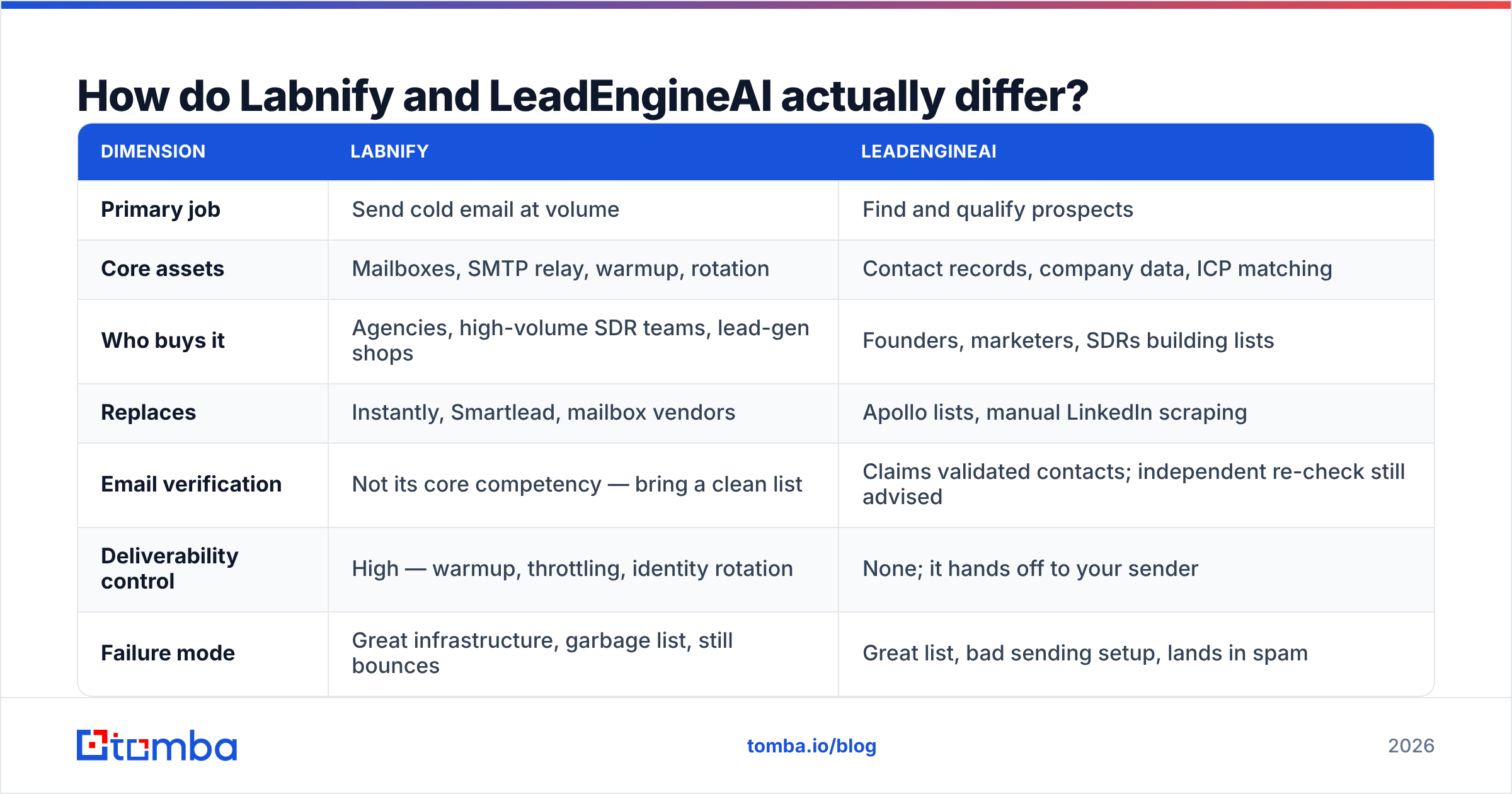
| Dimension | Labnify | LeadEngineAI |
|---|---|---|
| Primary job | Send cold email at volume | Find and qualify prospects |
| Core assets | Mailboxes, SMTP relay, warmup, rotation | Contact records, company data, ICP matching |
| Who buys it | Agencies, high-volume SDR teams, lead-gen shops | Founders, marketers, SDRs building lists |
| Replaces | Instantly, Smartlead, mailbox vendors | Apollo lists, manual LinkedIn scraping |
| Email verification | Not its core competency — bring a clean list | Claims validated contacts; independent re-check still advised |
| Deliverability control | High — warmup, throttling, identity rotation | None; it hands off to your sender |
| Failure mode | Great infrastructure, garbage list, still bounces | Great list, bad sending setup, lands in spam |
| CRM/workflow fit | Sits before the CRM, after the list | Sits before everything |
The pattern in that table matters more than any single row. Labnify's risk is downstream of data quality: no amount of warmup saves a list where one in eight addresses does not exist. LeadEngineAI's risk is downstream of infrastructure: perfect targeting delivered from a cold domain with no SPF record still ends up in Promotions or worse.
Which one should you buy first?#
Work through these in order. Most teams get this backwards and buy sending capacity before they have anything worth sending.
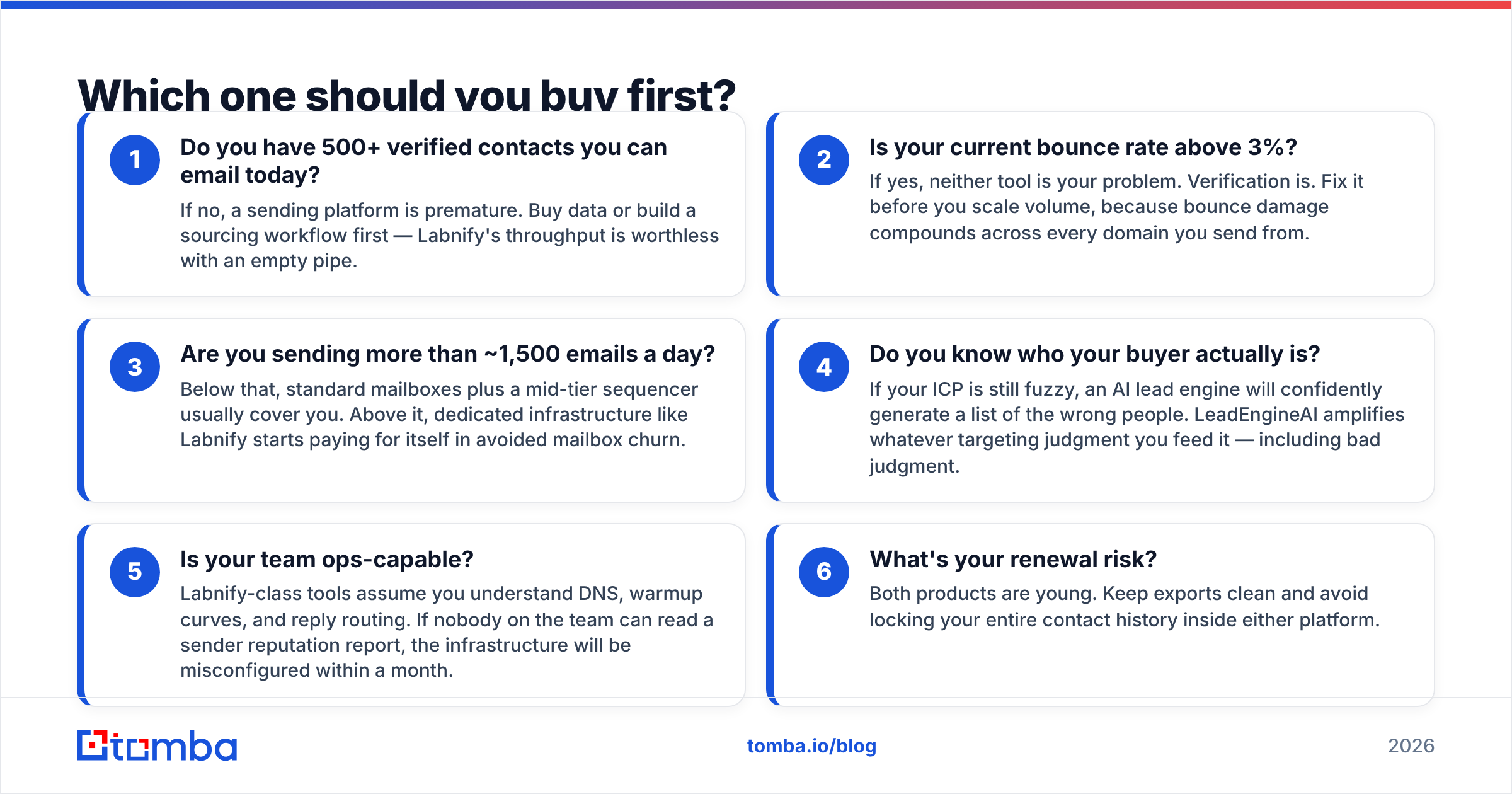
- Do you have 500+ verified contacts you can email today? If no, a sending platform is premature. Buy data or build a sourcing workflow first — Labnify's throughput is worthless with an empty pipe.
- Is your current bounce rate above 3%? If yes, neither tool is your problem. Verification is. Fix it before you scale volume, because bounce damage compounds across every domain you send from.
- Are you sending more than ~1,500 emails a day? Below that, standard mailboxes plus a mid-tier sequencer usually cover you. Above it, dedicated infrastructure like Labnify starts paying for itself in avoided mailbox churn.
- Do you know who your buyer actually is? If your ICP is still fuzzy, an AI lead engine will confidently generate a list of the wrong people. LeadEngineAI amplifies whatever targeting judgment you feed it — including bad judgment.
- Is your team ops-capable? Labnify-class tools assume you understand DNS, warmup curves, and reply routing. If nobody on the team can read a sender reputation report, the infrastructure will be misconfigured within a month.
- What's your renewal risk? Both products are young. Keep exports clean and avoid locking your entire contact history inside either platform.
Is Labnify's volume advantage real?#
Mostly yes — with a caveat that applies to the whole category.
The genuine advantage of a consolidated sending platform is operational. Provisioning mailboxes manually is miserable: buying domains, configuring SMTP, setting DNS records, waiting out warmup, replacing burned identities. Labnify compresses that into a dashboard. For an agency running twelve client campaigns, that's a real week of labor saved every month.
The caveat is that "unlimited sending" language across this category describes what the platform will let you do, not what mailbox providers will accept. Gmail and Microsoft enforce their own reputation thresholds regardless of what your relay permits. A platform can hand you the ability to fire 10,000 emails on day one; doing it is how you get a domain blacklisted by day three.
Practical guardrails that survive any platform change:
- Keep per-mailbox daily volume conservative — roughly 30–50 sends on established identities, far lower during warmup.
- Keep bounce rate under 2%. Above 5% you are actively training filters against yourself.
- Monitor reply rate as a health metric, not just a performance one. A collapse in replies usually means placement dropped before any bounce report shows it.
- Check your domains against a blacklist checker weekly, not after a campaign fails.
None of that is Labnify-specific. It's the price of admission for cold email in 2026, and it's the reason email deliverability is a discipline rather than a setting.
Does LeadEngineAI's data replace a dedicated email finder?#
This is the expensive question, and the honest answer is: not on its own.
AI lead engines are excellent at the discovery step — narrowing a universe of companies to a shortlist that matches your ICP description, then attaching plausible contacts to it. Where the category consistently underperforms is the last mile: is this specific address, for this specific person, at this specific company, deliverable right now?
Three failure modes show up repeatedly across the category:
Pattern-guessed addresses presented as verified. If a tool knows a company uses first.last@domain.com, it can generate an address for any employee name. That's an inference, not a confirmation. It will bounce whenever the person left, uses a variant, or sits behind a subsidiary domain.
Catch-all domains marked "valid." Roughly a fifth of B2B domains accept everything at the SMTP layer and discard the invalid ones later. A naive check marks all of them as deliverable. A catch-all verifier applies additional signals to separate real mailboxes from the accept-all noise — which is exactly where most bulk lists rot.
Stale records. B2B contact data decays somewhere around 25–30% per year through job changes alone. A database refreshed quarterly is meaningfully worse than one refreshed continuously, and vendor marketing rarely distinguishes the two. Independent reviews on G2 tend to surface this gap faster than vendor accuracy claims do.
The fix is boring and cheap: treat every list — from LeadEngineAI, Apollo, BookYourData, a partner export, whatever — as unverified input. Run it through an email verifier before it reaches the sender. For contacts where the address is missing entirely, an email finder resolves name plus domain into a confirmed address rather than a guessed one.
What does the complete stack cost?#
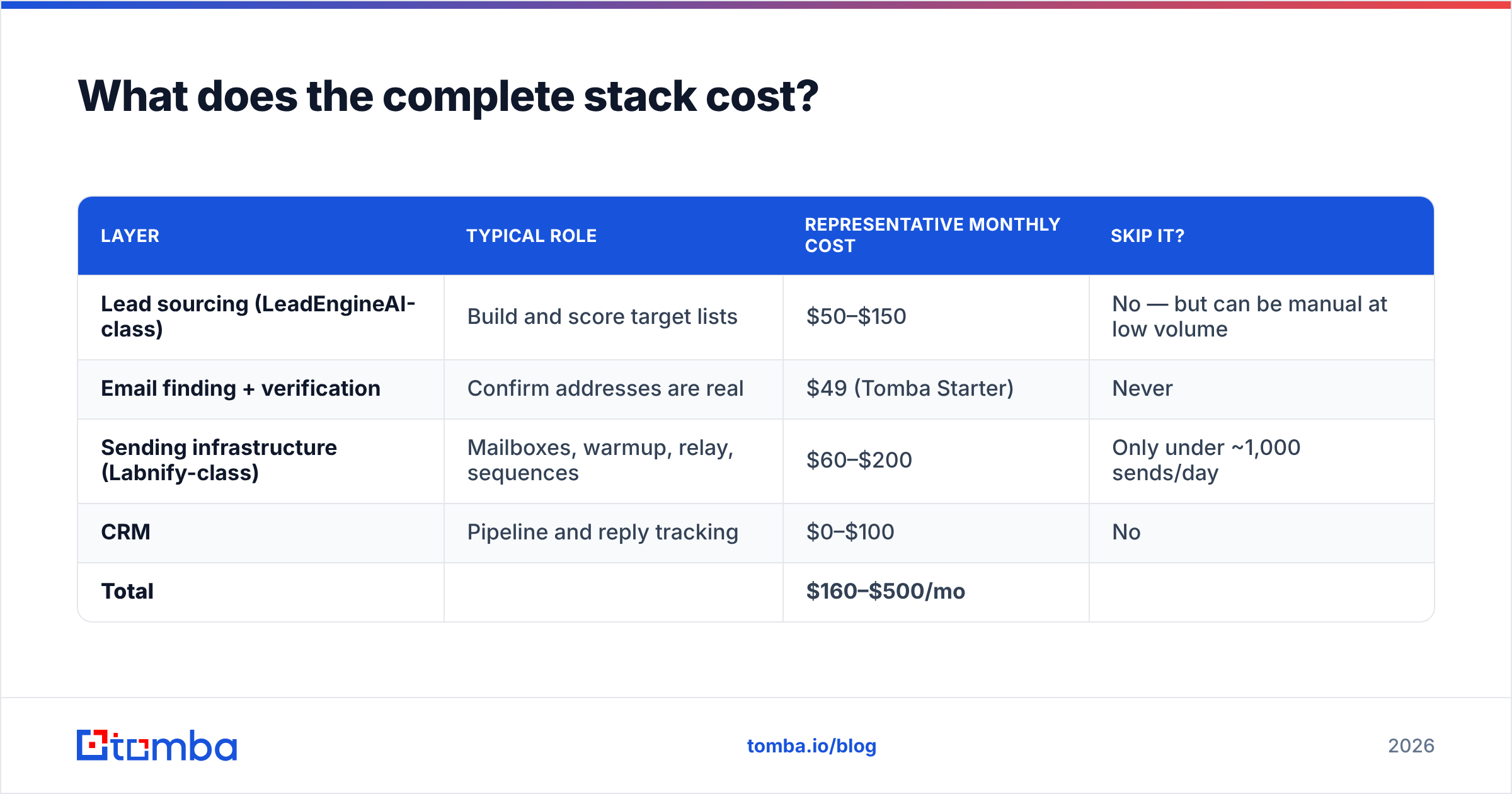
Here's a realistic build for a two-to-four person outbound team, comparing the two tools' roles plus the verification layer that neither owns.
| Layer | Typical role | Representative monthly cost | Skip it? |
|---|---|---|---|
| Lead sourcing (LeadEngineAI-class) | Build and score target lists | $50–$150 | No — but can be manual at low volume |
| Email finding + verification | Confirm addresses are real | $49 (Tomba Starter) | Never |
| Sending infrastructure (Labnify-class) | Mailboxes, warmup, relay, sequences | $60–$200 | Only under ~1,000 sends/day |
| CRM | Pipeline and reply tracking | $0–$100 | No |
| Total | $160–$500/mo |
For reference, Tomba pricing runs a free tier at 25 searches per month, Starter at $49/mo, Growth at $99/mo, and Pro at $249/mo, with Enterprise custom. Verification is the smallest line item in the stack and the one with the highest marginal return, because it protects the value of every other line.
That ratio is the single most useful takeaway here. Teams routinely spend $200 a month on sending infrastructure to protect domains they then damage with a $0 list. The bulk email finder workflow — upload the raw export, get back verified addresses with confidence scores, discard the rest — costs less than one burned domain's replacement.
Is there a scenario where you need both?#
Yes, and it's the most common one.
A lead-gen agency running outbound for multiple clients genuinely needs all three layers. Sourcing produces the raw universe. Verification decides what's safe to send. Infrastructure distributes it without cross-contaminating client domains. Removing any layer breaks the model.
Where you don't need both:
- Founder-led sales under 100 emails a week. Use your existing mailbox, source manually from LinkedIn and company sites, verify before sending. No sending platform required.
- Account-based outbound to 50 named accounts. Sourcing volume is irrelevant; precision is everything. A domain search against each target company beats any AI-generated list here, because you already know the accounts.
- Existing sequencer users. If you're already on a mature outreach platform, adding Labnify duplicates the sequencing layer. Evaluate it as a replacement, not an addition.
For a broader view of how sourcing, sending, and CRM layers fit together operationally, HubSpot's sales resources are a reasonable neutral baseline — they're vendor content, but the process frameworks hold up regardless of tooling.
What's the verdict on Labnify vs LeadEngineAI?#
Pick Labnify if your list is already good and your constraint is delivery capacity — you're sending over 1,500 emails a day, burning mailboxes, or managing multiple client domains. It solves a real operational headache, and it solves it well.
Pick LeadEngineAI if your constraint is knowing who to contact — you're early, your ICP is defined, and manual list building is eating your week. Treat its output as a strong starting point, not a finished list.
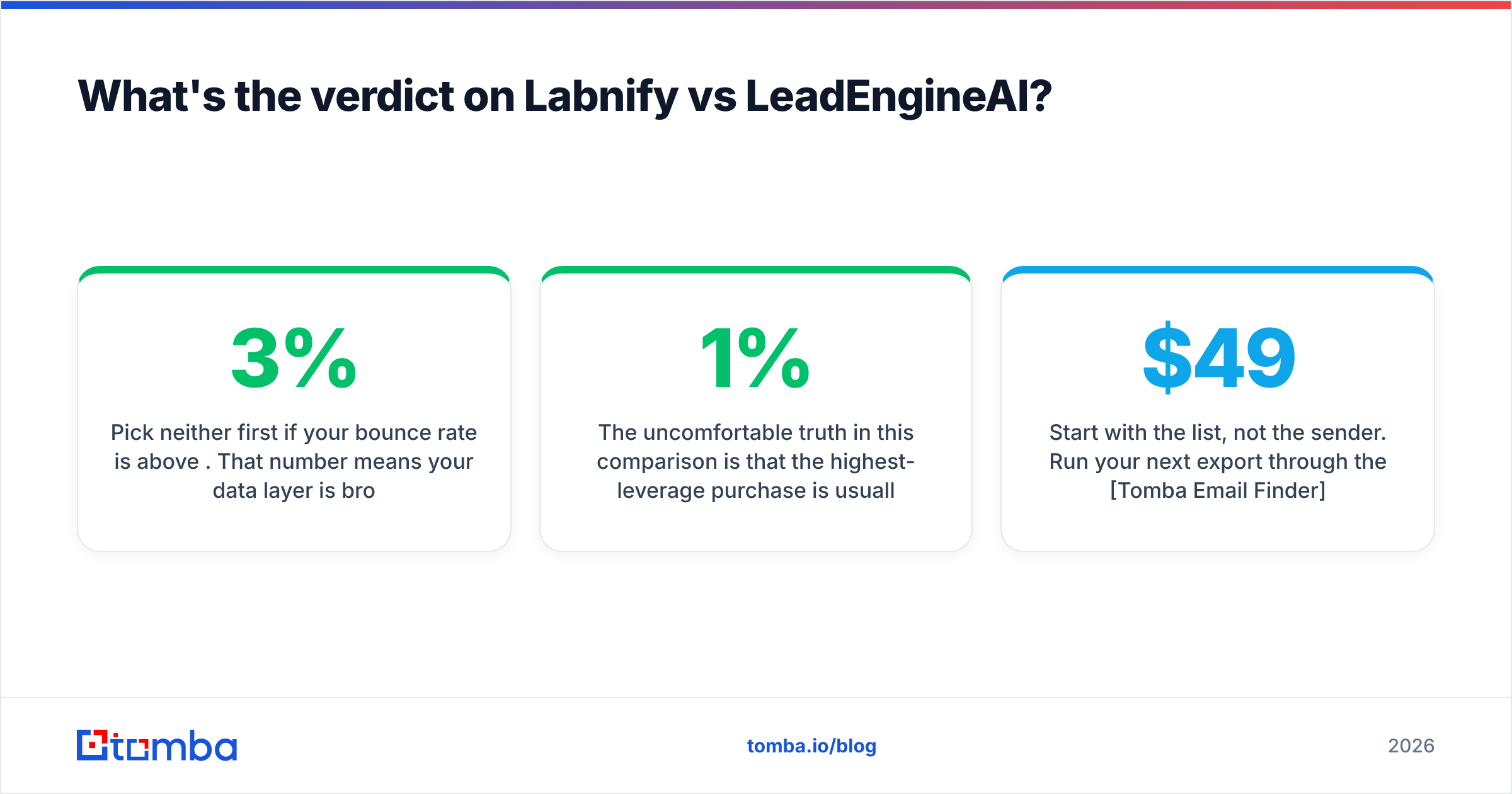
Pick neither first if your bounce rate is above 3%. That number means your data layer is broken, and buying either tool at that point makes the problem more expensive, not less. Fix the list, then decide which half of the stack to invest in.
The uncomfortable truth in this comparison is that the highest-leverage purchase is usually the one nobody frames as exciting. Sending infrastructure and AI lead engines both look like growth. Verification looks like housekeeping. But a 1% bounce rate is what makes the other two investments work at all.
Start with the list, not the sender. Run your next export through the Tomba Email Finder before it touches any sending platform — confirmed addresses, catch-all detection, and confidence scores on every record. The free tier covers 25 searches a month so you can test it against a list you already have and see the bounce delta yourself. If the numbers hold up, Starter at $49/mo covers most small outbound teams, and the Tomba API drops verification directly into whatever stack you end up choosing.
Related guides#
// get started
Find, verify and enrich your first contacts today
Start on the free plan with 25 searches a month, then scale when your team is ready.
Free plan · No credit card required · GDPR & CCPA
// about the author