Lace Pricing in 2026: Reviews, Real Costs, Pros and Cons
Lace does not publish a price list, which makes budgeting guesswork. Here is what actually drives the quote, what reviewers praise and complain about, and when a cheaper stack does the same job.
Lace pricing reviews are the only real way to budget for Lace, because the company publishes no price list. Here is what buyers actually report, what moves the quote up or down, and when a cheaper stack does the same job.
TL;DR
- Lace (lace.ai) is an AI call-intelligence platform that records, transcribes, and scores inbound phone conversations — mostly for home-services and other high-call-volume operations. It does not publish a public price list.
- Every number you will see quoted online is buyer-reported and directional. Lace prices per location, per call volume, and per contract length, so two companies of the same headcount can get quotes that differ by 3x.
- The strongest reviews praise call scoring accuracy and booking-rate lift. The most common complaints are annual-only contracts, implementation lead time, and the fact that Lace analyzes calls you already have — it does not create new pipeline.
- The hidden costs are onboarding, telephony integration work, and the seat sprawl that happens once managers want dashboards.
- If your real bottleneck is not enough conversations rather than poor conversations, a $49/mo contact-data stack will move revenue faster than a five-figure call-intelligence contract.
What is Lace and who is it actually for?#
Lace is conversation intelligence for the phone-heavy side of B2B and local services. It plugs into your phone system, captures inbound and outbound calls, and transcribes them. Then AI scoring answers the questions a manager cannot get to by listening to 40 hours of audio a week. Did the rep ask for the appointment? Did they quote a price? Was the lead qualified? Was the call a real sales opportunity, or a billing question sent to the wrong team?
That matters for pricing, because it sets the ceiling on your ROI. Lace makes existing calls more productive. It does not generate calls. Buyers who feel let down by the contract value almost always expected demand generation. They got analytics instead.
The realistic buyer profile looks like this:
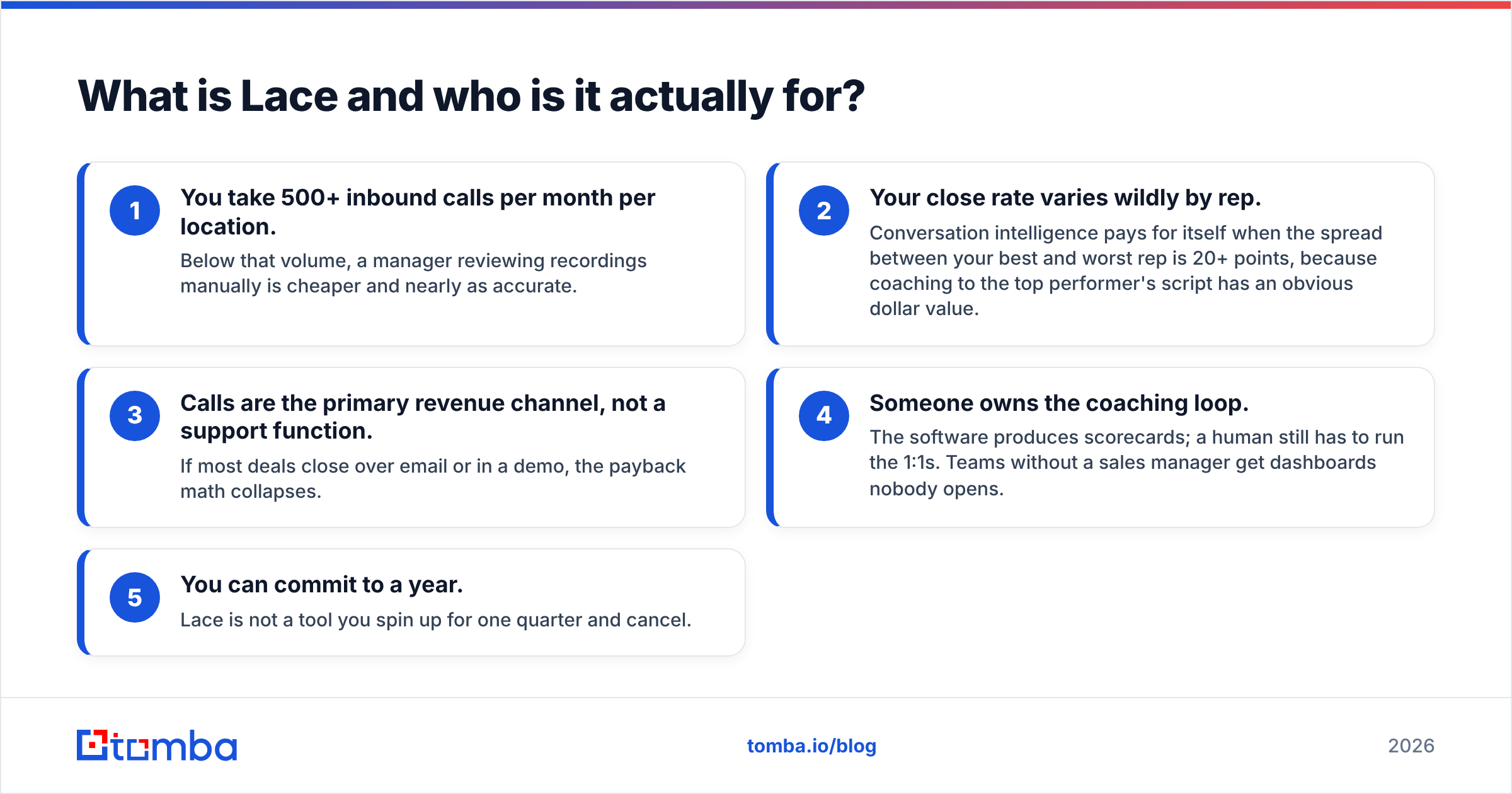
- You take 500+ inbound calls per month per location. Below that volume, a manager reviewing recordings by hand is cheaper and nearly as accurate.
- Your close rate varies wildly by rep. The payback is clear when the spread between your best and worst rep is 20+ points. Coaching everyone to the top performer's script has an obvious dollar value.
- Calls are the primary revenue channel, not a support function. If most deals close over email or in a demo, the payback math collapses.
- Someone owns the coaching loop. The software produces scorecards; a human still has to run the 1:1s. Teams without a sales manager get dashboards nobody opens.
- You can commit to a year. Lace is not a tool you spin up for one quarter and cancel.
If three or more of those describe you, keep reading the pricing section. If fewer than two do, skip to the alternatives table. You are likely solving a top-of-funnel problem with a bottom-of-funnel tool.

How much does Lace cost in 2026?#
The honest answer: nobody outside Lace's sales team knows. Any blog claiming a precise sticker price is guessing. Lace runs a quote-only motion — you book a demo, they scope your call volume and location count, and a proposal follows. There is no self-serve checkout, no published tier table, and no free plan.
That is normal in this category. Gong, Invoca, and most enterprise conversation-intelligence vendors do the same thing. But it means your evaluation has to change shape. Instead of comparing list prices, you are comparing pricing mechanics. Here is what drives your quote, and what to nail down in writing before you sign.
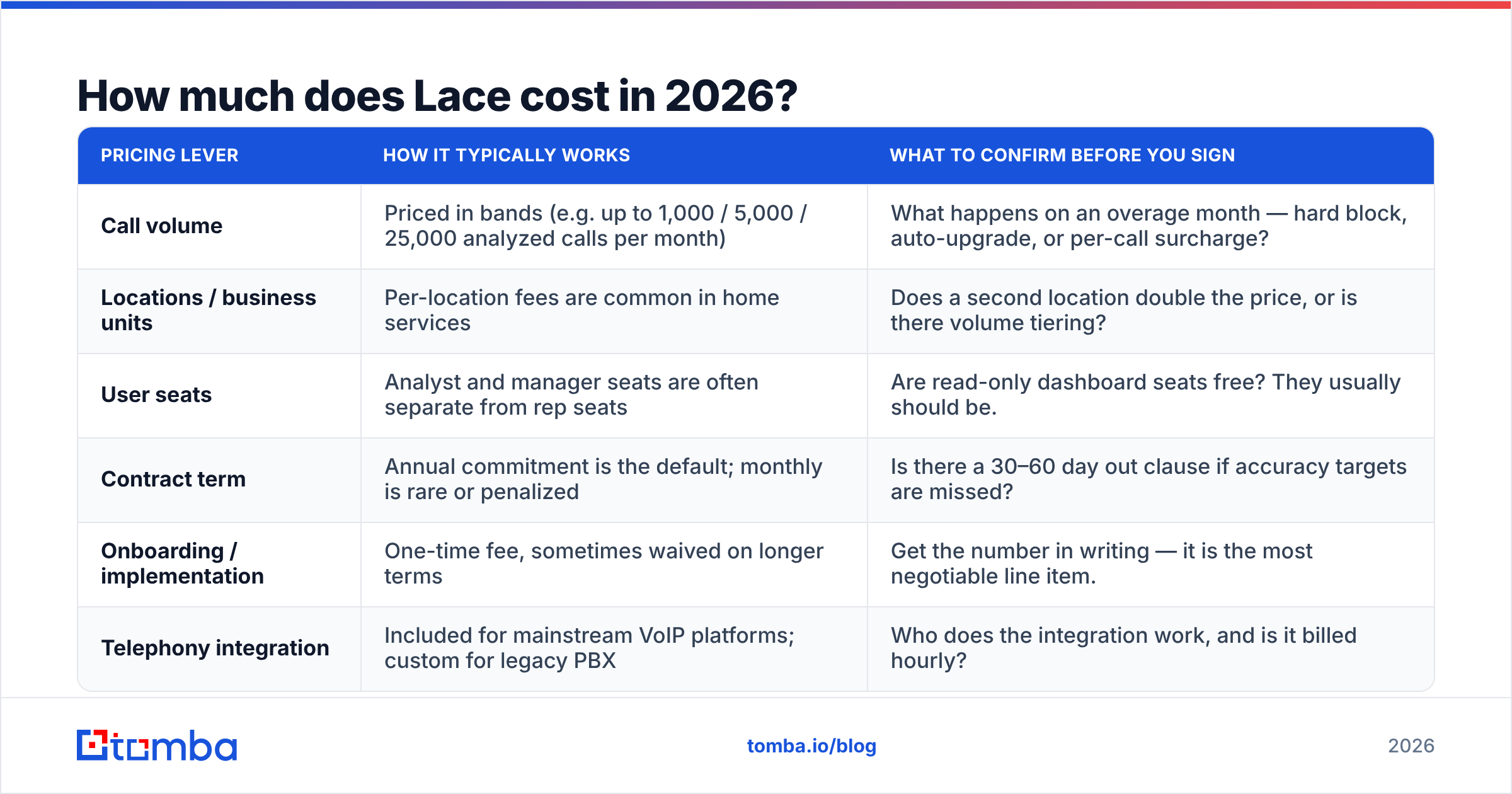
| Pricing lever | How it typically works | What to confirm before you sign |
|---|---|---|
| Call volume | Priced in bands (e.g. up to 1,000 / 5,000 / 25,000 analyzed calls per month) | What happens on an overage month — hard block, auto-upgrade, or per-call surcharge? |
| Locations / business units | Per-location fees are common in home services | Does a second location double the price, or is there volume tiering? |
| User seats | Analyst and manager seats are often separate from rep seats | Are read-only dashboard seats free? They usually should be. |
| Contract term | Annual commitment is the default; monthly is rare or penalized | Is there a 30–60 day out clause if accuracy targets are missed? |
| Onboarding / implementation | One-time fee, sometimes waived on longer terms | Get the number in writing — it is the most negotiable line item. |
| Telephony integration | Included for mainstream VoIP platforms; custom for legacy PBX | Who does the integration work, and is it billed hourly? |
Practical negotiating note: in quote-only categories, your discount depends on term length and on how close the vendor is to quarter end. Pushing hard on the monthly rate does much less. Ask instead for the implementation fee to be waived and for a volume band upgrade at no cost. Those are cheaper for the vendor to give, and they are worth more to you.
What do Lace pricing reviews actually say?#
Review coverage for Lace is thinner than for the megavendors, so read it carefully rather than counting stars. Check the current listings on G2 and Capterra directly. Pay attention to reviewer company size too: a 3-location operator and a 60-location franchise group do not have the same experience.
Here are the recurring themes across public Lace pricing reviews and buyer conversations.
What reviewers consistently like
- Scoring accuracy on domain-specific calls. Lace's models are tuned for service-business call patterns, not generic SaaS discovery calls. Reviewers notice the difference against horizontal tools.
- Missed-opportunity detection. The single most-cited ROI driver is surfacing calls where a booking was available and the rep did not ask. That is a concrete, countable number a manager can act on Monday morning.
- Manager time savings. Reviewers regularly describe cutting call-review time from hours to minutes, because the platform flags which 12 calls out of 800 are worth hearing.
- Responsive support during onboarding. Smaller vendors often out-service the giants here, and Lace reviews reflect that.
What reviewers consistently complain about
- No pricing transparency. The most common first complaint is not the price itself. It is not being able to budget without a sales cycle.
- Annual lock-in. Several reviewers note they would have preferred a quarterly pilot and were pushed to a year.
- Time to value. Between telephony integration, model tuning, and getting managers to run the coaching cadence, real results take weeks, not days.
- Transcription edge cases. Heavy accents, crosstalk, and poor line quality all hurt accuracy. That is a universal problem in this category, but it shows up in Lace reviews too.
- It analyzes, it does not prospect. Teams whose real problem was pipeline volume report buying the wrong tool, not a bad one.
That last point is the most important one in this post. Sit with it before you take the demo.
What are the hidden costs in Lace pricing?#
Quote-only pricing hides the total cost of ownership, not just the license fee. Budget for these:
- Implementation time from your team, not theirs. Somebody internal has to map your call flows, define what "qualified" means for your business, and validate the first few hundred scored calls. Assume 15–25 hours of a manager's time in month one.
- Telephony dependency. If your phone system is old or your call recording is inconsistent, you are buying a phone system upgrade first and analytics second.
- Seat creep. Dashboards are contagious. The GM wants one, then ops, then marketing. Confirm whether viewer seats are free, or your year-two renewal will be noticeably higher than year one.
Two more line items never show up on the invoice at all:
- The coaching program. The software is the cheap part. A manager running weekly call-review sessions across ten reps is the real investment, and it is the only reason the license produces revenue.
- Opportunity cost. Five figures spent on analyzing existing calls is five figures not spent on generating new ones. For a team at 60% of quota because of pipeline starvation, that trade is usually wrong.
How does Lace compare to the alternatives?#
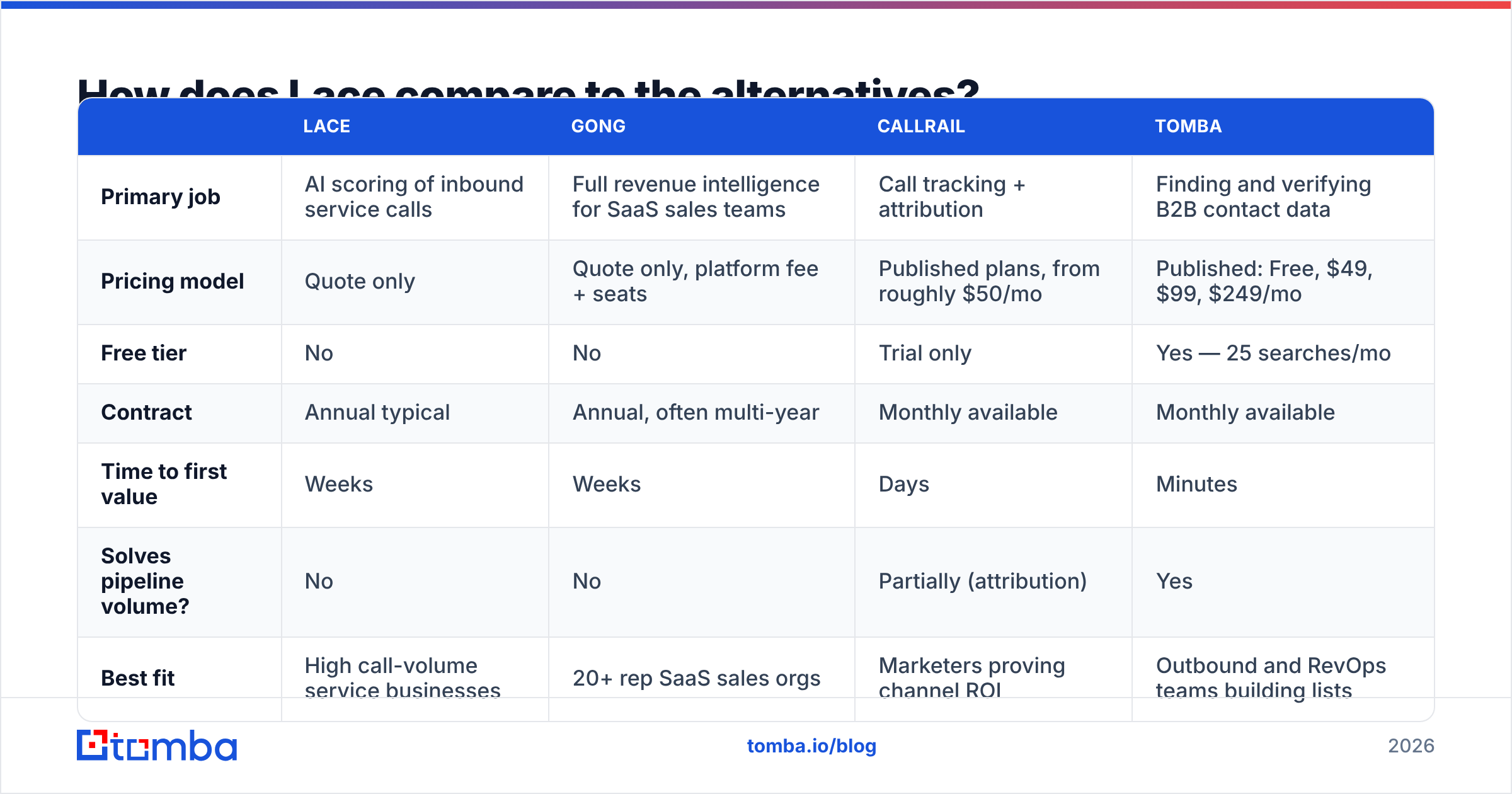
Different tools solve different halves of the revenue problem. The table below is deliberately mixed. The real decision most teams face is not "which call-intelligence vendor." It is "should I spend this budget on analyzing conversations or on creating them."
| Lace | Gong | CallRail | Tomba | |
|---|---|---|---|---|
| Primary job | AI scoring of inbound service calls | Full revenue intelligence for SaaS sales teams | Call tracking + attribution | Finding and verifying B2B contact data |
| Pricing model | Quote only | Quote only, platform fee + seats | Published plans, from roughly $50/mo | Published: Free, $49, $99, $249/mo |
| Free tier | No | No | Trial only | Yes — 25 searches/mo |
| Contract | Annual typical | Annual, often multi-year | Monthly available | Monthly available |
| Time to first value | Weeks | Weeks | Days | Minutes |
| Solves pipeline volume? | No | No | Partially (attribution) | Yes |
| Best fit | High call-volume service businesses | 20+ rep SaaS sales orgs | Marketers proving channel ROI | Outbound and RevOps teams building lists |
A few honest qualifiers. Gong is a heavier, more expensive platform aimed at a different buyer, so comparing it to Lace on price alone misses the point. CallRail's published pricing makes it the easy starting point if your question is "which campaigns drive calls" rather than "how well do reps handle them." And if your gap is contact coverage rather than conversation quality, purpose-built data vendors solve a problem no call-intelligence tool can touch — Tomba, or peers like BookYourData for pre-built list buying.
Is Lace worth it for your team?#
Run this diagnostic before the demo, not after.
- Count your missed calls and unbooked opportunities. If you cannot estimate this, you cannot build an ROI case. The vendor's model will then fill the gap with optimistic assumptions.
- Multiply the gap by your average ticket. Conversation intelligence converts part of that gap, not all of it. A 10–20% recovery assumption is defensible. 50% is a fantasy that will make the renewal painful.
- Compare against the same dollars spent on pipeline. What would 12 months of a contact-data and outbound stack produce at your current close rate? Do the arithmetic honestly.
- Check whether you have a coaching owner. No owner, no ROI. This is the single biggest predictor of whether the contract renews.
- Insist on a pilot structure. Even inside an annual term, ask for a 60-day accuracy checkpoint with defined success criteria and an exit if they are missed.
Lace is worth it when your conversations are plentiful and inconsistent. It is not worth it when your conversations are rare. That one distinction decides the purchase more reliably than any feature comparison.
What should you buy instead if your problem is pipeline?#
If step 3 above went badly, your budget belongs at the top of the funnel. In other words, if you do not have enough conversations to analyze, buy conversations first. That stack is much cheaper and much faster to prove out.
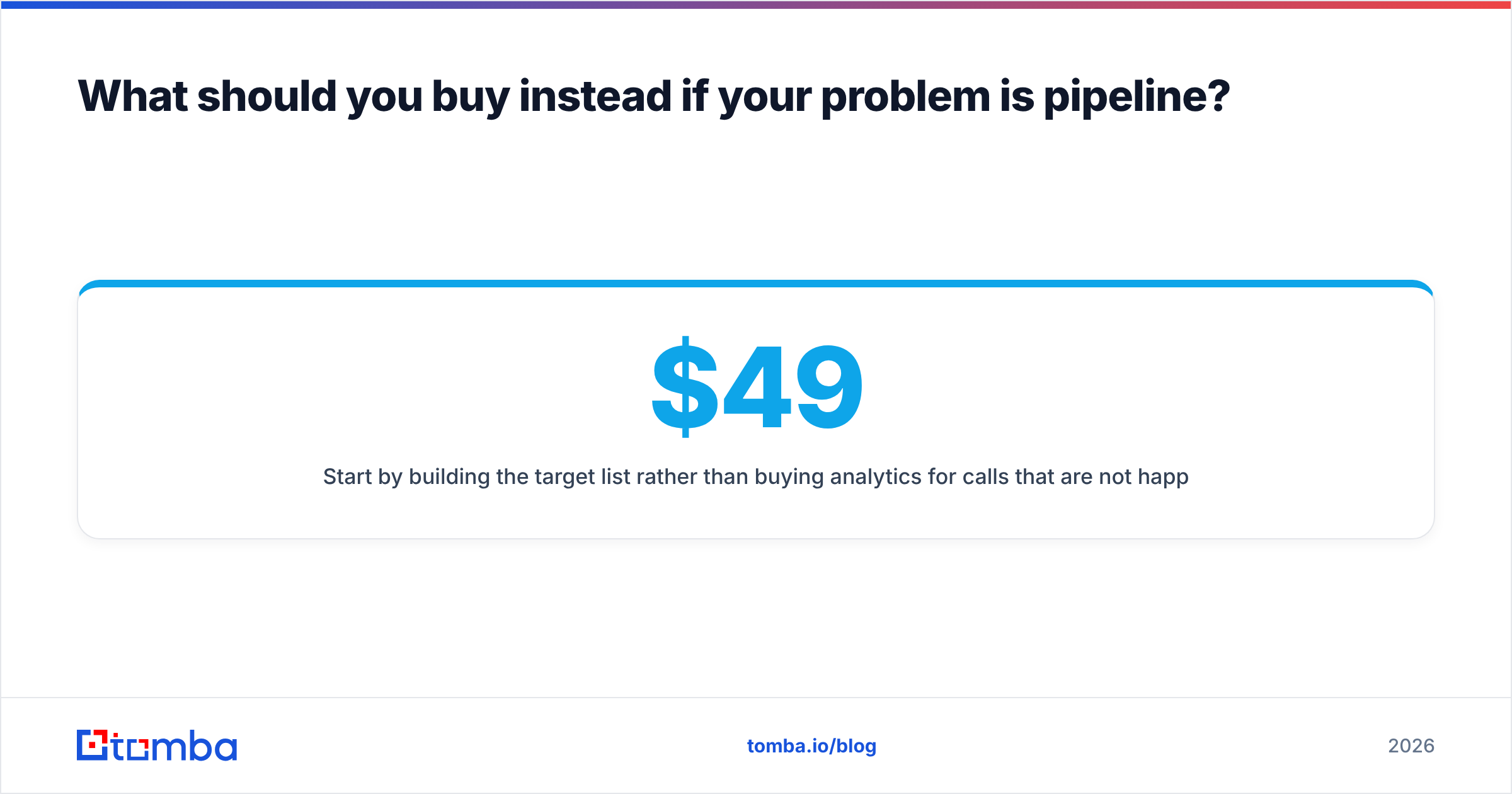
Start by building the target list rather than buying analytics for calls that are not happening. Use an email finder to get verified addresses for the decision makers at your ICP accounts. Add a phone finder to pair those records with direct dials, so reps skip the switchboard. Then push everything into your CRM so attribution stays clean. Unlike quote-only platforms, Tomba pricing is published: a free tier with 25 searches a month, Starter at $49/mo, Growth at $99/mo, Pro at $249/mo, and custom Enterprise terms. You can test the data quality this afternoon, on your own list, without a discovery call.
The sequencing argument is simple. Conversation intelligence multiplies the value of the calls you already get. Contact data creates those calls. Multiplying zero is still zero. So if your reps are sitting on empty calendars, buy the input before you buy the analyzer. Once call volume is healthy and the gap between your best and worst rep costs you real money, Lace becomes a defensible purchase.
The bottom line on Lace pricing reviews#
The reviews converge on the same verdict: Lace is a credible tool in a narrow lane. That lane is scoring high-volume inbound calls for service businesses that already have more conversations than a manager can review. The pros are real — accurate domain-specific scoring, missed-opportunity detection, and genuine manager time savings. The cons are real too: opaque quote-only pricing, an annual commitment, weeks to value, and a hard ceiling on ROI, because it improves conversations rather than creating them.
Go into the demo with your call volume, your average ticket, and your rep-performance spread already calculated. Negotiate the implementation fee and the volume band, not the headline rate. And if the arithmetic says your problem sits upstream of the phone call, spend the money there first.
Ready to fix the pipeline side before you buy analytics? Start with the Tomba Email Finder — find and verify decision-maker emails by domain, name, or company, with 25 free searches to test the data against your own target accounts. No demo call, no annual contract, no quote.
Related guides#
// get started
Find, verify and enrich your first contacts today
Start on the free plan with 25 searches a month, then scale when your team is ready.
Free plan · No credit card required · GDPR & CCPA
Get the Tomba newsletter
Product and data updates
// about the author