LAER Objection Handling: The 4-Step Framework That Works
LAER — Listen, Acknowledge, Explore, Respond — is the objection framework most reps quote and almost nobody runs correctly. Here is what each step sounds like live, where it breaks, and how it stacks up against the alternatives.
TL;DR
- LAER stands for Listen, Acknowledge, Explore, Respond — a four-step objection-handling sequence created by Carew International as the "LAER Bonding Process."
- The whole method lives or dies on step three. Most reps hear an objection, skip straight to Respond, and lose the deal to a rebuttal nobody asked for.
- LAER beats scripted rebuttal libraries on complex B2B deals and loses to faster frameworks on high-volume cold calls where you have eight seconds, not eight minutes.
- Objections are usually a data problem wearing a conversation costume. Half of "we don't need this" is really "you called the wrong person at the wrong company."
- Measure LAER with objection-to-next-step conversion, not with how clever your responses sound.
What is LAER objection handling?#
LAER is a four-step process for responding to sales objections without arguing. It sequences the rep's behavior: Listen fully, Acknowledge what was said, Explore the reasoning behind it, then Respond to the actual concern instead of the surface sentence.
The point is delay. Every untrained instinct pushes you to answer immediately — someone says "too expensive" and your mouth is already loading ROI math. LAER inserts two deliberate steps between the objection and your answer, which buys you the information you need to answer correctly.
Think of it like a doctor's appointment. A patient says "my shoulder hurts." A bad doctor prescribes shoulder painkillers. A good one asks when it started, what makes it worse, whether it hurts at night — and finds a neck problem. "Too expensive" is the patient's self-diagnosis. Your job is the exam, not the prescription.
Where did LAER come from, and who actually uses it?#
LAER was formalized by Carew International as part of its Dimensions of Professional Selling curriculum, where it is taught as the LAER Bonding Process — "bonding" being the operative word. The framework was never designed to win arguments. It was designed to keep the relationship intact while the disagreement gets resolved.
It spread well beyond Carew's training rooms. You will find LAER embedded in enterprise sales onboarding at manufacturers, medical device firms, and industrial distributors — industries where deals run six to eighteen months and burning a stakeholder over a pricing comment is unrecoverable. Adjacent frameworks borrowed the shape: Sandler's reversing technique, Chris Voss's tactical empathy, and the "feel, felt, found" chestnut all separate acknowledgment from response, though none of them make exploration a mandatory, named step.
What does each LAER step actually sound like on a call?#
Here is the sequence with concrete language for each step. Read the phrasing carefully — the difference between a rep who has internalized LAER and one who has memorized the acronym is almost entirely in the wording.
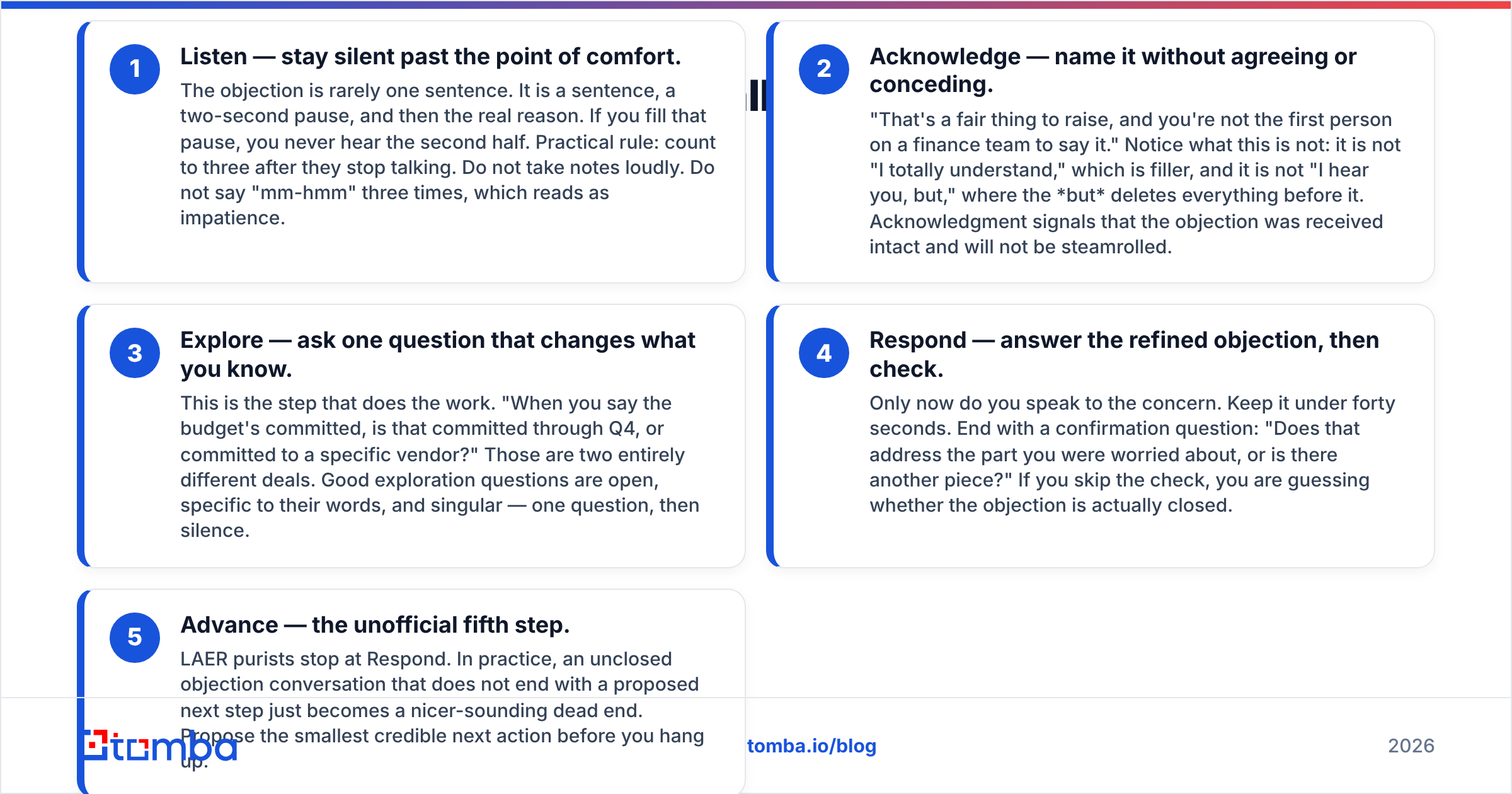
Listen — stay silent past the point of comfort. The objection is rarely one sentence. It is a sentence, a two-second pause, and then the real reason. If you fill that pause, you never hear the second half. Practical rule: count to three after they stop talking. Do not take notes loudly. Do not say "mm-hmm" three times, which reads as impatience.
Acknowledge — name it without agreeing or conceding. "That's a fair thing to raise, and you're not the first person on a finance team to say it." Notice what this is not: it is not "I totally understand," which is filler, and it is not "I hear you, but," where the but deletes everything before it. Acknowledgment signals that the objection was received intact and will not be steamrolled.
Explore — ask one question that changes what you know. This is the step that does the work. "When you say the budget's committed, is that committed through Q4, or committed to a specific vendor?" Those are two entirely different deals. Good exploration questions are open, specific to their words, and singular — one question, then silence.
Respond — answer the refined objection, then check. Only now do you speak to the concern. Keep it under forty seconds. End with a confirmation question: "Does that address the part you were worried about, or is there another piece?" If you skip the check, you are guessing whether the objection is actually closed.
Advance — the unofficial fifth step. LAER purists stop at Respond. In practice, an unclosed objection conversation that does not end with a proposed next step just becomes a nicer-sounding dead end. Propose the smallest credible next action before you hang up.
How does LAER compare to other objection-handling frameworks?#
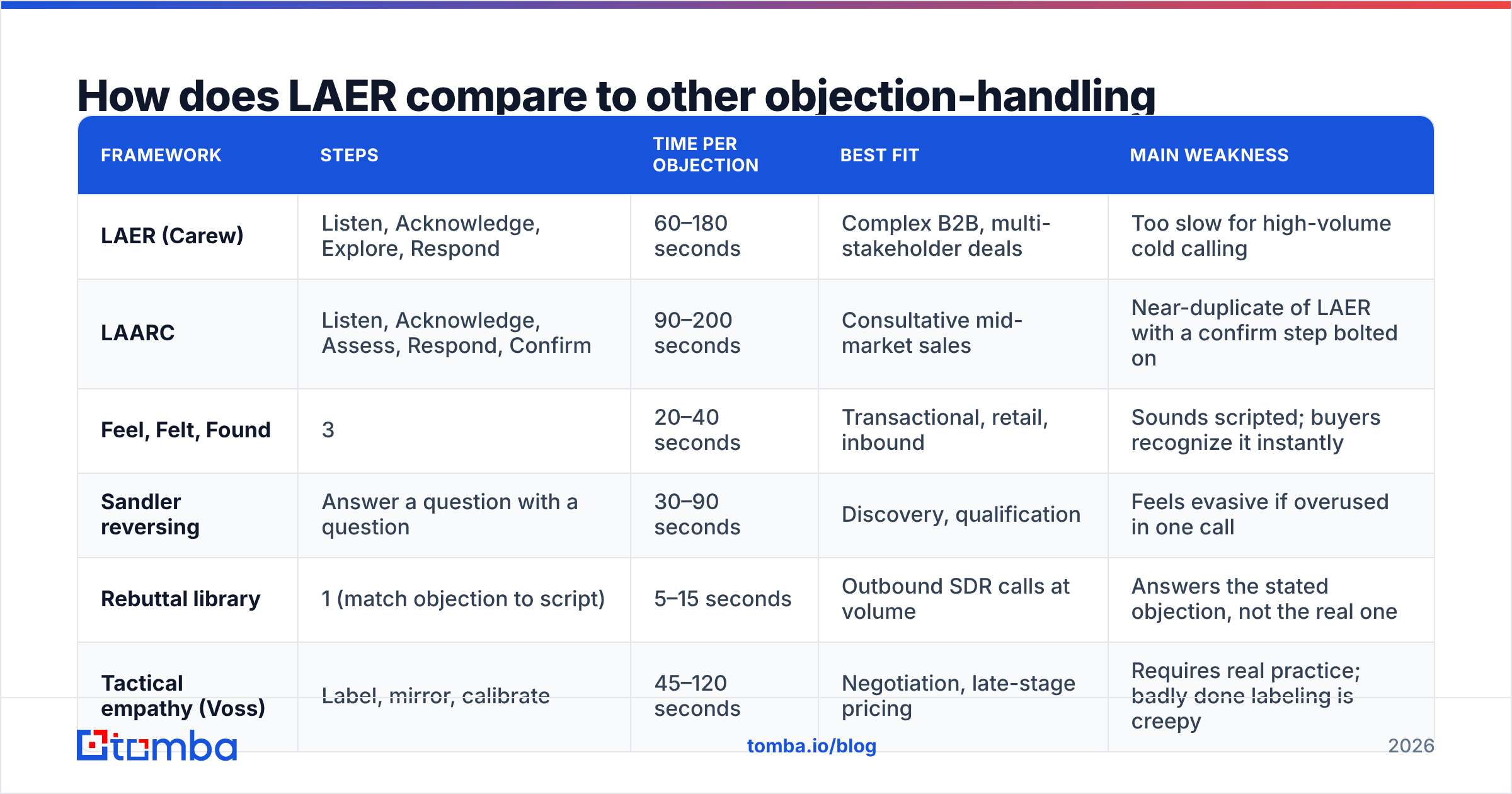
No framework is universally better. They differ in how much conversational time they require and how much they rely on the rep's improvisation.
| Framework | Steps | Time per objection | Best fit | Main weakness |
|---|---|---|---|---|
| LAER (Carew) | Listen, Acknowledge, Explore, Respond | 60–180 seconds | Complex B2B, multi-stakeholder deals | Too slow for high-volume cold calling |
| LAARC | Listen, Acknowledge, Assess, Respond, Confirm | 90–200 seconds | Consultative mid-market sales | Near-duplicate of LAER with a confirm step bolted on |
| Feel, Felt, Found | 3 | 20–40 seconds | Transactional, retail, inbound | Sounds scripted; buyers recognize it instantly |
| Sandler reversing | Answer a question with a question | 30–90 seconds | Discovery, qualification | Feels evasive if overused in one call |
| Rebuttal library | 1 (match objection to script) | 5–15 seconds | Outbound SDR calls at volume | Answers the stated objection, not the real one |
| Tactical empathy (Voss) | Label, mirror, calibrate | 45–120 seconds | Negotiation, late-stage pricing | Requires real practice; badly done labeling is creepy |
The honest read: LAER and LAARC are the same animal, and both are strongest when a single conversation is worth more than the minutes it costs. If your day is 120 dials and a 4% connect rate, a tight rebuttal library plus a single exploration question will outperform full LAER — you simply do not have the conversational runway.
Why do most reps fail at the Explore step?#
Three reasons, in order of frequency.
They ask a leading question instead of an open one. "So is it that the budget just isn't there this quarter?" hands the prospect an exit. You have now scripted their objection for them, and they will take it because it ends the discomfort faster.
They ask three questions at once. "Is it the price, or the timing, or do you already have something in place?" The prospect answers the last one. You learn the least useful thing.
They explore an objection that was never real. "Send me some information" at second nine of a cold call is a reflex, not a considered position. Exploring a reflex wastes the only goodwill you have. Frameworks like this assume a genuine objection; brush-offs need a different move entirely — usually a single permission-based question and a clean exit.
According to HubSpot's sales research, a large share of buyers report that reps talk past their stated concerns rather than addressing them directly. That is a diagnosis of the Explore step, not the Respond step. Gartner's research on B2B buying points the same direction: buying groups now average six to ten stakeholders, which means the objection you hear in the room is frequently a relayed version of somebody else's objection. You cannot respond well to a secondhand concern you have not unpacked.
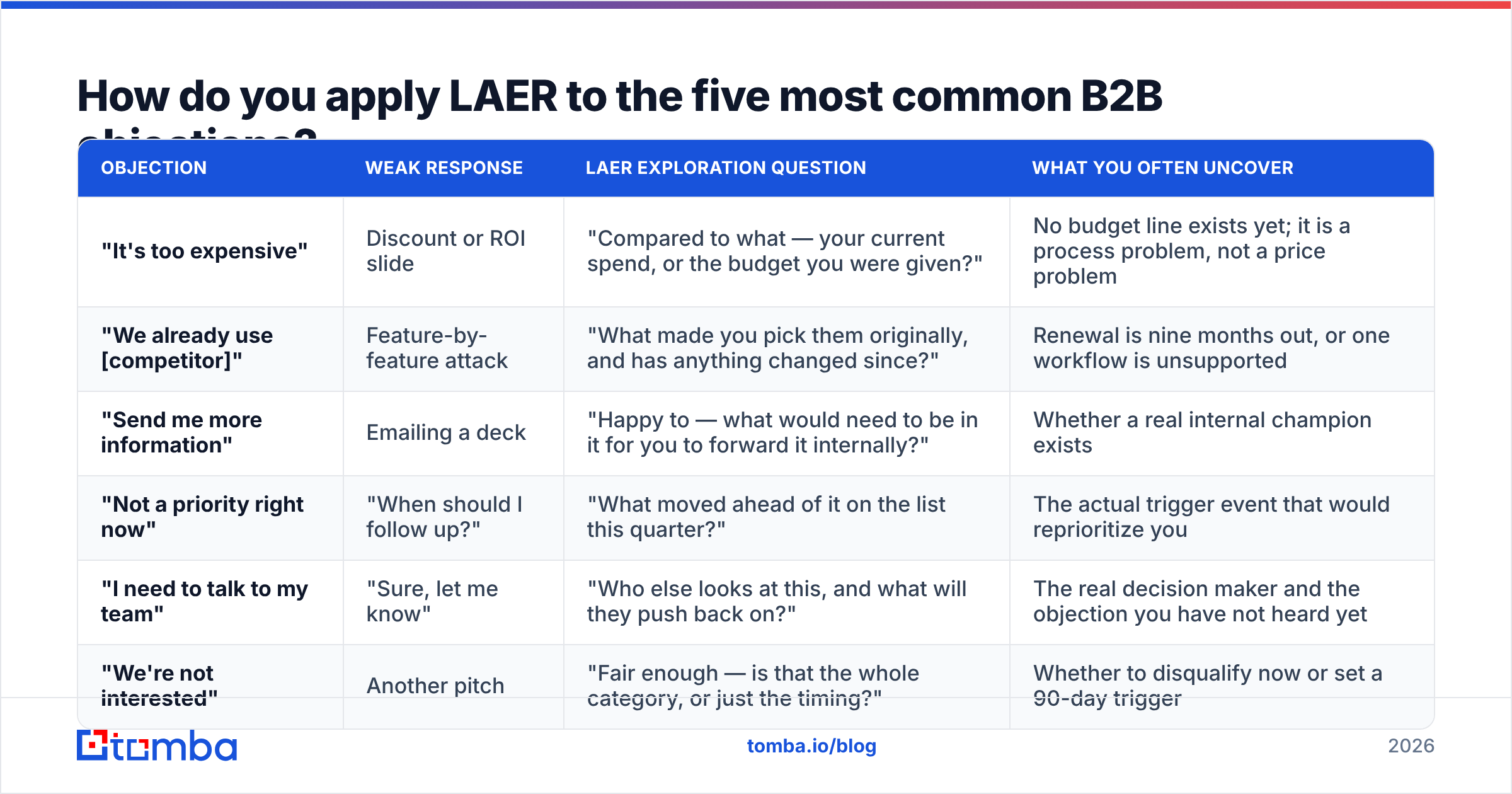
How do you apply LAER to the five most common B2B objections?#
| Objection | Weak response | LAER exploration question | What you often uncover |
|---|---|---|---|
| "It's too expensive" | Discount or ROI slide | "Compared to what — your current spend, or the budget you were given?" | No budget line exists yet; it is a process problem, not a price problem |
| "We already use [competitor]" | Feature-by-feature attack | "What made you pick them originally, and has anything changed since?" | Renewal is nine months out, or one workflow is unsupported |
| "Send me more information" | Emailing a deck | "Happy to — what would need to be in it for you to forward it internally?" | Whether a real internal champion exists |
| "Not a priority right now" | "When should I follow up?" | "What moved ahead of it on the list this quarter?" | The actual trigger event that would reprioritize you |
| "I need to talk to my team" | "Sure, let me know" | "Who else looks at this, and what will they push back on?" | The real decision maker and the objection you have not heard yet |
| "We're not interested" | Another pitch | "Fair enough — is that the whole category, or just the timing?" | Whether to disqualify now or set a 90-day trigger |
Use the exploration column as your practice sheet. The responses are situational; the questions are reusable.
Is LAER worth it on cold calls?#
Partially. Run a compressed version: Listen fully, Acknowledge in one clause, ask exactly one exploration question, then respond in two sentences. Total budget, 30 seconds. Full four-step LAER on a cold call turns into an interrogation — you are spending relationship capital you have not earned yet.
The bigger lever on cold calls is not technique at all. It is whether the person you reached should have been called. Objections cluster hard around bad targeting: wrong role, wrong company size, stale contact record, a number that routes to a shared line. No amount of exploration fixes "I'm not the person who buys this." That is why teams that clean their data see objection volume drop before their scripts change — fewer wasted conversations, better response rate on the follow-up sequence, and reps who stay sharp because their calls are with plausible buyers.
If your reps are burning their LAER practice on unqualified contacts, fix the list first. Verified direct B2B phone numbers and enriched firmographics turn "not interested" from a daily wall into a signal you can actually act on.
What metrics tell you LAER is working?#
Stop grading objection handling by listening for clever lines. Track these instead:
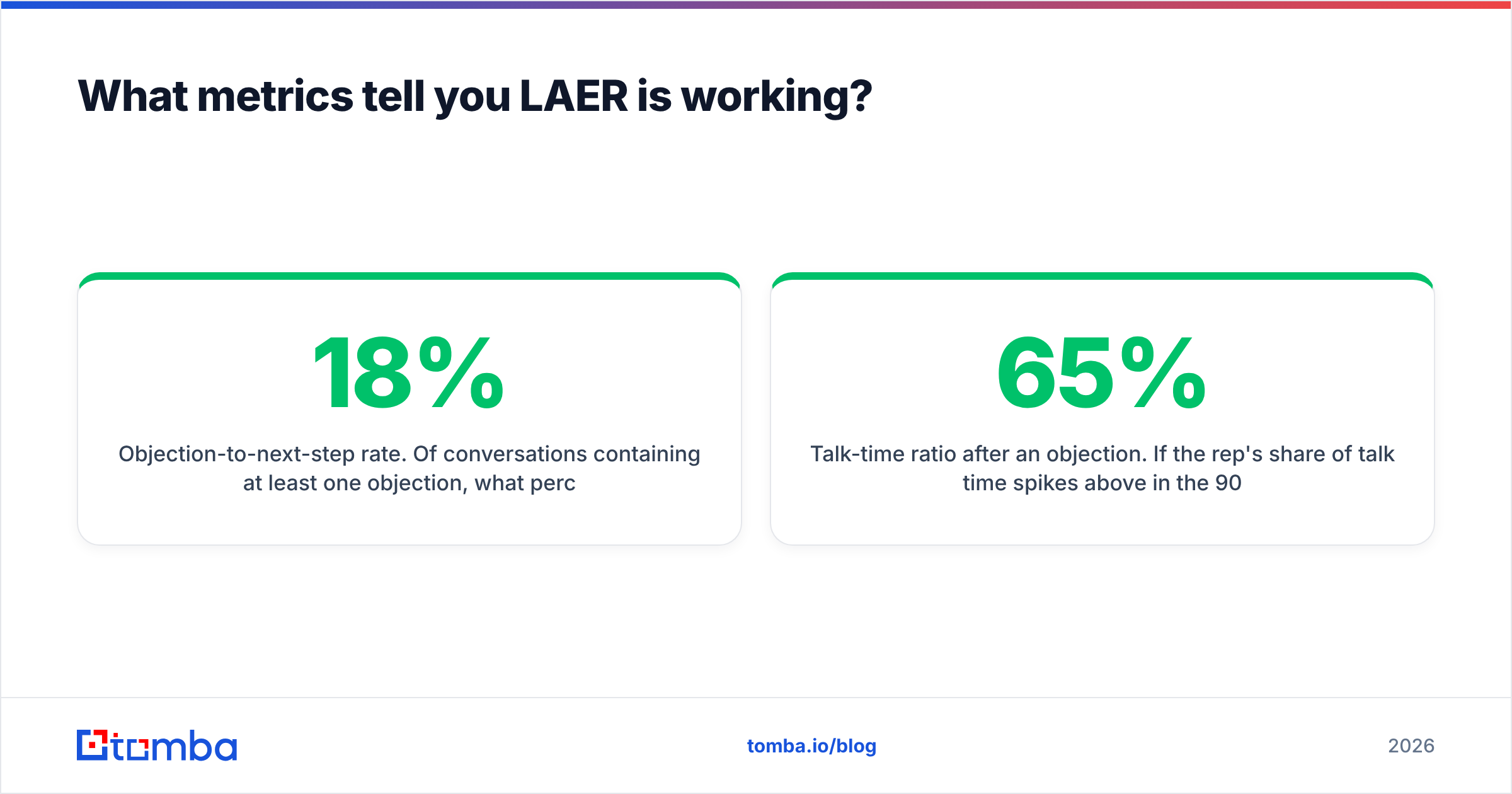
- Objection-to-next-step rate. Of conversations containing at least one objection, what percentage ended with a scheduled next action? This is the headline number. A team going from 18% to 30% here is worth more than any script rewrite.
- Talk-time ratio after an objection. If the rep's share of talk time spikes above 65% in the 90 seconds following an objection, Explore is being skipped. Conversation-intelligence tools surface this automatically.
- Questions asked per objection. Target one to two. Zero means rebutting. Four means interrogating.
- Repeat-objection rate. The same objection resurfacing in call two means your Respond step never actually closed it.
- Disqualification speed. Good objection handling produces faster nos too. Reps running LAER well should disqualify earlier, not later.
Run these at the team level for a full quarter before declaring the framework a win or a loss. Objection handling is noisy at the individual-rep level.
How do you train LAER without making it robotic?#
Drill the steps separately, never together. A week on silence: reps practice counting to three after the objection, nothing else. A week on acknowledgment phrasing, with "but" banned outright. Two weeks on exploration questions, where the only deliverable is the question — the response is somebody else's problem. Then assemble.
Role-play against real recorded objections from your own pipeline, not generic ones. And record the drills; reps consistently believe they paused when they did not.
One caution worth stating plainly: LAER can be weaponized into stalling. If a prospect has genuinely and clearly disqualified themselves, exploring three layers deep is not consultative — it is refusing to hear the word no. The framework improves conversations that deserve to continue. It does not resurrect dead ones.
Where does list quality fit into all of this?#
Objection handling is the last 10% of outbound, not the first. A rep with flawless LAER and a scraped, unverified contact list will still have a bad quarter, because most of their conversations are with people who could never have bought.
Build the sequence in the right order: identify accounts that match your actual closed-won profile, find the right role inside them, verify the contact, then apply technique. Clean data enrichment means your reps hear real objections — pricing, timing, incumbents — instead of the fake ones that come from targeting errors. That is the difference between coaching that compounds and coaching that fights noise.
Start at the top of that chain. Tomba Email Finder gets you verified, role-accurate contacts by domain, name, or company, with a free tier at 25 searches a month and paid plans starting at $49/mo on Tomba pricing when your team scales past testing. Fill the pipeline with people who can actually say yes — then let LAER handle the ones who say "not yet."
Related guides#
// get started
Find, verify and enrich your first contacts today
Start on the free plan with 25 searches a month, then scale when your team is ready.
Free plan · No credit card required · GDPR & CCPA
Get the Tomba newsletter
Product and data updates
// about the author