9 Best LakeB2B Alternatives in 2026 (Ranked and Compared)
LakeB2B sells custom-built B2B lists on a quote-only model. Here are nine alternatives - from pay-as-you-go credit packs to real-time email finders - compared on accuracy, pricing model, and how fast the data goes stale.
TL;DR
- LakeB2B is a custom list-building service, not a self-serve database. You send requirements, a sales rep sends a quote, and you get a CSV. That model works for one-off campaigns and breaks down for continuous outbound.
- The main reasons teams switch: quote-only pricing with no transparent per-contact cost, static files that decay roughly 2-3% per month, and no API to re-verify contacts before a send.
- Self-serve alternatives split into three groups: real-time finders (Tomba, Apollo), credit-based list platforms (BookYourData, UpLead), and enterprise intelligence suites (ZoomInfo, Cognism).
- Price per usable contact matters more than headline price. A $0.10 record at 70% deliverability costs more than a $0.20 record at 96%.
- If you need fresh, verified emails on demand rather than a bulk file, an API-first finder with built-in verification is the cheaper structural fit.
What is LakeB2B and who actually uses it?#
LakeB2B is a B2B data provider that has been selling contact lists since the mid-2000s. Its core offer is custom list building: you describe an audience — cardiologists in Texas, IT directors at manufacturers with 500+ employees, attendees of a specific trade show — and LakeB2B assembles a file against that spec. It also sells pre-packaged industry lists (healthcare, technology, education) and offers append, data-cleansing, and appointment-setting services.
The typical buyer is a marketing team running a defined campaign: a webinar push, a direct-mail drop, a conference follow-up. You need 20,000 records once, you do not need a tool, and you want someone else to do the sourcing. For that job, custom list vendors are genuinely useful — particularly in verticals like healthcare where NPI-linked data is hard to scrape.
The friction shows up when your motion becomes continuous. Outbound SDR teams, RevOps functions maintaining a CRM, and growth teams enriching inbound signups all need data on demand, in small increments, with a fresh verification timestamp. That is a different product shape than a quoted CSV.
Why do teams look for LakeB2B alternatives?#
Five recurring complaints drive the search, based on patterns visible in public review threads on G2 and vendor comparison pages:
- Quote-only pricing. There is no public price list. Every purchase starts with a sales conversation, which means you cannot budget, cannot compare cost-per-record across vendors without three discovery calls, and cannot test cheaply.
- Static files decay fast. B2B contact data degrades at roughly 2-3% per month as people change jobs — call it 25-30% annually. A list delivered in January is materially different by July, and a CSV has no mechanism to tell you which rows went stale.
- No self-serve API. You cannot programmatically look up one contact when a lead fills out a form. Everything routes through a procurement cycle.
- Verification is a separate step. Many buyers report running purchased files through a third-party email verifier before sending, which adds cost and reveals how much of the file was never deliverable.
- Minimum order sizes. Custom list building rarely makes sense for 200 contacts. If your ICP is narrow, you may be paying for volume you cannot use.
None of these make LakeB2B a bad product. They make it a campaign product being asked to do a pipeline job.
How should you evaluate a B2B data vendor in 2026?#
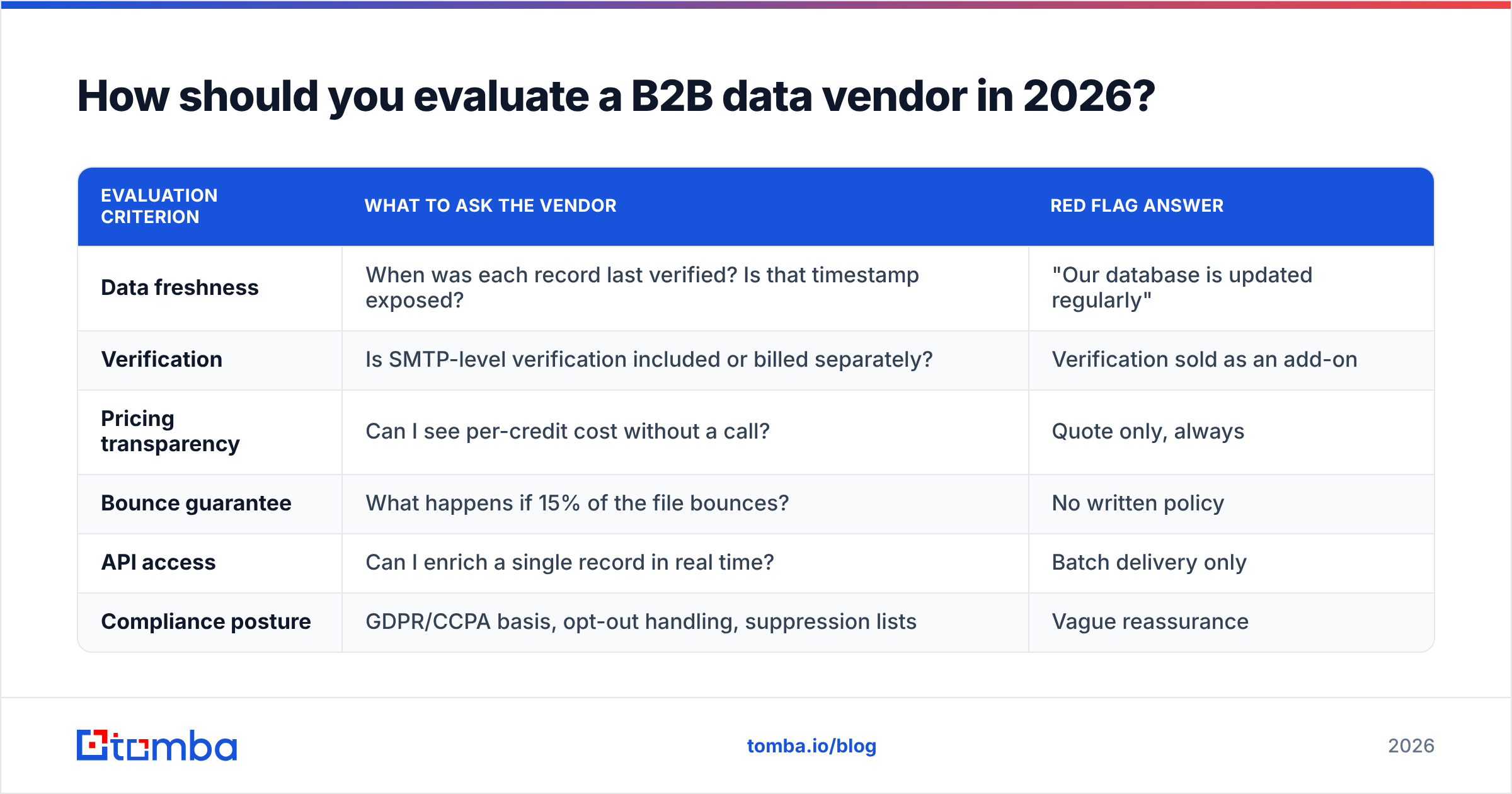
Score every option on these six dimensions before you look at price:
| Evaluation criterion | What to ask the vendor | Red flag answer |
|---|---|---|
| Data freshness | When was each record last verified? Is that timestamp exposed? | "Our database is updated regularly" |
| Verification | Is SMTP-level verification included or billed separately? | Verification sold as an add-on |
| Pricing transparency | Can I see per-credit cost without a call? | Quote only, always |
| Bounce guarantee | What happens if 15% of the file bounces? | No written policy |
| API access | Can I enrich a single record in real time? | Batch delivery only |
| Compliance posture | GDPR/CCPA basis, opt-out handling, suppression lists | Vague reassurance |
The freshness question is the one most buyers skip and later regret. A database of 700 million contacts is not impressive if the median record was last touched in 2023. Ask for the verification date distribution, not the headline count. Tomba publishes its data sources for exactly this reason — provenance should be inspectable, not asserted.
What are the 9 best LakeB2B alternatives?#
Here is the shortlist, grouped by what they actually do. Prices are publicly listed figures at time of writing; always confirm on the vendor's own pricing page before you buy.

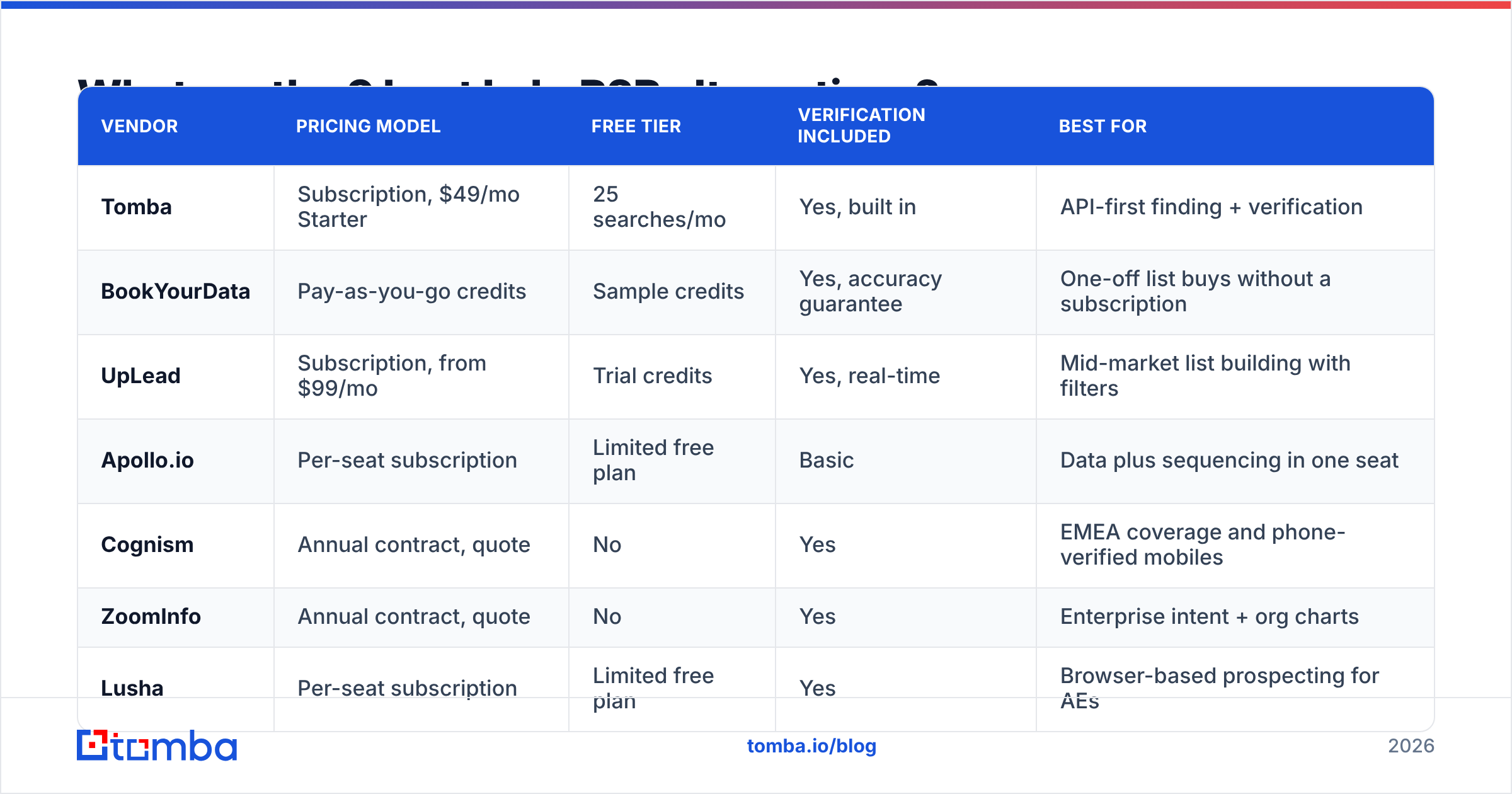
| Vendor | Pricing model | Free tier | Verification included | Best for |
|---|---|---|---|---|
| Tomba | Subscription, $49/mo Starter | 25 searches/mo | Yes, built in | API-first finding + verification |
| BookYourData | Pay-as-you-go credits | Sample credits | Yes, accuracy guarantee | One-off list buys without a subscription |
| UpLead | Subscription, from $99/mo | Trial credits | Yes, real-time | Mid-market list building with filters |
| Apollo.io | Per-seat subscription | Limited free plan | Basic | Data plus sequencing in one seat |
| Cognism | Annual contract, quote | No | Yes | EMEA coverage and phone-verified mobiles |
| ZoomInfo | Annual contract, quote | No | Yes | Enterprise intent + org charts |
| Lusha | Per-seat subscription | Limited free plan | Yes | Browser-based prospecting for AEs |
| Seamless.AI | Per-seat subscription, quote | Limited free plan | Real-time search | High-volume SDR teams |
| Data Axle | Quote, custom files | No | Partial | SMB and local-business coverage |
1. Tomba — best for API-first finding and verification#
Tomba is an email finder rather than a list vendor, which is the structural difference that matters. You supply a domain or a name plus company and get a verified address back, with a confidence score, in real time. Domain search returns every discoverable address at a company, and bulk processing handles CSV uploads when you do need volume.
Pricing is public: free tier at 25 searches per month, Starter at $49/mo, Growth at $99/mo, Pro at $249/mo, Enterprise custom. Full Tomba pricing is on one page with no call required. Verification is part of the product, not an upsell, and the data enrichment endpoints let you append firmographics to existing CRM rows.
Where it fits: continuous outbound, form enrichment, engineering teams that want an API. Where it does not: if you want someone to build a 50,000-record healthcare file for you, a list service is still the better tool.
2. BookYourData — best for pay-as-you-go list purchases#
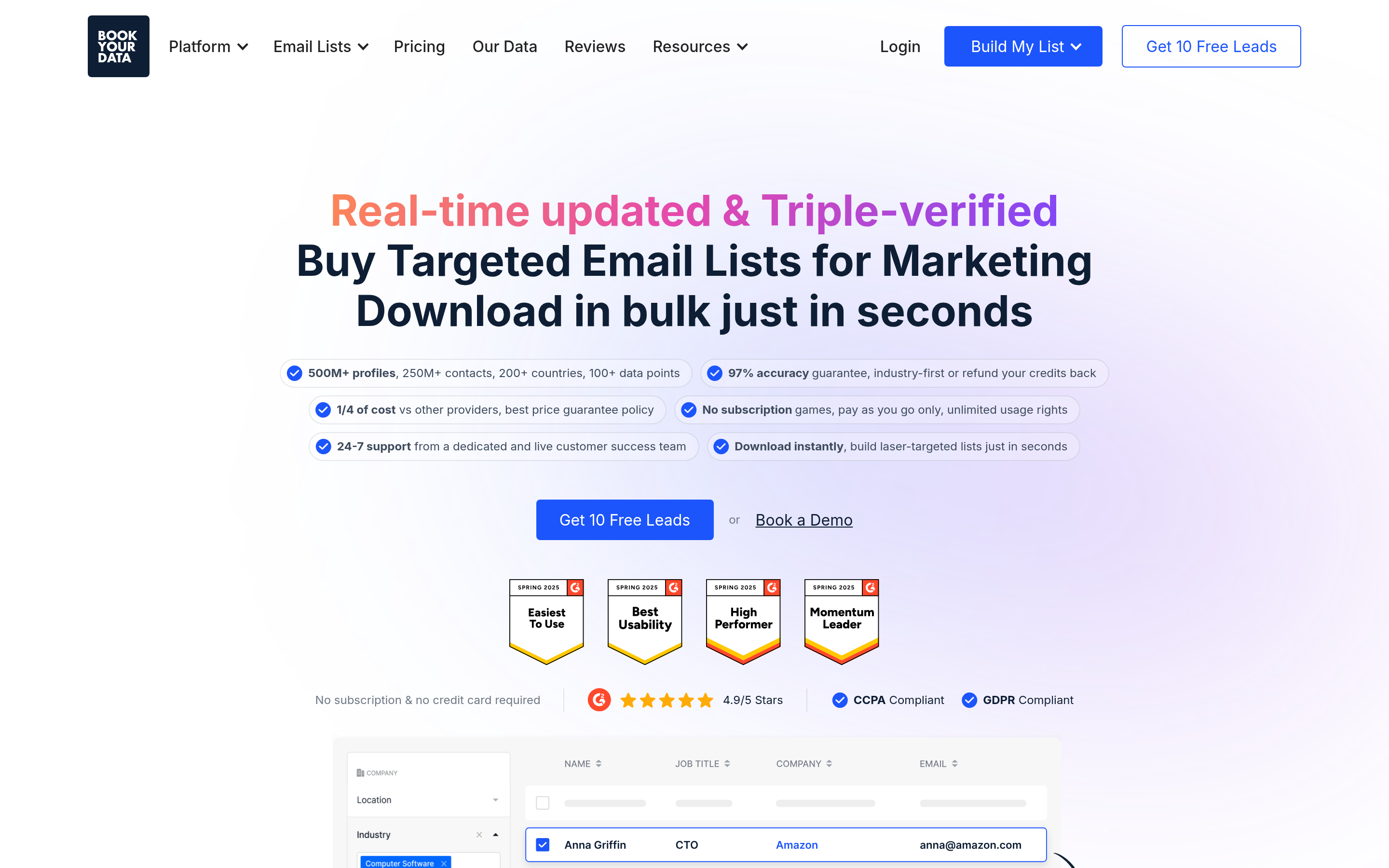
BookYourData is the closest philosophical alternative to LakeB2B for buyers who genuinely want a list but dislike the quote cycle. It sells credits outright with no subscription commitment, exposes filters in a self-serve builder, and backs its records with a stated accuracy guarantee — you preview counts before you pay.
For teams running two or three campaigns a year, the pay-as-you-go structure is the cleanest fit on this list. You are not paying a monthly fee to sit idle between campaigns, and the credit price is visible before checkout. It is a strong, transparent option in the list-buying category.
3. UpLead — best for filtered mid-market list building#
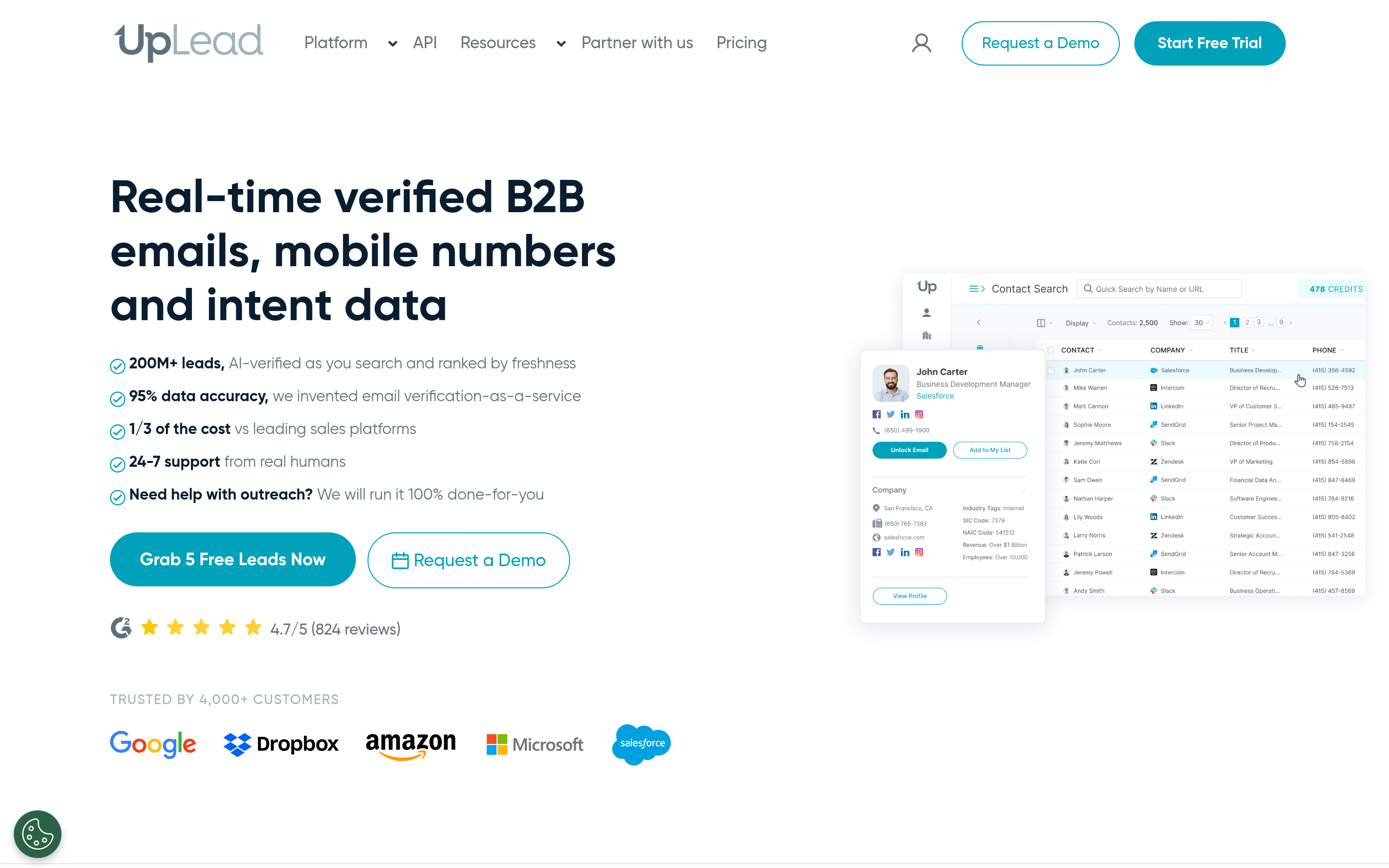
UpLead sits between a list vendor and a prospecting tool. You build segments with 50+ filters, see the count, and verify emails at the moment of export rather than at the moment the record was scraped. Published plans start at $99/mo. The trade-off is credit-based pricing that gets expensive at scale and a database smaller than the enterprise suites.
4. Apollo.io — best if you want data and sequencing together#
Apollo bundles a contact database with sequencing, dialing, and basic CRM sync. For a small team that wants one login, that consolidation is real value. The cost is data quality variance — because much of the database is community-contributed, coverage is strong in US tech and thinner elsewhere, and email accuracy fluctuates by segment. Teams often pair it with a dedicated verifier. If you are evaluating it head-to-head, see our notes on choosing an Apollo alternative.
5. Cognism — best for EMEA and phone-verified mobiles#
Cognism's differentiator is Diamond Data: human-verified mobile numbers plus DNC screening across European jurisdictions. If your ICP is UK/DACH and you run a calling motion, it is the strongest option here. It is also annual-contract, quote-only, and priced for funded teams — so it solves LakeB2B's freshness problem while keeping its pricing opacity.
6. ZoomInfo — best for enterprise org charts and intent#

The largest dataset in the category, with intent signals, org charts, and deep integrations. Also the most expensive, with annual contracts, seat minimums, and renewal negotiations that buyers frequently mention in reviews. Choose it when data is a strategic line item, not a tactical purchase.
7. Lusha — best for AE-led browser prospecting#
Lusha is a Chrome extension first. Reps pull contacts while browsing LinkedIn or company sites, and credits are consumed per reveal. Great for individual quota carriers, awkward for centralized list operations because usage is distributed across seats. Tomba offers a comparable browser extension if you want that workflow with API access behind it.
8. Seamless.AI — best for high-volume SDR floors#
Seamless runs a real-time search rather than serving from a static index, which helps freshness but produces variable results per query. Pricing is quote-based per seat. Popular with large SDR teams; less loved by RevOps for list hygiene.
9. Data Axle — best for SMB and local-business coverage#
Data Axle (formerly Infogroup) covers small and local businesses better than the tech-centric databases, which matters if you sell to dentists, contractors, or regional retail. It is a traditional list vendor, so you inherit the same quote-and-CSV workflow as LakeB2B — you are switching for coverage, not for model.
How accurate is the data, really?#
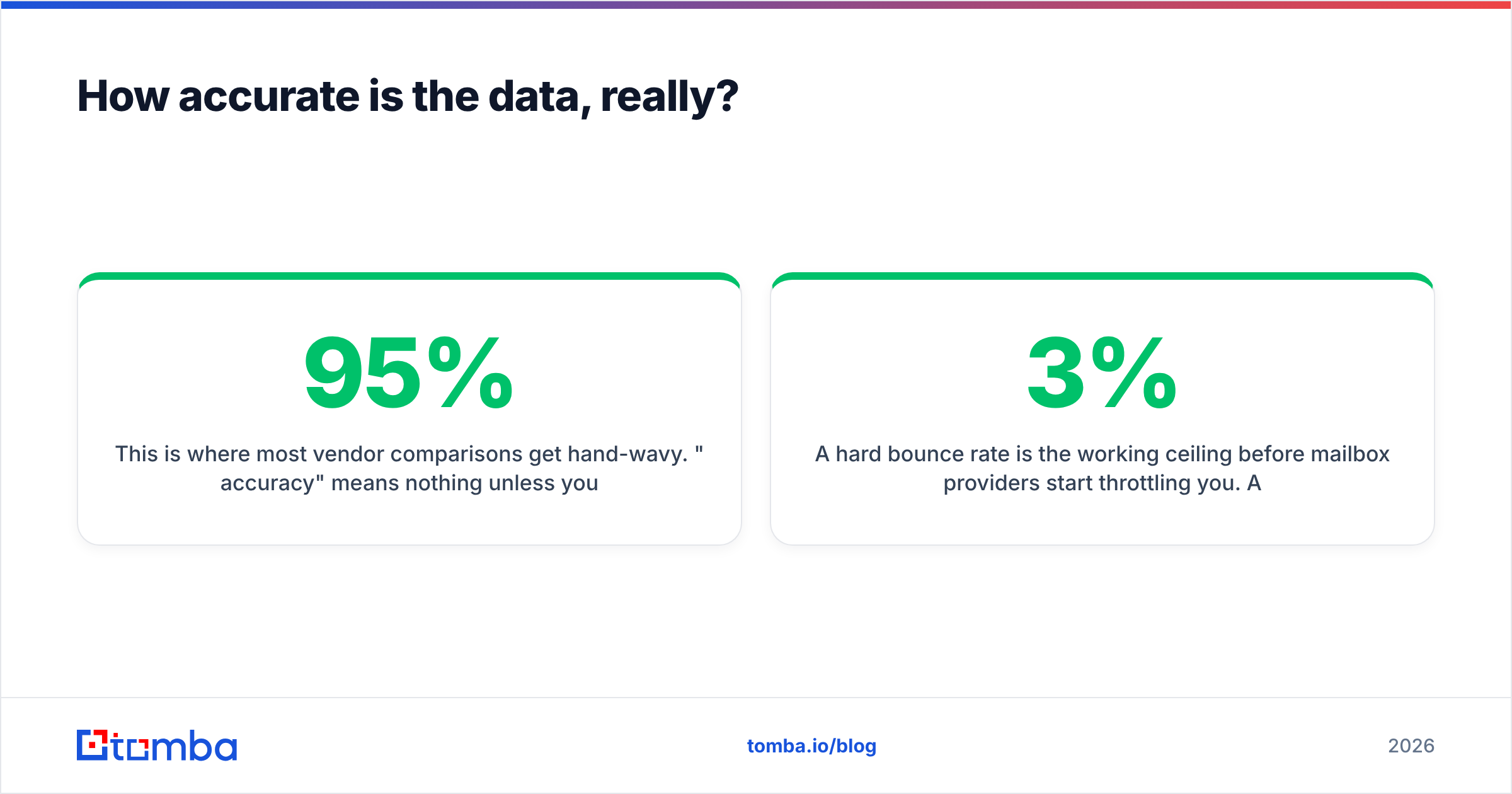
This is where most vendor comparisons get hand-wavy. "95% accuracy" means nothing unless you know what was measured: syntax validity, MX record existence, SMTP acceptance, or an actual inbox placement test. A file can be 99% syntactically valid and 60% deliverable.

Run this test before you sign anything:
- Pull a 100-record sample across your real ICP, not the vendor's cherry-picked demo segment.
- Verify it independently with a tool the vendor does not own — a free email checker is enough for a sample of this size.
- Count catch-alls separately. Catch-all domains accept everything at the gateway and bounce later. A vendor counting them as valid is inflating its number. A dedicated catch-all verifier tells you which ones are actually risky.
- Send a 50-contact test through a warmed domain and measure hard bounces at 48 hours.
- Compute cost per delivered contact, not cost per record. That single number reorders most shortlists.

A 3% hard bounce rate is the working ceiling before mailbox providers start throttling you. Anything a vendor sells you above that is not a list — it is a sender reputation liability.
How do the pricing models actually compare?#
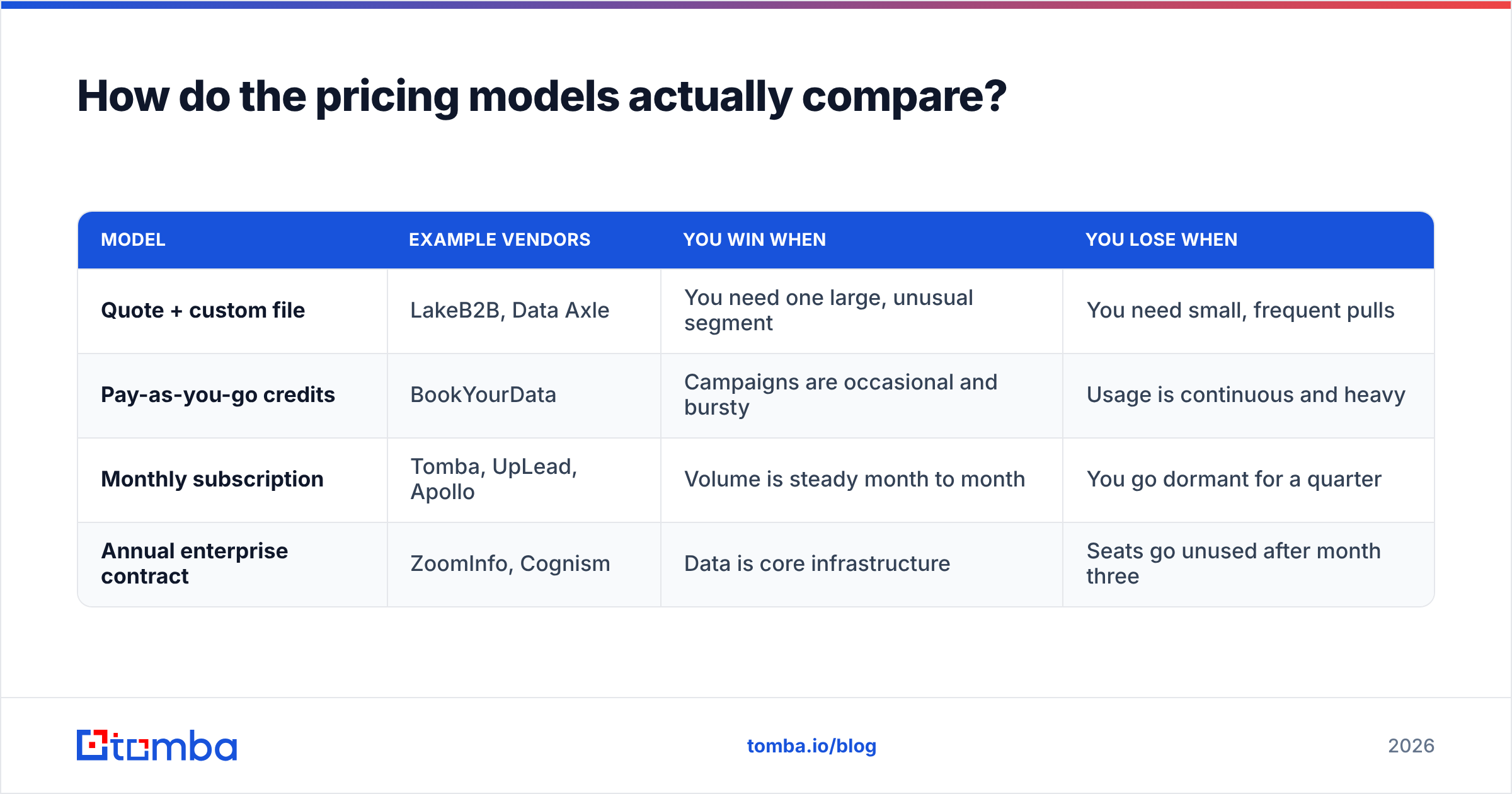
Three models, three different failure modes:
| Model | Example vendors | You win when | You lose when |
|---|---|---|---|
| Quote + custom file | LakeB2B, Data Axle | You need one large, unusual segment | You need small, frequent pulls |
| Pay-as-you-go credits | BookYourData | Campaigns are occasional and bursty | Usage is continuous and heavy |
| Monthly subscription | Tomba, UpLead, Apollo | Volume is steady month to month | You go dormant for a quarter |
| Annual enterprise contract | ZoomInfo, Cognism | Data is core infrastructure | Seats go unused after month three |
Run the arithmetic on your actual volume. A team pulling 800 verified contacts a month pays $49-99 on a subscription finder. The same 800 contacts as a custom-built file, quoted, verified separately, and refreshed twice a year, is usually several multiples of that — and arrives already aging.
Which LakeB2B alternative should you pick?#
- You run 2-3 campaigns a year and want a file: BookYourData for transparent pay-as-you-go credits, or stay with a custom list builder if your vertical is unusual.
- You run continuous outbound: an API-first finder with verification included. You will re-query rather than re-purchase.
- You sell into EMEA and dial: Cognism.
- You are enterprise with intent budget: ZoomInfo.
- You want one tool for data and sending: Apollo, with a verifier bolted on.
- You sell to local SMBs: Data Axle.
The honest framing: LakeB2B is not competing with Tomba, it is competing with BookYourData and Data Axle. If what you want is a file, compare list vendors. If what you want is a pipeline of fresh contacts, compare finders. Buying the wrong category is the expensive mistake, not picking the second-best vendor inside the right one.
Ready to stop buying stale files?#
If your outbound runs every week rather than every quarter, start with the Tomba Email Finder. You get a verified address with a confidence score at the moment you need it — not a CSV that started decaying the day it was delivered. The free tier gives you 25 searches a month to test against your own ICP, Starter is $49/mo when you are ready to scale, and the same verification that powers the finder runs on every result before it reaches you. Pull a hundred contacts, verify them independently, and compare the bounce rate against your last purchased list. That test answers the vendor question faster than any comparison post can.
Related guides#
// get started
Find, verify and enrich your first contacts today
Start on the free plan with 25 searches a month, then scale when your team is ready.
Free plan · No credit card required · GDPR & CCPA
// about the author