LakeB2B Pricing, Reviews, Pros and Cons (2026 Review)
LakeB2B sells B2B contact lists by quote, not by price page. Here's what teams actually pay, what reviewers complain about, and when a per-credit email finder beats buying a list outright.
TL;DR
- LakeB2B does not publish a price list. Every deal is a custom quote built around record count, vertical, and how many data fields you want appended — which means two buyers can pay very different amounts for the same list size.
- The model is list purchase, not per-lookup search. You pay up front for a static file, and that file starts decaying the moment it lands in your inbox.
- Reviewer sentiment splits hard: healthcare and education list buyers report genuine value; SMB cold-email teams report bounce rates and deliverability damage that wiped out the savings.
- Hidden costs are the real story — minimum order sizes, per-field append fees, data-refresh charges, and the verification bill you pay someone else to clean the file you just bought.
- If you need 200–5,000 verified contacts a month rather than a 50,000-row file, per-credit tools like Tomba (free tier, then $49/mo) usually cost less and bounce less than a bought list.
What is LakeB2B, and who actually buys from it?#
LakeB2B is a B2B data provider and list broker. Think of it less like a software tool and more like a specialty grocer: you tell them what you want, they assemble it in the back, and they hand you a box. You do not walk the aisles yourself.
The company sells pre-built and custom-built contact lists segmented by industry, job title, geography, company size, and technology usage, with a heavy emphasis on healthcare, education, technology, and manufacturing verticals. Alongside list sales it offers data appending (you send a partial file, they fill in missing emails or phones), data cleansing, and account-based marketing services.
That positioning matters because it determines who LakeB2B is actually good for:
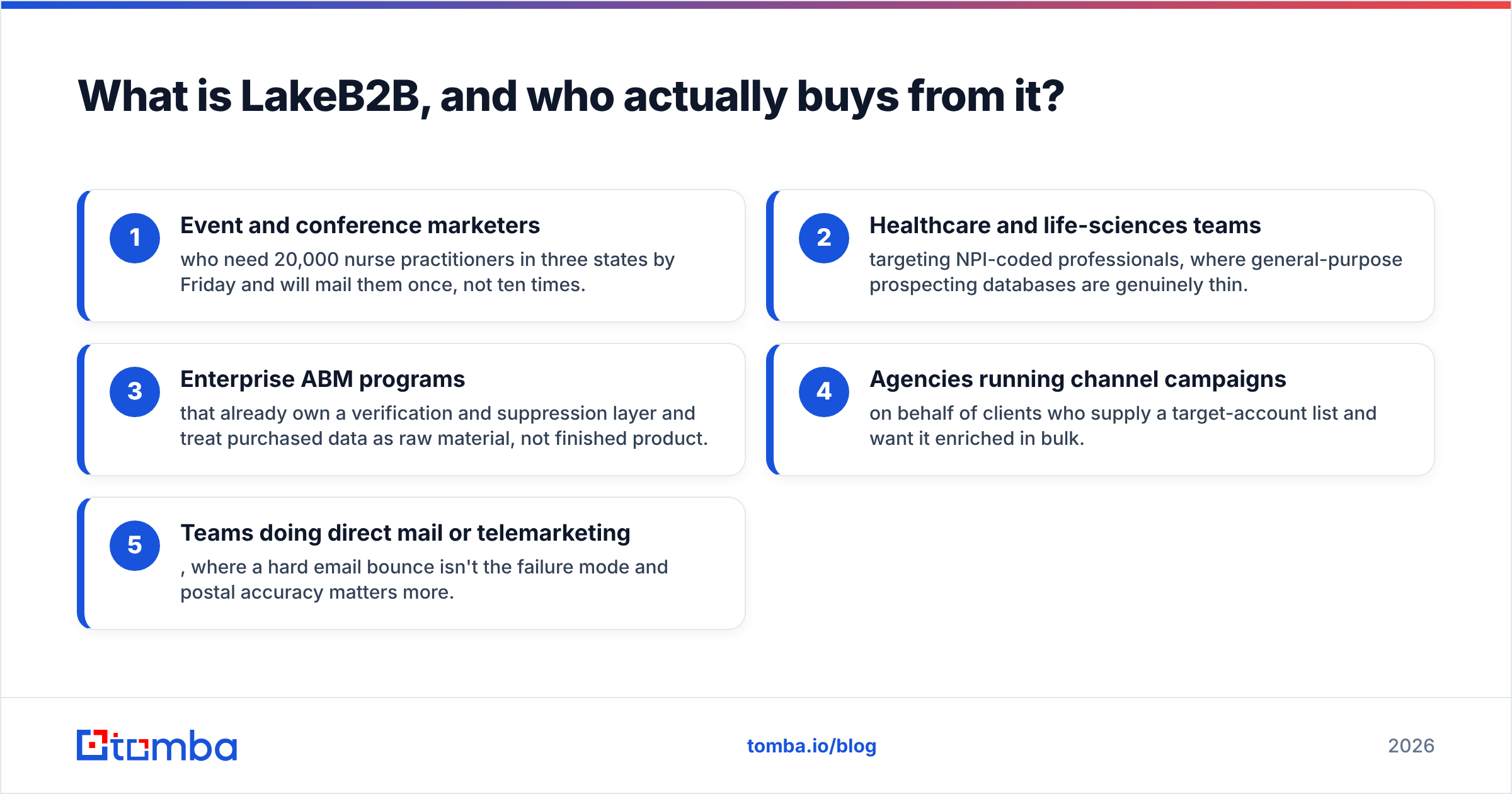
- Event and conference marketers who need 20,000 nurse practitioners in three states by Friday and will mail them once, not ten times.
- Healthcare and life-sciences teams targeting NPI-coded professionals, where general-purpose prospecting databases are genuinely thin.
- Enterprise ABM programs that already own a verification and suppression layer and treat purchased data as raw material, not finished product.
- Agencies running channel campaigns on behalf of clients who supply a target-account list and want it enriched in bulk.
- Teams doing direct mail or telemarketing, where a hard email bounce isn't the failure mode and postal accuracy matters more.
Who it is usually wrong for: a two-person SaaS sales team sending 80 cold emails a day from a single domain. That team needs freshness and verification per contact, not volume.
How does LakeB2B pricing work in 2026?#
Short answer: by quote, and the quote is a function of four variables, not one.
There is no public pricing page on lakeb2b.com — no self-serve checkout, no published per-record rate card, no free tier you can poke at before talking to sales. You submit a request, a rep scopes it, and a number comes back. That is standard practice for list brokers, but it has a predictable consequence: price discovery is on you.
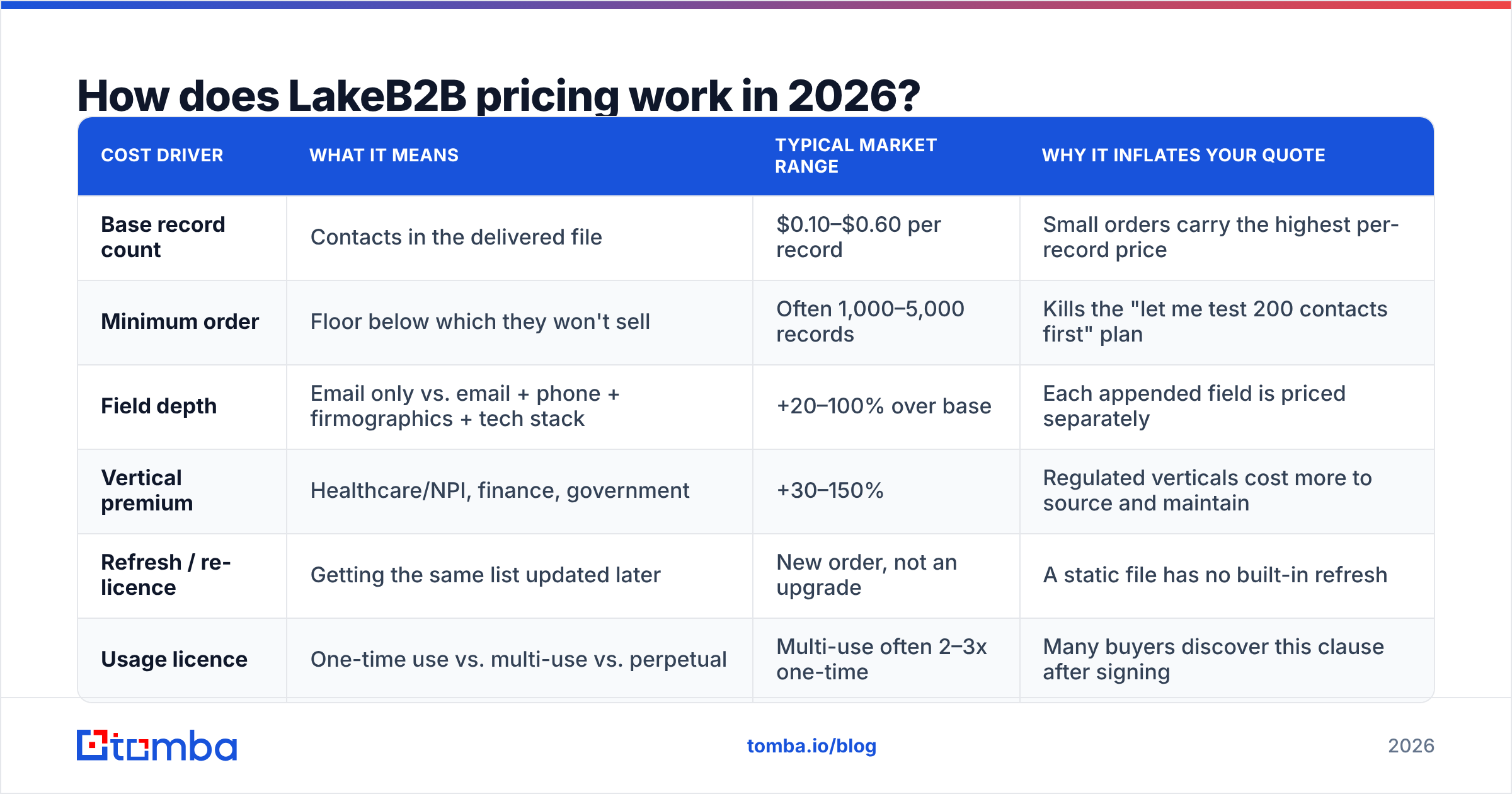
Here is how the cost actually assembles. The dollar figures below are market-typical ranges for the B2B list-broker category rather than official LakeB2B rates — use them to sanity-check a quote, not to quote back at a rep.
| Cost driver | What it means | Typical market range | Why it inflates your quote |
|---|---|---|---|
| Base record count | Contacts in the delivered file | $0.10–$0.60 per record | Small orders carry the highest per-record price |
| Minimum order | Floor below which they won't sell | Often 1,000–5,000 records | Kills the "let me test 200 contacts first" plan |
| Field depth | Email only vs. email + phone + firmographics + tech stack | +20–100% over base | Each appended field is priced separately |
| Vertical premium | Healthcare/NPI, finance, government | +30–150% | Regulated verticals cost more to source and maintain |
| Refresh / re-licence | Getting the same list updated later | New order, not an upgrade | A static file has no built-in refresh |
| Usage licence | One-time use vs. multi-use vs. perpetual | Multi-use often 2–3x one-time | Many buyers discover this clause after signing |
That last row is the one that surprises people. A "one-time use" licence means exactly what it says — the file is contracted for a single campaign. If you load it into your CRM permanently and mail it quarterly, read your terms first.

What is the real all-in cost?#
Whatever the quote says, add three line items to it:
- Verification. You will not send to a bought file unverified unless you enjoy bounce rates in the double digits. Budget for an email verifier pass across 100% of records before the first send.
- Deduplication and suppression. Purchased files overlap with your existing CRM and your do-not-contact list. Someone has to run that merge.
- Reputation risk. This one has no invoice, but it is the biggest number on the page. A domain burned by a bad list costs weeks of warmup and, sometimes, a new sending domain.
What do LakeB2B reviews actually say?#
Reviews for list brokers follow a shape, and LakeB2B is no exception: the positive reviews talk about service, and the negative reviews talk about data.
On the positive side, buyers on G2 and Capterra consistently praise responsiveness — reps who scope quickly, turn around custom segments in days rather than weeks, and will re-cut a list when the first pass misses the target. Several reviewers specifically credit the healthcare segmentation as being deeper than what they found in general-purpose sales databases. For a marketer who needs "hospital CFOs in the Midwest, 200+ beds," that specificity is worth paying for.
On the negative side, the recurring complaints cluster tightly:
- Bounce rates above expectation. Reviewers who ran their own verification after delivery frequently report a meaningful share of invalid or role-based addresses, especially in lower-priced segments.
- Job-change decay. B2B contact data goes stale at roughly 25–30% per year across the industry. A list assembled from records last touched 18 months ago is arithmetically about a third wrong before you send anything.
- Opaque sourcing. "Where did this record come from?" is a question buyers ask more in 2026 than they did in 2020, and reviewers report inconsistent answers.
- Post-sale support gap. Pre-sale responsiveness is praised; several reviewers describe a noticeable drop-off once the invoice clears and they come back with a data-quality dispute.
One caveat worth stating plainly: review volume for LakeB2B is thin compared with self-serve SaaS tools. A hundred-review sample tells you something. A dozen tells you much less. Weight what you read accordingly, and ask any rep for a free sample file of 50–100 records you can independently verify before signing. If they decline, that is itself a data point.
Is bought-list data accurate enough in 2026?#
It depends entirely on what "accurate" means to you — and this is where list buying and per-lookup finding genuinely diverge.
A list vendor optimizes for coverage: fill the file, hit the count, meet the segment spec. A search-based email finder optimizes for confidence on a specific person right now: you ask for one contact, the system verifies at request time, and it tells you when it does not know.

The practical difference shows up in your sending stats. A file delivered at 85% deliverable sounds fine until you do the math on a 10,000-record send: 1,500 bounces in one campaign is enough to get a fresh domain throttled at most major mailbox providers. A tool that returns 1,200 contacts at 97%+ confidence produces 36 bounces across the same period.
If you must buy volume, the mitigation is mechanical and non-negotiable:
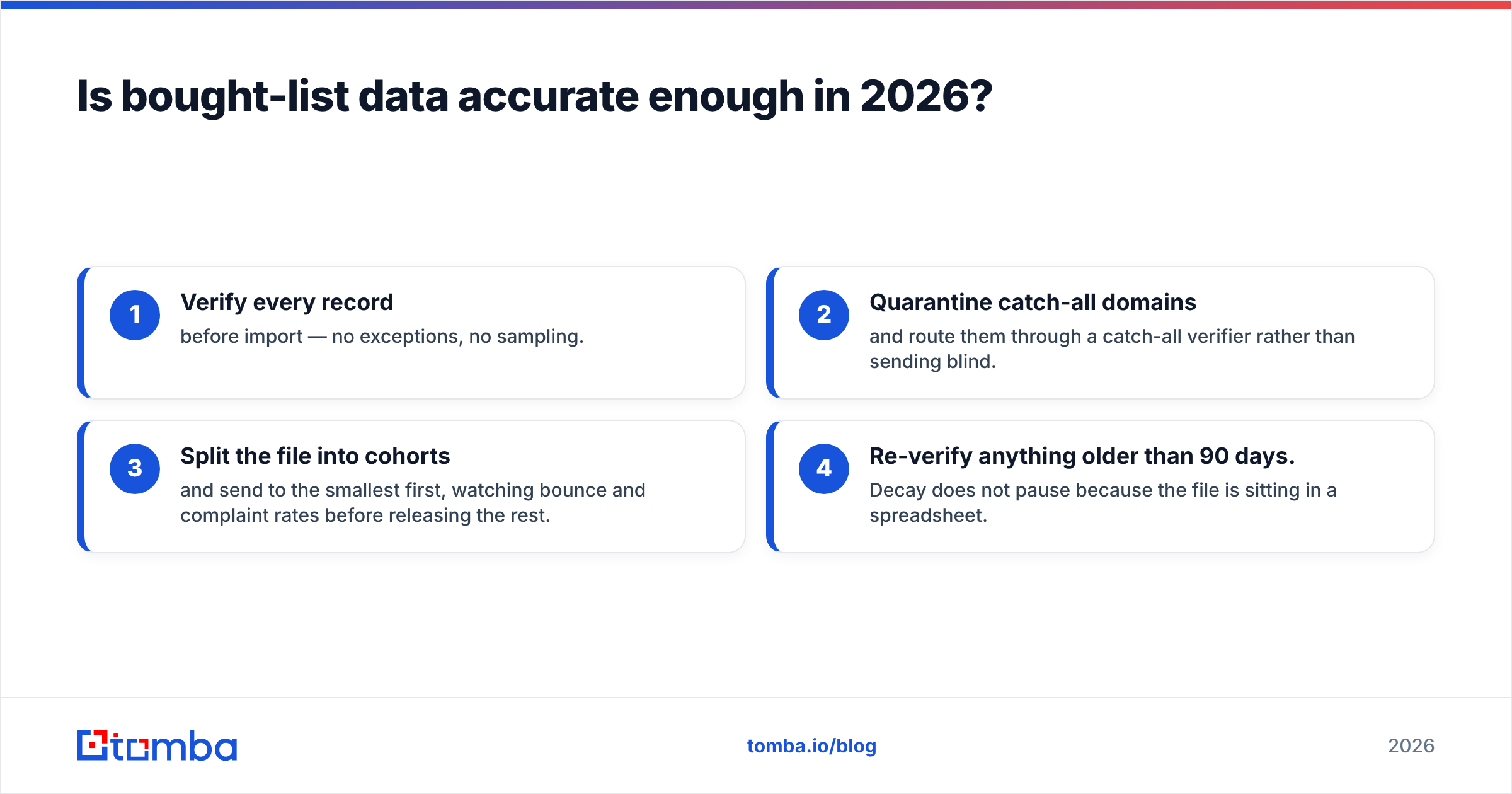
- Verify every record before import — no exceptions, no sampling.
- Quarantine catch-all domains and route them through a catch-all verifier rather than sending blind.
- Split the file into cohorts and send to the smallest first, watching bounce and complaint rates before releasing the rest.
- Re-verify anything older than 90 days. Decay does not pause because the file is sitting in a spreadsheet.
How does LakeB2B compare to other B2B data sources?#
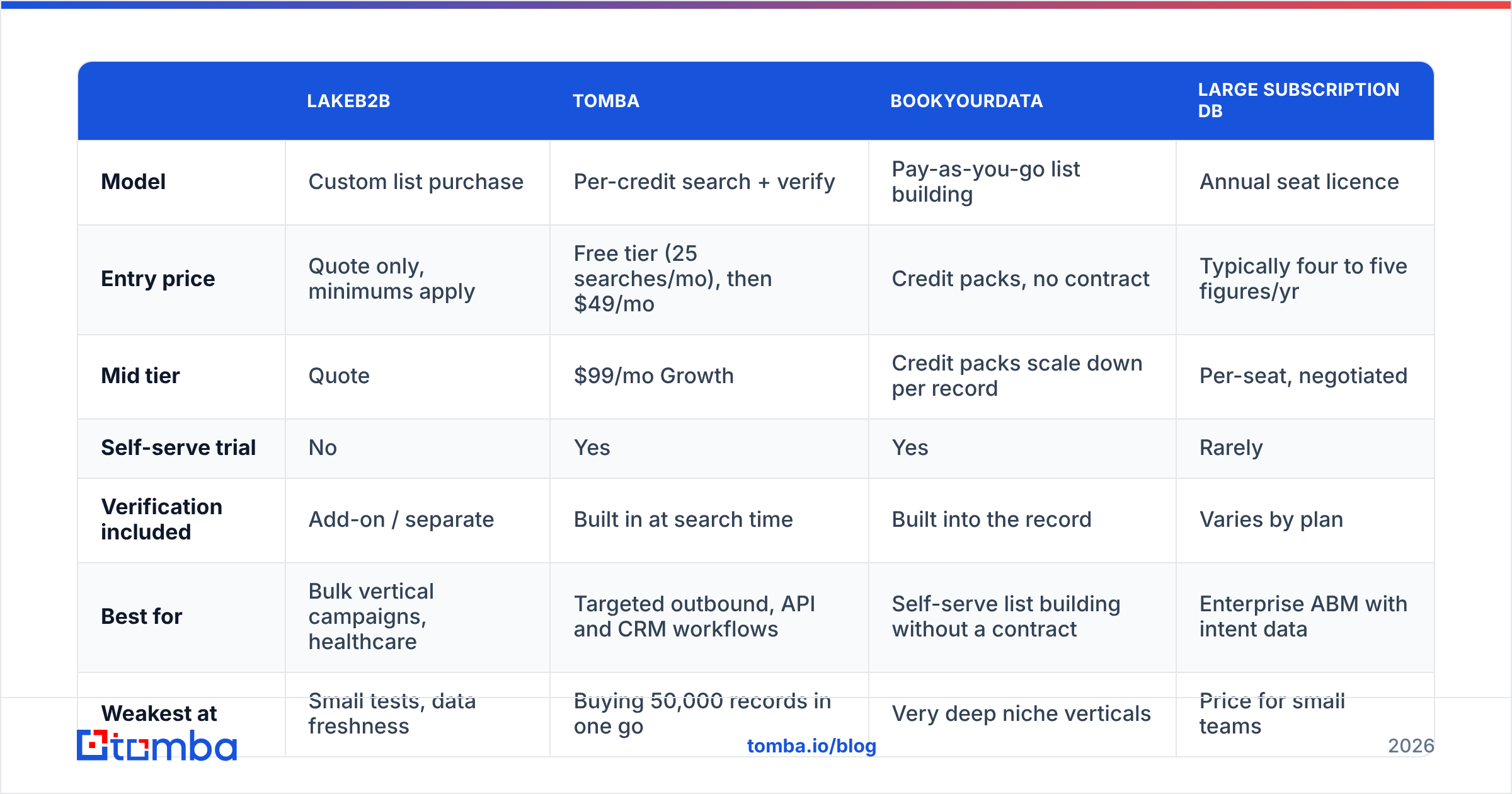
The honest comparison isn't LakeB2B versus one competitor — it's list purchase versus per-record search versus subscription database. Those are three different purchasing models, and picking the wrong model costs more than picking the wrong vendor inside a model.

| LakeB2B | Tomba | BookYourData | Large subscription DB | |
|---|---|---|---|---|
| Model | Custom list purchase | Per-credit search + verify | Pay-as-you-go list building | Annual seat licence |
| Entry price | Quote only, minimums apply | Free tier (25 searches/mo), then $49/mo | Credit packs, no contract | Typically four to five figures/yr |
| Mid tier | Quote | $99/mo Growth | Credit packs scale down per record | Per-seat, negotiated |
| Self-serve trial | No | Yes | Yes | Rarely |
| Verification included | Add-on / separate | Built in at search time | Built into the record | Varies by plan |
| Best for | Bulk vertical campaigns, healthcare | Targeted outbound, API and CRM workflows | Self-serve list building without a contract | Enterprise ABM with intent data |
| Weakest at | Small tests, data freshness | Buying 50,000 records in one go | Very deep niche verticals | Price for small teams |
| Contract | Sales-led quote | Monthly, cancel anytime | No contract required | Annual, auto-renew common |
BookYourData deserves a specific mention here because it solves the exact friction LakeB2B creates: it is a list-building product you can run yourself, with per-record credits and no quote call, while still producing a bulk file. If your objection to LakeB2B is "I don't want to talk to sales to buy 2,000 contacts," that's the category you want.
Tomba sits on the other axis. It is built for teams whose unit of work is a prospect, not a file — you run a domain search on a target account, pull the three people who matter, verify them, and push them into your sequence. Transparent Tomba pricing runs from a free tier at 25 searches/month through Starter at $49/mo, Growth at $99/mo, and Pro at $249/mo, with Enterprise quoted. No minimum order, no licence clause about how many times you may mail a contact you found.

What are LakeB2B's real pros and cons?#
Pros
- Vertical depth where it counts. Healthcare, education, and life-sciences segmentation is genuinely stronger than what most horizontal databases offer.
- Human scoping. A rep who understands your ICP and cuts the segment for you saves real hours versus filtering a database yourself.
- Volume in one transaction. Need 40,000 records? One order, one file, done. Per-credit tools make that clumsy and expensive.
- Append services. If you already have 8,000 company names and need contacts attached, appending is a legitimate use case and often cheaper than rebuilding from scratch.
- Multi-channel fields. Postal and phone data alongside email supports campaigns that aren't email-only.
Cons
- Zero price transparency. You cannot budget without a sales conversation, and you cannot benchmark the quote you get.
- Minimum order sizes block cheap validation of data quality before commitment.
- Static data with no refresh mechanism. The file is a snapshot; decay is your problem.
- Verification is your cost, not theirs. Whatever you save on the list, you spend on cleaning it.
- Licence terms can restrict reuse in ways that aren't obvious until you read the contract closely.
- Thin public review base makes third-party due diligence harder than it should be.
Is LakeB2B worth it for your team?#
Buy from LakeB2B if you're running high-volume campaigns into a regulated or niche vertical, you have a verification pipeline already, and the value of one well-scoped 20,000-record file exceeds the cost of cleaning it. That's a real scenario and the model works.
Do not buy from LakeB2B if your monthly contact need is under a few thousand, you sell into general B2B rather than a specialty vertical, or your entire outbound program runs off one or two sending domains you cannot afford to burn. In that case the minimum order alone prices you out of a sensible test, and the deliverability exposure is asymmetric — the downside is far larger than the savings.
The middle path most teams land on: use a per-credit finder for day-to-day targeted prospecting, and reserve list purchase for the two or three bulk campaigns a year where volume genuinely beats precision. Run purchased files through the same verification gate as everything else, and keep data enrichment running continuously so your CRM doesn't quietly rot between campaigns.
Where should you start instead?#
If your bottleneck is finding the right people at accounts you've already identified — not buying 30,000 rows — start with the Tomba Email Finder. You get 25 free searches a month to test accuracy on your own target accounts before paying anything, verification built into every lookup rather than billed as an add-on, and a published price ($49/mo Starter) you can put in a budget without booking a call. Run it against ten companies you know well, check the results by hand, and compare that hit rate against any quote you're holding. That's the only benchmark that matters.
Related guides#
// get started
Find, verify and enrich your first contacts today
Start on the free plan with 25 searches a month, then scale when your team is ready.
Free plan · No credit card required · GDPR & CCPA
// about the author