LakeB2B vs LeadsForge (2026): Which B2B Data Tool Wins?
One sells human-curated custom lists by quote. The other builds lists with AI in minutes. Here is an honest breakdown of accuracy, pricing, and which one your pipeline actually needs in 2026.
TL;DR
- LakeB2B is a managed data vendor: you describe an audience, a human team builds the list, you get a file. Pricing is quote-based, minimums are real, and turnaround is measured in days.
- LeadsForge is a self-serve AI list builder: you describe an audience in plain language, it assembles contacts in minutes on a monthly subscription.
- The decision is not "which has better data." It is who owns the verification step — LakeB2B charges you for it up front, LeadsForge leaves more of it to you.
- Neither is built as a real-time lookup layer. If you need an email for one specific person right now, a dedicated email finder does it in a second for a fraction of the cost.
- Cheapest safe path for most teams: run a small paid pilot with both, verify the output yourself, and measure bounce rate on 500 contacts before signing anything annual.
What is LakeB2B and who is it actually for?#
LakeB2B is a B2B data and demand-generation company that has been selling contact lists for roughly two decades. It sits in the "list vendor" category alongside players like Data Axle and ZoomInfo's data-licensing arm, not in the self-serve SaaS category. The core motion is simple: you tell an account manager which titles, industries, company sizes, and geographies you want, and their team assembles a file from a proprietary database plus manual research.
Where LakeB2B genuinely differentiates is verticalization. Healthcare is its best-known segment — physician lists segmented by specialty, NPI number, and practice size — and it also runs deep technology, education, and manufacturing datasets. If your ICP is "cardiologists in Texas at practices with 5–20 providers," a generic prospecting tool will struggle and a vertical list vendor will not. You can see the segment breadth on lakeb2b.com.
The trade-offs are the ones every list vendor carries. You are buying a snapshot, not a subscription to live data. Contracts and minimum order values push the entry point well past what a three-person sales team wants to spend. And because a human sales process sits between you and the data, you cannot evaluate quality until after you have talked to someone.
What is LeadsForge and how does it differ?#
LeadsForge belongs to the 2024–2026 wave of AI-native lead tools. Instead of filter dropdowns or an account manager, you type a request — "founders of Series A fintech companies in the UK using Stripe" — and a chat interface returns a list you can export. The pitch is speed and zero learning curve, and on that narrow promise it delivers.
Under the hood, AI list builders in this category generally aggregate from public web sources, licensed data partners, and enrichment APIs, then use a language model to translate your prompt into structured filters. That means two things worth understanding before you buy:
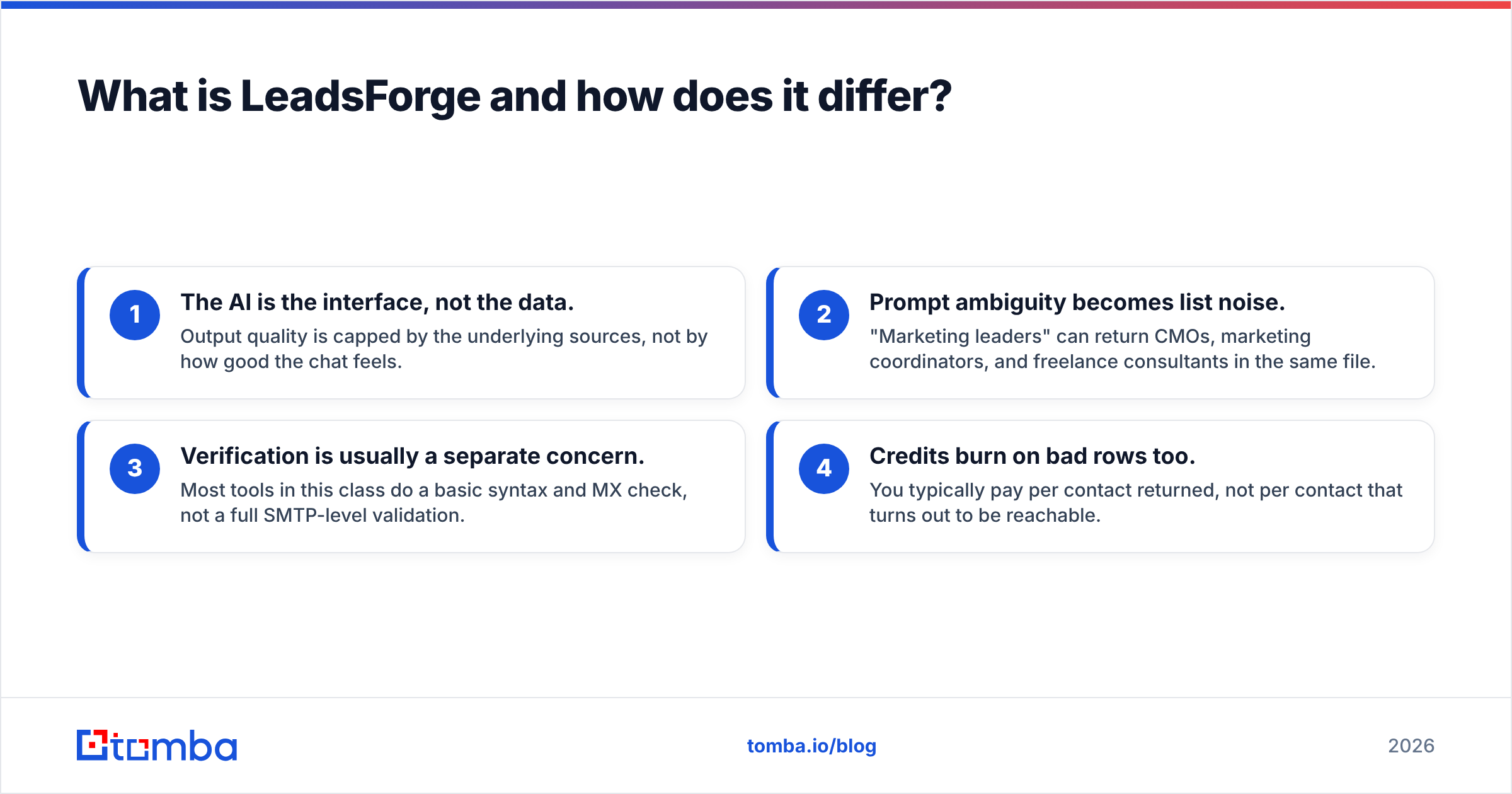
- The AI is the interface, not the data. Output quality is capped by the underlying sources, not by how good the chat feels.
- Prompt ambiguity becomes list noise. "Marketing leaders" can return CMOs, marketing coordinators, and freelance consultants in the same file.
- Verification is usually a separate concern. Most tools in this class do a basic syntax and MX check, not a full SMTP-level validation.
- Credits burn on bad rows too. You typically pay per contact returned, not per contact that turns out to be reachable.

How do LakeB2B and LeadsForge compare head-to-head?#
Here is the practical breakdown. Treat all pricing as directional — LakeB2B quotes per project and AI tools change tiers frequently, so confirm current numbers before you budget.
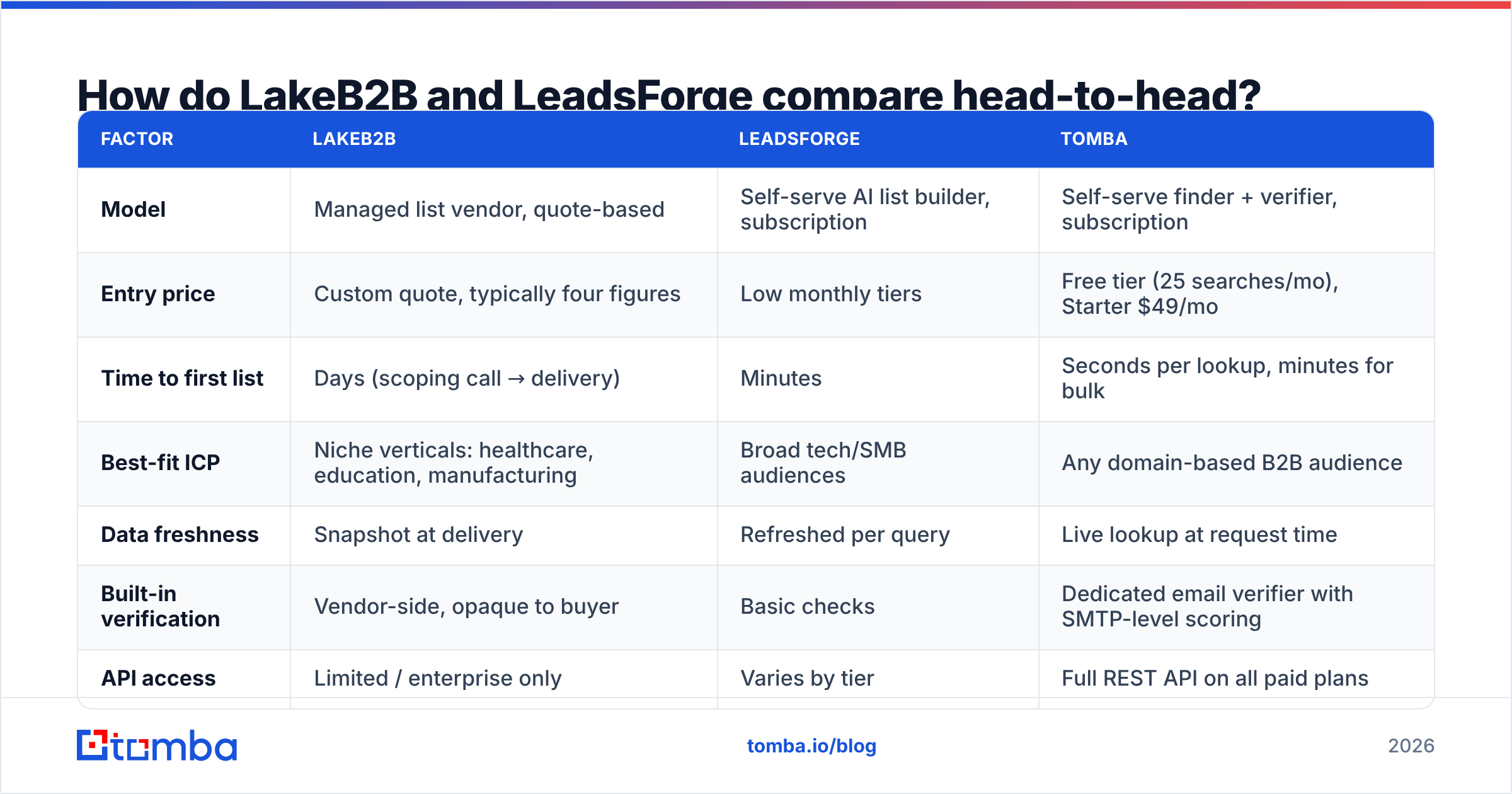
| Factor | LakeB2B | LeadsForge | Tomba |
|---|---|---|---|
| Model | Managed list vendor, quote-based | Self-serve AI list builder, subscription | Self-serve finder + verifier, subscription |
| Entry price | Custom quote, typically four figures | Low monthly tiers | Free tier (25 searches/mo), Starter $49/mo |
| Time to first list | Days (scoping call → delivery) | Minutes | Seconds per lookup, minutes for bulk |
| Best-fit ICP | Niche verticals: healthcare, education, manufacturing | Broad tech/SMB audiences | Any domain-based B2B audience |
| Data freshness | Snapshot at delivery | Refreshed per query | Live lookup at request time |
| Built-in verification | Vendor-side, opaque to buyer | Basic checks | Dedicated email verifier with SMTP-level scoring |
| API access | Limited / enterprise only | Varies by tier | Full REST API on all paid plans |
| Contract | Often annual or per-project minimum | Monthly, cancel anytime | Monthly, cancel anytime |
| Free trial | Sample file on request | Limited free credits | Free tier, no card |

The table makes the real split obvious. LakeB2B and LeadsForge are not competing for the same buyer as often as their marketing implies. LakeB2B wins when the audience is hard to define with filters and someone needs to go find it. LeadsForge wins when the audience is easy to describe and you need it before lunch.
Which one has more accurate data?#
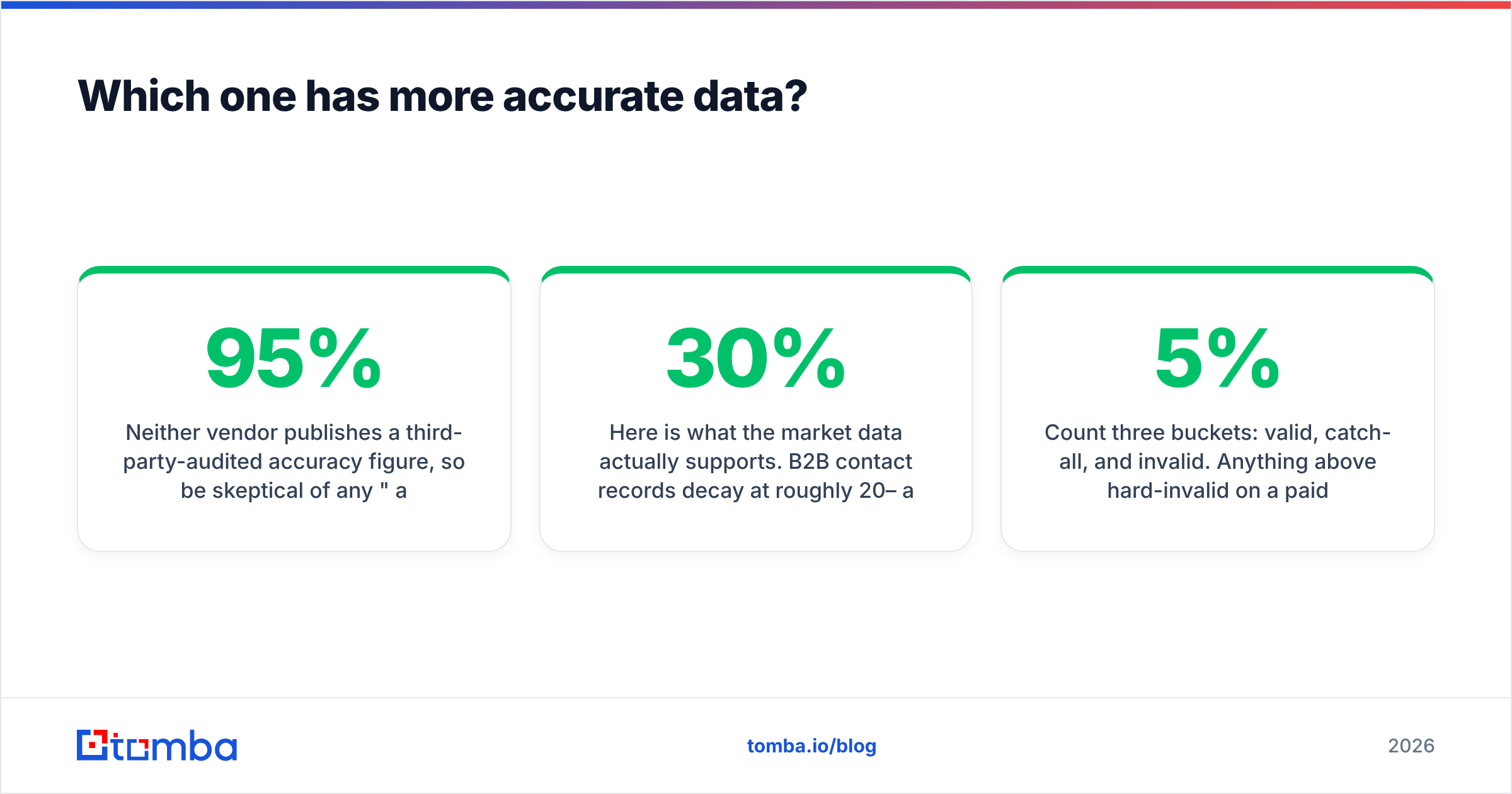
Neither vendor publishes a third-party-audited accuracy figure, so be skeptical of any "95% accurate" claim on either side — including claims you read in comparison posts. The only number that matters is the one you measure on your own list.
Here is what the market data actually supports. B2B contact records decay at roughly 20–30% per year as people change jobs, which means a list assembled in January is materially worse by July regardless of who built it. Gartner and other analysts have written extensively about the cost of poor data quality on revenue operations, and the pattern is consistent: the vendor's accuracy at the moment of delivery matters less than how often you refresh.

This is the strongest argument against buying a one-time file at all. A static list from any vendor starts rotting the day it lands in your CRM. A lookup-based tool re-checks the address at the moment you need it, which is why a lot of teams now keep a small finder subscription alongside whatever bulk source they use.
Practically, here is how to audit either vendor's output:
- Pull a 500-row sample before committing to the full file or the annual plan.
- Run it through independent verification. Do not use the vendor's own verification to grade the vendor's own data. A neutral bulk email finder and verifier gives you a clean second opinion.
- Count three buckets: valid, catch-all, and invalid. Anything above 5% hard-invalid on a paid list is a problem worth raising before you pay.
- Spot-check 20 rows manually against LinkedIn or the company site. This catches the failure mode verification misses entirely: a real, deliverable address attached to the wrong job title.
- Measure bounce rate on the first send, not open rate. Bounce is the honest signal.
What does each one actually cost in practice?#
LakeB2B's pricing is not published, which is standard for list vendors. Cost scales with record count, how many fields you need appended, and how much manual research the segment requires. Expect a scoping call, a proposal, and a minimum order value. For a genuinely niche healthcare or manufacturing segment, this is often money well spent — nobody else has the data.
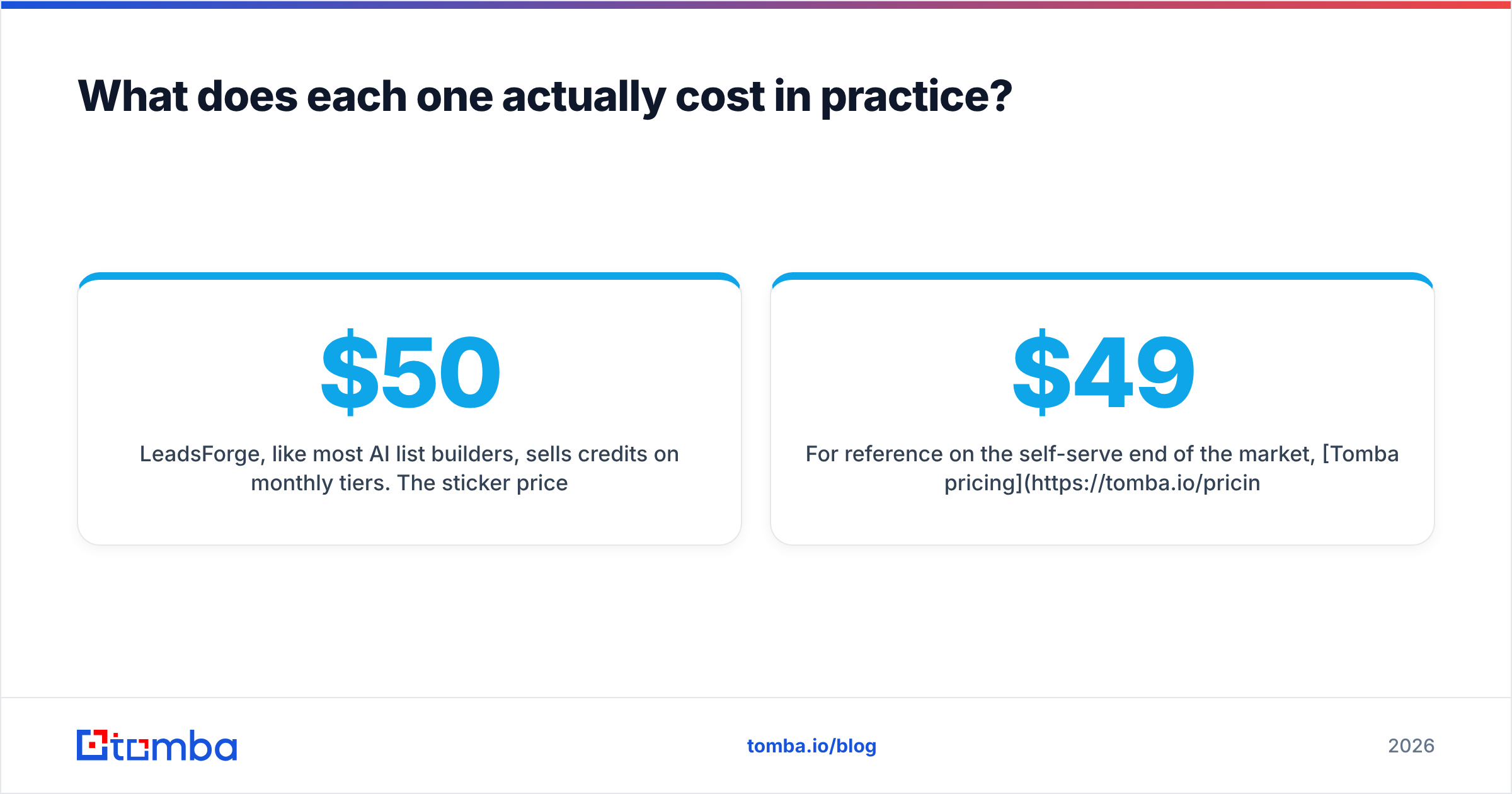
LeadsForge, like most AI list builders, sells credits on monthly tiers. The sticker price is low, which is the point. The cost you need to model is not the subscription — it is the effective cost per usable contact after you strip out the invalids, the duplicates, and the rows where the title does not match what you asked for. A $50 plan that returns 40% noise is more expensive per meeting than a $99 plan that returns 10%.
For reference on the self-serve end of the market, Tomba pricing runs a free tier at 25 searches per month, Starter at $49/mo, Growth at $99/mo, and Pro at $249/mo, with an Enterprise tier for custom volume. That is the band most self-serve data tools now compete in, and it is a useful yardstick when a vendor quotes you something dramatically higher.

Who should choose LakeB2B?#
Pick LakeB2B if you can say yes to most of these:
- Your ICP is defined by attributes that live in specialty databases — NPI numbers, accreditation status, equipment installed, license type — not by generic firmographics.
- You have a budget approver and a quarter-long campaign, not a two-week experiment.
- You need appended fields (direct dials, mailing addresses, compliance flags) that self-serve tools do not carry.
- You want someone accountable by name if the data is bad.
- You are running multichannel — direct mail, events, telemarketing — where a static file is the right artifact anyway.
If you are buying for a healthcare, higher-ed, or industrial audience, a vertical vendor is frequently the only source that exists. That is a real moat and worth paying for.
Who should choose LeadsForge?#
Pick LeadsForge if this sounds like your week:
- You need a list today and the audience is describable in one sentence.
- Your ICP is tech, SaaS, agencies, or SMB — segments with heavy public web coverage.
- You are testing three or four ICPs and do not want to commit budget to any of them yet.
- Nobody on the team wants to learn a filter builder with 40 dropdowns.
- Your volumes are small enough that manual cleanup of a noisy list is a one-hour job, not a one-week job.
The honest limitation: AI list builders are excellent at breadth and mediocre at precision. If your outbound depends on hitting exactly the right seniority at exactly the right company, budget time for cleanup. Reviews on G2 across this whole category tell the same story — fast and cheap, with variance in title accuracy.
Is there a better third option for most teams?#
For a large share of teams evaluating LakeB2B vs LeadsForge, the real answer is "a smaller, cheaper lookup layer, plus targeting you already own."
Most B2B teams already know which companies they want. The bottleneck is not discovery — it is turning a company domain and a person's name into a verified, reachable email address. That is a solved problem, and it does not require a list purchase or a scoping call. A domain search returns the contacts at a company on demand, verification runs at the moment of send, and data enrichment fills in the rest of the record.
The structural advantage is freshness. You are not buying a snapshot that decays; you are checking the address the day you email it. For teams sending a few thousand emails a month, this is usually both cheaper and more accurate than either alternative in this comparison.
The pattern that works well in practice: use a vertical vendor like LakeB2B when your segment genuinely requires specialist data, use an AI builder when you are exploring a new ICP fast, and keep a lookup-and-verify layer running underneath both so nothing leaves your CRM unverified.
How should you run the pilot?#
Do not decide on marketing pages. Run a two-week bake-off:
- Define one ICP precisely — industry, headcount band, three acceptable titles, one geography. Same brief to both vendors.
- Request 500 contacts from each. Ask LakeB2B for a sample file; use free or minimum credits on LeadsForge.
- Verify both files independently with the same third-party tool, on the same day.
- Score title match manually on 25 random rows per file.
- Send the same sequence to both, same copy, same sending domain, staggered by a day.
- Compare cost per reply, not cost per contact. That single number ends the argument.
Teams that run this test almost always find the gap between vendors is smaller than the gap between verified and unverified sending. Fix the verification step first; the vendor choice matters less afterward.
The bottom line#
LakeB2B is the right call for specialist verticals where the data does not exist anywhere else and a human has to go build it. LeadsForge is the right call for fast, broad, low-commitment list building when you are still figuring out who to sell to. Both are legitimate; neither is a substitute for verifying what you get.
If your actual problem is simply getting accurate, current email addresses for people you have already identified, skip the list purchase. Start with the Tomba Email Finder — 25 free searches a month, no card, and every result verified at lookup time. Run it against 50 of your target accounts today and compare the bounce rate to whatever file you were about to buy.
Related guides#
// get started
Find, verify and enrich your first contacts today
Start on the free plan with 25 searches a month, then scale when your team is ready.
Free plan · No credit card required · GDPR & CCPA
Get the Tomba newsletter
Product and data updates
// about the author