LakeB2B vs Seamless.AI: Honest 2026 B2B Data Comparison
One sells you a built-to-order contact list. The other sells you a seat in a lead search engine. Here is how LakeB2B and Seamless.AI actually differ on accuracy, pricing, contracts, and workflow — and when a cheaper third option beats both.
LakeB2B vs Seamless.AI is a comparison most buyers get wrong. One vendor sells a finished contact list. The other sells a seat in a search tool. The right pick depends on how your team works, not on whose record count is bigger.
TL;DR
- Different categories, not rivals. LakeB2B builds a custom contact list (a data service). Seamless.AI sells seats in a real-time lead search engine (a data tool). Comparing them on "records" alone will mislead you.
- Pricing is opaque on both sides. Neither publishes a self-serve price card. Both route you to a sales call, a scoped quote, and — in most reported cases — an annual commitment.
- Verify the accuracy claims yourself. Vendor-stated accuracy figures are marketing inputs, not SLAs. Run a 200-record bounce test before you sign.
- Seamless.AI fits reps who want self-service search and a Chrome extension. LakeB2B fits niche verticals — healthcare, education, manufacturing — where no search engine has depth.
- Need verified work emails on demand? A credit-based finder like Tomba at $49/mo covers the same ground for a fraction of either contract.
What are LakeB2B and Seamless.AI, exactly?#
Start here. Half the confusion in a LakeB2B vs Seamless.AI evaluation comes from treating the two as interchangeable.
LakeB2B is a data services company. You describe an audience — "hospital procurement directors in the Midwest, 200-bed facilities and up" — and they scope, build, and deliver the list as a CSV or a CRM-ready file. Their catalog leans into healthcare, education, technology, and manufacturing. They also sell data appends, email hygiene, and campaign execution. The model is closer to a market research vendor than a SaaS login. Their published segment catalogue sits at lakeb2b.com.
Seamless.AI is software. You log in, or use the browser extension, and search by title, company, industry, or technology. The platform builds contact records in real time from public sources plus its own index. Reps click "find email," burn a credit, and push the record to a CRM or sequencer. Seamless leans hard into AI positioning — buyer intent signals, autopilot list building, writing assistants — and sells mainly to SDR teams. Their product pages live at seamless.ai.
The short version: LakeB2B delivers a file. Seamless.AI delivers a search bar. One is a project. The other is a subscription habit.

LakeB2B vs Seamless.AI: how do they compare head to head?#
Here is the practical comparison. It draws on public product pages, buyer reviews on G2, and what B2B teams report during procurement.
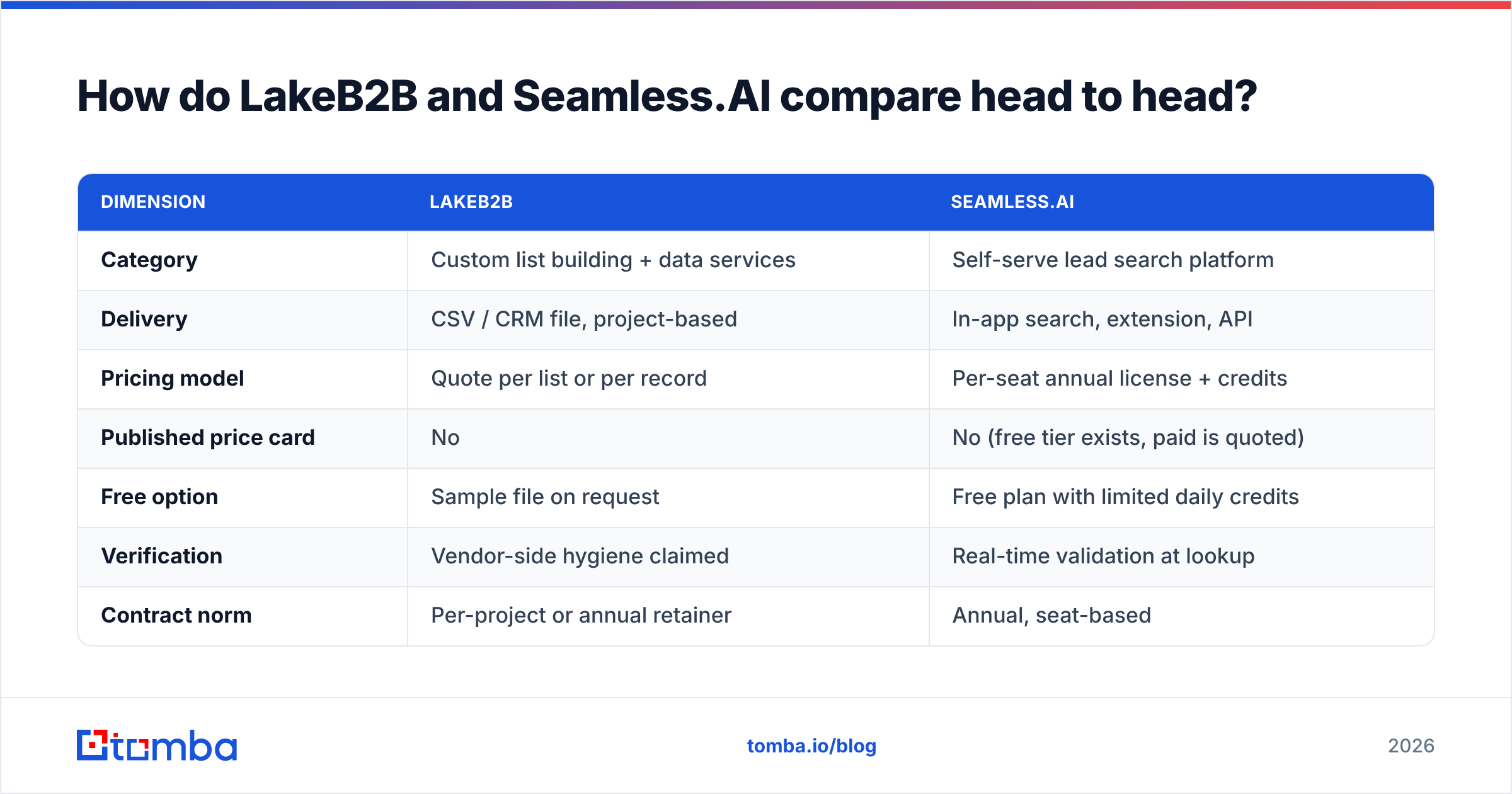
| Dimension | LakeB2B | Seamless.AI |
|---|---|---|
| Category | Custom list building + data services | Self-serve lead search platform |
| Delivery | CSV / CRM file, project-based | In-app search, extension, API |
| Pricing model | Quote per list or per record | Per-seat annual license + credits |
| Published price card | No | No (free tier exists, paid is quoted) |
| Free option | Sample file on request | Free plan with limited daily credits |
| Verification | Vendor-side hygiene claimed | Real-time validation at lookup |
| Contract norm | Per-project or annual retainer | Annual, seat-based |
| Best vertical depth | Healthcare, education, manufacturing | SaaS, tech, general mid-market |
| CRM push | Manual import / managed | Native integrations + extension |
| Learning curve | None for reps (list is handed over) | Moderate — reps must search well |
Two things jump out of that table.
First, neither vendor lets you price the decision without a call. That matters more than most buyers admit. When pricing is opaque, your leverage comes from how well you scope the ask and how credibly you can walk away.
Second, the workflows barely overlap. LakeB2B fits when you know your exact audience and want someone else to build it. Seamless.AI fits when your reps decide, hour by hour, who to contact next.

LakeB2B vs Seamless.AI: which one has more accurate data?#
No blog post can answer this for you, and any post that names a clean winner is guessing. What you can do is test both the same way.
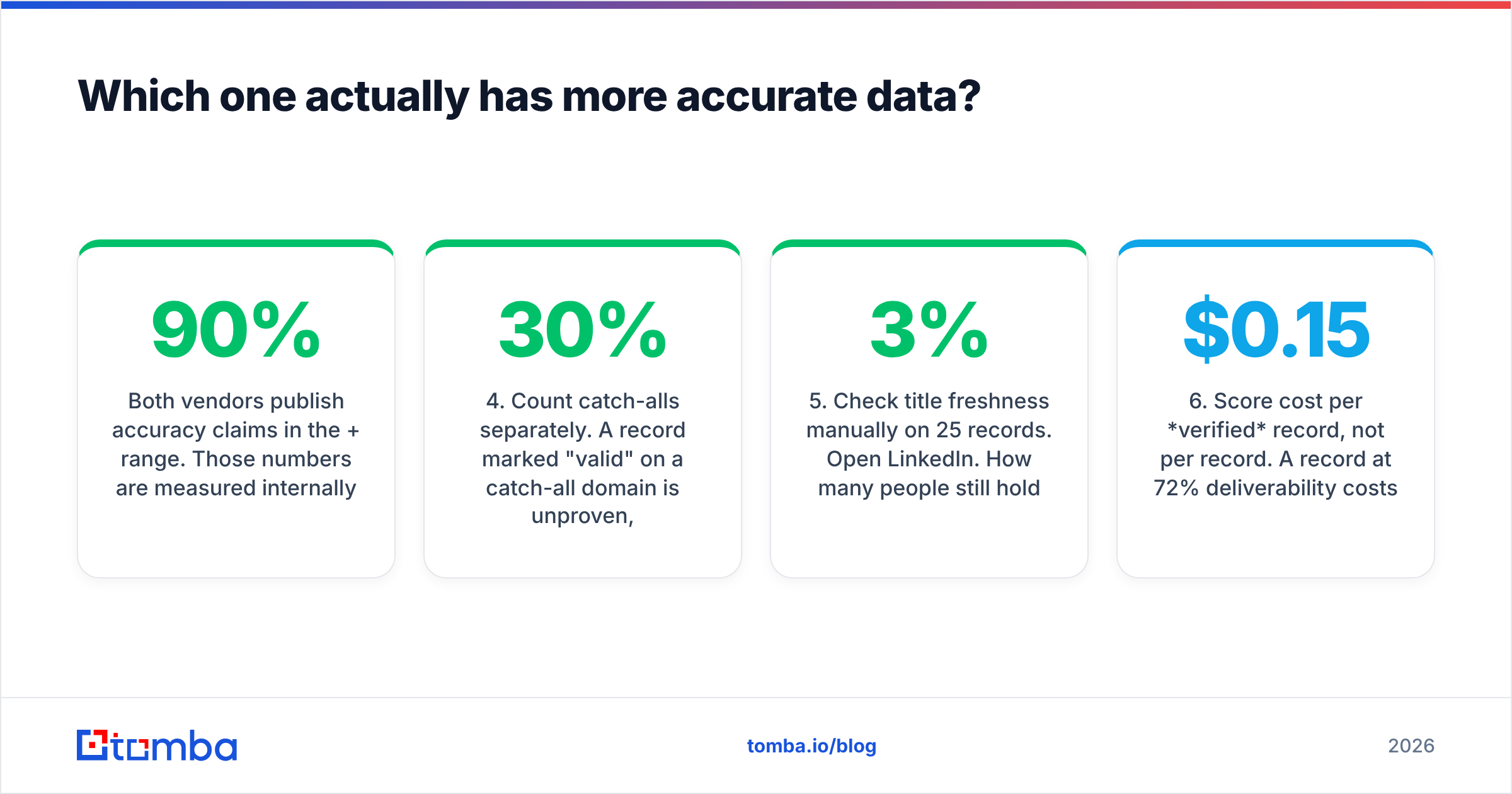
Both vendors publish accuracy claims above 90%. Those numbers are measured internally, against internal definitions, on internal samples. Treat them as a starting hypothesis, not a fact.
Here is the test that settles it in about two hours:
- Pick one narrow ICP segment you know well. Same title band, same company-size band, same geography, for both vendors. Vague requests produce vague data.
- Request 200 records from each. LakeB2B will usually provide a sample file. Seamless.AI's free tier gives you enough credits to pull a comparable set over a few days.
- Run both files through a neutral third-party validator. Do not let either vendor's own hygiene tool grade its own output. A separate email verifier gives you an unbiased deliverable/undeliverable/catch-all split.
Now grade the results. This is the part most teams rush:
- Count catch-alls separately. A record marked "valid" on a catch-all domain is unproven, not confirmed. If one vendor's file is 30% catch-all, its real accuracy sits well below its headline number. A dedicated catch-all verifier resolves most of those.
- Check title freshness on 25 records. Open LinkedIn. How many people still hold the title the file claims? B2B contact data decays 2–3% per month. A file built 14 months ago is wrong in places, even if every mailbox still accepts mail.
- Score cost per verified record, not per record. A $0.15 record at 72% deliverability costs more than a $0.25 record at 95%.
That last point is where most procurement decisions go wrong. Teams negotiate the sticker price and ignore the denominator.
How does pricing really work on each platform?#
Neither company publishes a price list. So what follows is the structure of each deal — the parts you should expect to negotiate — rather than invented numbers. In a LakeB2B vs Seamless.AI budget review, the shape of the spend matters more than the headline rate.
LakeB2B prices per project or per record. Your quote moves on segment difficulty (healthcare NPI-level data costs more than generic SMB data), record depth (email only vs. email plus direct dial and firmographics), exclusivity, and whether appends or campaign execution are bundled in. Ask one question early: is this a one-time file, a licensed list with usage limits, or a subscription refresh?
Seamless.AI prices per seat, per year, with a credit allowance on each seat. The variables are seat count, credit tier, and add-on modules (intent, autopilot, enrichment). On review sites, buyers complain most about credit exhaustion mid-quarter and the cost of adding seats mid-term. Ask three things: do unused credits roll over, what happens when a seat runs dry, and what does a mid-term seat add cost?
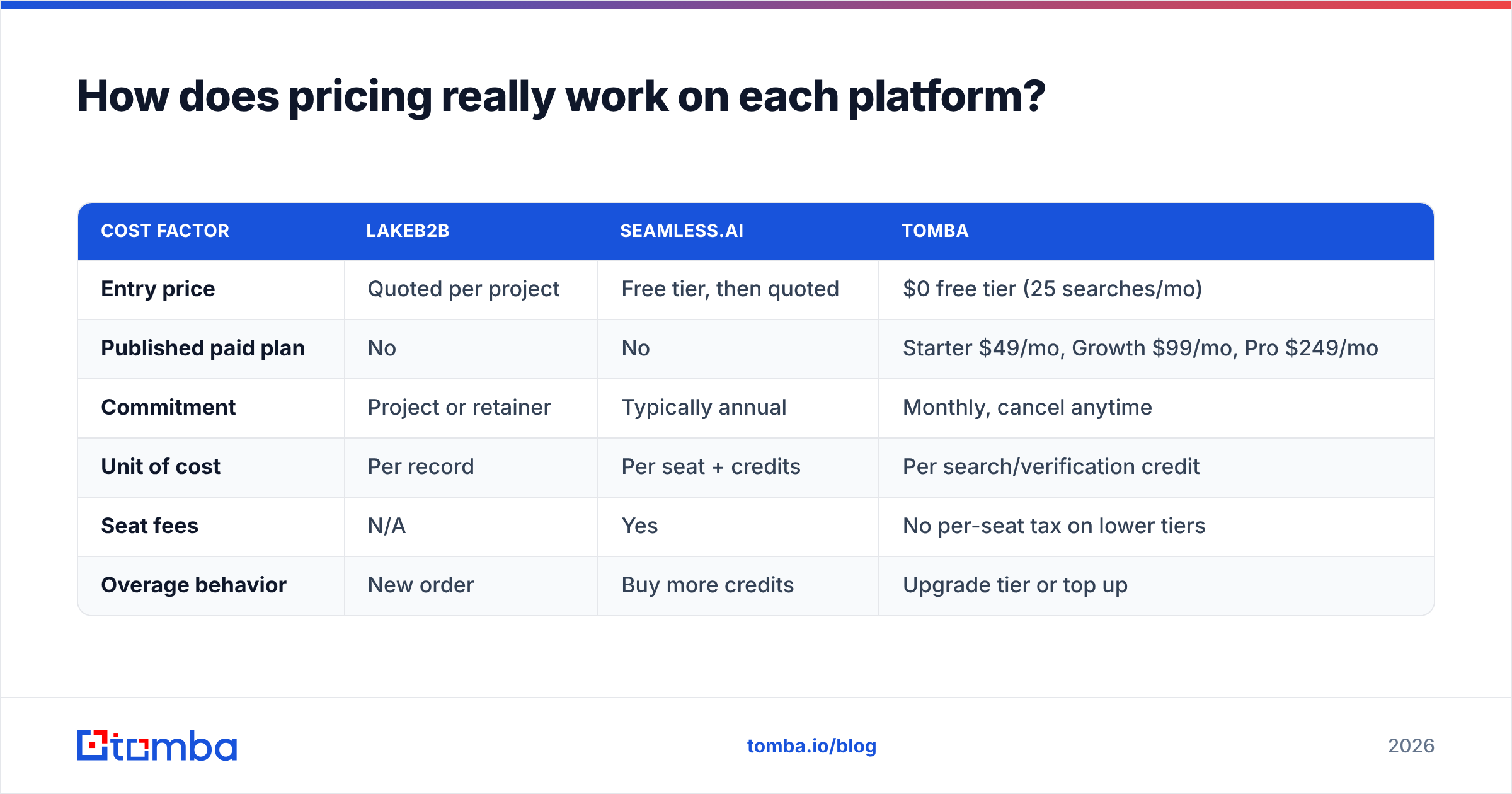
| Cost factor | LakeB2B | Seamless.AI | Tomba |
|---|---|---|---|
| Entry price | Quoted per project | Free tier, then quoted | $0 free tier (25 searches/mo) |
| Published paid plan | No | No | Starter $49/mo, Growth $99/mo, Pro $249/mo |
| Commitment | Project or retainer | Typically annual | Monthly, cancel anytime |
| Unit of cost | Per record | Per seat + credits | Per search/verification credit |
| Seat fees | N/A | Yes | No per-seat tax on lower tiers |
| Overage behavior | New order | Buy more credits | Upgrade tier or top up |
The point of that table is not that cheaper always wins. It is that your cost model should match your usage pattern. Run two big campaigns a year into a niche vertical, and a per-record project fee is rational while a 12-month seat license is waste. Put eight SDRs on daily prospecting across a broad market, and seats make sense while project files go stale before you finish them.
Who should choose LakeB2B?#
Pick LakeB2B when these describe you:
- Your ICP is vertical and specific. Healthcare administrators, K-12 district decision-makers, industrial plant managers. General-purpose search engines run thin here. Specialist list builders do not.
- You need attributes no tool exposes. Facility bed count, accreditation status, installed equipment, enrollment size. These live in curated datasets, not scraped profiles.
- Nobody on your team wants to build lists. You want a file, imported and ready to sequence. A managed engagement removes a job from your week.
- Compliance review is heavy. A contracted vendor gives you a paper trail, sourcing docs, and a named counterparty — which matters when legal asks where the data came from.
Pick something else when your prospecting is continuous and exploratory. A static file cannot tell you who just got promoted at an account.
Who should choose Seamless.AI?#
Pick Seamless.AI when these describe you:
- Reps self-serve their pipeline. They pick accounts, find contacts, and sequence in the same hour. That loop needs a live tool, not a quarterly CSV.
- You prospect broad mid-market tech and services. This is where the index runs deepest and search returns usable volume.
- Browser-extension workflow matters. Pulling a contact while reading a LinkedIn profile beats tab-switching into a data portal.
- You can absorb an annual commitment. If budget is committed anyway, seats are fine. If you're testing outbound for one quarter, they are not.
Pick something else if your team is two people, if your usage is spiky, or if you can't get the credit and rollover terms in writing.
What are the alternatives to both?#
Most teams weighing LakeB2B vs Seamless.AI are really shopping for one capability: verified work emails for a defined set of people. That capability sells for far less than either full platform.
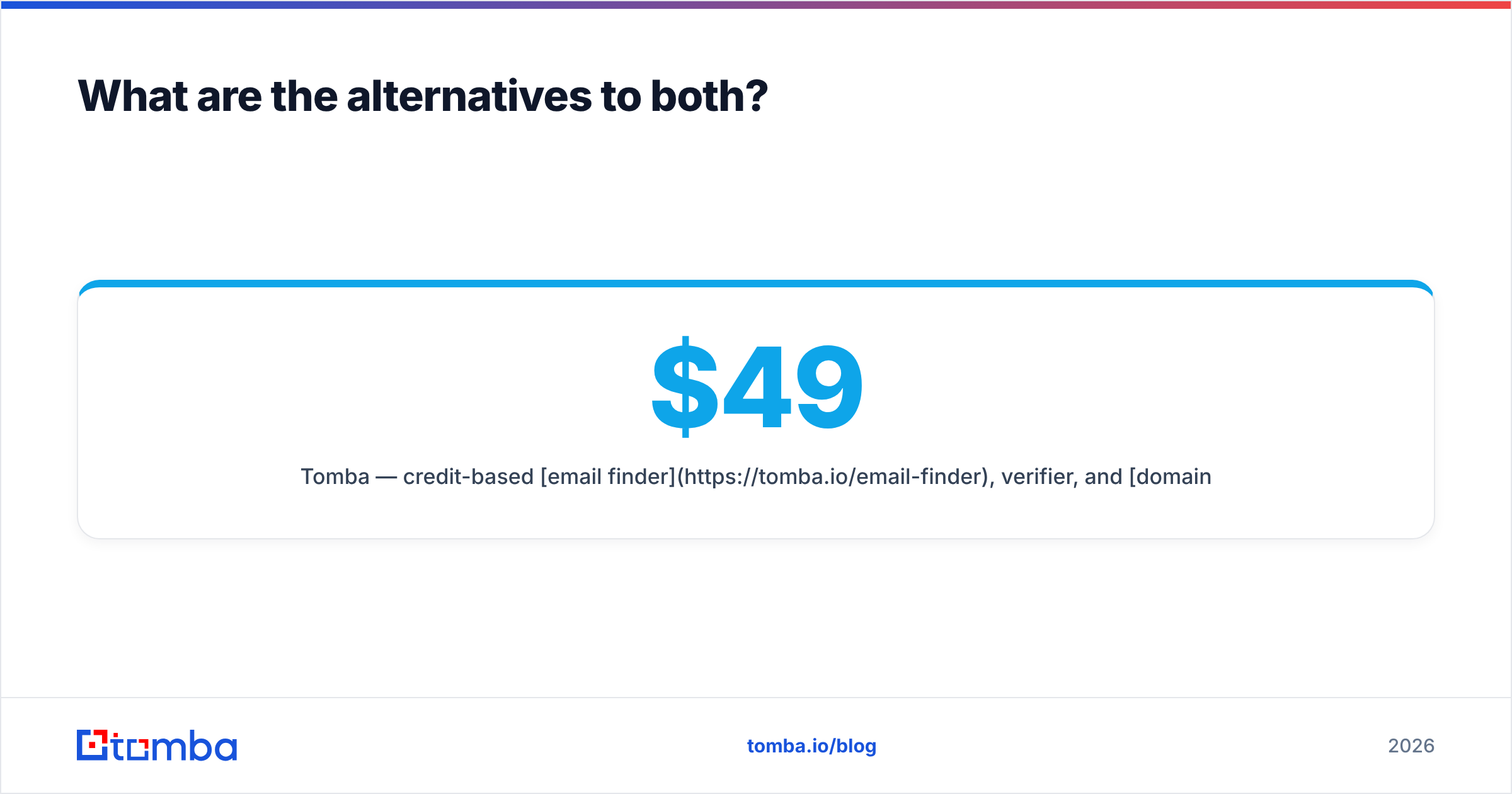
- Tomba — credit-based email finder, verifier, and domain search with published pricing: free tier at 25 searches/mo, Starter $49/mo, Growth $99/mo, Pro $249/mo. Monthly, no seat tax, plus a documented Tomba API for enrichment inside your own stack.
- BookYourData — a strong pick when you want a purchased list with an explicit accuracy guarantee and pay-as-you-go credits instead of an annual seat contract. If LakeB2B's model appeals but you want per-record pricing and instant download, evaluate it alongside them.
Two more worth a look if you are consolidating tools:
- Apollo — broad database plus sequencing in one subscription. Good for teams cutting tool count, heavy for teams who only need contact data. Our Apollo alternative breakdown covers the trade-offs.
- Point tools — if the only reason you're buying a platform is mobile numbers, a standalone phone finder costs a fraction of a full seat license.

A hybrid stack is legitimate and common. Use a specialist list vendor once or twice a year for the hard vertical data, and run a cheap per-credit finder continuously for everything else. That combination usually costs less than one enterprise seat bundle and covers more ground.
How do you protect deliverability whichever you choose?#
Buying data is the start of the risk, not the end of it. Treat every inbound file the same way, whatever the source:
- Re-verify on arrival. Even a file delivered yesterday was built earlier. Run it through verification before it touches your sending domain.
- Quarantine catch-all domains. Send to them from a secondary domain or a warmed sub-domain, never from your primary.
- Suppress role accounts. info@, sales@, and support@ inflate list size and depress the engagement metrics mailbox providers watch.
The next three steps protect you after the first send:
- Deduplicate across sources. Buy from two vendors and overlap is guaranteed. Duplicates mean double-sends, which mean spam complaints. A remove duplicates pass takes a minute.
- Cap first-week volume. A new list plus a high send volume is the classic recipe for a reputation hit. Ramp over 10–14 days and watch your sender reputation as you go.
- Re-verify anything older than 90 days. Decay is continuous. A list you verified in January is not a verified list in May.
Skip these steps and you will blame a vendor for a deliverability problem you created after delivery.
LakeB2B vs Seamless.AI: so which one wins in 2026?#
LakeB2B wins on vertical depth and hands-off delivery. Seamless.AI wins on rep-level self-service and daily prospecting speed. Neither wins on price transparency. Neither should be bought without a 200-record bounce test you run yourself, with a neutral validator.
If your honest requirement is "give me accurate work emails for the companies I already know I want," you probably need neither contract. Start with a bulk email finder run against your target domain list. Verify the output. Measure your reply rate before you commit five figures to a platform.
Ready to test the cheap path first? Run your next 25 target accounts through the Tomba Email Finder on the free tier, verify the results, and compare the deliverable-contact count against whatever sample LakeB2B or Seamless.AI sends you. If the numbers hold, Starter at $49/mo covers most outbound teams — and you'll have real data to negotiate with if you still want the enterprise contract. Settle the LakeB2B vs Seamless.AI question after that test, not before, and check current Tomba pricing ahead of your next vendor call.
Related guides#
Ready to find emails that actually work?
Join 150,000+ professionals who stopped guessing and started sending. Free credits on signup — no credit card required.
Get the Tomba newsletter
Practical outbound tactics and product updates — once every two weeks.
About the author