LakeB2B vs SignalHire: Which B2B Data Tool Wins in 2026?
LakeB2B sells curated lists and campaign services. SignalHire sells self-serve contact lookups with phone numbers. They solve different problems — here's which one fits your motion, and what each actually costs.
LakeB2B vs SignalHire comes down to one question: do you want a list, or a lookup? LakeB2B builds the list for you. SignalHire hands your reps a search bar. This guide compares both on price, data quality, phone coverage, and API access.
TL;DR
- LakeB2B is a list and services vendor. You brief them on an ICP. They deliver a curated file, often with campaign work attached. Pricing is quote-based, minimums apply, and you rarely self-serve.
- SignalHire is a self-serve contact lookup tool. You get a browser extension plus a searchable database. Credit packs start near $49 a month. Mobile numbers are the headline feature.
- They are not really competitors. One replaces a data-buying process. The other replaces a manual research step in your SDR's day.
- Neither is strong at verification. Both hand you addresses. Neither treats bounce prevention as the core product, so you'll want a separate verifier in the stack.
- Best fit: LakeB2B for one-off campaign lists in niche verticals like healthcare and education. SignalHire for reps who need a phone number right now. A dedicated email finder for steady, API-driven pipeline.
LakeB2B vs SignalHire: what does each one sell?#
Both tools sell B2B contact data. They sell it in very different shapes, and that shape decides everything else.
LakeB2B (lakeb2b.com) is a data and demand-generation agency. You describe a segment — "IT directors at US hospitals with 500+ beds." Their team builds the list. They can append firmographics, technographics, or intent signals. Many deals also bundle email deployment or full campaign work. Healthcare and education are their deepest verticals, and that depth is the real product.
SignalHire (signalhire.com) is a self-serve tool built around a Chrome extension. You open a LinkedIn profile and click the extension. It returns emails and phone numbers. There is also a searchable database with filters and an ATS-style feature set, because many SignalHire users are recruiters rather than salespeople.
That one difference shapes pricing, data freshness, integrations, and who on your team touches the tool.

LakeB2B vs SignalHire: a feature-by-feature comparison#
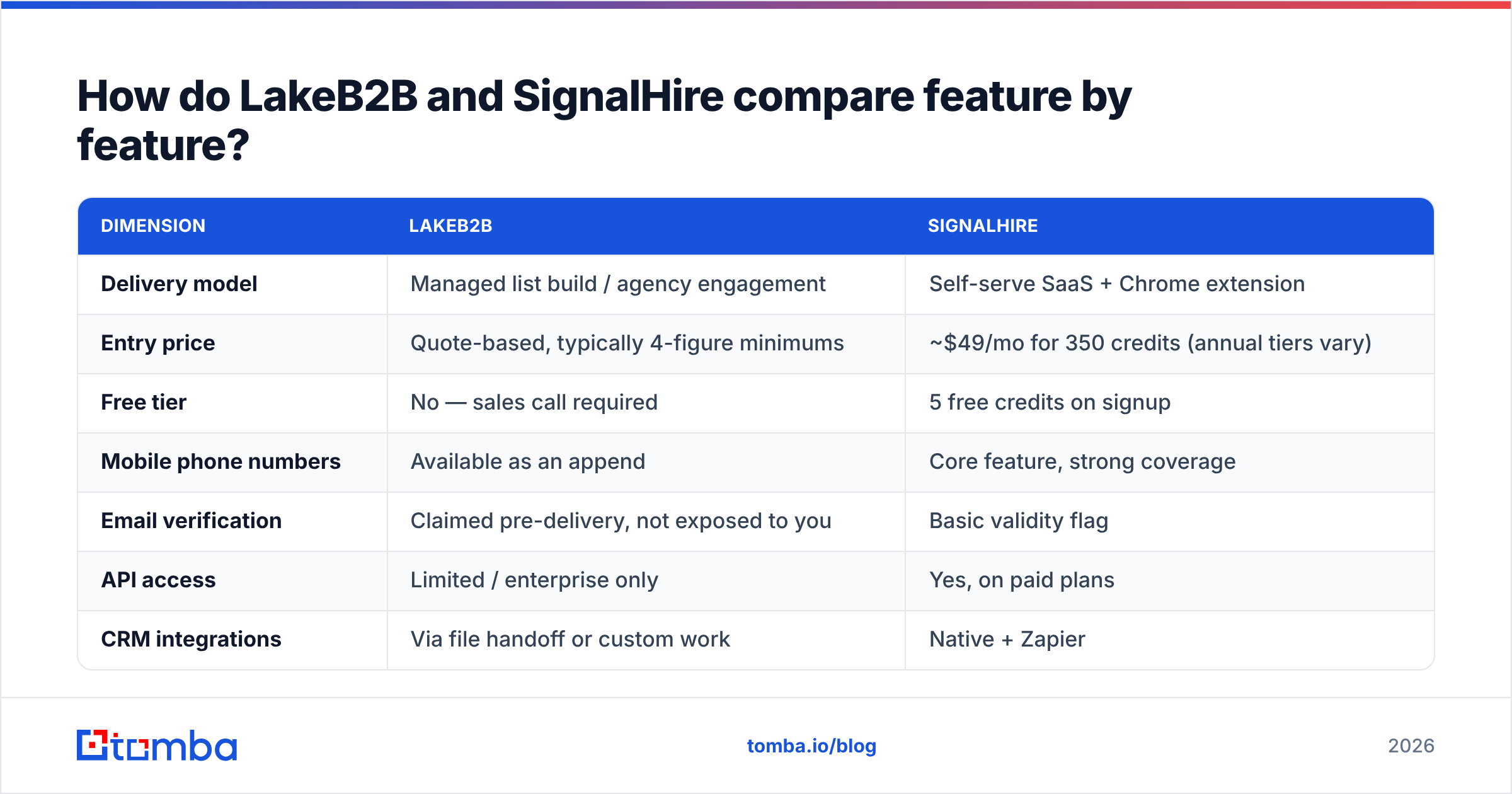
| Dimension | LakeB2B | SignalHire |
|---|---|---|
| Delivery model | Managed list build / agency engagement | Self-serve SaaS + Chrome extension |
| Entry price | Quote-based, typically 4-figure minimums | ~$49/mo for 350 credits (annual tiers vary) |
| Free tier | No — sales call required | 5 free credits on signup |
| Mobile phone numbers | Available as an append | Core feature, strong coverage |
| Email verification | Claimed pre-delivery, not exposed to you | Basic validity flag |
| API access | Limited / enterprise only | Yes, on paid plans |
| CRM integrations | Via file handoff or custom work | Native + Zapier |
| Turnaround | Days to weeks | Seconds per lookup |
| Best for | Vertical campaign lists, healthcare/education | Recruiters, SDRs working LinkedIn |
| Weakest point | No self-serve, opaque data refresh | Thin firmographic depth, credit burn |
The table makes the split obvious. Need 12,000 nurse-practitioner contacts for a Q1 campaign? LakeB2B is a real answer, and SignalHire is not. Has your AE got a LinkedIn profile open and needs a cell number before the 2pm block? Then SignalHire is the answer, and LakeB2B is not.
Which one has better data accuracy?#
Neither vendor publishes audited accuracy numbers. Treat any percentage in a sales deck as marketing until you test it yourself.
What you can judge is process. Here the two differ sharply:
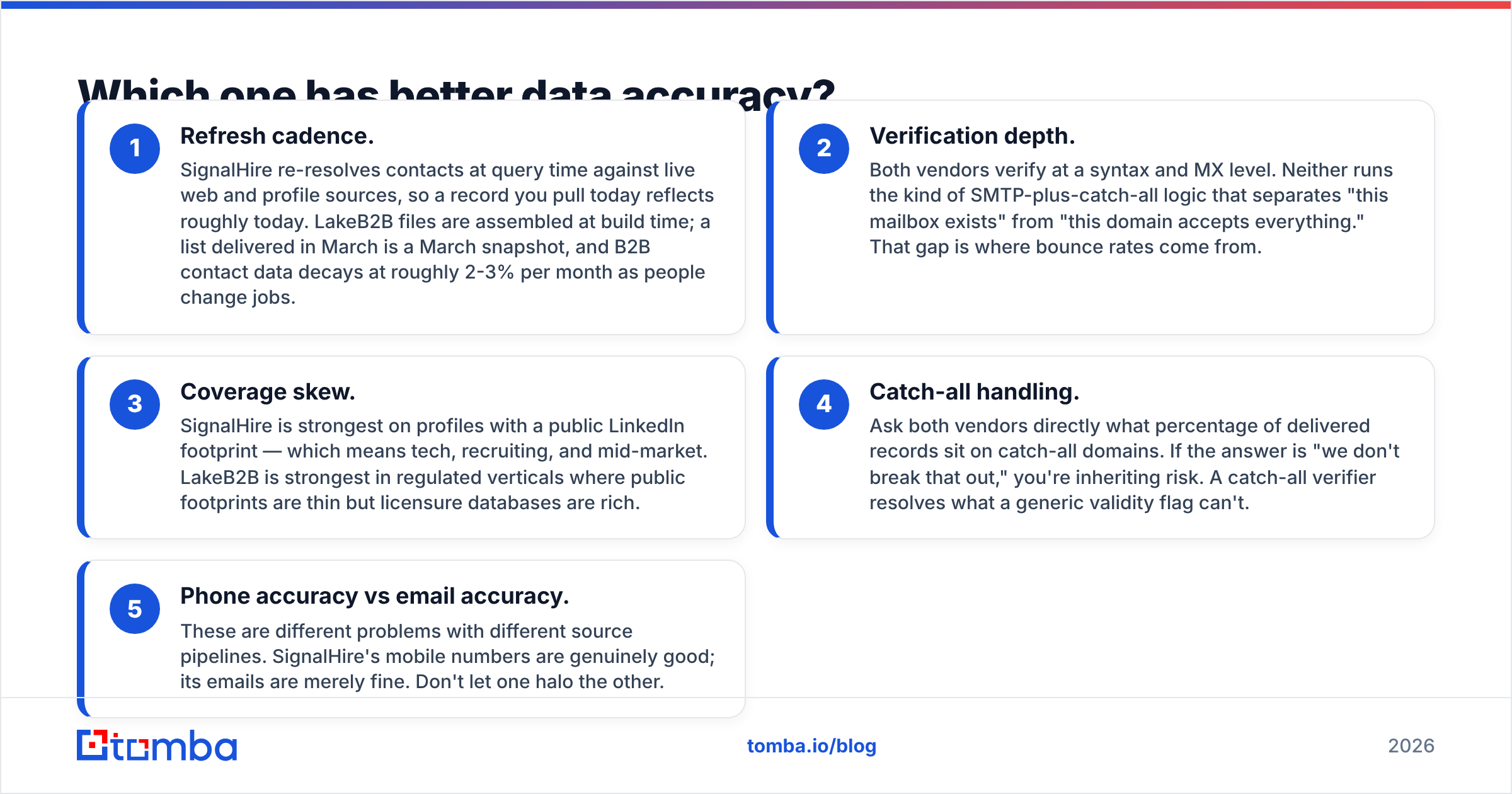
- Refresh cadence. SignalHire re-checks contacts at query time against live web and profile sources. A record you pull today reflects today. LakeB2B files are built once. A list delivered in March is a March snapshot, and B2B contact data decays about 2-3% each month as people change jobs.
- Verification depth. Both vendors check syntax and MX records. Neither runs the deeper SMTP and catch-all logic. So you learn that a domain resolves, not that a mailbox accepts mail. That gap is where bounces come from.
- Coverage skew. SignalHire is strongest on people with a public LinkedIn footprint: tech, recruiting, and mid-market. LakeB2B is strongest in regulated fields where public footprints are thin but licensure databases are rich.
- Catch-all handling. Ask each vendor what share of delivered records sit on catch-all domains. If they can't break that out, you are inheriting risk. A catch-all verifier answers what a generic validity flag cannot.
- Phone accuracy vs email accuracy. These are two problems with two different source pipelines. SignalHire's mobile numbers are genuinely good. Its emails are merely fine. Don't let one halo the other.
The practical test works for either vendor. Ask for a 100-record sample. Run it through an independent email verifier. Then count the real bounces. That single test tells you more than any sales deck. Reviews on G2 help too — read the complaint patterns, not the star ratings.
What does each one really cost?#
LakeB2B does not publish rate cards. Each deal is scoped per project. Price moves with record count, append depth, and whether campaign execution is included. Buyers often report four-figure minimums for anything meaningful. Per-record cost falls as volume rises. There is no monthly ceiling because there is no subscription — you are buying a deliverable.
SignalHire publishes tiers. The entry plan sits near $49 a month for a few hundred credits, and team plans scale from there. Watch the credit math. One contact reveal can burn several credits when you pull both email and phone. Unused credits rarely roll over forever. Teams that budget 1,000 lookups often spend them in three weeks.
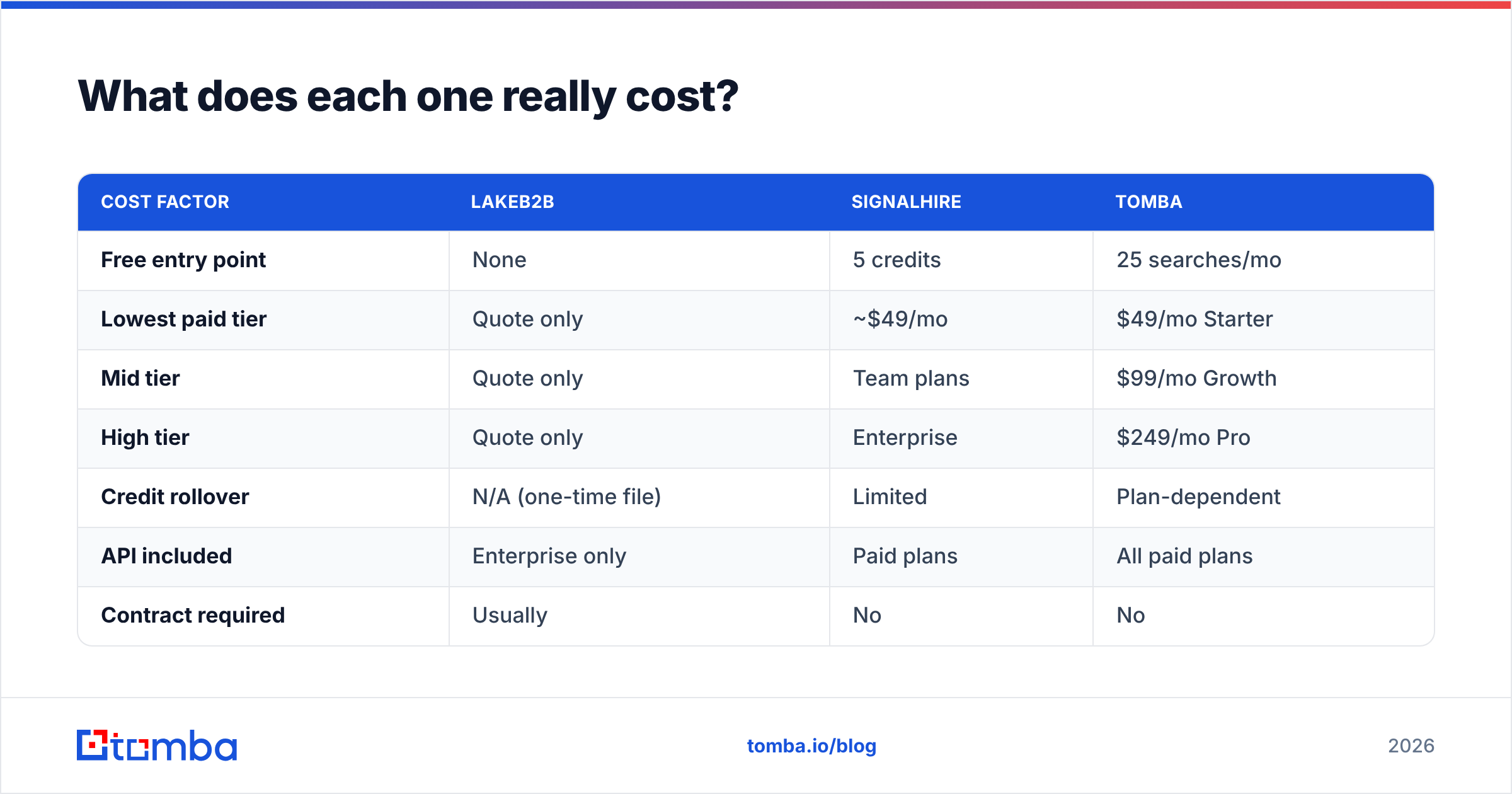
| Cost factor | LakeB2B | SignalHire | Tomba |
|---|---|---|---|
| Free entry point | None | 5 credits | 25 searches/mo |
| Lowest paid tier | Quote only | ~$49/mo | $49/mo Starter |
| Mid tier | Quote only | Team plans | $99/mo Growth |
| High tier | Quote only | Enterprise | $249/mo Pro |
| Credit rollover | N/A (one-time file) | Limited | Plan-dependent |
| API included | Enterprise only | Paid plans | All paid plans |
| Contract required | Usually | No | No |
The structural point is simple. LakeB2B is capex-shaped: one big buy, and the asset ages. SignalHire is opex-shaped: you pay every month, and the data stays current. Which is cheaper depends on how stable your ICP is. A list you mail once and archive favours the first model. A pipeline you refresh weekly favours the second, and the gap compounds fast. You can check Tomba pricing for a third view of transparent per-credit economics.
Is LakeB2B better than SignalHire for outbound campaigns?#
For one large, vertical-specific campaign, usually yes.
LakeB2B's edge is that someone else does the segmentation work. Say you need respiratory therapists in the Midwest. You will not filter your way there in a self-serve tool, because that job title barely exists in standard taxonomies. Vertical list vendors earn their fee in exactly these cases: regulated industries, licensure-based roles, and segments where LinkedIn coverage is poor.
The trade-off is control. You don't see the sourcing. You can't re-run the query next quarter without a new engagement. And if the file underperforms, your only real option is to ask the vendor.
SignalHire loses on volume but wins on iteration speed. A rep can test an idea in an afternoon — do VP Ops at logistics companies reply better than Directors? No procurement cycle needed. For teams running many small experiments instead of a few large campaigns, that speed beats list depth.
A third pattern is worth naming, because plenty of teams land there. Use a domain search to map everyone contactable at a target account, then enrich only the names you want. This flips the usual flow. You pick accounts first and pull contacts on demand, rather than buying a broad list and narrowing it. Spend stays tied to real pipeline.
Where do both tools fall short?#
Three gaps show up either way.
Verification is an afterthought. Both treat a validity flag as sufficient. It isn't. A flag tells you the domain resolves. It does not tell you whether the mailbox accepts mail, whether the domain is a catch-all, or whether the address is a spam trap. Sending to unverified data is the fastest route to a damaged sender reputation, and that damage takes months to undo.
Workflow integration is shallow. LakeB2B hands you a file. Getting it into your CRM cleanly, deduped against existing records, is your problem. SignalHire integrates, but one contact at a time. It is not built to bulk-enrich an existing 40,000-row database.
Neither covers the full contact record. Modern outbound wants email, phone, LinkedIn URL, company firmographics, and tech stack in one pass. LakeB2B appends these for a fee. SignalHire gives you contact fields but light company data. Teams end up stitching two or three vendors together, and per-lead cost quietly triples.
Price that stitching before you buy. Add up list acquisition, verification, phone append, and enrichment as separate line items. Then compare the total against one platform that covers data enrichment, verification, and lookup from a single credit pool. The bundled number often wins. Not because any one part is cheaper, but because you stop paying integration tax.
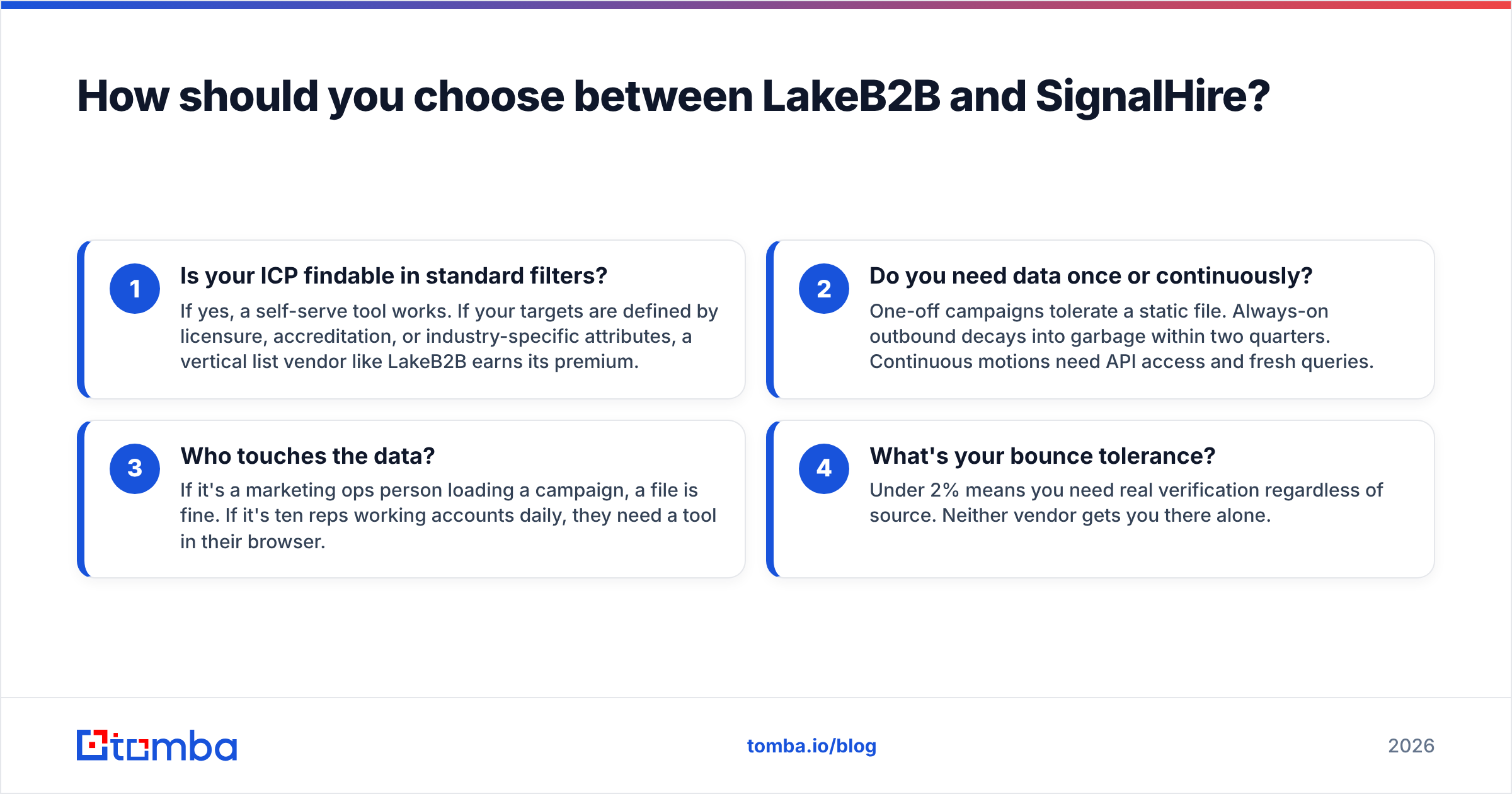
How should you choose between LakeB2B and SignalHire?#
Answer these four questions honestly.
- Is your ICP findable with standard filters? If yes, a self-serve tool works. If your targets are defined by licensure, accreditation, or industry-specific attributes, a vertical vendor like LakeB2B earns its premium.
- Do you need data once, or all the time? A one-off campaign can live with a static file. Always-on outbound decays into garbage within two quarters. Continuous motions need API access and fresh queries.
- Who touches the data? A marketing ops person loading one campaign can work from a file. Ten reps working accounts daily need a tool in the browser.
- What is your bounce tolerance? Under 2% means you need real verification, whatever the source. Neither vendor gets you there alone.
Here is the rule of thumb. Buy lists for campaigns. Buy lookups for workflows. Never buy either without a verification layer between the data and your sending domain. HubSpot's research on email deliverability is blunt about how fast list quality shows up in inbox placement, and that holds no matter whose data you send.
Many teams run a mixed motion: campaign bursts plus daily prospecting. For them, the cleanest answer is often neither vendor alone. Buy a vertical list for the segments you truly cannot self-serve. Use a per-seat lookup tool for everything else. Route both through one verification step. Three vendors, three credit systems, and three invoices cost more than they save. If you are consolidating, a bulk email finder handles list processing and single lookups in one place.
What's the verdict?#
SignalHire wins for day-to-day prospecting. You get self-serve access, real phone coverage, no sales call, and pricing you can judge without a meeting. If your team needs contact data as part of daily work, it is the more practical pick.
LakeB2B wins for vertical campaign lists. Targeting healthcare or education segments that standard databases handle badly? Their curation is a genuine advantage, and the managed-service wrapper saves real hours.
Neither wins on verification or API-first workflows. That is the gap most teams feel about six weeks in, right when bounce rates climb and someone asks where the data came from.
So the LakeB2B vs SignalHire answer depends on your motion, not on a feature score.
Need programmatic, verified contact data that feeds a system instead of a spreadsheet? Start with the Tomba Email Finder. The free tier gives you 25 searches a month, so you can test accuracy against your own ICP first. Starter runs $49/mo. Every paid plan includes API access, so the same data behind a rep's browser lookup also powers your enrichment jobs. Run a sample against whichever vendor you are weighing, and let the bounce rate decide.
Related guides#
// get started
Find, verify and enrich your first contacts today
Start on the free plan with 25 searches a month, then scale when your team is ready.
Free plan · No credit card required · GDPR & CCPA
// about the author