LakeB2B vs Sparklane: Which B2B Data Platform Wins in 2026?
LakeB2B sells you a list. Sparklane sells you a signal. Here is how the two B2B data vendors actually differ on coverage, pricing, GDPR posture and freshness — and when neither one is the right buy.
TL;DR — LakeB2B vs Sparklane in 60 seconds
- LakeB2B sells data. Sparklane sells software. LakeB2B builds custom contact lists, and it is strong in US health, education and tech. Sparklane is a European sales tool that scores and surfaces accounts from company signals.
- Neither one posts a price. Both run on quotes, annual deals and sales calls. If you want to pay by card today, neither vendor is built for you.
- For EU outbound, Sparklane is the safer pick. For a big, tightly filtered US list, LakeB2B is the better pick.
- Stale data is the real risk in both models. A bought list decays 2-2.5% a month. A signal tool can be right on the firm and wrong on the person.
- Most teams under 50 reps want a third option. Pay per lookup, then verify on the day you send.
LakeB2B vs Sparklane: what does each one sell?#
They answer the same question — "who do I contact?" — from opposite ends.
LakeB2B is a B2B data and demand-gen firm. You describe an audience, say IT directors at US hospitals with 200+ beds. Their team builds the list from owned and compiled sources. You get a file or a CRM push. They also sell appended data, intent data and done-for-you campaigns. It is a services-first deal: an account manager, a scope, a hand-off.
Sparklane is a French sales tool built on predictive scores. It does not hand you a static list. It watches a pool of firms — mostly French and wider European — for signals. Those signals include hiring, funding, new execs, filings and news. It then ranks accounts by how likely they are to buy. Contact data sits beside the account view rather than leading it.
That split drives most of what follows:
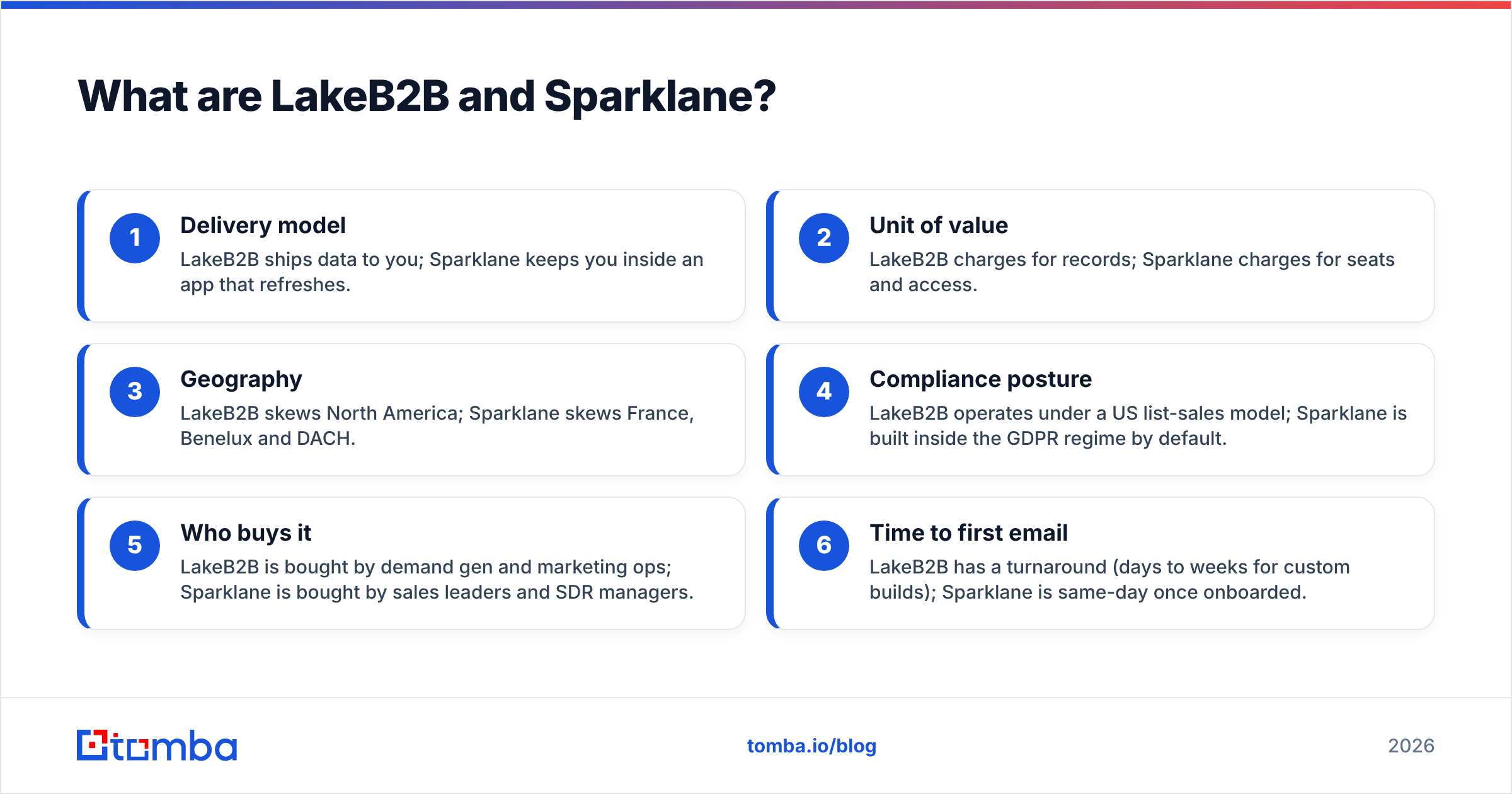
- Delivery model — LakeB2B ships data to you. Sparklane keeps you in an app that refreshes.
- Unit of value — LakeB2B charges for records. Sparklane charges for seats.
- Geography — LakeB2B leans North America. Sparklane leans France, Benelux and DACH.
- Compliance — LakeB2B runs a US list model. Sparklane is built inside GDPR by default.
- Who buys it — LakeB2B suits demand gen and marketing ops. Sparklane suits sales leads and SDR managers.
- Time to first email — LakeB2B takes days or weeks for a custom build. Sparklane is same-day once you are set up.
LakeB2B vs Sparklane: how do they compare head-to-head?#
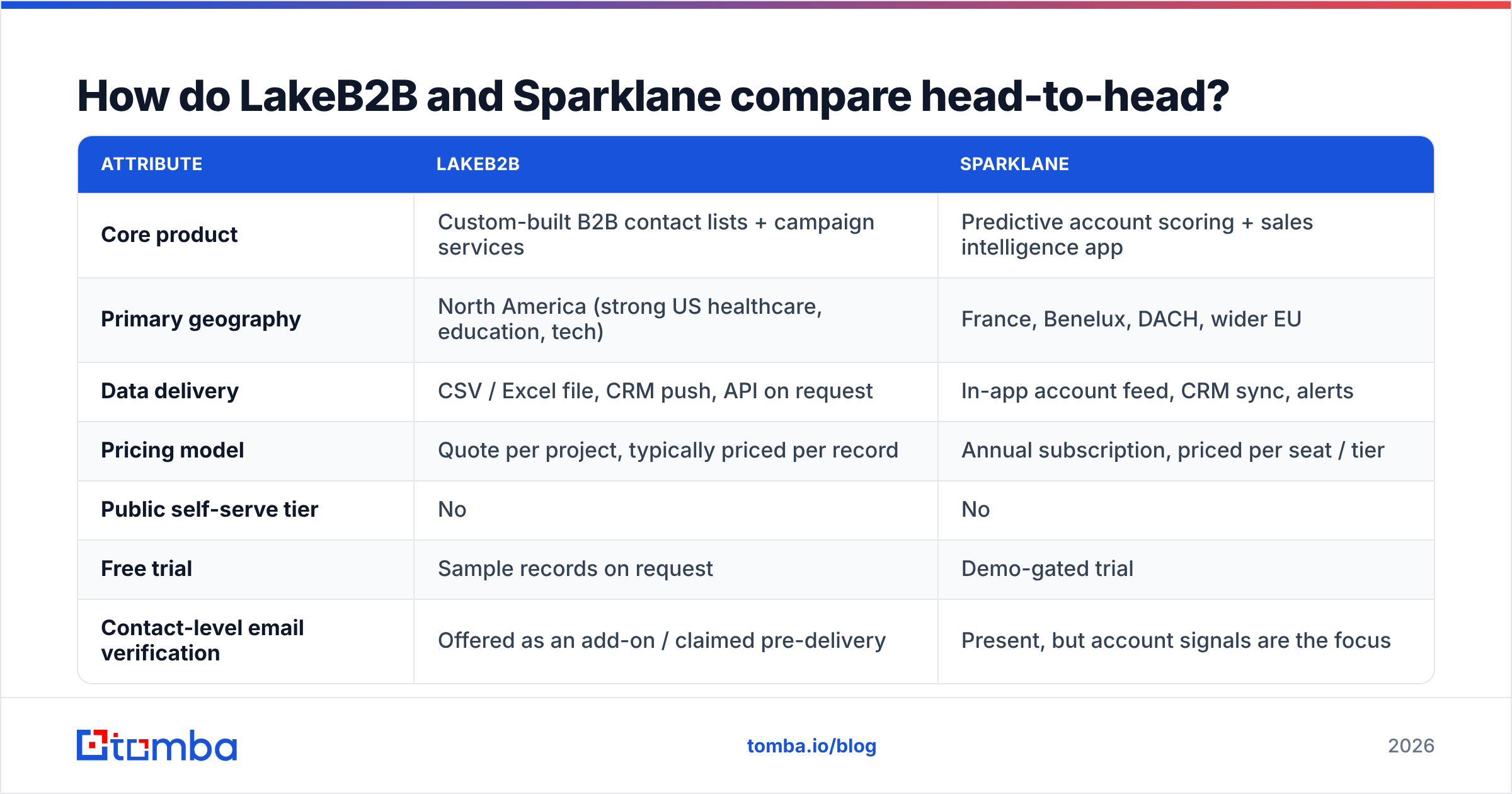
| Attribute | LakeB2B | Sparklane |
|---|---|---|
| Core product | Custom-built B2B contact lists + campaign services | Predictive account scoring + sales intelligence app |
| Primary geography | North America (strong US healthcare, education, tech) | France, Benelux, DACH, wider EU |
| Data delivery | CSV / Excel file, CRM push, API on request | In-app account feed, CRM sync, alerts |
| Pricing model | Quote per project, typically priced per record | Annual subscription, priced per seat / tier |
| Public self-serve tier | No | No |
| Free trial | Sample records on request | Demo-gated trial |
| Contact-level email verification | Offered as an add-on / claimed pre-delivery | Present, but account signals are the focus |
| Intent / trigger data | Third-party intent available as an upsell | Native — triggers are the core of the product |
| Best fit | One-off or recurring list buys for a defined US audience | Continuous EU account prioritisation for a sales team |
| Weakest fit | Teams wanting live, per-lookup data without a contract | Teams needing deep US coverage or bulk list exports |

Which one has better data coverage and accuracy?#
The honest answer: it depends on where your buyers sit. And neither accuracy claim should be taken at face value.
LakeB2B advertises huge record counts across dozens of verticals. The useful number is not the total. It is how many records survive your filter and a fresh check. Buyers who write about compiled lists on G2 report the same pattern. Headline counts are big. Counts after suppression and bounce tests are much smaller. That is not unique to LakeB2B. It is how compiled data works.
Sparklane has a different weak spot. Its company data — funding, headcount, legal filings — tends to be current for French and EU firms. It is pulled from public registers and news. The soft link is the contact layer. Knowing that a firm just raised a Series A only helps if the email for the right VP is right today.
Both models share the same decay problem. B2B contact data goes stale at 25-30% a year. People move jobs. Firms rebrand. Mail servers change the rules. A list you bought in January looks different by June. A tool that refreshes accounts each month can still hand you a contact last checked a year ago.
The defence is the same for both:
- Verify at send time, not at buy time. Run each address through an email verifier within 48 hours of the send, not when the file lands.
- Suppress before you segment. Drop role accounts, catch-all domains you cannot confirm, and anyone already in your CRM.
- Sample before you commit. Ask for 200 records from the exact segment. Verify them yourself. Then work out the real cost per valid contact.
- Track bounce rate as a vendor KPI. Above 3% on a verified file is a contract talk, not a bad week.
How does pricing work in LakeB2B vs Sparklane?#
Neither vendor posts a price list. That is the biggest day-to-day gap between them and modern self-serve tools.
LakeB2B prices per project. The quote turns on record count and how odd your filters are. It also turns on whether you want phone and postal data, and whether you license the file once or for good. Custom lists cost more per record than off-the-shelf ones. Expect a minimum order. Expect the per-record price to drop as volume climbs.
Sparklane prices like SaaS. You buy a year, tiered by seats and by how much of the data layer you unlock. CRM connectors and API access are common add-ons. There is no cheap way to test it first. You are buying a year.
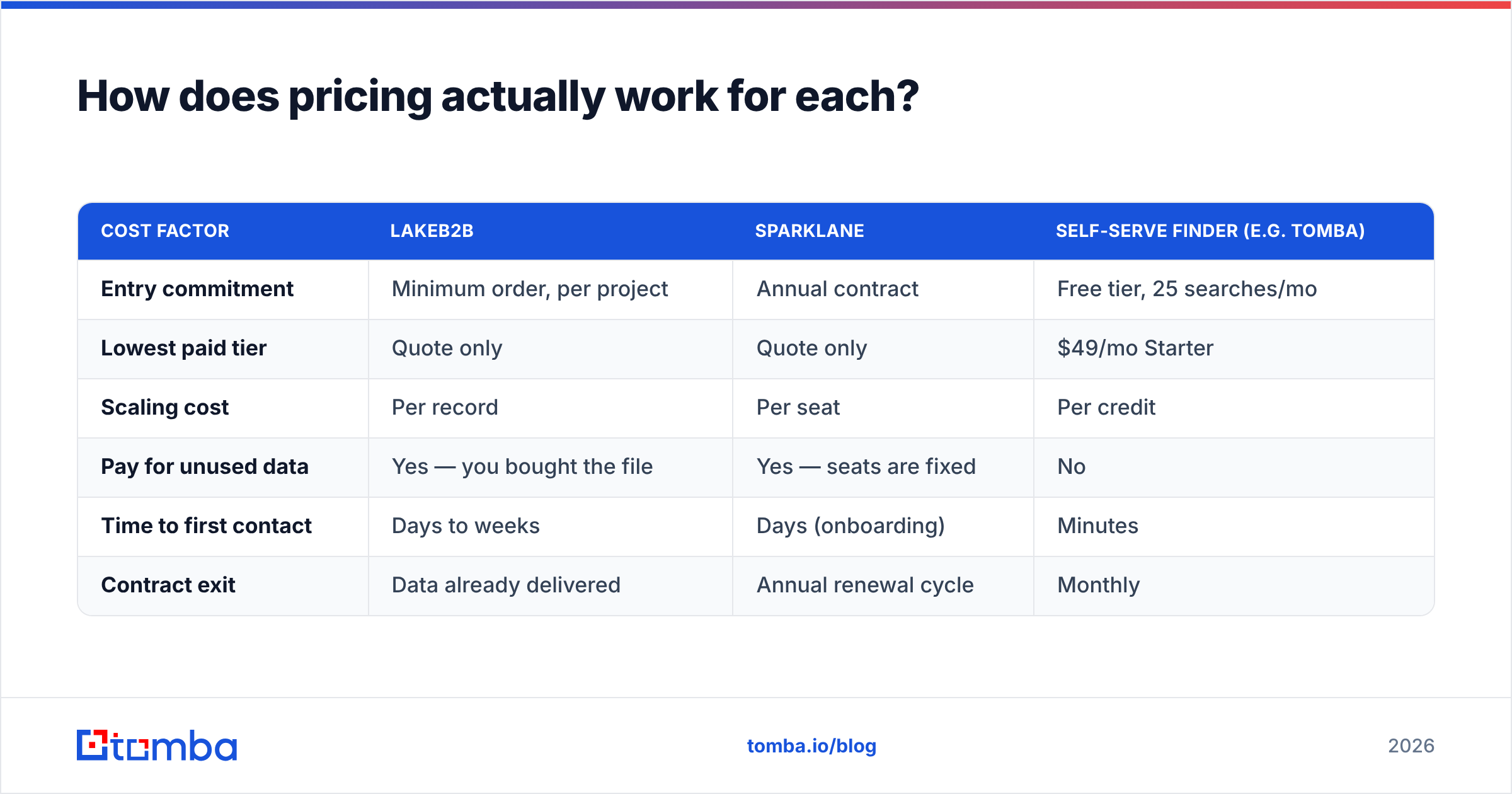
| Cost factor | LakeB2B | Sparklane | Self-serve finder (e.g. Tomba) |
|---|---|---|---|
| Entry commitment | Minimum order, per project | Annual contract | Free tier, 25 searches/mo |
| Lowest paid tier | Quote only | Quote only | $49/mo Starter |
| Scaling cost | Per record | Per seat | Per credit |
| Pay for unused data | Yes — you bought the file | Yes — seats are fixed | No |
| Time to first contact | Days to weeks | Days (onboarding) | Minutes |
| Contract exit | Data already delivered | Annual renewal cycle | Monthly |
If you are a two-person founding sales team, the gap is stark. A quoted list build and an annual EU licence both need budget sign-off and a buying cycle. Tomba pricing starts free with 25 searches a month. Paid plans run $49/mo Starter, $99/mo Growth and $249/mo Pro. That is a different kind of decision.
Is Sparklane better than LakeB2B for GDPR-heavy outbound?#
For European prospecting, yes. The reason is structural, not marketing.
Sparklane was built by a European firm for European sellers. Its sourcing, retention rules and opt-out flow are shaped by GDPR from the start. It leans on public company registers, which is solid ground for B2B. If your DPO asks where the data came from, Sparklane is the easier talk.
LakeB2B does offer GDPR-ready segments and will contract for them. But the core business is a US list model. That model draws more scrutiny in the EU. And "the vendor said it was fine" is not a defence. The duty sits with you.
Insist on two things from either vendor before an EU campaign:
- Written provenance per segment. Where did these records come from, and on what basis were they collected?
- A documented suppression and deletion path. How fast does an opt-out reach the source, and can you prove it in an audit?
Our notes on email deliverability cover what bad sourcing does next. Bounces and complaints from bought data pile up into domain-level harm.
What do buyers actually complain about?#
For LakeB2B: slow turnaround on complex custom builds. Quality also swings by vertical, and health and education beat long-tail SMB. Then there is the usual list problem. You pay once, the file ages, and a refresh means another buy.
For Sparklane: coverage drops off fast outside its core European markets. The contact layer is thinner than in dedicated contact tools. The annual deal is harsh if your team shrinks or your ICP shifts mid-year. Teams also note that a score is only as good as the ICP you feed it.
One complaint covers both: you buy a bundle when you need one part. Many teams already have a CRM. They have a sequencer. They know their target accounts. What they lack is a way to turn "Priya Raman, Head of Ops at Acme" into an email that lands. That is a smaller, cheaper problem than either vendor is priced to solve.
LakeB2B vs Sparklane: which should you choose?#
Choose LakeB2B if: you need a large, tightly filtered North American list as a file. You have marketing ops to clean, suppress and load it. And you run campaigns in bursts rather than all year.
Choose Sparklane if: your revenue sits in France or the wider EU. You want your reps told which accounts to work this week. And you can sign off on a yearly platform spend.
Choose neither if: your ICP is global or moves often, your team is small, or your gap is finding contacts rather than picking accounts. In that case, the flow that moves pipeline is:
- Build the account list yourself from LinkedIn, an event page, a G2 category or a lookalike export.
- Resolve contacts per account with a domain search. See who works there and what the email pattern is.
- Find the one person you need rather than buying 10,000 you will never mail.
- Verify at once and drop anything that is not confirmed.
- Enrich only the survivors with data enrichment so your CRM stays lean, not bloated with dead rows.
- Re-verify on a schedule — quarterly at least for any list you touch again.
This is not a knock on either vendor. "Buy the whole database" and "buy the whole platform" both answer a question most sub-50-rep teams are not asking yet. Vendors like BookYourData sit in a useful middle ground: pre-built, pay-as-you-go lists with no annual deal. Worth a look if a file really is what you need.
What does a realistic 2026 stack look like?#
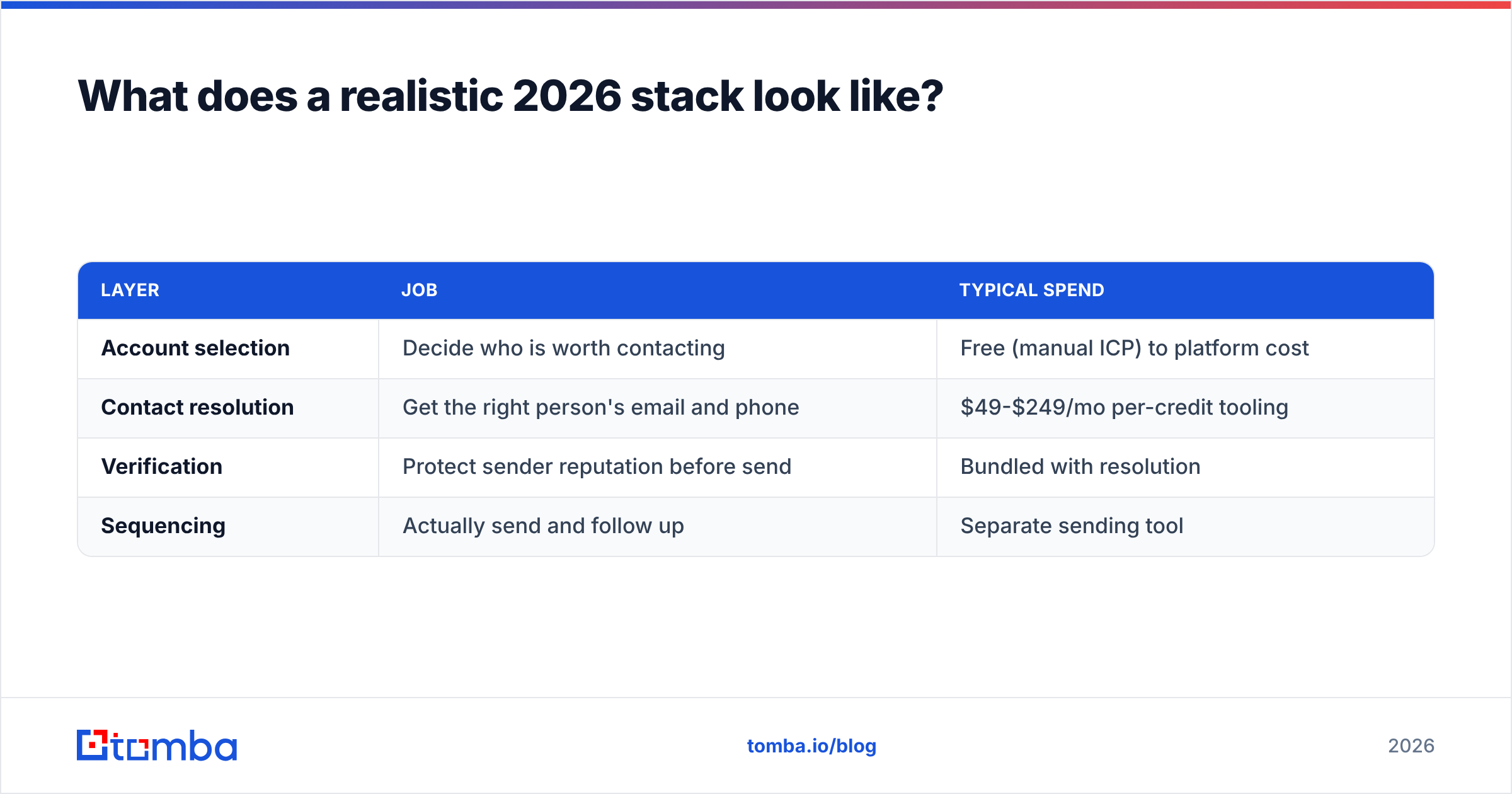
Most lean outbound teams now run three layers, not one platform:
| Layer | Job | Typical spend |
|---|---|---|
| Account selection | Decide who is worth contacting | Free (manual ICP) to platform cost |
| Contact resolution | Get the right person's email and phone | $49-$249/mo per-credit tooling |
| Verification | Protect sender reputation before send | Bundled with resolution |
| Sequencing | Actually send and follow up | Separate sending tool |
Sparklane plays in layer one. LakeB2B sells layers one and two as a single file. The resolution and verification layers are where a focused tool wins on cost, freshness and flex. You pay per contact you use, on the day you use it.
Where should you start?#
Start with the cheapest test that gives a real answer. Build 100 target accounts by hand. Resolve and verify their contacts. Then send. If replies are healthy and only volume is short, a LakeB2B file or a Sparklane seat becomes a rational next step. If the replies are not there, no amount of bought data fixes it.
For that first 100 — and the thousands after it — the Tomba Email Finder finds work emails by name, company or domain. Verification sits in the same flow. The free tier covers 25 searches a month, so you can test your ICP before anyone signs a contract. Starter at $49/mo scales with your list, not ahead of it. Run your next 100 accounts through it, measure the bounce rate, and let that number pick your next buy.
Related guides#
// get started
Find, verify and enrich your first contacts today
Start on the free plan with 25 searches a month, then scale when your team is ready.
Free plan · No credit card required · GDPR & CCPA
Get the Tomba newsletter
Product and data updates
// about the author