LakeB2B vs Warpleads: Which B2B Data Tool Wins in 2026?
LakeB2B sells curated, quote-based contact lists. Warpleads sells unlimited exports at a flat rate. They solve different problems, and picking the wrong one costs you your domain reputation. Here is the honest breakdown.
TL;DR
- LakeB2B is a managed B2B data provider: you brief a team, they build a custom list (often healthcare, tech install-base, or niche industry segments), and you pay a quoted price per record or per project.
- Warpleads is a self-serve export platform: flat monthly fee, large export volumes, instant CSV, no sales call. It is built for outbound teams who burn through lists fast.
- Neither one replaces verification. Purchased and bulk-exported records decay at roughly 2 to 2.5 percent per month, and a list assembled six months ago is already measurably worse than the day it was built.
- Pick LakeB2B when the segment is hard to find and the deal size justifies a quote. Pick Warpleads when volume and speed matter more than surgical targeting.
- The cheapest list is not the cheapest lead. Cost per usable, verified, deliverable contact is the only number that matters, and it is almost never the number on the invoice.
What is LakeB2B and who actually uses it?#
LakeB2B is a data services company rather than a software product. You tell them what you want (job titles, industries, firmographics, technographics, sometimes NPI numbers for healthcare targeting), and their team assembles and delivers a list. Pricing is quote-based, and most engagements run through a sales conversation before you see a file.
That model has real advantages and real trade-offs:
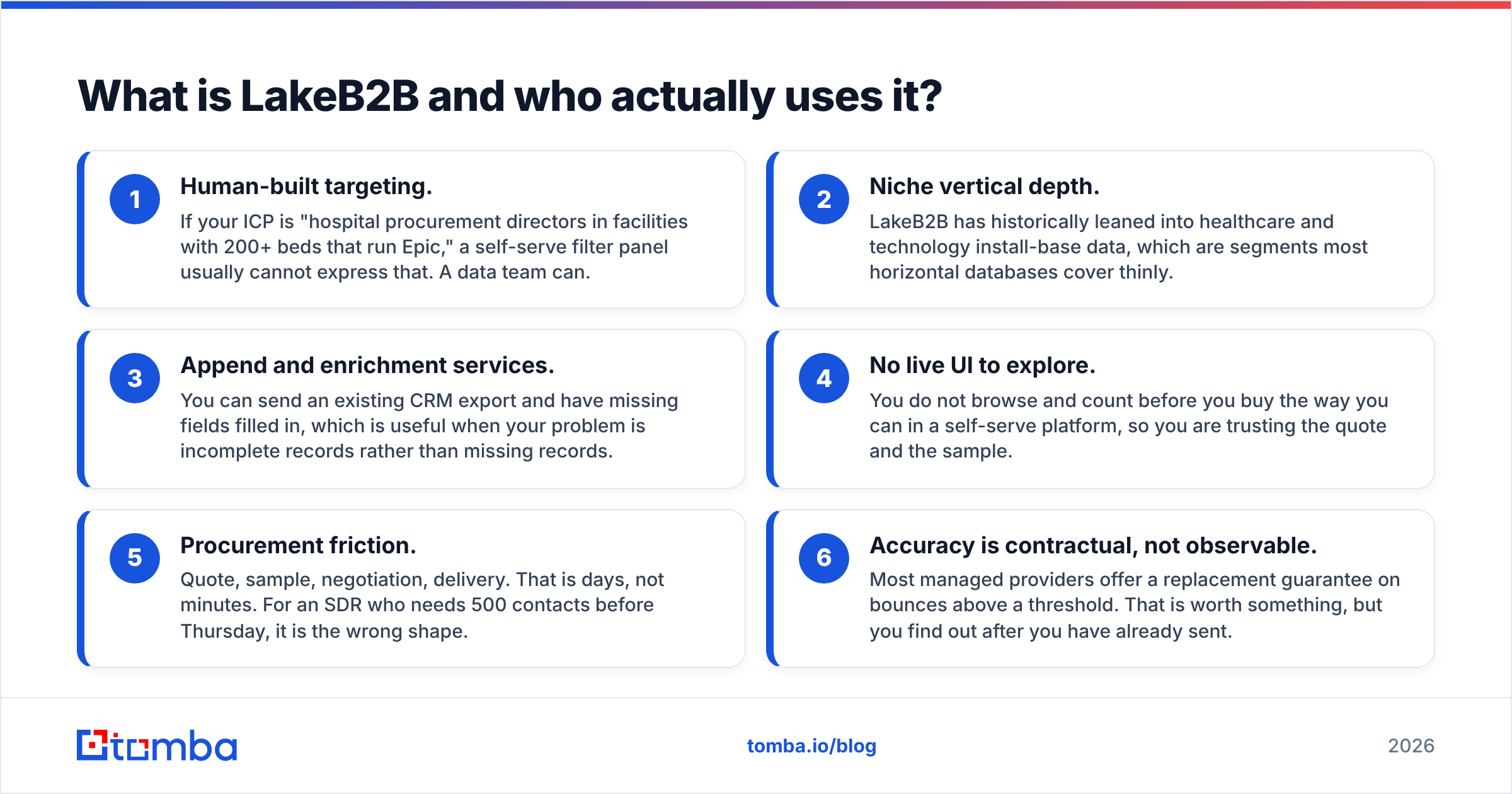
- Human-built targeting. If your ICP is "hospital procurement directors in facilities with 200+ beds that run Epic," a self-serve filter panel usually cannot express that. A data team can.
- Niche vertical depth. LakeB2B has historically leaned into healthcare and technology install-base data, which are segments most horizontal databases cover thinly.
- Append and enrichment services. You can send an existing CRM export and have missing fields filled in, which is useful when your problem is incomplete records rather than missing records.
- No live UI to explore. You do not browse and count before you buy the way you can in a self-serve platform, so you are trusting the quote and the sample.
- Procurement friction. Quote, sample, negotiation, delivery. That is days, not minutes. For an SDR who needs 500 contacts before Thursday, it is the wrong shape.
- Accuracy is contractual, not observable. Most managed providers offer a replacement guarantee on bounces above a threshold. That is worth something, but you find out after you have already sent.
What is Warpleads and how is it different?#
Warpleads sits at the opposite end. It is a self-serve lead export tool built around one promise: unlimited or very high-volume exports at a flat monthly rate, with verification built into the workflow. You filter, you export, you load into your sequencer, you send today.
The appeal is obvious for high-volume outbound. If you are running 3,000 emails a week across multiple domains, per-credit pricing turns into a budget line that scales badly. A flat rate does not.
The trade-off is equally obvious: breadth of filters and depth of niche coverage generally do not match a hand-built list. You get what the database has, shaped by the filters the UI exposes. For a mid-market SaaS ICP defined by headcount, industry, and title, that is usually plenty. For a regulated-industry segment defined by a licence number, it is not.

Reference: accuracy and bounce-rate comparison across contact data sources, 2026.
LakeB2B vs Warpleads: how do they compare head to head?#
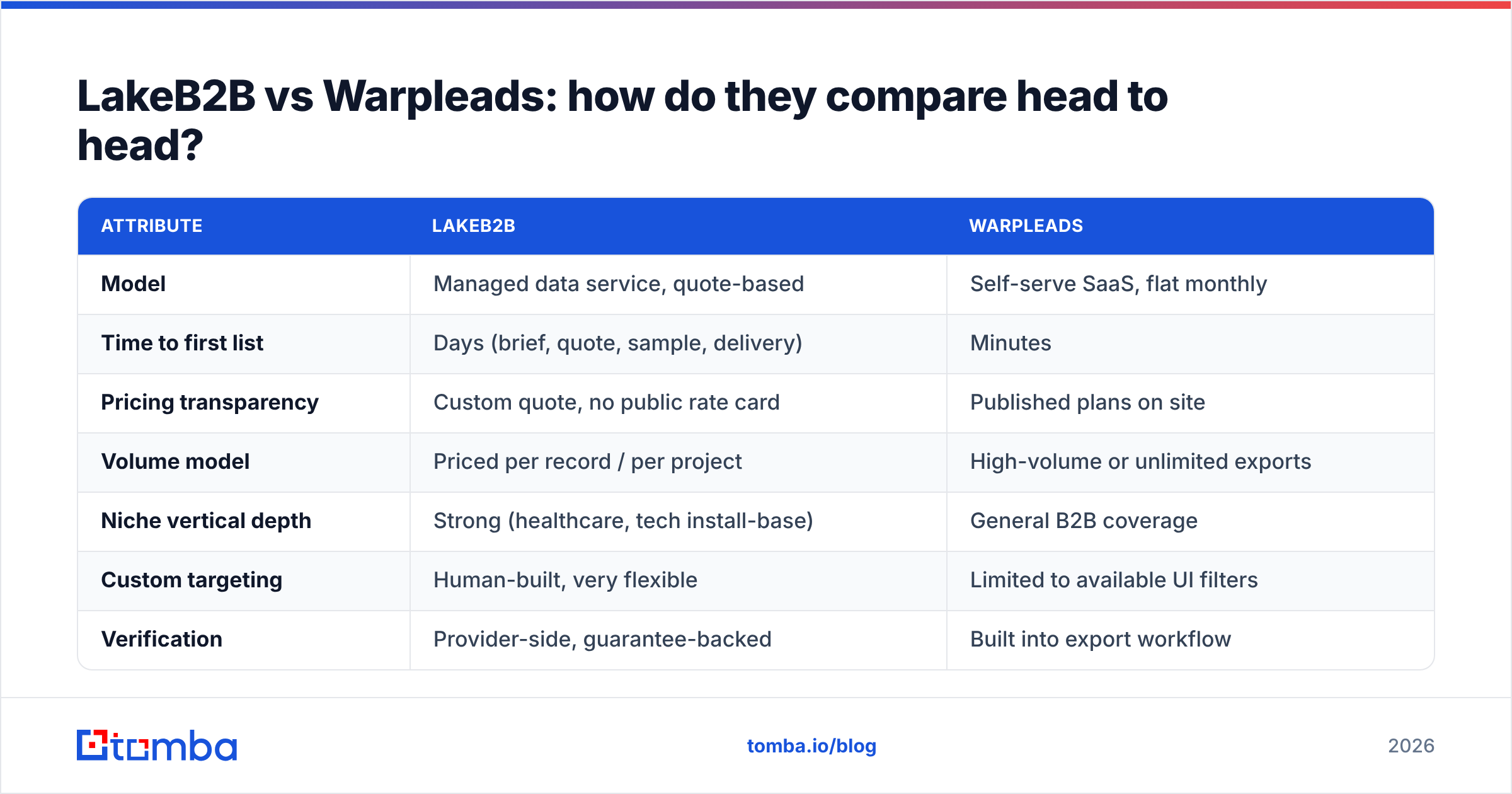
| Attribute | LakeB2B | Warpleads |
|---|---|---|
| Model | Managed data service, quote-based | Self-serve SaaS, flat monthly |
| Time to first list | Days (brief, quote, sample, delivery) | Minutes |
| Pricing transparency | Custom quote, no public rate card | Published plans on site |
| Volume model | Priced per record / per project | High-volume or unlimited exports |
| Niche vertical depth | Strong (healthcare, tech install-base) | General B2B coverage |
| Custom targeting | Human-built, very flexible | Limited to available UI filters |
| Verification | Provider-side, guarantee-backed | Built into export workflow |
| Free/self-serve trial | Sample list on request | Self-serve signup |
| API access | Limited / project-dependent | Available on higher tiers |
| Best fit | Complex ICP, high ACV, low volume | Simple ICP, high volume, fast cycles |
| Worst fit | Same-day list needs | Licence- or install-base-level targeting |
Read that table as two different jobs rather than two ranks on one ladder. LakeB2B is priced like consulting because part of what you buy is research labour. Warpleads is priced like software because what you buy is access. Comparing their invoices directly is a category error.

Which one has better data accuracy?#
Honest answer: neither publishes independently audited accuracy figures, so anyone quoting you a precise percentage for both is guessing. What you can reason about is where the data comes from and how stale it is when it reaches you.
Three things drive real-world bounce rates more than vendor marketing does:
- Recency of the underlying crawl. B2B contact data decays at roughly 2 to 2.5 percent per month as people change roles. A record sourced eight months ago has around a one-in-five chance of being wrong regardless of how good the original source was.
- Whether the address was pattern-guessed or observed. A record built by applying
first.last@domain.comto a name is a hypothesis. A record confirmed against a live mail server is evidence. Both appear identical in a CSV. - Catch-all domains. A large share of B2B domains accept everything at SMTP level, so a naive verifier marks them "valid" and your bounce shows up anyway. This is the single biggest source of surprise bounces on purchased lists, and it is why a dedicated catch-all verifier matters more than a generic syntax check.
The practical rule: treat every list from either vendor as unverified until you verify it yourself. Running a purchased file through an independent email verifier before it touches your sending domain costs a fraction of a cent per record and routinely strips 10 to 30 percent of a six-month-old file. That is not an indictment of either vendor. It is what happens to all contact data over time.
What does each one actually cost per usable lead?#
Sticker price is the wrong lens. Model it like this instead.
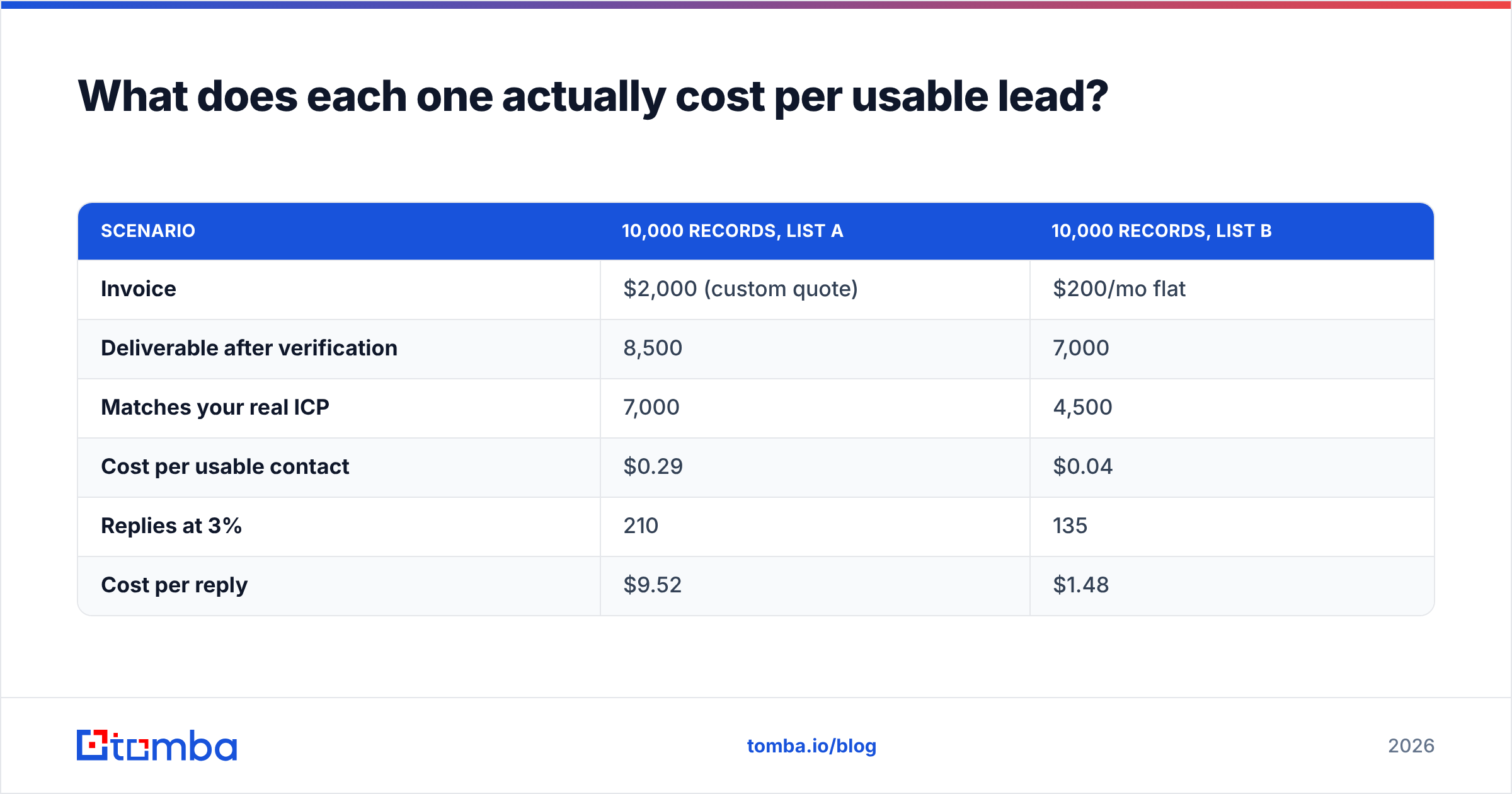
| Scenario | 10,000 records, list A | 10,000 records, list B |
|---|---|---|
| Invoice | $2,000 (custom quote) | $200/mo flat |
| Deliverable after verification | 8,500 | 7,000 |
| Matches your real ICP | 7,000 | 4,500 |
| Cost per usable contact | $0.29 | $0.04 |
| Replies at 3% | 210 | 135 |
| Cost per reply | $9.52 | $1.48 |
The numbers above are illustrative, not vendor-reported, and your own mix will differ. But the structure holds: a cheaper list with weaker targeting can still win on cost per reply, and a premium list can still win on cost per meeting if the targeted accounts are worth ten times more. Run the model with your own ACV before you argue about subscription prices.
One more line item people forget: a bad list costs more than its price. Sustained bounce rates above roughly 2 percent damage sender reputation, and the recovery cost of a burned domain (new domain, new warmup, weeks of lost pipeline) dwarfs any list invoice.
Who should choose LakeB2B?#
Choose the managed route when at least two of these are true:
- Your ICP cannot be expressed as filters. Licence types, install-base signals, facility characteristics, board memberships. If you cannot describe your target with title + industry + headcount, self-serve tools will underserve you.
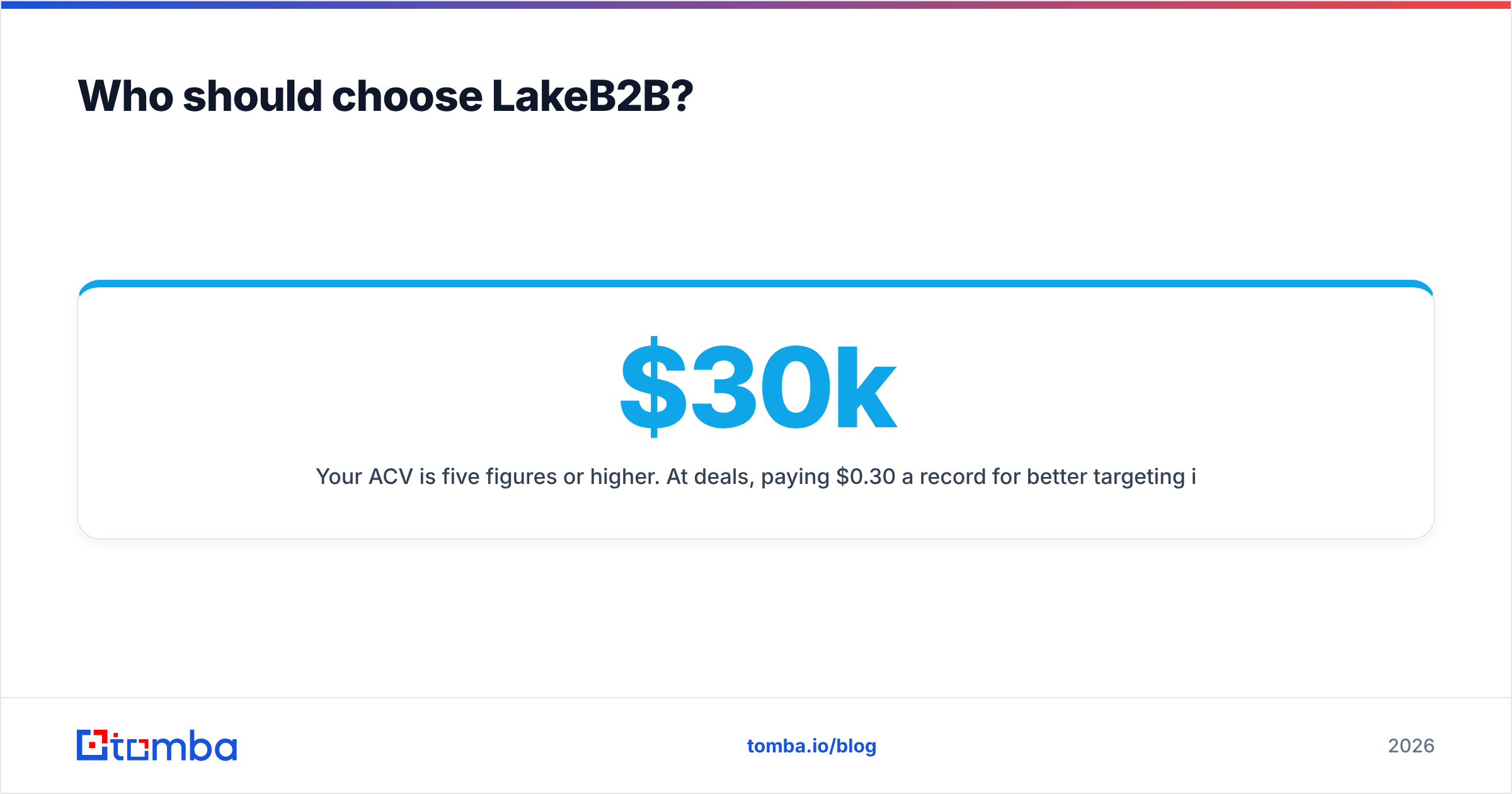
- Your ACV is five figures or higher. At $30k deals, paying $0.30 a record for better targeting is rounding error. At $99/mo deals, it is your entire CAC.
- You need an append, not a list. You already have 40,000 accounts and need missing contacts filled in. That is a service engagement, not an export.
- Compliance review is part of your buying process. A contracted data provider with documented sourcing is easier to get past legal than a self-serve export tool.
Choose it reluctantly if you need speed. The quote-and-sample cycle is the price of the customisation.
Who should choose Warpleads?#
Choose the self-serve route when:
- Volume is your constraint. You send thousands of emails a month and per-credit pricing has become the biggest line in your outbound budget.
- Your ICP is mainstream. SaaS, agencies, e-commerce, professional services defined by size and title. Horizontal databases cover these well.
- You iterate weekly. Testing five ICP hypotheses a month is impossible when each list takes four days to procure.
- You have no procurement patience. Card in, export out, sequence running the same afternoon.
The honest caveat: unlimited export plans encourage exactly the behaviour that kills deliverability. Having 50,000 contacts available does not mean sending to 50,000 contacts. Segment hard, verify hard, send small.
What are the alternatives to both?#
The LakeB2B vs Warpleads framing assumes you need a list at all. Often you do not. Three other shapes of the same problem:
Targeted finding instead of bulk buying. If you already know the 300 accounts you want, you do not need a database subscription. You need the right contact at each one. A domain search pulls the addresses and formats for a single company on demand, which is a very different workflow from exporting 10,000 rows and hoping.
Verified marketplace lists. BookYourData sits between the two models: self-serve like Warpleads, pay-as-you-go credits, with verification applied at the point of purchase. If the flat-rate commitment makes you uneasy but you still want instant access, it is a reasonable third option to price out.
API-first enrichment. If your team is technical, buying rows is often worse than calling an endpoint at the moment of need. Enriching a lead when it enters your CRM guarantees the data is fresh that day rather than fresh whenever the vendor last crawled. Both approaches have a place; the API route wins on freshness and loses on discovery.

Independent user reviews on G2 are worth ten minutes before you commit to either vendor, with one filter applied: read the two- and three-star reviews, not the five-star ones. That is where bounce rates and refund policies get discussed honestly.
How do you test either one before you commit?#
Run the same five-step evaluation on both. It takes an afternoon and saves months.
- Request a sample of 100 records scoped to your actual ICP, not a generic demo file. If a vendor will not sample your real segment, that tells you something.
- Verify all 100 independently. Use a third-party checker, not the vendor's own. Record valid, invalid, catch-all, and unknown counts separately. A bulk verify run on 100 rows costs almost nothing.
- Manually spot-check 20 records on LinkedIn. Is the person still in that role? Is the company still operating? This catches staleness that SMTP checks cannot.
- Send to 50 of the valid ones from a warmed test domain. Track bounces, spam complaints, and replies. Real send data beats every accuracy claim in a pitch deck.
- Compute cost per reply, not cost per record. Invoice divided by replies. Compare that single number across both vendors and the decision usually makes itself.
If a vendor's sample fails step 2 badly (say, under 70 percent deliverable), no pricing conversation is worth having.
What is the verdict on LakeB2B vs Warpleads?#
LakeB2B wins when targeting precision is the bottleneck. Complex, regulated, or install-base-defined segments and high-ACV deals justify the quote, the wait, and the per-record cost.
Warpleads wins when volume and iteration speed are the bottleneck. Mainstream ICPs, high send volume, weekly experiments, and a budget that cannot absorb per-credit pricing.
Both lose if you skip verification. The failure mode for purchased lists is never "the vendor lied." It is "the file was accurate in March and you sent in September." Whichever side you land on, budget for an independent verification pass every single time, and re-verify anything older than 60 days.
Ready to stop buying rows and start finding the exact contacts you need? Tomba Email Finder locates verified professional email addresses by name, company, or domain, with catch-all detection and confidence scoring built in, so you know what you are sending to before you send. The free tier includes 25 searches a month, and paid plans start at $49/mo on Tomba pricing. Test it against your next sample list and compare the bounce rates yourself.
Related guides#
// get started
Find, verify and enrich your first contacts today
Start on the free plan with 25 searches a month, then scale when your team is ready.
Free plan · No credit card required · GDPR & CCPA
// about the author