Landbase Pricing in 2026: Plans, Real Costs, and Cheaper Picks
Landbase sells an AI GTM agent on a quote-only model, which makes budgeting hard. Here's how its pricing is structured, where the real costs hide, and when a cheaper stack gets you most of the way.
TL;DR
- Landbase does not publish a self-serve price list. Pricing is quote-based, scoped per engagement, and almost always annual — expect a sales call before you see a number.
- Buyers consistently describe Landbase as a platform-plus-service purchase, not a per-seat tool. Budget in the low-to-mid five figures per year, not $49/month, and treat any figure you read online (including here) as a range to verify, not a quote.
- The line item you can actually compare is outcome-based: Landbase sells campaigns and pipeline, not credits. That makes ROI math easier and unit-cost math harder.
- The hidden costs are usually onboarding/implementation, minimum contract length, sending infrastructure (domains, inboxes, warmup), and CRM integration work.
- If what you actually need is verified contact data plus your own sequencer, a $49–$99/month data layer like Tomba plus an email tool covers most of the job for under 10% of an AI-GTM contract.
What is Landbase, and what are you actually paying for?#
Landbase is an agentic go-to-market platform. Instead of selling you a contact database and letting you figure out the rest, it packages research, list building, messaging, campaign execution, and reporting behind an AI agent trained on go-to-market data. You describe an ideal customer profile and an offer; the system proposes segments, drafts sequences, runs the campaign, and reports on what converted.
That matters for pricing because you are not buying a tool in the traditional sense. Think of it like the difference between buying a commercial oven and hiring a caterer. The oven has a sticker price you can compare against other ovens. The caterer quotes you per event, based on headcount and menu — and the quote is not directly comparable to the oven.
Most B2B software you evaluate alongside Landbase — Apollo, Clay, Instantly, ZoomInfo's lower tiers — is the oven. You pay per seat or per credit, you do the work. Landbase is closer to the caterer: the price reflects outcomes delivered, not units consumed. Check the current positioning on the Landbase site before you benchmark anything, because AI GTM vendors reposition frequently.
The practical consequence: you cannot line up Landbase against a $99/month tool and declare a winner on price. You have to compare it against the fully loaded cost of the stack plus the human hours it replaces.
How does Landbase pricing work in 2026?#
Here is the structure buyers report, broken into the five components that actually determine your number:
- Platform access (the base fee). A recurring fee for the agent, the data layer, and the campaign workspace. This is the floor of any quote and it scales with how many campaigns and segments you run in parallel, not with how many people log in.
- Scope of engagement. The single biggest multiplier. One ICP, one motion, one geography prices very differently from five segments across three regions with localized messaging. Vendors in this category price scope the way agencies price retainers.
- Volume and infrastructure. Sending volume drives cost indirectly: more outbound means more domains, more inboxes, more warmup, and more deliverability babysitting. Ask explicitly whether infrastructure is included or billed through.
- Onboarding and implementation. Almost every agentic GTM vendor charges — or heavily discounts as a negotiation lever — a one-time setup fee covering ICP workshops, CRM mapping, and data migration. This is where a "$X/month" quote quietly becomes $X plus five figures in year one.
- Contract term and commitment. Annual is the default. Monthly, where offered, carries a premium. Multi-year buys the discount. If a rep leads with a monthly figure, confirm the billing frequency and the minimum term in the same breath.

What does Landbase actually cost?#
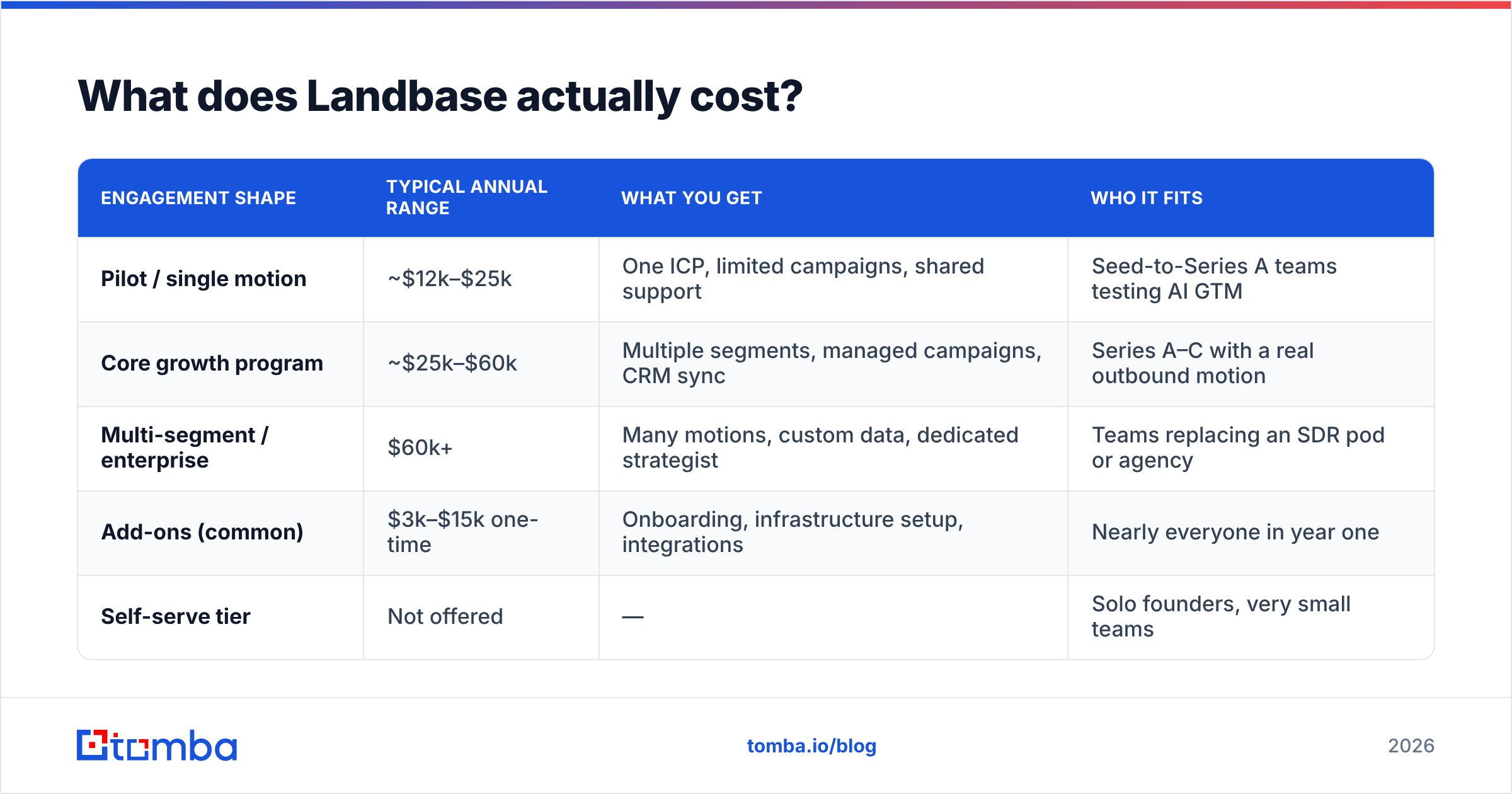
Straight answer: Landbase does not publish tier prices, so anyone quoting exact numbers is estimating. What follows is a planning framework based on how comparable agentic GTM platforms price, not a quote sheet. Use it to size your budget conversation, then get the real number in writing.
| Engagement shape | Typical annual range | What you get | Who it fits |
|---|---|---|---|
| Pilot / single motion | ~$12k–$25k | One ICP, limited campaigns, shared support | Seed-to-Series A teams testing AI GTM |
| Core growth program | ~$25k–$60k | Multiple segments, managed campaigns, CRM sync | Series A–C with a real outbound motion |
| Multi-segment / enterprise | $60k+ | Many motions, custom data, dedicated strategist | Teams replacing an SDR pod or agency |
| Add-ons (common) | $3k–$15k one-time | Onboarding, infrastructure setup, integrations | Nearly everyone in year one |
| Self-serve tier | Not offered | — | Solo founders, very small teams |
Two caveats worth more than the table itself. First, ranges in this category move fast; a vendor that was quote-only in January may launch a self-serve plan by Q4. Second, discounting is real. Annual prepay, case-study rights, and end-of-quarter timing routinely move these numbers 15–30%.
If you need a firm figure before you can get internal approval, ask for a written scope with the base fee, the setup fee, the term, and the renewal uplift cap separated into four lines. Vendors who resist that breakdown are telling you something.
What are the hidden costs in a Landbase contract?#
The quote is not the cost. Four things reliably show up later:
- Sending infrastructure. AI can write a thousand emails. It cannot make a cold domain deliverable. Budget for secondary domains, mailbox seats, and warmup — and for the two to four weeks before those inboxes are safe to scale. Our email warmup calculator will tell you how long your ramp actually takes, which is usually longer than the kickoff deck suggests.
- Data verification. Any platform building lists at scale inherits the accuracy problem. If bounce rates climb past 3%, your sender reputation takes the hit, not the vendor's. Many teams end up paying separately for an email verifier as an insurance layer, and that is money well spent.
- CRM and RevOps time. Mapping an AI agent's output into HubSpot or Salesforce without creating duplicate-contact chaos is real work. HubSpot's own data management documentation is a decent reality check on how much cleanup a new inbound data source creates.
- Internal ownership. Someone on your side has to review messaging, approve segments, and act on replies. "AI does outbound" still requires a human closing the loop. If nobody owns it, the contract underperforms and you blame the tool.
Is Landbase worth it, or should you build the stack yourself?#
It depends on what you are short of: money or people.
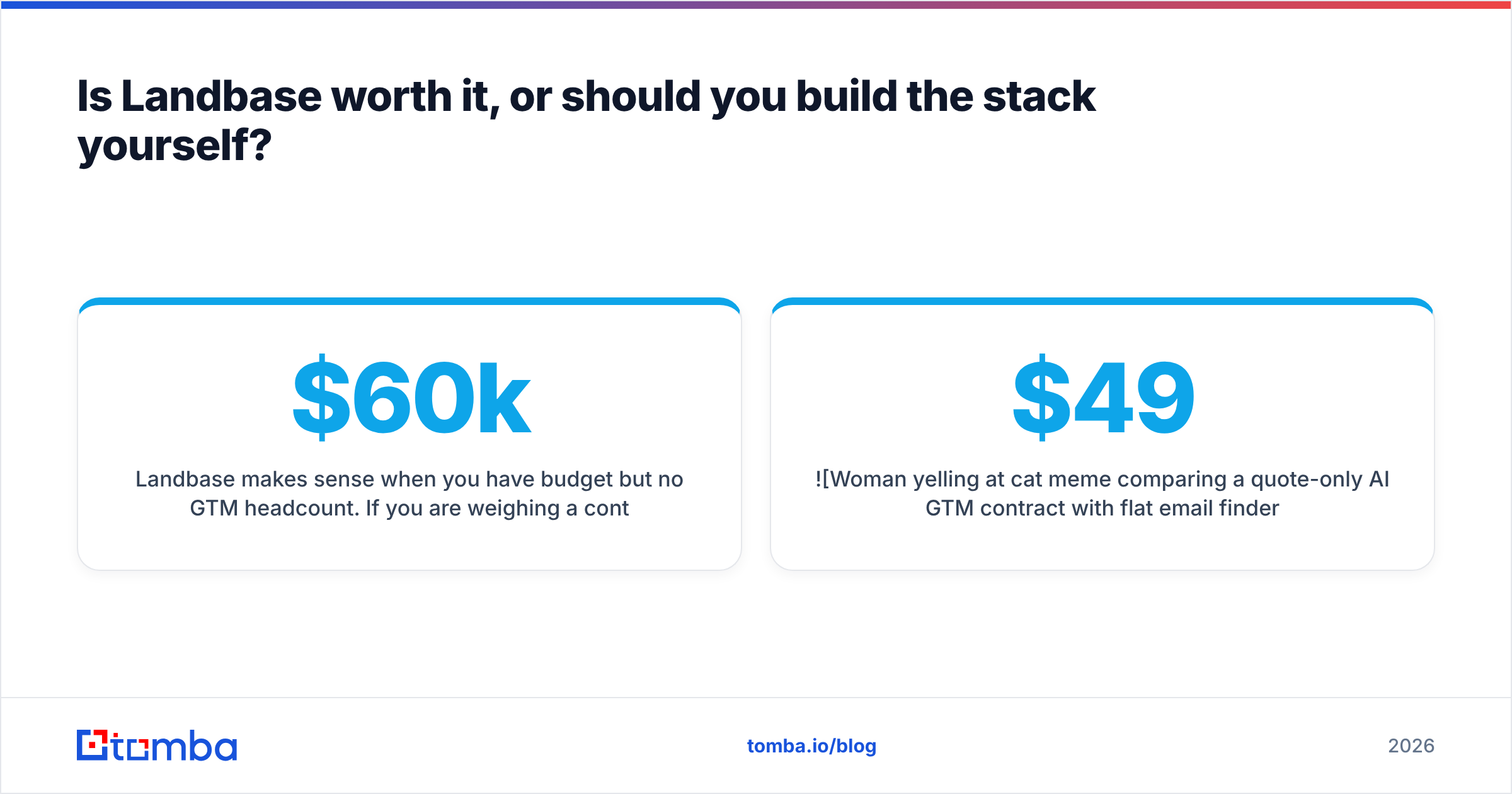
Landbase makes sense when you have budget but no GTM headcount. If you are weighing a $60k contract against hiring two SDRs at $70k each fully loaded, the math gets interesting quickly — especially in the first six months, when new SDRs are ramping and producing very little. Buying an operating system for outbound beats building one from scratch when you have no one to build it.
Landbase makes less sense when you already have an operator. If you have a growth marketer or a RevOps person who genuinely enjoys building lists and testing sequences, the assembled stack is dramatically cheaper and you keep the institutional knowledge in-house. You also keep your data — an underrated point when you eventually renegotiate or leave.
Watch the analyst framing too. Gartner and the review corpus on G2 both point the same direction on AI GTM tooling: outcomes correlate far more with data quality and offer clarity than with model sophistication. A great agent pointed at a bad list underperforms a mediocre sequence pointed at a great one.

How does Landbase pricing compare to the alternatives?#
This is the comparison most buyers actually need — not Landbase versus one competitor, but Landbase versus the cheaper configurations that solve adjacent problems.
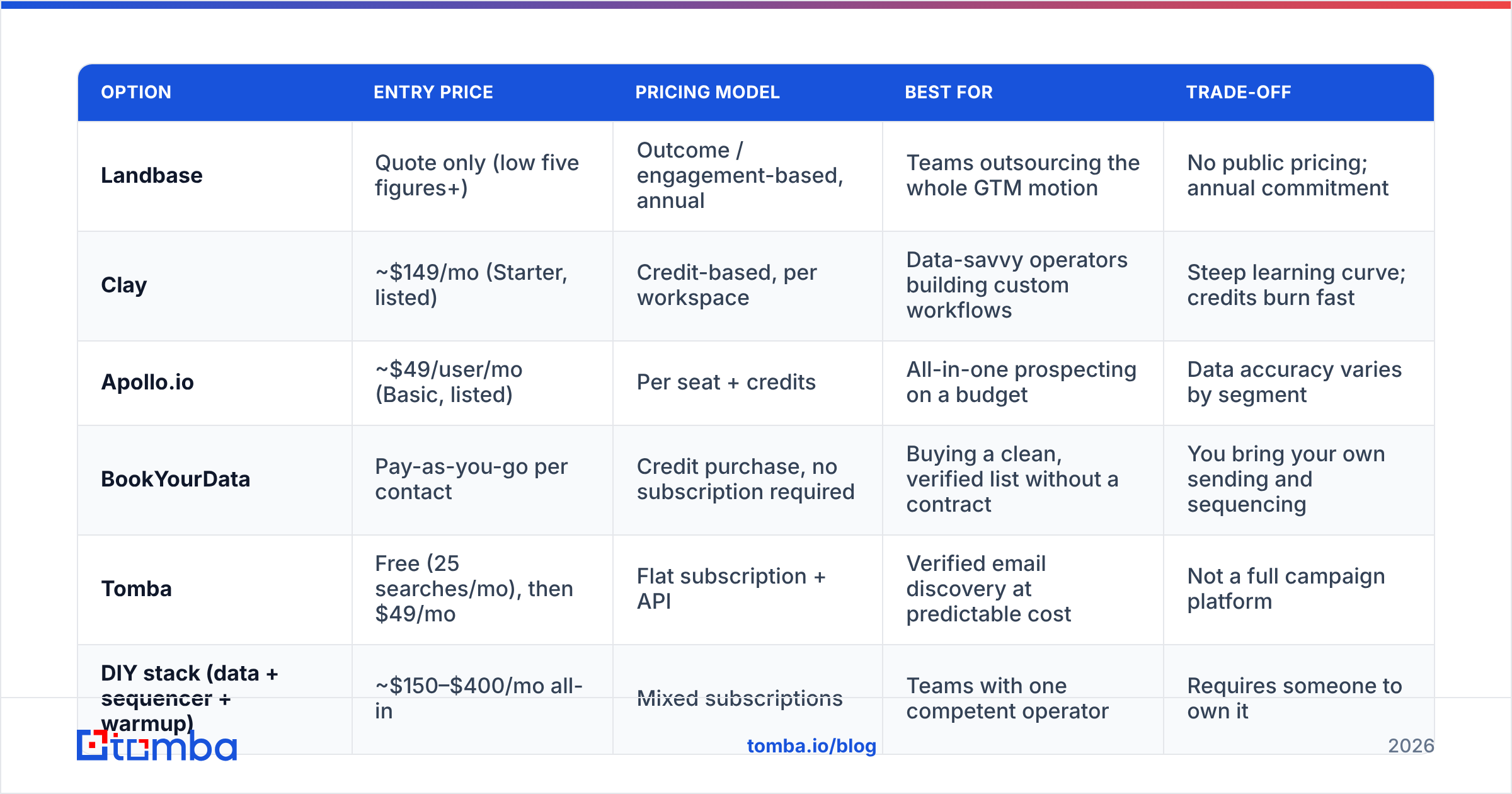
| Option | Entry price | Pricing model | Best for | Trade-off |
|---|---|---|---|---|
| Landbase | Quote only (low five figures+) | Outcome / engagement-based, annual | Teams outsourcing the whole GTM motion | No public pricing; annual commitment |
| Clay | ~$149/mo (Starter, listed) | Credit-based, per workspace | Data-savvy operators building custom workflows | Steep learning curve; credits burn fast |
| Apollo.io | ~$49/user/mo (Basic, listed) | Per seat + credits | All-in-one prospecting on a budget | Data accuracy varies by segment |
| BookYourData | Pay-as-you-go per contact | Credit purchase, no subscription required | Buying a clean, verified list without a contract | You bring your own sending and sequencing |
| Tomba | Free (25 searches/mo), then $49/mo | Flat subscription + API | Verified email discovery at predictable cost | Not a full campaign platform |
| DIY stack (data + sequencer + warmup) | ~$150–$400/mo all-in | Mixed subscriptions | Teams with one competent operator | Requires someone to own it |
Read that table as a spectrum of how much work you are outsourcing, not as a ranking. Landbase and a pay-as-you-go data source like BookYourData are not really competitors — they sit at opposite ends of the same line. One sells you the finished campaign; the other sells you clean raw material at a price you can calculate in advance.
The interesting middle ground is the DIY stack. For roughly $300/month you can assemble verified contact data, a sequencer, and warmup, and run a credible outbound program. That is under 10% of a mid-tier AI GTM contract. What you do not get is the strategy layer and the "someone else is accountable" layer — which is precisely what the five-figure price buys.
What questions should you ask before signing?#
Bring these to the pricing call. The answers, in writing, are worth more than any blog post:
- What exactly is the base fee, and what does it exclude? Get the setup fee, infrastructure pass-through, and overage terms itemized separately.
- What is the minimum term and the renewal uplift? Cap the uplift now, not at renewal. A 10% annual increase on a $50k contract compounds.
- Who owns the data and the campaign assets if we leave? Confirm you can export contacts, sequences, and performance history.
- What is the measured success criterion? Meetings booked? Qualified pipeline? Replies? Define it before the contract, and define what happens if it is missed.
- How is deliverability handled, and who is accountable when it degrades? Ask who owns domain reputation and what the remediation process looks like.
- Can we run a 60- or 90-day paid pilot? Many vendors will do this. It converts an annual bet into a bounded test.
What's the cheapest way to get 80% of the outcome?#
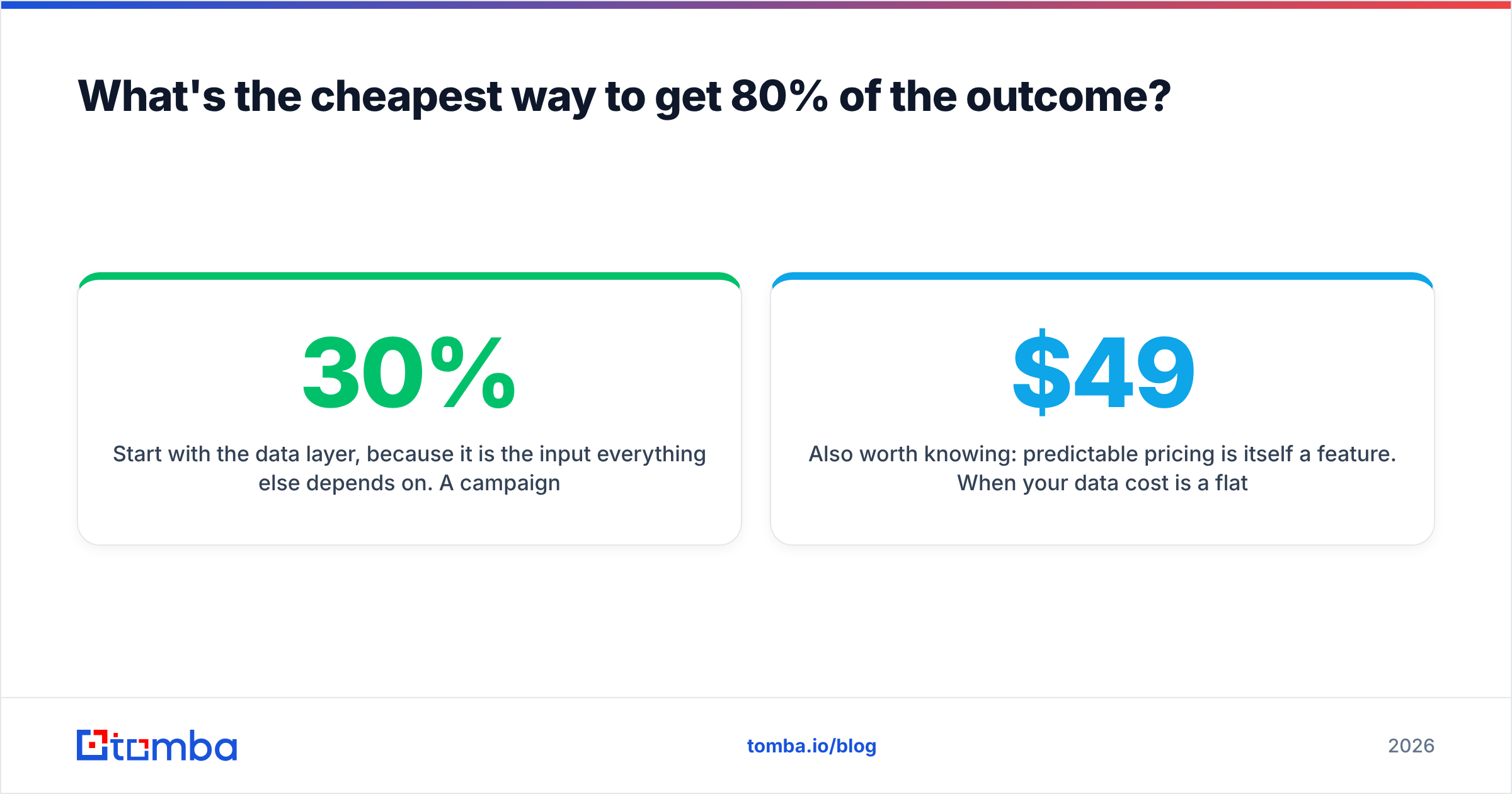
Start with the data layer, because it is the input everything else depends on. A campaign engine cannot fix a list that is 30% stale.
The minimum viable outbound stack looks like this: a verified source of contacts, a sequencer, warmed domains, and a person who reads replies. Find contacts with a domain search across your target account list, run the results through verification before they ever touch a sequencer, and push the clean set into your CRM. That is the same first step Landbase performs for you — you are just doing it at a fixed monthly cost instead of a negotiated annual one.
Once that pipeline is running and you can measure reply rate and cost per meeting, you have a real baseline. Then the Landbase question stops being philosophical and becomes arithmetic: does their quote beat your current cost per qualified meeting, including your own time? If yes, buy it. If you cannot answer that question, you are not ready to sign a five-figure contract — you are ready to run a cheap experiment.
Also worth knowing: predictable pricing is itself a feature. When your data cost is a flat line on the P&L, you can scale outbound without renegotiating anything. Tomba's pricing runs Free (25 searches/month), Starter at $49/month, Growth at $99/month, and Pro at $249/month, with an Enterprise tier for teams that need volume commitments. No quote call, no annual lock-in, no scope multiplier.
The bottom line on Landbase pricing#
Landbase is priced like a service because it behaves like one. If you are replacing headcount or an agency, the five-figure annual commitment can pencil out, and the outcome-based framing genuinely aligns incentives better than credit-metered tools do. If you are replacing a spreadsheet and some elbow grease, it will not.
The honest test: how much of your GTM motion do you want to own? Own all of it and a lean stack wins on cost by an order of magnitude. Own none of it and Landbase's model is coherent and defensible. The expensive mistake is signing an annual outsourcing contract when what you actually needed was better contact data.
Start with the input layer. Before you commit budget to any AI GTM platform, prove your ICP converts. Tomba's Email Finder gives you verified professional email addresses by domain, name, or company — 25 free searches to test your list, $49/month when you scale, and an API when you're ready to automate. Get the data right first; the rest of the stack is a much easier decision afterward.
Related guides#
// get started
Find, verify and enrich your first contacts today
Start on the free plan with 25 searches a month, then scale when your team is ready.
Free plan · No credit card required · GDPR & CCPA
// about the author