8 Best Landbot Alternatives in 2026: Chatbots Compared
Landbot is a slick no-code chatbot builder until chat-volume caps and the Business tier hit. Here are 8 Landbot alternatives compared on price, WhatsApp support, AI quality, and what they actually do with the leads they capture.
TL;DR#
- Landbot is still one of the best pure no-code conversational builders — the drag-and-drop flow editor and conversational landing pages are genuinely good, and the free sandbox is usable for testing.
- Most teams leave over three things: chat-volume caps that trigger overage, the jump to the Business tier once you need WhatsApp at scale, and AI answers that feel bolted on rather than native.
- There is no single best replacement. Tidio wins on SMB price-to-value, ManyChat and Chatfuel win on WhatsApp and Instagram, Voiceflow and Botpress win on developer control, Intercom wins on support deflection, HubSpot wins if your CRM is already there.
- A chatbot captures intent, not contact data. Roughly half the conversations that matter end without a usable work email, so pair whichever builder you pick with verification and enrichment.
- Budget reality: a serious conversational setup lands between $0 and $120/month for most SMBs; enterprise conversational-marketing platforms start near $2,500/month.
What is Landbot, and why are teams looking for alternatives?#
Landbot is a no-code conversational platform. You build chat flows on a visual canvas — blocks for questions, conditions, API calls, integrations — and deploy them as a website widget, an embedded flow, a standalone conversational landing page, or a WhatsApp bot. It launched as a "forms, but as a conversation" product and grew into a lead-capture and support tool used heavily by marketing teams in Europe and LATAM.
The product is not the problem. The reasons teams search for Landbot alternatives cluster into four patterns:
1. Chat-volume pricing. Landbot meters on chats, not seats alone. A campaign that performs well is a campaign that costs more. Teams that run high-traffic landing pages hit their cap mid-month and either upgrade or watch the bot stop answering.
2. The WhatsApp tier gap. WhatsApp is where a lot of conversational lead gen actually happens now, and on Landbot the serious WhatsApp capabilities sit on the higher plans. If WhatsApp is your primary channel rather than a bonus, a WhatsApp-native tool is usually cheaper and deeper.
3. AI that arrived late. Landbot added AI blocks and AI-assisted flows, but the architecture is still flow-first. If you want an agent that reasons over a knowledge base and handles unscripted questions, tools built AI-first handle it better.
4. Data quality on the other side. A chatbot that collects sarah@gmail.com and "we're a mid-size company" has produced a conversation, not a lead. Chatbot vendors rarely solve this because it is not their job.
What should you actually compare in a Landbot alternative?#
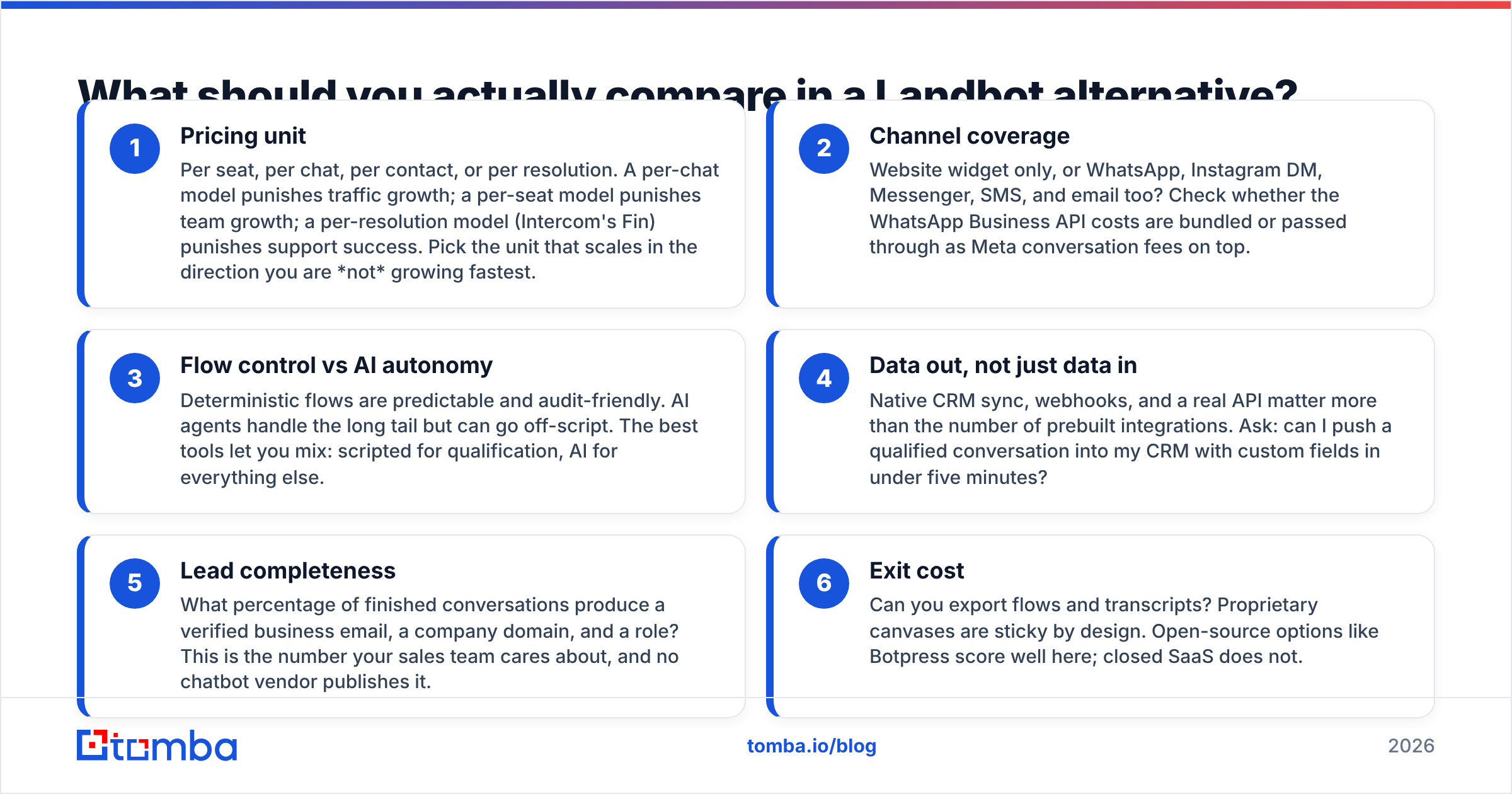
Feature checklists age badly. These six criteria predict whether you will still be happy in month six:
- Pricing unit — Per seat, per chat, per contact, or per resolution. A per-chat model punishes traffic growth; a per-seat model punishes team growth; a per-resolution model (Intercom's Fin) punishes support success. Pick the unit that scales in the direction you are not growing fastest.
- Channel coverage — Website widget only, or WhatsApp, Instagram DM, Messenger, SMS, and email too? Check whether the WhatsApp Business API costs are bundled or passed through as Meta conversation fees on top.
- Flow control vs AI autonomy — Deterministic flows are predictable and audit-friendly. AI agents handle the long tail but can go off-script. The best tools let you mix: scripted for qualification, AI for everything else.
- Data out, not just data in — Native CRM sync, webhooks, and a real API matter more than the number of prebuilt integrations. Ask: can I push a qualified conversation into my CRM with custom fields in under five minutes?
- Lead completeness — What percentage of finished conversations produce a verified business email, a company domain, and a role? This is the number your sales team cares about, and no chatbot vendor publishes it.
- Exit cost — Can you export flows and transcripts? Proprietary canvases are sticky by design. Open-source options like Botpress score well here; closed SaaS does not.
What are the 8 best Landbot alternatives in 2026?#
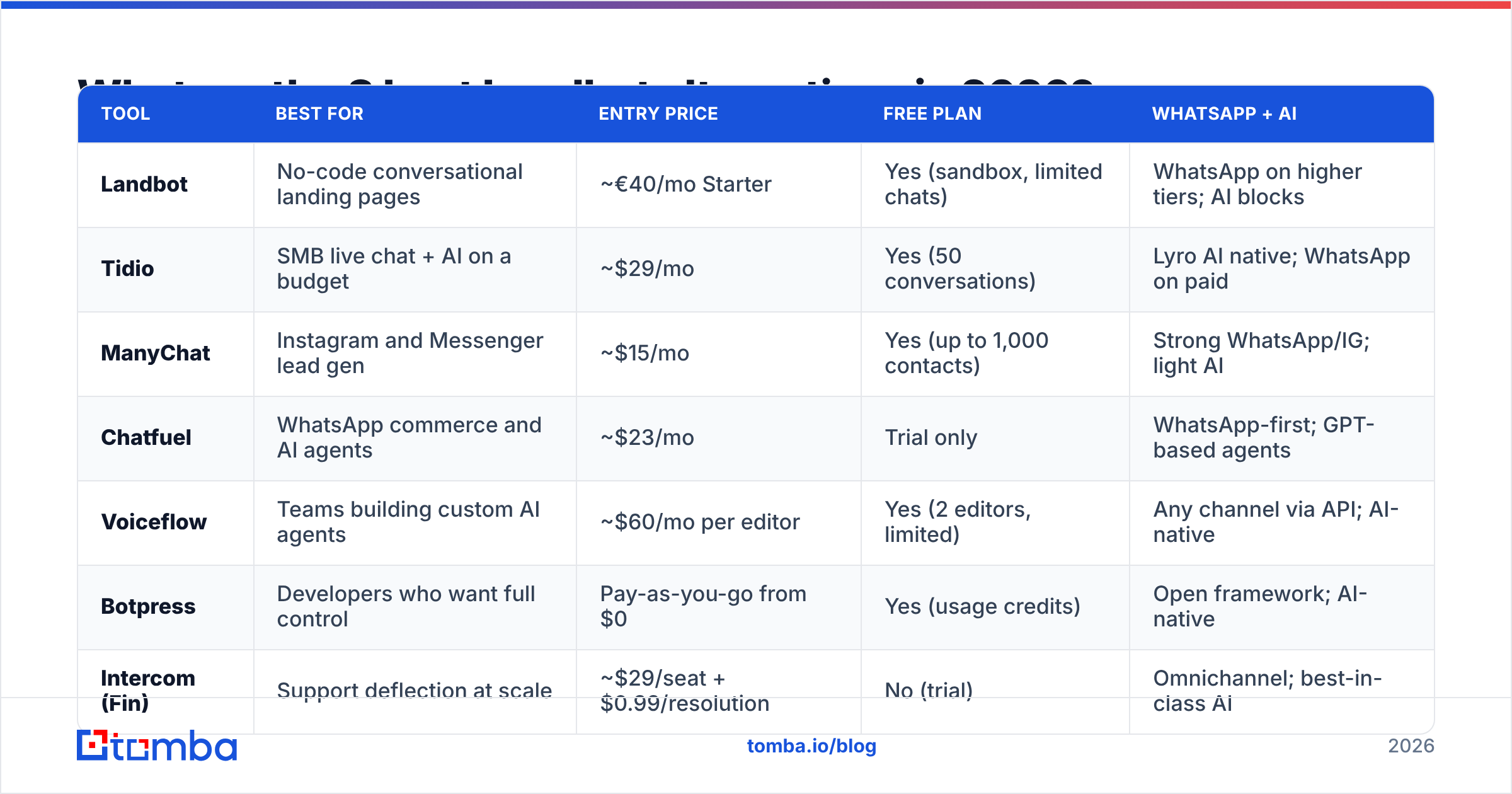
| Tool | Best for | Entry price | Free plan | WhatsApp + AI |
|---|---|---|---|---|
| Landbot | No-code conversational landing pages | ~€40/mo Starter | Yes (sandbox, limited chats) | WhatsApp on higher tiers; AI blocks |
| Tidio | SMB live chat + AI on a budget | ~$29/mo | Yes (50 conversations) | Lyro AI native; WhatsApp on paid |
| ManyChat | Instagram and Messenger lead gen | ~$15/mo | Yes (up to 1,000 contacts) | Strong WhatsApp/IG; light AI |
| Chatfuel | WhatsApp commerce and AI agents | ~$23/mo | Trial only | WhatsApp-first; GPT-based agents |
| Voiceflow | Teams building custom AI agents | ~$60/mo per editor | Yes (2 editors, limited) | Any channel via API; AI-native |
| Botpress | Developers who want full control | Pay-as-you-go from $0 | Yes (usage credits) | Open framework; AI-native |
| Intercom (Fin) | Support deflection at scale | ~$29/seat + $0.99/resolution | No (trial) | Omnichannel; best-in-class AI |
| HubSpot Chatbot | Teams already on HubSpot CRM | $0 (free CRM tier) | Yes | Basic AI; WhatsApp on Marketing Hub |
| Typeform | Conversational forms without a bot | ~$29/mo | Yes (10 responses/mo) | No WhatsApp; AI form logic |
Prices are list prices at the time of writing and move often — verify on each vendor's page before you commit.
Tidio — the easiest swap for SMB websites#
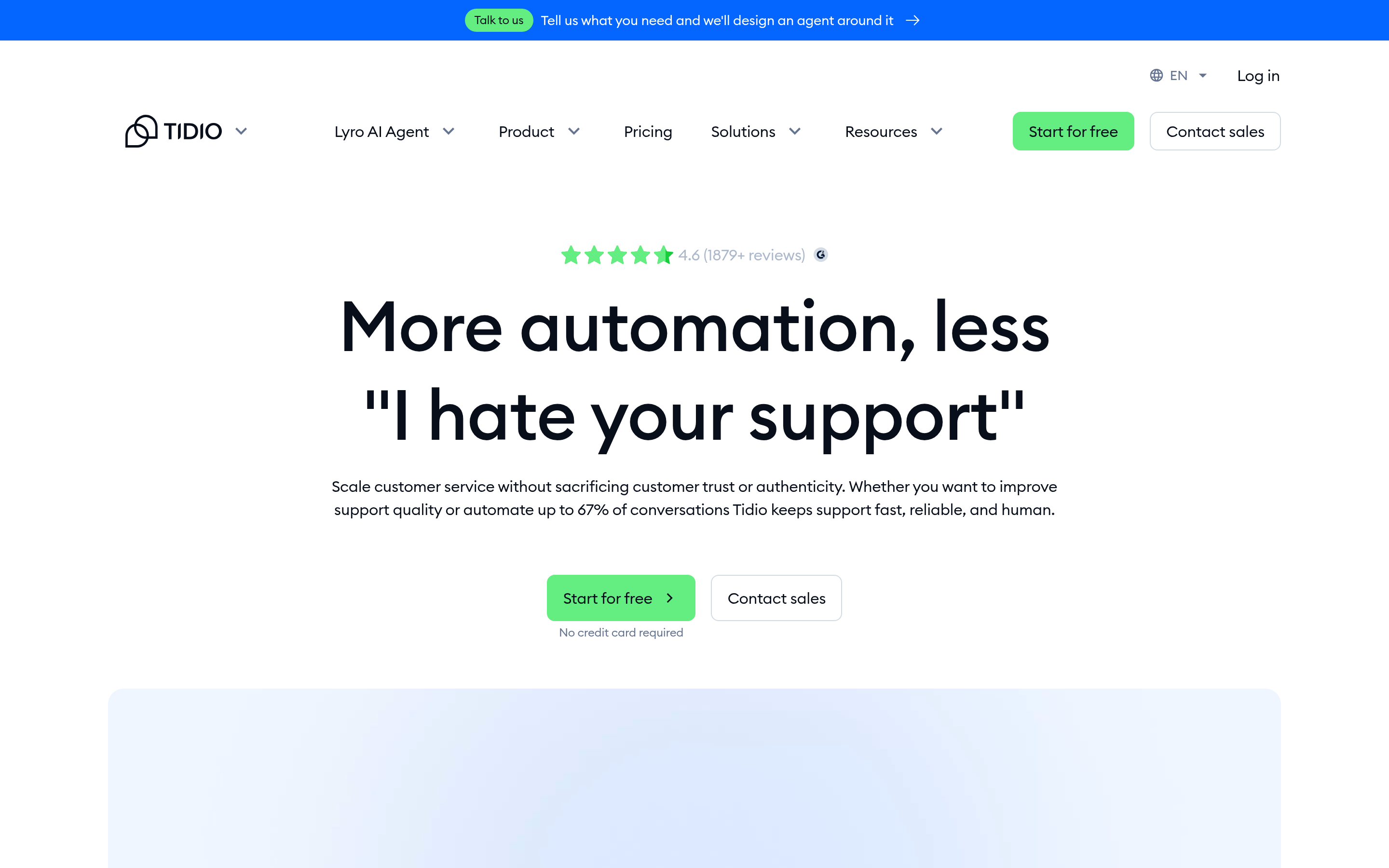
Tidio bundles live chat, ticketing, and the Lyro AI agent into one product at a price most Landbot users will find familiar or lower. The flow builder is less expressive than Landbot's canvas, but the AI agent is genuinely native: point it at your help docs and it answers unscripted questions without you drawing a single branch. Best fit: ecommerce and SMB service sites that want support plus lead capture in one widget.
Weak spot: the conversational-landing-page use case Landbot is famous for is not really Tidio's thing.
ManyChat — if your leads live on Instagram#
ManyChat owns the social-DM automation category. Comment-triggered DM flows, Instagram story replies, WhatsApp broadcast sequences — all of it is first-class, and the entry price is the lowest on this list. For creator-led and consumer-adjacent B2B (coaching, agencies, local services), ManyChat routinely outperforms a website widget because it meets people where they already scroll.
Weak spot: it is a messaging-automation tool, not a website conversational builder. Website widget capability is thin.
Chatfuel — WhatsApp-first with AI agents#
Chatfuel repositioned around WhatsApp commerce and AI sales agents. If your motion is "run Meta ads → click-to-WhatsApp → AI agent qualifies and books," Chatfuel is built for exactly that path, and it handles the WhatsApp Business API setup more gracefully than most. Pricing is conversation-based, so the same volume caution applies as with Landbot — model your spend before you scale ad budget.
Voiceflow — for teams designing real agents#
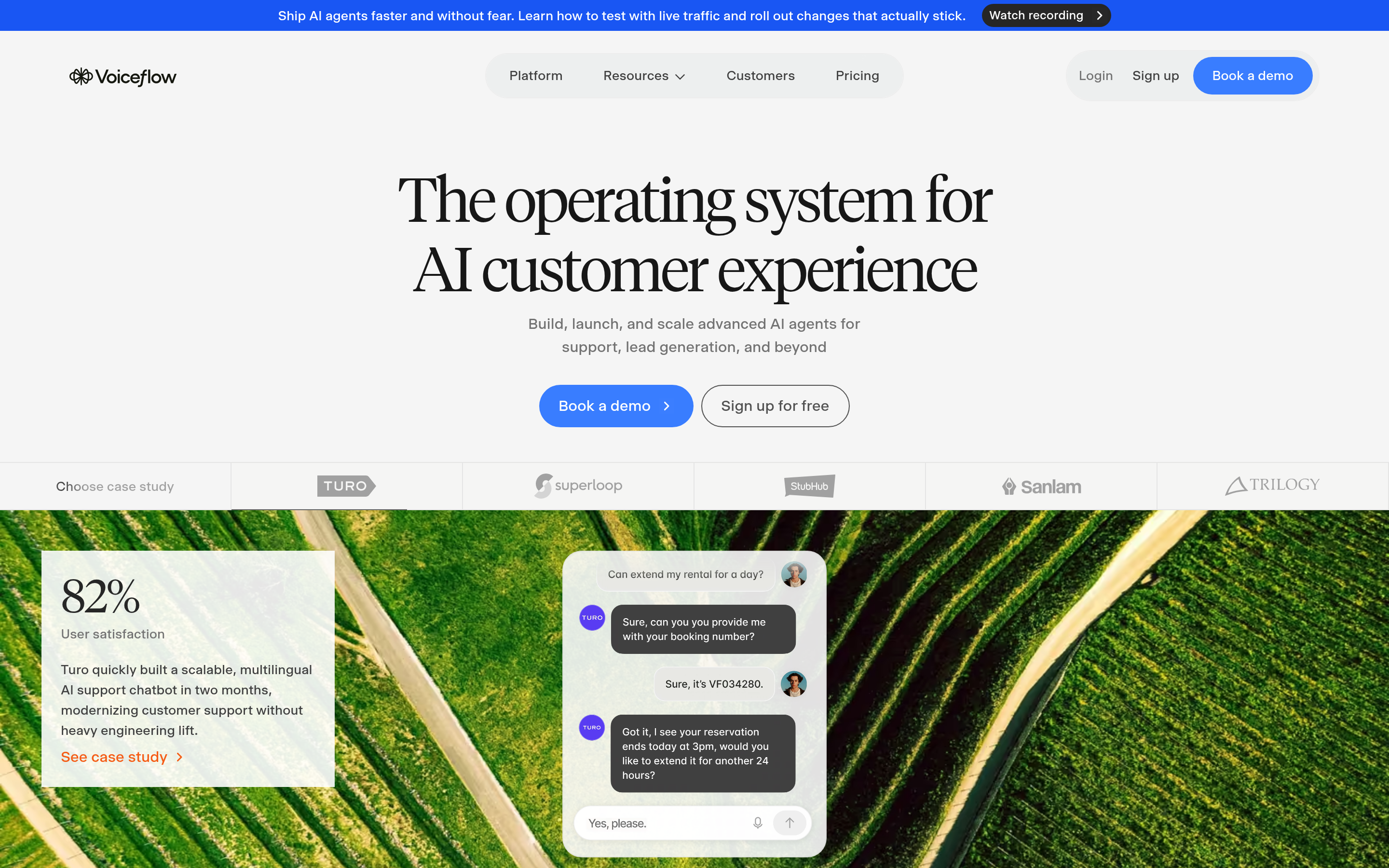
Voiceflow started in voice and became a serious agent-design platform. You get a canvas that engineers respect, a knowledge base, function calling, and deployment to web, WhatsApp, or your own app via API. Pricing is per editor, which means your traffic can grow without your bill growing. Best fit: a product or CX team with at least one technical person who wants to own agent behaviour properly.
Weak spot: overkill if you want three questions and a Calendly link.
Botpress — open control, usage pricing#
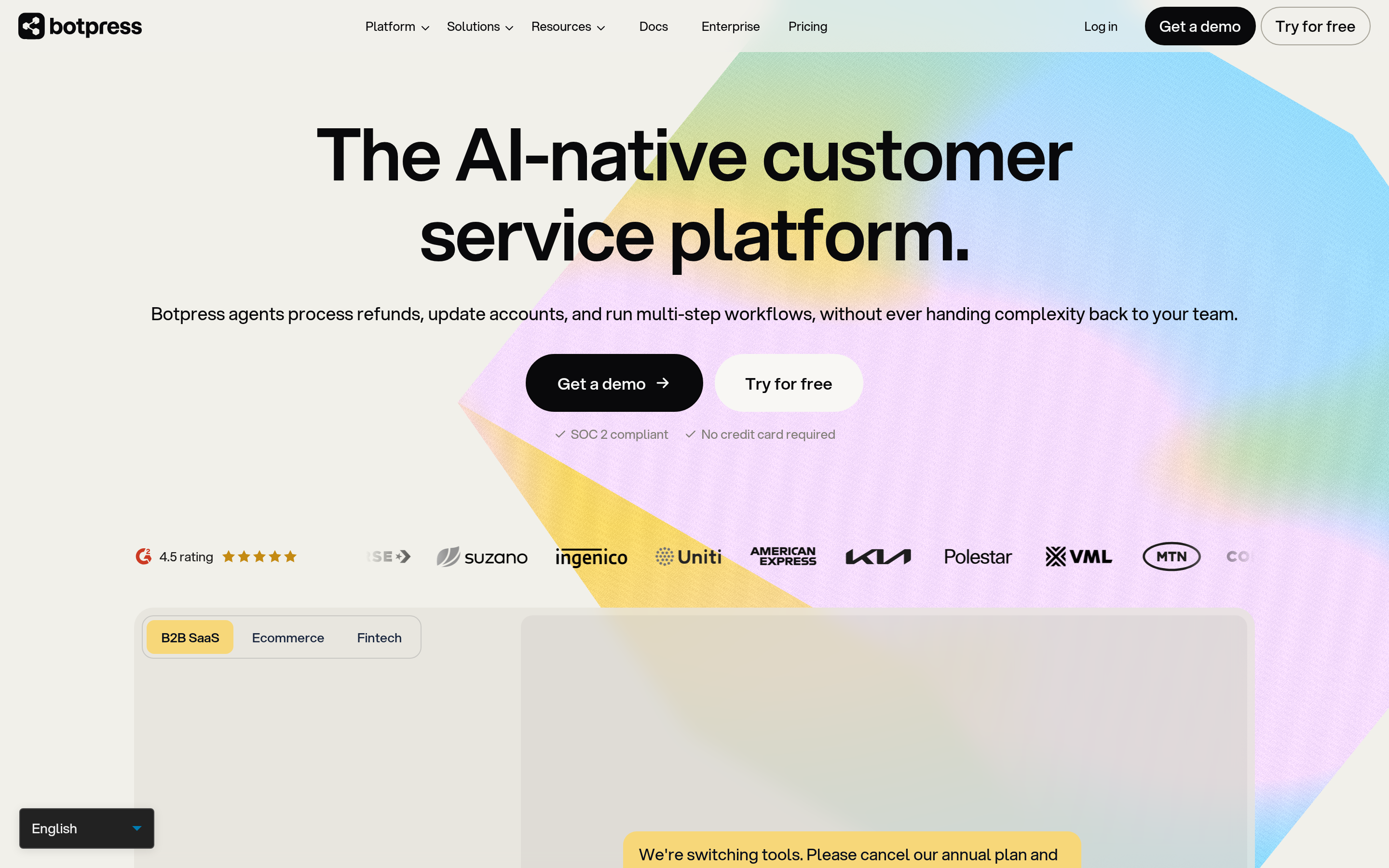
Botpress gives you an agent framework with a visual studio on top, self-hosting options, and pay-as-you-go usage credits starting effectively at zero. Developers like it because nothing is a black box; marketers find it steeper than Landbot. If exit cost and vendor lock-in are decision factors on your scorecard, Botpress is the answer.
Intercom Fin — when the job is support, not lead gen#
Fin resolves support conversations at a rate that made the rest of the category rewrite their roadmaps. The catch is the pricing model: a per-resolution fee on top of seats. That is excellent economics for a support org replacing tickets, and poor economics for a marketing team using chat purely for lead capture. Choose it if deflection is the KPI.

HubSpot Chatbot Builder — free, if you are already there#
The HubSpot chatbot builder ships with the free CRM. Flows are simpler than Landbot's, but every conversation writes straight to the contact record with no integration work, and routing to a live rep or a meeting link is native. For B2B teams whose single source of truth is HubSpot, that beats a better builder that needs syncing. Tomba's HubSpot integration covers the enrichment gap on the same records.
Weak spot: advanced logic and multi-channel push you into paid Marketing Hub tiers fast.
Typeform — the answer when you do not need a bot#
A lot of "we need a chatbot" projects are really "our form converts badly" projects. Typeform's one-question-at-a-time format captures much of the conversational lift with none of the flow-maintenance overhead, and its AI features now adapt follow-up questions to prior answers. If your bot is a linear qualification script with no support role, this is the cheaper, lower-maintenance path.
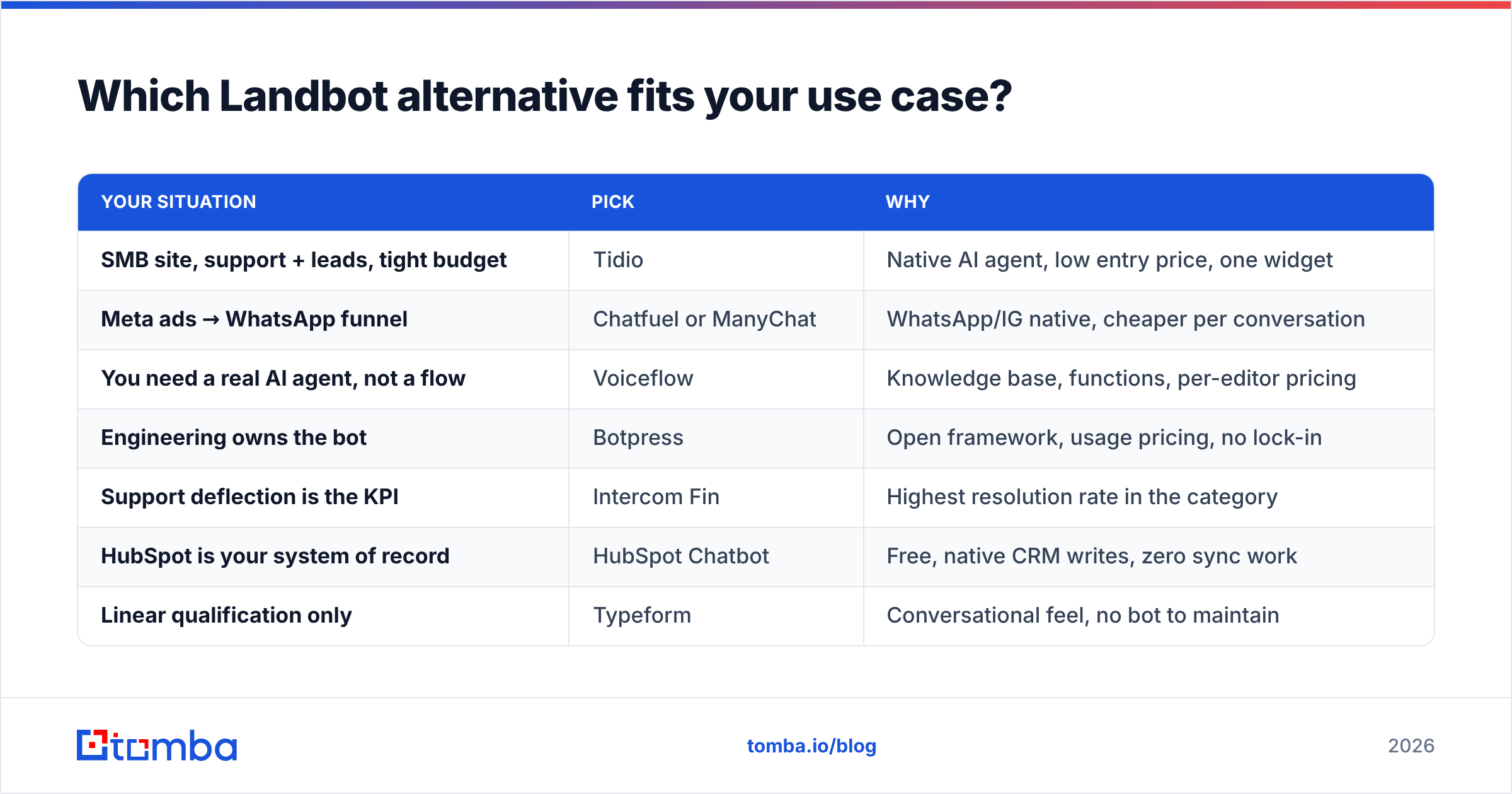
Which Landbot alternative fits your use case?#
| Your situation | Pick | Why |
|---|---|---|
| SMB site, support + leads, tight budget | Tidio | Native AI agent, low entry price, one widget |
| Meta ads → WhatsApp funnel | Chatfuel or ManyChat | WhatsApp/IG native, cheaper per conversation |
| You need a real AI agent, not a flow | Voiceflow | Knowledge base, functions, per-editor pricing |
| Engineering owns the bot | Botpress | Open framework, usage pricing, no lock-in |
| Support deflection is the KPI | Intercom Fin | Highest resolution rate in the category |
| HubSpot is your system of record | HubSpot Chatbot | Free, native CRM writes, zero sync work |
| Linear qualification only | Typeform | Conversational feel, no bot to maintain |
Is Landbot still worth it in 2026?#
Yes — for a specific profile. If you build conversational landing pages as campaign assets, need a visual builder a marketer can own without engineering, and your monthly chat volume is predictable, Landbot remains a strong pick and its G2 reviews reflect that. Users consistently praise the builder and consistently flag pricing at scale.
Leave when one of these becomes true: WhatsApp is your primary channel rather than a secondary one, your traffic is growing faster than your budget, or you need an agent that answers questions nobody scripted.
How do chatbots fit into a B2B outbound stack?#
Here is the part every chatbot comparison skips. A conversational tool is an intent-capture layer. It tells you someone is interested and roughly what they want. It does not tell you whether j.smith@ is a real, deliverable inbox, whether the company has 12 employees or 1,200, or who else on that buying committee you should be talking to.
The gap shows up in three places:
Personal emails. A meaningful share of chatbot submissions come in as Gmail or Outlook addresses. You can reject them and lose the lead, or accept them and enrich toward the work identity. A reverse email lookup resolves a personal address to a name, company, and role so routing is not a coin flip.
Anonymous high-intent traffic. Most visitors who read your pricing page never open the chat widget at all. Website visitor reveal identifies the companies behind that traffic, which turns a silent session into a target account your SDRs can work with domain search before any conversation happens.
Bounces from captured leads. Typos, throwaway addresses, and role accounts enter through chat the same way they enter through forms. Running captured addresses through an email verifier before they reach your sequencer protects sender reputation — the deliverability cost of a 12% bounce rate is far larger than the cost of verification.
The practical architecture: chatbot captures → webhook fires → verification and data enrichment run via API → enriched, verified record lands in the CRM → routing rules fire on firmographics you actually trust. Every tool on this list supports webhooks, so the pattern works regardless of which builder you choose.
What does a realistic switching plan look like?#
- Export your current flows as screenshots or documentation before you cancel anything. Landbot's canvas does not port to other tools.
- Rebuild one flow, not all of them. Pick your highest-traffic bot, rebuild it in the new tool, and split traffic 50/50 for two weeks.
- Measure completion rate and lead quality separately. A bot with a higher completion rate that produces unverifiable emails is worse, not better.
- Wire the data layer before you cut over. Verification and enrichment on the webhook path should be live before the new bot takes 100% of traffic.
- Give it 30 days. Conversational tools have real learning curves for the person maintaining them; judge on the second month, not the first week.
The bottom line#
Landbot alternatives are not a single-winner category. Match the pricing unit to your growth direction, match the channel to where your buyers already are, and be honest about whether you need a flow builder or an AI agent. Tidio for SMB value, ManyChat and Chatfuel for WhatsApp and Instagram, Voiceflow and Botpress for teams that want control, Intercom for support, HubSpot if the CRM decision is already made.
Then fix the part none of them handle. Whichever bot you deploy, the leads it captures are only as useful as the contact data behind them. Tomba Email Finder turns a name and company from a chat transcript into a verified work email — and with the Tomba API it runs on your chatbot's webhook automatically, before the record ever reaches your CRM. Start on the free tier at 25 searches a month, or see Tomba pricing from $49/month when your conversational funnel starts producing volume.
Related guides#
// get started
Find, verify and enrich your first contacts today
Start on the free plan with 25 searches a month, then scale when your team is ready.
Free plan · No credit card required · GDPR & CCPA
// about the author