Last Chance Email Templates: 9 Breakup Emails That Work
The last email in a sequence often outperforms every email before it. Here are nine last chance email templates, when to send each one, and the three mistakes that turn a clean exit into a burned lead.
TL;DR
- A last chance email (also called a breakup email) is the final message in a sequence that tells a prospect you're closing their file. It works because it removes pressure and triggers loss aversion at the same time.
- The best-performing versions are short, blame-free, and give one easy exit: reply "not now" and you stop. No guilt, no third pitch.
- Format matters more than word count. Assumptive-close and value-drop variants generally beat humor and guilt-based ones in B2B.
- Send it 3-5 business days after your last touch, in the same thread, and never on a Friday afternoon.
- If a breakup email gets zero replies across a whole list, the problem is usually data quality, not copy. Bad addresses never see any of your templates.
What is a last chance email?#
A last chance email is the final message in an outbound or follow-up sequence. You tell the prospect you're assuming the timing is wrong, you're closing the loop, and they don't need to do anything unless they want to keep talking.
Think of it like the last call at a bar. Nobody is being thrown out, but the signal is unmistakable: decide now or the option goes away. That shift from "please respond" to "I'm moving on" is the entire mechanism. Every email before it asked the prospect for something. This one releases them.
Sales teams call these breakup emails, closing-the-loop emails, or final follow-ups. The naming doesn't matter. What matters is that they consistently pull replies from threads that have been silent for weeks, including replies you would never have gotten from a fourth "just circling back."
Why do last chance emails outperform follow-up #3?#
Three things happen at once.
- Pressure inverts. Every prior email increased the ask. This one drops it to zero. People reply to low-effort requests far more than high-effort ones.
- Loss aversion kicks in. Behavioral research going back to Kahneman and Tversky shows people weigh losses roughly twice as heavily as equivalent gains. "I'm closing your file" is a loss, even for a mild maybe.
- It's easy to say no. And a no is a result. Half of what a good breakup email buys you is a clean pipeline, not a deal. Gartner's sales research has repeatedly found that B2B buying groups stall in the middle of a process, not at the start. A breakup forces that stall into the open.
There's also a practical reason. By the time you hit the last email, you've usually been ignored four or five times. Your downside is nearly nothing, so you can write something with an actual point of view instead of another polite nudge.

What makes a last chance email work?#
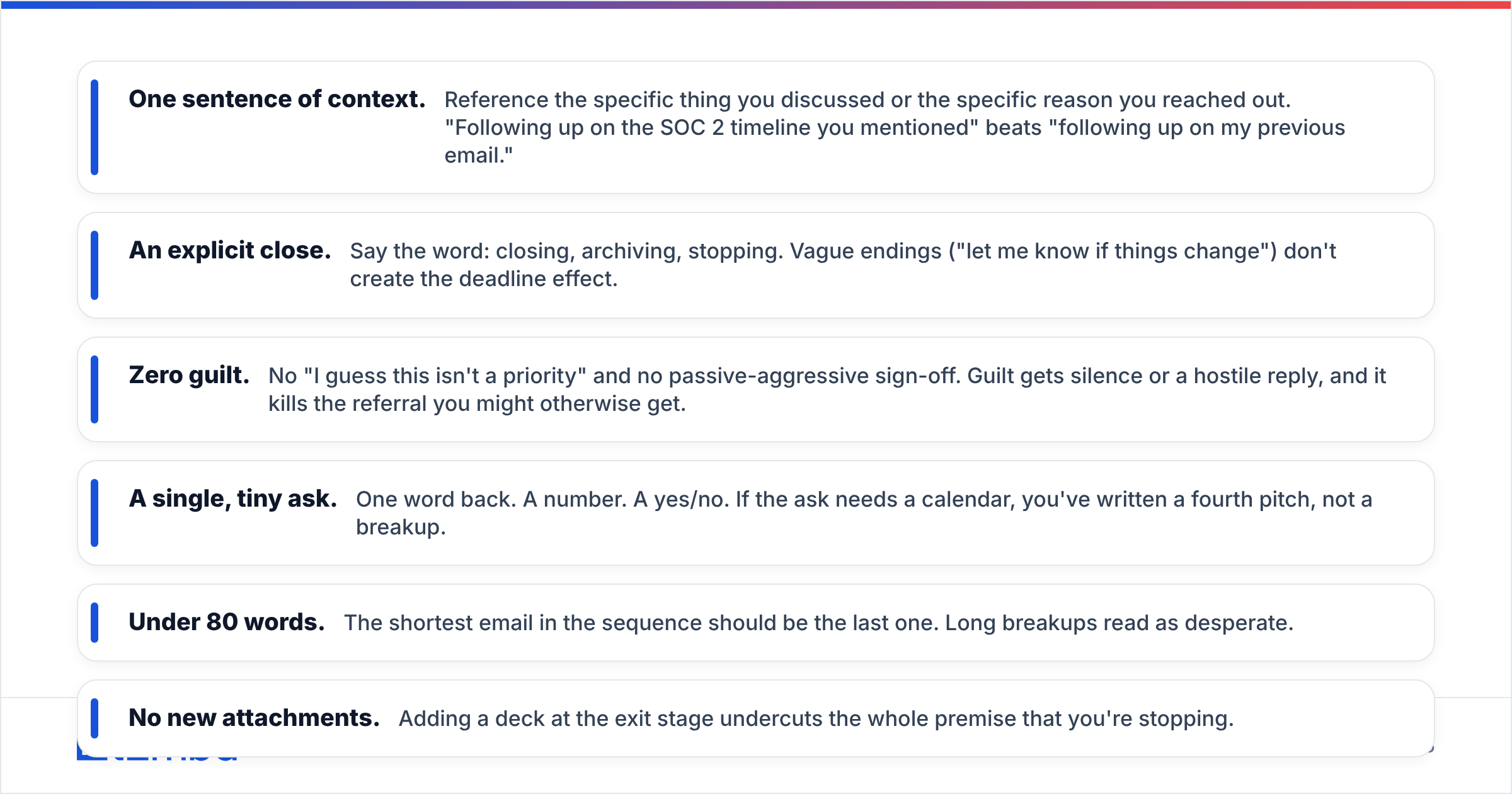
Five elements, and none of them are clever.
- One sentence of context. Reference the specific thing you discussed or the specific reason you reached out. "Following up on the SOC 2 timeline you mentioned" beats "following up on my previous email."
- An explicit close. Say the word: closing, archiving, stopping. Vague endings ("let me know if things change") don't create the deadline effect.
- Zero guilt. No "I guess this isn't a priority" and no passive-aggressive sign-off. Guilt gets silence or a hostile reply, and it kills the referral you might otherwise get.
- A single, tiny ask. One word back. A number. A yes/no. If the ask needs a calendar, you've written a fourth pitch, not a breakup.
- Under 80 words. The shortest email in the sequence should be the last one. Long breakups read as desperate.
- No new attachments. Adding a deck at the exit stage undercuts the whole premise that you're stopping.
Which last chance email format should you use?#
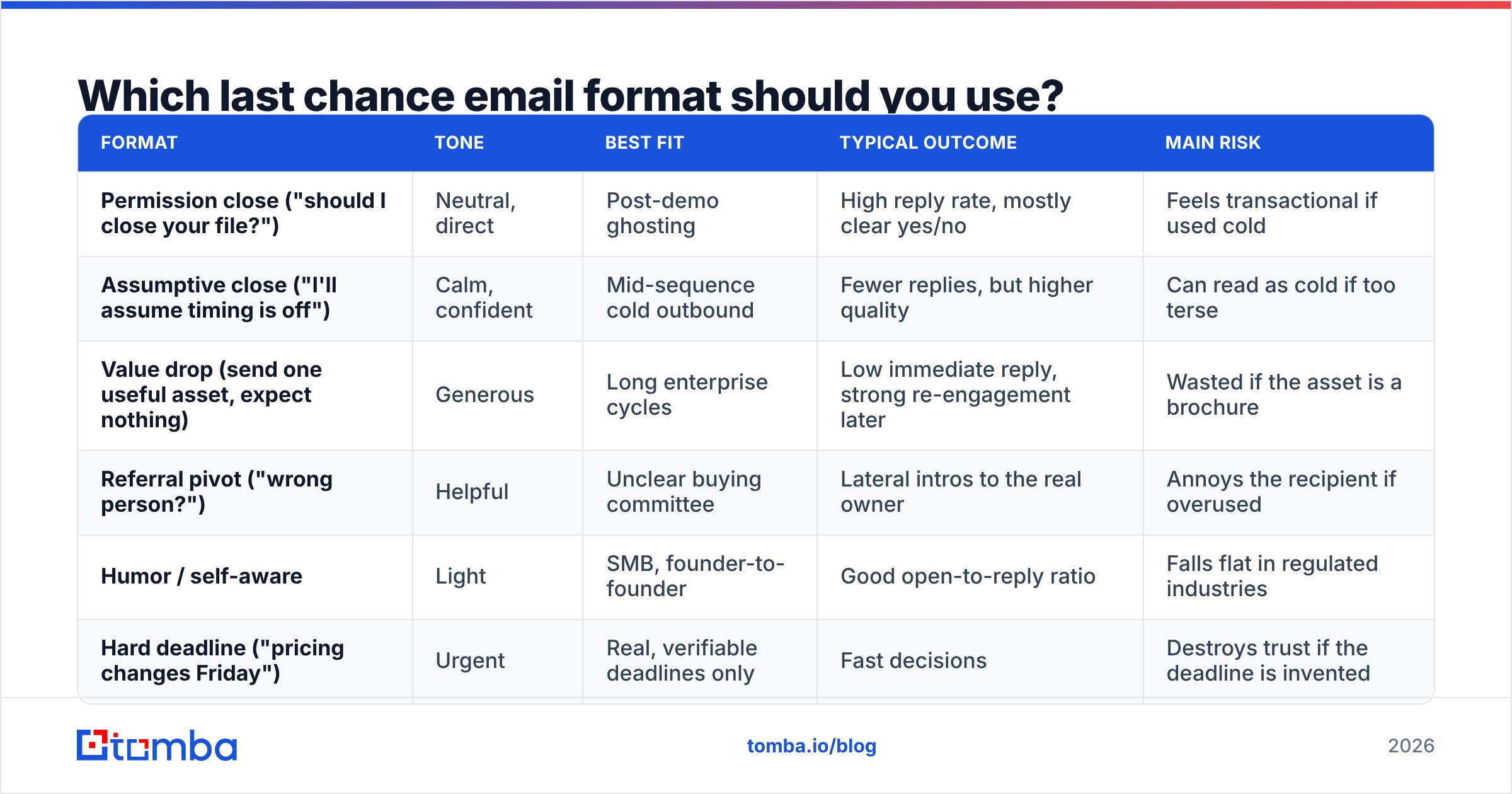
Not every breakup fits every deal stage. A prospect who ghosted after a demo needs a different exit than a cold lead who never opened anything.
| Format | Tone | Best fit | Typical outcome | Main risk |
|---|---|---|---|---|
| Permission close ("should I close your file?") | Neutral, direct | Post-demo ghosting | High reply rate, mostly clear yes/no | Feels transactional if used cold |
| Assumptive close ("I'll assume timing is off") | Calm, confident | Mid-sequence cold outbound | Fewer replies, but higher quality | Can read as cold if too terse |
| Value drop (send one useful asset, expect nothing) | Generous | Long enterprise cycles | Low immediate reply, strong re-engagement later | Wasted if the asset is a brochure |
| Referral pivot ("wrong person?") | Helpful | Unclear buying committee | Lateral intros to the real owner | Annoys the recipient if overused |
| Humor / self-aware | Light | SMB, founder-to-founder | Good open-to-reply ratio | Falls flat in regulated industries |
| Hard deadline ("pricing changes Friday") | Urgent | Real, verifiable deadlines only | Fast decisions | Destroys trust if the deadline is invented |
The only row on that table with a hard rule attached is the last one. Fabricated urgency is the fastest way to get marked as spam and the reason a lot of teams' "last chance" subject lines now underperform. Buyers have seen the trick.
What are the best last chance email templates?#
Nine templates below. Copy them, then rewrite at least the first line so it matches something real about the account. Templates that survive untouched don't get replies.
1. The permission close#
Subject: Close your file?
Hi {First name} — I've reached out a few times about {specific problem}, and I don't want to keep cluttering your inbox.
Should I close this out, or is it worth a look in Q{next quarter}?
Either answer is genuinely fine.
{Your name}
2. The assumptive close#
Subject: Re: {original thread subject}
{First name}, I'm going to assume {topic} isn't a priority right now and stop reaching out.
If that changes, reply to this thread and I'll pick it straight back up.
3. The one-word reply#
Subject: 1, 2, or 3?
{First name} — instead of another follow-up, pick a number:
- Interested, bad timing. Reach out in 90 days.
- Not the right person.
- Not interested, remove me.
Any of the three closes this cleanly.
4. The referral pivot#
Subject: Wrong person on my end?
Hi {First name} — I reached out about {problem}, but I may have picked the wrong contact.
If {function} sits with someone else on your team, could you point me their way? If not, I'll close this out and stop.
5. The value drop#
Subject: Last one, plus the {asset} I mentioned
{First name} — closing the loop here. Before I do, the {benchmark/checklist/teardown} I mentioned is attached and yours regardless.
No response needed. Good luck with {specific initiative}.
6. The observation close#
Subject: Noticed {trigger event}
{First name} — saw {hiring, funding, product launch, migration}. That usually means {consequence}, which is what I was reaching out about.
If it's not a fit, say the word and I'll stop. If it is, I'll send two dates.
7. The honest reset#
Subject: I got this wrong
{First name} — my last three emails pitched {feature}. Rereading your {role/site/post}, that probably wasn't your problem at all.
If {actual likely problem} is closer, tell me and I'll start over. Otherwise I'll close your file today.
8. The light humor breakup#
Subject: Breaking up is hard to do
{First name} — I've sent a few emails and heard nothing back, so one of three things happened: you're slammed, you're not interested, or you've been abducted.
If it's the first two, a one-line reply saves us both. If it's the third, I'll alert the authorities.
9. The real deadline#
Subject: {Date} is the actual cutoff
{First name} — our {onboarding cohort / pricing tier / implementation window} closes {specific date}, so this is the last time I'll bring it up.
If you want in before then, reply today. If not, no problem, and I'll check back after {date}.
For more subject-line variants and full sequences, Tomba keeps a free library of cold email templates you can lift from, and a subject line tester worth running each of the nine above through before you queue them.

When should you send a last chance email?#
Three to five business days after your previous touch, inside the same thread, mid-morning in the prospect's timezone. Not Friday after 2pm, not the week between Christmas and New Year.
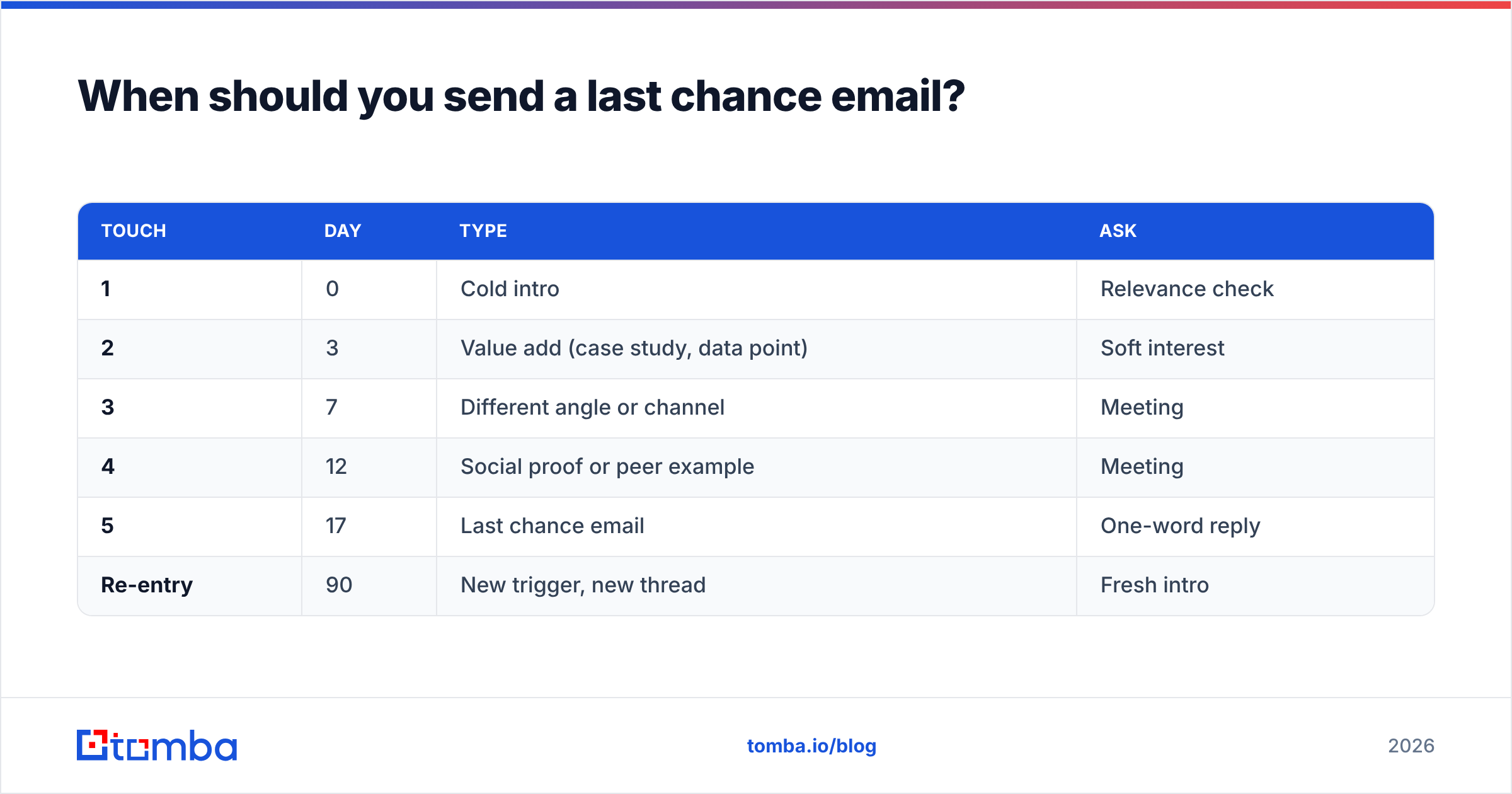
Position matters as much as timing. Here's what a sane sequence looks like:
| Touch | Day | Type | Ask |
|---|---|---|---|
| 1 | 0 | Cold intro | Relevance check |
| 2 | 3 | Value add (case study, data point) | Soft interest |
| 3 | 7 | Different angle or channel | Meeting |
| 4 | 12 | Social proof or peer example | Meeting |
| 5 | 17 | Last chance email | One-word reply |
| Re-entry | 90 | New trigger, new thread | Fresh intro |
Five touches, then out. Teams that run 11-step sequences and stack two "final" emails train prospects to ignore the word final. If you send a breakup and then follow it with another email, you've spent the mechanism and taught the recipient that nothing you say is literal.
The 90-day re-entry is not optional. A breakup email closes a sequence, not a relationship. Tag the contact, wait for a trigger, and open a new thread with new information.
What subject lines work for last chance emails?#
Short, literal, and free of manufactured urgency. Anything resembling "FINAL NOTICE" or "Last chance!!!" gets filtered before a human sees it, and depending on how you handle unsubscribes, it can also drag you toward the wrong side of the CAN-SPAM Act.
What tends to land:
Close your file?Re: {original subject}(thread continuity beats novelty)Should I stop?Wrong person?1, 2, or 3?{Company} + {your company}: last note
What tends to fail: all caps, exclamation marks, countdown language, emoji, and any subject line that promises something the body doesn't deliver. HubSpot's sales blog has published years of follow-up benchmarks pointing the same direction — plain subject lines out-reply clever ones once a thread is already warm.
What mistakes kill last chance emails?#
Sending a breakup that isn't one. If you write "last email" and then send three more, every future deadline you set is noise. Honor it or don't write it.
Blaming the prospect. "I've tried reaching you five times" makes the reader responsible for your sequence. They never agreed to it. Drop the count.
Asking for a meeting. The breakup email's ask is a word, not a calendar slot. Booking happens on the reply.
Stacking two CTAs. "Reply here, or grab a slot, or check out this page" defeats the low-effort premise that makes the format work in the first place.
Blaming copy when the problem is data. This is the big one. If a whole segment returns zero replies to a well-written breakup, check bounce and delivery data before rewriting a single sentence. Emails sent to dead addresses, role accounts, and catch-all domains never reach a human. Running your list through an email verifier before the sequence starts tells you whether you're testing copy or testing guesses. Catch-all domains deserve their own pass with a catch-all verifier, since standard SMTP checks return an ambiguous result on them.
How do you measure whether your last chance email is working?#
Track three numbers, not one.
- Reply rate on the final touch versus touches 2-4. A healthy breakup email pulls 1.5x to 3x the reply rate of the middle of the sequence. If it's flat, the copy is too similar to what came before.
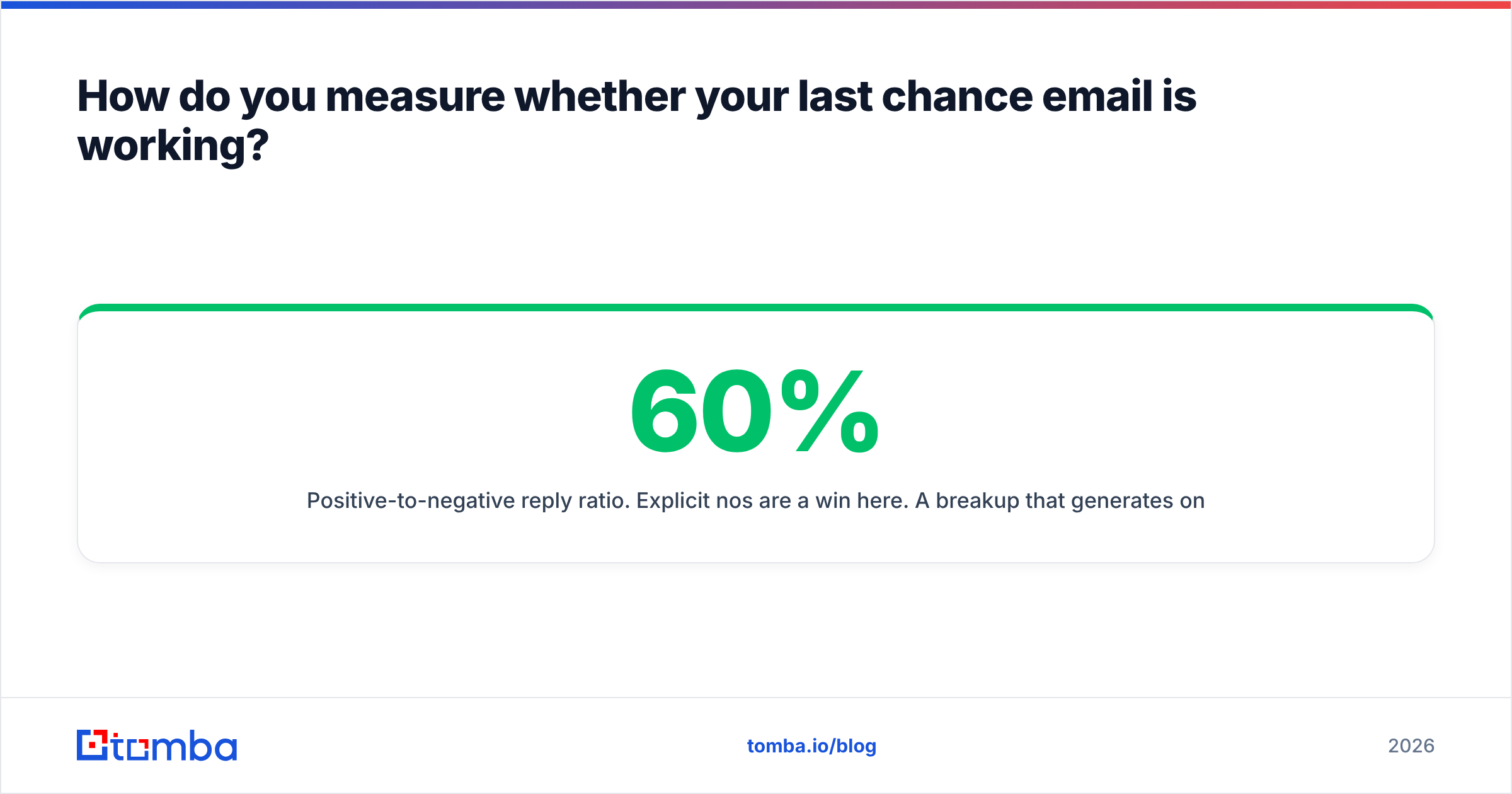
- Positive-to-negative reply ratio. Explicit nos are a win here. A breakup that generates only silence isn't doing its job; a breakup that generates 60% nos and 15% yeses is doing it perfectly.
- 90-day re-entry conversion. Track how many "bad timing" replies convert on the second pass. In longer enterprise cycles this is frequently where the revenue actually shows up.
Look at cohorts, not individual sends. A single breakup email tells you nothing. Fifty of them across a consistent ICP tell you whether the format fits your market.
Start with contacts that actually exist#
The best last chance email templates in the world can't outperform an invalid address. Before you spend another week testing subject lines, make sure the sequence is landing in real inboxes owned by the person you researched.
Tomba's email finder returns verified professional addresses by name and domain, with confidence scoring and source attribution so you know why an address is likely correct. The free tier covers 25 searches a month, Starter is $49/mo, and Growth is $99/mo if you're running volume — full Tomba pricing is public. Fix the data layer first, then let your breakup email do what it's good at: turning silence into an answer.
Related guides#
// get started
Find, verify and enrich your first contacts today
Start on the free plan with 25 searches a month, then scale when your team is ready.
Free plan · No credit card required · GDPR & CCPA
// about the author